Home Blog Page 1169

How my anxiety made me a better person

2

WEB-head

A little over two years ago, I had my first panic attack.

In retrospect, it was a pretty normal night — I was in bed with my (now ex) girlfriend, watching Parks and Recreation and eating junk food. This was right before I began university, and a dead end barista job was pretty much my only responsibility. I spent most of my days watching movies, drinking with my friends, and playing video games. I had no concrete plans for my future, and little to no passion for anything.

My anxiety changed all that. That night, my heart went into overdrive, my body started shaking uncontrollably, and my vision blurred. I laid on the bathroom floor for what seemed like hours, trying to catch my breath. I can still remember the feeling of the cold tile on my cheek.

I was sure that I was having a stroke, a brain aneurysm, a seizure — something like that. I’ve always been a hypochondriac, and that night, it felt like all my fears had finally been confirmed. I stuck my finger down my throat until I threw up, just to make sure I hadn’t accidentally swallowed something poisonous.

Things didn’t get much better from there.

The person I am today is a result of the struggles and challenges that my anxiety has presented me.

The next six months were a blur of sleepless nights, sick days, and empty beer bottles. Never the most social person, I retreated even deeper into my shell. I didn’t call anyone, and I barely ever went outside. I self-medicated with alcohol and chamomile tea. On the off chance someone tried to contact me, I pretended I wasn’t there. My girlfriend and I grew more and more distant, and my growing isolation only made me more anxious, more afraid.

For months and months afterward, I struggled to keep my head above water. I would start to feel my hands shake, a chill would go down my spine, and instantly I’d be transported back to that night, lying on the bathroom floor.

But somewhere along the way — whether it was the pills, a gradual increase in confidence, or plain old time — I got stronger. I stopped feeling sorry for myself and I started stepping outside of my comfort zone. It was scary, and more than once I felt like I was making a huge mistake.

Two years later, I’m in university, I’ve met someone new, and I’m doing the best work of my life. If I met the kid I was two years ago, I wouldn’t recognize him.

People with mental illness are too often told to “suck it up” or “think positively,” as though depression or anxiety are conditions that can be cured by sheer willpower. This, of course, is not true — it takes time, a steady support system, and often the help of a doctor or a medical professional.

But I’d be lying if I said that my anxiety hasn’t made my life better than it was before. I know that in no small part, the person that I am today is a result of the struggles and challenges that my mental illness has presented me.

Once I had the strength to start broadening my horizons, I did so; the thought of being holed up in my room for the rest of my life was even more terrifying than coming out of my carefully constructed shell. I applied to SFU, and got an entrance scholarship. I started writing for the student newspaper, and rediscovered a passion for writing and journalism. I ended an unhealthy relationship and I made new connections.

This meant stepping out of my comfort zone almost daily — most of the time, it sucked. But it didn’t suck half as much as standing still and waiting for my situation to get better on its own.

I told my doctor about what I was going through, even though I was terrified and ashamed of admitting it, and he wrote me a prescription. It took a lot more than willpower to put my life in the right direction, but having the courage to admit that I had a problem is one of the most important decisions I’ve ever made.

Now, I think of myself as a better, more courageous person, because I know that if my anxiety threatens to take over my life again, I’ll have the tools necessary to beat it. After all, I’ve done it before.

I’m not arguing that all other people in similar predicaments should take the same approach as me; different strategies work for different people. The important thing is to find what works for you, and to follow through. If watching reruns of Buffy the Vampire Slayer calms your nerves, do that. If exercise and healthy food make the world seem a little less dim, more power to you.

People forget that mental illness, at the end of the day, is a lot like most physical illness. It’s not easy to fix, and it’s impossible to beat it all by yourself. But that doesn’t make you powerless — if you’re willing to ask for help and to find out which strategies suit you best, you have a much better chance at controlling your illness, rather than letting it control you.

If I met my former self two years ago, worrying he’d be this way forever, I would tell him the same thing I’m saying here: your life isn’t over. It’s just beginning.

Satellite Signals

0

penny

Woodward’s

As part of a panel last Thursday night, four experts analysed and explored society’s fascination with superheroes. Discussing traditional and unconventional characters, and superheroes versus sidekicks, the panel delved into the implications of heroism on culture.

Each panelist touched on different topics, bringing to light heroic PTSD in dystopian fiction, gender representation of super heroines, as well as the redemption of the Hulk’s anger issues.
Surrey

Surrey campus’ annual open house, an event which usually sees over 3,000 visitors, took place last Thursday, Mar. 6. The open house provided campus tours, as well as information on academic programs, student services, and admission.

There were also various displays and performances highlighting the cultural diversity fostered on campus. Activities featured at the event included live experiments, wearable technology, robot battles that visitors could participate in, and touchable sea creatures.

Vancouver

The Canadian government announced its decision to phase out the Canadian penny in 2012 and on Feb. 4, 2013, the Royal Canadian Mint officially stopped circulation of the penny. A talk held downtown on Mar. 1 discussed the cultural ramifications of this change to our currency and how coins have affected culture in general. The event description questioned whether the loss of the penny will be easily accepted, or, “like inches and ounces, its ghost will continue to haunt our collective psyche.”

No coalition, no government

0

Fellow Conservatives, rejoice! Justin Trudeau has handed the Conservative Party another key to victory. And no, I’m not talking about his ill-timed joke about the situation developing between Russia and Ukraine.

I’m talking about his unwillingness to join with Tom Mulcair and the NDP to run as a united party in the next election. If this were to happen, it would ensure the defeat of Stephen Harper and the Conservatives.

Let’s look at the facts. Following the fragmentation of the Progressive Conservative Party in the early 1990’s, Canada entered a period of domination by the Liberal Party, at the time led by Jean Chrétien.

During his tenure as Prime Minister, there was never a serious threat to the government from the right-wing parties struggling for power amongst themselves.

If the Liberals and NDP ran together in the last election, together they would have defeated Stephen Harper.

It was not until the Canadian Alliance and the Progressive Conservatives united as the Conservative Party that they became a threat to the Liberals’ hold on power, reducing the Liberals to a minority government in the 2004 election, the first in which they ran as a united party.

The subsequent election in 2006 led to the Conservatives gaining their first victory in close to 20 years, despite being in the form of a minority government. Five years later, the Conservatives achieved a majority government, which we enjoy today.

At the time of the 2011 election, there were already some among the Liberals and New Democrats who proposed running as a coalition of the left. The Liberal leadership rejected the proposal, believing they did not need the New Democrats to defeat Stephen Harper. They made Canadian history that year as, for the first time since Canadian Confederation, Liberals formed neither the government nor the opposition.

If they had run as a coalition, the current situation in Canada would be very different.

Out of the 167 seats won by Conservatives, 45 were won with a minority of the vote, the remainder of the vote split between the two left-wing parties. Of those 45 seats, six are cabinet ministers, including both the Minister of Foreign Affairs and the Minister of Citizenship and Immigration.

Assuming all Canadians who voted made the same decisions, the coalition would have won 182 seats, with Conservatives only winning 121. Stephen Harper would be the Leader of the Opposition, and given Liberal power before the election, Michael Ignatieff would be the Prime Minister.

Both the Liberals and the NDP plan on courting the Canadian middle class and the province of Quebec in the buildup to next year’s election. With Quebec having played such a key role in the NDP’s surge to Official Opposition status, they will likely have to fight to keep the province. It was largely ignored by the Conservatives in the last election, but could become a battleground and the focus of large scale efforts by the two left-wing parties.

As next year’s election moves ever closer, the parties that seem bent on defeating Stephen Harper move farther and farther apart. Both Mulcair and Trudeau want to see the Conservatives defeated. But each wants to take responsibility for that victory, and that could be their downfall.

5-year old totally blanking on “magic word”

0

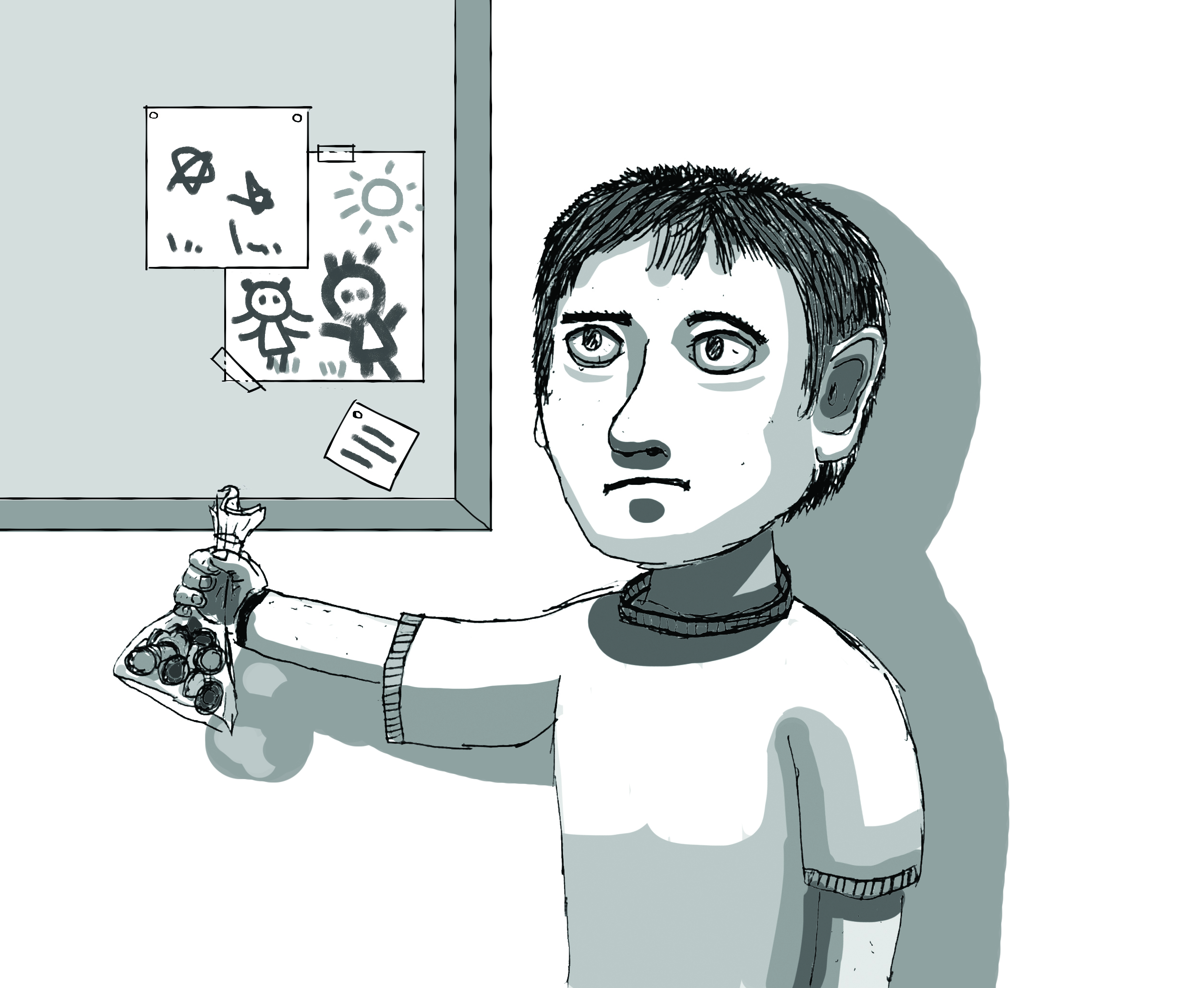
BURNABY —  A local 5-year old boy is on the verge of not receiving the cookie that he’s been looking forward to all day after reportedly freezing up on what “the magic word” is.

According to witnesses, little Johnny Parker had been waiting politely in line at Nelson Elementary’s annual cookie sale for almost 10 minutes before blowing his transaction at the very last moment.

“He seemed like a really considerate, good little boy,” explained Mrs. Linda Turner, an organizer of the sale and also Brian’s mom. “He had proper posture and didn’t raise his voice, but then when he got to the front of the line it all fell apart.”

While seemingly having a grasp on basic manners, Parker’s request for a chocolate cookie was met with more resistance than he had anticipated.

“When they came back at him with ‘what’s the magic word’, I could tell he was rattled”

– Stevie Harris, classmate

“He said ‘may I have a cookie’, which I thought was a pretty good way of putting it,” Parker’s friend Stevie Harris told The Peak. “But then they came back at him with ‘what’s the magic word’ and I could tell right away that he was rattled.”

It was at this point that witnesses say Parker went completely silent and just stared intently at the wall crinkling his face and clutching his forehead.

“They totally blindsided him and it was ugly to watch,” Harris explained as he watched his friend continue to struggle. “It was a sucker-punch, no doubt about it.”

After a couple seconds, Parker was told that unless he came up with the “magic word” he would not get his cookie despite being willing to pay full price for it.

Organizers say they gave him more than his fair chance and even started to mouth the first syllable “pl…” but that he was still drawing a blank.

“I don’t know what’s happening to me, I know this one,” Parker complained, looking to the sky. “I just said it when I borrowed a skipping rope this morning . . . gah what is it?”

While the sale’s organizers have come out on record stating that the cookie will be available whenever Parker is willing to come by and ask for it properly, at press time the “magic word” was still eluding the boy and most are predicting that the situation could continue well into recess.

Conference discusses becoming a living wage university

1

WEB-j bannister- courtesy of Living Wage SFU

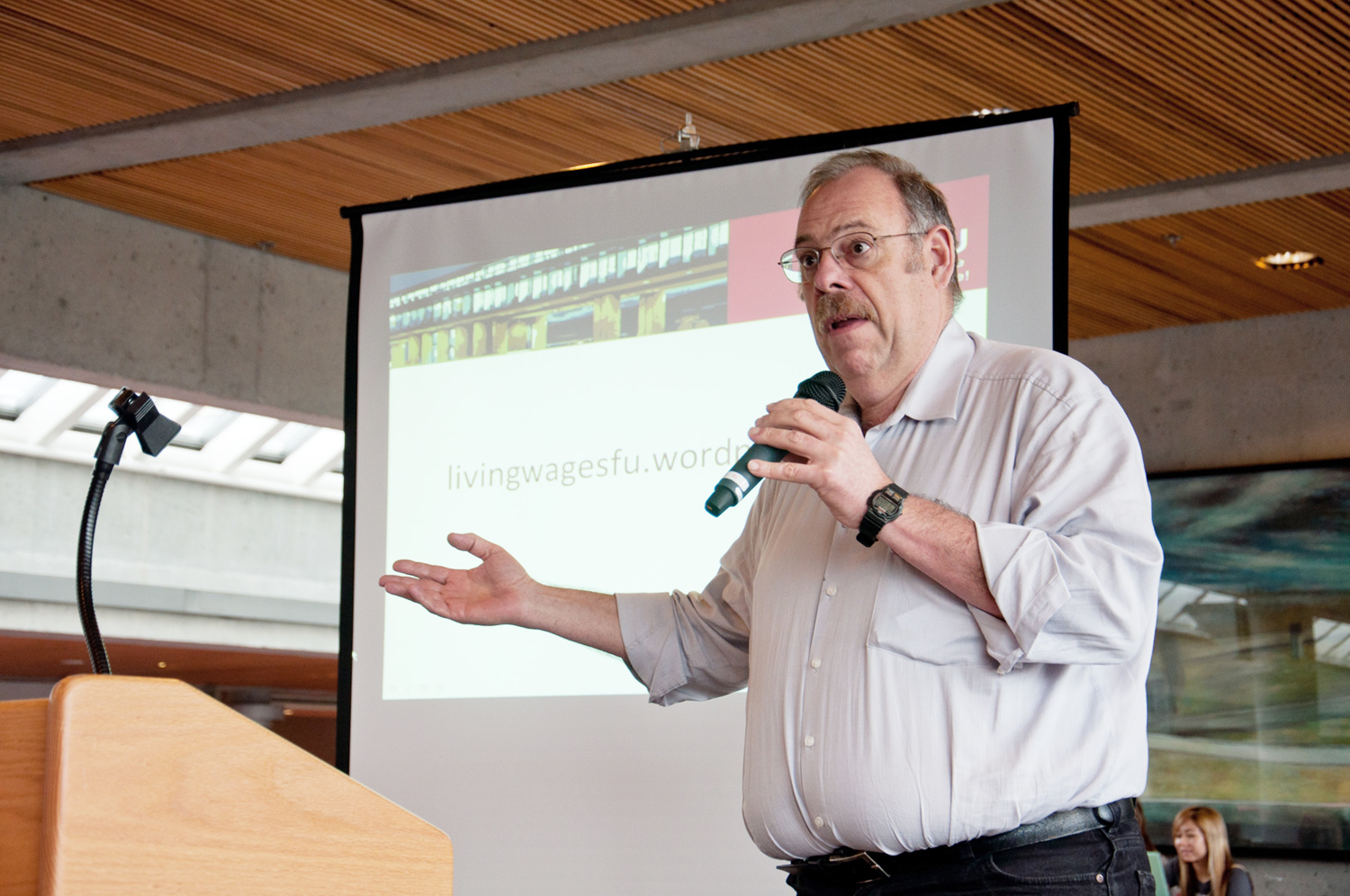
In a conference on Feb. 27, Living Wage SFU called for Simon Fraser to become the first living wage university in Canada, following the example of Queen Mary University of London (QMUL).

Living wage refers to the salary that one would have to make to earn a “decent living” according to Marjorie Griffin Cohen, a professor of political science at SFU, and the only faculty member currently a part of Living Wage SFU.

To become a living wage university by Metro Vancouver standards, SFU would have to pay all workers $19.62 per hour; this would also apply to jobs that are outsourced to other companies.

According to Adrienne Montani, provincial coordinator at First Call: BC Child and Youth Advocacy Coalition and leader of the living wage movement in BC, the province’s $10.25 minimum wage does not allow workers to get out of poverty, never mind make a decent living. “We’re not trying to get people at the poverty line; we’re trying to get them above it,” she said.

Also in attendance at the conference was Jane Willis, a professor from QMUL, the first living wage university in England. Willis stated that living wages for the workers at QMUL have resulted in increased productivity and less turnover as job satisfaction is higher.

Previously, despite similar arguments, the board of governors decided not to pursue becoming a living wage university, citing financial inability. As stated in an email from Judith Osborne, vice president legal affairs and university secretary, “the board felt it would not be appropriate for one publicly-funded university to pursue this policy in isolation from others.”

“The costs of adopting such a policy would [ . . . ] require off-setting cuts, thereby weakening the university’s position to meet its educational objectives and placing it at a competitive disadvantage relative to other institutions,” stated Osborne.

She suggested that the matter was more one of provincial policy, for which the government would need to provide the funding.


To become a living wage university, SFU would have to pay all workers $19.62 per hour.


SFSS board members also had mixed reactions to the idea, as discussed at their Feb. 19 board of directors meeting. Some, like ERO Chardaye Bueckert, were in favour, while others, including business representative Brandon Chapman, shared concerns about the financial implications. He stated, “We need to be careful, [ . . . ] we have a university that can’t make ends meet in many areas.”

Shahaa Kakar, of Simon Fraser Public Interest Research Group (SFPIRG) and a member of Living Wage SFU, does not believe cost is the problem. “They [university administration] had done some preliminary costings, and they basically told us that [. . .] they estimated it would cost them less than half a per cent of their annual operating budget to become a living wage employer.”

Member services officer Moe Kopahi reminded the SFSS board, however, that “it’s more complex than we think. It’s not a simple math of percentage increase.”

The board of governors stated that part of the problem is that they are unable to raise student tuition fees. Julia Lane, of the GSS, elaborated, “The university is still bound by the provincial mandate to cap tuition increases for domestic students by no more than two per cent per year. So I don’t think tuition fees would be a logical place to look for the necessary increases.”

However, both Cohen and Kakar agree that it should not be necessary to raise tuition fees to make SFU living wage. “The living wage campaign would not endorse raising tuition fees,” said Cohen via email. “That would be improving the situation of one vulnerable group at the expense of another and that is never the way people who advance this issue find acceptable.”

Kakar believes it is more of an “issue of political will.” She told the conference that it was necessary to raise public awareness, as the university allegedly told her that it was not a priority, and that it would not be dealt with until the community makes it known that it is a priority.

“But we’re a handful of people,” she stated. “We won’t be taken seriously by the university unless we can really show that there is a large amount of political will to make this happen.”

Skylor Davis qualifies for NCAA Div II Championships

0

Clan wrestler Skylor Davis will return to the NCAA National Championships in his senior season, as the sole SFU athlete to qualify for the event.

Davis finished second in the 125-pound weight class at the NCAA West Regional Championships, punching his ticket to his final NCAA Championship. He entered the regionals ranked second overall, and finished in the same position after falling in the final 9–6 by decision to California Baptist’s Bryden Lazaro.

Davis will be looking to better his third-place finish from 2013 where he fell in the national semi-final, but still left on a high note as the Clan’s first NCAA All-American in wrestling.

Davis, still ranked second in the nation in his weight class, has been focusing his efforts towards his final appearance in the NCAA this season. He will likely have to face Lazaro again at the championships as the West Region champion is the number one seed heading into the event.

Davis’ coach, Justin Abdou, explained that there were several calls that favoured Lazaro in the West Region final, but that Davis had an excellent show against the top 125-pound wrestler in the country.

Davis has earned over 40 wins in his senior season, many of which have been won by fal l and in very fast times. Davis has been a dominant athlete for SFU since joining the Clan in 2010, and will look to close his career on top of the NCAA Division II championships beginning March 14, in Cleveland, OH.

Whose Life is it Anyway? tackles disability in the theatre

0

Whose Life

Sometimes art and life imitate each other a little too well. During the research process for his new show, Whose Life is it Anyway? James Sanders fell ill and had to spend some time in the hospital. Since the play’s protagonist, a sculptor who has become paralysed, spends the whole show in a hospital bed, this experience provided actor Bob Frazer with a real life research opportunity.

Having been good friends with Sanders since their theatre school days, Frazer was at the hospital almost daily, observing the environment and forming relationships with doctors and nurses.

Sanders, artistic director of Realwheels Theatre, stumbled upon this play in his third semester of theatre school, after his own spinal injury. “As an able-bodied actor it’s difficult enough to get work. I wasn’t sure if I wanted to continue on that path, and I wanted to see what was out there.” He saw the film version starring Richard Dryfus: “I was 21 years old and was a bit too young to play the character, so I waited.”

After producing Spine during the Cultural Olympiad in 2010, Sanders thought the time was right to begin work on Whose Life is it Anyway? “I succumbed to health issues in August 2011, and they’re still not resolved. I had thought I was going to be performing the role, but we decided that we’d cast another actor and share the role, and now I’m not able to perform at all.”

He cast Frazer, who had directed Spine and also worked on another of his shows, Skydive. They worked closely to shape the role, and Sanders is glad Frazer has taken it on as he can incorporate his personal knowledge of Sanders into his performance.

“As an able-bodied actor it’s difficult enough to get work. I wasn’t sure if I wanted to continue on that path.”

James Sanders, artistic director of Realwheels Theatre

“We’ve been friends for 25 years,” said Sanders, “we met in theatre school before my injury, in the fall of ’89. Both of our families have gotten to know each other really well.” A proud alumnus of SFU, Sanders also cherishes the memory of meeting his wife at convocation. “I was the valedictorian for Arts in the morning, and Barb Wiesler was the valedictorian for the Sciences in the afternoon. We met at the reception at the Diamond Alumni Centre and got a married a year later in the same spot.” That was in 1998, and they are still happily married with a son.

“The program at SFU really encouraged students to create their own work and identity,” said Sanders, “I didn’t wait around for people to hire me.” He explained that it’s difficult with a disability to get work in mainstream theatre or television. To overcome this, he started his own theatre company which embraces disability and presents it as a normal part of life.

Sanders said his goal is to show “disability not as an issue, but as part of the landscape where other issues can be discussed.” In this way, he said it’s up to the audience to make up their own minds.

In Whose Life is it Anyway? the issue is whether or not someone should have the right to choose to end their own life, but instead of presenting a case for one side or the other, Sanders said he hopes the play will allow audiences to start a dialogue with family and friends.

“I hope they leave feeling like they’ve seen a great piece of theatre, feeling good about their night in the theatre, and coming away talking — opening up the discussion for things they maybe haven’t been able to address,” he said.

With a sparse set of just a hospital bed and the story’s protagonist, Ken Harrison, on stage the entire time, the show is an intense study of one man’s struggle. “He’ll be on stage all the time — from when you walk in until the last scene,” said Sanders. “It’s a fast moving show with no breaks between scenes.”

The common thread running through all of his works is the desire to subconsciously change the public’s perception of disability. “I want to bring the audience closer to understanding the disability experience, so that they see it as not something foreign, but natural. I want to bring society into a place of acceptance.”

Whose Life is it Anyway? will be presented at The Cultch from March 11 – 22.

Change starts with you

0

WEB-loretta saunders-facebook
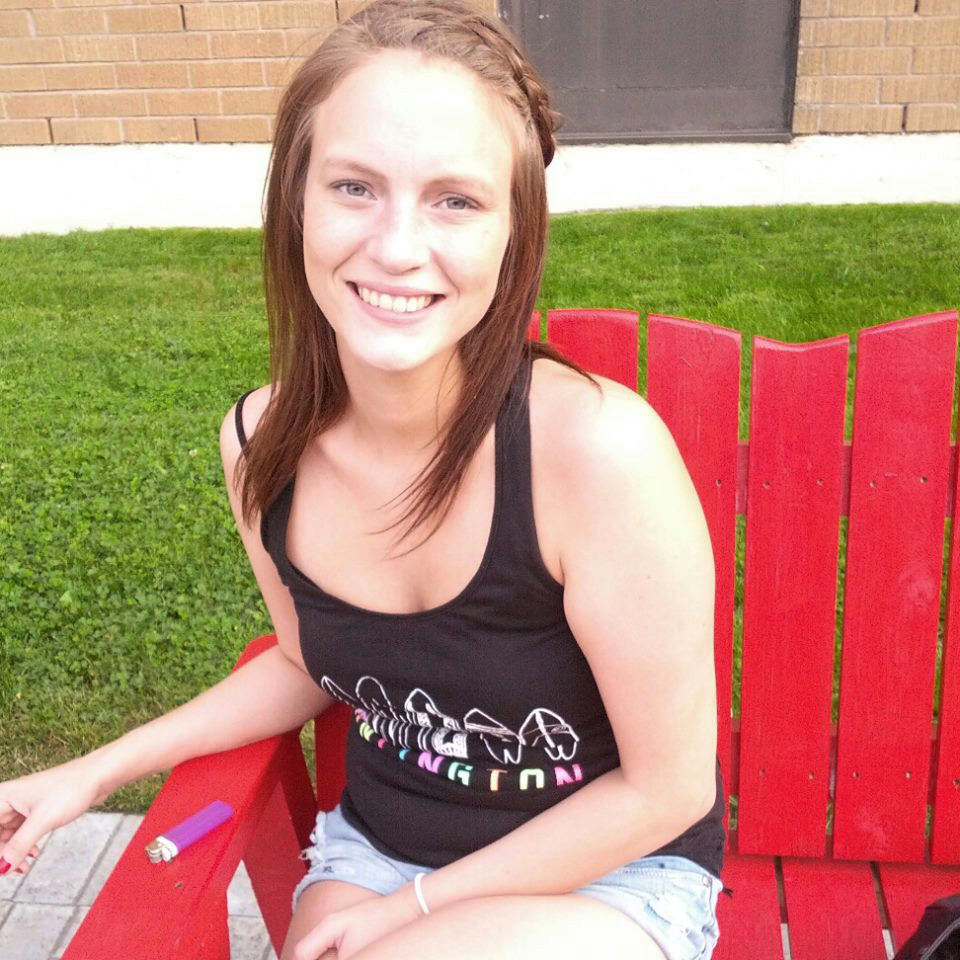
Loretta Saunders was a 26-year old Inuk woman. She was a criminology major brave enough to work on a thesis about missing and murdered Aboriginal women. She was a daughter, and a soon-to-be mother. She had blonde hair, blue eyes, and a radiant smile.

She was recently killed in New Brunswick, and found on the side of the highway. Darryl Leroux, her thesis advisor, wrote in a public statement to CBC that “she was aware of being a product of a Canadian society intent on destroying and eliminating indigenous peoples.”

The fact that you may have heard her story already means that demand for inquiry into the missing mothers and daughters across our country is finally being acknowledged by big media and policy-makers.

For years, human-rights advocates and First Nations groups have been calling on our government to acknowledge the ways in which colonialism has led to sexual and aggravated violence towards indigenous groups in Canada.

We need to call people out on sexism and racism, and speak up in our own circles.

Estimates vary, but Amnesty International estimates that Aboriginal women in Canada are at least five to seventimes more likely than non-Aboriginal women to be murdered or go missing. The Canadian federal government has been mostly silent on this issue.

Loretta Saunders’s death may have finally broken the silence and garnered enough international attention to our missing sisters that the federal government will finally have to act.

The United Nations, the premiers of all 13 provinces and territories, and both opposition parties in Ottawa have all called on the federal government to launch a national inquiry on missing and murdered Aboriginal women.

Even if this does occur, a federal inquiry is not nearly enough to prevent this kind of violence. Together, you and I have to work on decolonizing our language, our ways of living, our concept of “other,” and work together to build a healthy environment where indigenous communities are not continually marginalized and segregated.

We need to see the social and economic implications of the choices we all make, including environmental and land rights, as we learn at SFU, an institution located on unceded Coast Salish territory.

There are countless beautiful humans working on these issues already, but our culture needs to change fundamentally in order to make a difference in our rates of violence. We need to call people out on sexism and racism, and speak up in our own circles to demand justice for those that have already passed.

We need to be brave. We need to acknowledge our own privilege, and stop running away from traumatic stories. We need to work on healing our culture so that we stop losing the folks we love.

We need to be a little bit more like Loretta Saunders, and we need to honour her story by sharing it.

University Briefs

0

Cuppa kindness: paying it forward


The coffee-drinking student population of the Memorial University of Newfoundland has started a new trend — paying it forward by buying coffee for a complete stranger.

The movement entails generous students spending a couple extra dollars to purchase a second coffee “on reserve” for the next person in line.

Although coffee shop employees at the university notice the trend picks up around Christmas and “Kindness Day,” they remarked that many of the students don’t need a special occasion to brighten someone else’s day.


With files from The Muse


Kwantlen opens student brewery


Kwantlen Polytechnic University is introducing a new program hoping to engage students in a growing Canadian industry. A brand new brewery-lab has been constructed at the Langley campus, for the inauguration of KPU’s brewing program.

The two-year brewing diploma program will begin this September, with a total of 35 spots available. The courses will equip students with science and business skills, and hands on experience essential for success in the brewing industry.

SFU also adopted a new science of brewing course just last year and its brewing club, S.F.Brew, went on to win the Home Brew Showdown against brUBC last October.


With files from CUP Newswire


Student officials resign due to facebook scandal


Following a major uproar, four elected student officials have stepped down from their executive positions within the Student Federation of the University of Ottawa (SFUO) after a sexually explicit Facebook conversation was published online on February 28.

The subject of the conversation was the SFUO president, Anne-Marie Roy. The five men involved suggested and encouraged each other — in a very light-hearted manner —  to engage in various sexually violent activities with Roy.

One of the men suggested that they “punish her with their shaft,” and they accused Roy of having STIs. Students and staff alike openly condemned their outrageous behaviour, prompting their eventual resignations.


With files from The Fulcrum

SFU dances for those who can’t

0

WEB-Dance Marathon-Mark Burnham

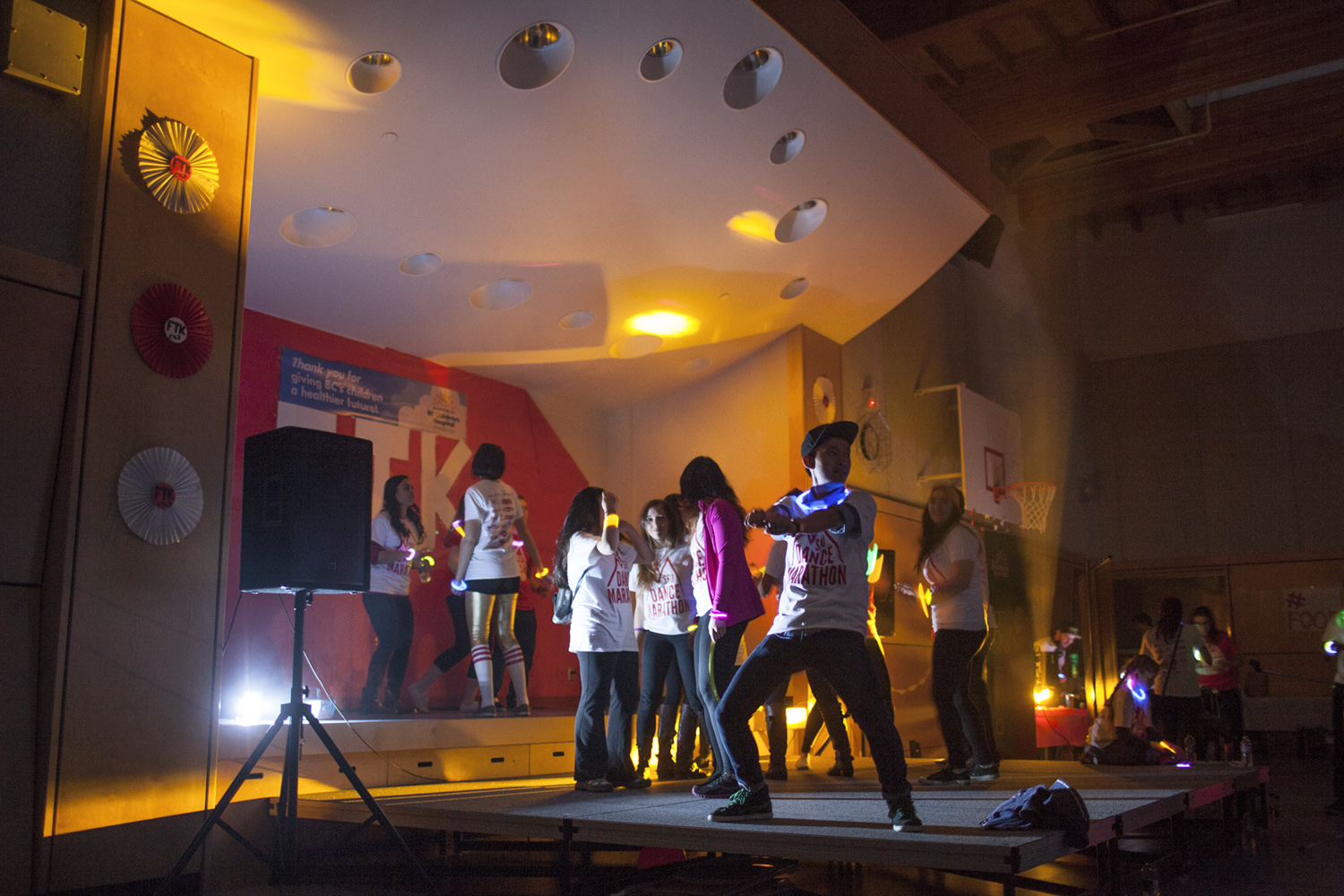
When Phi Delta Epsilon’s (PDE) president, Jordan Yao, received a call about potentially developing SFU’s first Dance Marathon — and, in doing so, being the first Canadian university to participate — he immediately accepted.

On Mar. 1, SFU students gathered to dance for six hours, raising money for BC Children’s Charity. The day’s goal was to raise $10,000 — 10 times the chapter’s annual goal.

“This is a big increase, but we know that universities in the States raise as much as two million dollars!” Gurleen Gill, Dance Marathon event co-chair and senior member of the Phi Delta Epsilon Canada Beta chapter, explained on the Children’s Miracle Network blog.

Yao told The Peak that he saw how “huge this event was in the United States,” where most of the Phi Delta Epsilon chapters either participated in or hosted their own dance marathons.

The trend began in 1991, when students at Indiana University founded Dance Marathon in the memory of a fellow student. The program is now an international phenomenon, and has raised over $62 million in the US.

While the day was filled with smiling faces, Blake Hudie, dance relation chair, remarked that they were extremely fortunate that everything came together. He explained that “the timing was not in [our] favor as [we] were faced with the difficulty of competing with other charities like Balding for Dollars and Relay For Life.”

“I think it should be [ . . . ] executed annually and on a bigger scale.” 

– Kelly Furey, public relations chair, Kappa Beta Gamma

Despite midterms, many students arrived at 11 a.m. to dance the day away. The turnout included members of UNICEF, Alpha Kappa Psi, the SFSS Power Rangers, and elementary and university students.

“I think this is a really great opportunity [ . . . ] for the greater community to come together as a whole for such a worthy cause,” said Kelly Furey, public relations chair, Kappa Beta Gamma. “I think it should be     [ . . . ] executed annually and on a bigger scale.”

According to Valeriya Zaborska, PDE’s activity chair, the team’s creativity and ability to think on their feet was what “drove the event’s success.” While the team mentioned a few hiccups here and there, such as difficulties with booking equipment or the use of Simon Fraser Elementary’s gym rather than a space at the university, everyone was content with the cozy environment.

Close to the end of the event, the fraternity revealed the final fundraising figure to the audience; it read $10,707.84.

Zaborska had a few last words of inspiration for The Peak at the end of the day: “If you’re looking to take initiative and develop something new at SFU, take a chance. Split up the responsibilities, don’t be afraid to make mistakes. You’ll learn and know where to improve on and make the future one much better.”