Home Blog Page 1164

Stop and smell the SFU roses

0


My personal experience in university, for the most part, was of a place where enthusiasm was infectious, spreading wildly throughout hallways and corridors, providing undergrads with a sense of multiple possibilities for the future. The idea that your degree can take you anywhere is a mantra lived and breathed by many, especially when we question the thousands paid in tuition each semester.

Losing the sense of security that my undergraduate studies provided me feels similar to losing a lover (albeit one whose expensive dates I will not miss). At SFU I met some of the most brilliant minds, built lifelong friendships, and acquired knowledge on matters beyond the scope of my imagination.

Now that I’m sending out applications for employment opportunities by the half-dozen each day and making ends meet temporarily by serving coffee, the nostalgia of my time spent writing papers and frantically cramming pulsates through me, highlighting what a relatively enjoyable and honouring experience getting a degree was.

Questions and suggestions float around in my head in each moment of this transition period: Could I update my LinkedIn profile further? Have I checked my phone for any missed calls from prospective employers? Did I pursue the right degree? Should I pursue my master’s only months after graduating if my job applications are not triumphant? What do I want to do with my life, exactly?

Of course, there is great relief simultaneously that comes from completing my studies. Gone are the looming deadlines of term papers, the repetitive nature of some courses within the same field of study, and the strains of financing education. Indeed, finding a relatively normal sleep routine after four years of writing papers during each hour of the day is miraculous.

The nostalgia of time spent writing and cramming highlights how enjoyable getting a degree was.

But it feels like the undergraduate experience happened all too quickly. Certainly, studies could have been prolonged but it seems futile to do so without a defined goal.

It is encouraging to be told, by people with far more wisdom and experience, that this transition period too will pass. Life continues. New opportunities will present themselves, learning will occur in a variety of forms, and time will provide the chance to reminisce and reflect about being at these unique crossroads.

At the risk of sounding like a cliché, truly do enjoy your time as a student. Seek involvement with the smartest people, the most determined of imaginations, and thrive on the inquisitive energy that is rare outside the setting of formal education.

After all, the privilege of being able to invest in your future is not accessible to all, and awakening to the reality of its end can be bittersweet.
University Briefs

0

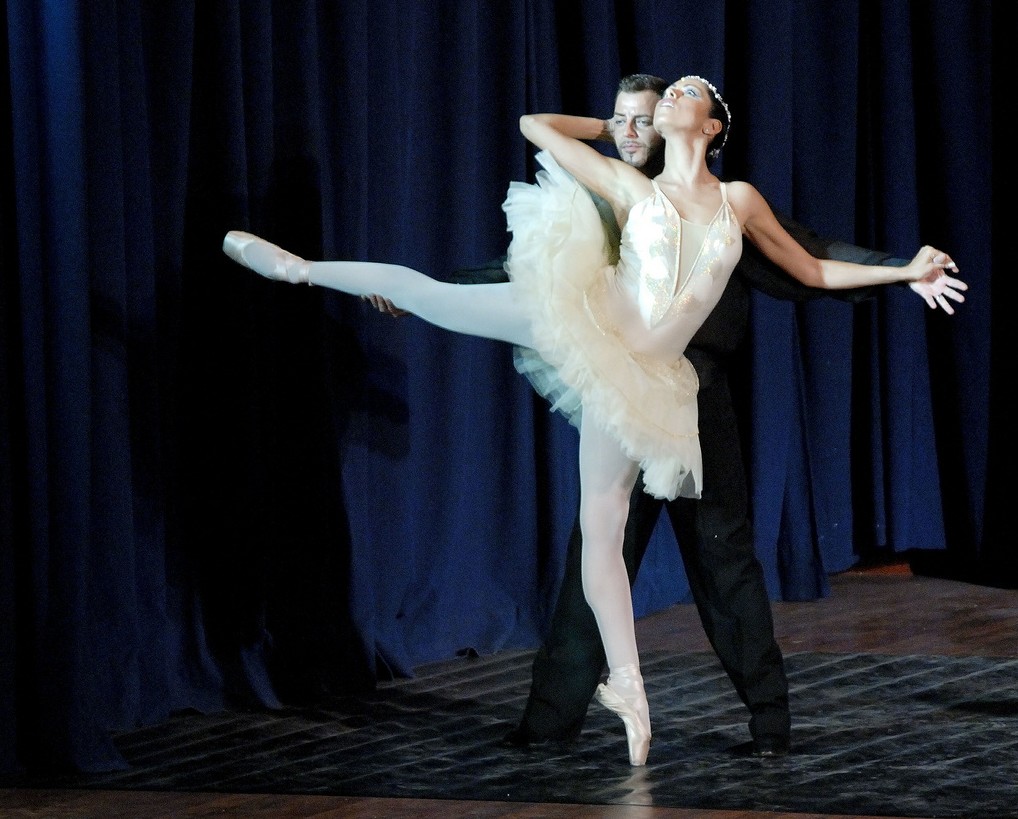
4121521415_45d78b2cbd_bProfessors create romantic ballet video game

An english and film studies professor from U of A recently collaborated with a computer science master’s candidate to recreate a classic romantic ballet in the form of a video game.

The game, titled iGiselle, is for Microsoft Kinect, and challenges its users to re-enact a tragic ballet by copying the dance poses of the protagonist, Giselle.

Although the female protagonist dies at the end of most classic romantic ballets, the creators of iGiselle decided to “to take a sort of feminist approach, ideally allowing the woman — the ballerina — some agency, and that would involve allowing her to stay alive.”

With files from The Gateway


UBC database hack goes undetected for almost two years

It was recently revealed that over two years ago, UBC was hacked by Team Digi7al, an infamous hacker group who succeeded in stealing information (such as passwords and email addresses) from the school’s very own database.

The group has also infiltrated the US Navy, the US Department of Homeland Security, and Harvard University.

The 24 people whose personal information has been compromised were immediately contacted by the school. Two members from the hacker group are facing punishment for what they did after mentioning the incident on Twitter.

With files from The Ubyssey


Students invent self-powered soybean harvester

Four engineering students at the University of Toronto have created a sustainable soybean harvester to till the farms of Brazil. Teaming up in a graduate design course modeled after the Hydrogen Student Design Contest, the group’s green machine produces zero emissions and powers its own cleaning, storage, driving, and threshing stages.

Dubbing their new start-up PURE (Powerful, Unique, Reliable, and Efficient), all four students presented their vision of greener farming and sustainable production to a panel of expert judges who evaluated the course projects. In the end, the team was awarded first place, earning $180 in prize money and an engraved plaque.

With files from University of Toronto News


Remembering Maya Angelou

0

CMYK_Maya_Angelou_visits_YCP_Feb_2013 Wikimedia Commons

Maya Angelou was a woman with the power to impact lives from the tip of her tongue to the turn of her pen. From a young age she was deeply affected by the world around her; Maya had a vision for how the world should be, one that we need to continue to strive toward today and tomorrow now that she is gone.

Born in 1928, Maya led a challenging life full of obstacles, racism, and pain, all of which she could have let cripple her. At the age of eight she was raped by her mother’s boyfriend, and subsequently stopped speaking after her rapist was murdered, presumably by her relatives.

Young Maya believed that her words, upon speaking about the incident, were the reason for his death. If her words could cause so much pain and death, she  decided that she never wanted another to come to harm because of her. She went five years without speaking a single word because of this fear.

But finally, she realized that her words did not connote pain, but rather power. She had the power to tell her story, and to positively affect the lives of others. Out of this experience and many others, she became an author, a poet, an actress, and an activist, among other jobs, to make ends meet in a world so cruel to women of colour.

Maya had the ability to bring a voice to the issues no one else could. She spoke from her heart, and encouraged others to follow.

Maya not only used her writing to inspire change in the world around her, she became an activist, working towards freedom for all despite their race. In this work, she witnessed the assassination of fellow friends and activists. Again, she could have called it quits, called it all too much. Instead, she pushed on.

She continued to shape her experience into her writing and humanitarian work. She led a life in pursuit of justice and civil rights for people of colour, and for all to have access to equal education. Her fiery passion for equality and optimistic outlook towards the future fueled many of her peers and successors.

Maya once said, “There is no greater agony than bearing an untold story inside you.” She pushed past racial and gender oppression just to tell us this. Now that Maya Angelou has left us, with her words and her actions leaving a mark on us all, it is our job to do the same: to push ourselves past all we know, specifically personal pain, and embrace all that we can be.

Strategy games do not make us sociopaths

0

CMYK-videogame2-lilyli

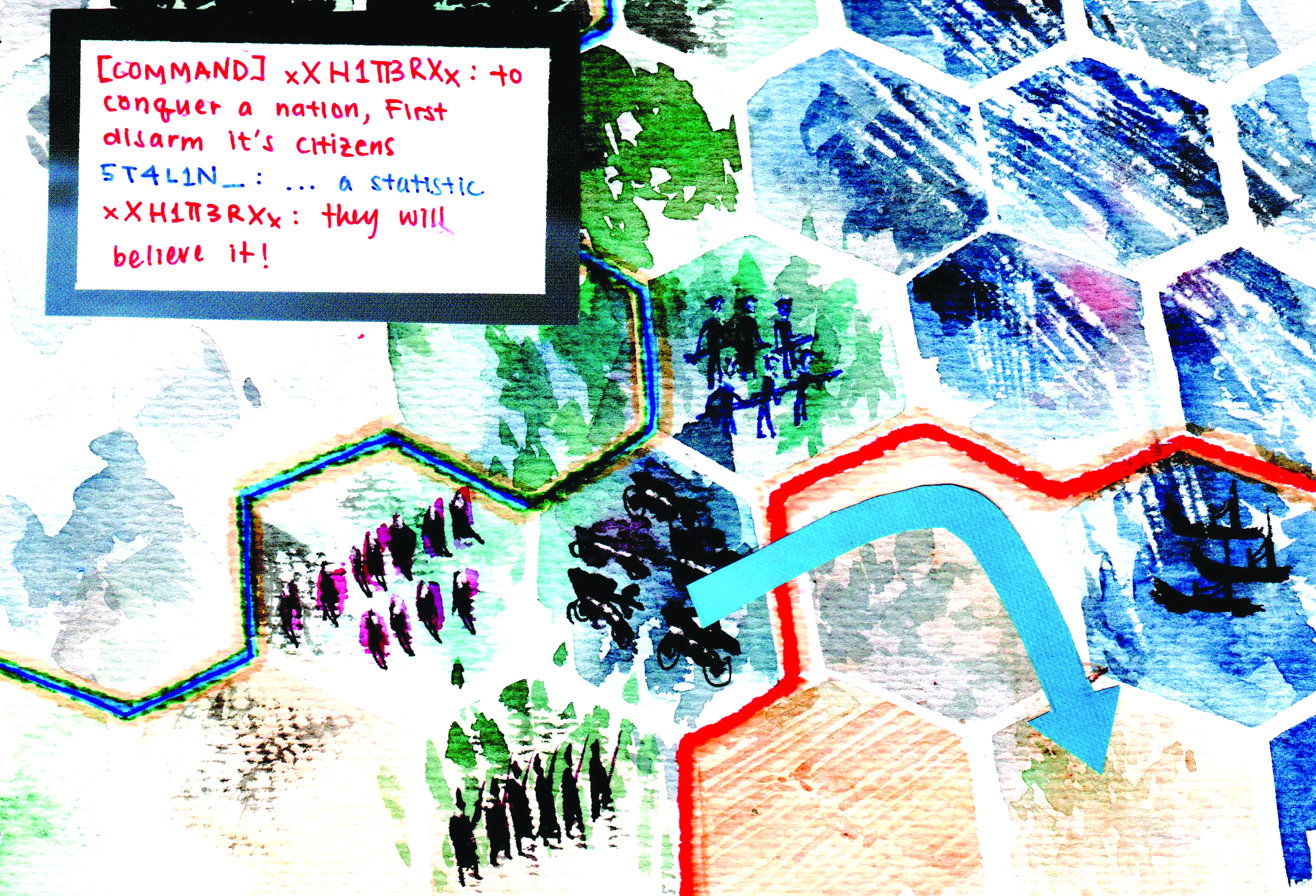
Did Hitler play strategy games?

In an article on Futurismic.com, “Seeing Like A State, Why Strategy Games Make Us Think and Behave Like Brutal Psychopaths,” Jonathan McCalmont adds his opinion to the raging debate on the psychological impact of video games. He links strategy video games with political psychopaths such as Hitler: the former causes the latter. McCalmont argues that strategy games turn liberal-minded people into “brutal tyrants” because they shift their worldviews from humanistic to state-centered.

This argument is farfetched.

McCalmont’s article overgeneralizes the impact of strategy games as he ignores the fact that most players of these games can distinguish reality from fantasy.

He believes that the escapism of strategy games is no different than the escapism of corrupt politicians into a state-centered view of the world where there is little concern for the human consequences of actions.

Yet, this comparison is erroneous simply because the players know they are playing a game. Such games, after all, involve actions that are impossible for an average person to accomplish, mainly the conquest of countries in different time periods and places. These time periods can involve the far off past or future as in Civilization or Starcraft, as well as worlds of fantasy like in The World of Warcraft.

McCalmont thinks that strategy games are all “politically savage.” They’re really not.

McCalmont’s simplification of the impact of strategy games is also apparent in his use of historical examples to support his case. In one example, he goes so far as to argue that the major genocides of the 20th century were caused by the state-centered views of tyrants, the same views that are prevalent in players of strategy games.

However, the psychopathy of leaders such as Hitler, Stalin, and Mao must have had some incentives that are unrelated to video games, being that these games did not exist.

Not only is McCalmont exaggerating the negative effects of strategy games, but he is also ignorant about the games themselves. He thinks that they are all “politically savage.” They’re really not. A case in point is the game Civilization. It is complex, demanding that the player use many strategies other than shedding blood to win the game, such as via cultural conquest or winning the space race.

There are also different political systems to choose from in Civilization based on the level of your civilization’s knowledge or circumstances at a particular point in time, as well as democratic elements within the game, such as the happiness level of cities. In addition, there are political, economic, and scientific advisors.

Civilization is a strategy game that is not just a lesson in psychopathic tyranny but rather in political diversity. This can help the player exercise his or her democratic rights and gain a broader perspective of the world.

McCalmont’s belief that players of strategy are psychopathic tyrants or dictators with worldviews that exclude social realities shows that he takes these games too seriously. Any mature gamer will tell you that to play a game, you have to distinguish fantasy from reality.

Satellite Signals

0

WEB-woodward

Woodward’s

The premiere of Victoria composer Christopher Butterfield’s fall for string quartet was performed by Montreal’s Bozzini Quartet last Thursday at SFU Woodward’s; attendees were invited to experience Butterfield’s latest composition. The Bozzini Quartet consider themselves to be “radically contemporary,” and so provided a perfect partnership for Butterfield’s “eclectic approach to composition.” 

surreySurrey

The Sikh Student Associations at SFU, UBC, and UFV hosted “Reflections on the 1984 Sikh Genocide: Why does it matter?” The session addressed the specifics of what went on, as well as what can be done now. Special guest Harinder Singh, an interdisciplinary researcher and global orator on Sikh and Punjabi heritages, led the interactive, dialogic event on the ever-lasting consequences of the 1984 Sikh Genocide.


vancouver

Vancouver

The 8th International Gender and Language Association conference took place at Harbour Centre from June 5 to 7. The conference aimed to promote an awareness of how language affects differently gendered students in learning environments. Findings from co-chair Allyson Jule showed that teachers will generally encourage male students to speak more so than females. This could potentially have long-term effects on girls, making them less vocal in certain situations, such as in the workplace.  

Bard on the Beach brings Shakespeare to life

0

Equivocation_Shag_0615_FINAL


Scribbled on a wall near the production site of the Bard on the Beach is the statement “Shakespeare IS God.” The present tense is always reassuring, especially for those of us who agree with Harold Bloom’s statement that “if any author has become a mortal god, it must be Shakespeare.” 

But the origins of “Bardolatry” are not modern. It was in 1769 that the actor David Garrick held a three-day jubilee for the Stratford native, where he proclaimed him “the god of our idolatry,” and it was a century earlier in 1623, when Shakespeare’s contemporary, Ben Jonson, wrote the following about his friend: “Thou art a monument, without a tombe, And art alive still, while thy booke doth live.’’

I don’t mean to offend with such blasphemous anecdotes, but only to point to one of the more vile cultural norms of today: the relegation of Shakespeare to the confines of the classroom. Doing so has led most students reading him to the conclusion that Shakespeare is an academic exercise best kept as such, and reaffirms the echoes of students past: that Shakespeare is somehow too distant or difficult for them to enjoy and appreciate.

Of all the saddening opinions which have coagulated about Shakespeare, that last one seems the most unfortunate. 

Shakespeare sits at the head of the Western literary canon because his works mirror life better than anything else. If there is any writer more apt to cure those stuck in the gloom of educational anxiety, it would be Shakespeare. The poetry of his works, what C. S. Lewis calls “the highest type of lyric,” is never as complex as people make it, and the merest attempt to comprehend it will usually lead to the clear manifestation of Shakespeare’s genius.

Counteracting such notions is always difficult, but one can hope that productions such as Bard on the Beach can help. One of the show’s producers told me that if the yearly shows can do anything, it is to remind or show people that Shakespeare is actually quite entertaining. After all, Shakespeare’s works were meant to amuse a stadium of individuals, most of whom were standing, for hours at a time. 

If Bard on the Beach can help prove this, then perhaps it can also entice those flirting with the prospect of reading Shakespeare to dive in. 

The three plays to be performed this year are some of his best. A Midsummer Night’s Dream, Shakespeare’s first true work of genius, punctuates C. S. Lewis’ recognition of the sweet thunder of Shakespeare’s lyricism, and his ability to weave a story through the creation of the most interesting of characters.

The Tempest, like so many of Shakespeare’s great plays, has divided many over the interpretation of its characters, giving more credence to the notion that, with Shakespeare, one can never exhaust all interpretative possibilities about his plays.

The character of Iachimo in Cymbeline, is a wonderful hint at the more famous characters of Shakespeare’s high tragedies, and acts as a positive vestigial of the author at his best. 

All critics agree about the genius of A Midsummer Night’s Dream, but hesitate when it comes to the latter two. Regardless of where the last two plays hover in a ranking of the Shakespearean canon, I suspect that they will prove entertaining and linguistically pleasing, and hint at the possible joys one can get from Shakespeare.

I’m rooting for the Rangers

0

7140964333_26418cc4b8_b

The Montreal Canadiens are out of the playoffs. That’s a bummer, as I guess the Bettman conspiracy will last at least one more year. (While it’s hard to believe, the last time a Canadian team won the cup was in 1993, just after Bettman began his reign as commissioner.)

On the plus side, this means the Canucks could be the first Canadian team to win the cup in 20 years.

You may be surprised, however, to hear who I am cheering for in the finals: the New York Rangers. This may sound like sacrilege, as the Rangers not only beat my previous bandwagon team, the Canadiens, but also beat the Canucks in the 1994 finals. (Note: I don’t think you will ever see me cheering for the Boston Bruins.)

However, before the playoffs (after the Canucks were out), I chose three teams. I know three teams is a lot, but these were the three teams I could stomach contending for the Stanley Cup.

My first choice, well ahead of the other two, was the Montreal Canadiens. First off, they were the only Canadian team left, and I think that is enough of a reason to cheer for them (although Toronto and Calgary would be exceptions for me). Not only that, but they are a fun team to watch, and with small players like Brendan Gallagher defying the odds, they went against the grain of what a playoff team is supposed to be.

My second choice would have been equally, if not more shocking: the Chicago Blackhawks. Although they beat the Canucks numerous times in heartbreaking playoff matchups, I always respected them; they played a good game, and unfortunately, they deserved to win.

Alain Vigneault was probably Vancouver’s best coach, and really should have had a cup ring here.

Not only that, but they play a game based heavily on skill. Although they are big and mean, their offensive game is something to watch, something that can’t really be said of the Kings.

Now, that just leaves the New York Rangers. My reason can be summed up in two words: Alain Vigneault.

Although some would rather see him crash and burn, and justify the Canucks firing him, I have always liked him. He was probably Vancouver’s best coach, and really should have had a cup ring here.

That is not to say his firing was unwarranted. I still believe that the Canucks needed a shake-up in coaching at the time, just for a change. But that’s why I am still cheering for him, I think his firing was justified, not because he was a bad coach, but because things were stale.

I certainly would have rather seen Vigneault get his ring in Vancouver, but I will cheer for him to get one on another team (providing that team does not rhyme with “the ruins”). It should also be noted that New York’s crimes against Vancouver were a bit before my time, so I don’t hold that grudge strongly against them.

A smaller factor in my choosing the Rangers is that, in the Western Conference, the Blackhawks and the Kings are almost guaranteed a spot at the conference finals (though hopefully not for long, if you know what I mean). They seem to have a stranglehold on playoff success in the West. However, in the East, there is constant turnaround. It would be nice to see a team that is not a playoff juggernaut win the cup.

And really, who wants to see the Kings win?

Douglas Coupland exhibit at Vancouver Art Gallery explores contemporary society and technology

0

CMYK-Coupland-01

Many of us know Douglas Coupland, the successful author: the man has charmed us with novels and works of non-fiction ever since Generation X in 1991. Perhaps fewer know Douglas Coupland, the visual artist, who graduated from Emily Carr Institute of Art and Design in 1984 and has been exploring concepts of Canadian and pop culture, contemporary life, and the pervasiveness of technology  through visual arts ever since. 

Douglas Coupland: everywhere is anywhere is anything is everything is a culmination of millings within these themes, and is presented through a stunning array of media including installation, photography, painting, lego, quilts, plastic containers, and nick-nacks he has collected over the years. This manifestation of contemporary Canadian culture is Coupland’s first major, solo art exhibition, and it is big, beautiful, and thought provoking. 

The colourful and comforting exhibition guides us through six central themes. The first, Secret Handshake, explores Canadian cultural stereotypes and invites us to consider the familiarity of everyday objects that are uniquely Canadian. It is a sentimental display of often overlooked treasures, from prairie licence plates to miniature Canada Post boxes — all of which invite us to reflect on place and time. 

In Growing Up Utopian, Coupland displays his brain-tickling lego structures to illustrate our post-war dystopic and utopic possibilities, capturing the possibilities of where we might take our world.

Words into Objects Slogans for the 21st Century is driven by Coupland’s question: “What’s something you can say, right now, that would make no sense to someone 10 years ago, or 20 years ago?” Coupland explained, “It’s the culture speaking rather than myself speaking.” This work is 172 bright captions, some humorous, some sorrowful. 

A couple of my favourites include “Knowing everything turns out to be slightly boring,” and “I miss my pre-Internet brain.” As Coupland was allowing us to soak it all in, he muttered, “I no longer remember my pre-internet brain.” 

Pop Explosion follows, a burst of modernized pop culture including framed Andy Warhol wigs and candy-coloured paintings inspired by icons such as Roy Lichtenstein.

In The 21st Century Condition, Coupland examines the impact of the 9/11 terrorist attacks on our lives. This collection also embraces smart phone technology and blends the themes together in such pieces as a distorted photo of Osama Bin Laden which reveals itself better when viewed as a photo taken by a mobile device. 

The last theme is The Brain, a collection of 5,000 objects Coupland has amassed over the years to resemble the way the brain functions. Coupland confessed, “I have been on that weird line between collecting and hoarding for quite a long time now, so this experience here, this is part of de-hoarding.” 

He also remarked, “Collecting reveals a lot about you that you may not know.” The array of beautiful objects in this section is impressive, but their intimate organization and presentation is even more so. “I think every house in the world should have a brain room,” said Coupland. 

Not only can you step inside Coupland’s brain in this exhibit, but you are also encouraged to stick gum on his face: Coupland placed a seven-foot tall sculpture of his head, entitled “Gumhead,” just outside of the gallery. Coupland describes it as a “gum-based, crowd sourced, publicly interactive, self-portrait.”

Douglas Coupland: everywhere is anywhere is anything is everything is at the Vancouver Art Gallery from May 31 to September 1.

The Leo Awards celebrate the best of BC film and television

2

CMYK-Beverly Elliott - Leo Awards, EloraB. -9


The Leo Awards, celebrating excellence in British Columbia film and television, kicked off on Friday, May 30 and filled the Fairmont Hotel Vancouver with the province’s most talented, adventurous, and dedicated artists. The awards ended on a pure note of red carpet glamour at the gala awards on Sunday. 

Friday’s celebration honoured design, editing, music, screenwriting and cinematography. Anxious Oswald Greene dominated the Short Drama category and walked away with 10 awards. Continuum, the science fiction TV series set in Vancouver future and present, also led its Dramatic Series category, winning four awards. Elysium, the Hollywood blockbuster starring Matt Damon, won Best Visual Effects in a Motion Picture. 

Vivacious Beverley Elliott, who stars as Granny in the television series Once Upon a Time, hosted Saturday night. She kept the evening — which she called the “hump celebrations” — rolling, with cheeky jokes and a foot stomping song: “I’m Mad at Myself.” Kalyn Miles, 2013 Best Host Leo award winner, added her own brand of comedy via video clips of interviews with nominees. In one clip, Miles told Ryan Robbins, from Sanctuary, that he was good looking, then stripped to her underwear and hit on him for the rest of the interview. When Miles finally asked about his nomination, Robbins, almost speechless, recovered with a quick, “I deserve another one for holding myself together here.”

On Saturday, the Leos tipped its hat to British Columbia’s flourishing do-it-yourself production and distribution culture by adding two awards to Web Series, a new category introduced in 2013. Johannah Newmarch won Best Performance by a Female for Polaris, while Colin Cunningham won Best Performance by a Male for Fools For Hire. Best Web Series went to The True Heroines, a science fiction tale set in the 1950s about three housewives with superpowers.  

The Vancouver Film Orchestra was on hand for the Sunday night gala with tight, punchy movie themes that brought a touch of dramatic tension to the winners’ arrivals on stage. Co-host Christopher Heyerdahl opened the awards with the comment “Our theme tonight is technical difficulties. We hope you enjoy our feedback.” 

The theme this year was actually abundance, in reference to the 1,052 nominations received, plus a slew of new categories, leading to a decision to extend the celebrations to three nights. Fellow host Zak Santiago made reference to this theme, as well as to the Save BC Film campaign that pulled the industry out of lean times in 2013. “Last year it seemed like everyone I knew was talking about plan B,” he said. “Now we’re looking at our best year ever.”

Continuum won Best Dramatic Series and two more awards. Down River, written and directed by Ben Ratner, added Best Motion Picture and Best Supporting Actress to the Best Screenwriting award it took on Friday. 

I spoke with Ratner and Jennifer Spence on the red carpet. Ratner wrote the role of Aki with Spence in mind for the part. When I asked Spence what about Aki she identified with most, she responded, “I like the nerd; I’m a nerd.” To see Spence poised elegantly on the red carpet, no one would think there was an ounce of nerd in her, but when she bounded onto the stage and clutched her Leo, saying “Holy sheeit,” I thought maybe, I saw a charming glimmer of it in her. 

Michael Eklund, known for The Watchmen and 88 Minutes with Al Pacino, won Best Supporting Performance for his role as the serial killer Michael Foster in The Call, a Hollywood movie starring Halle Berry. 

The Student Awards, presented by Gabrielle Rose, who took Best Performance by a Female in Short Drama for The Corpse and the Courier, were an important part of the evening. As Rose said, “It is vital that the Leos promote, support, and recognize student filmmakers. They are our future, and hopefully our future employers.” 

One of the films nominated for Best Student Production, O Angel of God, was written, directed, and produced by David Manuel, a graduate of the Simon Fraser University film studies program.

And last, but by no means the least, Beverley Elliott delivered a saucy song to poke fun at the life of a British Columbia actor, “This Actor’s for Hire,” (cue Alicia Keys’ “This Girl is on Fire”). She brought the roof down and got a well-deserved standing ovation.

Coffee, Tragedy, History: Musette

1


It started like all good things do: from something vague I heard in passing. I heard from my friend that my other friend’s dad mentioned some cyclist café in an alley somewhere — the thought stuck in my head. It felt romantic somehow, like a secret gathering place for conspirators. Only instead, hipster cyclists. 

The thought captured the true feeling of the café. After all, some of the first cafés were banned out of fear of conspiracy; the local rulers thought that such places would encourage too much talk among intellectuals and, inevitably, dissidence.

I did some digging (a Google search) and found the address of the mysterious biker’s retreat. Seeking to camouflage myself I mounted my road bike and set off. It wasn’t the hidden smuggler’s den I’d expected it to be, and I found it with relative ease. In fact it wasn’t even in an alley, a fact that threw me off the trail for some time. The café was more capable of subterfuge than I had calculated; the bastard was hiding in plain sight.

Upon entering, the first thing I noticed was the minimalist decor. Faded wood trim, simple black and white menus and chipped paint gave it a Parisian feel. TV screens were showing elite level bike racing and old bike memorabilia dotted the walls. I’m no elite cyclist, but I still appreciate any opportunity to pretend I’m French.  

Keeping with the minimalist themes of the café, I ordered a basic dark roast coffee and sat inside. Old school hip hop played over the sound system, the coffee was good quality and it was reasonably priced — all good signs. The menu offered all the basic espresso drinks (Americano, Cappuccino, Latté), but nothing incredibly extravagant. There was a wide array of sweets and sandwiches available, all of which looked tasty. 

Musette is a place for good honest coffee but it’s more than that. It’s a place for cyclists to connect and to share in their love of both coffee and cycling. It’s a farewell to traffic after a long bike ride; it’s the place where the next Hemingway could write his first book. 

Normally, I would evaluate the café’s level of support for the arts but, with such a specialized café, it’s hard to judge. This spot offers information regarding local bike races and other cycling events and it does not discriminate. Cyclist or not, it’s a great place to write, read or draw. Musette supports the art of cycling and the art of community. Not to mention it’s a cheap vacation spot: cycle there and order a coffee, sit facing in, and with a little imagination you could be in Paris. 

I would definitely recommend Musette to artists. Even if it does not directly support all forms of art, it does encourage enjoyable physical exercise in the form of cycling. Exercise is my tried and tested cure for writer’s block and I believe it can help any artist in need of inspiration.

Musette is located at 75 E Pender Street & 1262 Burrard Street, Vancouver.