Home Blog Page 1163

A sneak Peak into the SFU Concert Orchestra

0

orch1

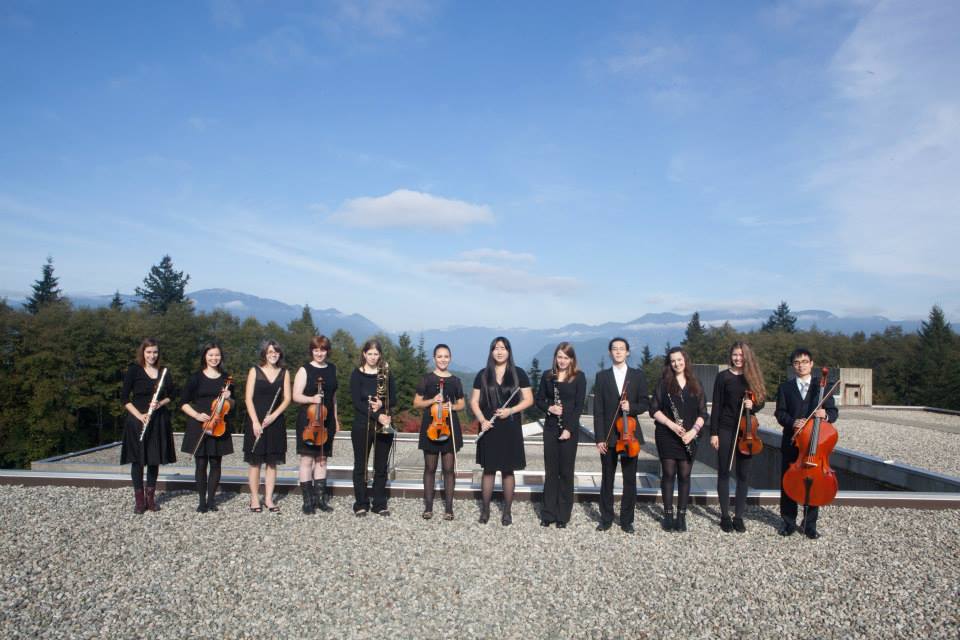
On the third floor of the Maggie Benston Centre, when the day is nearing its end and many people have headed home after a busy day of school, you may hear the faint echoes of an orchestra playing. “There’s a [musical] presence on the Burnaby campus — other than the pipe band!” says orchestra co-president Kristen McLaughlin.

The SFU Concert Orchestra, founded in 2007 by Jerry Yon and George Chung, is a student-run club on the Burnaby campus. The club was started as the SFU Chamber Orchestra, but as it expanded, the name changed to adapt to the additional members and instruments. Yon and Chung founded the club to fulfill the lack of  musical groups on the campus.

The current co-presidents Adrienne Mariano and Kristen McLaughlin, and vice president Nathalie Scott-Hsiung, look back at their past three years with pride and delight when they talk of their fellow musicians, whom they have witnessed transform before their eyes, often in the course of one semester.

Today, the orchestra averages at about 30 to 40 members each semester. Mariano notes that when she first joined, the audition process was an intimidating hurdle, one she attributes to the group’s smaller size years ago. “If it would have scared us away, it would have others as well.” Now, instead of an audition, any musicians with some experience looking to join can sign up at Clubs Days at the start of the fall or spring semesters.

With so many diverse members, it’s interesting to note that none of them are going to school for music studies. Each person comes from different backgrounds, with different majors and hobbies, yet they have one thing in common: the drive and the commitment to make the orchestra better and more enjoyable each year.

Any musicians with some experience looking to join can sign up at Clubs Days at the start of the fall or spring semesters.

The SFU Concert Orchestra would not be the growing club that it now is without the hard work and talent of its members. Many use the club as an opportunity to grow a childhood passion, while others perform in this orchestra as well as youth orchestras in the Metro Vancouver area, and SFU’s various other music groups and clubs.

Each semester the orchestra holds a concert at the SFU Burnaby theatre. This spring’s concert will take place on March 29 at 7:00 p.m. Each semester the concert is named after a favourite piece in the show, resulting in this semester’s title: The Sound of Music. The concert will feature Celtic and classical music, and the presidents say that “the audience will get a bit of everything.” The show will also feature sectional showcases of some of the musicians.

Additionally, the orchestra will be performing at the Burnaby Rotary Club’s Wine and Music Festival in the heart of Loughheed Mall on April 26.

The SFU Concert Orchestra is optimistic about the future: “In our three years, we’ve seen it grow slowly but surely every year,” says Scott-Hsiung. As the school’s awareness of the club grows, they intend to continue growing as a group, and develop their personal musical talents.
SFU still winless after home opener

0

After playing their first two homes games of the season, the Clan softball team is still searching for their first win of the year.

Playing their first home games almost a month after three exhibition contests were snowed out, SFU was in tough against the defending Great Northwest Athletic Conference (GNAC) champions, the Saint Martin’s Saints. A scrappy Clan team gave the Saints everything they had, but fell in both ends of the weekend doubleheader.

SFU fell 9–6 in the first game. SMU jumped out to an early 3–0 lead, but the Clan tied it in the fourth, and then took over the lead 6–3 before the inning was over. SFU held the lead until the sixth inning when the Saints pounded the Clan for six more of their own.

“I think I’ve got to go buy some bullet proof cleats for our players because we seem to find a way to shoot ourselves in the foot every game,” said head coach Mike Renney. “The first game, the wheels just came off in one inning where we made several errors against the team that won the conference, that’s projected to win the conference again and they took advantage of it with a six spot in a game where we had worked hard and earned the lead. Other than that one inning, we competed the entire game.”

The second game featured a Clan collapse as well. SFU lost 5–2, but only trailed by one heading into the seventh and final inning. With the top of the SFU order due up in the bottom of the seventh, the Clan’s defence allowed two more Saint runs in the top half to seal the deal.

The two losses drop the Clan’s record to 0–8 within the GNAC and 0–17 overall.

“I was really pleased with our compete [this weekend],” added Renney. “Having said that, we’re not where we need to be yet and we’re not where we want to be but I’m confident in this group of athletes.”

SFU’s next batch of home games are this weekend, against Central and Western Washington, two teams near the top of the GNAC standings. Renney’s squad will need all the compete they can muster to earn their first win of the season.

Spring Sendoff on track

0

WEB-spring concert-Mark Burnham

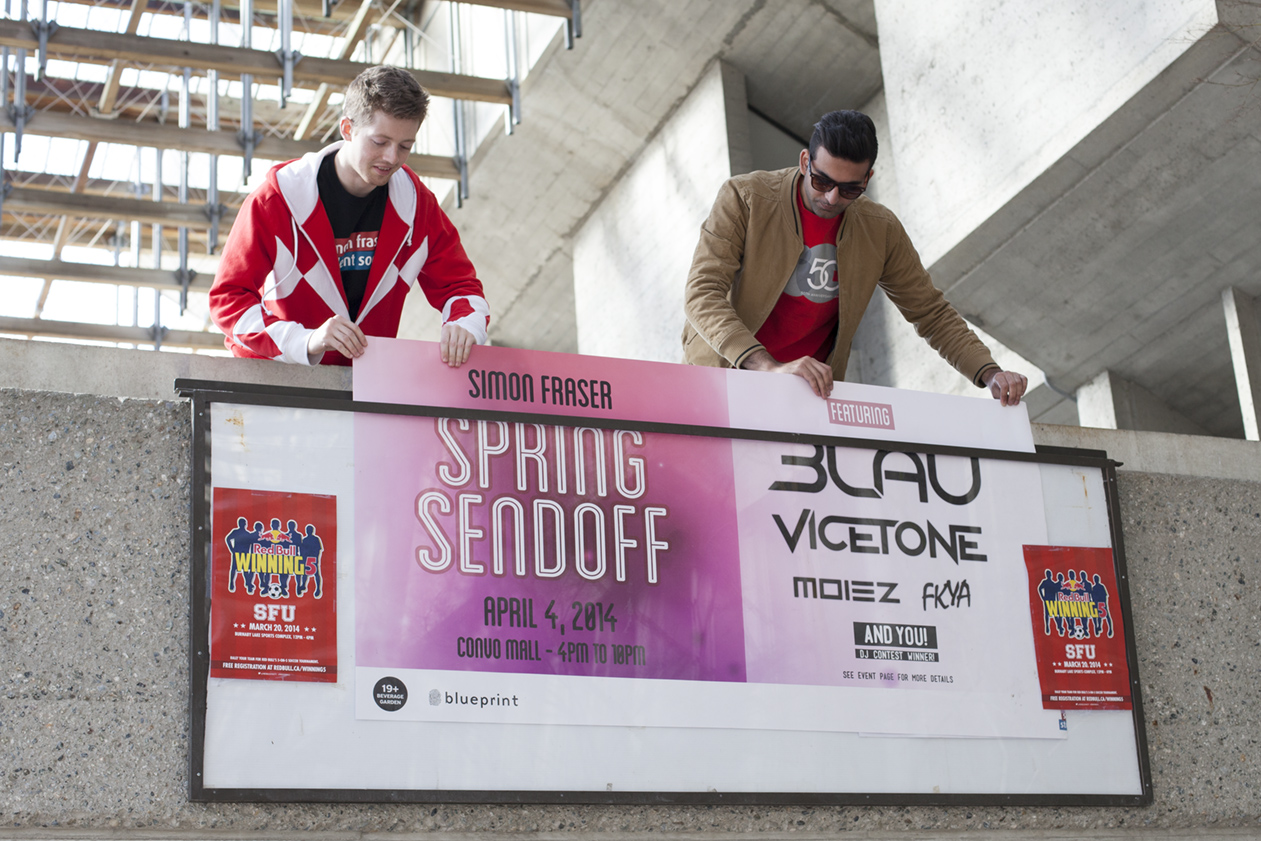
Plans for the SFSS Spring Sendoff concert are well underway, and this second event promises to be bigger and boozier than the first. In response to student feedback from the dry Fall Kickoff concert, this time around there will be a separate beverage garden open to concert-goers of age, pending final university approval.

The event will take place on Apr. 4, and will feature electronic dance music artists 3LAU, Vicetone, Moiez, FKYA, and the winner of this semester’s SFU DJ contest. Student interest in the concert appears to be high, with over 700 tickets sold as of last week.

Last fall’s concert was met with hesitation on the university’s part, but in light of its success and positive feedback, SFU approved a second concert. While both the university and SFSS agreed to keep the event largely the same, a major change is the inclusion of a beverage garden.

Board members did discuss changing the genre of music in order to appeal to a greater scope of students, however, it was decided that the lack of alcohol was the biggest complaint and, therefore, the natural next step.

Brandon Chapman, business rep on the SFSS board of directors, explained that their aim is to make incremental changes to the concert model, so as to not risk the university’s disapproval.

The SFSS has already received approval from the City of Burnaby and the RCMP for the beverage garden. They are still in conversation with the liquor inspector, after which they can be receive the official  green light from the university and will have a clearer idea of how the beverage garden will run.


The aim is to make incremental change to the concert model, so as to not risk the university’s disapproval.


Chapman has spearheaded the project since the SFSS began to entertain the idea of a second concert near the end of the fall semester. A task force of 12 people was formed mid-December and put forth the proposal to board on Jan. 20.

Despite concerns from other board members over the near $19,300 deficit of the last concert, the spring concert was approved.

“That won’t happen again,” said Chapman of the deficit. “We’ve already secured over $12,000 in sponsorships, which is huge.” A sum of $10,000 was contributed by the university and the rest came from external sources.

Ticket prices have also increased slightly to offset the cost of the concert, but it is still important to the organizers to keep this event affordable for students. The team is also evaluating the expenses of the fall concert to see where money could have been saved.

Chapman said that the society’s goal for similar future events is to break even. The SFSS has been working closely with Student Services to move towards a more sustainable and cost-efficient way of hosting concerts.

There has already been talk of another kickoff event next fall, which could potentially offer a more varied collection of artists. Chapman shared his vision for this event with The Peak: “Imagine Terry Fox Field being a place where people can come and just listen to some indie music in the afternoon when the sun shines, have a beer with some friends and reminisce about the summer.”

Salt and Paper: Cashew lime squares

1

Processed with VSCOcam with f2 preset

I will be the first to admit that I love cheese and am in no way a vegan. If you’ve ever read the arts section, you probably already know this, as I never tire of talking of my adoration of all things fromage.

I also have a major sweet-tooth, and sometimes it becomes detrimental to my health, in more ways than one. Craving cheesecake at 10:00 p.m., I once walked several blocks just to buy a little slice to satisfy my very specific desire. I’ve also been known to eat an entire bag of five-cent candies while binge-watching Gilmore Girls. Sometimes, my sweet-tooth takes the wheel.

Occasionally, a (moderate) intervention is needed, and while my sweet cravings will likely never dissipate — I pity the soul who has to supply me with pints of ice cream and almond croissants when I’m pregnant — there is a solution: healthy sweets.

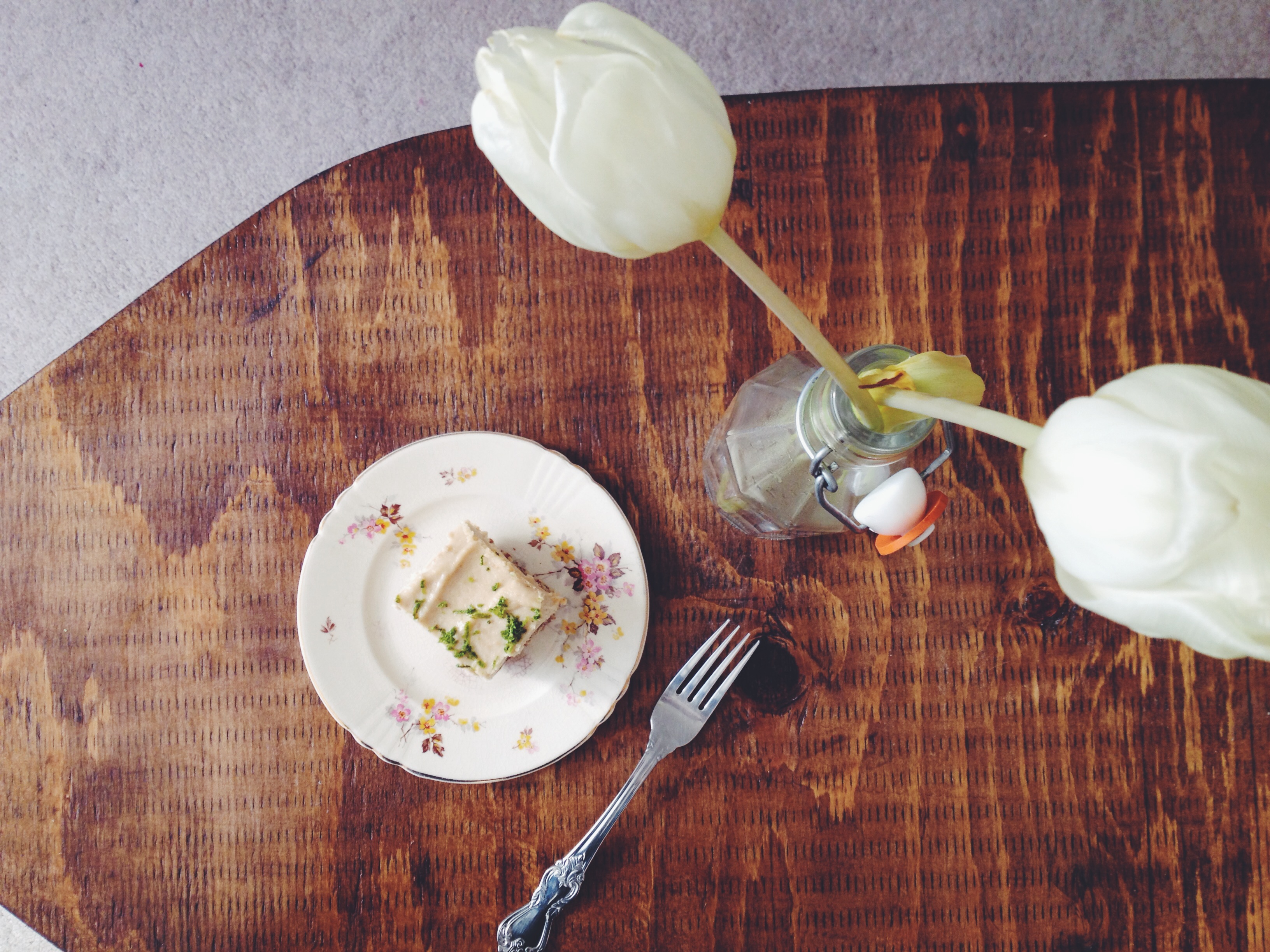
And I’m not talking just fruit here, folks. I’m talking creamy, citrusy lime squares made entirely of healthy ingredients. So while I still love a classic lemon or lime tart or cheesecake square, the discovery of entirely vegan, raw treats has rocked my world a little.

These lime squares are so incredibly creamy and flavourful that you’d never know they were made from nuts. It’s kind of, well, nuts.

This recipe is also highly adaptable. Not a fan of lime? Try lemon with a blueberry compote, or add some chocolate and peanut butter to the mix and really get the party started.

Processed with VSCOcam with f2 preset

For the crust:

• 1 cup almonds

• 1/4 cup pitted dates

• Coconut oil (as much as is needed for the crust to be moist, around 3-4 tbsp)

Blend the almonds in a food processor until well chopped. Add the dates and coconut oil, a bit at a time, until the mixture is moist enough to press into the bottom of a pan. You can either use a circular pie pan or a small square one, depending on what you’ve got.

For the filling:

• 1 1/2 cups cashews, soaked four hours or overnight

• 1/2 cup lime juice

• 1/2 cup honey

• 1/2 cup coconut oil

• 1 tsp vanilla

• 1/4 tsp sea salt

Blend all ingredients in food processor until creamy, around five minutes. Add ingredients as you see fit: Not lime-y enough? Add some more juice or some zest. Not sweet enough? Add a bit more honey.

Pour the filling over the crust in the pan and add some zest to the top, if you’d like. Pop in the freezer and let set for around three hours. Store in the refrigerator, or consume all in one sitting — you know what I’d do.

lime4

Experiential learning site matches students with researchers

3

WEB-Living campus-Mark Burnham

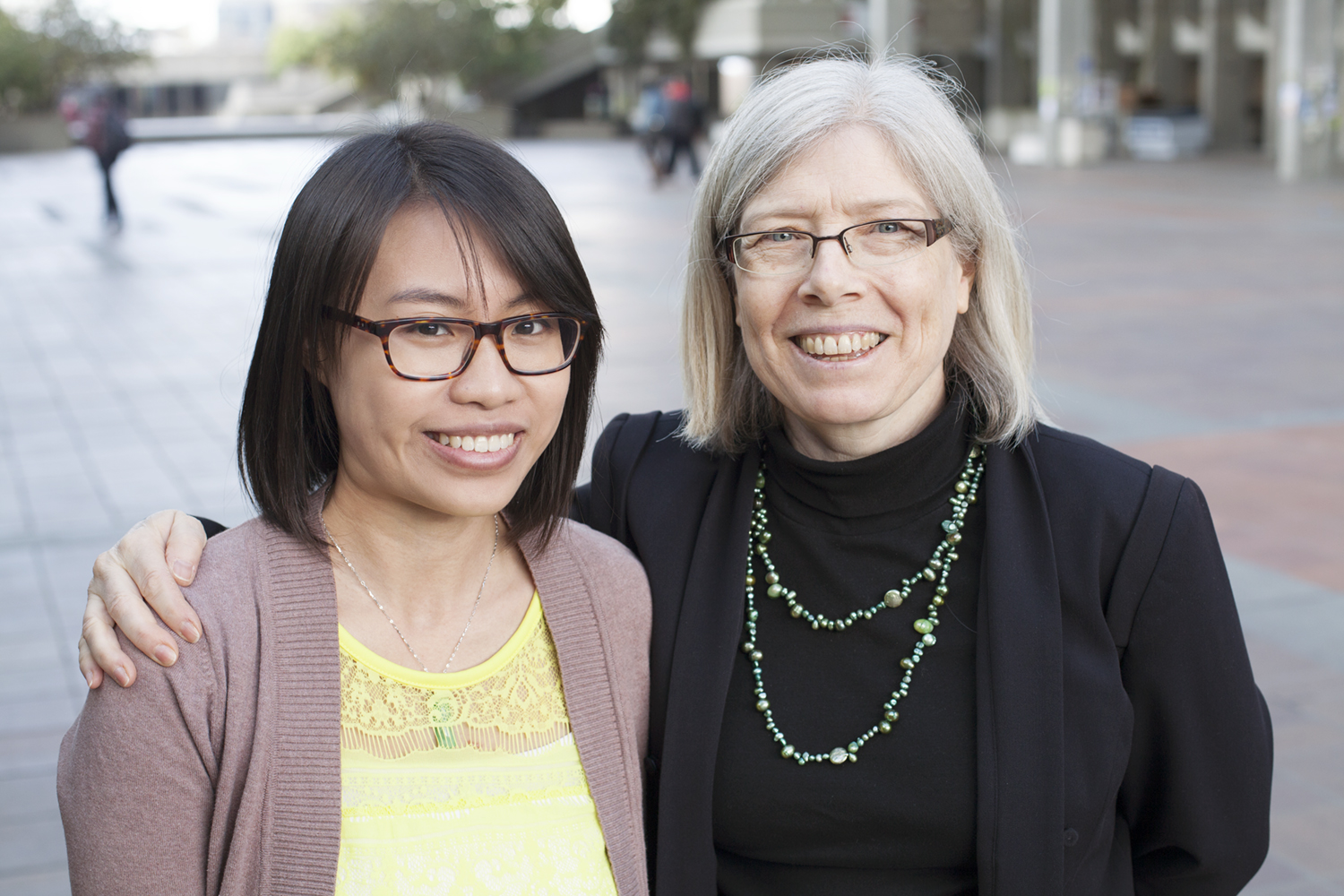
A recently launched SFU-based website is hoping to find you the perfect match — but we’re not talking about a love connection. Campus as a Living Lab aims to pair students and faculty with projects and people in order to gain experiential learning as well as course credit.

Helen Luo, a work-study student from SFU Teaching and Learning Centre, had the idea for the site last May. Working alongside Vivian Neal, her supervisor and an educational consultant for SFU in the Applied Sciences and Environment faculties, Luo hopes to expand the university’s offerings to include more experiential learning in its course curriculum.

Neal explained that this site is meant to fill a gap in what is offered at SFU. She said, “There’s lots of co-op student job planning sites and there’s volunteer project sites [ . . . ] but there seems to be very little to match action learning with credit based courses.”

The site encourages students who are looking for projects to fulfill course credit — either as individuals or groups — to post ideas on the site. There, they can be connected with researchers or companies with similar goals.

Eventually, Luo hopes the site will act as a project database, where both students and researchers can scroll through listings, choose projects in which they are interested, and form partnerships based on research compatability.

According to Neal, inspiration for the project came from the university population’s own desire for greater opportunities. “Instructors were looking for projects for their students, and students in project courses were looking for good projects, and they didn’t know where to find them,” Neal said. “They didn’t know what were useful things to do, on campus or near campus, that would have a real world outcome.”

Luo extolled the site’s accessibility as one of its most attractive features. “As you can see on the site, anyone can post a project, whether you are a student or staff,” she said. She explained that this provides a vehicle for those who may have a vision, but not necessarily the resources to put a project into action.

Although the current project listings are mainly related to sustainability, Luo and Neal feel that all faculties at SFU could benefit from the site. “There’s probably lots of hidden histories at SFU which would be interesting to dig up,” Neal said. “[There could be] real life, campus based research for history students.”

Anyone can find their scholarly soul mate: Neal continued, “Pretty much for students in any discipline, there is going to be something on or near campus which could be studied or managed or proposed.”

Although the two anticipate challenges, such as getting students to engage with the site, Neal is optimistic that students will use this opportunity “to engage in real world problems and problem solving through programs and research so they can make real changes on campus.”

On the bright side

0

WEB-Sedin-flickr-Lauren Zabel copy

Although the Canucks are still realistically out of the playoff picture, they have shown marked improvement as of late.

Scoring, which was hard to come by even in December when the Canucks were winning, has not been the issue recently, with the Canucks scoring three or more goals in many of their last few games.

Alexandre Burrows — who had not scored up until a game against Winnipeg two weeks ago — is scoring nearly every game, perhaps making up for lost time.

This has reignited the first line, along with rookie call-up Nicklas Jensen. Jensen had a slow start in the AHL, but is averaging just under a point a game playing with Burrows and Henrik Sedin. For the first time in a long time, the first line looks like a first line.

In the game against the  Tampa Bay Lightning on March 17, though it ended in a 4–3 loss, the Canucks mounted an impressive third period comeback from 4–1. Perhaps “impressive” is a strong word, but it was only a week or two ago that 2–0 would have been a safe lead against the Canucks.

It should be noted in that game that the comeback was in the third period, after a lackluster first two periods. Previously, the third period was the Canucks’ kryptonite: If they had a lead it would almost surely be surrendered; if they were behind, there was no chance.

The fact that they came back from a sluggish start is promising, in contrast to the 6–1 Dallas whooping in which the Canucks looked like they gave up early.

Even David Booth, who will still likely be bought out this offseason, has been showing a better game, laying hits on the competition making up for his lack of scoring. Also notable is new addition Shawn Matthias who looks like he could be a solid player for the Canucks.

There have still been problems, no doubt. The Canucks are still amazingly inconsistent, the defence seems questionable, there are too many boneheaded penalties, and the pressure seems to be making de facto No. 1 Eddie Lack uncomfortable. Not to mention, the Canucks would be hard pressed to make the playoffs even if they won every one of their games.

But, recently, there has been light. They have been playing decent, entertaining hockey; every game seems winnable, not just some futile exercise. If they started playing like this at the Olympic break, they would likely be in playoff contention, though that’s hardly a silver lining.

I don’t see race, I just see people with bombs in their turbans and people without turbans

0

Written by Gill Smith, TSA

Listen, I know a lot of people think that airport security employees aren’t always the most impartial people when it comes to “random checks” but I’ve got to say that I, for one, do not discriminate based on race, creed, or ethnicity.

The only thing I look at when I see another human being is their turban, that’s it. If they’ve got one, I know they’re carrying a bomb and I won’t rest until they are brought to justice.

You could be brown, black, white . . . hell even purple and I wouldn’t give a damn. I treat every single one of god’s creatures the same, as long as you don’t got a turban on.

Personally, I can’t believe we still live in an age where people are judged on where they were born and not on what type of obviously weapon-concealing headgear they wear.

“Race is just a made-up concept anyway, but it’s a known fact that a turban’s only purpose is to hold explosive devices”

Terrorists can come in all shapes and colours, you know, so it’d be crazy to just single out one group based on something as arbitrary as the country they grew up in.

Race is just a made-up concept anyway, but it’s a known fact that a turban’s only purpose is to hold explosive devices.

So yeah, when I see one of these turban-wearers, I don’t even see what colour they are or what shape their jaw-line is, I just stop them immediately and take them back for three hours of questioning.

I don’t just do it when I’m at work either, even when I’m off-duty I help make our world a little safer and our country a little-less destroyed.

And I’d say I’ve been pretty successful too; I’ve never let a single bomb go off or my watch. Not on a plane, not at the grocery mart, and not even at my favourite Pakistani restaurant, which I always have a few close calls at.

So please, do not judge a man on the colour of his skin . . . just check if he’s wearing a bomb-hat. If we can manage to do that, discrimination will become a thing of the past in no time.

From Crimea with Love

2

iGCy9_CbjQUY

It has been less than a month since the overthrow of President Yanukovych by the Euromaidan protesters, only days after it looked as if hell had broken loose in Kiev, Ukraine, as government forces opened fire on the crowds. The international community thought that the Ukrainian crisis was over. As it turns out, it was only beginning.

As protesters stormed the president’s palatial estate and found overwhelming evidence of his corruption — including personalized brandy, a private golf course (complete with monogrammed golden drivers), and a private zoo — Yanukovych addressed the the nation that had deposed him from across the Russian border, claiming to still be the legitimate leader of Ukraine, and asking for Russia’s assistance in reclaiming the presidency.

While Vladimir Putin did receive permission from the Russian Duma to intervene militarily, he initially contented himself with a massive military exercise on Ukraine’s eastern border, close to some of the cities that had held pro­-Russian demonstrations in response to the Euromaidan protests in Kiev.

The international community thought that the Ukrainian crisis was over. As it turns out, it was only beginning.

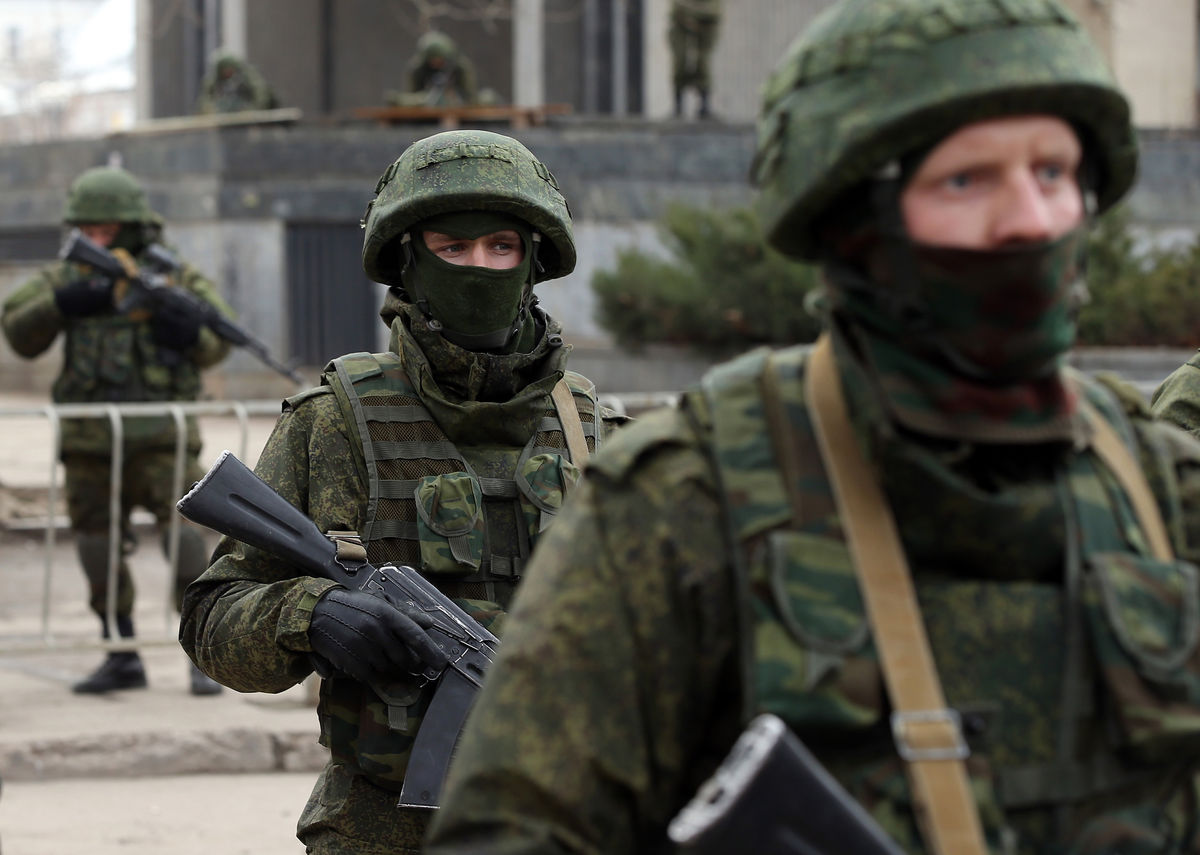
When we in the Western world checked the news the following day, we were shocked to hear reports of uniformed soldiers lacking any national identifiers blockading and seizing control in the Crimea.

Crimea, despite being the home of the Russian Black Sea Fleet, is part of Ukraine, and guaranteed to the nation by a 1994 treaty. Though the Duma denied that these men were Russian military, referring to them as Crimean self­ defence forces, very few in the international community were fooled — many began to refer to this as a Russian invasion of Ukraine. Russian forces stationed on the peninsula by treaty did move out of their bases, but under the pretext of protecting the ethnic Russian population.

With the government in Kiev still reeling from the rapid transition of power, the Russian forces swiftly seized control, with some estimates claiming that close to 11,000 Russian military personnel were on the peninsula and in control. What followed was a brief period of calm, in which the Prime Minister of Crimea announced that they would be holding a referendum wherein the people of Crimea could vote to secede from Ukraine and join Russia.

For reference, the Russian population in the peninsula accounts for about 58 per cent of its total inhabitants.

Despite sanctions from the international community and an attempt by the United Nations Security Council to condemn the referendum and move towards a diplomatic solution (which Russia vetoed), the vote went forward on March 16. When the votes were counted, it was found that almost 95 per cent of those who voted were in favour of Crimea joining Russia. Talk about a majority.

I say “those who voted,” however, because massive irregularities in the referendum are already being reported. According to Vice, who has reporters in the area, many of those who were against secession never received voting information. As if that wasn’t enough, they also have reports that the city of Sevastopol, the capital of Crimea and headquarters of the Russian Black Sea Fleet, had a voter turn out of 123 per cent.

It is no wonder that after the results were announced, Prime Minister Stephen Harper made the following statement: “The so­-called referendum held today was conducted with Crimea under illegal military occupation. Its results are a reflection of nothing more than Russian military control. This ‘referendum’ is illegitimate, it has no legal effect, and we do not recognize its outcome.”

The following morning, Crimea declared its independence, and within hours, Ukrainian symbols were torn down from local government buildings, the local currency was switched to the Russian ruble, and clocks were synchronized with Moscow time. President Putin followed with a recognition of the new republic, a potential first step towards annexation.

In response, Ukraine is preparing for conflict. Volunteers, many of them former participants in the Euromaidan protests, have begun training to supplement Ukraine’s professional army in the event that Russia is not content with merely occupying Crimea. As of this article’s publication, shots have already been fired between Russian and Ukrainian forces. It’s only a matter of time before the conflict escalates, possibly resulting in a full scale war.

Interim President Oleksandr Turchynov compared Russia’s actions with those of Nazi Germany, occupying the Sudetenland in the lead up to the World War II. As a student of history, it is hard to ignore the parallels.

It’s only a matter of time before the conflict escalates, possibly resulting in a full scale war.

Both involve major powers becoming involved in a region of another country populated by members of their ethnic groups, and both Crimea and the Sudetenland are seen as strategically valuable. Both areas were occupied by military or paramilitary forces, and though the Sudetenland was given up in an effort to maintain peace, there was also a referendum held there to ensure that the inhabitants really did want to join Germany. This referendum also passed, with 97.32 per cent in favour of the move.

Putin is also claiming that he has no designs on the rest of Ukraine, but Hitler, in his time, said, “The Sudetenland is my last territorial claim in Europe.”

It was mere months later that the German dictator occupied the remainder of Czechoslovakia, and less than a year later, World War II began. Is history doomed to repeat itself in Crimea?

The Conservatives score another one for Canada

2

Last week, Prime Minister Harper was in Seoul, South Korea, signing another victory in the name of the Conservative government. Specifically, he signed a free-trade agreement with the country, adding to the recent trade agreements with the European Union last October. All of these together are estimated to boost the Canadian economy by around $13 billion.

Many, though, are wondering why the Conservative government is pursuing trade with a large variety of nations, as we have always had a steady and stable partner in the United States. The biggest problem with this is that the strength of our economy was very tightly tied to the strength of the American economy, which could be headed for turmoil in the near future.

One of the reasons for the diversification of Canadian trade is because of this reliance on the United States as a trade partner. As of 2007, 77% of all of our exports went south to our neighbours, leaving very little for us to trade with the rest of the world. As long as the American economy remained strong, we had little to fear. But this situation may not last much longer.

America doesn’t want the construction of the Keystone XL pipeline? Then we’ll sell our oil to China.

According to the Congressional Budget Office, without massive change to the current laws, America’s debt will reach 100% of its Gross Domestic Product (GDP) by 2038, and would continue upward from there. In other words, within the next 25 years, the world’s most powerful economy will collapse, unable to sustain itself any longer. That’s not exactly a train we want to hitch ourselves to.

Diversification of trade allows us to have more of a say in our trading relationships. In a situation where we are solely dependent on the United States for certain resources, they have been able to force us to accept terms we did not necessarily want in order for us to acquire what Canada needs. With a more diverse trade portfolio, we are able to shop around, and find the best deal amongst many nations.

More trading options also allows us a better bargaining chip at the negotiation table, as we have seen in recent years concerning the export of our oil products. America doesn’t want to get on board with the construction of the Keystone XL pipeline? Then we’ll build Northern Gateway and sell our oil to China, something that would have been unheard of in the past, as the United States could have attempted to retaliate for the loss of this vital resource.

These new trade agreements have opened up a wealth of possibilities for the Canadian economy, and will continue to help our economy stay strong in the face of continued economic uncertainty.

Canada is projected to lead the G7 nations economically for the next 50 years, according to the Organization for Economic Co-operation and Development. As we do so, Canada’s economic diversity will help us to remain strong in the future.

Satellite Signals

0

surrey
Surrey

The Surrey Campus Committee, an offshoot of the SFSS, held the first Campus Wide Ideas Exchange event on SFU’s Surrey campus last Thursday.

Open to representatives from all faculties, clubs, departments, and student unions, the event’s purpose was to foster a vibrant campus community by inspiring communication and collaboration between all groups.Main initiatives that emerged were plans for a formal Winter Gala and a commitment to providing more student networking events.


WEB-woodward

Woodward’s

Artistic displays for the enjoyment of all were abound this week. A series called Blackbox held on March 20 and 21 showcased a number of plays written and directed by students. Described as “a bi-weekly stew of blood and guts, and too many tears,” Blackbox demands film students create, rehearse, and perform a show all in just a few weeks. This week’s theme was “We’ll Sleep When We’re Dead.” Students took inspiration from Samuel Taylor Coleridge’s poem to create their mini masterpieces.


vancouver

Vancouver

SFU’s downtown campus hosted a two-day workshop on March 17 and 18 that invited forty BC First Nations representatives to give input on the development of an app that will teach users how to speak a First Nations language.

In attendance were SFU linguists such as Marianne Ignace, who has spearheaded the project with the help of her fellow professors. The app will include data recorded from some of the remaining native speakers of indigenous languages found in BC and the Yukon.