


Satellite Signals

 Harbour Centre
Communications student Caroline Brown and her team are researching youth political engagement for their CMNS 362: Qualitative Research Methods class, and invited participants out on Wednesday, July 9 to participate in a focus group.
Brown explained that the research seeks to understand the relationship between youth political engagement and social media, specifically in Canada. “Social media is undoubtedly a very powerful force in today’s society, yet it is questionable whether or not Canadian politics, politicians and parties use it to the best extent to engage with youths,” Brown said.
Segal
Vancouver Speaker Series presented David Andolfatto, SFU professor of economics, last Monday, July 7 in a talk entitled, “Cryptocurrencies – Bitcoin & Beyond.”
He discussed the nature of money, payments, and monetary policy and how they influence and are influenced by cryptocurrencies such as bitcoin. Following the lecture, Andolfatto joined cryptocurrency commentators Stephen Hui and Michael Yeung, founder of SFU Bitcoin Club, for a moderated discussion.
University Briefs

Beyonce course coming to UVIC
Starting in January, students at the University of Victoria will be able to study the pop singer Beyonce.
This new music department course will be taught by Melissa Avdeeff, a musicology researcher who has lectured at both the University of Alberta and the University of Edinburgh. Avdeeff has written on how women are portrayed in popular music, specifically focusing on Beyonce, for her MA thesis at Hamilton’s McMaster University.
For the course, Avdeef considered other singers such as Lady Gaga and Justin Bieber, but eventually picked Beyonce since a variety of pop-music studies could be included.
With files from The Globe and Mail
Five Alberta university-colleges now called universities
Five university-colleges in Alberta have received provincial permission to name themselves universities.
Recently renamed schools such as Concordia University and The King’s University have already started making plans to change billboards and letterhead. Concordia President Gerald Krispin noted that these post-secondary institutes have been pushing to get their names changed for years.
Bill Diepeveen, chair of King’s board of governors, believes this will help with campus recruitment: “You are coming to a university. Don’t have any doubt in your mind.”
With files from Edmonton Journal
Michael Ignatieff leaves U of T for Harvard
The former leader of the Liberal Party of Canada and a professor at University of Toronto’s Munk School of Global Affairs, Michael Ignatieff, is leaving the university to pursue another post at Harvard University.
At Harvard, he will teach a variety of topics ranging from human rights, to sovereignty and interventions, to political life, to responsibility and representation as the Edward R. Murrow Chair of Press, Politics, and Public Policy.
“[Harvard] is an exciting and dynamic place where our future leaders are engaged in the very real process of gaining a greater understanding of the challenges they will face and the tools they will need to confront them,” said Ignatieff.
With files from The Varsity
Concert number crunch

The SFSS has approved a budget of almost $80,000 for a 2014 Fall Kickoff event, causing us to reflect on the financial outcomes of concerts past.
Here is a brief breakdown of the numbers from the SFSS’ 2013 Fall Kickoff and their more recent 2014 Spring Sendoff.

Board Shorts

Turn down for naps
Build SFU general manager Marc Fontaine brought forward the option of including a napping room in the new Student Union Building (SUB). He said, “There are positive implications in terms of mental health and creating spaces that are comfortable for people.”
The change in the floor plan would result in a decrease in the number of student organization suites from eight to seven; the number of larger suites would remain the same, while the number of smaller suites would decrease from four to three.
At large representative Pearce spoke in favour of the motion, citing student responses to the Build SFU survey that ranked napping space 5th in student preferences.
The board approved the modification to the SUB space program.
Fall Kickoff budget approved
Board voted to approve the 2014 Fall Kickoff budget as recommended by Financial and Administrative Services Committee (FASC).
The motion moved to increase the large scale events line item by $25,000 in order to cover expenses such as artists, production, and marketing. The motion also allowed the disbursement of up to $80,000 for the 2014 Fall Kickoff Concert, which will act as a sort of price cap.
The budget provided $500 for child care funding, as well as $100 for the net loss of the event. VP finance Adam Potvin was also tasked with disbursement authority for requests under $500.
Interfund transfer – Space Expansion Fund
Board voted to transfer $1 million from the General Fund to the Space Expansion Fund as a partial repayment of the outstanding $2.44 million interfund loan. The money will later be transferred to Build SFU.
VP finance Adam Potvin explained that the decision would help Build SFU to obtain loans because having a larger amount of funds would strengthen their equity position.
Build SFU stadium investigation
At large representative Rebecca Langmead was tasked to work with Build SFU general manager on a preliminary stadium investigation.
Fellow at large representative Jeremy Pearce was previously tasked to work on the same investigation. Both Langmead and Pearce have been involved with SFU athletics as varsity athletes.
Referees need replay analysis in the World Cup

Fans never seem to hesitate in their chant “I’m blind, I’m deaf, I think I can ref!”
At times we can swear by those words out of frustration, but do we truly understand how difficult it is to officiate with perfection? With 50,000+ fans screaming in your ears, trying to influence the decisions you make, while knowing that events may have escaped your vision, the challenge is evident.
The 2014 World Cup in Brazil has provided numerous instances for referee decisions to leave entire nations to languish in frustration. How much longer do we have to wait until replay analysis is utilized in referee judgement?
This year’s tournament has been no exception to controversy, as hosts Brazil were given a dubious penalty shot after their striker Fred tripped himself in the box against Croatia. Mexico was denied two goals for being ruled offside against Cameroon when the replay showed both of them should have counted in their 1-0 victory. If Mexico were in fact given those two goals then they could possibly have finished first in Group A over Brazil.
More tragic was the fate of Ivory Coast, who lost in the dying minutes of their final group stage match against Greece for a controversial penalty shot decision. Replays show Greek striker Georgios Samaras to have made contact with the Ivorian defender while attempting to shoot, then eventually scuffing the grass, and falling in the penalty box.
In a recent article from the Wall Street Journal, FIFA President Sepp Blatter offers his own rough guidelines to how replays can be implemented for a better future in the game.
He said, “We should give another help to the referee and a little bit more justice to the game by giving the coaches a so-called challenge call,” a chance to dispute the refs, “so that they have a challenge call twice in a half.” This of course reflects a change of heart from the president, who resisted changes for many years, believing that human error is typical of soccer and allows for a better fluidity of match play.
Take a look at goal-line technology, which shows exactly whether goals have occurred or not, that was resisted for several years. Goal-line officials were introduced in lieu of the technology in recent history, yet some, of course, failed in seeing what replays reveal.
You may remember the last straw for not having the technology, from 2010, when a shot by England’s Frank Lampard bounced into net off the crossbar, and was not considered a goal. In this year’s World Cup, we have seen the cruciality of this technology through some goal-scoring moments for France and Costa Rica in the tournament.
If not for replays, Uruguay’s Luis Suarez would probably not be currently serving a four-month ban for biting Italy’s Giorgio Chiellini. Not to mention the hot debate following the tournament-ending injury of Brazil’s starlet Neymar. The forward suffered a broken vertebra after being kneed in the back by Columbia’s Juan Zuñiga during an aerial battle. By now, it’s clear that clinging to archaic rules and practices will hurt the game’s fairness and reputation.
The reputation of referee decisions and legitimacy can, and will be reinvigorated if necessary changes are made; the fans are most certainly willing to see them. With the influence of technology proving to only be a positive addition to the beautiful game, maybe FIFA’s consideration of replays can be taken as another glimmer of hope.
Rhye makes love to the audience at The Commodore


I think it’s a safe bet to say that electronic R&B duo, Rhye, can be labeled as elusive chanteurs. Comprised of lead singer Milosh and producer Robin Hannibal, the two have set out to create sensuous sounds with airy, androgynous vocals, laced with groovy beats.
Thus, one’s curiosity is piqued with the dangerous cocktail combination of mystery and talent that Rhye possess. An introduction to their music could be best described as a serendipitous meeting with a sexy stranger.
On tour to promote their 2013 ten-track debut album, Woman, Rhye manages to maintain their enigmatic persona and still sound so focused on their musical style. Performing at the Commodore Ballroom on July 4, their pared down sets and stage productions were refreshing in an age of visual inundation in mainstream music. This kept the focus on their sound and craft, creating a metaphysical plane of intimacy with the audience.
The music eased into the atmosphere. Milosh created a live harmony, building up the layers of his ethereal alto one at a time with Robin Hannibal’s funky synth beats anchoring the arrangement. Then the rest of the band phased in: the plucking of the cello strings welcomed the cadence of the percussion, and with a bow’s caress to the violin, “Woman” started playing.
It was sensual sonic foreplay. Rhye kept the pace slow, serving slow jams, “Verse” and “3 Days,” to build up anticipation for the climax, as Milosh slightly teased the audience saying, “It always takes three songs to warm up.” Further baiting the audience, Rhye played “The Fall” to much cheering and applause. The crowd was given a taste of release, and the song was extended with a wild piano solo before transitioning into another slow tempo track, “One of those Summer Days.” It was then that Milosh’s soulful vocals and the smooth bellow of the horn ached for a climax.
It wasn’t until the latter half of the set that the tension of aural eroticism was rewarded. Rhye brought down the house with the nu disco track, “Last Dance” — a song so sensual, gyration is the only autonomous bodily response acceptable upon hearing it. In keeping with the momentum of climax, the up-tempo groovy “Hunger” followed, with a surprisingly vampy keyboard solo. The cooldown was equally rewarding, as the strings that accompanied “Major Minor Love” were so lush in their sound.
After an hour of play, Milosh apologised to the audience, saying “We don’t have anymore songs . . .” and closed the show with an a capella rendition of “It’s Over” from his 2006 solo album, Meme. It seemed apt as he crooned, “Everything’s so temporary/I should have known.” The lyrics were a thoughtful match to the ephemeral quality of his voice as he sang in the darkness, “It’s over . . .” As Milosh phased out, the band members walked away. Then silence.
That night, Rhye’s musical offerings and performance were sensual and erotic to the core — the aural equivalent of the best one night stand you’ve ever had.
True identities are revealed in The Tempest
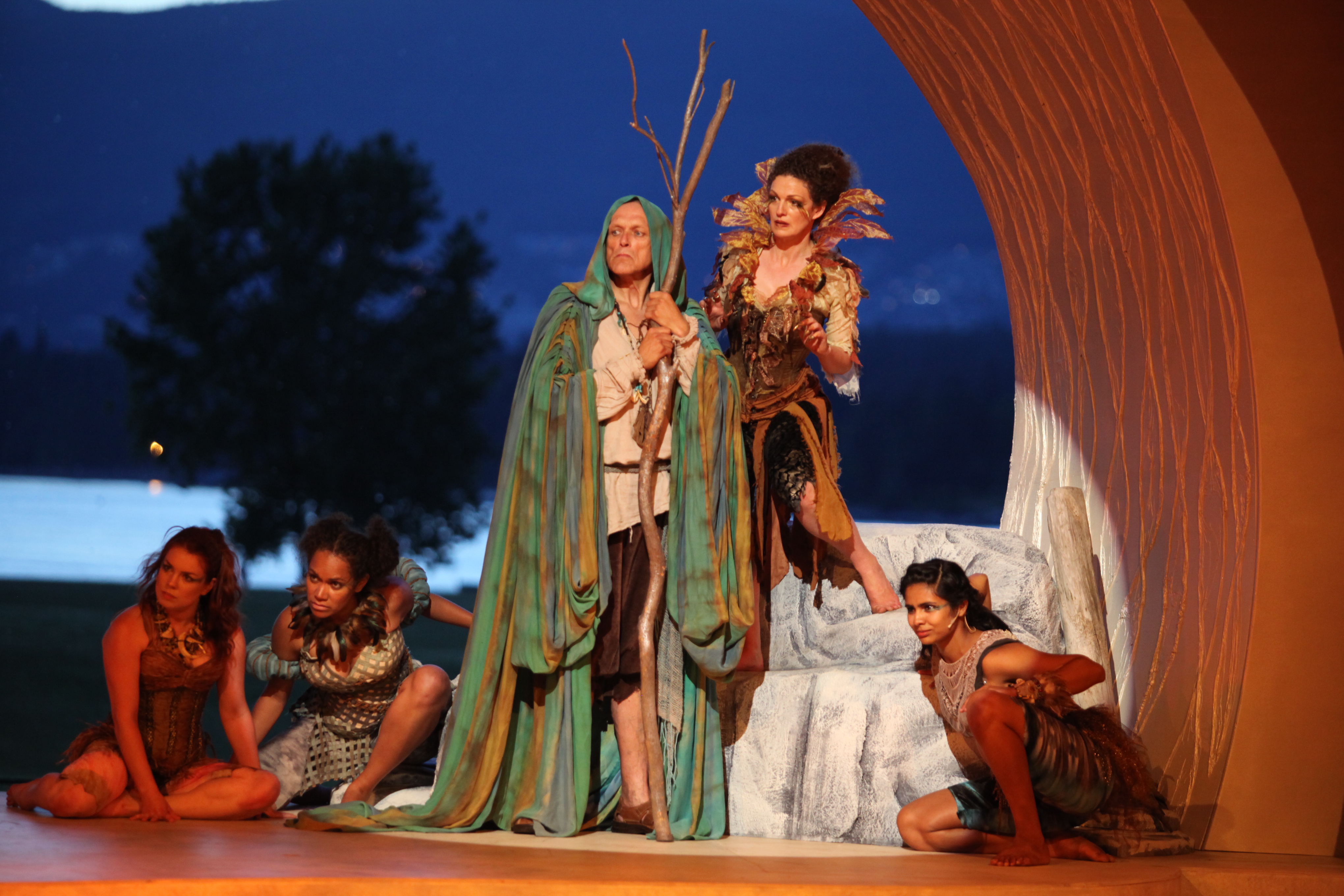

The ethereal beauty of Prospero’s deserted island and Ariel’s spritely magical powers make The Tempest a unique exploration of identity and longing. Meg Roe is back to direct this remount of her 2008 production as it moves from the studio stage to the larger main stage. Some of the actors have also returned; most notably Jennifer Lines as Ariel.
Although Prospero (Allan Morgan) is our protagonist, his servant Ariel and her sprites control much of the action with their spells. She creates the tempest that shipwrecks Alonso, King of Naples; Antonio, Duke of Milan; and their entourage. Prospero has asked Ariel to raise the storm in order to seek revenge on his brother, Antonio, who cast him away years earlier. Prospero and his daughter Miranda ended up on the island and managed to survive.
Also on board the ship is the king’s son, Ferdinand (Daniel Doheny), who captures Miranda’s affections. Stephana (Naomi Wright) and Trincula (Luisa Jojic), ladies of the court of Naples also find themselves shipwrecked but make the most of it drinking themselves silly. They provide most of the comedy, especially in the scene where they come across Caliban, Prospero’s slave. Caliban falls in love with Stephana, licking her feet and submitting to her every whim.
The on-stage band provided the perfect musical accompaniment to the action in beautiful chairs made of branches, and I was impressed by the grand set design and the contrasting costumes of the islanders and mariners. I thought that the larger theatre demanded something more to fill the space — perhaps some special effects or larger set pieces would have done the trick.
There was one scene that hinted at this: Ariel descended the steps from the back of the stage with massive outstretched wings. Her presence filled the whole tent, and when Ariel sang her melancholy songs, the whole tent went silent in awe.
The performances of Wright as Stephana and Jojic as Trincula were a huge highlight of the show as they bumbled about the stage, their hair and clothing becoming more and more bedraggled. Prospero was magnanimous in his flowing blue and green robe and had a presence befitting his power, but his performance could have used even more gravity and seriousness.
In the end, Prospero must decide if he will use his powers for good or evil now that he has his enemies under his control on his island, and he must also decide if he will he give Caliban and Ariel their freedom. Take a trip to this magical island to find out the outcome for yourself.
The Tempest runs from June 12 to September 18 at Bard on the Beach in Vanier Park. For more information, visit bardonthebeach.org.
Indian Summer heats up SFU Woodward’s


The Indian Summer Festival kicked off on June 3 with their Opening Gala featuring a culinary tour of Asia by Vikram Vij, who curated the tasteful journey. The annual Indian Summer Festival was founded in 2011 with the support of SFU Woodward’s Cultural Unit and Teamwork Arts India.
Each July, over the course of two weeks, the Indian Summer Festival celebrates arts, ideas, and diversity in Vancouver and the Lower Mainland. The founding festival directors, artistic director Sirish Rao and managing director Laura Byspalko, steer the operations and are supported by a dedicated leadership council, board of directors, and a team of seasonal employees and volunteers.
The aim of the Indian Summer Festival is to promote and build public awareness of artists of South Asian origin. Some of the creative features that are presented at the festival include performing, visual, literary and folk arts, which help foster an interchange of ideas between Canada and South Asia.
Trisha Dulku, SFU world literature student and this year’s volunteer coordinator for the Indian Summer Festival, says “The Indian Summer Festival is important because, outside of Ontario, Vancouver has one of the largest South Asian populations. It is important to have a forum where we can showcase the insights and ideas from different artists and intellectuals so that the community can begin to engage with one another and create a dialogue.”
This year’s festival presents an array of artists, poets, writers, and musicians. Some featured events include the readings of Rumi’s poems, translated and presented by Coleman Barks; the storytelling of Zarqa Nawaz, creator of Little Mosque on the Prairie; the Dabbawalas of Mumbai, who have come to share their stories of delivering lunch boxes across the busy city of Mumbai; and the culinary magic of Vikram Vij, whose fine food is served at a few of the events.
Dulku says that students can benefit from attending Indian Summer Festival events because, “they are a great networking opportunity and can often provide insights into topics that are culturally relevant. A good example of this is ‘An Evening with Reza Aslan’ which will be on July 11. This talk will provide fascinating and provocative insights into religious studies, which is always an important lens when examining the human character.”
Indian Summer runs from July 3 to July 12 at SFU Woodwards. For more information, visit indiansummerfestival.ca.

