Home Blog Page 1087

Meet the Clan: Oliver Jorgensen

0
Oliver Jorgensen was the first male to qualify for the NCAA Outdoor Track and Field Championship — and he did it in his freshman year.

Screen Shot 2014-11-24 at 11.34.22 PMRookie seasons can be tough for athletes. Not only do they have to prove themselves to their coaches, but often they lack the experience and size of the veterans that they play amongst and face. In some sports, freshmen are redshirted — this means they won’t get to play with the team until their second year. Meanwhile, they have to learn the ropes of university athletics.

On the track field, though, Oliver Jorgensen has already met with tremendous success during his freshman year, becoming the first male at SFU to compete at the NCAA Outdoor Track and Field Championship, and in steeplechase, winning the Great Northwest Athletic Conference (GNAC) title. As a result, he was named the GNAC Freshman of the Year.

To top that off, Jorgensen says that this success came as a surprise to him: “My first year competing was kind of a shock. In high school I was never really front of the pack, kind of always in the middle, not the best.

“I came here and the program just clicked, and with Brit [Townsend] as a coach it all just came together. And then I kept improving and improving, until in outdoor track I won the steeplechase at the GNACs . . . it was kind of like, ‘That actually happened.’”

He explains that qualifying for the championship in the first place came as bit of a surprise. “I honestly didn’t think I was going to make it, it came down to the last minute. I ran a pretty fast time for my first steeplechase early in the season in California and we didn’t think the time would hold. We kept trying to run faster, but I got sick, I hurt my ankle, things just kept adding up and I wasn’t able to get as fast for the rest of the season. Right as they were making the national list, I was in the 20th spot and they took 20.

“It was kind of a shock, and then two people dropped out, so I was 18th, two more people were allowed in, and I was guaranteed a spot. It was pretty crazy, it happened so fast, and next thing I know I’m in Michigan [for the tournament].”

Despite his preference for track and field — a more individual sport than cross country — Olivier puts a lot of emphasis on the value of the team, saying, “It’s mentally straining and it’s physically straining, and sometimes your teammates support you a lot.”

This team dynamic extends beyond the field, as Jorgensen points out that the team motivate each other academically as well.

“[School work] can definitely be hard, especially when you’re away on the weekends. It can be really hard to do work when you’re driving in a bus for nine hours, or flying across the country. It’s hard to do homework, but that’s another team aspect: If someone starts doing homework, everyone starts doing homework.”

He explains further that he lives just off campus with six of his teammates, and the same thing applies at home.

“It’s a messy house,” chuckles Jorgensen. “It’s good because it motivates you to keep [working]. You see them going for a run, you’ve got to go too. Definitely keeps you focused on track, and focused on school, instead of doing other things you probably shouldn’t be doing.”

Despite his quick ascendance on the field, he admits to some difficulty in his first year with a university workload, saying, “It wasn’t so much right away; it was in the second semester [that] it happened to me. The first semester was fine and I kept improving. and then in the second semester my grades started to drop.”

Jorgensen adds, “When things went down for a bit, as I got injured and school got tougher, I realized, not only running-wise, but also academically, this is a lot harder than high school.”

He notes that he is “in-between majors,” stating that he did not like his original area of study, geography, and is contemplating a move into health sciences. This year, he wants to focus more on his academics and raise his grades.

“[I’d like] to be in a spot where I’m not worried about failing a test, where it’s okay if that happens, or not okay, but it wouldn’t be the end of my academics,” Jorgensen says, laughing.

He has also set his eyes on another goal, focused on his team: “My main goal right now is to get the entire cross country team to nationals [. . .] that would be the first time we’ve gotten a [men’s] team to nationals [. . .] that’s a huge accomplishment.”

Right now, he believes the team is on the right track, saying, “[We’re] doing really well right now. We’ve got some great new team members adding to the team. This year is going to be really good for us. I have a feeling we’ll have our highest placing ever in the GNAC.”


Screen Shot 2014-11-24 at 11.25.57 PM

VIFF Highlights

0


The Incident

Christopher Cross


Time travel movies generally have one main problem: they explain too much too quickly. Most of the time, this is intended to create a confusion that reflects that of the characters going through the predicament of time loops. This means that all of the plot elements surrounding the final explanation need to be entertaining, intriguing, and cohesive.

Although Isaac Ezban’s time travel film, The Incident, suffers from this problem, parts of it are interesting. Two brothers and a detective find themselves trapped in an infinite staircase after an explosion occurs somewhere outside of their apartment building. There’s no way in or out of the stairwell, but every day, anything within the room that is not biological (humans, animals, etc.) is duplicated. So every day, a vending machine in that stairwell doubles its stock, with no obvious explanation as to how or why. Meanwhile, another story has a family trapped on an infinite road after the explosion.

The two storylines are related in that there is someone injured, or at risk of dying, when this explosion happens. Because of these infinite loops, the characters are able to grow and see how they cope with the loss of someone with whom they are trapped in time.

Unfortunately, the film is rarely entertaining, and though the final explanation does help make sense of what has happened, the actual character growth takes a sideline to the semantics of the science fiction plot. This is a shame because moments of grief are far more interesting in terms of character development than seeing the before and after of someone suffering a loss — especially when the added stress of time travel is involved.


A Different Drummer

Tessa Perkins

Based on a 10-year study of eccentrics by Dr. David Weeks, John Zaritsky’s film profiles seven very interesting people and explores the concept of eccentricity.

Daniel Suelo hasn’t spent or earned a cent in over 14 years. He lives in caves, uses the town library as his office, and claims he is happier now and feels more secure than he ever did when he had money. Darla Shaw is an entertainer who seems to play dress up for a living. She received a PhD at 60 and is having the time of her life while waiting for someone to show her the rule book of how she’s supposed to act.

Gary Holloway takes people on unusual tours of San Francisco, collects tea tins, and hosts séances for his Martin Van Buren fan club. Inventor John Ward of the UK doesn’t care what others think, and if you tell him he can’t do something, he’ll build it anyway. One of his most prized possessions is his fully functional three-wheeled fire engine.

The duck lady of Vancouver, Laura-Kay Prophet, told her tragic story of being forced into homelessness and feeling like she was worthless. Her ducks got her through and she eventually started her charity Duck Soup. How about voting for England’s Monster Raving Looney Party? Lord Toby Jug carries on the legacy of party founder Screaming Lord Sutch.

Dr. Weeks found that eccentrics live longer, are more self-sufficient, want to make others happy, score higher on IQ tests, and have a great sense of humour. So maybe these folks have got it right. This documentary will get you thinking about what it means to be ‘normal.’

SFU Woodwards Students on the Homeless

0

Peak Speak: SFU Woodwards Students discuss homelessness in the neighboring downtown east-side community.

Kids to watch in the 2015 NHL Draft

0

If you follow the NHL draft, or hockey at all, you’ve probably heard of Connor McDavid, arguably the most hyped prospect to come out of Canada since Sidney Crosby. It’s also fairly common knowledge that Jack Eichel will compete with him for the first spot — this upcoming draft could be the best one since the now legendary 2003 draft. However, it’s not just the top two players who make this draft so exciting, it’s the depth behind them. Here are some players to watch out for in the upcoming draft:

Noah Hanifin (Boston College, NCAA): The 6’2, 205lb defenceman has all the tools necessary to become a dominant NHL defenceman. He’s overachieved at every level so far, with 20 points in 31 games on the same team as Eichel, and 32 in 45 on the US national U17 team. Hanfin will play in the NCAA for Boston College as a 17-year-old, which is a remarkable feat.

Draft Prediction: 3rd Overall

Oliver Kylington (Färjestad, SHL): The Swedish defenceman doesn’t have any points after his first eight games, but he’s playing as a 17-year-old against grown men in the SHL, a Swedish professional league. He’s an excellent skater, has a great shot, and has been compared to Victor Hedman. Much like Hedman, though, it may take him a while to get used to the NHL. Some scouts might be wary of taking him in light of how Adam Larrson, another Swedish defenceman, has stalled in his development after being selected fourth overall in 2011. He’s top four now, but a lot of it will depend on his performance in the world juniors.

Draft Prediction: 4th overall

Travis Konecny (Ottawa 67’s, OHL): As a 16-year-old last year in the OHL, he put up 70 points in 63 games. Quite impressive for a rookie, which is why he won top rookie of the year in the OHL. At 5’10, growing two or three inches would help his draft stock, but he’s got excellent hands, is very shifty, and is a powerful skater.

Draft Prediction: 5th – 8th overall

Mathew Barzal (Seattle Thunderbirds, WHL): This local kid from Coquitlam had a good rookie season, with 54 points in 59 games. He’s got great vision, as evidenced by 40 of those points last year coming as assists. He only had 19 goals, but that is not for a lack of ability when it comes to shooting the puck: he has a great release, but tends to pass instead of shooting. He is being compared to another highly touted pick from the Lower Mainland, Ryan Nugent-Hopkins.

Draft Prediction: 6th – 10th overall

Dylan Strome (Erie Otters, OHL): Dylan Strome is an interesting case. The brother of NHLer Ryan Strome, Dylan is having a excellent start to his OHL season, with 13 points in four games. Of course, it helps if you get a good amount of playing time with Connor McDavid. That fact alone might send Strome down the rankings, as scouts might worry if he can produce without McDavid; but he’s 6’2, and a big centre with his skillset will be hard to pass up. He could go as high as fourth, but  could easily slip to 11th if scouts are worried he’s just riding McDavid’s coattails. There’s just too much uncertainty.

Draft Prediction: 7th -11th overall

Mitch Marner (London Knights, OHL): Last year, his first in the OHL, Marner had 59 points in 63 games. Like Barzal, his vision and playmaking ability are his bread and butter. He did very well for himself on a stacked London Knights team that featured the likes of Bo Horvat and Max Domi. He could be given a bigger role if the veterans stick with their NHL clubs, which would lead to more ice time and production. He will have to overachieve and hope some of the other prospects falter in order to shoot up the draft rankings.

Draft Prediction: 8th overall

Clan golf makes great strides

0

Men’s Team: Victory at Last

The Clan men emerged victorious at the Golfweek Division II Fall Preview held October 3 to 5, achieving even par as a team over three rounds, defeating their closest rival, California State University-Stanislaus by three strokes.

After the first round, they finished with a team score of 292 strokes (+1) which put them at fourth place, however, they picked up the pace in the second round, notching a score of 276 (-3), firmly taking the lead.

This rise in the second round was assisted by John Mlikotic who shot 67 (-5), which tied for the best score of the tournament.

“I kind of struggled a bit in the morning, but I wanted to stay patient and try to get a round together for the afternoon. I was playing alright and then [. . .] I finally got a couple of shots close and ended up making five birdies in a row [which] kind of sparked my round,” said Mlikotic, who finished tied for the second best total individual score along with teammate Bret Thompson, with 213 (-3).

SFU would hit a final round of 296 (+2) and hang on to the lead for their first victory in the NCAA.

“The team’s playing great, we’re just going to try to ride this momentum into the last tournament of the semester,” said Mlikotic. “The team played well, you can’t ask for more than that.”

The men play next at the Cal State Monterey Bay Invite in Monterey, CA on October 20-21.

Women’s Team: Getting Stronger

The women’s golf team opened their season placing second at the Saint Martin’s Invitational, behind Saint Martin’s University (SMU), the home team, at the Olympia Golf & Country Club.

SFU achieved a team score of 632 over two rounds, consisting of the scores of four players. This was 30 strokes behind first place SMU, and 33 strokes ahead of third place University of Hawaii-Hilo.

Individually, junior Mackenzie Field led the Clan, coming in second with a total score of 159, scoring 79 and 80 in the two rounds. Breanna Croxen finished right behind her, coming in third, only two strokes back from Field.

All SFU golfers made the top 15, with sophomore Erin Farmer placing 11th, while Jennifer McTeer and Kylie Jack placed 14th and 15th respectively.

The Clan women will play next at the Vikes Invitational in Victoria, BC from October 20-21.

Sports Briefs

0

Cross-Country

The Clan men’s and women’s cross-country teams competed at the 41st Annual Western Washington University Classic on Saturday in Bellingham, WA.

Swim Team

The SFU swim teams defeated the University of Puget Sound Loggers in their first meet. The men’s team won by a score of 159-91 and women’s team won 170-81. They combined to win 27 out of the 28 events. Dimitar Ivanov and Lucas Greenough led the men’s team with 18 points, along with freshmen Adrian VanderHelm, Tim Woinoski and Gabriel Lee, while on the women’s team, Alexandria Schofield, Nicole Cossey, Grace Ni and Megan Barrack led with 18 points. The Clan swim next against the University of Pacific Tigers in Stockton, CA on Friday, October 24.

GNAC Honour

Middle linebacker Jordan Herdman was named the Great Northwest Athletic Conference (GNAC) defensive football athlete of the week for the week of September 29-October 5. He leads the GNAC with 60 tackles and averages 12 per game, which places him 12th nationally. Against Dixie State, Herdman recorded 10 tackles and forced a fumble leading to an SFU touchdown.

Women’s Soccer

The SFU women’s soccer team lost 3-1 against the Saint Martin’s University (SMU) Saints on Thursday. SMU scored first, but 10:43 in, midfielder Sierra Leung scored her second goal of the season to tie the game. The game would remain tied until the 75th minute, when the Saints scored twice, taking the victory. Goalkeeper Priya Sandhu had four saves.

Volleyball

Clan volleyball swept the SMU Saints in Lacey, WA Thursday, in their second straight win. Despite the Saints claiming the first point of the night, SFU handily won the first set 25-11, which included an eight-point streak for the Clan. The next two sets were closer, with SFU winning 25-21 and 26-24. Senior Amanda Renkema led the Clan with 11 kills, while libero Alison McKay led the team defensively with 20 digs. Outside hitter Kelsey Robinson also provided 16 digs.

Men’s Soccer

SFU Men’s Soccer returned to winning ways Thursday shutting out the South Dakota School of Mines (SDSM) 3-0 in Rapid City, SD. Captain Jovan Blagojevic notched two goals, while forward Mateo Espinosa opened the scoring with his first goal of the season. Espinosa would end the night with two points, as he assisted Blagojevic on his first goal. Ryan Dhillon would also notch an assist.

With files from SFU Athletics and GNAC Sports

The Clan storms to first win

0
SFU’s first victory also featured quarterback Tyler Nickel’s first start.

After dropping four straight games to start the season, the Clan finally put one in the win column.

In St. George, UT, SFU defeated the winless Dixie State Red Storm (DSU) by a score of 29-19. In spite of the end result, though, the Red Storm put up the first few points.

With 3:44 left in the first quarter, DSU quarterback Ben Longshore threw an 11-yard touchdown pass, after previously rushing the ball 27 yards on the same drive, to claim the first lead. However, perhaps as an omen of things to come, they missed the extra point kick, leaving the score at 6-0 for DSU.

On SFU’s side, second-string quarterback Tyler Nickel got his first start in place of Ryan Stanford, who finished the game. On his third drive of the day, immediately after the Red Storm touchdown, Nickel threw his first touchdown pass for 12 yards to wide receiver Kyle Kawamoto.

“Well, I thought Tyler [Nickel] did well when he went into the game against Central [Washington] and that he deserves an opportunity,” head coach Jacques Chapdelaine said. “From my point of view, the Central [Washington] game was challenging for [Stanford] so it was good for him to take a step back.

“Ryan [Stanford] did play in this game, and he played very well, and so did Tyler [Nickel],” he added.

The game was now in the Clan’s control. After a fruitless drive by the Red Storm, SFU kicker Tiernan Docherty kicked a 42-yard field goal to bring the score to 10-6 in SFU’s favour.

Despite completing 28- and 32-yard passes, the Clan were able to prevent the Red Storm from converting for points during the final drive of the half.

Dixie State started with the ball for the second half, but, just 17 seconds in, middle linebacker Jordan Herdman forced a fumble, which his brother Justin recovered and ran in for a 27-yard touchdown.

Jordan would also end the day with 10 tackles, second only to Mitchell Barnett.

On their next few drives the Clan would not fare as well, with Nickel throwing an interception and being sacked twice in a row on the next drive, before Stanford stepped in. However, SFU would gain two points off a safety, after sacking DSU quarterback Longshore in his endzone.

The Clan would continue to struggle offensively, though, as a completed pass to Lemar Durant was ruled a fumble, giving Dixie State the ball.

Luckily for the Clan, they were able to keep the Red Storm from scoring and SFU snapped their offensive rut with a 61-yard punt return by Earl Anderson for a touchdown, gaining a dominant 26-6 lead.

The Red Storm would not go quietly, however. They scored a touchdown at the end of the third quarter, off of a goal line play, which was made possible by a 37-yard pass from Longshore, whose arm was a major thorn in SFU’s defence.

The Clan and the Red Storm would manage one more scoring play each in the fourth quarter.

SFU made their final mark on the scoreboard with 6:06 left in the game, notching a 43-yard field goal, a season best for Docherty, while Dixie State scored another touchdown on the back of a 46-yard pass with 3:48 left.

DSU would attempt both a two-point conversion and an onside kick, but would be unsuccessful in both attempts with Bobby Pospischil recovering the onside kick. The game ended 29-19.

Clan cornerback Bibake Uppal and safety Matt Isherwood both managed interceptions in the fourth quarter.

“The guys played hard, they certainly played with a lot of intensity,” said Chapdelaine. “Defence made some key plays and the offence was able to win the time of possession.

“The biggest thing as a team is the process of learning and improving upon overcoming the negative plays that can occur early in the game,” the coach added.

“I don’t think we did that very well last week but I thought we did that better this weekend. Dixie had the first points scored and despite that, they never looked back, worked hard and overcame that,” he observed. “Overall, it was a great team win.”

Now the Clan move to 1-4 overall and are 1-1 within the GNAC.

This week in SFU soccer…

0

Men’s Team: A Quest for Consistency

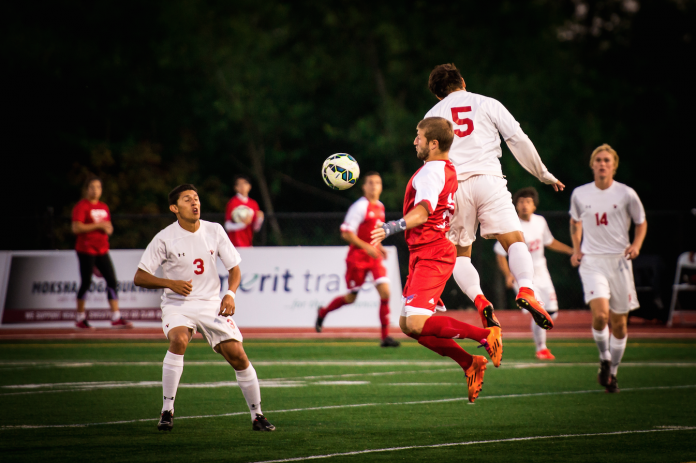
The SFU men’s soccer team has been hit with the unfamiliar feeling of adversity in Great Northwest Athletic Conference (GNAC) play this season. As four-time champions, the soccer program branded itself as the team to fear in recent years, but has been humbled in the early stages of the 2014 campaign.

Last season’s results set the bar tremendously high, with 14 victories and just one loss and one draw. This season, the Clan went winless for the opening three rounds of GNAC play before notching their first conference win away against St. Martin’s University last week in impressive fashion.

Despite the much needed confidence boost, SFU fell to their biggest test soon after, falling to the high flying Seattle Pacific Falcons in a 3-1 result. The Falcons are now on a seven-game winning streak following their win against the Clan.

However, there are certainly no question marks about the quality of the side, something that head coach Alan Koch firmly believes will generate better results.

“I’ve got faith in all of my players, no matter who I start, I know they will be ready,” Koch said.

The men return to action at home when they welcome the Seattle Pacific Falcons to Terry Fox field on Thursday, October 16, hoping to avenge their recent loss.

Screen Shot 2014-10-10 at 8.51.41 PM

Women’s Team: Signs of Improvement

SFU’s women’s soccer team has had its fair share of hardship in seasons past, prompting a change in philosophy and coaching staff ahead of the 2014 campaign. Head coach Annie Hamel assured that a new approach to the game would be implemented, and that it would take time for the team to adjust, but we are already witnessing a positive shift.

It only took three rounds of GNAC play for the ladies to find their first win, the first of back-to-back 1-0 results at home against the Western Oregon Wolves and Saint Martin’s Saints respectively.

This is already leaps and bounds ahead of last season, during which the Clan achieved their only victory in the 11th round of GNAC play.

Hamel’s side is building confidence in attacking play as well. The team has notched six goals in their seasonal play so far, only one shy of their goal total for all of last season.

While the results have not all gone their way, the side remains resilient, hoping to improve and overcome any obstacles.

The women will host the Northwest Nazarene Crusaders on Thursday, October 16.

Women’s hockey team aim high

0
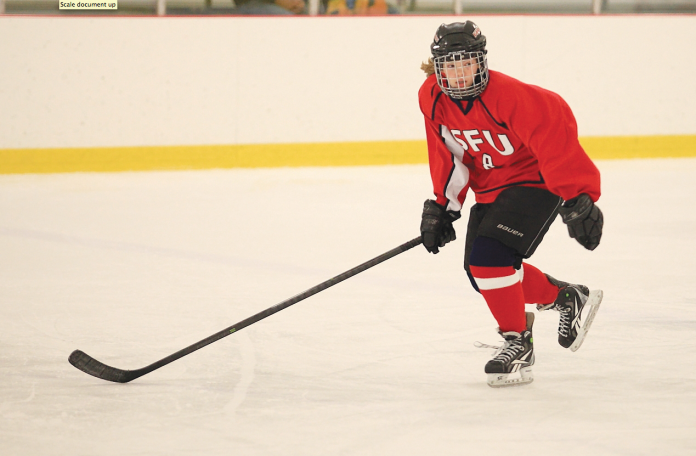
Forward Shay Gronnemose is among the newcomers to the women’s team.

Were you aware that SFU has a women’s hockey team? You’re forgiven if you didn’t know, as they are a young program, only in their fifth year of existence. In fact, the team is still considered a club, rather than a varsity program, and as such, they don’t receive the same amount of attention and support as many of SFU’s teams.

“With varsity, you would have [the] support [of a] financial budget to work with. As a club, it’s all student funded and student operated; it’s real grassroots level, and these girls have done a fantastic job of doing most of the work as well as their schooling,” said head coach Grant Wallace.

“The men’s team is on the ice four or five times a week, and some [practices] are in the day,” explained Wallace. His team’s practices, however, are outside of school hours.

“The players do not get as much leeway in terms of school, so it’s harder to juggle,” said forward Caitlin McNamara. She explained that the team does a lot of fundraising to make up for the lack of financial support, alluding to future pub nights and collaborations with the men’s hockey team.

Despite the program’s youth and relative anonymity, the women’s hockey team has already met with success. Last year, they finished fifth in the South Coast Female Amateur Hockey League (SCFAHL) with 17 points in 26 games, making the playoffs. This a tremendous rise from their humble beginnings, as during their first season, they could only ice seven skaters.

There is still, of course, room to improve. Coach Wallace explained that one of their goals this season is to “do better in the regular season and take it into the playoffs.”

McNamara, who had four goals and seven points last season, said the aim is to “score a few more goals and have more goals for [rather than against].” Last year the team averaged just 1.4 goals per game. Coach Wallace echoed these sentiments, and added that he would like to improve his players’ skills, so they “have the finish when they have [goal scoring] opportunities.”

This season, there are some new and familiar faces that should help ease the team’s goal scoring woes. One of these is rookie Michelle Toor. “She came to us from the Fraser Valley Phantom, and I expect her to add some assists and some scoring chances from the point,” said Coach Wallace. Her sister, forward Chanel Toor, will rejoin the team as well, and coach Wallace has “high hopes” for her to create some offence for the team.

Forward Shay Gronnemose is an exciting new addition, and the coaching staff expects her to adjust quite rapidly and start generating offence. Last season’s point leader, with 12 goals and 17 points, Katrina Armstrong will also return, along with Caitlin McNamara and Michela Deluca, who had great chemistry on a line with Sam Schiiler. Unfortunately, Schiiler will be out until the end of October.

The women also have aspirations off of the ice, says McNamara, explaining that they want to try to “take female hockey [at SFU] to the next level.”  She elaborates, “We’re at the highest level you can play at [here], but compared to other provinces, we’re just not quite there.”

As part of their plans to take the team to new heights, both on and off the ice, the team would also like to get a second set of jerseys.

For now, though, after one week of play, SFU sits in third place with a 2-1 victory over the Richmond Devils, and a 2-2 tie against the BC Thunder. Their next game is against the Meadow Ridge Moose at the North Surrey Rec Centre on Friday, October 17 at 9:45 p.m.

Meet the Clan: Dimitar ‘Mitko’ Ivanov

0
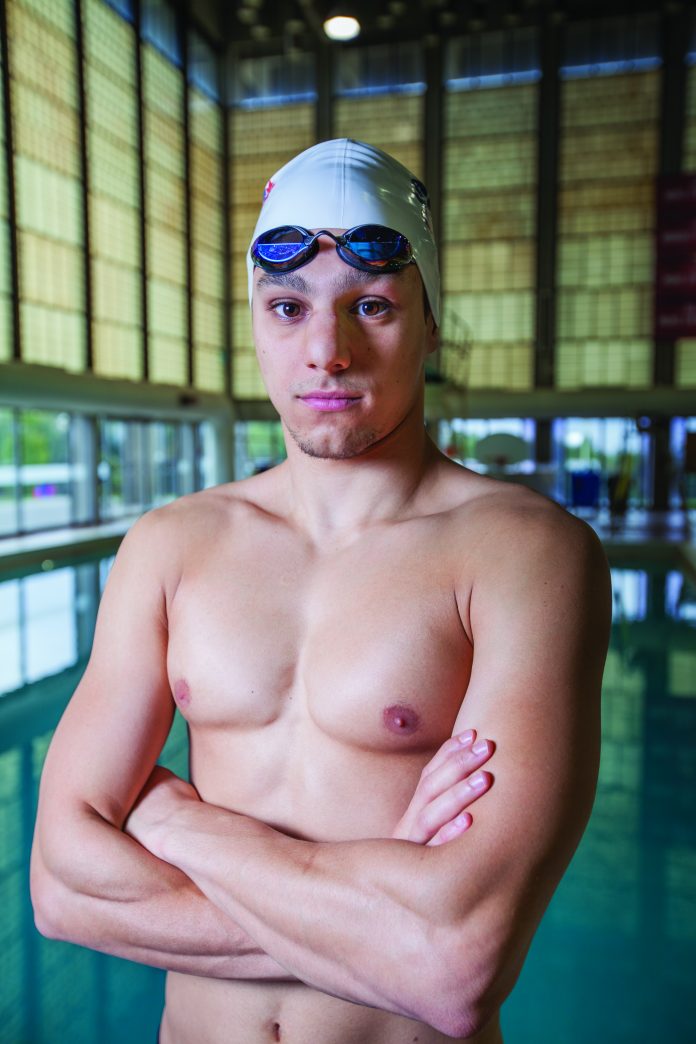
Swimmer Dimitar Ivanov, who goes by ‘Mitko’, was born to Bulgarian immigrants in Toronto before relocating to BC.

Screen Shot 2014-11-25 at 5.35.56 PMOften, in sports, it all comes down to luck. Just the right break at the right time — a shot that goes in rather than hitting the post, for example — can mean the win. Luck can go the other way too, though, with ill-timed injuries or illnesses cutting seasons short, or simply preventing an athlete from reaching their full potential.

Swimmer Dimitar ‘Mitko’ Ivanov knows this all too well. After a successful first season, he faced two seasons of sickness, becoming a “little sick” in his second year, before coming down with mono in his third year.

“Mono makes you feel tired all the time. You just have a lower level of energy, you go to bed super early, and you can never get enough sleep,” the backstroker explains.

Despite this hurdle, his illness was just that — a hurdle to jump over — as he still swam through it all.

“We had our main competition at the end of November [last year] and I was on antibiotics at the time,” Mitko says. “I actually went through two waves of antibiotics because they didn’t know what I had until December.”

Mono is a pretty good excuse for a subpar performance, but Mitko still put in a tremendous performance, narrowly missing qualifying for the national championship by only a second: “I was sick, competing at our peak meet, and I still got pretty close.”

No member of the men’s swim team has ever qualified for the national championship, and this is not the first time that Mitko has come oh so close, having missed by just half of a second in his second year.

“We haven’t actually sent a man, so it would be really exciting to be on the first men’s team [to qualify],” he explains.

However, getting so close and just missing the cut was a painful experience for Ivanov: ”It was definitely tough. In my second year, we didn’t really know how the system worked yet, so I was confident that I did make it, and then they released the standards in February or March [. . .] and I found out I was so close, it made me pretty sad.

“Then in my third year with the whole mono thing, I was once again pretty disappointed, but I understood, ‘If I’m this close when I’m sick, hopefully next year I can make it.’”

With a clean bill of health, Mitko looks poised to make a serious bid for a spot, and he’s confident that his team will find their way into the nationals as well. “We’ll definitely get some guys to go this year, we have a pretty strong team, a lot of good freshmen,” he says.

Mitko’s priorities are not limited to his role on the swim team, however. Entering his fourth year at SFU, working towards a degree in business and economics, he is just as enthusiastic about his studies as his time on the swim team.

“I love economics [. . .] it’s a different way of looking at the world. You can answer just about any question [like] why would a company set this price for something, or why are we in a recession, why is the economy bad? It’s just weird questions like that, that you wouldn’t really think about, I think about for everything.”

He hopes to use his degree to get into finance, and become a Chartered Financial Analyst (CFA). He admits, though, that the road won’t be easy: “It’s going to take a while, they require four years of experience, three exams and the fail rate is 50 per cent, so I’m going to have to work pretty hard to get through that.”

Throughout his athletic career, Mitko has shown resilience in the face of sickness, and worked hard to compete nonetheless. While he prepares for his last season with the team, he also prepares for the road ahead which, given his academic drive, sure looks bright.Screen Shot 2014-11-25 at 5.34.35 PM