Home Blog Page 1074

SFU cross country comes up big at GNAC championship

0
Runner Miryam Bassett finished 17th with a time of 21:30.89.

At the Great Northwest Athletic Conference (GNAC) Championship in Monmouth, OR, the women’s cross country team won their first ever NCAA conference title.

“It’s awesome, it’s a great feeling to [know] you made history,” said runner Rebecca Bassett.

“I’m really excited because it’s our first conference championship [. . .] since we’ve been in the NCAA, so hopefully it’s the start of bigger things in the future,” head coach Brit Townsend told The Peak.

Bassett led the pack with a time of 20:38.08, which netted her second place individually, while teammate Jennifer Johnson followed closely behind, placing fifth.

“I went out as hard as I could, I was going into my race hoping to make top three all conference, so I was looking for a higher positioning and hoping some other girls would come with me,” said Bassett.

The times of only five SFU runners counted toward the team’s total score, however, Townsend emphasized the effort of the whole team: “Our girls came through, all seven of them mattered [. . .] it was really important that all of them rose to the occasion.”

The five whose scores did count finished within the top 20, with Miryam Bassett placing 17th, Kansas Mackenzie 18th, and Peggy Noel 20th.

The team as a whole finished with a time of 1:45:59.43 and 62 points, only one point ahead of second place, and two ahead of third — needless to say, it was a close finish.

“We were pretty unsure [if we were going to place first], they kept saying it was ‘very close’, ‘too close to tell,’ ‘we’re going to review the results’ and we ended up on top,” said coach Townsend.

The men put up a great performance as well, placing third in their tournament behind University of Alaska-Anchorage and Western Washington University; Oliver Jorgensen led the charge, coming in sixth.

The teams scorers all placed in the top 30 out of 82 runners, with Marc-Antoine Rouleau placing 13th, Cameron Proceviat 16th, Austin Trapp 25th, and Travis Vugteveen 30th. SFU also had four more runners place in the top 50, a point of emphasis for the coach.

“[We need to] have our fourth, fifth, sixth and seventh runners go as close as they can to the lead runners, because if we can make that gap between our first runner and our fifth runner really small we’re going to have a better chance at performing well in three weeks.”

Townsend’s focus has already shifted from the teams’ performances at the conference championship to regionals, where both teams must place in the top 16 in order to move on to the national championship.

“I have to look ahead because the regional meet is how we qualify for the national championship,” the coach explained. “That is the most important meetup in the season.”

The women’s team qualified last year for the first time, but the men have not yet made the cut. Townsend is confident that this year could be the year: “I think we have a chance, a really good chance of making [the national championship] on the men’s side.”

The west regionals will be held Saturday, November 22 in Billings, MT. Should either team qualify for nationals, they will compete for the championship in Louisville, KY on Saturday, December 6.

Taylor Swift – 1989

0

I’ll start by saying what a thousand think-pieces and reviews have spent bloated word counts tiptoeing around: Taylor Swift’s new album, 1989, is good. Like, really good. Not great, per se, but certainly much better than most well-adjusted adults would argue a T-Swizzle album has any right to be.

Coming off the heels of the commercially successful but wildly inconsistent Red, Swift’s newest LP is a confident and carefully constructed synthesis of everything that makes her brand of YA sugary-sweet pop irresistible. There are even moments where she hints at a broader, more versatile talent, one which could eventually propel her to Madonnaesque levels of superstardom — that is, if she isn’t there already.

The album falters a little at the start — the opening track “Welcome to New York” might be the most half-baked and grating of the bunch — but quickly picks up speed. The cheeky electropop of “Blank Space” and the cheesy synth party of “Style” (get it? Style?) lead into the career high of “Out of the Woods,” which turns several Swiftian tropes on their heads — the star crossed lovers, the nerdy girl who gets the guy, the diaristic specificity — along with what might be her strongest hook since “We Are Never Ever Getting Back Together.”

Admittedly, 1989 is a little front-loaded; there are several more memorable tracks peppered throughout the 13-song tracklist (in particular, sombre album closer “Clean” and unashamed earworm “Shake It Off”), but others, like the maudlin “How You Get the Girl,” feel a bit like retreads, as though Swift is afraid to alienate her country-fried fanbase through her aims for worldwide pop domination. They’re not necessarily weak songs, but they miss the high bar set by the album’s series of high caliber singles.

It’s a shame, because so much of 1989 is funnier, weirder, and more creative than anything Swift has ever done. As much as she’s living up to her own standards, she’s also subverting them — songs that would have read as straight faced five years ago come across as tongue in cheek here. Not every idea lands, but that she’s willing to try at all is more than enough to convert staunch nonbelievers.

My advice to those who hate Taylor Swift is this: you probably don’t. You just think you do. 1989 is the kind of album where you’re bound to find something you like — there’s so much energy and vitality in these songs, so much willingness to make it all work, that it’s hard not to nod along and take Swift’s hand no matter where she takes you. The haters gonna hate, hate, hate.

Talking it Out

0
Would be better if she had a partner in crime to lean against back to back.
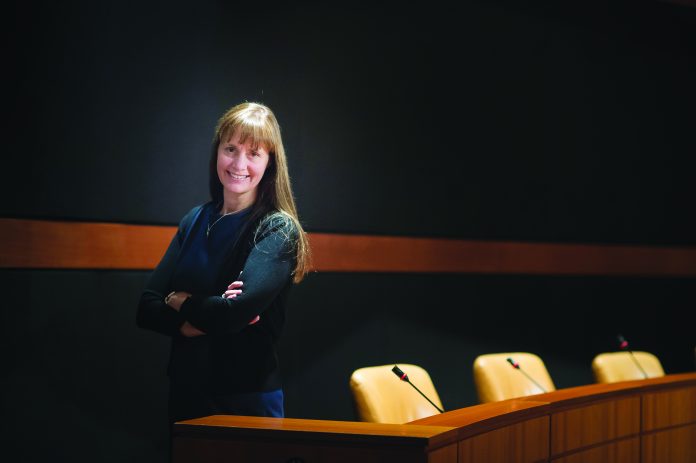
Since becoming director in September, Shauna Sylvester has focused on expanding the reach of the centre.

At a September reception for SFU’s Centre for Dialogue, Shauna Sylvester shared a firsthand experience of the power of true dialogue and communication. She was meeting with two parties of powerful people holding vastly different ideologies — the goal was to find a way for them to work together in order to end a war and advance peace and development in their region.

It wasn’t until two members from the opposing parties realized that they were blood relatives that the tension between the groups faded and a dialogue began to emerge. Both parties were able to find a common ground and use it to create a platform for negotiation, acknowledgement, and resolution; this resulted in the 1999 Kathmandu Accord between India and Pakistan.

“My new motto became ‘walk to the opposition’ — talk to them and really understand their position,” she told the crowd. “It was at that point, I put away my debating robes and started to study dialogue as a tool for social change.”

“Dialogue requires [. . .] being aware that you have things to learn from others.”

Throughout most of her life, Sylvester has focused on promoting social change. She helped to found Carbon Talks, — an SFU-based program that collaborates with local municipalities transitioning to a low-carbon economy — as well as the Institute for Media Policy and Civil Society, a charity that promotes democracy and advocacy in Canada and elsewhere. In 2003, she was named one of the country’s Top 40 Under 40 by The Globe and Mail.

Sylvester is a master of argument, having spent plenty of time on debate teams in high school and university. However, she eventually realized that she would rather encourage discussion than dominate it. According to her, a debating mindset will often deepen a conflict rather than resolve it — it emphasizes our differences rather than our similarities.

This September, Sylvester took over the directorship of SFU’s Centre for Dialogue. She now oversees all programs relating to the centre, including its many fellowships with local educators and diplomats, as well as the SFU Public Square.

The Centre for Dialogue is unique in that it’s both a program and a physical space. “[It] is a centre within SFU that promotes conversation on issues of concern for the public,” explains Sylvester. “So really, it’s a centre that supports difficult conversations.”

In particular, the Morris J. Wosk Centre, located in the Segal Building on Seymour Street, is a place where people can come together and hold a meaningful discussion on difficult topics in a safe environment. Opened in 2000, the centre regularly attracts hundreds of visitors from across the globe.

Having already introduced several new initiatives during her time at SFU, Sylvester has even bigger plans for the centre’s future — within five years, she hopes to turn it into an important global centre for knowledge and practice in dialogue, with a focus on international diplomacy, environmentalism, cultural interpretation, and civic engagement.

It’s a large task, but Sylvester is up for the challenge. In particular, she hopes that the international community sees the Centre for Dialogue as a space in which they can feel free to share and discuss ideas. According to her, dialogue is one of the most important practices one can have in our modern age; it begins with the establishment of connection, and finding common ground.

“Dialogue is about seeking the centre of a discussion, and trying to find those places where you can build on other people’s ideas,” she says. “[It] requires listening, understanding, having curiosity, having humility, and being aware of not holding all the pieces, that you have things to learn from others.”

Whenever groups seek out the centre to host dialogues, the discussion is specifically tailored to the people involved and the space in which it’s held. In the Morris J. Wosk Centre, parties are seated at a large round table; this enables speakers to be on even ground, where everyone is considered an equal.

Sylvester hopes that the centre helps students see the value of formal discussions and exchange of ideas. “It is formal [dialogue] that guides our policy and frames our public lives through regulation and legislation,” she says.

Sylvester’s connection to Simon Fraser goes back to her childhood; her father attended SFU as an undergrad, and she did the same. To her, there is something unique about our university; the need to be engaged within the community is, to her, “a part of [SFU’s] DNA.” It’s this quality that makes our university an ideal environment for initiatives which strengthen our democracy and advocate for environmental change.

Ultimately, she’s looking forward to increasing the centre’s reach, and introducing more students to the benefits of open dialogue. “I love to work at SFU, because I get to work within that framework and how many of us can actually say that we get to do that in our world. It’s a highly privileged position to be in.”

Six superfoods to buy, neglect, and then feel badly about letting spoil in your fridge

0
Each superfood offers something unique for your health — but only if you actually consume them.

With schoolwork ramping up and the holiday season creeping closer, it’s easy to put your health on the backburner while you try to juggle everything at once. Even if you don’t have the time to exercise regularly, maintaining a proper diet is key to maintaining your overall health — which is where superfoods come in handy.

What is a superfood? It’s a term invented by people in marketing who want you to buy a product, even if the logic behind the word is unsound and often has no basis in reality. But none of that matters, because anything with the word “super” in it has to be good. (Like Superman. Or the hit CW show Supernatural!) Help combat winter flab with these six superfluous superfoods!

1) Kale: Loaded with calcium and antioxidant-boosting vitamins, kale has become the go-to superfood for its diversity in the kitchen. As part of a salad, blended into a smoothie, on its own as kale chips — these are all ways in which you’ll fantasize about using kale before inevitably throwing the wilted leaves away after weeks of neglect. Luckily kale already tastes like dirt, so the transition from produce to compost will be even more seamless.

2) Beetroot juice: A simple combination of juiced beets and a few other added citruses contains 80 per cent of your daily vitamin A and 40 per cent of your daily vitamin C, which you’ll never actually get because beet juice is awful. It also never stops being alarming how red your pee gets after consuming a bunch of beets.

3) Cauliflower: Ignoring for a moment that it looks like terminally-ill broccoli, the internet was a-buzz back in January that 2014 was the year of cauliflower. I could list off all of the reasons why the vegetable is great for you — and there are a lot of them — but it won’t matter. Four out of five times you’ll go for something that’s more convenient, doesn’t look like brains, and isn’t nearly as good for you. Like carrots. Have you actually ever stopped to think about what carrots taste like? They’re bland as shit, but people love them because they’re brightly coloured and come in smaller ‘baby’ form. You’re pathetic.

4) Acai Berry: Achee? Ahsee? No one really knows how you’re supposed to pronounce acai, which means it’s even healthier for you. Full of antioxidants and heart-healthy fats, acai berries are the perfect superfood to impulsively buy without any real understanding about what they are or what they taste like.

5) Quinoa: Sure, why not? Are you really going to argue with me on this one? Do you even know what quinoa is? You probably thought it was a pasta until someone had to correct you. Quinoa is high in protein, an ideal source of dietary fibre, and is gluten-free — which we all know is supposed to be good for you. Quinoa is as super as superfoods come.

6) Yard trimmings: If you’re lucky enough to have a yard, then you have ready access to this incredible superfood. Yard trimmings are organic, ready to eat, and come in a variety of flavours, depending on the conditions under which they were grown and what kinds of life forms were living on them when you mowed the lawn. Plus they’re dirt cheap!

SFU volleyball win tight match against Western Oregon

0
Libero Alison McKay led the team defensively with 29 digs on the night.

The Clan snapped a two-game losing streak on Thursday, defeating the Western Oregon (WOU) Wolves in their second-last home game of the season.

SFU took the first two sets, and looked primed to sweep the Wolves. The Wolves had other plans, however, and took the game to five sets.

Western Oregon scored the first point of the match and jumped out to the early lead. SFU responded immediately, though, and came back from a three-point deficit to take the lead for much of the set, winning the first 25-22.

DSC_5064

The Clan would take the next set in a close battle. Western Oregon scored first once again, but this time, SFU took the early lead with two straight points, the first off of an attack error by the Wolves.

At one point, SFU held a six-point lead, at 20-14, but the Wolves clawed their back into the match, tying the score at 24-24. The Clan battled back scoring the next two points to clinch the win at 26-24.

In the third set, SFU once again jumped out to the quick lead 8-3. However, they would let this one slip, allowing five straight points for the Wolves. The Clan would nevertheless hold the lead for much of the set, looking to go home early.Screen Shot 2014-11-10 at 3.49.44 PM

At the 20-point mark though, the Wolves pounced and seized the lead, going on to win the set 25-22.

The Wolves would take the next one 25-20 as well, tying up the game, jeopardizing the Clan’s once easy victory.


SFU managed to achieve the elusive victory in the fifth. For a few plays, it looked as though they might once again blow the lead after allowing the Wolves notch a three-point streak.

Middle blocker Madeline Hait had other plans, however, and closed the game with a kill — her 14th of the night — to win the final set 15-12.

Kelsey Robinson led the team with 20 kills, while libero Alison McKay led the defensive effort with 29 digs, and Brooklyn Gould-Bradbury put up a stand-out effort with 22. Robinson contributed significantly defensively as well, notching 15 digs.

With the win, the Clan improve to nine conference wins, and remain at fifth in the Great Northwest Athletic Conference.

DSC_5169

Meet the Clan: Bailley Halvorson

0
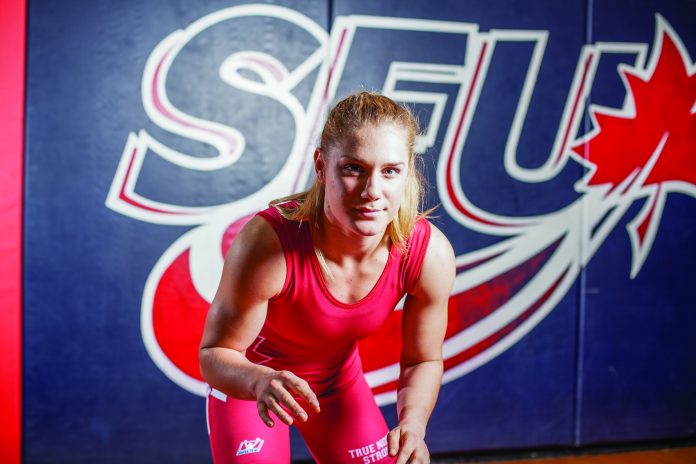
Despite an early interest in swimming, and coming from a family of swimmers, Bailley Halvorson chose to wrestle.

Screen Shot 2014-11-10 at 3.37.22 PM

Some sports are team sports, and some sports are individual sports — wrestling is a little bit of both.

When a wrestler is training, they rely on their teammates as training partners. Typically, one doesn’t think of training as part of the sport, but in wrestling, athletes work at the same level and intensity in training sessions as they would in a competition.

In order to ensure that every member of the team is ready to compete, each athlete relies on their teammates to elevate their technique and expand their versatility. One member of SFU’s women’s wrestling team, who has become an essential member both in training sessions and in competitions, is 155 lb senior Bailley Halvorson from Thunder Bay, ON.

However, her experience is not limited to the mats. She has also shown resilience in the face of injury, and knows the pain of having to sit by and watch her team compete without her.

During her second competition in the 2013/14 season, Bailley tore her ACL, with minor tears in her MCL and meniscus.Her injuries required surgery, which took her senior season away from her, and left her uncertain as to whether she would ever compete for SFU again.

“After not being able to compete last season, I was devastated because I didn’t know if I was going to be able to obtain a medical redshirt,” she explained, noting that redshirt status would allow her to play in her fifth year. “[However], I ended up getting it, and since then have felt more motivated than I ever have.”

Teammates — both past and present — have expressed excitement in seeing the elevation in Bailley’s performance since returning from knee surgery. However, it is not only her teammates who have noticed a change in her wrestling; Bailey has also noticed a difference since returning to the mats.

“Since returning from my knee surgery, I have felt more motivated than in previous years,” she said.

Being a redshirt senior this year, Bailey discussed her feelings about being one of the captains and leaders of the team: “As a senior I knew I would have to take on more of a leadership role, especially at tournaments [. . .] initially I wasn’t too excited about it, but after our first competition, I really enjoyed my role as one of the captains.”

Now entering her fifth and final year as a university competitor, Bailey recalls her last year of high school and what drew her to SFU. “I remember coming to SFU for my senior high school nationals [in 2010], and getting to see the campus and meet the team.” She continued, “My high-school coach had also gone to SFU, and highly recommended it.”

When Bailley made the decision to attend SFU, she was also deciding to move away from home — over 2,400 km away. Initially she felt nervous, but she quickly found a new home with her teammates.

“We have always had such a friendly and supportive team and coaching staff, which made it very easy for me to adjust even though I was so far away from home.”

CMYK-MTC-Anderson WangBailley’s teammates have also helped her develop as an athlete, acting not only as friends and teammates, but as teachers.

“I have learned so much from not only the coaches, but also my teammates,” she explains. “Although you are competing against one another in competitions, on the mats you work as a team to help improve one another’s technique and skills. [. . .] Even though we may inevitably wrestle one another in the future, you can rely on your teammates to critique and elevate your wrestling.”

Looking back at how far she has come, Bailley recalls her decision to continue with wrestling after high school, noting that it wasn’t her first sport.

“It’s kind of funny, I swam my entire life, and both of my parents were swimmers,” Bailey explains. “However, I was really slow and enjoyed the dry-land training [. . .] so that, and seeing the SFU campus eventually helped me make my decision to continue wrestling.”

In the end, Bailley reiterated how the individual-team dynamic of wrestling suits her: “I love being in an individual sport because you inevitably control your result; you control how hard you train and whether or not you leave it all on the mat. [On the other hand], as a team — especially in duals — you get to cheer on one another, and want the best for your teammates both on and off the mat.”

FUN FACT:
FAVOURITE PRE-GAME BEVERAGE:
Bailley admits that before every tournament she drinks grape Kool-Aid. Any reason? No, she just likes grape Kool-Aid.

SFU puts on dominant showing at Clan International

0
SFU hosted the Clan International.

The men’s and women’s wrestling teams hosted the Clan International on November 1 at SFU Burnaby’s middle gym. The Clan were among the top teams at this event, with nine members capturing top-three spots in 10 different weight classes.

Rounding out the first-place winners on the men’s side were Reid Watkins at 74 kg, and Ciaran Ball at 90 kg. Josh Kim finished second in the 86 kg weight class, while teammates Morgan Smith at 78 kg, and Ryan Yewchin at 125 kg would capture third-place titles. Also obtaining a third-place title was Ciaran Bell at 97 kg, competing in two weight classes.

On the women’s side, freshman Payton Smith won the 85 kg weight class, while teammates Abby Lloyd at 48 kg, Jen Anderson at 55 kg, and Bailley Halvorson at 63 kg captured third-place titles.

Simon Fraser University University Wrestling

The Clan International was also the season opener for the men’s wrestling team, where Watkins was able to showcase his practice efforts, after having dealt with injuries during his first two years training as a university athlete.

“My first two years at SFU were dissatisfying because I felt my injuries were holding me back from my goals,” Watkins explained. “So finally going into my third year, I feel healthy and ready to train and compete at my full potential. [. . . My coaches] Justin [Abdou] and Clete [Hanson] have been working with me, in practice, on my speed and power to help me be dominant in competition, [and] I think this past weekend I did just that.

“The Clan [International] was just the tip of the iceberg of what my teammates and I can do as athletes [. . .] I am super excited for this season, and have my eyes set on an NCAA title at 165 lbs,” Watkins concluded.

The men and women traveled to Forrest Grove, OR to compete at the Mike Clock Open.

Simon Fraser University University Wrestling

This week in comics

0


The Adventures of Agoraphobia Man: World Defender (Jacey Gibb)

Agoraphobia Man (Jacey)


Skin Ninja (Kyle Lees)


An Introduction to Vancouver (Evgeny Vinnik)
Online comics


8-10 Servings (Jacey Gibb)8-10 servings (Jacey Gibb)

Man recovering from a hangover learns the men he was partying with were KKK members

1
Hatemonger Hangover

A severely hungover Coquitlam man awoke last Sunday to discover that his previous night’s drinking companions were, in fact, not attendees of a belated Halloween party, but rather members of a local Ku Klux Klan chapter.

Despite it being well into November, 25-year-old Mark Thompson failed to recognize the red flags around his Saturday night drinking buddies. Prior to the incident, Thompson had been partying at Caprice Nightclub in the Granville Entertainment District, but was kicked out after trying to fight the DJ for “glancing” at him “all funny-like.”

After hailing a cab, Thompson’s night should have ended, but he encountered a minor setback by forgetting where it was exactly that he lived. Attempting to play off the gap in memory, Thompson suggested several fictional addresses (including 123 Fake Street) to the driver, who became increasingly irritated by the clearly phony addresses. When Thompson tried apologizing for his forgetfulness by vomiting in the backseat, the cab driver forced him to leave the vehicle.

“Luckily he kicked me out right in front of another bar,” said Thompson, “so I was able to go in and have a couple of beers while I tried to remember where I lived.”

Once safely inside the bar, Thompson planted himself next to a booth of men dressed in pale white robes, recalling they “looked weird as shit” and “everyone else looked afraid of them.

“I wanted to show them they weren’t the toughest guys in the room, so I tried impressing them by pointing to my Tapout T-shirt,” said Thompson, “but that didn’t work. I thought to myself ‘Which group of people would really make these dudes think I’m a tough guy too?’ and I was like ‘What if I told them I was part of the SFU Clan football team?’”

After explaining that he played on the Clan football team, the robed men immediately warmed up to Thompson and said they were Clan members themselves.

When asked how the robes were not an immediate indicator of their KKK status, Thompson defended his ignorance by claiming he thought they were celebrating Halloween posthumously: “It seemed kind of weird that the football team was celebrating Halloween in November, but hey, YOLO.”

Thompson’s new acquaintances eventually offered to take him back to their clubhouse, where Thompson passed out fairly quickly. It wasn’t until the next morning, when Thompson had called a friend for a ride home, that he became aware of where he’d spent the night.

“When my friend arrived at the clubhouse, he looked really nervous and asked me what I was doing there,” recalled Thompson. He asked what the problem was and Thompson’s friend pointed to the clubhouse sign, which read “Kanadian Knights of the Ku Klux Klan-Lower Mainland Chapter.” They proceeded to flee the clubhouse before any of the KKK members noticed.

Plastic grocery bags should be taxed

0
Canadians use between nine to 15 billion plastic bags a year.

When purchasing groceries at the supermarket, it seems natural to respond with a “yes” when the cashier asks, “Do you need a bag?” Whether we are purchasing one item or a refrigerator’s worth, at least one plastic bag always seems to make it home with us. Most shoppers are unaware of this habit, and must begin to realize the damage resulting from the consumption of plastic bags.

To tax shoppers for the use of these bags is a very plausible solution — one that is currently in effect at a few supermarkets. A ‘plastic bag tax’ isn’t simply a way to collect more money, but is about recognition, education, and developing a culture of increased sustainability.

The production of plastic bags uses high amounts of energy and non-reusable resources. According to the Greener Footprints website, Canadians use nine to 15 billion plastic bags a year. To produce this number of bags would require copious amounts of energy. Furthermore, the production of plastic bags requires petroleum — 8.7 plastic shopping bags contain enough petroleum energy to drive a car one kilometre — as well as natural gas and chemicals, leading to greenhouse gas emissions.

Approximately 1.5 billion bags are distributed in BC annually. Most of these eventually end up in a landfill or the open ocean, as less than one per cent are actually recycled. Plastic bags are not biodegradable and could take hundreds of years to break down. Researchers estimate that one bag has the potential to kill one animal every three months due to unintentional digestion or inhalation.

One bag has the potential to kill an animal every three months due to digestion or inhalation.

While we may understand the damages caused by using plastic bags, this knowledge hasn’t spurred significant behavioural change. So how can we make change happen? A tax on plastic bags could save us from plastic mountains and a garbage-laden ocean. Perhaps, a few cents charge on these bags could motivate us to pick up our cotton, reusable bags on the way to the supermarket.

In Toronto, retailers were required to charge five cents for every single-use plastic shopping bag requested by customers. The result led to an over 70 per cent decrease in the distribution of plastic bags, and diverted 1.3 billion plastic bags from landfill sites in 2009 — that’s almost the number of bags that British Columbians use every year!

Additionally, many large retailers in Toronto, including Loblaws, Metro, and Shoppers Drug Mart, continue to charge for plastic bags as a claim of commitment to sustainability.

Is money the only motivation for us to stop using plastic bags? A five-cent tax may only cost the average shopper $10 a year, which may not be a significant enough amount to seriously consider. However, one of the major components of a plastic charge is to increase awareness of our habits.

The tax asks us to pause for thought before deciding on plastic bags at the check-out. Plastic bag charges could lead us to question whether we truly need to use a plastic bag at the supermarket, and remind us that we have the option to answer: “No bags please.”