Home Blog Page 1072

Clan lose second-last game to the Cougars in offensive no-show

0
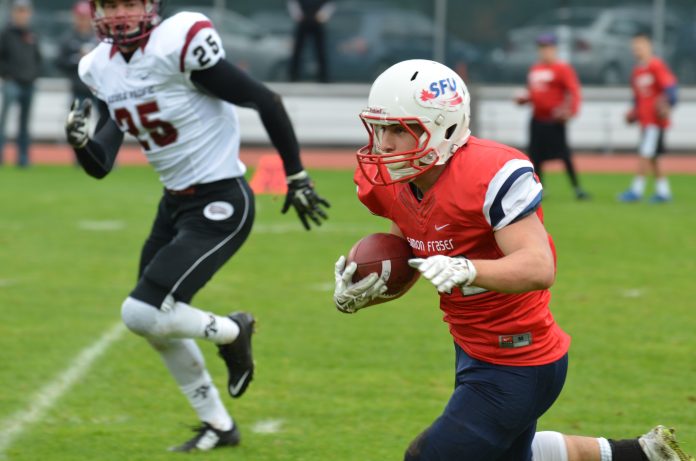
Running back Stephen Spagnuolo had a standout game, achieving 146 all-purpose yards. He is among the seniors playing their second-last game with the Clan.

The Clan suffered their eighth loss of the season last Saturday to the Azusa Pacific (APU) Cougars.

The Cougars are ranked first in the Great Northwest Athletic Conference (GNAC): they haven’t lost a conference game, and have only lost one in non-conference action, garnering them the 23rd spot in the national rankings. SFU lost to Azusa earlier this season by score of 32-24; in that game, the Clan played a weak first half, but dominated the second half, falling just short of a victory. Slow starts such as this have plagued the Clan for most of their season.

DSC_9121


All things considered, SFU played a solid game against the first in the conference rushing offence, playing a tight defensive game. During the first quarter, the Clan did not allow Azusa onto the scoreboard once.

“We did some very good things, the guys played really hard, I thought we contained their defence pretty good,” said head coach Jacques Chapdelaine.

DSC_9346


However, their offensive game left much to be desired — they were unable to put up a single point until late in the third quarter, and were held scoreless otherwise.

The Clan currently rank last in the GNAC for total offence (though only by four yards). A running theme in recent games has been missed opportunities by the Clan offence — they’ll make it to the goal line only to throw an interception, and have nothing to show for the drive.

DSC_9379


Right after a missed field goal attempt by Azusa, SFU actually had the chance to put the first points on the board on the back of running back Stephen Spagnuolo, who notched 77 yards in one drive. However, in the first of the aforementioned missed opportunities, quarterback Ryan Stanford threw an interception trying to connect with Spagnuolo for the touchdown.

The Cougars would score for the first time at the beginning of the second quarter off of a five-yard rush by Azusa’s star running back Terrell Watson, to take a 7-0 lead. The Clan nearly answered back, making it to the APU 11-yard line, however their 28-yard field goal attempt was blocked by Azusa’s special teams.

DSC_9326


The Clan appeared to be on the right track, forcing an Azusa fumble, which — although recovered by the Cougars — led to a turnover on downs. However, Stanford threw another interception to give Azusa their second touchdown of the game.

SFU would finally put up their first touchdown 4:45 into the third quarter on a nine-yard pass to tight end Phillipe D’Entremont. They took a false start penalty on the extra point kick, however, losing five yards and eventually missing the kick, taking the score to 14-6.

DSC_9099


The Clan would be given the chance to rectify the blunder moments later when defensive back Matt Isherwood forced an Azusa fumble, giving SFU the ball. Once again though, the Clan’s offence would fall short, unable to make a single yard on the drive.

The final nail in SFU’s coffin came after the defence’s only real blunder of the game. They allowed Azusa’s Watson — who finished with 135 rushing yards — to run in for a 55-yard touchdown, effectively sealing the game at 21-6.

DSC_9124


In the end, this game told the same story as those of weeks past: the Clan’s defence once again held their own, playing a great game minus one play, while the offence was unable to provide any support.

Jordan Herdman once again led the team defensively with 19 total tackles, while Spagnuolo put in another high-flying offensive effort with 146 all-purpose yards.

DSC_9257


“I think there’s promise out there. You can be disappointed, and you should be disappointed after a game like this, but you certainly can’t be discouraged,” said coach Chapdelaine. “The thing is how you rebound.”

SFU will look to win their final game of the season this coming Saturday against the Central Washington Wildcats — who previously crushed the Clan 63-7 in the Battle for the Border — to wrap things up on a positive note.

DSC_9287


It will be the last time many players will suit up for the team, including Spagnuolo, Isherwood, Bobby Pospischil, Cole Tudor, and Chris Tolbert.

“It’s seniors day next week, so if there hasn’t been a motivation to want to send those guys off on a positive note, I don’t know what else,” said Chapdelaine.

DSC_9359


Honoured at the game:

DSC_9207


The Clan honoured the 2004 SFU football team, which included current BC Lions offensive lineman Dean Valli at halftime. In attendance were Valli, Brendan Mahoney, Darcy Grant, Conrad Deugau, Ryan Christie, Luke Parm, and Aaron Hargreaves, along with former head coach Chris Beaton, and offensive coordinator Terry Bailey. Hargreaves also went on to have a career in the CFL, currently playing with the Ottawa Redblacks.

DSC_9217


CHL lawsuit could be bad for junior hockey

0
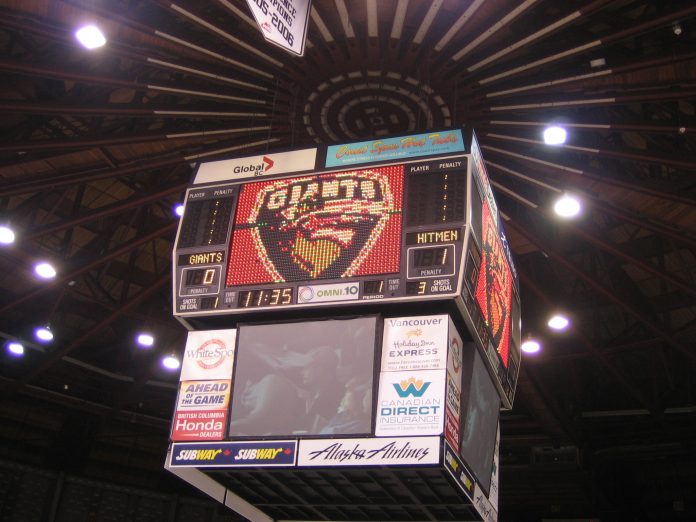
Junior teams like the Vancouver Giants could suffer if junior players are paid more.

Over the last few weeks, there have been numerous lawsuits against the CHL — the umbrella company that overlooks the WHL, OHL, and QMJHL, and comprises a total of 60 teams — for its compensation practices.

Most notable, perhaps, is the class action lawsuit filed by former player Sam Berg on October 17 for $180 million. The suit asks for “back wages, overtime and vacation pay, as well as any punitive damages,” according to a report by The Globe and Mail. Currently, players are paid a flat rate between anywhere from $35 to $125 a week.

It’s important to note that this case will not be brought to court unless a judge first certifies it.

At the heart of the case is whether players in the CHL are considered employees or amateur student athletes. If a judge rules that they are the teams’ employees, they will have to be paid according to the minimum wage laws in the region where their team is located.

The suit puts forward the example that the average OHL player works 35 to 40 hours a week and gets paid, on average, $50 per week, which is clearly under the student minimum wage of $10.30 an hour in Ontario. The CHL argues that the players are amateur student athletes and said, in a press release, that they will fight “because this could not only [. . .] have a negative effect on hockey in Canada, but through all sports in which amateur student-athletes are involved.”

This situation can be compared to the ongoing NCAA-player debate in the States, whose big football and basketball programs are fighting to maintain the status quo.

One of the biggest draws of junior hockey, especially in Vancouver, is its affordability. I’ve got tickets to see the Giants play the Seattle Thunderbirds in February, and I was able to get tickets right behind the penalty box for under $30. If the players were to be paid more, I don’t think I could get those tickets for even $60.

Merchandise prices would also increase. Right now, you can get a Vancouver Giants home jersey for $105, which is still a bit pricey. That number could increase to match its NHL counterpart, whose jerseys sell online for anywhere from $175 to $249.

Associated prices would have to increase to match the new expenses incurred due to a successful lawsuit. We could see a lot of the small town teams fold, as they rely heavily on ticket sales to keep the lights on.

Even in bigger market cities like Vancouver, the team draws in fans because of the cheap ticket prices — it’s cheap entertainment. But if you add in higher wages, we can kiss that goodbye. Higher prices meansfewer people will watch and, as a result, we could be talking about the death of junior hockey.

I’m not saying that the junior hockey players who are filing the suit aren’t right, but the bottom line is that if the CHL were forced to compensate players more than they already do, it could be very harmful to the league; the extra cost will go right to the consumer, and who’s to say that the consumer will pay that extra coin.

Unexplained dark spots raise questions about Venus’ surface

0
One theory suggests that metallic compounds have condensed on Venus’ surface like frost.

The surface of Venus may be more complex than previously thought. Elise Harrington, an SFU earth sciences undergraduate student and intern at the Lunar and Planetary Institute, has made new discoveries as to how radar properties change along Venus’ mountain ranges.

Venus has been thought of by researchers as a very homogenous planet, but Harrington, who revisited spacecraft data collected by Magellan two decades ago, noticed unconventional variations in the planet’s landscape.

Alongside her supervisor, Allan Treiman, she noticed unexplained dark spots present on only one of two mountain ranges on the planet’s surface. The team thinks these new discoveries may inspire renewed interest in Venus, which has not been visited since the Magellan journey.

In conducting their observations, Harrington’s team used the property called radar reflectivity, rather than emissivity — which was used by previous researchers — in order to look at the ranges in higher resolution. Although these radar properties are very closely related, the new method was able to provide a higher spatial resolution than that of the past.

In observing Ovda Regio, the mountain range near Venus’ equator, Harrington said, “We noticed that, like the previous researchers saw, the reflectivity increased with elevation [as expected].”

However, she said that there were some observations that diverged from the expected trend. She explained that her research team noticed some anomalous dark spots occurring at the highest elevations. “We expected it to keep getting brighter and brighter, and then suddenly it got dark,” remarked Harrington.

One theory to explain why the surface brightens as elevation increases is the metal frost hypothesis, which attributes the brightness to Venus’ metallic compounds. These metallic compounds are volatile in the atmosphere, but would condense on the surface like frost on earth.

Harrington explained, “[Metal Frost] theory would explain why the surface would get brighter, but not explain the dark spots we noticed.”

Later, her research team observed Maxell Montes, located in the poles of Venus, a very different area than Ovda Regio. They wanted to see if the Maxwell mountains were showing dark spots as well.

Using the same procedure, they noticed that there were no dark spots. The mountains on Maxwell kept getting brighter, eventually reaching a stable level of luminosity. Harrington said, “That is very different from what we saw in the first mountain range.”

Although the implications of the discovery are unclear as of yet, Harrington said that this new research may inspire greater interest in the planet: “The fact that we noticed something different [. . .] raises additional questions for future researchers.”

Poll Party

0
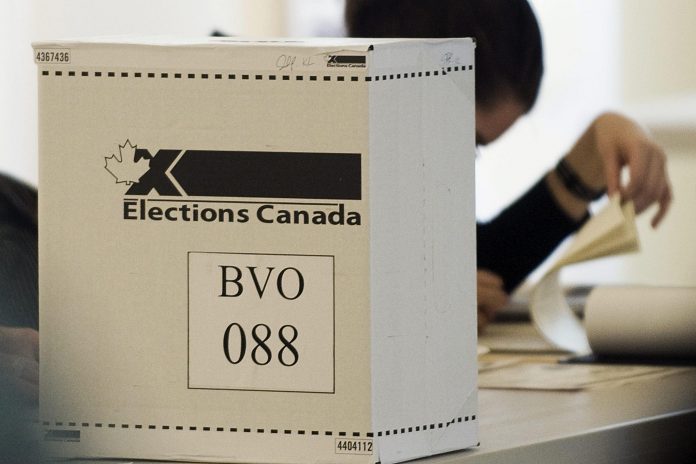
This might be the most boring photo I've ever seen.
An informed voter is a good voter — read this feature to learn the positions of those running for mayor in Surrey, Vancouver, and Burnaby.

This coming Saturday, November 15, voters across British Columbia will head to the polls to elect their next municipal governments. Sadly, if past statistics are any indicator, very few people will actually exercise this right, which is even more tragic considering that elections at the municipal level may be more important than either provincial or even federal elections. After all, it is in municipal elections that we vote for the candidates who live and work in our communities — arguably, municipal candidates have more of an effect on our daily lives and communities than our prime ministers or premiers.

To become a registered voter, you must be 18 years of age and a Canadian citizen. In addition, you must have been a resident of British Columbia for at least six months prior to the election, and have lived in the municipality you are voting in for at least 30 days.

For some of you, this may be your first opportunity to join in the democratic process. If you are already registered to vote, you should have received your Voter Information Card in the mail, which you should bring with you on election day, in addition to a piece of photo identification with a signature and a second piece of identification that has your name and address printed on it. If you need to register on election day, you must bring at least least two documents with your identity and address — one of these documents must also have your signature.

In the interest of ensuring that we are all knowledgeable voters come Saturday, here’s a breakdown of the major players in the mayoral races of the three cities that house SFU campuses: Burnaby, Surrey, and Vancouver.

Burnaby

There are a grand total of six mayoral candidates striving for the top seat in the City of Burnaby, but it’s likely that only two of them actually stand a chance of winning — current mayor Derek Corrigan, and his main opponent, Daren Hancott. To be fair, one of the independent candidates, Sylvia Gung, has made headlines with her promises to ban public displays of affection; the remaining three are relative unknowns.

Derek Corrigan (I)
Burnaby Citizens Association

CMYK_DerekCorrigan_chenchen

Corrigan goes into this election with quite a few advantages, the main one being his longevity, having first been elected in 2002 and reappointed in each subsequent election. In addition to his many years as mayor, Corrigan has also been a member of Burnaby Council for over 25 years. In both of these roles, Corrigan has consistently led the economic, social and environmental development of the city. He recently gained a lot of attention on a greater stage for his steadfast opposition to the twinning of the Kinder Morgan pipeline, which is only a part of his dedication to environmental advocacy. Corrigan has popular support both in and out of the city — enjoying a 67 per cent approval rating among Metro Vancouver mayors — and is recognized region-wide for his knowledge and leadership on transportation issues.

Daren Hancott
Burnaby First Coalition

CMYK_DarenHancott_chenchen

Hancott is the main opposition to Corrigan’s continued incumbency, and he has his work cut out for him. In stark contrast to the sitting mayor, Hancott enters the race with a distinct lack of political experience. In its place, Hancott brings a PhD in business, which is coupled with a breadth of experience in that field, having conducted business in over 22 countries and been in several high-powered positions along the way.

He also previously served as chair of the BC Chamber of Commerce, and has called for stronger relationships between the city and higher levels of government. Hancott plans on using years of business experience and management expertise in order to bring a high degree of responsibility to Burnaby City Hall.

Sylvia Gung
Independent

CMYK_SylviaGung_ChenChen

This second-time mayoral candidate is well-known in news circles around the country, due to her, uh, interesting way of looking at things. Gung’s official profile on the City of Burnaby’s website proclaims her as a candidate who desires to “empower citizens” and establish a “wholesome society.” Just in case you were wondering what that incredibly vague statement means, Gung has made it loud and clear — she’s plainly stated that she intends to ban public behaviour that hints at sex or sexuality, including public hand-holding and kissing at weddings. On top of that, she also plans to put those who are on welfare to work cleaning up garbage — welfare payments would be rechanneled to form their wages — along with abolishing the school board, and innovating what she describes as the “backwards organizations that are the unions and PACs.”

For those of you living in residence or spending the day studying on Burnaby Mountain, there will be a polling station conveniently set up at University Highlands Elementary School on election day.

Surrey

Surrey is currently in a state of confusion following the resignation of longtime mayor Dianne Watts, who announced last April that she would not seek re-election after holding the position for almost a decade — Watts is now seeking the Conservative nomination for the federal riding of South Surrey-White Rock. This bewilderment is easy to spot in the polls, as a full 32 per cent of Surrey residents are unsure of who they will vote for, while the leading candidate in the race has only 27 per cent of the popular support.

While seemingly worrisome, this confusion is perfectly understandable when you consider that Watts won the last election with an unheard-of 80 per cent of the vote. While there are several candidates vying for the position, there are three candidates who currently stand out from the pack: acting mayor Linda Hepner, former mayor Doug McCallum, and city councillor Barinder Rasode.

Linda Hepner
Surrey First

CMYK_LindaHepner_chenchen

Hepner is currently the city’s acting mayor, having taken on Watts’ role following her resignation. Hepner was a member of the city council as part of the former mayor’s team, and is thus viewed by some as a natural successor to the popular leader. On the other hand, some critics have argued that Hepner is riding Watts’ coattails and endorsement, rather than presenting a clear plan for what her leadership will do for the city during her term as mayor. While Hepner has accomplished much during her time on city council, her future plans are light on details, and she seems to advocate for merely continuing to support and build upon plans put into place during Watts’ time in office. While this isn’t necessarily a bad thing, it doesn’t do much to show off her ability to form policy regarding the future direction of the city.

Doug McCallum
Safe Surrey Coalition

Doug-McCallum

Former Surrey mayor Doug McCallum hopes to return to the chair he occupied from 1996 until his defeat at the hands of Dianne Watts in 2005. One of the biggest factors working in McCallum’s favour is his former position as the chair of Translink, and his promise to deliver much-needed transit upgrades to the city.

Less inspiring is his promise to cut down on crime and improve public safety, as it was during his tenure that the city was dubbed the “Car Theft Capital of North America,” beating out both New York and Los Angeles in a per-capita comparison. Though McCallum has referenced the experience he has gained since his defeat almost a decade ago, critics are skeptical, and believe he may simply try to reset the clock. Like Hepner, McCallum has been light on details, but that could change as election day looms closer.

Barinder Rasode
One Surrey

Barinder-Rasode

Another councillor who started off as part of Watts’ initial team, Rasode recently left in order to run her own mayoral race with her One Surrey team. Though she currently is trailing Hepner and McCallum in the polls, Rasode could still become a force to be reckoned with. In contrast to her opponents, Rasode has actually released details of her 10-point plan to make Surrey one of the safest cities in Canada; it features input from chief constable Jim Cessford — the longest serving police chief in the country — and professor Curt Taylor Griffiths from the SFU Police Studies Program. In addition, she has two former police officers on her One Surrey team, including a former staff sergeant in charge of community policing in Surrey, which is an integral part of her plan for the city.

The closest polling station to SFU Surrey on Election Day is Old Yale Road Elementary School. It’s about a 10-minute walk from campus.

Vancouver

As Canada’s eighth-largest city heads to the polls this weekend, the rest of the Greater Vancouver area will be watching in anticipation. The results of Vancouver’s election will likely have the biggest effect on the greater metropolitan area, if only because the city itself is so large. In terms of popularity, incumbent mayor Gregor Robertson is still topping the polls — it remains to be seen if his two biggest challengers can prevent him from securing a third term.

Kirk LaPointe
Non-Partisan Association

Kirk-La-Pointe

Currently second in the popularity polls with 32 per cent, LaPointe and the NPA are the biggest threats to Robertson’s third term. Though he is making his first foray into politics, LaPointe is well-known in media circles, having served in a variety of senior positions at various news organizations, including the Vancouver Sun, the National Post, CTV, and the CBC. In these positions, LaPointe has been a long-time advocate for greater government openness, inclusiveness, and public access to information, which he plans to transfer into the political arena with a commitment to government transparency, fiscal responsibility, and meaningful community consultation. LaPointe envisions a Vancouver wherein citizenry would continue to have a voice, and would be kept in the loop on the activities of the municipal government.

Gregor Robertson (I)
Vision Vancouver

Gregor-Robertson

Former NDP MLA Gregor Robertson is nearing the end of his second term as mayor, and seems poised to enter into a third term if the polls are any indicator (he currently enjoys 46 per cent of support from decided voters). Despite some critics being upset with the influx of bike lanes into the city and the handling of incidents like the Stanley Cup Riot, Robertson managed to sweep the previous 2011 election — all of Vision Vancouver’s city council, park board, and school board candidates were elected.

Moving forward, Robertson has promised to “continue to address affordability and homelessness,” along with refusing Kinder Morgan’s proposal to “put 340 more oil tankers in our waters,” and advocating for a Broadway Skytrain line. Demographically speaking, Robertson currently has the edge among home renters, women, voters under 45, and those living in the Downtown core and areas east of Main Street.

Meena Wong
Coalition of Progressive Electors (COPE)

Meena-Wong

Coming in at a distant third in the polls are Meena Wong and COPE. A former employee of the Toronto Star and an assistant to Toronto mayoral candidate Olivia Chow back when she was a city councillor, Wong has been a COPE activist since 2005. No stranger to politics, Wong previously ran for the federal NDP in the last federal election, and has a vision for the city that is very different than those of Robertson and LaPointe. Committed to social reform and making Vancouver more liveable, Wong supports some very intriguing measures, including a tax on vacant properties (which she plans to use to fund affordable social housing), a $30 per month U-Pass to be made available to all Vancouver residents, and increasing the city’s minimum wage to $15/hour. While these all sound like great policies, Wong has been less open about how these goals will be accomplished, which may be partially to blame for COPE’s comparably low rating in the popularity polls.

For those of you attending classes at SFU Woodwards, your closest polling station will be at the International Village Mall on West Pender Street. Harbour Centre students, on the other hand, can head to the Morris J Wosk Centre for Dialogue, which is literally seconds away from campus.

Illustrations by Eleanor Qu and Chen Chen.

Study reveals BC degrees pay off for recent grads

0
In the game of life, you win or you die.

The Research Universities’ Council of British Columbia (RUCBC) released a report on October 24 titled Putting Degrees to Work, the findings of which indicate that a university degree from a BC institution has substantial value.

The report compiled survey data collected from the province’s class of 2008 two years and five years after receiving their degrees.

Findings showed that the overall unemployment rate for university graduates at the five-year mark (2013) was 4.7 per cent, compared to the provincial average of 6.6 per cent and the BC youth unemployment rate of 12.9 per cent.

In an interview with The Peak, SFU president and chair of RUCBC Andrew Petter said, “I was pleased that this [data], in fact, validated what I believe to be true about university education  [. . . that it] is clearly a pathway that will not only be beneficial to [students] as citizens, but will also help graduates in terms of securing good jobs.”

He continued, “If you compare the rate of unemployment of graduates five years out [. . .] it’s pretty obvious that university education is very much serving the needs of students.”

The report showed that BC university graduates are also garnering comparably high salaries, earning an average of $48,000 a year two years after graduating, and an average of $60,000 a year five years post-graduation.

In Ontario, home to some of Canada’s top-ranked universities, individuals with undergraduate degrees are making roughly the same amount as BC graduates two years after receiving their degrees.

According to a report published in November 2013 by the Council of Ontario Universities, graduates of the class of 2010 were earning a little over $49,000 annually, on average.

Putting Degrees to Work also reported that over 96 per cent of British Columbia grads from 2008 were working in fields requiring post-secondary education by 2013, no matter their field of study.

“In some disciplines, it takes a little longer sometimes to get into that career path than in others. And some career paths are likely to produce higher incomes, at least earlier on,” explained Petter. “But generally, coming out of a university with a degree puts you in a much better position in the labour market than if you hadn’t done that.”

Earlier this year, the provincial government revealed its BC Skills and Jobs Blueprint, which refocuses the province’s education strategies to emphasize high-demand occupations, including many in the energy sector such as welding, pipe-fitting, and heavy machine operation.

This plan includes a redirect of 25 per cent of provincial operating grants, currently provided to post-secondary institutions, to training for in-demand jobs.

For Petter, however, the data showcases the continued success and importance of traditional education: “I think [this report] shows that universities are already very responsive to the labour market. [The] government can take some comfort from the fact that universities are already moving in the direction that they want us to.”

As to concerns that this funding shift might harm certain programs, Petter said, “Simon Fraser’s philosophy is one based on student-demand [. . .] The budget follows the students rather than the other way around.”

He continued, “If we can give students flexibility, some work experience, and support our faculties to respond to that student demand, we’ll be more successful in meeting the students’ needs in terms of employment.”

SFU’s president made sure to point out, however, that a university education is valuable for reasons other than simple remuneration: “I hope that universities are not just about preparing students for the labour market, [but] about helping people to be able to think critically in ways that will assist them, not only in getting a job and being successful in a career, but also in being contributing citizens, building a better society, having more gratifying lives for themselves, [and] making good choices.”

Chuckling, he added, “To the extent that there has been this myth out there that if you go to university, you’ll end up as a barista, serving coffee, it’s kind of nice to know that, even disciplines that some people have suggested [. . .] would [not] lead to a good career, in fact, do.”

A SUB of one’s own

0
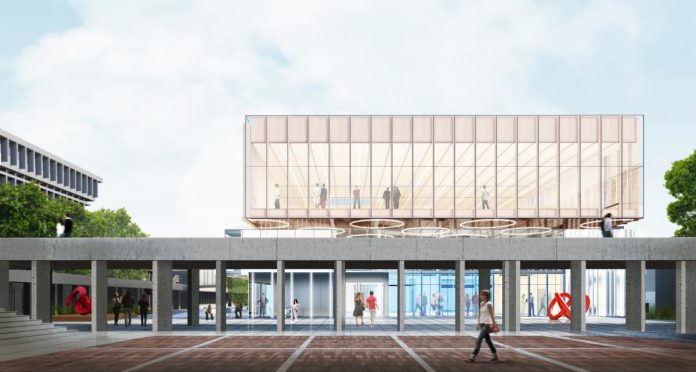
SFU's student union building and stadium are slated to open in Fall 2017.

It’s official: after years of careful planning and budgeting, SFU’s Student Union Building (SUB) is going to happen.

At the recent Simon Fraser Student Society (SFSS) Annual General Meeting, students gave Build SFU the green light to pursue a loan for its SUB and stadium, which means the $65 million project can now begin preparations for the actual construction of the building.

But what has your student levy actually bought you? We’ve crunched the numbers and brought you the inside scoop of what’s in store for the SUB.

derp-flerpderp-flerp2peak_101114_28

Graphics by Phoebe Joy Lim.

Harry Potter exhibit open to SFU muggles

0
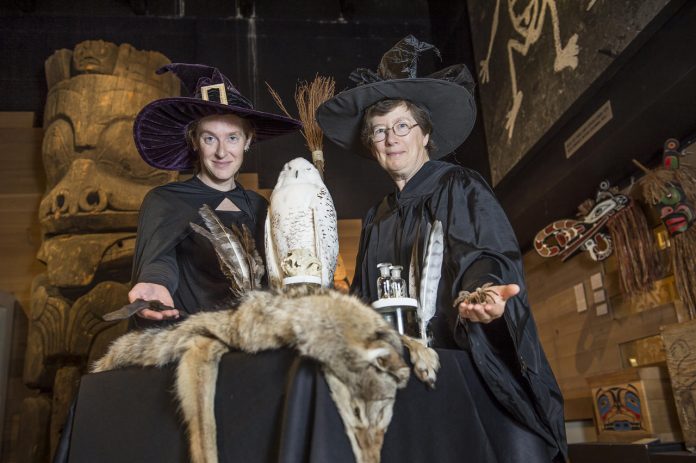
The idea for SFUwarts began as a jest between Hart (left) and Winter (right).

The SFU Museum of Archaeology and Ethnology recently unveiled SFUwarts, an exhibit based on the fantastical wizarding world of Harry Potter, which contains a wide array of magical creatures and Hogwarts essentials for visitors to peruse.

Melanie Hart, a collections technician in the Department of Biology, explained the inspiration behind the exhibit: “It seems fitting for Halloween to do something a little bit more fun to try and engage more people in the museum.”

Some exhibit items, collected with the assistance of the museum’s work-study student Denee Renouf, include sea stars, quills, and pickled millipede. The display also features school supplies that might be required in one of Professor Snape’s infamous potions classes, with items such as griffon talons and flubberworm mucus.

The dragon blood, however, is fake. The museum’s curator Barbara Winter explained, “We don’t have any komodo dragons we could bleed, so I just made it up with corn syrup.”

Winter, who collaborated on this project with Hart, told The Peak that the whole thing began in jest: “I think as a joke, [Hart] said something like ‘Let’s do something on Harry Potter. I’ve got all kinds of weird stuff.’

“SFU is all about collaboration and it’s all about working with people in different areas,” said Winter. “In archaeology [. . .] we are always trying to get that collaboration and work in a more holistic fashion.”

The exhibit quickly began to attract attention. According to Winter, the Facebook page for the museum usually sits at around 75 likes, but has now been liked by over 1,000 users. The uptick in popularity occurred after Winter posted a Harry Potter-themed photograph on the museum’s Facebook page.

Those who have dropped by to see the exhibit firsthand have had nothing but positive responses at seeing such outlandish specimens, such as a Great Horned Owl and several bats.

A group of Grade 10 students from Gleneagle Secondary School enjoyed the exhibit, in particular the Snowy Owl. Hart and Winter said the students kept busy by taking “selfies with Hedwig.”

The bird specimens on display — which will later be used in science outreach programs — are strikingly similar to the real thing because they are, in fact, taxidermy samples.

Hart explained the general process of taxidermy: “It’s a bit gruesome. You take out the major bones, you leave in their legs, you leave in their skull, and you take out all the meat, clean the remaining skin and tissue and stuff them [with cotton,] and stitch them up.” She continued, “A well-preserved bird should last over 300 years.”

Hart explained the reason for choosing Harry Potter to showcase at the museum: “I think it makes it less intimidating for people if you can show that there is something familiar that they can come and look at and connect to it at a different level.”

Winter elaborated on the anthropological value of Harry Potter. “It’s a huge field and it has connections with a lot of people, because they can see the symbolism and they can see the way Harry Potter has grabbed the imagination of many people,” she said. “They can apply that using anthropological theory and principles.”

The exhibit runs until November 14 and students can ‘slytherin’ during the museum’s regular hours.

Students discuss future of SFU Learning Garden

0
SUB construction will begin on the site of the current gardens in April 2015.

Gardeners and garden enthusiasts alike met last Thursday, November 6, to discuss the future of the Sustainable SFU Learning Garden.

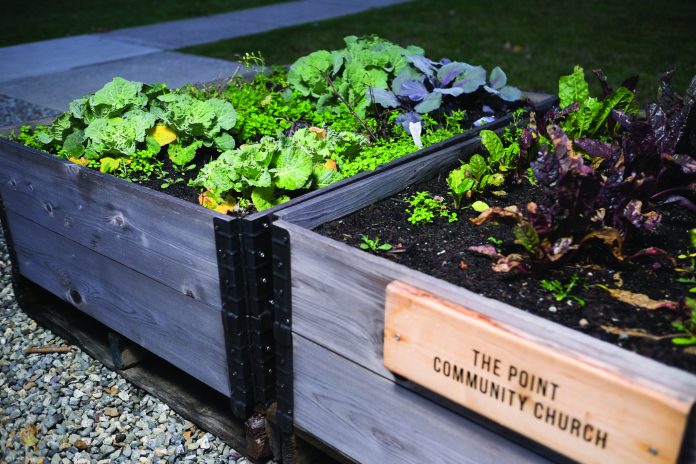
The Learning Garden is currently located between the Academic Quadrangle and the Maggie Benston Centre, but as plans to build the Student Union Building in the same location progress, an initiative to relocate the garden is taking place.

Michelle Vandermoor, the evening’s facilitator, led 19 participants through each stage of the event. The discussion began with an introduction to the goals of the Sustainable SFU garden, which are to advocate for and put into practice sustainable economic, environmental, and social action at SFU.

“The Learning Garden is a unique opportunity for the SFU community to engage in the process of growing produce. It is a chance for people to see produce go from seed to crop,” said Vandermoor.

Throughout the evening, emphasis was put on the garden’s Spade to Spoon Club, whose members participate in the planning, maintenance, and harvest of produce in the Learning Garden. After crops are harvested, they are brought to the Community Kitchen in the Madge Hogarth kitchen space.

Club members also plan the menu and supply the produce for the kitchen’s events. And of course, they eventually get to taste their hard work.

After an introduction to the goals of the Learning Garden, attendees were split into groups in order facilitate discussion. At “three tables, three rounds,” participants discussed three separate questions about the future of the Learning Garden.

Questions that were asked included what the learning garden is, what you or someone you know could do for the learning garden, and what the future of the learning garden should be.

Group discussion was lively, and one group even suggested remodeling the garden to be circular with a fire pit in the middle. However, a lot of the discussion among groups dealt with possible ways in which the Learning Garden could be promoted through social media and other outlets.

The event came to a close with a raffle, the prize being dinner at Club Ilia. Smaller prizes were also given out to those participants who were lucky enough to have a sticker placed underneath their chair.

Construction of the SUB will begin in April, 2015, at which point the garden will be relocated.

Researchers highlight need for better bike safety

0

Although Vancouver has become known as a cycling hotspot, cycling around the city is not without its risks.

According to Meghan Winters, associate professor of health sciences, cycling is a great way to get around, but when incidents and injuries do occur, they need to be better documented.

She emphasized the need to collect and understand data in order to keep people as safe as possible, given that cycling is becoming increasingly popular. Currently, only 30 to 40 per cent of serious cycling incidents are reported.

Despite the health benefits of cycling, road safety continues to be a concern for governments and decision makers. Winters recently led a study on the need for planning for active transportation as part of Healthy Canada by Design — a Coalitions Linking Action and Science Prevention Project — and found that more comprehensive data is needed.

The Insurance Corporation of British Columbia (ICBC) only records cycling crashes when they involve a motor vehicle and when an insurance claim is made, but near misses and other incidents — such as swerving to avoid a vehicle, road obstacle, or pedestrian — typically go unreported.

As such, the ICBC data currently used by municipalities to highlight safe or unsafe intersections and address cycling safety is based on an incomplete picture. This insufficient data could lead to some areas being overlooked, said Winters.

“One of the big, active transportation data needs expressed by municipalities was for more complete data on cycling and pedestrian injuries, and easier access to it,” explained Winters.

A potential solution to this data gap was launched this fall through the website Bikemaps. The site, built by Trisalyn Nelson’s Spatial Pattern Analysis & Research (SPAR) lab at the University of Victoria, displays ICBC and police-reported data, but, most importantly, allows cyclists to add information about incidents that typically go unreported. This includes near misses, thefts, and hazards, all of which can be uploaded in real time.

Given that major crashes are far more rare than near misses, having information on these near miss incidents can contribute to developing a more comprehensive picture of road conditions and safety for cyclists in Vancouver.

The data contributed to Bikemaps will be used to produce maps and analyses, which will be shared with decision makers and advocates. The website is also a great tool for cyclists to check in and be aware of any possible high or low risk zones near their local areas, according to Winters.

Winters said that she hopes SFU students will engage with the project as well: “My hope is that SFU students contribute data to this citizen-mapping project, whether they are regular cyclists, or whether it is just a trip around the seawall on a sunny day in the summer.”

Virginia to Vegas – Volume 1

0

Virginia to Vegas is up and coming singer-songwriter Derik Baker, who was discovered when Wax Records saw his Youtube videos. Hailing from Ontario, the 24-year-old has created a name for himself across Canadian radio with his unique fusion of indie pop and feel-good electronic dance music.

With his first EP to be released on November 11, and currently supporting a cross-Canada tour, Virginia to Vegas is poised to become a frequent guest on the airwaves.

Radio listeners may recognize “We Are the Stars,” featuring fellow Canadian pop singer Alyssa Reid, which was Virginia to Vegas’ debut single. Released in January of 2014, the song has enjoyed radio play across Canada, earning Baker his first Gold single.

From the EP’s opening anthem, “Last of the Fighters,” to the gentle ballad, “Beautiful You Are,” the album sounds cohesive and positive throughout, though varying in tempo and instrumentals.

Listeners will hear a bit of everything on the tracks — whistling, pianos, acoustic vocals, and their synthesized counterparts. If you’re looking for happy music to brighten your rainy Vancouver days, this album is perfect for you.

Virginia to Vegas can be seen as part of Alyssa Reid’s Timebomb Tour, with stops all across Canada this fall.

For more informarion about Virginia to Vegas, visit virginiatovegas.com.