Home Blog Page 1067

University briefs

0

Student vote to end pop quizzes and early classes

Students at Ryerson University are tired of 8:00 a.m. classes and pop quizzes, and they’re hoping to see the end of both unpopular practices.

The Ryerson Students’ Union (RSU) passed two motions at their general meeting on November 11, tasking themselves to lobby the administration to stop offering classes before 10:00 a.m. and to eradicate surprise tests.

The changes in class start times would especially benefit students with long commutes. However, Ryerson president Sheldon Levy explained, “The challenge is that we have to be able to accommodate the schedule and the number of hours and the number of classes we have. That’s already difficult.”

With files from The Eyeopener


UBC grad donates $7.5 million to computer science program

David Cheriton, one of Google’s founding investors and a Stanford University computer science professor, has donated $7.5 million to UBC’s computer science department.

Cheriton, who graduated from UBC in 1973 with a bachelor’s degree in mathematics, made the contribution in hopes of making “computational thinking [. . .] as commonplace a skill as reading and writing.”

The donation will go towards hiring a senior computer researcher and funding a new first-year course on computational thinking, which will be offered in the 2016 winter term. The course will be based on utilizing computer science techniques for problem-solving.

With files from The Ubyssey


University lacks childcare services for student parents

From November 25 to 27, students at the University of Concordia will be able to vote on whether or not to approve “the continued prioritization and active support of the establishment of a Daycare Centre” which is meant to improve student space on campus through the student space, accessible education and legal contingency fund.

Although approximately 10 per cent of students are also parents, a 2010 study showed a lack of childcare and support for student parents at Concordia. The current daycare program is less than sufficient, with a capacity of only 14 children per year.

The university and student union have yet to make improvements, but the student union says they plan to discuss with the university should the students express a desire for better daycare services.

With files from The Concordian


SFU alumnus raises over $25,000 for sweatpants line

0

For SFU economics graduate Winson Tam, nothing is better than wearing sweatpants every month of the year. Unfortunately, the weather doesn’t exactly allow for that, which is why Tam decided to create a product he could wear all year long.

“I was walking around earlier this year in sweatpants on a hot day [. . . and] I was literally drenched in sweat, looking to buy an alternative. [That’s] when I realized nobody really offered what I want — a pair of sweats that look good, and would keep me feeling fresh,” Tam said in an email interview with The Peak.

He took his idea to Kickstarter, a website that enables fundraising for different start-ups and charities. Tam had a few friends that had fundraised on the site before and thought it would be able to help him get his business started. If the plan failed, Tam explained that he’d only lose money on prototyping and video costs, so the cost of evaluating market demand was very little.

As it turns out, his product was what the market wanted. In weeks, Tam has raised over $25,000 for his all-season sweatpants line, which he described as “a really stylish, functional pair of sweatpants made with premium material.”

The design is inspired by jogger-style sweats as well as high-end fashion sweatpants.

“I created the design with the help of my manufacturer,” he explained. “The drop-crotch style is what seems to be the new trend, and we’re trying to capitalize on it.”

Despite the overnight success of his Kickstarter campaign, Tam’s journey is a classic case of if at first you don’t succeed, try try again.

“Before this I’ve failed at seven businesses, from selling USB lighters to drop shipping baby strollers,” Tam said. “[These were] all lean start-ups which have broke even or made very little money. It’s been a great learning experience to get me where I am now. I’ve learned to give the market what they want, and quickly step away to take another swing instead of lingering on bad ideas.”

Tam plans to make his sweatpants available in February of next year, and will sell them for $78 a pair.

With regards to his future plans, Tam is excited to continue his foray into the world of sweatpants: “My plan is to take every dollar from the campaign and invest it back into this business, [and] to bring my supporters what they want and give them a great experience with All Season Sweats. I want to be the king of sweatpants!”

Study challenges Kinder Morgan economic calculations

0
Arrests began on the mountain on Thursday morning, following Monday’s injunction.

While the legal battle concerning the anti-pipeline protests on Burnaby Mountain rages on, Doug McArthur, director of the SFU School of Public Policy, has co-authored a study examining the public policy aspects of the pipeline expansion.

The study, entitled Economic Costs and Benefits of the Trans Mountain Expansion Project (TMX) for BC and Metro Vancouver, found that Kinder Morgan has exaggerated the number of jobs that would be created by the project, both in its construction phase and operations phase, by about three times.

In McArthur’s opinion, this “changes the job profile of the project quite considerably in terms of benefits for British Columbia.”

This study comes in the midst of a political battle taking place on Burnaby Mountain. On November 14, a BC Supreme Court judge granted Kinder Morgan an injunction against protesters who have gathered on Burnaby Mountain to block work being completed by survey crews for the Trans Mountain Pipeline Expansion Project.

The protesters refused to clear the site as the Monday deadline approached, and on Thursday morning, the RCMP enforced the injunction, arresting multiple individuals.

McArthur explained that the disparity between the estimates of his study and those of Kinder Morgan may be due to the use of a different multiplier in each.

He said, “We did the same thing that they did, except we used the multiplier that is used as a standard in the pipeline industry,” while Kinder Morgan “used a multiplier that is about three times that and which creates this misleading proposition.”

Kinder Morgan’s president, Ian Anderson, told reporters from The Globe and Mail that, while he has not yet reviewed the SFU study, he believes that “the SFU study has used a different set of assumptions than what [our] work has,” and that Kinder Morgan’s estimates are based on “fair and reasonable assumptions.”

“[This] changes the job profile of the project quite considerably in terms of benefits.”

Doug McArthur, director of the SFU School of Public Policy

He continued to say that the National Energy Board (NEB) based their estimates regarding job creation on research conducted by the Conference Board of Canada, an Ottawa based think-tank. The research estimated that the pipeline construction would generate 36,000 person-years of employment.

Regarding the financial benefits to municipalities in Metro Vancouver, McArthur said that they “are quite small on the scale of things.” He continued, “Given the cost to municipalities in terms of infrastructure and other impacts, the net revenues to municipalities would be close to negligible.”

Concerning economic benefits to British Columbia as a whole, the study found that they appear to be heavily exaggerated. Kinder Morgan has stated that the project would contribute an estimated $50 million in annual tax revenue towards BC’s $44 billion budget, but has neglected to put this number in a greater context.

McArthur explained, “The proportion of the overall net financial revenues — outside of those earned by Kinder Morgan themselves — that would go to tar sands producers is in the range of about 68 per cent [while] about 31 per cent goes to Alberta and other provinces and the federal government.”

The study found that the $50 million that would go to BC is only approximately two per cent of the total revenues.

The pipeline has also generated controversy based on its environmental implications. Kinder Morgan has estimated that a “worst-case spill scenario” would cost $350 million, well within the company’s $750 million liability insurance coverage.

McArthur suggested that these estimates are not just conservative but “widely off the mark.” Based on the costs of previous onshore spills, he estimates that the cost of a “major spill” would be approximately $1 billion, whereas the cost of a “catastrophic spill” would be between $2 billion and $5 billion. He also cited costly environmental impacts, such as the loss of wildlife habitat and the deterioration of the quality of water.

Anderson rebutted claims that the cost of a major spill would exceed Kinder Morgan’s estimates, citing a 2007 incident in which a ruptured pipeline cost $21 million to clean up.

When asked under what conditions the NEB should approve such projects, McArthur outlined two: 1) it should provide a “substantial economic benefit, which this one does not,” and 2) it should not cause significant environmental damages.

In any event, he said that the NEB ought to consider whether the economic benefits exceed the cost by a significant degree. For McArthur, the answer is clear: “No they do not.”

Reviews: Loon and Christmas Queen

0

Loon – Wonderheads Theatre

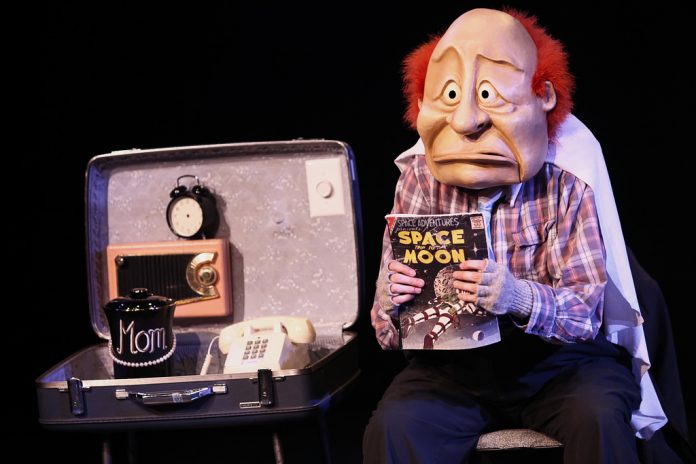
You wouldn’t think that one person in a full-face mask not speaking for almost an hour would be an entertaining show, but this melancholic story about a man who falls in love with the moon was incredibly moving. Wonderheads, a physical theatre company from Portland, brought Grim and Fischer to The Cultch last year, and it was so popular they’re back again this season with Loon.

Kate Braidwood plays Francis, a lonely janitor searching for love. He compulsively calls to see if he has any voicemails from his phone dating service, but he is always left disappointed. While finding solace in a comic book from his childhood, the power goes out and the moon is the only light he has. Thus begins his bizarre courting of the moon as he pulls it down from the sky and brings it home.

The set was very simple with only a chair and suitcase on legs that opened up to reveal a phone, alarm clock, light switch, and radio. There were also a set of curtains off to the side that Francis could look through to gaze at the moon — a large white ball lit from the inside.

When Francis brings the moon home, it begins to shrink and he must set it free or lose it forever. During this time, radio broadcasts report on the extreme weather and abnormal tidal patterns that are wreaking havoc all over the world.

Braidwood’s ability to portray such emotional depth from behind a static face mask was impressive. Her body language and gestures conveyed so much meaning that I almost forgot that the mask’s facial expression was a permanent state of dismay. Looking at the giant frown on Francis’ face, his bright red hair sticking straight out, was surprisingly humbling.

Loon is presented by Wonderheads Theatre at The Cultch from November 18 to 23. For more information, visit thecultch.com.


christmas-queen

Christmas Queen – Theatresports

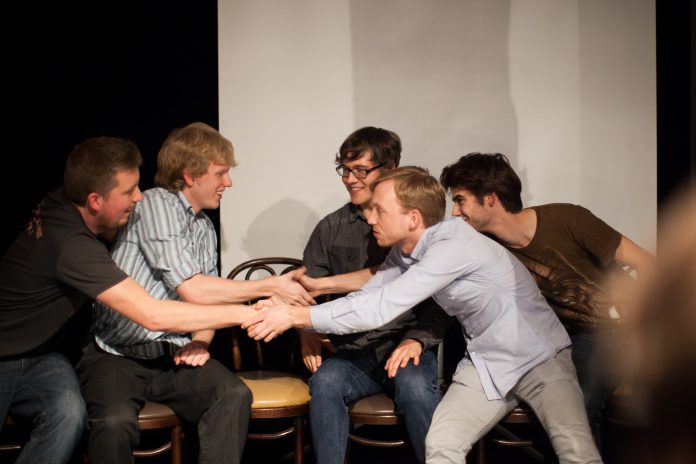
If improv and pantomime had a child, it would be Christmas Queen, an “improv comedy fairytale.” This magical story is brought to life each night through audience suggestions and a spunky narrator, who guides the action as the evil Christmas Queen tries to ruin the holiday for everyone. In true pantomime fashion, the audience is told to boo every time the Queen comes on stage, and the Queen is played by a man. This character, with overly perky fake breasts and classic pantomime makeup, is hilarious on its own. With the addition of the other improvised characters and a crazy plot of random elements, the night is guaranteed to be entertaining.

On opening night, the story was set in the town of Florale, where a cat breeder was having trouble getting her cats to mate, a German man was very proud of his borscht, and there were flowers everywhere. The lawn dart toss which kicked off the Christmas season was officiated by the mayor, and romances were blooming.

The Christmas Queen, up on her mountain and emulating the Grinch’s bah humbug demeanour, decided that she would ruin Christmas by contaminating the flowers of Florale with Monsanto seeds. The epic battle between the Queen and the townsfolk involved a look back at the Queen’s past attending Avon University.

Of course the plot sounds bizarre, but that’s what makes the show so much fun, along with watching the improvisers try to come up with jokes on the spot and make fun of each other and the audience as they perform.

Christmas Queen is presented by Vancouver Theatresports from November 19 to December 21. For more information, visit vtsl.com.

Police make arrests at Burnaby Mountain protests

1
As of 10:30 a.m., at least 12 individuals were arrested after refusing to leave the sites.

Police arrested at least 12 pipeline protesters on Burnaby Mountain this morning beginning at 8:00 a.m. and ordered the remaining protesters to move their camp or face arrest.

A dozen officers arrived at the site to read off the injunction, after which they arrested four protesters who remained in the camp.

Many of the remaining protesters moved across the road as directed by the police, but it remains unclear whether or not the protesters at the second camp, which lies deeper in the woods, will be arrested.

One protester has rigged themselves up in a tree above the second site and is refusing to come down.

The road leading up to the protests at Centennial Way and Burnaby Mountain Parkway continues to be blocked by police and reporters have been ordered to stand behind tape laid out by police.

The police have also set up a perimeter and an area in which protesters are allowed to be present

Although he is out of town speaking at events this week, Stephen Collis, the spokesperson for the protesters and an SFU professor, posted in the Stop Kinder Morgan on Burnaby Mountain Facebook group today, “Strength and love to all on this difficult day.”

Kinder Morgan released a statement at 1:00 p.m. today regarding the resumption of work: “As of 12:45 p.m., Trans Mountain staff and contractors have arrived at Burnaby Mountain to begin preparing the work sites for our geotechnical field studies.”

In the statement, the company expressed that it was “pleased that the majority of the individuals occupying the area complied with the order and continue to exercise their rights to express their views in a respectful manner, while allowing [their] team to begin the work safely.”

The crews will dismantle the blockade and hand over any items it finds on the sites to RCMP.

This story is currently breaking and will be updated as more information becomes available.

Pipeline protesters gather despite Kinder Morgan injunction

0
Protesters gathered in the Burnaby Mountain Conservation Area on Monday, November 17.

Want to add an aural element to your reading experience? Listen to CJSF’s recordings of protester singing and interviews:


Pipeline protesters gathered once again at survey sites in the Burnaby Mountain Conservation Area yesterday afternoon in response to the injunction granted by the Supreme Court last Friday that declared all protesters had to vacate the sites by 4 p.m. on Monday, November 17.

Shortly before 2:30 p.m., Kinder Morgan crews, accompanied by police, arrived at the main protest camp to read out the court order, which requires the protesters to leave the survey work areas. After 4 p.m., it would be illegal for protesters to interfere with the company’s survey work for the Trans Mountain pipeline expansion.

By the 4 p.m. deadline, approximately 300 concerned citizens had gathered in the park

However, this announcement did not deter crowds, and by the 4 p.m. deadline, approximately 300 concerned citizens had gathered in the park and on the hill opposite the first borehole site. No additional police arrived to remove citizens from the sites.

Burnaby RCMP Staff Sgt. John Bois told media that they had no plans to make arrests related to the injunction on the Monday.

“While we are under a court directed enforcement order, it does recognize our authority of discretionary powers,” said Bois. “This discretionary authority allows police to take time to assess the situation.”

Some protesters are still prepared to outwait the police and crews, even if it means their arrest.

“The [First Nations] people are a peaceful people, but we’re also the guardians of the land and the sea. And Kinder Morgan does not have our consent!” exclaimed Sut-Lut, a Coast Salish elder. “And to you, my humankind family, [. . .] I am willing to go to jail for you.”

“Kinder Morgan does not have our consent!”

Sut-Lut, Coast Salish elder

Along with Sut-Lut, several First Nations representatives were present to speak to the crowd.

“I have to meet my ancestors one day and talk to them, and explain to them what I did with what they gave me,” said Kelsilem from the Squamish Nation. “This land doesn’t belong to me. This land doesn’t belong to any of us. We belong to this land.”

He continued, “It’s time that we start to reach out and bring other people to march with us. Because we will win this fight, we will stop this pipeline. It will not happen on these lands, I guarantee you that.”


Find more images of the protest in our gallery below

[huge_it_gallery id=”3″]

The costumed campus

3
Gorillas and terriers and bears, oh my!
We've come a long way, baby.

“I think the mascot is dead.”

That’s all the opposition’s radio announcer could say about what he had just witnessed. It was a timeout in the first half of a Clan basketball game in the spring of 1996, and the gym fell dead silent as one of SFU’s central figures was injured. Yes, laying unconscious on the ground was the dilapidated, ratty, smelly, yet beloved SFU Gorilla.

His clearly unrehearsed attempt at a trampoline slam-dunk — resulting in his head connecting directly with the rim and causing him to fall backwards onto the ground — was a sight the crowd had never seen before.

The idea of a crazy costumed character causing a ruckus on campus, however, is a scenario that is all too common at SFU.

SFU’s mascot didn’t die that night. In fact, he wasn’t really even an official mascot. However, the moment is indicative of this school’s bizarre costume culture, which seems to see a constant rotation of strangely dressed figures taking up residence on Burnaby Mountain.

For almost 50 years, creatively costumed individuals have roamed SFU’s halls, revved up our sports fans, and even occasionally dated our presidents. SFU may be a “commuter school,” but if you stay long enough, you might just notice that it’s also a “costumer school.”

Radical Costumes

The need for a mascot at SFU was recognized almost immediately. Unfortunately, recognition is far from realization.

The very first issue of SFU’s original student newspaper, The Tartan, printed in September 1965, included an exciting announcement for a contest to choose a campus mascot. Although the ad promised a prize that was “too fabulous to put in words,” the editorial staff seem to have never determined a winner, and the contest was never mentioned again as the paper folded within six issues.

The idea of a crazy costumed character causing a ruckus is a scenario that is all too common at SFU.

The early years at SFU certainly weren’t an ideal time to have a mascot. The radical nature of the school’s formative years made pretty much everything fair game for mockery and dissent. The few costumed individuals who turned up in the first decade of SFU’s existence were far stretches from the big, cuddly dog we have today — most were pranksters looking to raise a little hell every now and then.

It would take more than a decade before any costumed character would truly win the hearts of the student body.

Great Bear on Campus

In comparison to most schools, the number of yearly visits SFU receives from bears is relatively high.

While the usual suspects have always been black bears from the surrounding forest, beginning in the summer of 1976, the school would become a frequent hotspot for an entirely different sort of ursine guest, native to a local fast food chain.

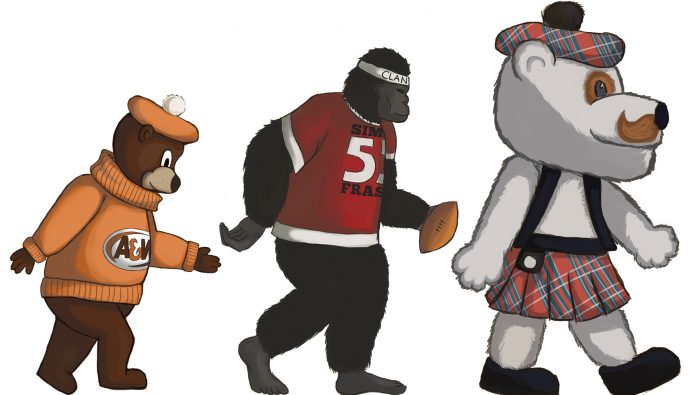
In 1974, popular restaurant A&W first introduced their large, cuddly orange-sweater-wearing brown bear mascot, the “Great Root Bear,” in a series of TV commercials featuring a catchy tuba jingle. Within two years, the Great Root Bear was already ‘Ba-Dum, Ba-Dum’-ing his way up to SFU, and soon found himself fraternizing with some very prominent people on campus.

At an event that took place near the swimming pool in March of ‘76, a photograph was snapped that showed the Root Bear holding hands with SFU’s then-president Pauline Jewett.

It was the beginning of a nearly year-long love affair.

Of course, it wasn’t a real ‘love affair’ but it would be reported as such in the campus’ pesky student newspaper The Peak, whose editors used the photo to create an elaborate long-running joke about the pair. Inspired by the wacky antics of Monty Python and a burning curiosity about the personal life of their ‘spinster’ president, co-editors Lee Rankin and Brian McDonald published stories in the newspaper throughout the summer chronicling Jewett and the Great Root Bear’s ‘relationship.’

It was a rocky romance to say the least, with the couple constantly breaking up and denying their involvement with each other. The two apparently disagreed fervently on a campus strike taking place, and the Root Bear is quoted by The Peak as dumping Jewett due to her “bleeding heart liberalism.”

The prank finally came to a dramatic climax in the fall of that year when the editors of The Peak took advantage of A&W’s promotional services and had the mascot come to a council meeting to present the president with a bouquet of red roses.

Jewett was good natured about the entire event and jokingly expressed some reservation about making the relationship so public before taking the flowers and denying the bear a kiss.

While at the time the story was determined worthy enough to make the cover of the November 10, 1976 issue of The Peak, Rankin looks back on the whole thing as “pretty adolescent.”

SFU students would continue to make use of A&W’s mascot — the Root Bear appeared at a variety of functions in the late 70s and early 80s, but as far as the public was concerned he kept his paws off the president from that point on.

Dawn of the Ape

Since its inception, SFU has had a strong Scottish connection. The school is named after scottish explorer Simon Fraser, the first ever gift SFU received upon opening was a broad Scottish claymore, and the Athletics nickname “Clan” has its roots in the term for a kinship of people from Scotland. Finally, in the mid-1980s, they added the final piece of the puzzle: a gorilla mascot.

Wait, what?

While the origins of the SFU Gorilla — the Clan’s unofficial official mascot for more than a decade — aren’t very clear, it’s most commonly speculated to be due to the fact that someone happened to own a gorilla suit. But whether it was an old Halloween costume or a Salvation Army deal, when the suit got into the hands of Athletics marketing head Rod Harrison, a legend was born.

A photograph was snapped of the Root Bear holding hands with SFU’s then-president, beginning a nearly year-long love affair.

Its cloudy origin story is befitting of a mascot that has been played by so many different people over the years that almost everyone who did it swears that they were one of the first. Beginning around 1985, this plain, ratty gorilla suit with holes in its knees was used sporadically. For years it was mainly worn at the corner of Gaglardi and Burnaby Mountain Parkway, and only occasionally at important games.

In the early 90s, the suit was still being shared by a number of different performers: some game recaps describe a Gorilla sometimes capable of doing backflips, but other times barely able to stand without falling on his head.

In 1993, the costume passed to a young business student named Victor Tamm, who accidentally became the first regularly performing mascot in the school’s history.

Gorilla Mountain

Two weeks into his new job as assistant to head of Athletics marketing Rod Harrison, Victor Tamm was given a rather odd job, even for an intern.

Harrison happened to be on vacation at the time, and when the Clan faced off against UBC in an early preseason basketball game, Tamm was told that “someone normally gets in the Gorilla suit.” He happily obliged, but didn’t quite understand that he wasn’t expected to fill in for every game.

Tamm borrowed a jersey from men’s basketball head coach Jay Triano, put on a headband, bought a $20 drum, and showed up to every single game cheering his heart out. Both Triano and women’s coach Allison McNeill were so delighted by the life he brought to the crowd that, upon his return, Harrison told the intern he “now had a full-time job.”

Tamm developed a routine which saw him banging his drum along to Queen, air guitaring on his back like Angus Young, and giving away t-shirts to the crowd, all of which helped evolve the Gorilla into a real mascot.

He also helped promote SFU sports by running around campus in the suit, showing up in residences and around the AQ, and urging people to go to games. His efforts were a huge success, and the Clan soon doubled attendance to their basketball games.

The Gorilla was a star attraction, especially to elementary and middle schoolers who attended the games in droves at the time. Tamm printed out a few photos of the Gorilla in action and soon he was facing hordes of tiny followers, asking for his autograph at every game.

The Gorilla would even take a few trips off the mountain, travelling with the basketball team to a playoff game in Washington where American fans made Tamm fear for his life, attending Vancouver Grizzlies press conferences, and appearing in a Canucks game intermission show.

At the Canucks game, Tamm had a run in with the UBC Thunderbird. Before their scrimmage hockey game, Tamm told the T-bird to take it easy on him since he’d thrown his shoulder out.

When the UBC mascot didn’t listen, the Gorilla beat him up in front of the entire Pacific Coliseum. Tamm says it was easy to get the best of him since his lack of a big-head made him freer in his movements, so he could make it look like he was wailing on him with abandon.

As Tamm’s successor would soon learn, being inside the Gorilla costume had its advantages, especially when it came to UBC attacks.

Great Ape Escape

While Tamm would secure a job at the termination of his internship, his legacy as sports marketing intern created a brand new requirement for the position.

According to James Phillips, who took over Tamm’s job in the fall of 1995, one of the main interview questions was: “do you fit into a gorilla suit?” Phillips did, and was immediately thrown into the fire with a novel challenge: he was a first-time mascot going to the Shrum Bowl.

Held almost annually until 2010, the Shrum Bowl was SFU Athletics’ premier event. It was the one time a year SFU played football against UBC, but what occurred on the field was often a sideshow to what took place in the crowd. Alcohol consumption was high, mustard and ketchup bombs were always on hand, and mascots were clear targets for mischief.

In 1993, the Gorilla’s head was stolen by some UBC fans during a game held on SFU turf, so when Phillips made the trip out to Thunderbird stadium for the ‘95 instalment he knew he was in for a treat.

McFog’s head was so large that it caused the person inside it to frequently tip over, rendering them almost immobile.

It only took a single snap before the UBC Thunderbird ventured over to taunt SFU’s fans. In an ill-advised choice, he specifically targeted the SFU wrestling team. Apparently, the mesh fence separating them was nothing for 10 wrestlers, all of whom broke through and gave the UBC mascot a good pounding.

Phillips, the opposing mascot, was soon charged by a number of vengeful UBC fans. He tried to swat them away with his drum but was eventually overwhelmed.

Pulled out of the dogpile by security, both mascots were escorted from the stadium. Even away from the game, Phillips said that the Thunderbird continued to challenge him to a personal fight, because his drum had allowed him to avoid the injuries the Thunderbird had sustained.

Phillips’ job settled down after that, although the Shrum Bowl incident did help inspire him years later when he co-produced and co-directed a documentary entitled Behind the Mascot, which premiered at the Toronto Film Festival in 2004.

After Phillips was hired as head of marketing, the costume was passed on to a rotating group of athletes — after all, it seemed wrong to have a prominent professional staff member continue to wear the Gorilla suit.

A young track athlete named Hidayet Arslan wanted to take the Gorilla’s basketball routine up a notch. He asked if he could perform a slam dunk off a trampoline during the game’s first time-out, and Phillips said “great,” without thinking twice. He showed up to the game and witnessed what is still the most talked-about mascot blunder in school history.

Although Arslan did return to the game after slamming his head into the baseboard, the first ever rule for SFU’s mascot was instituted: no trampolines. This didn’t turn out to be an issue, as developments were already underway for the creation of new mascot, who would not only be incapable of dunking, but would hardly be able move.

Foggy Dog Story

In 1995, a major shift occurred in SFU’s Athletics department when inaugural director Lorne Davies retired after 30 years on the job.

New athletic director Mike Dinning came in with a desire to break down the barrier between varsity athletics and recreation. He sought to remove the exclusivity of Clan Athletics apparel and make it available for purchase by any student.

Before Dinning could open his new sports shop, however, SFU’s logos and image had to go through a rebrand because, well, they were all stolen.

The Clan’s primary logo at the time was a exact replica of the NFL’s San Francisco 49ers’ interlocking “SF,” slapped in front of a maple leaf instead of an oval. The Gorilla also posed problems, not only because the NBA’s Phoenix Suns already employed a similar mascot, but also because Dinning agreed that it made absolutely no sense.

Dinning and a committee which included former-Gorilla Phillips started working with graphic designer and SFU alumnus Clay Yandle to design a new mascot. Finally taking the school’s Scottish tradition into account, a Scottish Terrier was chosen in 1996 as the unanimous choice for the new mascot; his name was McFog the Dog.

The perfectly rhymed name was suggested by SFU Athletics staff member Margaret Jones, who borrowed the nickname of Patrick McTaggart-Cowan, SFU’s inaugural president. McTaggart-Cowan earned his nickname during World War II as chief meteorologist for the RAF Command. After an extended period of poor weather, aviators started to call him “McFog.”

Combined with the tongue-in-cheek reference to Burnaby Mountain’s normal state of clarity, Dinning loved the name and Yandle submitted two separate McFog designs, one aggressive and angry, and the other one more child- and family-friendly.

Dinning chose the latter, but while McFog’s image was being sold on everything from water bottles to t-shirts at the new sports shop, students were less than impressed by him. Many felt that the new kilt-wearing, mustachioed terrier was simply not intimidating enough.

One Peak writer claimed to have seen McFog “taken down from behind and mugged by three pre-teenagers” and lamented that he wasn’t forced to enter into a cage match against the Gorilla to earn his place.

Another source of ridicule and difficulty for performers was McFog’s enormous head. It was so large that it caused the person inside it to frequently tip over, rendering “McFog the Log” almost immobile.

While McFog was also treated to a Shrum Bowl assault in his first year, keeping up with tradition, his need for a handler and difficulty moving didn’t allow him to pump up the crowd like the Gorilla did. By 2003, McFog was gone.

While there are a number of rumours about what happened to McFog in 2003, lack of popularity and waning interest in mascot maintenance are the most likely factors in Athletics’ decision to discontinue McFog at the time. The Dog would not be put down for good, though — he soon returned with a brawnier physique, a fresh attitude, and an extra ‘g.’

McFogg the God

In an attempt to strengthen community spirit at SFU, Student Services acquired the rights to McFogg’s image in 2008. Yandle was once again tasked with updating McFogg, keeping his family-friendly vibe while making him more ferocious with a more muscular frame.

Student Terry Forst, an active member of orientation and student life at SFU, would be the first person inside the new McFogg suit. He rotated mascot duties between a group of students, bringing new consistency to McFogg’s exaggerated movements by teaching movement classes with a friend from the theatre department.

The new costume was not without its problems, however, and Forst found himself in a bit of an embarrassing situation at an open house event in May 2008.

As he started to walk through Convocation Mall, Forst became acutely aware of the fact that he was skinnier than the recommended waist size of the costume when his velcro kilt slowly started to slide down to his knees. While trying to let his handler know of the situation without speaking and ruining the illusion that McFogg was a real giant anthropomorphic dog, SFU’s mascot flashed the crowd.

Suspenders were added to McFogg’s look following the incident, and he has avoided exposing himself ever since.

After a successful run under the watch of Student Services, McFogg returned to Athletics in 2010 and can be seen at most varsity sporting events as well as any student event that requests his presence. However, the McFogg costume still doesn’t allow for the most agile of performances.

A handler is required, the person in the suit can’t stay in the suit for over 20 minutes without a long cooling break, and the head still contains a rather bulky fan, but McFogg has finally found a place in the community’s heart.

While his technical challenges have contributed to McFogg being an ‘inside dog’ that isn’t allowed out much for football games, he does keep up with his duties and even has his own Facebook and Twitter pages.

McFogg isn’t alone on campus these days in the crazy-costume game. While they may not realize it, many students have continued the traditions pioneered by the Gorilla and even the Root Bear.

The most notable of these are the SFU Power Rangers, a group of students joyfully mixing promotion for student government with 90s nostalgia and super-tight spandex. Besides promoting EDM concerts, passing out candy and unintentionally giving freshman girls lessons on the male anatomy, they’re joining a long, costumed battle against SFU’s ‘no-fun’ reputation.

So before you dismiss SFU as a concrete prison, maybe just pick up an odd costume, put it on, and embrace everything this place has to offer.


SFU alumni compete in CBC ComedyCoup competition

0
Heir Heads and Human Town hope to make the final five, which will be announced on Nov. 24.

Current SFU students aren’t the only ones feeling a little stressed out and over-worked right now. Although they may not have final exams to worry about, four SFU alumni are pulling all-nighters to compete in the CBC’s ComedyCoup competition.

The contest, in which Canadian comedy creators work towards developing an original show concept by advancing through a 10-week series of challenges, was narrowed down to the top 15 on November 10.

Two entries still in the running, Heir Heads and Human Town, feature creative teams comprised of former SFU students who say that the competition rivals a students’ hectic study schedule.

“Work usually goes from 9 until 4:30 and ComedyCoup goes from 4:30 until forever,” explained Dylan Innes, who created Heir Heads along with his brother Taylor. “All weekends, all evenings, all consuming.”

Originally conceived as a starring vehicle for the two men, Heir Heads is the story of two anti-genius brothers who must make a million dollars in order to earn their deceased father’s billion dollar inheritance. As the project developed, the two decided to have their parts played by acclaimed local actors Ryan Beil and Bruce Novakowski.

For the Innes brothers, who are two years apart, comedy is something they’ve been working on both separately and together since they were in high school. While they’ve taken some breaks, they’re all in now.

“I did four years of dramatic films and then I graduated and said, ‘Well that’s out of my system,’” Innes explained about his time in the SFU film program. “We haven’t done anything but comedy since.”

Taylor, on the other hand, studied towards a psychology degree at SFU, and while he laughed at it being considered a “hilarious faculty,” he says it has enhanced his writing abilities.

“It helps just to understand characters and what makes sense for someone to be doing or saying,” Taylor explained. “Character continuity is important in these shows.”

Kajetan ‘Ki’ Kwiatkowski and Kane Stewart, the two SFU alumni who are part of the six-headed sketch comedy beast known as Human Town, also started their journey to the Coup as high schoolers, before continuing on to SFU’s film program as classmates.

“We took a video course in grade 8 and made funny stuff, and it was popular enough that we decided to keep doing it,” Kwiatkowski told The Peak.

He explained that they’ve been working on their unique sketch show ever since. The show features linked sketches and recurring characters, all set in the fictional world of Human Town.

When the ComedyCoup contest came along, they jumped at the chance to gain more exposure, although they too have felt the intense pressure of the contest.

“Basically you have to accept that you’re going to sleep when you’re dead,” Kwiatkowski said. “You get home, eat and then [immediately think about] what are we going to shoot next, what props do we need, and the next day we shoot it. Then we have to edit it. It’s a go, go process.”

As for an inter-SFU rivalry, Kwiatkowski says there isn’t one and that he’s rooting for the Innes’ project just as much as his own.

“I’d be just as glad if [Heir Heads] won as us,” Kwiatkowski explained. “I love those guys and I think they actually have a really good idea and all their videos have been strong.”

The prize of the competition is $500,000 to create a half-hour comedy special to be broadcast on CBC prime time in the fall of 2015. The top five will be announced on Monday, November 24.

SFU receives donation for autism research

0
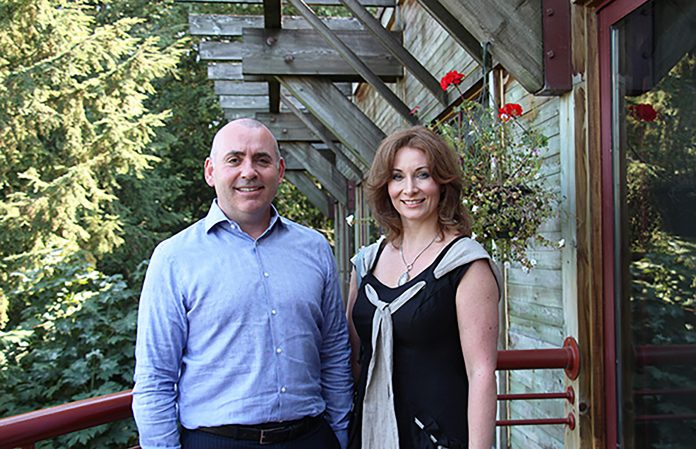
Darryll and Lee Frost began searching for treatment options after their son was diagnosed with autism in 2012.

Darryll Frost and his wife Lee have donated $500,000 to SFU to support research on atypical brain development and the potential for oxygen therapy to treat autism.

In 2012, when their then three-year-old son Callum was diagnosed with autism, the Frosts scoured the internet for information about autism therapy. One of the more sophisticated and expensive therapies they tried was hyperbaric oxygen therapy (HBOT).

Coupled with a massive change in Callum’s diet, the intensive HBOT therapy had impressive results. “After three months, he started talking in sentences. He was compliant. His behaviour was really calm. And we realized that he was going to recover from autism,” said Lee Frost.

However, these hyperbaric chambers are not regulated, and some parents  purchase them for private use. Because of this high price tag, the pair decided to raise money in order to fund research to prove the science behind the treatment.

In May, Central City launched its Imperial IPA for Autism beer, with $2 from each bottle going to fund the SFU donation. Along with other fundraising initiatives, the two were able to raise $100,000 over their $400,000 goal.

The $500,000 donation will be used to establish the Callum Frost Professorship in Translational Research in Autism at SFU.

Peter Ruben, associate dean of research in SFU’s Faculty of Science, explained the importance of conducting research on previously unregulated medical therapies: “Tragically, people have died from these home hyperbaric chambers, so what we’re trying to do with this research is first figure out if it works to treat autism and other brain disorders.”

He continued, “Then [we will] try to get a handle on what specifically needs to happen for hyperbaric oxygen therapy to be effective.”

Instituted in 1981, the hyperbaric chamber at SFU is the only chamber in a Canadian academic institution that can be used for research. Chambers work by filling with air at a higher atmospheric pressure and a higher oxygen concentration, and have been used to treat diving disorders such as decompression sickness.

Although there has been some research done on the effects of HBOT on ‘normal’ brains, there hasn’t yet been a careful case-control study of the effects HBOT on autism.

“We don’t really know how it works or, for that matter, whether it works,” Ruben said. “One could hypothesize that HBOT increases the amount of circulating oxygen in the blood and therefore increases the amount of oxygen going to the brain.”

The hypothesis is that this would have a positive effect on tissue that has been damaged through traumatic brain injury or has not developed normally. “We can only guess that this increased oxygen concentration would help that brain tissue function more normally,” Ruben explained.

The newly established professorship will allow the university to add a faculty member who will specialize in studying brain disorders in general and autism in particular. Ruben said that he hopes to finalize the employment search soon, with the newly hired researcher beginning sometime in the next year.

Ruben emphasized how grateful he was for the support from the Frost family: “I think it’s going to be a really neat opportunity to put SFU on the forefront of this in terms of research.”

For the Frost family, they hope the research will support other families who are living with the daily challenges of autism. “We’re hoping that it enables other children to have the treatment and make the same progress as Callum,” concluded Lee Frost.

Clan football sends off seniors in final game

0
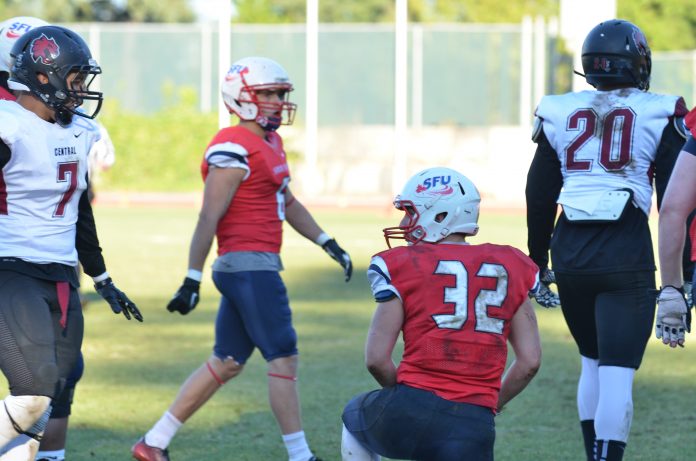
Running back Stephen Spagnuolo put up 136 all-purpose yards in his last game in a Clan jersey.

When eight points are scored on an opening drive, it’s considered a great offensive start. However, those points usually go to a single team; this wasn’t the case last Saturday.

The Clan looked to be headed for a promising start — a rarity for SFU — on Senior’s Day against the Central Washington Wildcats. Quarterback Ryan Stanford threw a 40-yarder to Lemar Durant, right after tossing one for 15 yards to running back Stephen Spagnuolo, bringing his team to the goal line on their first drive.

Although the Clan have a tendency to miss opportunities in the end zone, this time they followed through, putting up a six-point lead, with Spagnuolo finishing the drive. Normally, six would become seven with the extra kick point, and the Clan would have actually started with positive momentum.

Instead, the Wildcats blocked the kick and ran it into the other endzone, a rare occurrence worth two points for Central Washington. SFU was still in the lead — by four points — but all that positive momentum for the Clan dissipated.

A great initial push turned into another flat first half, with the Clan unable to put another point on the board until the fourth quarter — and allowing 37 points before then.

Head coach Jacques Chapdelaine speculates that the Senior’s Day festivities — which honoured 19 seniors playing their last game in a Clan uniform — contributed to the weak start.

“It’s a long day, it’s a different day, the Senior’s Day, and especially [since] we’re honouring 19 guys, which is a really large graduating class. So it does bring down [the energy] a little bit,” he explained.

Spagnuolo, who was among the seniors playing their last game at SFU, said, “We came out flat and we didn’t play well in the first half.”

However, despite being down 30-6 at the beginning of the fourth quarter — which 15 seconds later became 37-6 — the Clan did not go quietly. They put up 21 points in the fourth, and allowed only 10 in the whole second half.

Spagnuolo, whose 136 all-purpose yard performance was a key contributor to SFU’s final stand, explained, “If you would have told me that I’d come out of here with a 40-27 loss [feeling happy], I’d probably think you’re crazy.”

Spagnuolo looked solid on the field, but he explains he was nervous entering his last game with the Clan: “I had a lot of mixed emotions going in, more nerves than I’ve ever had in my whole entire life. I couldn’t even eat breakfast this morning, because [I had] so many nerves. But once I got out here and I saw all my buddies, I was relieved and ready to play football.”

In a game that looked poised to become a blowout — much like the Clan’s first loss to the Wildcats with a score of 63-7 — the defence tightened up, not allowing a single score by the Wildcat offence in the third quarter.

DSC_9456


In the second quarter, when starting quarterback Stanford went down with a clavicle injury, backup Tyler Nickel was pulled in favour of third-string quarterback Mitchell Rushton. However, Chapdelaine put Nickel back in for the second half, where he played a key role in SFU’s resurgence, throwing two touchdown passes and running one in himself.

“I thought [Nickel] was a lot better, to say the least, than in the first half,” explained the head coach. “If they’re not established starters, they don’t see themselves in that role, and you always have to prepare yourself like you’re going to be playing.”

With 13:08 left in the game, Nickel put SFU back on the score sheet with a 25-yard pass to senior wide receiver Bobby Pospischil.

Though the Wildcats would score one more field goal to round out their points to 40, the rest of the game was all Clan. Nickel ran the ball in for 20 yards on the third down for the team’s third touchdown.

The last of the game — and a great closer to a less-than-stellar season — came with only 30 seconds left. The drive, which included a last 28-yard pass to senior Pospischil, ended with Nickel throwing it one last time to Spagnuolo for the game’s closing touchdown, concluding the game at 40-27 for the Wildcats.

“Every time you go in and you meet with a little bit of adversity [. . .] we learn something from it. I think we displayed that in the second half, we learned and we responded,” said Chapdelaine.

Although SFU could not manage the full comeback, they sent off the seniors with a great fourth quarter performance, and ended the season on a high note.

Now, Chapdelaine has a heavy task ahead of him: filling the spots left by the 19 departing seniors. Listing both the offensive and defensive lines as focuses of recruiting, he explains that he has already begun the process.

Said Chapdelaine, “We’ve already made eight offers [. . .] We’re very aggressive in what we’re doing, and we’re looking forward to getting some great student athletes into our school.”

While the team looks to fill his spot, Spagnuolo looks ahead to his future after the Clan.

“I’ve got to plan out my life now,” explains the 5’9 Vancouver-born running back. “I’ll try and pursue the CFL draft, if that doesn’t go well I might try and play football in Europe, and if not I’ll be a teacher.”