
[ninja_forms_display_form id=2]
University Briefs

110 million-year-old crab fossil discovered by University of Alberta researcher
The fossil of a 110 million-year-old crab was found in the Colombian tropics by University of Alberta PhD student Javier Luque.
The species of higher true crab, Telamonocarcinus antiquus, dates back to the Early Cretaceous period and has challenged the previous notion that crabs were not as diverse or widespread during this era.
This discovery, Luque said, adds much-needed knowledge about the early evolution of this particular group of crabs and how early branches of the crab family are connected those of the present day.
With files from The Edmonton Sun
Brock University professor publishes paper in new autism journal
An educational assistant professor at Brock University has become one of the first researchers to publish a paper in an online journal that focuses on developmental disabilities.
In the first issue and volume of the Journal of the Division on Autism and Developmental Disabilities (DAAD), Kimberly Maich, along with her associate Carmen Hall of Fanshawe College, presented their research on how the use of an iPad by a nine-year-old girl with autism to keep track of her school schedule helped decrease off-task behavior between learning activities.
In her research paper, Maich argues that since autistic people are visual thinkers, an iPad lessens this “latency” by presenting vivid images of scheduled activities for the autistic child to follow.
With files from Brock News
A final project, and a business opportunity to boot!
Ryerson alumna Ivonne Serna has co-created Tycra Wear, which features winter boots with a twist. These boots can be customized using a detachable calf tube, which can be replaced with a bigger or smaller size tube.
“You could have different combinations of styles and colours. You could just change the tube and have a complete boot makeover,” Serna told The Eyeopener.
Tycra Wear started out as Serna’s final year fashion project, and has now turned into an entrepreneurial opportunity for her and her husband. Using Kickstarter to launch their boot campaign, the husband-wife duo has set a goal of $84,000 to be met by January 23, 2015. If Tycra Wear fails to reach this goal, all the money pledged will be returned to donors.
With files from The Eyeopener
Samuel Beckett at his best

Written in 1956, All That Fall by Irish playwright Samuel Beckett has never been professionally produced in Canada, until now. First broadcast on BBC radio, Beckett never allowed the play to be produced on stage. He insisted that it was meant to be heard, as it was better if the audience could imagine the story for themselves. The Beckett estate recently allowed for the play to be produced on stage, but only as a radio play.
Comparing a radio play to a stage play is like comparing a book to a film — one must imagine what everything looks like, and picture the story unfolding in one’s mind. A radio play produced on stage is a bit strange because we are watching actors on stage, but they aren’t really acting anything out so much as reading their lines as if they were the voices for an animated film. I found watching the actors on stage distracted my mind from the task of picturing what was happening, and it was almost better to close my eyes and just listen.
The play’s title comes from Psalm 145:14 of the King James Bible: “The Lord upholdeth all that fall, and raiseth up all those that be bowed down.” When the main character, Maddy Rooney, says this line, she and her husband roar with incredulous laughter.
An abstract portrait of Beckett presided over the stage as the actors brought this story to life through dialogue and sound effects. As with Beckett’s Waiting for Godot, this is a play with little plot or action. Maddy Rooney grumbles along to meet her blind husband, Dan, at the train station. She meets a few interesting characters along the way, including Mr. Slocum, who gives her a lift, and Miss Fit, a religious woman who describes herself as “not all there.” Dan’s train is delayed for an unknown reason, and as the Rooneys take the long walk home from the station, Dan refuses to tell Maddy what the holdup was.
Despite very little happening in this play, the grim comic demeanour of Mrs. Rooney holds your attention for over an hour until the surprising conclusion. Mr. Rooney remarks repeatedly, “If I’m alive tomorrow,” and there are many matter-of-fact references to death and aging that foreshadow the gruesome ending. Ultimately, the play’s dark humour and Mrs. Rooney’s bleak outlook is what makes this classic both entertaining and profound.
Blackbird Theatre presents All That Fall at The Cultch from December 29, 2014 to January 24, 2015. For more information, visit thecultch.com.
Ryan Hemsworth resists pop music with Alone For The First Time

Ryan Hemsworth’s 2014 release, Alone for the First Time, maintains his trademark eight-bit, intimate bedroom electronica that fans have come to love, while simultaneously painting a more personal picture of the artist than previous releases.
Winning Electronic Album of the Year at the Juno Awards in April has not affected Hemsworth’s style. “The Juno has helped with regards to recognition, but the music itself is not reflected by it so to speak,” Ryan says over the phone on a quiet morning in Toronto. As the album opener, “Hurt Me,” begins with a lovely synth-string melody that reflects those sentimental soundtracks of video games like Final Fantasy, you find yourself immediately pulled into a space that is simultaneously wondrous, yet lonely and somber. Fans will find it a lot quieter than his previously R&B, pop-melody inspired Guilt Trips, and frankly, that is not a bad thing.
As the glockenspiel and xylophone samples drive over sustained fuzz synths in tracks like “Snow In Newark” and “Blemish,” there is a sense of self-reflective comfort that could be equaled to wrapping yourself up in a blanket on a cold winter day. Aside from the vulnerable voice chorus’ that plead for lost love in “Walk Me Home” and “Surrounded,” Hemsworh is capable of producing a surprisingly humanistic feel that tends to be difficult to find in electronic music.
“Other than the fact that this album was mostly produced by myself in dark hotel rooms, I try to add some live instrumentation in to add that humanistic quality — the guitar in ‘Blemish’ was me playing guitar and some of the drum samples are complicated pieces of a live drum kit that I’ll mesh together,” explained Hemsworth.
The lonely, vulnerable aesthetic of Alone for the First Time is ironically unexpected. Winning a Juno Award is arguably the Canadian equivalent of winning a Grammy, which any young, up and coming artist would likely desire to reflect on in their following album. However, these potentially boastful, “lean-towards-the-masses” undertones are significantly absent in Alone for the First Time.
“Becoming the biggest artist in the world is not really a goal to me as much as it is to make my own work, and I get how people could react to this based on circumstance, but it’s just not something I really think about,” said Hemsworth. The album does not intend to go against this recognition, but rather acts as an ineffectual nod to the circumstances that may naturally be forgotten as time goes on.
Alone for the First Time proves that Ryan Hemsworth is still the awkward, vulnerable artist that fans have grown to love for his nostalgically warm, bedroom electronica. However, listeners will inevitably leave Alone for the First Time with a feeling that is equivalent to discovering a deer in the forest that flees before you even get to know what it’s truly all about.
SFU administration responds to SFSS concerning international student fees

The SFU administration has officially responded to a letter sent to them by the Simon Fraser Student Society (SFSS) on October 24 regarding the proposed 10 per cent increase in international undergraduate student tuition fees for the 2015/2016 fiscal year.
The letter states that while the administration appreciates the interest the SFSS has taken in the university’s financial situation, they will not institute a ‘grandfather clause’ for current international undergraduates, nor will they freeze the current cost of their fees.
In March 2013, the SFU Board of Governors approved an increase in tuition fees for international students by 10 per cent per year for the following three years. In contrast, domestic undergraduate student fees are scheduled to rise by two per cent per year.
In their original letter,, the SFSS expressed their concerns about the lack of consultation by the university with the international student community, as well as the lack of sustainability of the fee increases to support the university’s increasing operating costs.
“We were pretty disappointed that all of our requests [. . .] were turned down.”
Chardaye Bueckert,
SFSS president
The university responded on December 10 in a letter signed by VP, Academic and Provost Jon Driver and VP, Finance and Administration Pat Hibbitts.
The letter stated that the SFU administration believes the increases are justified by four factors: the university receives no governing grants for international undergraduate students; the fees will allow the university to maintain a balanced budget; the prices are comparable to international undergraduate student fees at other Canadian universities; and international undergraduate student fees will contribute to infrastructure costs, which domestic students otherwise support with their taxes after they graduate.
The letter also stated that the university would not institute a ‘grandfather clause’ that would exempt current international undergraduates from the most recent proposed increase.
In their original letter, the SFSS also requested that the university create a degree completion fund to support international undergraduates, as well as commit to keeping international student fees at current levels for the next five years.
The university stated that they will set aside 25 per cent of the revenues from the eight per cent increase to international tuition for student support, including scholarships and bursaries. However, they explained that they cannot commit to keeping international fees at current levels.
SFSS president Chardaye Bueckert spoke to The Peak about the response.
“We were pretty disappointed that all of our requests, even the one that didn’t entail any monetary contributions or have any monetary consequences, were turned down,” she said, referring to the request to amend the consultation protocol to increase student awareness.
She continued, “We made those requests with the intention of working cooperatively with the university to ensure that, if the fees were increased, that they were the least harmful to students as possible.”
Bueckert explained that the next step for the student society is to approach the Board of Governors before they decide whether or not to approve future increases at their meeting in March.
The SFSS will also make efforts to involve the international student body in the coming months. “We still have quite some time to get organized and to get students involved in that process,” said Bueckert. “So that hopefully the increases won’t be approved as a part of that budget package.”
Original letter from the SFSS


Response from the SFU Administration:


Clan look for new football coach as Chapdelaine resigns

Wednesday evening, SFU announced that Clan football head coach Jacques Chapdelaine has resigned “to pursue other career options.”
Chapdelaine, a Clan alumnus himself, was brought in this past February to replace former head coach Dave Johnson, who was dismissed in November last year. Prior to coaching at SFU, Chapdelaine was an offensive coordinator with the BC Lions and had spent time on various coaching staffs in the Canadian Football League (CFL).
Recent speculation has predicted him making another appearance in the CFL as the new offensive coordinator for the Saskatchewan Roughriders — although neither Chapdelaine nor the Roughriders have confirmed the reports.
Meanwhile, SFU now has to find a new head coach, and will yet again have to move forward recruiting without the eyes of the man who will coach the team.
However, athletics director Milt Richards stated that Chapdelaine left the team in good shape before his departure.
“Jacques Chapdelaine and staff have put the program in excellent shape to succeed,” Richards told the Peak Thursday. “We’re disappointed that he’s decided to move on, but we’ll be fine. We’ll be naming an interim head coach in the next few weeks, and we’re going to start a national search, and we’ll recruit a great coach like we did before.”
The interim head coach will lead recruitment efforts while SFU begins it search for a new coach — which has already drummed up significant interest.
“It’s only been a day, and I’ve already had about 15 people inquire about the position,” said Richards.
As for a timeframe, Richards noted that it took less than 90 days to hire Chapdelaine earlier this year. As well, preference will be given to Canadians or “those authorised to work in Canada” which would speed up the process.
“I’m happy with the process, and it worked before. It worked with Gina Schmidt, our volleyball coach, it worked when we hired Annie Hamel, our women’s soccer coach, and it worked when we hired coach Chapdelaine. And it’s going to work again,” said Richards.
When asked about possible concerns about recruiting without the head coach in place, Richards stated that he was not worried.
“I think the head coach makes a tremendous difference, but I also think think a great university that plays in the NCAA [and] that’s located in Vancouver is very attractive to a lot of recruits,” he noted. “We’ve been talking to some good kids, I think we’re going to continue to do that, and hopefully we’ll win some of those prospects.”
Although he admits that Chapdelaine’s departures creates some new “challenges,” he refuses to call this a setback for the team. Richards is confident that the Clan are trending in the right direction, and will continue to do so under the next head coach.
“I think we’re going to continue to get better,” he stated. “Even though our record was 2-9 this year, I thought we had a good team. We played hard, I thought we were in a lot of games, and I hope to improve on that. And I think we will.”
The Peak is hiring a Business & Advertising Manager

The Peak Publications Society, the student newspaper of Simon Fraser University, is seeking a Business and Advertising manager. This is a unique opportunity to grow your media, business, and people skills within an academic environment where the challenging exchange of thought and ideas is encouraged.
The successful candidate will:
• Manage all of the Society’s day-to-day financial affairs, including accounting;
• Sell and manage the Society’s advertising;
• Have chief responsibility for the Society’s budget;
• Hire temporary employees;
• Advise the Board of Directors on all financial decisions;
• Produce a “diversions/etc” page in every issue.
The Business Manager will also complete a large and varied assortment of other tasks when they become necessary or to compensate for other employees who are unable. The successful candidate will be expected to conceive of additional projects designed to improve the Society and work on them without necessarily being assigned to do so.
The successful candidate will have experience and skill in financial management, accounting, and sales (especially of advertising). Equally important are business and people management skills, as the position works with student groups, editors, and elected Board of Directors. Personal abilities of patience, flexibility, time management within a fast-paced environment that demands daily resourcefulness, a consistent customer service focus, and an ability and desire to fit into the culture of a student organization are also required.
Applicants should have at least 1-2 years of experience in a student publishing/journalism environment. Experience with Sage Accounting software and a class 5 driver’s license will be considered strong assets. The position is compensated with an annual salary of $40,000 plus commission on ad sales, annual support towards medical/dental, generous vacation, and flexible hours.
Please submit a cover letter and resume to [email protected] by 5:00 p.m. PST on December 12, 2014. It is the society’s desire to have a new member of our team hired and in training on December 29, 2014. Further questions may be forwarded to David Proctor at [email protected].
Tony Hawk officially announces his endorsement of the Kinder Morgan half-pipeline
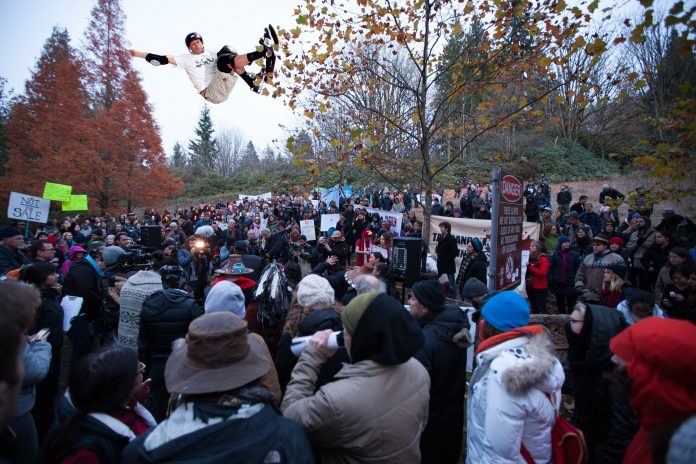
Amidst a sea of protesters and environmental activists this week, skateboarding icon Tony Hawk has publicly announced that he is in favour of the proposed half-pipeline extension through Burnaby Mountain.
If approved, the Kinder Morgan half-pipeline will be the largest outdoor skateboarding half-pipe in British Columbia and the third largest worldwide.
“I’m not supporting this half-pipeline just for me,” a teary-eyed Hawk told reporters this past Monday. “I’m supporting it for my children and for my children’s children. This half-pipeline is for future generations.”
A professional skateboarder from 1982 until his retirement in 1999, Hawk’s pro half-pipeline stance is hardly surprising, but could prove beneficial to energy giant Kinder Morgan, as opposition is ramping up and some take a neutral stance.
On November 7, SFU president Andrew Petter released a statement expressing neutrality on the issue, saying he was really “more of a rollerblades kind of guy.”
Last week the BC Supreme Court granted an injunction to Kinder Morgan to forcibly remove any skater haters or protesters who might prevent further survey work being conducted in preparation of the half-pipeline.
Strongly opposed to the half-pipeline are many environmentalist groups who worry about what impact the project will have on Burnaby Mountain’s ecosystem. Several moms have also expressed a disinterest in the project, wondering why their teenagers couldn’t find a nicer, less dangerous hobby.
“You know, his second cousin Jane broke her arm skateboarding when she was eight,” Travis Bell’s mom, who is against the half-pipeline, told reporters. “Why can’t you just read a nice book or play checkers with your sister instead of skateboarding all over the place?” she asked her son in exasperation.
While Kinder Morgan has yet to make an official statement on Hawk’s endorsement, a press release from earlier this year suggested that the half-pipeline backlash is largely unwarranted and “more of a knee-jerk reaction.”
“People see the world’s ‘half-pipeline’ and they immediately assume the worst,” said a representative from Kinder Morgan. “The reality is that they’re one of the safest means of carrying skateboarders across large distances. If you’re against half-pipelines then you’re against skateboarding. Can you live without your skateboarding? No? Then we have to invest in half-pipelines.”
“I won’t wake up tomorrow in a world completely independent from half-pipelines,” Bell’s mom retorted, “but it’s time we started investing in cleaner, safer hobbies for our children.”
2014 Fall Kickoff concert by the numbers

The numbers from the 2014 Fall Kickoff concert have been released, showing that the largest concert in Simon Fraser Student Society (SFSS) history also had a surplus of $10,992.
Zied Masmoudi, VP student services and project lead, presented his evaluation of the event to the SFSS board of directors on November 12.
“I can happily say that we have succeeded in fulfilling [our] goals [as outlined],” Masmoudi stated. He said those goals — diversity, accessibility, efficiency, and sustainability — were achieved by featuring diverse artists, accommodating students with disabilities, and reducing the amount of energy used in terms of production,
With regards to engagement, over 200 students collaborated to put on the concert. Masmoudi reported that stakeholders, including campus security, student services, and SFSS staff, were pleased with how the event went and how the volunteers conducted themselves.
Including staff and volunteers, over 1,800 people attended the concert on September 19. Of those in attendance, 30 per cent were between the ages of 16 and 18 and 65 per cent showed their SFU ID at the door.
Masmoudi explained the numbers: “Among the other 30 per cent, a lot of the attendees displayed that they are SFU students, but they did not bring their IDs. Unless students show their identification, we do not count them. [. . .] I’m pretty sure the ratio is much higher than that.”
In the past, administration has expressed concern over non-SFU students attending the concert events. However, Colleen Knox, executive director of the SFSS, lauded the high number of SFU students who attended: “The university has a sense that non-SFU students coming to our campus do not have the same loyalty and respect for the campus, and so they really do like to see that what we’re doing is on behalf of the members.”
In presenting the financial report, Masmoudi suggested that there may have been an error in counting ticket sales, as there was an extra $300 in sales combined with a number of tickets unaccounted for by the end of the night.
“[University administration] really do like to see that what we’re doing is on behalf of the members.”
Colleen Knox, executive director of the SFSS
Shadnam Khan, business representative added, “Some of the missing tickets weren’t actually missing tickets. I might not have accounted for them properly.”
Similar concerns around ticket sale disparities have been raised in light of the financial reports from previous SFSS concerts, but this is the first time that concern has related to a surplus, not a deficit.
In his recommendations for future events, Masmoudi suggested that the working group begin preparing for concerts sooner in order to book artists at lower expense. Furthermore, he suggested that they reduce the number of tiers at which tickets are priced and begin the actual concert at a later time in the evening.
At the end of the presentation, SFSS president Chardaye Bueckert brought up concerns about whether the board would continue to act as a working board — with members directly involved in event planning — or instead act as more of a governing body.
“It’s probably not the most sustainable thing to have the entire duty of organizing a huge concert fall on the shoulders of one or two individual board members,” she said.
Following Bueckert’s point, Khan recommended that Masmoudi formulate a proposal for a spring concert. “Based on what Chardaye said, board can then choose through what avenue they want to host a concert. I just want this to continue,” he explained.
Board voted in favour of tasking Masmoudi to bring forward a proposal for a spring concert to board.
Zine Scene

Two weeks ago, SFU Woodward’s hosted one of Canada’s greatest annual independent cultural events: Canzine. Organized by Broken Pencil magazine, Canzine West (along with Canzine Toronto and Canzine Central in Winnipeg) is a full-day event dedicated to zine culture, independent media, and small press. With the exception of two major Vancouver groups, Geist magazine and Lucky’s Comics, Canzine West featured table after table of independent zinesters, illustrators, artists, and other independent media-makers from near and far, exhibiting their handmade creations.
There were well-established artists such as Colin Upton, who’s been self-publishing mini-comics since 1985, along with first-time tables like the ladies of Pizza Cola, a collective of young Vancouverites making zines about teen girldom.
“You are your own editor. You can have control of what you want to say in the work.”
In addition to the zine and small press fair on two floors of SFU’s School for the Contemporary Arts, Canzine West hosted four awesome events, including an hour-long talk by New York Times bestselling cartoonist Mimi Pond. Pond’s most recent work, Over Easy, was published this year by Canada’s own Drawn & Quarterly. There was also the highly anticipated Punch Book Pitch, in which locals were given two minutes to pitch their book ideas to a panel of judges, which included Broken Pencil editor Alison Lang.
When I caught up with Lang during the final moments of the event, we discussed the defining features of zine culture in 2014. “It’s events like this where people come together,” Lang said. Broken Pencil, which has been reporting on independent creative action since 1995, is another hub for zine culture. According to their website, “From the hilarious to the perverse, Broken Pencil challenges conformity and demands attention.”
At this point, some of you may be asking yourselves: WTF is a zine, anyways?
A zine (pronounced “zeen,” short for magazine or fanzine) is, first and foremost, a labour of love. Zines are self-published, hand-crafted works which often resemble a magazine or chapbook, although they are never confined by conventions. They can be folded, stapled, sewn, photocopied, drawn, cut, pasted, posted online, mailed, sold, traded, or gifted.
As articulated in The Book of Zines, zines and the artists behind them are “obsessed with obsession” — often embodying the fangirl-esque mindset of those who live and breathe things like music, books, sex, movies, politics, food, and civil disobedience, zines are the product of fanaticism. Zines are not made to sell, although when people help you cover the oft minimal cost of production, big ups to them. They are intensely personal accounts of those who are bored by the glossy, ad-ridden print publications surrounding us, and an outright rejection of storytelling within a capitalist framework.
So here’s the story
I’ve divided the story of zines into three waves in order to accommodate some trends that I’ve noticed in my research and in conversations. I’ve chosen to address this timeline as a “story” rather than a “history,” because I think that in most cases, zines have always stood in opposition to the patriarchal narrative: they aim to redefine, reclaim, and reject an oppressive, colonial presentation of history.
The first wave is what I’ll call the “pre-punk” wave. Before punk, zines can be traced back to traditions from the 18th century and before in the Western world. Pamphleteers, as they were called, would distribute their self-published works during times of political unrest. During the 19th century in America, hundreds of African-American writers and illustrators published their own pamphlets containing personal accounts of colonization, slavery, emancipation, identity and more.
Most historical accounts tend to attribute the birth of the zine to the beginnings of science fiction writing in the early 1930s. However, many other traditions that began around this time shared the DIY ethos of zinesters: pamphlets, broadsides, Dadaist art, mail art, minicomics, manifestoes, poetry chapbooks, and of course, fanzines. Another example is Russian samizdat publications, which political activist Vladimir Bukovsky described thusly: “I myself create it, edit it, censor it, publish it, distribute it, and get imprisoned for it.”
Before the 1970s and the emergence of punk, zine culture was growing its roots as the centrepiece of the counter-culture establishment. According to writer Stephen Perkins, “Drugs, rock music, the war in Vietnam, and racial inequality were just part of the volatile mix that would alienate many from the dominant ‘establishment’ culture, into the search for and the construction of, a more authentic culture that reflected the concerns of this generation in revolt.” This culture gave way to a sort of pre-punk underground press.
In addition to the social-action ethics of many zinesters, 1960s-era counterculture saw the emergences of self-publishing art books (which challenged conventions of layout and design), and underground comix (which rejected the rigid censorship of mainstream comics).
“If you can’t find a zine that you want to read, write that zine. You can do that.”
And then punk happened.
This second wave of zine culture began in mid-1970s England, and saw an explosion of new zines, many of which became key anti-establishment resources. Zines had also become easier to reproduce, with newly cheap and accessible technology, such as photocopiers.
“The most basic ingredients of punk zines,” writes Perkins, “were the ubiquitous gig reviews, interviews with bands, record and tape reviews, personal rants, letters from readers and a healthy dose of undigested leftist/libertarian/anarchist tracts, manifestoes and pronouncements, all strewn together within a potpourri of collages, montages, ransom note lettering, and banal mass media images juxtaposed against assorted taboo imagery.”
The 1980s saw the first official zine-review publication Factsheet Five, as well as conferences on mail art and the amazing emergence of alternative comics publications such as Raw magazine.
This wave of zine culture is also characterized by the emergence of voices otherwise unheard: LGBTQ folks, women, and others who were sharing their experiences from a marginalized or minority group. The do-it-yourself ethos had, by this point, woven itself into the fabric of zine culture: mailing zines to friends, speaking out against violence and oppression within existing subcultures, and of course the pinnacle of zine culture’s second wave, riot grrrl.
Riot grrrl was born between Washington, DC and the Pacific Northwest (Vancouver included!), and is characterized as an underground third-wave-feminist punk movement — its very manifesto was published in a zine called Bikini Kill and was written by members of the band by the same name. The 1990s saw zines published with such titles as Conscious Clits, Hangnail, Sissy Butch, Hit It or Quit It, Bitch, Unskinny, Slut Magnet, Bust, and Alphabitch Afterbirth.
The third wave of zine culture is the one we’re living in now, and it began with the popularization of the internet. E-zines began to surface and gain steam at the turn of the millenium, and brought with them a whole new set of tools to play with. Those privileged enough to have access to computers were able to reach people in remote communities through the world wide web. This wave has also fostered many academic examinations and theses on zines and zine culture.
Vancouver and the rest of the Pacific Northwest have been integral to the ongoing story of zines. One of the earliest bonafide zines I could find from Vancouver dates back to 1957, and is dedicated to folk music. For nearly eight decades (!) local artists and authors have been publishing fanzines on science fiction. In 1973, the British Columbia Science Fiction Association began publishing zines, and has put out nearly 500 of them since.
Some have even attributed the birth of riot grrrl to the formation of a Vancouver two-piece rock band, Mecca Normal, in 1984 — the band’s lyrics, written by frontwoman Jean Smith, were riddled with feminist and DIY attitudes.
Where to find ’em
After all that, you’re probably wondering where you can find zines in Vancouver, Salish Territories! Here are some of my personal favourite spots.
Lucky’s Comics: Located at the corner of Main and King Edward, Lucky’s is a haven for zinesters and lovers of comics, graphic novels, and other print oddities. This is the place to buy zines for your own collection, but be prepared to spend a great deal of time shuffling through the shelves at the back corner of the store.
Regional Assembly of Text: A stone’s throw away from Lucky’s, the Regional Assembly of Text is the shop with the typewriters in the window, and is owned and operated by two Emily Carr grads. Here you’ll find the lowercase reading room: a storage closet-turned-library that is home to hundreds of zines and art books. Also, there’s a free letter writing club event at 7:00 p.m. on the first Thursday of every month (free cookies and tea, typewriters galore) to stretch your mail art muscles.
Vancouver Public Library: That’s right! The VPL boasts a (pretty impressive) collection of zines at both their Central and Mount Pleasant locations. You can browse by topic and if you get inspired, plop yourself down on a computer, print your zine and photocopy it, all under one roof!
Spartacus Books: In the first year at its new home near Trout Lake, Spartacus Books has survived its renoviction from the DTES. Here you can find anything and everything radical: zines, anarchist books, comics, music, patches, and awesome people. It is a hub for alt culture and runs on a steady foundation of amazing volunteers who are sure to know their way around the zine scene.
All this considered, zines have never been confined to one postal code, and there are simply too many great organizations to mention them all here. If you are reading this on or near a web browser, though, I highly encourage you to check out the Broken Pencil website for its wealth of information, archives, and resources. Also, theQueer Zine Archive Project (QZAP) and their website is an amazing example of the work being done to support and maintain the amazing world of underground queer communities.
Zines are self-published, hand-crafted works which often resemble a magazine or chapbook, although never confined by conventions.
I also highly recommend checking out local zine fairs like Canzine or Short Run Festival. Getting out there and seeing zines, meeting zinesters, trading, chatting, laughing, and learning is the best way to get involved. During my time at Canzine West, the founder of Vancouver’s own paper innards distro, Sarah Thompson, gave me some solid gold advice: “If you can’t find a zine that you want to read, write that zine. You can do that. You can be a part of that conversation.”
If you’re not already armed with scissors and glue, then here’s some more advice from some of the best and brightest in the Vancouver zine scene.
Stacey Bru (Queer Fudge): “I really love zines because they don’t have to be edited. It’s a really true representation of what I want to make and the things I like to write about. Zines should be unedited accounts of who the person who’s making the zine is and what they want to share with the world.”
Heather Joan Tam (Ballast Canting): “I choose a different type of paper or colour to be able to present the mood or the topic or what the story’s about. Some of it is nice, printmaking paper and sometimes it’s just office supplies, so just whatever I find and can run through my inkjet printer.”
Ho Tam (XXX Zine): “You are your own editor. You can have control of what you want to say in the work.”
Shane Lange (Skyscrapers. . . All on fire): “You’re connecting with people on the basis of not only the work that you’re putting out, but the fact that you’re putting it out in this format.”
So by now, you’re probably totally excited to get started making zines of your own — here are some basic tips on where to start.
Step 1: Find your voice. What matters to you? Are you telling fact or fiction (or a bit of both)? Some common starting points for zines are to write a story, start doodling, or brainstorm a topic and send out a call for submissions to your friends and circles.
Step 2: Find your tools. Is your zine going to be online or print? What do you want your zine to look and feel like? For print zines, I recommend starting off with some basics like scissors, writing instruments, images/stickers/colours to collage with, and paper. The first thing to do is map out how your zine will be assembled. Will it be bound by staples, thread, glue or consist of one sheet of paper? My first zine was a no-staple mini zine with eight pages out of one sheet of printer paper. This is an excellent place to start!
Step 3: Find your audience. You’ve completed your first zine — props! Now it’s time to get it out into the world (if that’s what you’re into). One way is to make bunch of copies at your local photocopier, then number the copies and give or mail them off to friends, strangers, distros, libraries, tuck them under doors, or host a table at a zine fair.


