Home Blog Page 1054

Koch and Blagojevic make triumphant return

0
Jovan Blagojevic played as a forward in his four years with the Clan. Photo courtesy of Ron Hole

Fittingly, after their many years on SFU’s men’s soccer team, former Clan head coach Alan Koch and forward Jovan Blagojevic returned to Burnaby Mountain to play their first professional game on their former home field.

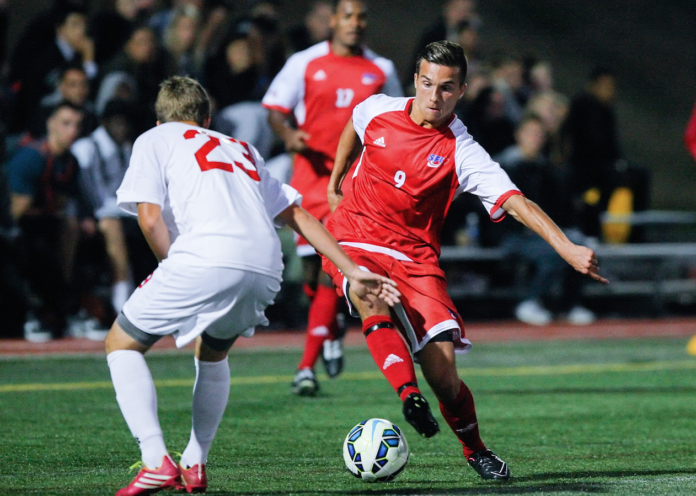
With Koch as head coach, the Vancouver Whitecaps FC 2 (WFC2) played a pre-season intrasquad game at SFU Field 4 on Saturday, February 28. The players were split into two teams: one in a blue kit and the other in a grey kit.

For the first-time pro-head coach, the step from coaching student athletes to coaching professionals is a big one.

“The higher you go in the game, the better the player is. We had great players at SFU, SFU will continue to produce great players, but these are professional players now,” said Koch. “A lot of them come through the college ranks — some are from SFU, some are from other schools, some of them signed as professionals when they were very young.

“The guys have the same winning mentality as the group we had at SFU,” he continued.

Just over a month into his new role, Koch has a clear vision of the style of play he wants to implement — one similar to the style he employed while at SFU. “At SFU, we had a high tempo, fast paced team, a very attacking team and possession-based team. I will do the exact same thing here. We’ll possess it, we’ll try and build from the back, look to play as much, possess the ball, and obviously go to goal and hopefully score a lot of goals,” he stated.

Joining Koch on the Whitecaps USL PRO affiliate was Blagojevic, who broke SFU scoring records as a forward on the Clan. When asked whether Koch had changed in his transition to the professional level, Blagojevic responded, “I still think it’s a little early to say. But he seems relatively the same. It’s a little bit of a different approach, it’s more professional. I haven’t seen that friendship side of him yet, but it’s still early. We’ll see how it goes, but it’s looking good. I’m really enjoying it. It’s nice to still be under him.”

Blagojevic was the first Canadian university athlete drafted into the MLS, and was invited to to the pre-season roster of the Whitecaps FC 2 — which will be cut down to form the final team roster.

Former Clan teammate Alexander Kleefeldt was also invited to the pre-season roster; however, while Blagojevic was signed to a team contract shortly after camp began, Kleefeldt was released from camp.

Blagojevic made an immediate impression on his new team; playing on the much stronger grey side that won 5–0, he maintained an excellent pace and was able to create space for himself multiple times on the wing. He also scored his team’s fifth goal, a powerful half volley off a deflection from the centre back.

For Blagojevic, the biggest difference between amateur and professional play is that “there’s just no room for error. It’s a lot cleaner play, it’s quicker, faster, and more intense. It’s a lot more mental [. . .] you’ve got to be perfect right from the start.”

Coach Koch waxed nostalgic about coming back to the school he coached for six seasons: “It’s kind of ironic, [to] leave and then come play our first game where we actually come back to SFU. It’s kind of special, actually. I love this mountain. It has a special place in my heart. It’s nice to be here, and I’ll come back a lot over the next few years, that’s for sure.”

The WFC2 will return to SFU to face the Clan in a pre-season matchup on Thursday, March 19 at 3 p.m. at the Terry Fox Field.

How has Fifty Shades shaped public perspectives of BDSM?

0
Image Credit: Eduardo Santos

It encourages a more sexually open and accepting community!

By Amelia Hill

With its enormous popularity, Fifty Shades quickly launched its readers into the world of BDSM — Bondage, Discipline, Sadism, and Masochism. While there has been controversy over the story’s depictions of BDSM, the reality is that the story is a fiction that, despite its flaws, has brought BDSM out of its previous taboo, and has created a more sexually open and accepting community.

I’d like to express clearly that the film and book are works of fiction. The actions are exaggerated and imagined, and don’t necessarily reflect the real world. Those who critique Fifty Shades for its disregard of values should be expected to hold the same distaste for action films, war films, and most any Hollywood drama. Fifty Shades combines overly dramatic occurrences purely to sell tickets.

But the mystery, intrigue, and extremes in the story have brought about a breakthrough for the BDSM community. Over 100 million copies of the book have been sold worldwide since the publication in 2011. These millions of readers were brought into a world which made them realize that it’s okay to find enjoyment in ‘kink.’

Millions of readers were brought into a world realizing that it’s okay to find enjoyment in ‘kink.’

When Hudsy Hawn, a professional BDSM educator was asked by BuzzFeed what she thought of Fifty Shades, she responded: “What I love is that it has brought the [. . .] BDSM community up close and personal to what we call the ‘vanilla’ general public.” I argue that this couldn’t be more true. As the series’ popularity has grown, BDSM supplies have become common in stores that were previously much more “vanilla.”

Whips and bondage material an now be found at La Senza, handcuffs and blindfolds can be found at Target, and a large expansion in the sex and lifestyle section has taken place at Chapters. Not only has this novel made BDSM more understood and accepted, but it has also increased the accessibility for those who choose to practice it.

To have less of a taboo surrounding BDSM means a more sexually accepting community. The book may not the ideal example of consent and respect, but it is a work of fiction based on a real subculture that has captured our imaginations and curiosity. The openness it has inspired has transformed our sex culture for the better.

Fifty Shades of Grey has encouraged the world to consider sex as no longer black and white.

It portrays unrealistic sex and encourages misogyny!

By Neelam Gandevia

While kinky sex can be fun, I do have a problem with how Fifty Shades of Grey distorts its portrayal of this sex, or BDSM. I wonder how little author E.L. James knew about BDSM when writing this story. I’ll admit that I won’t go near the film, when the book is so problematic on its own. Take this quote:

“Oh, Anastasia Steele, did you just roll your eyes at me?”

Crap.

“No,” I squeak.

“I think you did. What did I say I’d do to you if you rolled your eyes at me again?”

“Shit.”

This moment occurs just before the main character, Ana Steele, engages in any kind of BDSM. Along with the entire series, this passage parallels many stories about battered women.

“What did I say I’d do to you if you. . .” are the words of an abuser threatening a victim. Christian Grey’s behavior is dominant and abusive. The author makes excuses for Grey’s “deviant” sex behavior, and by the end of the story Grey is supposedly “cured” by Ana’s true love, thus portraying an unrealistic conclusion to these kinds of abusive relationships. Here unconsentual BDSM is portrayed as acceptable sexual abuse — something that Ana submits to even when she’s uncomfortable with it.

I’m worried that people will read the story and think that this sort behavior is okay.

For these reasons, Fifty Shades upsets so many members of the BDSM community: it portrays men as abusive control freaks, and women as meek and helpless. BDSM is about opening up your vulnerabilities and trusting your partner; limits and tolerances are discussed before play begins, and you can stop at any time, without fear or repercussion, if you’re uncomfortable.

Fifty Shades takes the classic ‘sexy rogue that needs taming’ archetype and includes poorly-written porn scenes that aren’t even that intense, turning itself into a misrepresentation meant to thrill and titillate.

So where does this leave people who want to try BDSM? I’m worried that Fifty Shades attaches a further stigma to BDSM and only furthers rape culture, and that people who aren’t properly educated on BDSM are going to engage in this activity improperly, and potentially hurt themselves.

Go ahead: Be curious about BDSM, talk with your friends or partner about it. Hell, go out and try it with someone you trust. But please do your research first to make sure you understand what this kind of sex actually entails.

Kinky sex can be great; just be aware of what’s fact and what’s fiction, because there’s a lot of fiction in Fifty Shades.

Board rejects Builds SFU-related referenda proposals

2
Several student groups were present at the meeting to advocate for various referendum questions. - Mark Tallman

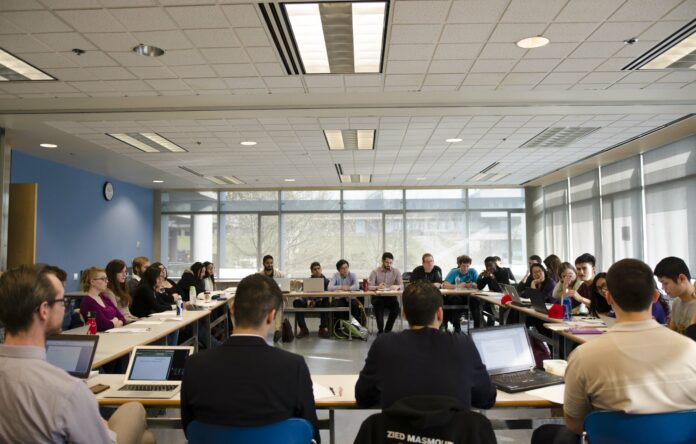
As the clock ticked towards the imminent deadline for submitting referendum questions on March 4, the Simon Fraser Student Society (SFSS) board of directors debated which questions should be put to a student vote in the 2015 SFSS elections.

These yes or no questions allow active members of the student society — any undergraduate student registered in a course or program for the semester — to vote on resolutions concerning the activities of the society. Referenda are required for the SFSS to make changes to student levies, bylaws, and debentures, among other matters.

In total, eight potential referendum questions were discussed; after much deliberation, board approved four questions that will be put to SFU undergraduates for a vote between March 24–26.

The future of the Build SFU projects generated extensive discussion among board members. No to Build SFU, a group that has been campaigning against the projects for the past several months, brought two motions to the table to be discussed by board.

The first motion proposed the immediate removal of the Build SFU levy. If passed, this would effectively remove any future student funding for the Student Union Building (SUB) and Stadium projects.

The second motion called for a bylaw addition to ensure that any project valued at over $5,000,000 and involving student money require a minimum of 10 per cent voter turnout and a 75 per cent majority vote.

No to Build SFU presented a petition to add the questions to the referendum, which had garnered 628 of the 1,000 student signatures required to force the questions’ inclusion on the ballot.

Several board members acknowledged the student support for the questions, but expressed concerns surrounding the wording of the proposed referenda. “The bylaw addition question doesn’t conform to the conventions of a special resolution, and thus would not have the force of effect on the SFSS bylaws upon an affirmative vote,” said Chardaye Bueckert, SFSS president. “I don’t disagree with its intention, but I have concerns around the wording and the process.”

The board felt there was not enough time to reword the questions before the 6:30 p.m. deadline that evening.

No to Build SFU members expressed their dissatisfaction with the process, saying they tried to come to the working group for help forming the questions, but received none.

At-large representative Rebecca Langmead moved to instead produce a web survey that would poll student opinion on the Build SFU projects. Built into the motion was a clause to withhold board members’ stipends should they fail to do so.

In addition to the proposed Build SFU questions, six other potential referendum questions were debated.

Health Sciences Faculty Student Union: Approved

The Health Sciences Faculty Student Union (HSUSU) is seeking to become the official faculty student union for health sciences.

In the election period, health sciences students will have the opportunity to vote yes or no to being officially represented by HSUSU.

SFSS Emergency Food Bank Levy: Approved

Board members are asking students to vote on increasing funding for the SFU Food Bank, which served 251 students this semester alone.

The program currently functions by providing certificates to be redeemed at Nester’s Market and the SFU Dining Hall.

The university has offered to match whatever the SFSS contributes, up to $16,000 yearly. In order to monopolize on that offer, the society would like to reallocate 25 cents per full-time student and 15 cents per part-time student from the Space Expansion Fund to finance the Food Bank.

Space Expansion Fund Levy and the Membership Fee Levy: Approved

The board added a question to the ballot that will ask students whether or not they support reallocating over half of the $10 full-time student Space Expansion Fund (SEF) levy to the society’s general fund.

Previous boards have suggested that the general fund is consistently under financial pressure, and since the board sees no pressing need for maintenance, which is the purpose of the SEF, the money could come from there.

Accessibility Fund Levy: Failed

Students will not vote on a question to discontinue the Accessibility Fund levy.

The question called for the immediate removal of the levy and the transfer of remaining funds into the unrestricted surplus, on the grounds that the Accessibility Committee does not use a good portion of the money.

Without an Accessibility Committee, VP finance Adam Potvin suggested that accessibility issues could be brought to the Space Expansion Committee.

Anthony Janolino, representative for Students United for Disability Support (SUDS) and member of the Accessibility Committee, expressed his opposition to the motion on the grounds that reallocating the funds could be seen as lowering the priority of accessibility. He instead suggested that the untouched money be put towards making member participation in society matters more accessible.

“This meeting is barely accessible,” he stated, pointing out that for someone with a vision impairment like himself, it is impossible to read the meeting agenda or to hold up the correct ballot at an SGM without braille.

Schools Building Schools Levy: Approved*

Students will have the opportunity to decide if they want to continue to fund Schools Building Schools, which currently costs $1 per term per full time student and 50 cents per part time student through an optional levy.

Schools Building Schools, which has a club at SFU, gives Canadian university students “the chance to gain practical experience in the development field” building schools in Uganda. Board members argued that, because the club is an external organization and not directly connected to SFU, requiring students to pay a levy may not be appropriate.

Members of Schools Building Schools were not present at the meeting, but sent in a letter stating that they were disappointed with the lack of communication from the board, and that they had only received informal notice the night before the meeting.

HiFive Levy: Withdrawn

Board also moved to reallocate 10 cents from full-time students and five cents from part-time students from the Accessibility Fund levy to the HiFive movement to address mental health issues.

The motion was ultimately withdrawn because of concerns that HiFive is not actually an SFSS club, and the request was not put forward by any of their representatives.


*The Schools Building Schools levy question was removed from the ballot at the March 11, 2015 board of directors meeting.

Sixth annual Gathering of the Clan honours Lorne Davies

0
Steve Nash said he would have played at SFU had he not gone to the US. Photo courtesy of SFU Athletics.

The sixth annual Gathering of the Clan breakfast was held last Tuesday at the Vancouver Convention Centre.

The breakfast, which costed $200 a seat and raised $264,000 for SFU athletic scholarships, was hosted by TSN correspondent Farhan Lalji, an SFU graduate and active member of the BC high school football community. The event also honoured Lorne Davies, SFU Athletics founding athletics director and inaugural football head coach, who had passed the weekend before and for whom a moment of silence was held.

Lalji recounted how Davies gave him his first job in the sports entertainment business as a sports intern at SFU Athletics, before he eventually became the sports information director from 1991 to 1994.

“More than anything else, [Davies] gave us a great love for this university; he bled red and blue,” Lalji reflected on his former boss and mentor. “He talked a lot having that school spirit, that pride in your institution, and really made us feel good about being members of the Clan.”

Davies’ influence, it seems, was not limited to the athletics community. SFU president Andrew Petter explained that the man who ran SFU Athletics for 30 years touched all parts of the school.

“Lorne [Davies], as many of you know personally, was the heart and soul of Clan athletics from the beginning of SFU almost 50 years ago, when he became our first athletics director,” Petter told the crowd of nearly 800. “He mentored coaches, athletes, even university presidents — including this one.

“He always understood the importance of athletics to the well-being of a university: energizing campus life, embodying school spirit, and exemplifying our commitment to being the best we can be,” he concluded.

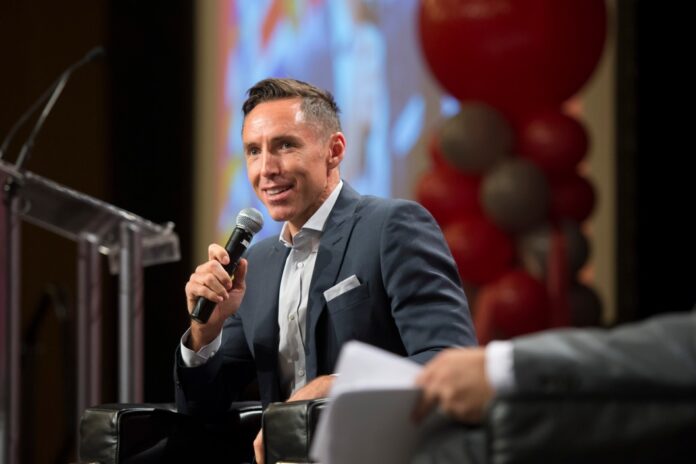
Two-time NBA MVP Steve Nash was the keynote speaker for the breakfast. He told the crowd about his SFU experience — despite choosing to go to Santa Clara, an NCAA Division I school in the US, he was recruited by and considered SFU as an option.

“Simon Fraser is where I would have gone if I hadn’t gone to the States,” Nash said.

However, then-SFU head coach and current Portland Trail Blazers assistant coach Jay Triano told him to follow his dream to an American university, a moment that made him respect the Clan program.

“[Triano] said to me, ‘If you got the chance to play Division I, I think you should go,’ and that said an incredible amount about him, and his willingness to advise me in a way that was best for me and not necessarily best for him or his team. I’ll always remember that, and I’ll always be thankful for that, and it definitely spoke highly about Simon Fraser,” said Nash.

The Victoria, BC native also talked about the importance of athletic scholarships to student athletes, a key part of Davies’ vision.

“It’s an amazing thing getting an athletic scholarship and going to a great institution, to play sports, and have the resources to do it at a high level. It’s incredible. [I’m] proud that I can help, and I’m proud of what SFU has been able to do in our community,” Nash told The Peak after the breakfast.

Since the inaugural Gathering of the Clan in 2010, the event has raised a total of $1.5 million for Clan athletic scholarships.

If categories for greeting card stands were accurate

0
Image courtesy of Wikipedia Commons

Instead of “Baby”
“Congratulations on not using a condom”
“I’m going to miss hanging out with you”
“Is the baby mine?”

Instead of “Condolences”
“Sorry (I’m not sure for what exactly, but I’m sorry)”
“Why bother?”

Instead of “Anniversary”
“Please accept this card as my annual re-application to continue being your significant other”
“Look at me, I remembered something”

Instead of “General”
“I spent more time looking at my nose hairs this morning than I did selecting this card for you”
“Please don’t exclude me from your will”
“Hope this makes its way to you okay. I’m not sure if this is even your address anymore”

Instead of “Congratulations”
“Obligatory praise”
“Good enough”

Instead of “Wedding”
“I didn’t put any money inside this card”
“Words to go with the kitchen appliance I purchased for you and your new spouse”

Instead of “Birthday”
“Congratulations on still being alive”
“I know you well enough to feel obligated to buy you something, but not enough to buy you something of significance. So I got you a card”

Canadian universities need to address sexual assault on campus

0
Image credit: Talha Qadir

If you attend a Canadian university, chances are you’re blissfully ignorant about sexual assaults at your school, and the policies in place to deal with them. This may be because your university has no special policy to deal with these crimes.

Last year, a study done by the Toronto Star found that a mere nine out of 78 Canadian universities had any sort of special policy to deal with sexual assault. There isn’t even a law in place for institutions to convey the statistics on their crimes. Clearly, Canadian universities are not doing enough to keep students safe, and further measures must be taken.

Unfortunately, campus rape is an epidemic in Canada. In terms of university policies, we differ on this topic from our southern neighbours. The United States adopted the Clery Act in 1990, which legally requires universities to report sexual assaults as well as issue a warning to the campus community when one occurs. Canadian campuses have no such policy, making it disturbingly easy for sexual assaults to be overlooked and underreported.

In 2011, the White House implemented an awareness campaign based on Title IX, a federal amendment meant to prevent sexual discrimination in the education system. The campaign aims to assist sexual violence survivors with anything they need, whether it’s switching classes or leaving residence. The goal is to put pressure on institutions to take responsibility for assaults among students and faculty, and remind them of their lawful obligations.

Such legal measures should encourage Canada to follow suit.

Typically, post-secondary establishments are very concerned with their image; no university wants to be seen as ‘dangerous.’ Brushing sexual assault under the rug is commonplace for a university trying to preserve their positive reputation. Not only is this insensitive, but it also defies the morals we expect a university to uphold. When a school is too worried about their image to report an assault, the entire campus community is placed in danger.

Even progressive institutions like SFU discuss rape with hushed tones.

Sexual assault has always been a taboo topic. Even progressive institutions like SFU discuss rape with hushed tones. SFU security has a page with advice for victims of assault, but along with warnings on how to avoid it, the page mostly consists of outside resources and advice to call the police.

Even our university’s own website on assault states that “it’s difficult to estimate the number of women from the SFU community who are sexually assaulted each year. Sexual assault is one of the most underreported crimes; official statistics from law enforcement agencies are not an accurate picture of what’s actually happening.”

SFU seems to blame law enforcement for its lack of reporting, but it is very unclear what measures the university itself has taken.

With this attitude in place, protecting students becomes difficult, as does holding perpetrators accountable. To create a safer campus, Canadian universities need to both change their policies and break the silence. A federal law, similar to that in the United States, should be enacted which requires universities to report their on-campus crimes.

Students need to feel safe at school. Without the necessary sexual assault policies in place, we cannot depend on these establishments to make the changes needed to create a safer student environments.

Men’s basketball close historical season just shy of playoffs

0
Image Credit: Hamed Yaghoubi Shahir /The Peak

The men’s basketball team finished with a .333 record in the conference, losing 110–77 to the Western Washington Vikings in their final game, and just missing a chance to compete at the playoffs.

On paper, this sounds like a bad ending to a mediocre season. But when you consider that during their time in the NCAA, they’ve never had a winning percentage above .167, and that they’ve never previously won consecutive conference games before — this year they had two winning streaks — it was an outstanding season.

With a revamped, high-octane offence, the Clan led the entire NCAA Division II in scoring offence with 104.2 points per game — the nearest team in the Great Northwest Athletic Conference (GNAC) scored on average 81.9 points per game.

The key to the team’s success this season was the fact that SFU either won or almost won nearly every game they played. Sure, there were some blowouts, but for the most part, even in the losses, the Clan kept the game close.

The team’s better, more competitive performance this season inspired fans to come out. In the West Gym, there was an emergence of a true college basketball atmosphere — the Clan fans were loud and proud. Even during reading break, a solid contingent of fans came out.

“It was a successful season, it was historical,” said head coach James Blake. “The university should be proud, the kids should be proud. They really put a stamp on SFU basketball, on the men’s side finally. People are talking about SFU men’s basketball.

“I’m excited for the kids, I’m excited for the program,” he continued.

The Clan still ran into trouble after Christmas break, losing seven straight once the new year began — it’s probably not a coincidence that before Christmas SFU plays mainly local, non-conference competition, while after the break they face only GNAC competition.

Coach Blake acknowledges this as one of the team’s weaknesses — a problem he attributes to the exam break in January, which he noted forced the team to take a nearly three-and-a-half week break.

“We haven’t gotten over that hump yet,” Blake told The Peak. “We’ve got to figure out as an institution, and as a program, how we’re going to combat that.”

But even after the new year, the Clan put up five wins, which was the best January/February record for the team. Seven out of their 12 previous losses were within 10 points or less.

This season, the men’s basketball team was headed in the right direction. Although they will have a challenge replacing seniors Sango Niang, Justin Cole, and Daniel Deflorimonte — key cogs in SFU’s scoring offence — the Clan should only improve next season.

Scrap the tuition fees; education is a right

0
Image Credit: Andrew Moss (Flickr)

I’ll let you know right off the bat that I’m currently $25,000 in student debt. With another two years of post-secondary education on the horizon, I estimate I’ll be at over $30,000 in debt by the time I finally graduate — a figure that creeps over the average amount of debt Canadian students leave school with.

As I edge closer to the prospects of finding work after flinging the mortarboard, an unnerving swarm of anxiety quickly erupts in my gut at the realization that this debt won’t just disappear. I’m not the only student terrified by the notion that I’ll leave university in a far worse financial state than I entered it with, and I’m further frustrated that, in one of the wealthiest countries on the planet, students have to pay for their education in the first place.

A few months ago, the entire country of Germany scrapped its tuition fees. This may seem surreal to us Canadians; free tuition is like something out of a fantasy. The President of the Hamburg Parliament claimed that these fees “discourage young people who do not have a traditional academic family background from taking up studies,” and that “tuition fees are socially unjust.” And he’s correct in every sense.

Education is our right. To attend and graduate from a post-secondary institution is a value to us as students, and for the whole of society. Our country would not have the ability to govern itself as effectively, nor would services operate as smoothly (if at all), if people did not attend a college or university. As Canadian citizens, we should all be granted the chance to gain the skills necessary for the job market, without having to bear thousands of dollars of debt upon graduation.

Our government could easily afford to shift its monetary priorities in our favour.

I’m flabbergasted that countries with less money and sometimes larger populations than us — Brazil, Norway, France, Sweden, and Finland — can shell out the dough to help their students thrive, while Canada spends billions on war efforts rather than the people of our future. Three words, Harper: ignorance, thoughtlessness, and greed.

What further troubles me is that taxpayers already pay for the Canadian Student Loans Program, a system designed to help students pay for their education. Wouldn’t this be better dealt with if these fees were jettisoned altogether?

A university degree today is basically equivalent to a high school diploma four decades ago. Thousands of desperate students take the risk and work their asses off for that master’s degree with the hope of finding reliable work, thus spinning them further into a financial hellhole.

Point blank, tuition is discriminatory. It perpetuates an economically divided society, and it places barriers on those with low incomes who truly have the necessary skills and tools to succeed in a post-secondary institution. In light of Germany’s retraction of these fees, it’s time for us to seriously consider whether our country could follow suit.

Free tuition is not a fantasy. Our government can easily afford to shift its monetary priorities in our favour through a commitment to increase and sustain financing for universities. In this way, we can compete with our wealthy European neighbours, and we can create an environment that doesn’t pluck out the well-off while leaving those in a harsh financial state to say ‘adios’ to their career goals.

I don’t want our next generation of students to have to spend even more borrowed money than they can afford on something they have a human right to obtain. We simply deserve better than that.

Ignorance in marriage is bliss, study suggests

0
Premarital counselling may not be a useful tool for couples. - Anosha Ashfaq

When it comes to marriage, ignorance may indeed be bliss, according to Rebecca Cobb, associate professor in SFU’s Department of Psychology.

In her study of 201 couples from Metro Vancouver, Cobb found that couples who participated in relationship-education programs (or premarital counselling) experienced a significant decrease in their marital satisfaction. Couples who did not participate in such programs did not experience the same decline in satisfaction.

“The wives in particular have steeper declines in their satisfaction compared to the wives who did not participate [in relationship-education programs],” said Cobb.

The couples were engaged at the beginning of the study and transitioned to marriage over the course of the two years that Cobb followed them. They reported back to Cobb on their relationship satisfaction in a series surveys that took place eight times over two years.

Cobb found that a large proportion of the couples participated in programs through their religious organization or their church.

Many religious organisations actually require couples to participate in premarital counselling in order to be married through their institution.

Cobb’s objective was to compare similar couples solely on their participation in relationship-education programs, rather than let pre-existing differences influence the results.

“We measured different risk factors [for marital distress]. Based on those risk factors, we created a matched sample of people who participated in premarital education and those who did not,” she explained.

Couples were matched based on family history, relationship dynamics, personality characteristics, commitment level, and baseline satisfaction before they participated in the study.

The study found that wives who participated in these programs experienced a decrease in marital satisfaction. Cobb explained why this might be so: “The suspicion that we have is that these programs create an expectation for these wives about what relationships should look like [. . .] it sets a high bar for these wives to fail to meet.”

Husbands did not experience the same decline in satisfaction as their spouses over the two years that Cobb studied them.

“The differences in the husbands that did or did not participate may be something that emerges over a period longer than two years,” Cobb speculated.

She warned that the results of study suggest that these programs might actually have an adverse effect on couples who participate in them.

“We have to be cautious in encouraging people to participate in these programs without evidence of their effectiveness,” she reasoned.

This does not mean that couples should avoid counselling completely. Cobb advises couples who want to strengthen their relationship “to seek a program or premarital counselling from a registered psychologist or counsellor.”

Cobb explained that their next step is to look further into the kinds of programs that couples participate to differentiate which aspects are helpful.

“We need to know more about what [types of relationship-education] they are receiving,” she explained.

Researchers map genes to better treat cancer

0
Jones hopes to develop personal therapies for different patients. - Momo Lin
Jones hopes to develop personal therapies for different patients. – Momo Lin

Cancer cells of the same kind may not look the same for all patients, according to new research coming out of SFU.

Steven Jones, an SFU professor of molecular biology and biochemistry, and Marco Marra, an SFU alumnus, are working together at the BC Cancer Agency to understand how an individual’s diseased cells differ from patient to patient.

The researchers are currently working on a project to map the human epigenome, a part of cells that allows the genomes — “the recipe books of the DNA,” according to Jones — to be read properly.

When epigenomes interpret the genomes within a cell’s DNA, they gather a better understanding of what makes a specific cell unique, and what doesn’t. Jones’ recipe book analogy continued on to explain that an epigenome “knows the important parts of a [specific] cell, and [knows] the parts of the recipe it shouldn’t be using.”

In simpler terms, the epigenome indicates “a way of organizing the information, and a way for the cell to organize the ways that the information is being used.”

When they began the project, some of the technology Marra and Jones are reliant on today wasn’t yet available. They attribute the project’s recent success in part to new rapid DNA sequencing devices that they use to understand the strands of DNA they are analyzing.

The main goal of their project is to gain a more in-depth understanding of how human cells work, and how the cells, specifically the epigenomes, change in a diseased cell. To do this, they study both healthy and diseased cells, and meticulously map the similarities and the differences.

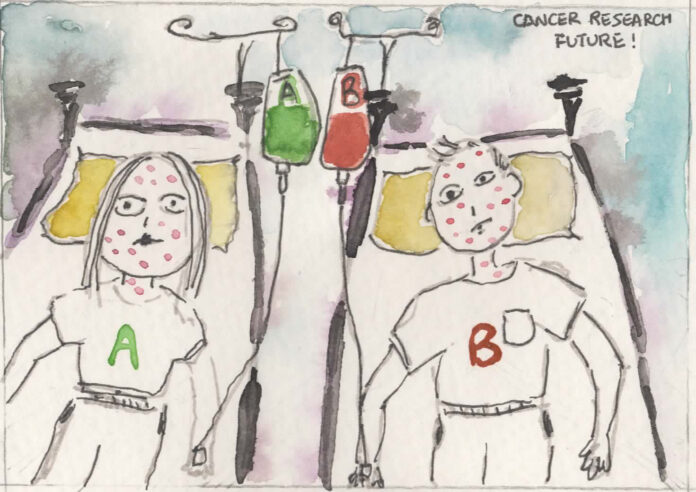
Gathered from their research, a fact that may mark a new development in how cancers are treated in the future, is that “though two of the same cancers seem very similar, there might be very different ways in which they’ve changed their biology,” said Jones.

In other words, two patients with the same type of cancer could have completely different cancers, ones that should be treated as such.

With these answers in hand, Jones says they can begin to develop “personal therapy, where [they] can tailor the drugs [they] give a patient to the chemical makeup or biology of their particular tumour.”

Jones and Marra hope their research will contribute to a greater understanding and the eventual treatment not only of cancer, but of other diseases such as Alzheimer’s and Huntington’s.