Home Blog Page 1053

Art collection in AQ North Concourse illustrates BC colonialism

1
Photo courtesy of SFU Art Collection.

Several years ago, on a brisk and sunny autumn morning in Montreal, I walked up to the top of Mount Royal. The view of the city and Saint Lawrence River was impressive, but the sight that made the strongest impression in my memory came from inside the Mont Royal Chalet.

Hung between the ceiling’s wood beams were paintings by various artists that traced the history of Montreal. What struck me about the paintings was not the images of colonization and genocide of First Nations people — some of which were extremely violent — but that these images lacked any kind of context.

It was unclear whether these images were celebrating the conquering of a land and its first peoples or attempting to portray an uncensored account of what actually happened. With no apparent context, the former was implicit.

Photo courtesy of SFU Art Collection.

This experience came to mind when looking at the Charles Comfort mural, British Columbia Pageant. Installed in the Academic Quadrangle’s north concourse over 10 years ago, the 64-foot-long painting on canvas was a donation from the Toronto Dominion bank when one of its branches closed on Granville and Pender. It provoked criticism from both students and faculty almost immediately.

The mural depicts the settlement and colonization of a land and its First Nations from the point of view of the colonizers. Another similar mural painted by Comfort was rejected by UBC, 40 years before the SFU installation. As written in the Vancouver Sun, this piece was rejected because it showed Captain George Vancouver “being depicted as a conquering hero, with Native people in a demeaning position at his feet.”

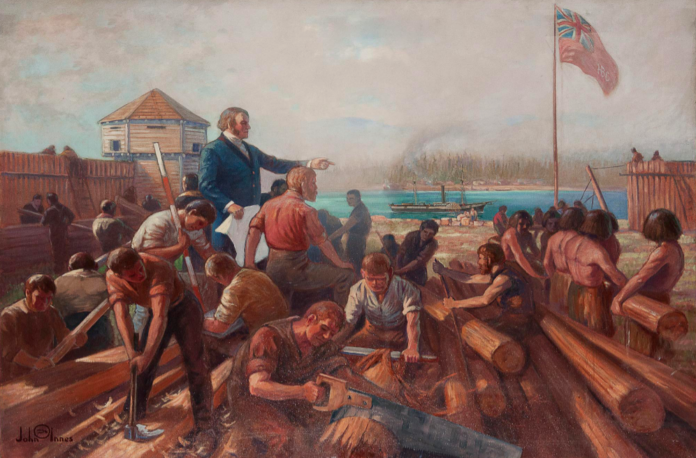
On the opposite side of the hallway are a series of paintings from 1925 by John Innes that illustrate specific scenes of the “founding” of BC.

One of these paintings shows Alexander McKenzie’s arrival at the Pacific; the other, James Douglas building the Hudson’s Bay Post in Victoria. In each painting, the First Nations people are shown in what appears to be a compliant role, either assisting the white European explorers or acting as passive onlookers.

Although the Comfort mural and remaining Innes paintings still hang in the North Concourse, they are joined by a group of works that represent a conflicting view of history. As part of the Re-setting the Cedar Table conference and art contest that took place in response to SFU mounting Comfort’s mural, the three works across from the mural do not actively criticize British Columbia Pageant, which is described in the accompanying information panel for the conference as “a monument to colonization,” so much as offer context.

The artist Edgar Heap of Birds donated one of these works, titled Insurgent Messages. This confrontational poster was part of a public intervention that was placed in bus shelters around Vancouver in 2007. It questions the rights of those in power to subjugate the First Nations people by asking: “IMPERIAL CANADA WHERE IS YOUR STATUS CARD?”

The other two works — Teen BC, a mask/sculpture by Nate Woodbury, and Civilization is a Crime Scene, a print by A.S. Matta — were winning entries from the Cedar Table art contest.

These artworks, along with the Bill Reid sculptures installed with the mural, offer an Indigenous counterpoint to the colonial images of the hallway. The effect is to illustrate conflicting histories, where each must properly understand the other.

Careful consideration should be given to artworks associated with colonization. Without the context provided by Indigenous works, the display would send the wrong message about the history of intercultural relations in BC. Obviously Indigenous artworks do not require a colonial context for interpretation, but a work such as Insurgent Messages becomes even more powerful when it is placed against Comfort’s and Innes’ depiction of history.

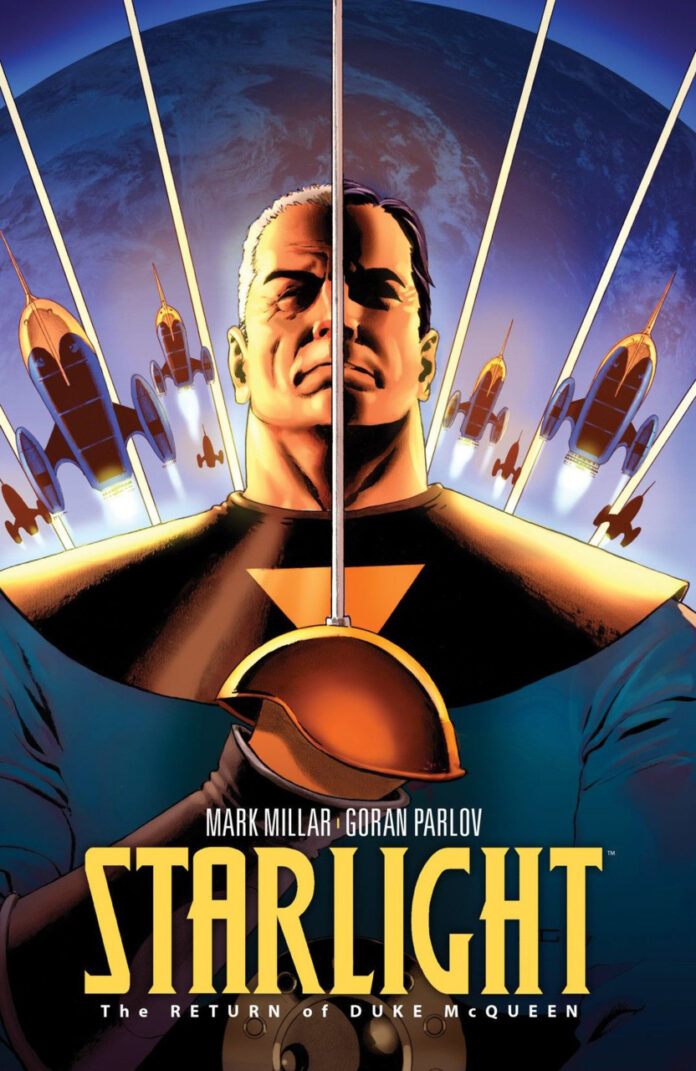
Starlight kicks intergalactic ass

0
Photo courtesy of Image Comics.

In Starlight: The Return of Duke McQueen, we follow the story of Duke McQueen, an aging 62-year-old who once saved a distant galaxy from tyranny back in his youth. Across the cosmos, Duke is celebrated in song and lore, and even has a statue built in his likeness. But on Earth, he is the subject of constant ridicule from young children and newspapers alike.

With the exception of his late wife, he is hard-pressed to find anyone who believes in his adventures long past. As such, Duke spends most of his days alone reminiscing about his glory days and searching to find significance in the world — that is, until a spaceship lands on his lawn, and he is beckoned to save the universe one last time.

Beneath the glitz and fast-paced action, writer Mark Millar weaves an endearing tale of a man trying to rediscover his strength. Duke McQueen is easy to identify with, even in his old age. He is held back by doubts and an aging body, but he retains an overriding sense of justice from his early days.

Duke does not care about a medal or a statue with his face on it; all that matters to him is protecting those who cannot protect themselves. He is the glue that holds the story together, and the strength of his character makes the whole experience that much more enjoyable.

The art of Goran Parlov helps encapsulate the retro feel of this graphic novel. The artwork at first glance might seem unimpressive, but it really fits with the story being told. While the character designs may leave some wanting more, the architecture of the graphic novel’s spaceships and buildings make up for it tenfold.

Parlov’s real talent lies in making every panel seem three dimensional; every scene feels like it is bursting off the page and straight at the reader. It brings us closer to the action and makes us feel the sentimental moments that much more.

Starlight’s main flaw is that it does little to stand out. It pays homage to science fiction stories of old, such as Flash Gordon and Star Wars, but really does not bring anything else to the equation. The story is enjoyable, but familiar. While this never hurts the overall experience of reading the graphic novel, it may keep readers from revisiting the story a second time.

Starlight: The Return of Duke McQueen is a callback to a time when science fiction did not take itself so seriously. It lacks the qualities to make itself memorable, but still stands as a fun, accessible sci-fi swashbuckler. It will leave you cheering on Duke McQueen to the very end, and remind you that you’re never too old to kick some intergalactic ass.

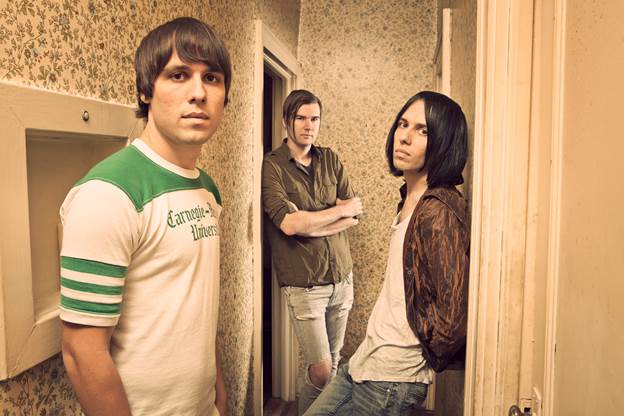
The Cribs prove that growing up is tough on their new album

0
Photo courtesy of Arts & Crafts.

It’s been three years since The Cribs released new material on In the Belly of the Brazen Bull, giving them plenty of time to reflect on their lives, music, and sound. In 2011, the band parted ways with former The Smiths guitarist Johnny Marr, and in 2012 Ryan Jarman (lead vocals) and girlfriend Kate Nash split up.

So what has all the heartbreak taught the trio of brothers? According to them, a newfound love and embracement of the poppier side of life. Working alongside ‘80s pop powerhouse Ric Ocasek, frontman of The Cars, the Jarman brothers sought catchy hooks and a less abrasive sound on their new album, For All My Sisters.

Photo courtesy of Arts & Crafts.

Teaming up with musical vets has worked for them in the past: their album Ignore the Ignorant was clearly influenced by Johnny Marr, and the effect was a cohesive and sophisticated sound for the band. With this success in mind, it’s no surprise that they enlisted Ocasek to produce a pop record.

For All My Sisters kicks off, guitars blazing, with “Finally Free.” This and the following track, “Different Angle,” provide plenty of woo’s and ooo’s for all those wanting a sing-along. The band’s lyrical style has changed little over their 13-year career, and their distinct voices clamber through the album, expressing a breadth of emotions. 

On “Burning for No One,” the album’s first single, Gary Jarman expresses his eternal gratitude for the realisation of his own irrelevance. The self-deprecation continues on tracks “Mr. Wrong” and “Simple Story.”

But the album finds its stride after the reprieve of “Simple Story.” The catchy, fast-paced second half of the album powers on, ending on the undulating “Pink Snow,” which shifts between tame verses and high-velocity choruses with added screams for good measure.

The Jarman brothers are under the impression that they have some growing up to do: protecting their sisters like any good brothers would, they promise to “try and be brave for you,” but are equally aware that they’re “gonna have to be a man someday.” Maybe it’s this immaturity that keeps leading them to the musicians of an older generation.

As for Ric Ocasek’s influence on the band, it comes across diluted, and was maybe not ‘just what they needed.’ Ocasek’s ‘80s pop influence aside, For All My Sisters is a raucous album full of roar. While not quite the pop album they had hoped for, The Cribs continue their unique style that needs no outside influence — if only they were man enough to realize it. 

Can we please talk about the literal elephant in the room?

0
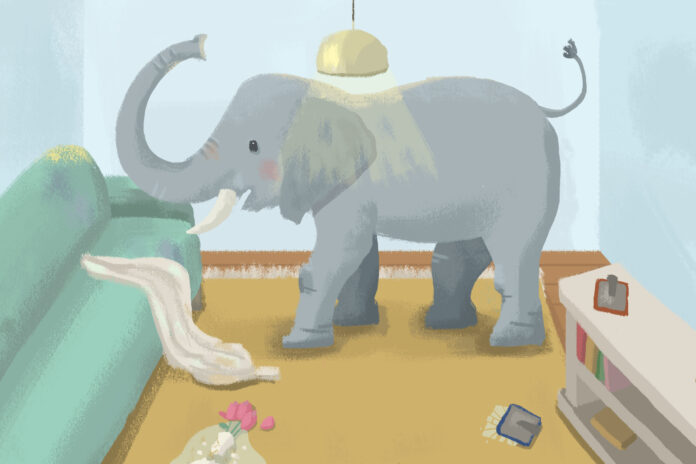
“We can’t just keep ignoring that elephant forever. Scandal is on tonight.” || Illustration by Chen Chen
Illustration by Chen Chen

Shaun, as you’ve probably grown to realize over the span of our relationship, I’m a woman of action and a woman of priorities; someone who’s not afraid of confronting things head-on and dealing with them as effectively as possible. This is why I think it’s imperative that we postpone our conversation about my arguably ‘excessive’ drinking habits in favour of addressing the adult African elephant currently stomping around in our living room.

How did a full-grown tusked mammal get to be inside our third-floor apartment? I don’t know, Shaun. How did that half a bottle of chardonnay I had left in the fridge last week end up empty in the recycling bin? Did some magical breeze just blow in here, whimsically pull out the cork, consume the wine, and then neatly plop the bottle into the correct bin? Maybe it was the same magical breeze that swept an elephant off its feet and into our living room.

No, I’m not using the elephant as an excuse to avoid having an honest conversation with you. I promise. I can understand why you might think that, but I’m genuinely more concerned about dealing with the animal that is currently occupying one of the four rooms in our apartment. It just seems like a more pressing issue than listening to you overreact about how much alcohol I consume on a weekly basis.

Sorry, that was a bit defensive. Honestly, I’m worried that at any moment now, that elephant is going to start getting anxious about being indoors and it’s going to knock something over, like that vase your mother lent me. If I have to give your mother’s vase back to her in little pieces, then we’ll have two trampling elephants to deal with.

As soon as I started saying that last part, I immediately regretted it. I’m sorry, Shaun. Again. Your mother’s not an elephant. But you know who is an elephant? That elephant in our living room.

Is there someone we could phone who could maybe help us deal with this? What good would a therapist possibly. . . oh goddamn it, for the elephant, Shaun. I’m talking about calling someone to help us with the seven-and-a-half ton Loxodonta africana undoubtedly tracking dirt all over our new carpet and probably destroying any chance we ever had at getting our damage deposit back. Unless you think the elephant has a drinking problem too, in which case maybe we should contact a therapist. Would that make you happy?

Okay, here’s what we’re going to do: I’m going to call animal control and tell them what our situation is. Maybe get them to send someone over, like a circus trainer. Shaun, I need you to find a way to get past the elephant without getting stomped to death, make your way into the kitchen, and get the Kraken rum that’s in the freezer. Why do you have to be the one to risk your life? Because of the two people in this room, you’re the one that seems fixated on ignoring any elephants presently inhabiting our apartment.

Okay, okay, never mind, forget about the Kraken. It’s fine. I keep a backup mickey of butterscotch Schnapps in the nightstand for emergencies anyways.

Now, what were we talking about before all of this elephant business came up?

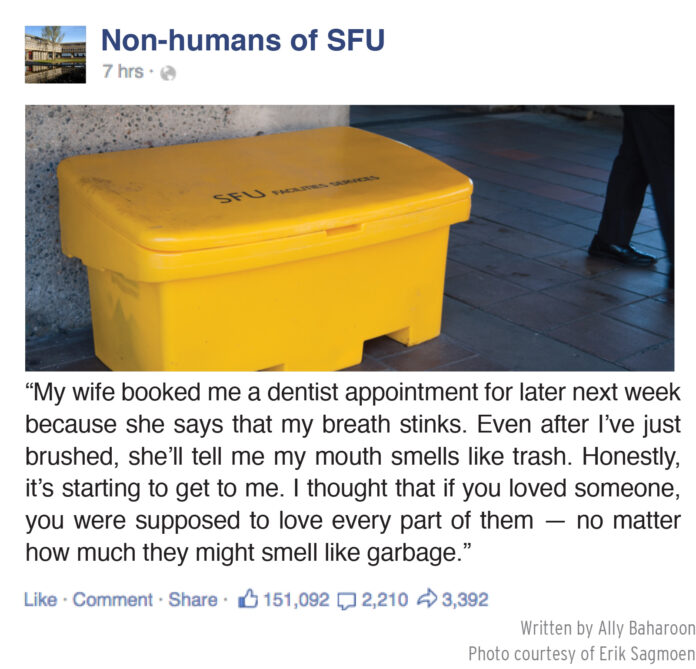
Non-humans of SFU

0

WEBNONHUMANS

Obsessed to the nines

0
Image Credits: Talha Qadir

About a year ago, I went out on a blind double date with a friend of mine, his girlfriend, and her friend. It was bound to be an awkward night, and as someone who is often painfully shy, I was especially nervous about making conversation.

To my surprise, things actually started off really well. I kept up with discussions on everything from school to movies to philosophy, without saying anything too weird, and I quickly began to loosen up.

But then my date noticed the hockey game playing on the TV behind us.

“I like those red jerseys,” she remarked innocently, looking at the Calgary Flames uniforms. Now, I can’t recall exactly what I said in response, but I’m pretty sure it went something like this.

“Oh, those are their new thirds. They’re definitely a step up from their primaries. I mean, at least they don’t have that horrible piping or those flag shoulder patches. They’d look a lot better with the flaming “C” as the crest instead of that wordmark, though. I also can’t say I love the collar. Obviously they should go back to their ’80s look, without the black, full-time. . .”

I’ve never seen a face go so blank.

I quickly laughed and shifted to another topic, as I suddenly remembered that that level of passion for sports uniform aesthetics was something I normally kept to myself.

Of course, I’m well aware that most people couldn’t care less about the way athletes dress, but as strange as it may seem, the study of sports logos and jersey design is one of the greatest joys in my life.

Having enthusiasm for something, independent of what other people think, is a wonderful and unique feeling.

I first really got into sports aesthetics in my early years of high school, after I discovered online communities of like-minded weirdos. Researching and creating my own jersey ‘concepts’ quickly began to take up a lot of my free time as a teenager. It was definitely an odd obsession, and one I didn’t talk about.

Even though I would frequently spend entire weekends in 11th grade doing nothing but photoshopping together complex uniform ideas, I pretended to spend my time doing something a little more normal instead, like playing basketball, watching TV, or riding my bike.

But having a secret passion that was completely my own thing was precisely what I loved about being into sports aesthetics. Everything else I did — whether it was schoolwork, creative writing, or playing sports — felt like I did so primarily hoping to seek the approval of others.

Sports design was something that no one I knew had even the slightest interest in; it was, and continues to be, an interest based entirely around my own personal passion. Having enthusiasm for something, completely independent of what other people think, is a wonderful and unique feeling.

Although university has certainly limited the amount of time I can spend obsessing over and designing sports uniforms, I will never stop loving it. I’ll always be more excited about the chance to see the Pittsburgh Penguins wearing their throwback jerseys with real gold than I ever will about the chance to see Sidney Crosby playing in a game.

I know most people won’t understand that, and I really don’t need them to. If I want to relate to people, I still have plenty of knowledge about sports, movies, and Breaking Bad to rely on. My thoughts on how wide the stripes on the Carolina Hurricanes socks should be, on the other hand, is something I know I’ll probably only entertain myself with. And I like it that way.

I should probably wait until at least the third date to bring it up, though.

The History of Women at SFU

3

By: Micaela Evans and Cecile Favron

In the summer of 1968, a group of women with children approached the SFU administration and asked for a room to set up a daycare. The administration swiftly denied their request. The women set one up anyway.

This was just one instance in a movement for women’s rights that swept SFU in the 1960s. The struggle shared similar concerns with those that women currently face on campuses across the world, and ultimately led to the opportunities that women at SFU have today.

The story of women’s rights at SFU is as complicated and ambiguous as it is radical and liberating. When SFU’s campus first opened in 1965, the climate was starkly different than the one we know today.

Kate Braid, a member of the SFU Women’s Caucus and a Peak contributor in the 1970s, recalls the feeling of SFU’s campus in those early days as one which included great barriers but also incredible optimism.

“In those days the atmosphere was fermenting — people were talking all the time, politics was everywhere, everyone was active,” Braid recounted.

SFU was a radical campus and played a big role in the women’s movement. With International Women’s Day just behind us, now more than ever is an important time for us to remember just how influential our ladies have been.

The Early Days    

When SFU first opened its doors in 1965, women made up only 37 per cent of the student body. The faculty also held low representation of women, with only 16 women out of its 126 members.

The university lacked any childcare services for mothers on campus. As a result, mothers set up a childcare area within the AQ, volunteering approximately four hours a week to watch each others’ children.

Women lacked the opportunity to study topics that directly reflected or affected the things they encountered in their lives. The university, like most others at the time, offered no women’s studies or related areas of study.

SFU was the new university in the Lower Mainland, and had a reputation for hosting a politically active student population. Marcy Cohen, a founding member of the women’s movement on campus, remembers that women felt “there was a lack of democracy, [there was] inequality, [and] they felt invisible inside the student movement,” with male activists receiving all the credit.

The only housing option for women on campus, Madge Hogarth House, was closely regulated in ways that one would never encounter today. There were also high-profile incidents of “panty raids” in Madge where young male students, including photographers from The Peak, would break in and terrorize young women.

According to Hugh Johnson’s book Radical Campus: Making Simon Fraser University, SFU’s first chancellor, Gordon Shrum, publically held women’s athletics as pointless. At the opening of the university, there were no women’s intercollegiate athletic programs. By 1968, there were four women’s varsity teams (basketball, track, field hockey, and swimming) but they received almost no funding or support from the university.

The Beginnings of Change

The Women’s Caucus

Feeling discriminated against, women first began to organize what would eventually become known as the Women’s Caucus in the summer of 1968.

Following their first gathering, the headline “Pussy Power Strikes at SFU” was splashed across the front page of The Peak, calling the group “a diabolical plot.” This was the first occasion of student opposition to the women’s movement on campus, but it would not be the last.

The Women’s Caucus soon moved off campus to reach more women in the Greater Vancouver area.

As Cohen explained, the Caucus “didn’t want to work just on campus, [they] wanted to work in the community.”

The Caucus then began holding workshops “featuring a number of women academics, on a number of different issues, [. . . ] really opening the whole issue of women’s studies and women’s scholarship,” according to Shelley Rivkin, a student politician elected in the 1970s on a platform of bringing women’s studies to SFU.

The Women’s Caucus also provided one of the only sources of abortion counselling in Western Canada, and would receive calls from as far away as Saskatchewan for information.

Marcy Toms, founding member of the Women’s Caucus and prolific writer for The Peak, recalled the profoundness of what they were doing, as “[abortion counselling was] illegal, and [we] were doing it.”

In 1968, the Women’s Caucus placed one of the first ever advertisements for abortion counselling in The Peak reading “Girls — need help? In trouble?” and provided an address for the SFU Student Society, where the counselling took place.

In 1970, the Women’s Caucus and the SFSS agreed to send Caucus member Janiel Jolley as a protest contestant to the Miss Canadian University pageant held in Waterloo. The Caucus decided to take this route because a simple boycott would go unnoticed. Instead, Jolley took the microphone from the emcee and explained her opposition to contestants and university journalists from across Canada.

Not everyone at SFU was on board with this new movement.

“I’m sure that some guys were threatened,” Braid explained. “Not all women supported us by any means either.”

The Caucus certainly met with its fair share of mockery — their response to the degrading headline following their first meeting was printed by The Peak in between two photos of naked female breasts with the headline “Pussy Power Strikes Back.”    

Common labels bestowed on the female activists were bossy, unfeminine, and ‘ugly lesbians’ who hate men. As Peak contributor George Reamsbottom whined, they “are attempting to unite our sweet young mass of campus chics into a militant voting bloc.”

To be sure, women’s mobilization on campus was often radical, and at times militant.

“We were going into classes and disrupting them and encouraging people to join the strike,” Cohen reflected. “We were very militant in those days.”

However, many remained uncomfortable with the women’s movement. Braid remembers “a lot of skepticism about what women were talking about.”

Women’s Scholarship

On the academic front, large-scale changes were emerging in the early ‘70s. Facilitators of the Women’s Caucus workshops, such as Maggie Benston, were pushing for women’s studies courses to be offered at SFU.

The first women’s studies not-for-credit courses were provided by the Women’s Caucus. SFU professors Benston and Andrea Lebowitz were speakers at these lectures. Lebowitz went on to become the first coordinator of Women’s Studies at SFU.

Michael Elliot Hurst offered the first for-credit course at SFU on women’s issues in 1971, entitled “Geography of Gender.” SFU’s Women’s Studies Minor program, the second of its kind in Canada, emerged in 1975. There certainly was demand for the program, as it was “part of a broad movement of women starting to come into their own as scholars,” said Shelley Rivkin.

The SFSS was also quite receptive to the women’s movement on campus. In 1972, the SFSS voted 36–4 in support of bringing  women’s studies to SFU.

However, like any new stream of scholarship, it had its fair share of backlash.

“There was concern that there wasn’t going to be the content or the research to make [women’s studies] academically rigorous,”  Rivkin explained. “[Many believed that] by creating women’s studies, you would be diluting other forms of scholarship.”

By 1999–2000, almost 650 students were enrolled in over 40 Women’s Studies courses. Today, the department has multiple undergraduate programs, including a major, and offers master’s and PhD programs as well.

While SFU was one of the first universities to create a women’s studies program, they were also the very first to introduce “sexuality” to the study of gender (in 2009), renaming the Department of Women’s Studies the Department of Gender, Sexuality, and Women’s Studies.

The Women’s Centre

In 1974, SFU saw the birth of the Women’s Centre, a product of activists whose values aligned with the off-campus Women’s Caucus.

The Centre became a 24/7 safe space for all self-identified women, with an adjoining library open to all SFU students. Described in The Peak’s 1980’s Women’s Day anthology, the centre was a place for “socializing with friends, resting, studying, nursing a baby, or talking about personal or social issues.” 

Past Women’s Centre volunteer and Collective member, Halimah Basrael, reflected on her time in the centre, explaining that, “If you know [the women’s centre] and are a part of it, [it] is feminism [. . .] but they construct it in many various ways.

“Sex positive, embracing, inclusive of other peoples’ orientations.” Basrael listed. “[It is] a space where everyone is accepted and feels comfortable.”

Although the centre did grow out of an atmosphere of activism, Basrael describes it as an important place for women of all backgrounds. “[The Women’s Centre] became much more diverse [. . . ]women [came] from everywhere.”

Sexual Harassment

Many people felt that sexual harassment was a key issue on university campuses. There was an emerging consciousness of this issue in the early days of SFU.

“We had just, for the first time ever, heard the term sexual harassment,” Braid explained. “So all of this was so new, and it was so exciting to have names for what was going on.

“[Sexual harassment] was really common and very acceptable,” Braid said of her early years at SFU. “And to not like it — you ‘were a bitch’, ‘you have no sense of humour,’” she explained.

Some things have changed, but many have stayed the same for women on campus. As Cohen explained, “there’s still a lot of violence against women and a lot of objectification of women [today].”

Chardaye Bueckert, President of the Simon Fraser Student Society, also described those same issues of sexual violence in the present day.

“Forty-four per cent of women in university face sexual violence and unwanted touching in their time at university,” Bueckert explained, citing statistics from the University of Ottawa. “But between 2009–2013 there were only nine instances of sexualized violence that was reported to the [SFU] administration.”

It’s clear that, while times may have changed, some issues have not disappeared from our cultural landscape.

Women in Politics

Yet another challenge that women still face today is a lack of representation within governing bodies.

“In terms of the SFSS, women, over the past four years, have only had 14 per cent representation on the executive of the student society, despite making up 54 per cent of the student body,”  Bueckert explained.

Bueckert says she feels that female representation in student politics is an important issue because women are hugely involved “in clubs on campus and departmental student unions, but the challenge is how that translates into the formal institutions of power.”

Why might there be such a hesitation for women to get involved in student politics? Bueckert cited her own experience with a discriminatory backlash to her campaign runs.

“When I was running for external relations officer,” she said, “a lot of my posters were defaced with what I would consider to be less than positive and certainly gender-[based] comments [. . .] comments on my appearance and my weight.

“I think that there is a pretty clear nexus between having [sexual violence] addressed and having women in student politics,” she added.

Despite its shortcomings, SFU administration was considered progressive in the 1970s, and still is today.

Pauline Jewett, SFU President from 1974–78, was the first female president of a co-ed university in Canada. She was very conscious of women’s issues on campus, and lent a helping hand to the budding Women’s Studies program and the Women’s Caucus.

This progressiveness has translated into the modern day as well. Currently, the SFSS is the only university in British Columbia with a female student body president (Bueckert) who was directly elected for the title in a general election.

Looking Forward

In terms of women’s rights, today’s campuses have come a long way, but women still face many challenges similar to their radical counterparts of times past.

Women’s leadership at SFU was groundbreaking on a national scale and prevailed through skepticism to bring more opportunities to the women of today.

The safety and representation of women are continuing issues on our campus, a campus that hosts a majority of female students.

Women’s scholarship transformed from relative obscurity in the early year, to something that is ever-growing and relevant.

We can today be sure that individual and collective self-identifying women will continue to fight for equality — keeping our radical campus forever progressive.

If inspirational sports movie quotes were rewritten to be about tacos

0
Photo by Brandon Hillier
Friday night delights || Photo by Brandon Hillier

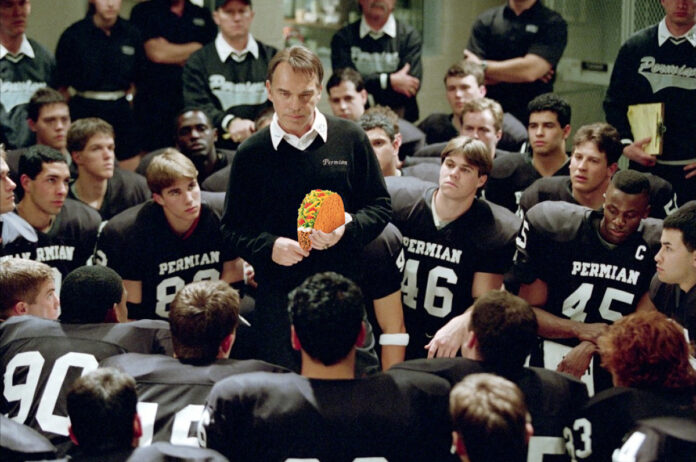
Our deepest fear is not that our tacos are inadequate. Our deepest fear is that they are flavourful beyond measure. It is our taste, not our blandness, that most frightens us.

Great tacos. . . are born from great opportunity. And that’s what you have here tonight, boys. That’s what you’ve earned here, tonight. One taco. If we ate here ten times, we might get bloated nine times. But not this meal. Not tonight. You were born to be taco aficionados — every one of you. And you were meant to be here tonight. This is your time. Now go out there and take it!

Well, it’s real simple: you’ve got two more tacos and that’s it. Now, most of you have been eatin’ at this TacoTime for ten years. And you’ve got two more tacos and after that, most of you will never eat this food again as long as you live. Now, y’all have known me for a while, and for a long time now, you’ve been hearing me talk about being perfect. Well I want you to understand something. To me, being perfect is not about that menu board out there. It’s not about eating. It’s about you and your relationship to yourself and your tacos and your friends’ tacos. Being perfect is about being able to look your tacos in the eye and know that you didn’t let them down, because you told them the truth. And that truth is that you did everything that you could. There wasn’t one more thing that you could’ve done. Can you live in that moment, as best you can, with clear eyes and tacos in your heart? With joy in your taco? If you can do that, gentlemen, then you’re perfect. I want you to take a moment and I want you to look each other in the eyes. I want you to put tacos in your hearts forever, because forever’s about to happen here in just a few minutes.

Remember, kid, there’s heroes and there’s tacos. Heroes get remembered but tacos never die. Follow your heart, kid, and you’ll never go wrong.

Forget about the crowds, the size of the tortilla shell, their fancy side dips, and remember what got you here. Focus on the fundamentals that we’ve gone over time and time again. And most important, don’t get caught up thinking about soft or hard shell. If you put your effort and concentration into gorging to your potential, to be the fullest that you can be, I don’t care what the receipt total says at the end of the meal. In my book, we’re gonna be winners.

I just want to say to you all tonight I’m very grateful to be here. A lot of people told me that I’d never eat Mexican food again and that’s all I do. You know, if you live hard and play hard and you bite the taco at both ends, you pay the price for it. You know in this life you can lose every food you love, every food that loves you.

I don’t know what to say, really. Three minutes ‘til the biggest Taco Tuesday of our professional lives. All comes down to today, and either we consume as a team or we’re going to crumble, inch by inch, bite by bite, ‘til we’re finished. We’re in hell right now, gentlemen, believe me. And, we can stay here — get the shit kicked out of our stomachs — or we can fight our way back from indigestion. We can eat outta hell one inch at a time.

I am currently writing a script for what is sure to be the first critically acclaimed sports movie about badminton

0
webCMYK-badminton-EstherChang
Illustration by Esther Chang

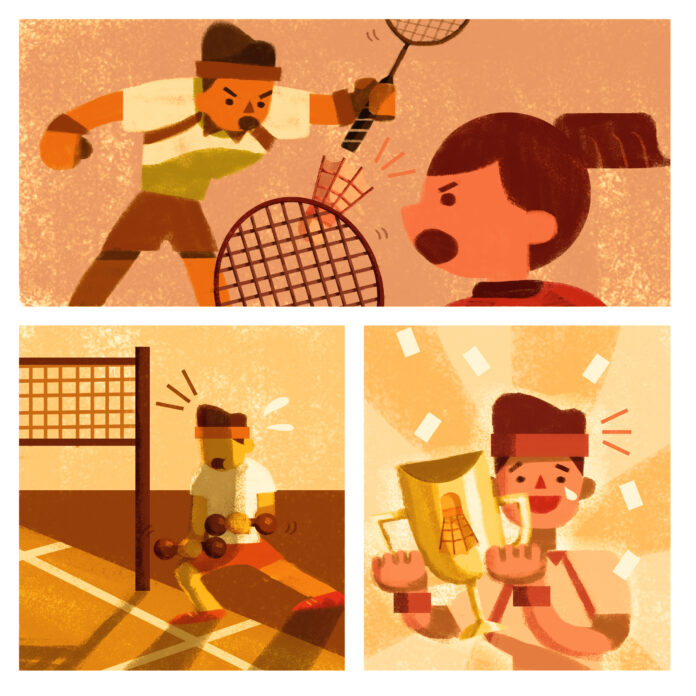
For years, the action-packed sport of badminton has been without its own iconic feature-length film; a movie that accurately encapsulates the electrifying thrill of the game while balancing dynamic characters with an original, engaging narrative. But that was then, and this is now, and this now is right now.

As God and you readers are my witnesses, I’m here to say that I am nearing completion on a first draft of what I will prematurely dub the world’s first critically — and hopefully commercially — successful film about badminton.

To be candid, I’m not sure how we made it this far in cinema without producing a film such as this one. It’s hard to even think of a movie that heavily involved badminton in a way like this before. Sure, we’ve had films like 2011’s Bruce Lee Played Badminton Too and Badminton from 1945, but those are just obscure titles that came up when I did an Internet search on “popular badminton movies.”

These are dire times for movie buffs that are also devoted badminton fans — but I’m here to pull those folks from out of the dark ages.

Picture this: a black background, with introductory credits in white text as the sound of fans builds gradually to a nearly deafening volume. The film’s title flashes on-screen before we cut to a stadium, with thousands of badminton-adoring spectators cheering. Heavy breathing begins to overtake the sounds of the crowd as we have a closeup of the protagonist’s eyes, sweat coming down his forehead. He’s in the match of a lifetime and his opponent is serving.

It all comes down to this last round — and then we jump back in time to show how the stakes got to be so high.

That’s just a taste of the Oscar-bait lurking in my script. You’ve never seen badminton portrayed like this before. Mostly because no one gives a shit about badminton, and so it’s never even been considered for something as prestigious as this. But after decades of neglect, with the spotlight shining on “better” sports like football or table tennis, badminton’s time has finally come.

What the world needs now, perhaps more than ever, is a biographical sports drama centred on badminton.

Will the sport of badminton itself act as a conduit for the protagonist’s insecurities to lash out at him? Will his professional rival, someone who’s older and maybe even a cautionary tale, be a metaphorical as well as a literal obstacle for our protagonist to overcome? Will the film include at least 18 minutes of actual adrenaline-fuelled badminton gameplay? Yes, yes, and goddamn it, yes.

Did I mention the script’s working title? Net Worth. It could be referring to the absurd financial wealth that top-ranking badminton athletes are prone to; it could also be an allusion to how the protagonist is going to struggle with his own self-worth. You’ll have to wait until 2018 — or sometime around then, depending on how long it takes for Warner Bros. Pictures to respond to my messages — to find out.

As with any iconic sports movie, the tricky part will be the film’s casting. Our male protagonist will have to be handsome enough for audiences to enjoy looking at, but not handsome enough that people don’t believe him as someone who would actually play badminton.

He’ll need a love interest, too. Any actress will do, really. She’ll have some surprisingly strong material to work with, revolving around the protagonist’s struggles, but that’s about it. The overall lack of female characters in the film isn’t about sexism; it’s about there being little room for romance in the high-velocity world of badminton. Hopefully the Academy recognizes her for the 10 minutes of screen time she does receive.

It’s badminton’s time to shine. For too long, jocks have had no choice but to fill their favourite quotes section on Facebook with inspirational lines from football movies. Even horse derbies had their moment in the sun when Seabiscuit came out. Up until now, almost every other sport has gotten a slice of that critic-adored pie, and it’s badminton’s turn to take a bite. If there can be a critically acclaimed film about baseball starring Jonah Hill, then surely anything is possible.

Ask Professor Peak

0

Help! I went on a vacation with my family during midterm season, and now I’m screwed! 

DEAR PROFESSOR PEAK: Okay so I’m basically fucked. I’m swamped with term papers, midterm exams and other assignments, and for some reason I decided to leave on a five-day vacation to Florida with my parents last week. I just couldn’t pass up a trip to this beautiful, sunny state; Universal Studios and Disney World were amazing. However, upon return I realized that I underestimated just how much school work I have to catch up on. Now I’m crammed with deadlines left, right, and centre, and I don’t see any way I’ll be able to get these in on time to salvage a decent grade. Do you have any suggestions on how I can cope with this situation I’ve stupidly landed myself in? —SWAMPED STUDENT

DEAR SWAMPED: Life as a student can often feel like a never ending game of catch-up, but don’t worry: regardless of how overwhelmed you might be at this point, remember that the semester will be over sooner than you realize and you can get back to having spare time. (Remember what that felt like?)

I can’t speak for everyone, but when I’m staring down the barrel of multiple papers/projects due in as many days, it helps to prioritize. Focus on any projects that might be due in the next day and then tackle them as the deadlines come at you. It’s a lot less organized than most people like to operate, but it’ll help you get through everything that’s built up. Just take things one day at a time. After you’ve made it through the slew of immediate deadlines, you can regroup and reprioritize.

PS. While you’re at it, stop wasting time writing to your student newspaper about your issues, and get your ass in gear! —PROFESSOR PEAK