Home Blog Page 1002

Cinephilia: The Look of Silence speaks volumes

0

In Indonesia from 1965 to 1966, union members, many farmers, and numerous intellectuals were branded as communists and executed. In that short span, close to one million people were killed, and the perpetrators have ruled the country ever since.

Oppenheimer’s genre-defying debut The Act of Killing, one of this decade’s finest films, chronicled some of the odious gangsters directly involved in the genocide as they bragged about and recreated their killings on film.

The Look of Silence has a significantly smaller scope — we follow one man’s search as he learns about his brother’s murder by interviewing those involved with the killing — but it is almost as powerful.

The facial expressions are convoluted and complex. Sorrow is expressed with narcissism, and narcissism is expressed with sorrow. When the perpetrators are bragging about their killings, they hide their pain; when they express pain, they do so with insincerity and for their own sake.

We see the wrinkly, old faces of a mother and father whose son was senselessly killed. Adi’s teary eyes hint at a torment induced by never meeting his brother.

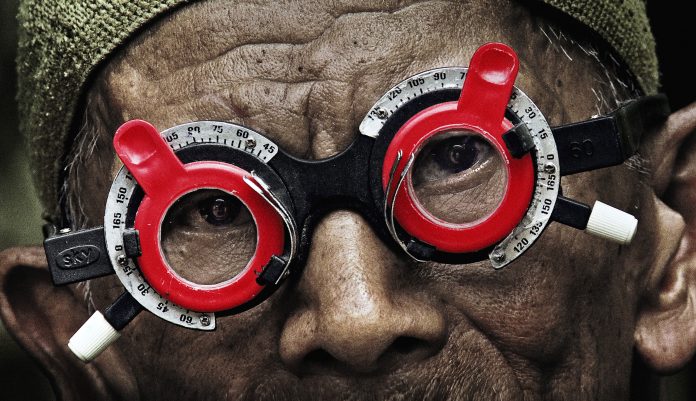
The film explores the pain on the faces primarily through a metaphor: an eyesight test. The examinations are performed by Adi, a middle-aged man who interviews those who were involved in his brother’s murder.

The reason behind this device in the film is twofold: from a practical perspective, it gives Adi and Oppenheimer the opportunity to talk with the perpetrators in a safe context, and it is also a metaphor for the blurred vision that the people of Indonesia have towards their past.

During the first eye examination, a local woman who doesn’t appear to have any direct role in the killings tells Adi that he is “asking too many questions.”

The intense irony is that she is being prescribed a new pair of glasses, and yet she still fails to see the injustice that was done and is still being done.

As we meet the perpetrators, they have identical reactions: an unrelenting hatred that is disguised by present comforts and a blind eye to the past that their lifestyle is built on.

The eye exams are given metaphorical significance through Oppenheimer’s stylistic choices of framing perpetrators in extreme close-ups when they are wearing the eye-testing apparatus. By highlighting certain aspects in the frame with color correction, Oppenheimer is not just documenting reality but commenting on it through the filmmaking process.

He is a poet and a journalist. Oppenheimer uses metaphors from true situations to affect us more deeply. He uses symbols in real life to unveil injustice.

The camera seems like a fly on the wall, but by juxtaposing images, creating visual motifs, and developing metaphors cinematically, he is directly intervening in the documentation process, while preserving the conventions that create the appearance of unmediated truth.

The excruciating irony that the perpetrators are blind to their crimes despite Adi’s eye examination, the agony caused by forgetting their crimes, and the unease created by the ghosts of the victims.

These images, faces, and metaphors in Joshua Oppenheimer’s The Look of Silence are the closest that we will come to understanding the pain inflicted by the senseless killings during 1965 and 1966 in Indonesia.

The Harpoonist and the Axe Murderer to play at Shorefest

0
Photo courtesy of 604 Now.

Shorefest is back with a wide-ranging lineup that is sure to please any festival goer. Set in one of the most picturesque settings in Vancouver, English Bay, Shorefest promises not only great scenery, but great music, good food, and even the Celebration of Light firework display.

I was able to catch up with Shawn Hall, one half of the BC blues duo The Harpoonist and the Axe Murderer. For those who don’t yet know of this band, The Harpoonist and the Axe Murderer released their fourth album last year, and we are sure to see more from them in the near future.

Matt Rogers and Shawn Hall inventively combine an old school blues sound, harmonica, and their own original, grittier style with wonderful guitar riffs and unique vocals.

Hall, the man behind the microphone and the harmonica stated that being a part of a band was the route he had imagined for himself. After receiving a harmonica as a Christmas present when he was young, he began to play and develop a deep curiosity and respect for the instrument and those who played it. Playing in the orchestra, he said he was drawn to the fact that the blues scene was the polar opposite of what he had been accustomed to.

Going to speakeasy-type joints in the Toronto area, Hall painted a picture of the dark and mysterious men and women playing their bluesy tunes at night in the dim pubs, providing that gritty, blues inspiration for his future band.

Believing at first that the harmonica’s old-school sound couldn’t hold its own in a band, The Harpoonist and the Axe Murderer started as a “project” to prove that the duo could cut it in the merciless musical world.

Today, after many awards, and much recognition, including a Sirius XM indie award for Blues Artist of The Year, the band has proven they are more than a project and a serious contender in the modern blues scene.

The Harpoonist and the Axe Murderer hit the Shorefest Sunset Beach stage on July 29. They are joined by many other celebrated artists such as Daniel Wesley, Bend Sinister, and Platinum Blonde.

Shorefest is a free music festival, preceeding the Celebration of Light fireworks, presented July 25 and 29 and August 1 at English Bay. For more information, visit lg1043.com

HUMOUR: The Peak’s guide to camping

0
Photo courtesy of Al_HikesAZ (Flickr)

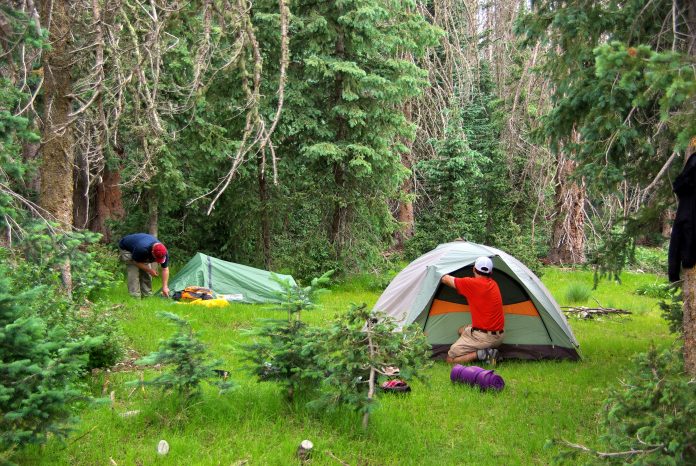
It’s that time of year again: the season made for exploring the great outdoors and going camping. (At least that’s what Canadian Tire commercials have taught us. No one currently employed at The Peak has ever actually been camping.) If you’re one known for not thinking for yourself and need help from a guide written by some hack, you’re in the right place; allow me to introduce you to The Peak’s guide to camping.

Fire: The first step to any successful camping trip is a big roaring fire. Lucky for you, British Columbia’s currently experiencing a severe drought and most things will catch fire with little to no effort. To be safe though, pour some gasoline over the area you intend to light. As for types of firewood, nothing screams old-fashioned like going out and chopping down your own tree — really, though, the ground around you will light easily enough.

Clothing: So at this point, you’ve probably started a forest fire. If you  really want to rough it out, you’re going to need to wear something fire-proof. Some sort of fire-proof suit; and considering you’ve gone this far in making bad decisions, why not make it asbestos?

Food: If you’re a normal human being, you would bring some hot dogs, marshmallows, maybe some potato salad, and that would be good enough. But if you’re in the mood for something extra special, try hunting for your food (assuming you haven’t scared away all the wildlife with the forest fire). See a bear? Yeah, go take it down. If you need to, maybe bring a stick or some kind of blunt object, but this is a job best done with your bare hands. Bear carcass will taste fantastic after just a few minutes of cooking on the forest fire.

Funeral arrangements: Truth be told, I don’t think you’re cut out for the camping life; you’re starting forest fires, hanging around afterwards to make a light snack, and even fighting bears with your bare hands. Chances are slim you’ll make it out of camping alive, so it’s best to prepare beforehand. Take care of funeral arrangements and find a life insurance policy that doesn’t discriminate against self-immolation, or fighting bears, or following the advice of poorly-written camping guides. Whatever you do, don’t leave the burdens on your loved ones — though, knowing you, you probably will.

Student to Kickstart “speaker ecosystem”

0
Photos courtesy of Spark Audio

An SFU engineering student is Kickstarting an innovative way to create an efficient, customizable audio system that will be unique to the owner’s needs.

Yousef Javaher developed the idea for SparkBlocks four years ago when he was creating backpack-style speakers. “The initial spark for the Blocks was when we realized that by separating difficultfunctions of a speaker into blocks [. . . they] could be connected together in any way the user desires,” he recalled.

Javaher, the co-founder of SparkAudio and a mechatronics engineer at SFU, also found his greatest motivation from his family. “My father has a master’s in mechanical engineering and has been the biggest inspiration in my path.”CMYK - kickstarter - Sparkblocks

As the lead designer and technology developer at his company, Javaher has been active in the development of audio systems. His expertise with audio speakers hints at his experience of “creating speakers for over four years.” Having “started with backpack style speakers,” he “slowly progressed in [his] designs” towards the final SparkBlocks product.

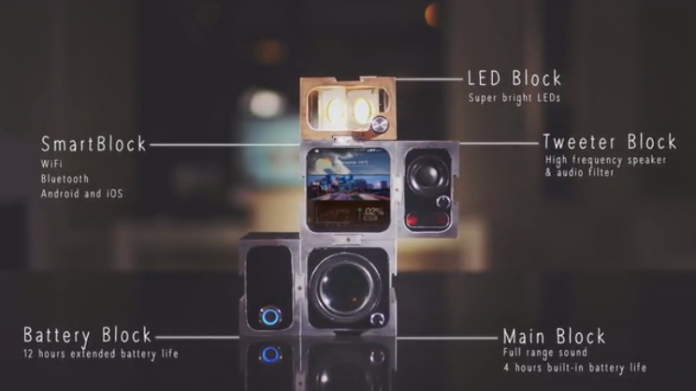
The SparkBlocks are a system of customizable speakers and accessories surrounding a centre ‘Main Block.’ Javaher considers the different modules to be something many people would appreciate.

“The unique modular system has allowed us to specifically calibrate each block to carry out a specific set of tasks with considerable quality,” said Javaher. “Rather than weighing the trade-off between form and functionality, we have strove to make form the functionality within a unique ecosystem of blocks that give users endless possibility for customization.”

There are many attachable accessories, ranging from specifically to generally useful. These include a battery pack, which will add an extra 12 hours to the four hour base power, and a bicycle mount. Javaher feels that the accessories are both practical and unique.
SparkBlock

Javaher’s goal with the SparkBlocks was “to enhance user experience.” The interesting interlocking designs of the Blocks is to create “a fundamental component of user experience [. . . through] the visual impact of the speaker system.

“The biggest challenge for me was to create a speaker that can capture all the detail of music,” Javaher stated. “I wanted to create something that was truly unique and customizable it every individual’s needs.”

Javaher also considers his experience at SFU as helpful in the development of his innovative project. “Being at SFU really helped shape my path as an engineer and as an entrepreneur. Not only have I gained knowledge about my field, I gained experience in facing challenges and pushing through those challenges.”

Javaher and his partner Ramtin Bidshahri have worked since 2014 to make the product a reality. Bidshahri earned a Bachelor of Arts degree at the University of British Columbia, and is currently earning a diploma in accounting at UBC.

“I would like to say that SparkBlocks is not just a speaker,” said Javaher. “It is an ecosystem of audio control, gadget and accessories that allows [everyone] to create their own unique device.”

Javaher concluded, “The main concept behind SparkBlocks is that people should have the choice of what their system should do.”

“O” magazine fat-shames irony

0
Photo Credit: Phoebe Lim

The latest O by Oprah magazine has come under fire by feminist bloggers, after it published a fashion ‘Q and A’ article telling readers exactly who should wear crop tops, and even more importantly, who shouldn’t: the average person.

The magazine responded to the question of how to wear a crop top by stating you should wear one “if (and only if!) you have a flat stomach [. . .] For more coverage, layer the top over a longer shirt.”

Since this particular magazine has a readership older than the average university student, why does it matter to those our age? The magazine, whether it meant to or not, is perpetuating the negative ‘fashion rules’ that serve to keep women viewing their bodies as inadequate against the ‘norm.’ Regardless of what magazine it appeared in, this is an issue we should not take lightly, as fat-shaming happens within other magazines far too often as well.

Advice like this is not a new phenomenon, and unfortunately, it’s unlikely to go away anytime soon. Women are constantly shown unrealistic standards the media feels they need to aspire to, and as a result can suffer from any number of medical and mental health issues. Eating disorders are a common and dangerous result of these body-shaming images and expectations.

O Magazine perpetuates the negative ‘fashion rules’ that serve to keep women from viewing their bodies positively.

Articles like these perpetuate internalized shame and oppression. We stop ourselves from wearing and acting how we feel most comfortable and beautiful, because we suddenly see from these sources that we should not look or feel how we do. We punish ourselves, we restrict ourselves, and it can become a vicious cycle.

Magazines such as O by Oprah, led by someone who has openly spoken about her own body image struggles in the past, claim they exist to empower the 21st century woman. If this is so, they need to watch the words they use and make sure they are propelling women to self-worth and self-love, not the opposite.

Magazines must monitor the language they use more closely, and avoid fat-shaming women who do not have a “flat stomach.” They need to understand that all bodies are meant to be appreciated and dressed how they so choose, and there is no reason to ever shame someone into covering up just because your beauty standards are less inclusive than theirs.

SFU’s co-op program: the other side of the story

5
Photo Credit: Phoebe Lim

Almost every young student lives the paradox of ‘needing experience before you get experience.’ Co-op programs present themselves as the ideal solution to this ‘experience’ dilemma, and as the ultimate way to begin in the working world. But there are many details about the process that they don’t tell you when you hand over your $125 application fee.

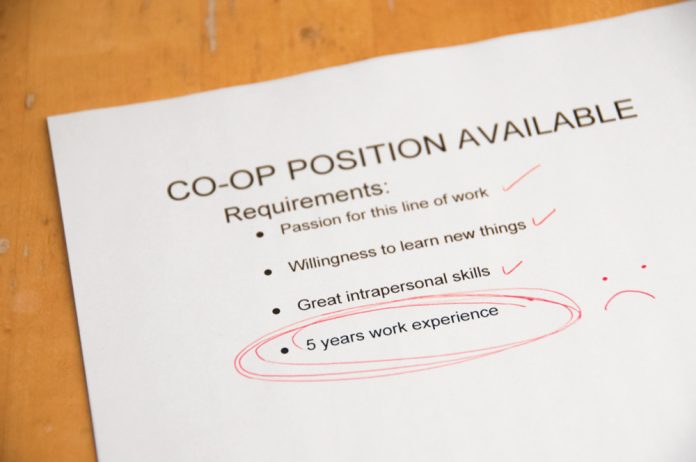
I saw a couple of co-op postings the other day that listed “extensive event management experience” and “at least two to three years in marketing” as requirements. I definitely feel like I missed the part where I was supposed to gain this experience while, like most other young students, I’ve been in university full-time since graduating high school. In my view, these job postings definitely don’t belong in a university co-op program.

If an employer has agreed to work with a post-secondary co-op department to hire a student, they are committing to hiring someone who has little to no work experience in the industry, but has the theoretical knowledge and eagerness to learn.

At first glance, co-op appears to be combatting classism; work terms are integrated into the school year and therefore it may be easier to pay off student loan debt with less interest. However, that doesn’t appear to be the case.

Sure, most of the positions listed pay over $11 an hour — however, many unpaid internships are also listed. Normally, this wouldn’t be an issue (aside from the fact that unpaid internships are morally questionable, especially when it’s from a corporation that can definitely afford to pay you), but SFU co-op explicitly advertises and emphasizes paid work experience.

I didn’t get a job I was apparently qualified for because my handshake wasn’t strong enough? Please.

I have also come across a posting that paid minimum wage and whose job duties involved ‘food pick-ups.’ That certainly doesn’t constitute ‘degree-related experience.’ In that case, I may as well go back to my job as a waitress, because I’d at least be making $20 an hour with the tips, and would probably enjoy myself even more.

Moreover, there have been many jobs that require you to have a class five driver’s license along with your own vehicle. When I had my one-on-one meeting with a co-op advisor, and I told him I didn’t have a car or the funds to buy one in the foreseeable future, he scoffed and said, “You need to have a car. At least get a scooter — like, you know, a Vespa.” Wow. If only it were that simple.

Another ‘great thing’ about co-op is that quite frequently, employers will send you feedback through the co-op office on how you performed at an interview. In fact, an employer once told me that I was indeed qualified for the position but “[my] handshake was not as strong as the other applicants’ were.”

I didn’t get a job I was apparently qualified for because of my handshake? Please. I’d rather you just told me you didn’t like me! At least make up some excuse about other candidates fitting in more easily with the corporate culture or whatever. However, such comments are to be anticipated in a corporate mindset where ‘fake’ is synonymous with being professional.

In the end I don’t want to discourage anyone from applying to co-op — who knows, you might be incredibly successful. But personally, I’m tired of reading articles that applaud the co-op program at SFU. There is always another side to the story; it seems to me that co-op programs no longer provide the “foot in the door” that they should, and that they are unable to offer any alternatives to the demoralizing demands of the corporate world.

Reflections on my veganism

1
Photo courtesy of Katrinka Kober

Going vegan was the most challenging and rewarding decision I have ever made for my health. I can still remember, a couple years ago, being asked “would you ever go vegan?” with my response being, “No way. Never.” Ironically enough, after living a vegetarian lifestyle for a year, I made the decision to do exactly that.

So what changed my mind? A multitude of things. Not only do I feel a plant-based diet is beneficial to one’s health, but it is sustainable for the planet and merciful towards the lives of animals. Being used to a vegetarian lifestyle was definitely helpful in making the transition to going vegan, though it was still not a smooth one.

If you’ve ever examined the ingredients in processed foods, you’ve probably found that they contain either milk, gelatin or eggs. In other words, these foods most certainly cannot be categorized as ‘vegan.’ Finding vegan alternatives that were within my budget was a bit of a fiasco, especially since it meant I had to prepare my food beyond just throwing instant noodles into the microwave on a regular basis.

After six months of being vegan, I can tell you that I still struggle with adjusting to this lifestyle. First of all, I’ve never been a huge fan of cooking for myself. After a long day of work or school I feel tempted to eat something that requires minimal effort to conjure, before lounging on the Netflix couch. Instead, I’ve developed a recipe book that includes super lazy recipes such as avocado toast and green tea smoothies. In that respect, if you ever find an Instagram photo of my own gorgeous-looking homemade vegan dish, know that I’m incredibly proud of it.

Being a vegan doesn’t mean that I’ll try to crush your soul for choosing to eat differently.

Additionally, though I rarely crave meat, I do often crave eggs in the morning, or cheese on my pizza, and while at one point I was extremely restrictive of these foods, I now allow myself to eat them once in a while. I figure that if a vegan lifestyle is a choice I want to maintain for an indefinite amount of time, I’ll have to be slightly lenient with my indulgences, according to the situation. For example, if I’m out with a friend and there is nothing vegan on the menu, I’ll allow myself to order the closest thing to it.

Vegan life is sometimes frustrating and inconvenient but it’s rewarding in more ways than one. While I passionately advocate this dietary choice for many reasons, it doesn’t mean that I’ll try to crush your soul for choosing to eat differently than me. The negative stereotypes that surround veganism is something I find quite astonishing, and even unnecessary. Even vigorously passionate vegans have good intentions about the subject, even when it seems they ‘attack’ those that eat meat.

While at Boston Pizza with a friend a while back, veganism surfaced in the conversation, and my friend halted mid chicken-wing, thunderstruck.

“Oh my goodness, I’m sorry. Does this disgust you?” The answer for most vegans, I find, is “no.” A dietary restriction or preference does not change a person; everyone is free to respectfully decide what kind of diet they want to upkeep, and this is not as big of a deal as everyone makes it seem.

So continue eating your bacon and I’ll continue eating large portions of guacamole. Veganism is my lifestyle, my struggle, my reward, and to each their own.

Potential airplane seating leaves me face-to-face with discontent

0
Photo Credit: Saida Saetgareeva

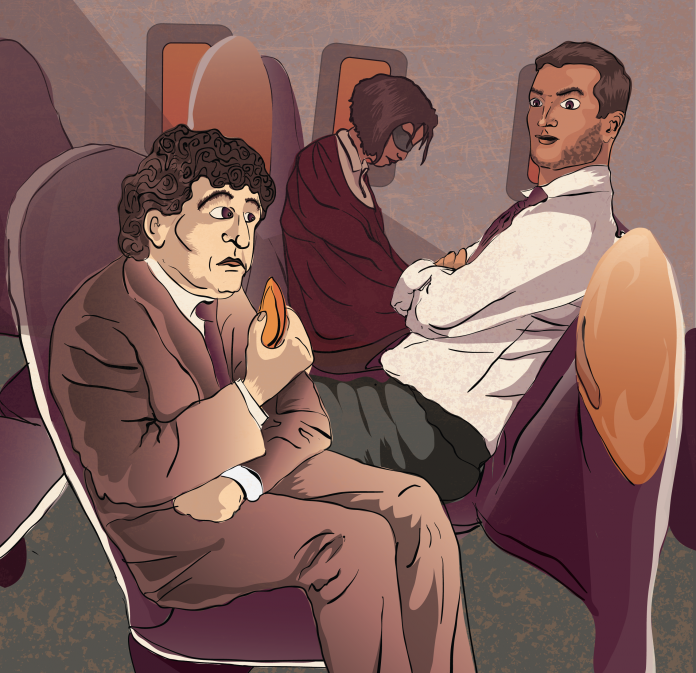
Stepping onto an airplane in France may never again be the same thrilling experience. Airline Zodiac Aerospace has filed a patent for an airplane seat design that would save space by forcing passengers to sit face-to-face with one another. Though implementation is not yet in practice, the possibility has engaged public debate; many are seething with anger and anxiety at the prospect.

Last I checked, humans have never had wings. Our biological makeup confirms that we simply aren’t meant to fly. Flight is pretty much as natural to us as a Quarter Pounder with Cheese. Naturally, flying can come with some anxiety.

Couple the fear of being suspended mid-air in a hurling death machine with the girl opposite you interpreting your absent-minded gaze as a creepy come-on. Well, let’s see, I didn’t pay attention in social studies, but I’m pretty sure existential dread plus social faux pa equals projectile vomit on whoever is directly facing me.

CBC reports that the design would encourage real, human social interaction. Who knows, a little footsie could lead to more than just footsie, right? Please. If I wanted to interact with people I’d go on Facebook. Is airline social interaction really even worth it?

Existential dread plus social faux pas equals projectile vomit on whoever is directly facing me.

I suppose, if introduced to other countries, this seat design is meant to include more seats on a plane, which allows more passengers to fit on board, which results in more profit for airlines like Air Canada, and hence cheaper flights for us all. However, given that so few airlines dominate the air travel industry, there’s a chance they’ll collectively decide to not implement these blueprints to physical space. We’ll have to wait and see how things ‘plane out.’

Moreover, there are some logistic considerations. Though tests are still to be carried out, I’m skeptical of the evacuation procedures on such planes. During loud and frantic emergencies, the seating placements could be disorienting and inefficient during potential evacuations where people look to flight attendants for directions.

A side note, will there still be space for those little personal entertainment systems that planes have nowadays? I’m doubtful, and this is a real shame, considering I love what airplanes have implemented entertainment-wise in recent years.

It’s important to note that these changes, if made, will not be made for a while. Control your uproar, people — these plans aren’t set in stone. Here’s to hoping I never have to sit face-to-face with any of you on my flight to France.

Teaching and course evaluation forms go digital

0
Photo courtesy of Branded3

If you have ever taken a course at SFU, you can tell it is nearing the semester’s end when your instructor hands out the blue inked sheets that are meant to evaluate the course and the instructor’s teaching.

Soon, though, there will be less ‘handing out’ and more ‘logging in.’ SFU is joining a growing number of Canadian and international institutions in digitizing course and instructor evaluations.

“A real driving force behind this transition is to focus more on how students learn,” said Corinne Pitre-Hayes, leader of the Student Evaluation of Teaching and Courses project.

A survey done by The American Association of University Professors shows that there is a general dissatisfaction with the approach of the current paper form evaluation. “SFU is taking a leadership role in focusing course evaluations on teaching and learning,” explained Pitre-Hayes.

The new system will incorporate a formative approach, rather than just a summative one. In a summative evaluation, the form is used to evaluate the instructor’s overall performance, whereas a formative approach allows the instructor to receive feedback on particular teaching techniques to see how effective they are and how they can be improved.

The project also plans to experiment with ongoing feedback with a special tool that enables daily feedback to be given very efficiently. 

SFU is also looking into ways to increase student participation in the evaluation process. Even though filling out the evaluation forms is not mandatory, consideration may be given to awarding bonus marks for students who do.

“The university is engaging with students in a way that actually makes a meaningful difference in teaching and learning.”

Corinne Pitre-Hayes, project director

“The start of the project had nothing to do with people being dissatisfied. It was more to look at new understanding from educational research and take advantage of that. We also aim to move the focus more to teaching and learning, as opposed to student perceptions of their professors,” expressed Pitre-Hayes.

“Moving to online was also preferable because of the efficiencies of the system. [. . .] The system has a lot of flexibility and we can do a lot with it.”

Evaluation will open for the students in the first pilot of the system on July 27. There will be 35 participating courses from two faculties — Health Sciences and Education — involving both undergraduate and graduate students.

Pitre-Hayes mentioned that an additional benefit is ease of access from smartphones, tablets, and laptops. Students will be given a two-week window prior to the end of classes to fill out the evaluations. For administration, one of the advantages of the online system is that students will be given more time to provide answers.

Professors will be able to select or create their own questions to get specific feedback on their courses. The results of those questions will only be released to the instructors in order to help them modify the course and see how their teaching techniques fair according to the students.

“A really strong part of the overall SFU vision is being the ‘engaged university,’ and this is an example of how the university is engaging with students in a way that actually makes a meaningful difference in teaching and learning,” said Pitre-Hayes. 

Due to the gradual phasing in of various faculties, the plan is for all students in the university to be using the online evaluation system by 2017.

Woohoo, Boohoo

0
Photo courtesy of Flickr

Woohoo: Poutine

Nothing says satisfaction like fresh cut fries, blanched and cooked to crispy perfection, sided with squeaky cheese curds and hot gravy in one big bowl. What looks like cheese and gravy chaotically tossed into a dish actually sings a quiet harmony if you listen closely. Delicious flavor aside, no one has ever finished a poutine and claimed to still be hungry. Can you ask any more of a meal?

Certainly Quebec has given the rest of Canada a few things to groan about, but all is forgiven when we consider this glorious gift.

There is no limit to the power this fine food holds. World peace is only one international poutine party away.

I tip my hat to you Quebec! Sincerest thanks.

Boohoo: Putin

If there is one political leader that stands out from the rest as being a massive pain in the world’s diplomatic ass, it’s this guy.

He tries to fool us with some of his quirky stunts, like the time he dressed up as a bird and flew a hang glider south to take endangered cranes for their first ever migration, but that won’t distract us for long from his terrible human rights record — most recently being his “straight pride flag” that was launched (‘coincidently’) days after the US Supreme court ruled in favor of same sex marriage.

But what can you expect from a man who was formerly part of the KGB?

You didn’t read that wrong, Putin was indeed part of the KGB, a fact some Russians must certainly find mildly disturbing.

Maybe the cold Russian winters have him feeling bitter, but if you ask me, what this man needs is a good ol’ bowl of poutine and maybe a big Canadian gay kiss to help him start feeling the love.