
Home Blog Page 1003

My first kiss wasn’t a fairytale

0
Photo Credit: Phoebe Lim

When I was young, I would always dream about what my first kiss would be like. I hate to admit it now, but in my tween years I was consumed with the idea. I was never the teeny-bop kind of girl who read J-14 to figure out Zac Efron’s favourite breakfast food or Nick Jonas’s dream date. I didn’t start wearing make-up until I was 18, didn’t own high heels until I was 19, and, as of writing this, still haven’t been in a steady relationship at 20.

I was more the awkward teen who spent recess fawning over the latest fantasy Young Adult novel in the library. I watched anime in my room instead of going to the school dance. I put my schoolwork before my love life. Even so, my heart would flutter at the thought of locking lips with the boy of my dreams.

Wow, it almost physically hurts to write that, but it’s true. I’m a closeted romantic. Even if my actions never seemed to indicate that I wanted young love, my entire being internally desired it. In my head, I pictured a shy, sweet kiss, me slightly tip-toeing to reach his soft lips, our hands intertwined as the sun set on a lazy summer evening. However, life didn’t pan out like a Wes Anderson movie — at least not for me.

What I expected was a loving embrace from my soulmate.

As much as I love her to bits, she is not my Ryan Gosling.

What I got was a wet, drunken smooch on the dance floor in a nightclub from my intoxicated female friend. As much as I love her to bits, she is not my Ryan Gosling.

Though the events of that night are a tad hazy due to all the alcohol, I distinctly remember the feeling of her lips pressed against mine. She is shorter than me, so she had to hold my head closer to her face. And I could tell she was much drunker than I was, but not by a large margin. With ‘EDM-ified’ top 40 hits as our soundtrack, blue spotlights dancing around us to set the stage, and the faint smell of long island iced teas, we felt the moment and we kissed.

It wasn’t an unpleasant experience; rather, it was quite the opposite. When I kissed her, I did not feel like I had lost anything, or given anything up. I did not feel like I had wasted my first real kiss, or that it had been taken from me. Although it wasn’t the type of romance I was anticipating, it was nevertheless a spontaneous expression of love and friendship.

Even if I am pretty straight along the sexuality spectrum, having my first kiss with a girl is something that I am not ashamed of. I feel as though there is too much hype attached to the notion of a ‘first kiss,’ and if you are going to kiss someone, it might as well be with someone you care about, and who also cares about you.
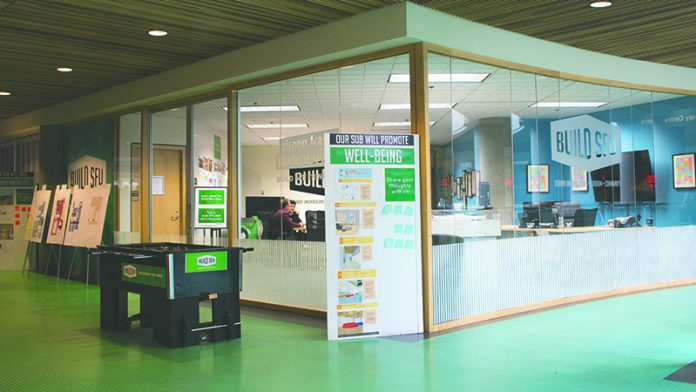

Build SFU asks students for feedback

0
Photo credit: Adam Madojemu

Build SFU sent out a member survey to SFU undergraduates in April, posing questions about the Student Union Building and Stadium projects.

The survey came on the heels of the spring Special General Meeting (SGM) of the Simon Fraser Student Society (SFSS), where students voted against allowing the society to pursue a loan that is essential in funding the projects.

Following the vote, the No to Build SFU movement continues to call for increased transparency and more student participation in the democratic process. Prior to the SGM, the group brought forward a petition to hold another referendum calling into question the continuation of the project. The petition only obtained 628 of the 1000 signatures required to add the question to the agenda. In an online post, they expressed, “The SFSS will not give students the opportunity to either affirm or deny continued support for this project.”

In the survey, Build SFU asked students to identify their main priorities and concerns around the Build SFU projects. It was completed by 1,879 students, 7.1 per cent of the undergraduate student body.

As a result of the survey process, the SFSS came to the conclusion that a considerable amount of students are concerned about the consideration of satellite campuses in these projects, as both are to be built on Burnaby campus.

SFSS President Enoch Weng addressed the issue, stating, “I take concerns really seriously, especially regarding the Surrey and Vancouver campus communities.”

He added that there seems to be a general confusion regarding some of the information being circulated about Build SFU. Weng looks at this as an “opportunity to clear up the mist, and to reach out to students with more easily accessible information.”

Overall, Weng says, it comes down to giving students what they want. “People want space to call their own, and they want a fair and just process, as well as having their voice heard.” Build SFU has attempted to incorporate student opinions along the way, with numerous student consultations being held during the design process.

The design itself is complete and the SFSS is ready to begin construction as soon as the loan can be secured. Had the SGM vote turned out differently, construction would have begun this summer. Regardless of when it does begin, construction is expected to last for 24 months.

Weng explained that going forward, the society will need to ask students’ permission once again to pursue the debenture; SFU has already agreed to contribute $12.5 million. Weng added, “I am hopeful that ethical sponsorship can and will be a significant part of funding, and I am adamant on pursuing any avenues that can lead to decreased costs to students.”

Board Shorts

0

New Executive Director

After 25 years of service, former SFSS Executive Director Colleen Knox is to be replace by Martin Wyant. Wyant has a history of work with non-profit youth-focused organizations and is “excited to be joining the Simon Fraser Student Society.” In his new position, Wyant will be guiding and managing the operations of the society. President Enoch Weng expressed, “We are very privileged to have Martin join our team. [. . .] Martin brings a good combination of experience and leadership, along with an excellent managerial and community-building track record.”

Ombudsperson Presentation

SFU’s ombudsperson Jay Solman attended the meeting as a guest speaker, and spoke to the various aspects of his job and the services he provides within the SFU community.

Solman’s presentation identified one of the main challenges faced by the Office of the Ombudsperson as being the lack of student awareness and understanding regarding his role and the services provided. Although the office is funded by SFU, the SFSS, and the Graduate Student Society, the ombudsperson is completely separate from the university and only deals with SFU policy as it pertains to students.

Governance Reform

To increase efficiency, a motion to explore a new governance model was put forward, sparking conversation on why a new model was not selected prior to seeking the board’s approval. A small committee has been formed to work with staff on developing a draft of the model, which would then be brought to the board table for review. In the presented “Roadmap to Policy Governance,” it was proposed “to segregate the operational policies from the SFSS Policy Manual, delete the Policy Manual, and institute its Governance Policies.”

University Briefs

0
Image credit: The Runner

Kwantlen cuts athletics funding

[SURREY] — In line with Kwantlen Polytechnic University’s strategic plan, the university’s varsity athletics program will receive a major budget cut, bringing its soccer, golf, and possibly basketball teams to an end within the next two years.

Their membership with PACWEST, the regional collegiate sports authority, will also be terminated and funding will be re-allocated within the university for “health and wellness opportunities to [all students].” Varsity sports are currently only located at the Surrey campus. Student athletes were given a say at their town hall discussion on Thursday, July 16.

With files from The Runner

Ontario students can redeem Aeroplan points for tuition

[TORONTO] — The Government of Ontario has announced the establishment of the Ontario Student Assistance Program and the Higher Ed Points program, which allow for Aeroplan miles to be used to pay tuition. 35,000 points can be exchanged and used to pay $250 of tuition, which would have required around $35,000 in purchases with Aeroplan partners to acquire as many points.

The Canadian Federation of Students is heavily criticising the government for turning the serious problem of student debt into a “loyalty program that asks [students] to spend money they don’t have.” The University of Toronto is not currently one of the participating institutions, but the program is aimed at all Canadian post-secondary institutions.

With files from The Varsity

McGill medical program on probation

[MONTREAL] — McGill University’s undergraduate medical program has been put on probation by the Committee on Accreditation of Canadian Medical Schools due to a lack of women’s health and domestic violence education.

Based on a preliminary review this February, the lack of documentation and curricular planning on those issues led to the decision. While their accreditation is still valid, there will be further discussion and planning between McGill and the Committee, with the goal to have all problems addressed by 2017.

The school has acknowledged the lack of documentation, such as meeting minutes, as a reason for this probation. This was echoed by students, who have mentioned a lack of feedback for filed complaints.

With files from The McGill Daily

Satellite Signals

0

Surrey

Got an idea for a new business but don’t know where to start? Venture Connections offers free one-on-one consultations for SFU students and recent alumni.

The next drop-in session will be on Tuesday, July 21 from 4:00 p.m. to 5:00 p.m. in the Mezzanine. Explore venues for starting your own enterprise and find out what support programs are available and which best suit your business.

Segal Graduate School

The Centre for Global Workforce Strategy is hosting a research presentation by Mark Harcourt. Harcourt’s research focuses on how minority unionism works in New Zealand.

The presentation will take place on Monday, July 20 from 10:30 a.m. to 12:00 p.m. at the Segal Graduate School on 500 Granville Street, in room 2800. There is no cost to attending the event, but those interested are recommended to RSVP on the website.

Swordplay shines in Shakespeare’s Rebel

0
Photo courtesy of David Blue.

In 2013, Bard on the Beach held its first ever book launch event for Shakespeare’s Rebel, by Christopher Gaze’s longtime friend C.C. Humphreys. Now, this world premiere adaptation of the novel brings to life the raucous, exciting world Shakespeare lived in while presenting the compelling story of his fight choreographer, John Lawley.

It’s London in 1599, and the city is preparing for a possible revolution. The threat of a rebellion in Ireland prompts Queen Elizabeth (Colleen Wheeler) to enlist her dear Robbie Devereux (John Murphy), Earl of Essex, to go and suppress the rebels. Wheeler spectacularly commands Essex and her secretary, Sir Robert Cecil (Robert Klein). Cecil, in turn, attempts to assert his influence on the queen and always “happens to be passing by” when she summons him (he is clearly eavesdropping). Some of my favourite moments were her spearing Cecil with insults before telling him to get out.

While this is a play about Shakespeare and his theatre company, the true protagonist is John Lawley (Benedict Campbell). Essex asks his old friend Lawley to join him in Ireland, but after giving up swordplay, all Lawley wants is to get back together with Tess (Jennifer Lines) and spend time with his son, Ned (Chirag Naik) who is a player in Shakespeare’s company, the Lord Chamberlain’s Men.

The conflict comes when Tess is engaged to the impish Sir Samuel D’Esparr (David Marr), whom Lawley refers to as “despair.” Amidst avoiding the battlefield, fending off Essex, pleasing the Queen, and trying to stay alive, Lawley tries to win Tess back. Campbell performs this important role with the swashbuckling style his character is known for, and did one hell of a job (though I think his performance as King Lear on the main stage finds him at the top of his game).

Lawley’s old friend Will Shakespeare (Anousha Alamian) is struggling to finish writing Hamlet, while the Queen asks Lawley to convince him that the country needs a patriotic play. Some of my favourite lines are about Hamlet, such as when Lawley says, “If it lasts a week they’ll be lucky.”

The only thing I would have preferred more of in this play is the Bard himself. He wasn’t on stage very much, and when he was, I didn’t get the same sense of his character as when Bob Frazer played him in Equivocation.

While I may have quibbles with some of the casting, this play shines most in its plot development. Never did the action drag on, and that is due to Humphrey’s ability to successfully translate his novel to the stage. He also skillfully incorporates the language of the time in a way that is not contrived or obvious. And, importantly, there are some wonderful lines that stick with you, such as, “I hate the theatre. It encourages base appetites in men and ungodly desires in women. Worse, it encourages people to think for themselves.”

Shakespeare’s Rebel is presented by Bard on the Beach from July 2 to September 19 on the Howard Family Stage, in the Douglas Campbell Theatre. For more information, visit bardonthebeach.org.

The Arts Club presents an intimate performance of Les Miserables

0
Photo courtesy of Ross den Otter.

Tragic narratives, heart-wrenching songs, and some humour sprinkled in between. These are the plot elements of Victor Hugo’s classic novel Les Miserables. While the novel has been brought to life on the Broadway stage for many years, and was made into a movie in 2012, the Arts Club in Vancouver brought the production to life on the Stanley Industrial Alliance stage with mixed results.

Set in 1800s France, the story centres on the journey of convict Jean Valjean (Kieran Martin Murphy) who is released after nineteen years of imprisonment for stealing a loaf of bread. He breaks his parole and tries to start anew and live an honest life. However, his past always seems to follow him as he is tracked by the ruthless Inspector Javert (Warren Kimmel) throughout the years. Meanwhile, a revolutionary movement is brewing in France, and several young idealists have come together to make a stand at the barricades against the French monarchy.

While the size of the theatre limited their set capabilities, the cast was still able to convey the emotional depth of the story through their enthusiastic commitment to their roles. The blocking of ensemble numbers such as the rowdy “Master of the House” and the compelling anthem “One Day More” was strategic and purposeful. Never has a more surefooted crowd of people held command of such a small stage.

However, the placement of actors onstage didn’t allow for a set focal point for certain scenes, as, for instance, actors who were standing parallel to each other on opposite sides of the stage made the song “A Heart Full of Love” hard to follow. This was disappointing, considering it was a scene that had multiple narratives running through the lyrics — one being the young love blooming between Cosette (Kaylee Harwood) and Marius (Sayer Roberts), the other being the heartbroken plight of Eponine (Jennie Neumann) as she is in love with Marius herself.

Some of the transitions between scenes were also abrupt and sacrificed audience comprehension of events for the sake of musical continuity.

Yet the smaller theatre also had its benefits, as the intimate venue allowed for audiences to see characters at their most vulnerable. Murphy gave an incredible depth to Jean Valjean, as the swells of his voice moved the story forward while depicting the moral struggles he had between his life as a past criminal and an adoptive father. Never too showy with his voice, his narration made for a compelling and resonant performance.

Another standout was Neuman’s heartfelt and forlorn rendition of the song “On My Own,” which spoke of her unrequited love. Roberts also displayed his emotions with a trembling voice  in the grief-laden tune “Empty Chairs at Empty Tables.”

All in all, Les Miserables was a captivating musical that successfully translated a traditionally large production onto a smaller stage. By bringing melody to tragedy, the cast’s performance transcended the limitations of their venue and made the audience feel right alongside them.

Les Miserables is presented by the Arts Club Theatre Company from July 2 to August 16. For more information, visit artsclub.com.

Peak Speak: First Kisses?

0

This week The Peak asks students about their first kisses.

SFU observatory hosts Pluto viewing party

0
The first high quality images of the dwarf planet reveal Pluto’s heart. - NASA

Simon Fraser University’s Trottier Observatory was alight with activity on July 14.

Dozens of people gathered late at night to celebrate the unprecedented close-up pictures of Pluto acquired by NASA’s New Horizons probe. The crowd was made up of professional and amateur astronomers, as well as families and students, all hoping for a glimpse of what was happening billions of kilometres away.

New Horizons finally arrived at Pluto nine years after the probe was launched in 2006. The close encounter provided new images and information about the dwarf planet, revealing striking patterns on its surface and removing layers of uncertainty about its size and mass.

During the same night, the Trottier Observatory showed visitors breathtaking views of various celestial beauties, focusing on Pluto. Open to the public since April, the observatory has served as a staging ground for other telescopes to be set up in the courtyard. There were line-ups to see the ‘all-star’ cast of the night sky, which included Saturn, Mizar, and Alcor.

Just beyond the circle of telescopes, the courtyard glowed with coloured light from LEDs installed in the benches. Each bench represented an element and had a unique pattern of light that corresponded to the spectrum astronomers use to interpret objects in space.

Howard Trottier, SFU physics professor, expressed his excitement over the event and the completed observatory.

“It transcends anything that I had imagined,” Trottier said, adding that it was “fantastic that people are getting so excited about [the Pluto flyby].”

The new information has raised many questions about the origin of Pluto and its largest moon, Charon, which are extremely different despite being locked in orbit and sharing an atmosphere. A dark spot discovered on the top of Charon has been termed “Mordor” by NASA. In an interesting and adorable twist, there appears to be a large feature on Pluto’s surface that looks like a heart.

Trottier explained that these mysteries remind people “that we know a lot about the solar system, but there’s still a lot that we don’t know.”

Aside from the historic event, Trottier contended that there is something else that Canadians in particular should be looking forward to next in the world of astronomy.

The Thirty Meter Telescope (TMT), currently being built in Hawaii, will have its mirror and enclosure built by Port Coquitlam-based Dynamic Structures. The reflecting mirror, that will measure 30 metres across, is half the length of an NHL hockey rink. The Canadian government announced in April that it would contribute $243.5 million to the telescope’s construction, and that Canada will get 20 per cent of telescope time.

Trottier anticipates the TMT’s completion in the early 2020s, saying that it will “make the Hubble look like a toy.”

For now, anyone interested can take advantage of the Starry Nights group at SFU to glance upwards at the night sky. Somewhere out there is the little machine which showed us, literally, that Pluto has a heart.

TSSU resumes strike action

0

The labour dispute between the Teaching Support Staff Union (TSSU) and SFU administration trudges on.

After calling off the job action in response to an unfair labour practice complaint filed by the university, the union is going through the motions once again and has passed a second strike vote by an 86 per cent majority.

The TSSU has served SFU with a 72-hour strike notice and is to resume job action on Monday, July 20., beginning with reinstating an overtime ban for instructors at Harbor Centre’s English Language and Culture program (ELC) and Interpretation and Translation Program (ITP), with the expectation that it will escalate as it did before, with the possibly of picket lines in the future. The union intends to implement these escalations until a new collective agreement has been reached.

The roots of this discord trace back to April of 2014 when the previous collective agreement between the TSSU and the university expired and new negotiations began.

In February 2015, after nearly a year without a Collective Agreement, the TSSU voted to hold a strike vote, which occurred in March, leading to the commencement strike action with 92 per cent of voting members in favour.

Reagan Belan, Chief Steward of the TSSU, listed “Seniority rights for sessional instructors, equity for our ELC/ITP [English Language and Culture/Interpretation and Translation Program] members, improved access to work for TAs and TMs, and including the minimum standards of BC labour law for Occupational Health and Safety and payment of wages” as issues they would like the administration to address.

Belan explained, “What students need to know is that improving our working conditions improves their learning conditions. TSSU members provide 50 per cent of the face time teaching and teach the majority of the distance courses offered by SFU.”

SFU administration filed a complaint on June 25 to the BC Labour Relations Board on the basis that the union was bargaining in bad faith because of the bargaining demands it put forward before returning to the bargaining table.

“TSSU members provide 50 per cent of the facetime teaching and teach the majority of the distance courses offered by SFU.”

Reagan Belan,

TSSU Chief Steward

The university has contended that since the union had not re-filed their strike notice after the Essential Service Order, the strike contravened the Labour Relations Code and was therefore illegal.

To this, the union responded by ceasing all job action and members promptly resumed releasing grades on July 2.

The union then proceeded with another strike vote, which was held on July 15 and 16. In an online labour update, the university expressed, “We are disappointed that the Union also immediately announced their intention to hold another strike vote on July 15 and 16 with the apparent intention of reinitiating disruptive labour action.”

So where do the negotiations go from here? Both sides appear to be deadlocked. SFU reported that a meeting on July 8 resulted in “agreements on two minor changes, [but] there was no agreement on any of the remaining substantive bargaining issues.”

The University has applied to the Labour Relations Board for a mediator to help reach a collective agreement. The union, however, believes the University has been stubborn on the core issues. The frequently asked questions section of the TSSU website stated, “There is no reason to expect that [SFU] would respond favourably to mediation.”

However, the TSSU raised issues with the possibility of mediation, citing laws which prohibit a union from striking during mediation unless their employer allows it. The union sent a letter to the university to protect their right to strike during mediation — however, the university rejected this offer.

When asked if the university would make concessions to prevent a full walkout, SFU University Communications responded, “SFU is committed to the principle of not bargaining through the media.”

The university also expressed disappointment over the union’s choice to reject their offer of mediation: “We continue to believe that labour action is detrimental to the entire campus community and that a new Collective Agreement can only be achieved at the bargaining table.

“Negotiation, rather than strike activity, is in the best interest of students and the campus community. To this end, we have asked the TSSU to confirm their availability for bargaining during the month of August, but have yet to receive a response from the Union.”


Update: Since publication, the TSSU has decided to withhold grades as the next step in the job action. SFU Administration and the union met on the morning of July 24, resulting in a negotiation to allow ELC/ITP instructors to maintain their seniority after nine weeks of work (previously 13). The next bargaining meetings will not be until the last two weeks of August.