

By: Kelly Chia, Editor-in-Chief
I’m sure many people, like me, see creativity as a luxury they can rarely indulge in during adulthood. I can’t count how many unfinished projects pile up in my brain, waiting for the day I declare I finally have time to honour them. So one day, I decided to try following my impulse into a Michaels store after seeing a number of adorable baked-clay projects on YouTube. I daydreamed of making figurines, like YouTube creator Squash Clay, who makes adorable Pokémon figurines, one thin strip of clay at a time. It just brought me so much joy to imagine making a tiny town for my plushies and figures to take photos in. These are the things I tried in the process of learning how to sculpt!
Materials
To begin, I bought a package of white oven-baked Sculpey III clay ($14.99), a three-piece set of sculpting tools ($16.99), and a small package of white air-dry clay ($6.99). The toolset is helpful, and I love using its ends to carve or roll out my clay. In hindsight, though, household items like toothpicks, knives, or the ends of chopsticks could probably achieve similar results, albeit with less precision, so I didn’t need to buy the set outright.
Next, I thought it’d be easier and cheaper to paint the finished result with acrylic paint than to buy multiple packages of different colours, which is why I decided to stick with a white base. This would make it easier to prime — which means applying a primer to create a stable base for acrylic paint to stick.
As for why I picked up two different types of clay: oven-baked clay and air-dry clay have different densities, and different purposes. Oven-baked clay, like its namesake implies, is finished in the oven. It can be used for small planters, as it’s waterproof and quite durable. When you first work with it, you’ll have to cut it into small pieces and warm it with your hands so it becomes flexible and workable. Air-dry clay, on the other hand, is much more malleable and feels spongy in your hands, like PlayDoh. If you’re satisfied with what you’ve made, you can leave it alone for a few days, and it will harden! However, it’s more fragile than its oven-baked counterpart, so it’s best used for making small, decorative pieces. I wanted to try using the air-dry clay to make some cosplay accessories, and the oven-baked clay to make planters for presents.
A hoot of a project
I decided to make an owl planter for my mom — we’ve both always loved how round they are. Plus, I figured I’d only need to really carve patterns into a round, bowl-like figure, so it’d be an easy project. I took out some aluminum foil and rolled it into a ball, so it could safely bake in the oven. I rolled my clay out and draped it on top of the aluminum foil ball so that it would form a planter shape. Then, I promptly added a plucky tail to its butt! I cut thin lines to create tail-feathers. I then pinched the top of the planter with my fingers to create little hairs. Watching it slowly come to life out of a brick-like block of white was delightful. I thought of my mom’s expression as I placed a little bow on the owl’s chest, and rolled out wings that tucked into the planter’s sides.
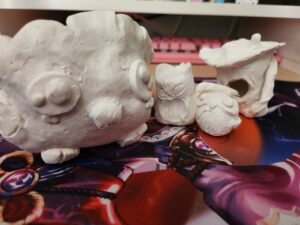
This owl was far from perfect, and in fact, closely resembled a beady-eyed fish. But it still brought me joy to think of new things to add to its face, or imagining what colours I would use to paint it. Every new line etched, every scallop added to its chest, was proof of my handiwork. And really, even though there were imperfections, this reminded me that art is sometimes best enjoyed in its process, not in its results. The time that you take to buff out details, riding out every mess and mistake along the way, is what makes your art unmistakably yours. It felt so nourishing to let myself experiment with different shapes, poking and prodding to see what came out, without feeling guilty that I could be doing something else. And if you find yourself suppressing those impulses because you’re too busy, I highly suggest you try something creative that you’ve always been curious about! It might be more rewarding than you expect.


