Home Blog Page 991

Woohoo, Boohoo

0
Photo Credit: The Peak

Woohoo: Turning 50

Hey SFU, I have seen the photos, and I can honestly say you have not aged one bit. You’re just as youthful as you were back in September, 1965, when you came into this world. For a university hitting its bicentennial, you’re hitting it in stride. I tip my hat and raise my glass to you. Here’s to aging like a fine wine and making 50 the new 20. Keep this up and you will be looking fabulous by the time you hit triple digits!

Boohoo: Turning 15

Turning 15 sucks ass, and there is no amount of sugar that can coat this unsavoury truth. Prepare yourself for a brutal curb stop from your good friend, Puberty. Braces, acne and awkward voice changes await you and let me tell you, your school photo is going to look terrible no matter what you do. Get ready for hormonal flux comparable to bag of feral cats in a burlap sack. But rejoice, my friend, as you look on the bright side: in just 365 long days, it will all be over. Except not really.

__________________________________________

Woohoo: McFogg the Dog

McFogg the Dog has endured as the face of SFU Athletics for over a decade, and shows no signs of retiring anytime soon. This Scottish terrier is the toast of his generation and the most prolific of all the mascots in SFU history. More than being the figurehead to SFU’s varsity sports teams, this pooch is a testament to rising above adversity.

According to SFU athletes, after facing a harsh breakup in 2003 with his chihuahua girlfriend and bumping into debilitating confidence issues, he travelled the globe to find himself. McFogg went through some hefty soul-searching in the Scottish highlands, he returned to the mountain re-energized with purpose.

These days McFogg is in better shape than ever and continues his mascot duties as the heart of the university.

Boohoo: UBC’s Thunderbird

Fun fact about UBC’s Thunderbird: when the name was established, hardly any UBC students wanted “Thunderbirds” as their team name. Back in 1933, students voted through the student newspaper, The Ubyssey, for a sports team name. Of the choices considered, Seagulls was voted the most popular (beating out the highly regarded Peewits and Sea Slugs).

The Pep Club and Ubyssey staff then controversially ignored the decision, held another election, and chose the name Thunderbirds instead. As many today still attest, the only place the Thunderbird belongs is on a box of cereal with his drunk uncle, Toucan Sam.

While Thunderbird wears his blue and gold, SFU can boast having a mascot that can leave him black and blue any day of the week.

__________________________________________

Woohoo: Simon Fraser University

Putting aside the quips about SFU Burnaby looking like a correctional facility for British Columbia’s finest, SFU might just be one of the best places to go to school. One can choose to study on a mountain, on the beautiful streets of Vancouver, or in Surrey on a boat-shaped campus above a shopping mall.

And let me ask you: where else can you see a statue of Terry Fox and a giant avocado within five meters from one another? Also, SFU has a cornucopia of illustrious alumni such as Riaz Meghji, and more Miss Hong Kong and China Vancouver winners than you can shake a stick at. So kick it with BC’s finest undergraduate elite. You know you want to.

Boohoo: Every other university

If you don’t attend SFU, you probably wish you did. Sure, you could go to the University of the Fraser Valley, but who wants to attend school in the middle of nowhere? And UBC, do I really need to say anything? These guys overcompensate more than someone with a small penis driving Ford F-150. SFU has a colourful history, personality, and gusto to fully match its top notch roster of studious professors and mindful students. Besides, our hats and hoodies are totally boss.

SFU Athletics director search still ongoing

0

SFU has narrowed down the list of candidates for the athletic director to a “medium list”, according to Tim Rahilly, associate vice president of students.

“We ended up with quite a large pool of applicants,” he said. “The selection committee reviewed all of those applications and narrowed that down to about 10 people who we think have the highest potential for the position.”

Candidates in this phase will be interviewed over Skype. From the medium list, SFU will narrow the list of candidates down further into a shortlist.

“We will bring those people on campus later in September to come meet us on campus, meet some important stakeholders, and give them an opportunity to check us out.”

SFU Athletics has been without an athletic director since Milt Richards, who had held the position since 2011, resigned in July. Richards was the first American athletic director at SFU.

SFU has had only five athletic directors in its 50 year history. Lorne Davies ran the program from its inception for thirty years, before retiring in 1995. Mike Dinning, who previously held the position at York University, became the school’s second athletic director, holding the position until 2001.

Wilf Wedmann, a former Clan track star, Olympian, and Rhodes scholar, succeeded Dinning, running the program until his retirement in 2007. David Murphy, the school’s fourth athletic director, brought SFU into the NCAA.

This time around, Rahilly said that they had received applications from a wide spectrum of people in the collegiate athletic community.

“[The search] included people who are currently sitting as athletic directors in NCAA schools that would include people who are associate directors in NCAA schools, Canadians working in the US, people who have previously worked in NCAA schools who are in Canada. It also includes people who are in the Canadian system in the CIS.

“We’re aiming to have an offer to the preferred candidate at the end of September or early October,” he continued. “In terms of actually having someone in the position, that’s going to depend very much on the circumstance of that individual, whether or not they’re local, or from parts unknown, and their personal circumstances in terms of their ability to move quickly.”

For now, however, the department still has to run, even without an athletic director hired. Peg Johnsen is listed as the interim director, handling day-to-day operations.

“It has to be business as usual, we’ve got a department to run,” said Rahilly. “We’ve got people who are stepping up to make sure things are operational.”

Whitecaps finding success their own way

0

The Whitecaps are having the best season of their short Major League Soccer (MLS) existence. They’ve won the Amway Canadian Championship, and at publication time are one point back of being the top team in the MLS. All of this without a big name star from Europe.

The MLS has long been dependent on star players from Europe to boost ticket sales and to help market the league. This all started in 2007 when David Beckham transferred from Real Madrid to the LA Galaxy. This immediately launched the MLS into the public consciousness. I hadn’t even known what the MLS was until I found out Beckham was coming over. Not only was he a success financially, he was a success on the pitch as well. The team won the MLS Cup three times with him, and finished top of the league twice. The Galaxy have continued with this trend, signing Giovanni dos Santos and Steven Gerrard this past summer.

“There is still much to be decided in MLS, but the Whitecaps have found success this season with no high priced talent.”

Of course, having a big star from Europe doesn’t guarantee success. Last year Toronto spent lavishly on players such as Jermaine Defoe and Michael Bradley, and still finished far out of a playoff spot. Whitecaps fans are probably never going to see a big signing like this for the franchise, for a couple of reasons. The ownership group doesn’t have the kind of money to spend on high salaries, and the artificial surface at BC Place is a deterrent for almost all European trained players, so much so that Thierry Henry refused to play on it when he was with the New York Red Bulls.

The Whitecaps have achieved success this year without a David Beckham. Under the designated player rule in MLS, teams can sign a player for any salary and not have it count against the salary cap. The ‘Caps have three of them, the maximum allowed under the rule. The highest paid one of them is Pedro Morales, whose $1,410,900 salary is close to six million dollars less than what Kaka of Orlando City makes. Octavio Rivero and Matias Laba both make less than a million. The Whitecaps have found success by buying players from South America and outcasts from the major European leagues such as Morales.

The team’s defence and goaltending has been terrific this year, and not one of their players is designated. Kendall Waston is one of the best centre backs in the league, completely dominant in the air. And David Ousted could very well be named the best goalkeeper in the league at the end of the season.

There is still much to be decided in MLS, but the Whitecaps have found success this season with no high priced talent.  Recent MLS championships have been been dominated by LA, winning three of the last four with the likes of Beckham and Robbie Keane. It remains to be seen if this run of success for the Whitecaps can be maintained without the big name players.

Driver to customer ratings are an über good idea

0
Photo Credit: Phoebe Lim

Whether it’s directed towards your friends, family, or community, doesn’t the act of giving back make you feel all warm and happy? App-based transport company Uber utilizes an innovative means of giving back to users — although what’s being given has elicited mixed feelings from recipients.

Like many other companies, Uber lends clients an ear by requesting that they rate their experience on a five-star scale. However, this ridesharing service bears two proverbial ears, and it offers the second to its partner drivers, who rate passengers in the same manner.

Yes, that’s right: Lady Karma has acquired a taste for ritzy smartphones and riding shotgun, and she’s quickly laid down the law. While courtesy will net five stars and your drivers’ blessings, cringeworthy conduct might lead to retribution.

Drivers see your average rating, and if it’s low, they’re less inclined to accept pickup requests. Low averages can even lead to suspension from the app, just as low-rated partners risk dismissal. While the concept (and consequences) of drivers rating passengers are off-putting for some, I’d say turnabout is long-overdue fair play.

Now, I’m sure many clients have legitimate complaints; God forbid you be denied the aux cord. But to allow users to make or break their drivers with a few taps on a screen is only fair if the reverse holds true as well — after all, the former party is equally capable of atrocious behaviour and should be equally accountable.

Lady Karma has acquired a taste for riding shotgun, and she’s quickly laid down the law.

Considering how passengers treat drivers sometimes, I’m surprised that letting the former speak out isn’t the norm. Many clients take advantage of ‘always being right’ to bully and harass employees over the smallest things — heck, there are online communities and discussion forums dedicated to relating horror stories of unreasonable passengers. Surely protecting your associates is just as important as protecting your customers?

Besides, even some well-meaning passengers need a wakeup call regarding etiquette. Learning to refrain from being late to meet your driver, leaving your trash in their car, et cetera, isn’t just great for expediting travel and staying in Uber’s good books; it’s also, well, common courtesy that people in general will appreciate. Paying someone for service in this case doesn’t negate their right to be shown basic manners.

Of course, many have criticized the system, particularly taxicab associations. The Florida Taxicab Association labels it “discriminatory,” with board member Roger Chapin questioning how drivers rate “poor tippers, an elderly person who requires more assistance, someone who regularly needs a short trip to the doctor,” or “someone whom the driver may just not like the way they look?’’

Frankly, that’s a risk no matter who’s awarding stars. Should passengers stop rating drivers too? For that matter, what makes Uber’s ratings more problematic than other entities? Shall we outlaw literary critics as well?

If we condemn Uber on that basis, then forget the next election; we need to pour taxpayer dollars into a countrywide revolution, outlawing Yelp and burning issues of Rolling Stone. The future is now.

Personally? I vote we skip that crusade. All Uber seems to aim for is a kinder atmosphere between driver and passenger. I genuinely doubt minding your manners for a half hour is too much to handle, and if you can do that, you should have nothing to fear from a simple rating.

Stop throwing shade on the grade

0
Photo credit: Lisa Dimyadi

Within the past year, I’ve read a fair share of prompt words by ‘letter grade reformists’ online, preaching change from our grading system that dates back to the 1800s, to one that better reflects a student’s academic performance in the 21st century, and would, to sum up their argument, ‘actually teach us something.’

To my understanding, the letter grade system has been labelled as a game of stifled creativity, fostering a negative environment riddled with anxiety, plagiarism, and extensive competition. Elyse Watkins in The Globe and Mail, suggests the alternative focus be placed on feedback, “team-teaching” and “interdisciplinary classes” designed to promote a “lifelong learning process” — which sounds like the kind of exhausted rhetoric my high school principal would fart out during a school-wide assembly.

First of all, I’ll agree that the grading system is a game. But guess what: so is everything else! In fact, life is just a big game called “How well can you do to match the standards set by our society?” Letter grades are simply an arbitrary standard of academic measurement that plays the more tangible counterpart to the adult world, where we pull up our big kid pants and work our darndest to get the job done efficiently, satisfy societal desires, and try to make ourselves look good in the process.

You think a system of letters creates undesired competition? Welcome to the life we must face outside SFU’s walls.

Without a printed letter to symbolize the ‘level’ of our academic achievements (or lack thereof!), how will we concretely measure how well we’ve done? What would we truly have? Ambiguity, scholarly distrust, false or bloated accomplishments, and, if anything, a hazy educational system, that’s what.

To those who feel that the letter grade system inhibits actual learning by promoting simple memorization and regurgitation, I’ll say this: one’s motivation to learn and to take away something meaningful from their degree is entirely dependent upon the student. We aren’t spoon-fed at this institution; the initiative lies with students to put the effort into actually learning something. As our mothers once told us, attitude is everything — sorry folks, but the statement rings true.

You think a system of letter grades creates undesired competition? Welcome to the life we must face outside SFU’s walls.

Where I will criticize the system is in its failure to snapshot the exact measurement of a student’s performance. At SFU, each grade is assigned a certain GPA point ranging from 0 to 4.33, so if a student receives a mark that’s 0.1 below the range of GPA points associated with an ‘A,’ that student’s GPA is pretty much shit out of luck and will be bumped down to the minimum number associated with a ‘B plus.’ In other words, these marks are unrepresentative and simply unfair.

So, rather than to throw out the grading system entirely, perhaps SFU should switch to a percentage system that would more responsibly reflect a student’s achievements.

In any case, grades are essential in providing order and stability to the system, while a process focussed on plain feedback would introduce chaos and confusion. Maybe you endured an unfortunate year; maybe you ran into personal difficulties that put a mental barricade on your school life. I’m cringing as I write this, but tough luck. It might be in your best interest to retake the class and aim for that higher grade. A big person job won’t simply allow you to provide poorer quality work because of your personal life.

In our constantly evolving standardized world, if we want to be better students, then it’s our job to do so, and the university must provide that template for us.

Compass Cards for all

0
Transit users will not need to tap out between transfers. - Alfred Zhang

TransLink’s Compass Card, which was released to students through the U-Pass BC program in May, will soon be available to all transit users.

The Compass Card has been introduced in phases up until this point, and TransLink estimated that by this month there would be approximately 220,000 customers using the new system.

The smart card project launch is now two years behind its original timeline, and $24 million over budget.

During August, the old ticket machines were phased out as users were able to purchase single tickets from the new Compass Vending Machines. By November, Compass Cards will be available for purchase at all Compass vending machines, various retail locations, and online.

Another change brought by this new phase is the “Bus Anywhere with a One-Zone Fare” campaign, which will allow users to travel through any number of zones by bus while only paying the standard one-zone fare.

The fare zone system, however, will remain intact for the SkyTrain, SeaBus, and West Coast Express, and there’s a chance it may return to the bus system sometime in the future. The fare gates at these stations will remain open for the time being, and TransLink has assured that they will provide ample notice before shutting them.

SFSS VP Student Services Darwin Binesh spoke to the challenges and successes of the U-Pass transition.

Binesh explained that since the launch of the Compass Card for U-Pass, the SFSS have met with students to discuss their experiences with the new system. So far, the society has consulted with about 250 to 300 students who are currently using the system.

He identified some initial difficulties students expressed during meetings in mid-to-late June with TransLink’s digital card reading system. Students noted that when transferring between buses and the SkyTrain the card readers would often display a red screen, indicating that the card had been rejected.

More recent consultations have revealed that rejected cards are no longer a major issue. Binesh explained that these sessions are about giving students access and information for a service for which they are already paying, and have so far been well received.

However, Binesh identified tapping in and out as one of the main concerns students have raised: “Because they have unlimited ridership, no one wants to tap in or out.”

Translink responded to these concerns in a media release, saying that, “starting October 5, bus-only passengers with Compass Cards and Compass Tickets will tap in but will no longer have to tap out when exiting the bus.”

Binesh explained, “The whole point is to tap in and out so that we can get a better sense of ridership — what it looks like, the use — so that we can use that data to improve service.”

He further elaborated that the one-zone bus fare element of the new phase “creates conditions where people won’t be overcharged in the instance where they forget to tap out, or there is an error.”

GSS Director of Graduate Services Adam Rinne explained that it’s important “for old students to not throw away their pass that they got during the summer, and to continue using it even when they have graduated from SFU.” This eliminates the need to pay the $6 deposit for a new card.

Furthermore, the electronic system that links each card to a student ID makes it much more difficult for students to sell and buy their U-Pass. Binesh noted that the electronic system makes it easy to deactivate any lost or stolen cards online, and then replace them by paying the $6 deposit.

Even though the Compass Cards have been available from SFU’s U-Pass kiosks since May, there will be a large influx of new students and students who were away for the summer in need of their transit passes.

The SFU U-Pass Office plans to have volunteers standing at the kiosks during peak hours, encouraging students to pick up informational brochures as they collect their Compass Cards.

“The university is really well prepared, all the cards have been ordered, we’re all set to go with the distribution. The promotional materials are ready so people know what to expect,” said Binesh.

Free your sexuality, free yourself

0
Photo credit: Jerry Guo

Gay, straight, bisexual: as a university student in British Columbia, I am fairly confident that you know what these words mean, and you have more than likely identified yourself as one of these three options at some point

These are words we hear thrown around often as concrete, unnegotiable labels that tend to feel inescapable. This is nothing new. When it comes to a human’s sexual orientation, being put into an inflexible box is all too common — most of us have come to expect and even occupy fixed sexual identities.

There have always been those who argue that sexuality is far more fluid than mainstream society would have us believe, but until recently it was considered more of a fringe idea than an accepted reality. You see, things have been changing. As a society we have gone from discussing Lesbians and Gays, to LGB, then to LGBTQ+; it’s been over a decade-long process.

However, with celebrities like Caitlyn Jenner publicly transitioning, these discussions have not just hit the mainstream but have become part of celebrity culture. While some are still adamantly heteronormative, many of us have expanded our views to include and accept all orientations (as we should).

Our generation has had a front row seat for witnessing this cultural shift. But while we generally accept homosexuality, Western society still places shackles on the idea of gender fluidity, rejecting any movement outside of the three fixed sexual identities we are ‘allowed’ to occupy. Even bisexuality, I feel, is still placed outside most mainstream discourses, so the idea of a fluid continuum is the next frontier.

Many people’s sexuality will not be as definitive as ‘gay and ‘straight,’ and this is completely normal.

Is it truly realistic that amongst the 7.125 billion people that live on this planet, we are only capable of craving love and intimacy from one specific gender? Even considering the boundless complexities of the human mind? The reality is that our sexualities fall on a spectrum from heterosexuality to homosexuality, which could also be referred to as the Kinsey scale, developed by sexologist Alfred Kinsey in 1953.

Of course, one can be completely straight, gay, or bisexual, as these all fall on to the spectrum. But many other people’s sexuality will not be as definitive, and this, too, is completely normal. Some people may be attracted a little more to men than to women, or may feel physical attractions to women but more emotional attractions to men. The balances are infinite, and they are real.

Even scientific research has shown that many people possess the capability to love anyone, regardless of their sex or gender identification. Attraction stems from a deeper chemistry, on an individual case-by-case basis; not from preconceived notions and conditioning of our own (and other’s) sexual orientations.

This change in thinking opens all kinds of sex-positive doors; a rejection of a simplistic label defining the single most complex and intimate part of us. And for those not so sure who they like, or those sure they do not belong with only one gender, they could find their point on the continuum — which, in itself, is not entirely fixed, as people could slide back and forth on the scale at any point.

We cannot deny the existence of the sexuality spectrum, one that forces us to reconsider our sexuality, and fosters a positive and realistic perspective on a topic that has generated so much needlessly negative controversy. Without gender and sexuality labels we would all feel more free to be who we really are; a shift in thinking that will help make this world a better place.

Canada’s first Prime Minister shouldn’t be on the $10 bill

0
Photo Credit: Jerry Guo

Have you ever held a crisp new bill straight from the ATM and asked yourself, what would I have to do to get myself on one of these?

The answer is really quite simple: if you come from a background of privilege and have influence or power, chances are you will be labeled a grade ‘A’ Canadian hero no matter what your moral compass and accomplishments may be.

John A. MacDonald, long regarded as a hero, brought the leaders of the colonies together in Charlottetown to rally support for a unified Canadian confederation. But that is not a holistic overview of who this man was.

What is often left out from our history books is that this Canadian ‘hero’ — whom we recognize through an established national day of celebration and whom we showcase on our 10 dollar bills — wasn’t actually an honourable man by modern Canadian standards.

While he may have played an integral role in establishing unity amongst Canada’s colonies, that doesn’t change the fact that he was a racist who consistently expressed prejudice against Aboriginal people, spoke in front of the House of Commons suggesting measures needed to be taken to control the “mongrel” Chinese race moving into British Columbia, and openly sympathized with the pro-slavery confederate South in the USA.

If you come from a privileged background and have influence or power, chances are you will be labeled a grade ‘A’ Canadian hero.

With a track record like that, why do we continue to praise and honour this man? Because as long as you have clout, like MacDonald did as a high profile politician, then you’re guaranteed to be recognized as a hero.

Because of this, Canadians must ask themselves: who deserves to be recognized as an outstanding individual? Rather than idealising power and status, we should choose to remember those who have truly helped shaped our country for the better, such as historical BC governor James Douglas, who was culturally and linguistically diverse, had public respect for Aboriginals, and established provincial order during the gold rush. He is a figure who would better fit the ‘hero’ label, yet he goes unsung.

When deciding who is worthy of national praise, we must take into account the moral background of said hero. No Canadian is perfect by any stretch of the imagination, but that doesn’t mean we should include historical leaders like MacDonald who were openly prejudiced. There have been many men and women who have fought to make the great North a better place to call home and who never engaged in hate speech.

Simply put, it is not hard to find Canadians who have stood up for our great nation, and who have preached equality and acceptance. In recognizing people like MacDonald, we are letting down those who lived by the Canadian virtues we wish to be upheld today. Without a doubt, the next time we create a national day of celebration or redesign our currency, we should strive to include only those who, on a moral level, Canadians can be proud of.

Reflecting on 50 years of SFU

0
Photo by Lisa Dimyadi

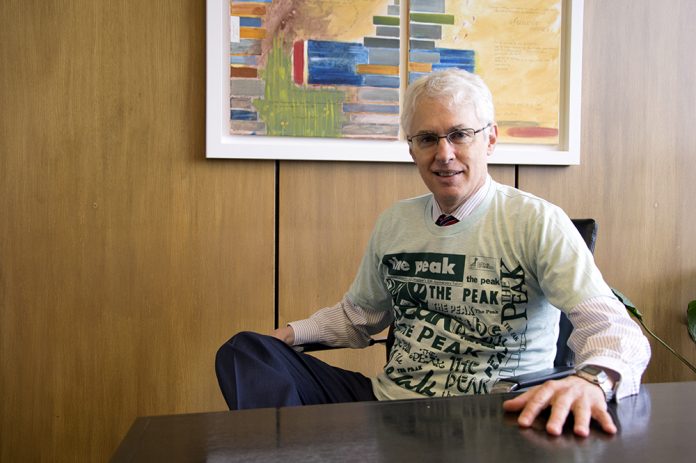
The Peak: I’m going to start with a tough one, if you don’t mind.

President Petter: Whatever you want to throw at me.

P: Egg or avocado?

[After a moment of confusion, it was established that we were talking about the landmark sculpture in SFU’s AQ gardens, and not Petter’s dietary preferences.]

Petter: I’ve always seen it as an egg, but I don’t want to denigrate those people who see it as an avocado.

P: SFU earned its reputation as the ‘radical university’ when it first opened its doors. Do we still live up to that reputation? How has the university evolved?

Petter: I think SFU’s history of being a radical campus has very much informed who we are today. I think we’re a different university than we were 50 years ago in a lot of ways. But I think there’s a certain degree of energy about the university — a willingness to do things differently, a bit of an adventurous spirit, a sense that people should speak out on controversial ideas. [. . .] The university, even in the early days, was a place of [fomentation] and controversy.

I guess I sometimes say we’ve gone from being a radical campus to an engaged university, which hopefully suggests that a lot of that energy informs who we are today, but also recognizes that we are today, of course, a much larger university, but also a university that I think has a much larger mission and relationship to the community than would have been the case 50 years ago.

P: You mentioned engagement, I think everyone’s become quite familiar with the term. What was the driving force behind that thought?

Petter: It came to me through a process of consultation that we engaged in. [laughs]

P: What are some of the most significant things to happen for SFU during its 50 years?

Petter: For an instant university that was created, really, of a piece, over a very short period of time, I guess the greatest highlight is just how far we’ve come in a 50 year period, to a three campus university with 35,000 students and rated the leading comprehensive university [by Maclean’s]. Our research performance has gone up astronomically. [. . .] That development of the university into something that I think we can all be really proud of has made a huge difference.

P: Do you have any particular goals for SFU in the long term?

Petter: Yeah, well, the vision sort of informs those goals. I think as much as I believe we already are extraordinary in terms of the engagement that we practice in our educational research [. . .] I think there’s much more we can do in that dimension.

For example, we will soon be announcing an innovation strategy, and that innovation strategy not only connects a lot of the work we’re already doing, including student innovation in social innovation at the RADIUS incubator and venture lab which was just started a few years ago [. . .] Surrey Innovation Boulevard, Venture Connection, the student incubator, but I can see that becoming a much extended presence in the university and also linking internationally.

It’s no secret that the buildings, some of which are 50 years old and some less so, [are] showing signs of wear and tear and we’ve had to devote internal resources to deal with those. But I’m very hopeful we will have more government support in the years ahead to really bring this campus up to the kind of condition that I think everyone would like to see it in and do justice to [architect] Arthur Erickson and to the students who are here now.

P: Are there any challenges you foresee that SFU will face in the future?

Petter: Well, finances are always a major challenge. We’ve had to endure some funding cuts in operating grants the last three years. And that’s very, very difficult because, like it or not, without funds we can’t do a lot of the things we want to do. We can’t address our desire to improve the quality of the student experience, which is a real priority throughout the university and particularly on this campus. So, I would say the financial challenges are probably first and foremost in my mind.

But are there other challenges? Sure. There’s always challenges. The technology for example is both a challenge and an opportunity for us. [. . .] Not only do we have to change our computers over every few years but there’s always a new software program, there’s always a new need to upgrade. So, technology is both a blessing and a challenge.

I do think this. We have to never allow education to be in service of technology. Technology has to be in service of education. Education is a human experience and if we allow tech to displace the human dimensions of education, we will be denying our students what is truly valuable about education community [and an] educational institution.

P: What has been the most defining moment of your term up till now?

Petter: It’s a little hokey, but I’ll say it, because the most defining moment for me is every year at convocation when you see the students cross the stage. You see that look in their eyes, you see the look in their parent’s eyes, a combination of pride, 90 per cent, relief 10 per cent. That sort of brings it all together and I think reminds us of what we dare not forget, and that is that it is about building human potential.

And it’s when I see those students cross the stage that is, I think, defining. It was particularly so this past convocation when we had a significant cohort of Aboriginal students cross the stage including students in the program we created, the Executive MBA. But all students crossing the stage. . . It’s moving and it’s defining.

P: Do you have a favourite SFU historical figure?

Petter: There are some people [who are] regularly and constantly referenced — and appropriately so — people like Gordon Shrum who made the decision to put it on top of a mountain or W.A.C Bennett who decided to create a couple new universities. . . Arthur Erickson. But you know the one I think doesn’t get the credit, perhaps, he should, and who I have a great story about because I met him recently, is the guy this building is named after, Ken Strand.

Ken Strand came here as an economist, a very young economist. And he kind of got thrown into the presidency. [. . .] And he, I think, really helped at a time when this instant university and a lot of the raucous qualities of SFU were being expressed. [. . .] He helped the university to really start to develop a trajectory and move forward and not to be undermined by, or distracted maybe, is the better word, by some of the controversies and things but to really get the university moving forward. And it’s appropriate that this administration building is named after him, but his name doesn’t come to people’s mind as quickly or as often as it should.

And he told me a great story [. . .] he told me a story that shortly after he became president, he got a call to come over and meet the premier. And this was during the time of all the protests and people with megaphones and decrying the government, decrying the university, and he got called over to meet the premier and he wasn’t quite sure why. He of course went over and he sat in the premier’s office [. . .] and the premier said, “I have a question for you, President Strand. Do you think it’s appropriate for universities to get involved in provincial politics?” Ken said that he thought about it, and took a minute, and he said “You know premier, I don’t think it’s appropriate for universities to get involved in provincial politics no more than I think it’s appropriate for provincial politicians to get involved in universities.” And apparently the premier thought about that and said, “Thank you President Strand, that will be all.” [laughs heartily] Isn’t that a great story? I hope that I’ve done justice to it.

But I think it shows that he’s a guy who really understood the mission of universities and their relationship to society and to government and their importance in their autonomy and the legacy he left us in terms of the academic. [. . .] I think he’s someone we should all be very thankful for particularly on the 50th anniversary.

P: Do you have any final thoughts you would like to add?

One of the things that I really value about this university is the commitment we do have to free speech and to diversity. I’ll tell you another favourite quote I have that actually comes from W.A.C. Bennet, who was the person who decided to create SFU and put the funds there to create it. [. . .] But one of his favourite sayings which I endorse is, “When everyone thinks alike, no one thinks much at all.” And I think that characterizes this university. We don’t believe everyone should think alike and we think we’re better off when people don’t think alike, provided their dialogue, debates, and disputes are respectfully carried out, we’ll be the stronger for it. And so I think it behooves us to remember that and to listen, to learn from each other in a respectful way, and not to become worried when we have disagreements, but not to become complacent either.
And it’s one of the things I really value about this university. Like it or not, that people are not afraid to speak their minds vigorously and challenge each other and challenge the administration and, while I don’t encourage that gratuitously, I celebrate the fact we have a university that supports that and sees it at as a core part of its commitment.


CampusPack de-stresses move in week

0
The three friends founded CampusPack out of a common interest to help students. - Photos courtesy of CampusPack

The first week on campus can be a dizzying experience for incoming students, from the relentless sign-up sheets for various clubs to the frenetic pace of welcome events.

Three SFU students have engineered an innovative business that aims to make for an easier transition to university life, and for many students, life away from home for the first time.

Started by SFU students Erik Sagmoen, Cyrus Wong, and Jeffrey Wu, CampusPack aims to provide a low-cost alternative to students for basic housewares by offering packages with a predetermined set of items.

Wong explained the logic behind this business model: “By simplifying it down to the necessities, we can avoid charging a higher cost to the students while conveniently providing them this service.

Currently on offer are a 32-piece KitchenPack that includes items such as cutlery, plates, and cookware, and a five-piece BedPack that includes bedding essentials. Said Wong, “Our sets are built primarily on the thinking of, ‘what exactly will students need once they arrive on campus?’”CMYK - CampusPack

The inspiration behind CampusPack came from a desire to help out students. “All of us are involved at SFU through student organizations, and we wanted to go one step further to help students save money and time while getting value for the products they buy,” Wong said. “We decided to do this together because we have similar interests in entrepreneurship and to help improve student life.”

The business launched last July, and this will be its first year welcoming incoming students on SFU and UBC campuses. Currently, products are offered through an e-commerce store and through pop-up stores on university campuses.

Wong described some of the challenges of “bootstrapping” a business — that is, funding it by oneself with the profits. “The hardest thing was starting our company with our minuscule amounts of capital, which was used to order our products from manufacturers,” he said.

“Every step we took was restricted by how much we could spend, so it really taught us how to properly budget while strategically planning for the future.”

In Wong’s opinion another major problem is competition from “big-box retailers” such as Bed Bath and Beyond and Home Hardware. He explained that because universities receive profit sharing from these retailers, “they are more inclined to work with [them] despite their prices being overly expensive.”

WEB- CampusPack2CampusPack has been developed by utilizing input from students. Wong elaborated, “To determine the items in the kitchen set, we conducted a survey asking students what they considered to be most important. We took this information and directly shaped our kitchen set around it.”

Sagmoen, Wong, and Wu hope to use data from a survey from current users to determine what items will be included in the next set. Wong remarked that, so far, the feedback has been positive. He noted, “Many people like our BedPacks because of its high quality build and its simple designs.”

The entrepreneurs behind CampusPack hope to expand and upgrade their product line for next year, in addition to creating a system whereby products can be easily moved from the storage space where they assemble the packs to universities.

The three students want to maintain a simplicity-centered approach to Campus Pack. Said Wong, “We would like to maintain the CampusPack model because, essentially, helping students is our priority.”