Home Blog Page 990

Macra-Mafia

0

[dropcap]I[/dropcap] was making my boyfriend a knitted cap for his birthday when I ran out of the right colour of yarn. So I went to a supply store downtown to find more — they didn’t have any. So the proprietor, a woman named Lisa, told me she’d order it in.

A few days later she called, said it had arrived. I went in, but turns out she’d ordered the wrong colour. This just wouldn’t do. It would mean the cap would have a strange stripe on the top half, just a slightly lighter coral than the bottom. Not right.

We were in her backroom, making the call for the second time. It was all very black-market, the rotary phone sitting in the middle of the otherwise empty table, a single light swinging from above. She spoke in hushed tones, using yarn jargon I’d never heard before.

She ordered the yarn again, this time the right shade of salmon that I needed. She was pretty good about it, really. She even ordered it with expedited shipping so it would arrive in two days time.

I’d decided to wander around the city that day and I came upon a yarn shop I’d never seen before. When I went inside, I discovered the exact shade of yarn I was yearning for. When Lisa called me the next day to say the bundle had arrived, I told her, regretfully, that I’d been in a rush and had to look elsewhere for it. She was furious. She began yelling at me, explaining how the yarn cost her more than it was worth, especially with the additional price of the courier. She lost a lot of money on it, she said, and it was all my fault.

Of course I felt terrible, but it was cutthroat, the yarn trade, and I had to do what I had to do. I needed the yarn, so I had to find someone else who could supply it to me.

I hung up, and convinced myself I’d done the right thing. She called back again. She told me I was forbidden to ever enter her store again. Her voice was level but deep. I felt embarrassed and also a little insulted; I certainly wouldn’t be paying her a visit anytime soon, I decided.

That evening I woke in the middle of the night to a loud crash in the dining room. I padded across the floor to find that the window had been smashed. Bits of glass covered the floor like a mosaic reflecting the moonlight. I tiptoed around the shards, trying to find the cause. Blood pooled around the crevices of my toes, left footprints behind me.

At last I found the culprit under the table. It had an odd, unexpected weight to it, and I figured it must be a brick wrapped in yarn, but as I unraveled it I discovered that the yarn never ended; it just continued all the way through, until I was left with a long trail of thin wool behind me. Peculiar, I thought. I cleaned my foot and went back to bed, resolving to have the window fixed tomorrow. Must have been kids fooling around.

The next morning I awoke to find something heavy at my feet. That’s strange, I thought, I don’t have a dog. I pulled the sheets back to find a large crocheted horse’s head at the foot of the bed, next to my legs. It was immaculately crafted; clearly the creator knew what he or she was doing. There were long red and pink loops hanging from what was the horse’s neck, woolen arteries and muscles. This, I thought, was no work by the neighbourhood children. This must be a sign. Someone is trying to tell me something, and they’re using wool to do it.

 . . .

I decided to venture over to Lisa’s shop despite her warning for me to stay away. I felt she could be the only person behind this yarn, and I decided it best I just confront her, maybe pay her for the bundle she’d ordered for me in order to remove this bad blood between us. I was just walking up to the front of the shop when I felt someone grab me from behind and slip a knitted sack over my head. Next thing I knew, I was in the back of a black town car surrounded by muffled gruff voices. Throw her into the river, I heard a deep female voice say. I tried to speak, talk myself out of the situation and maybe reach into my pocket for money, but I felt threads wrap around my wrists and my eyes felt heavy. They must have chloroformed the wool sack. Everything went black.

I awoke to cold water rushing around me, and something was carrying me down – fast. I struggled to get out of my crocheted cuffs, twisting my wrists viciously until my hands came free. Fools, I thought, such sloppy knots. I pulled the sack off my head and, quickly running out of breath, began fumbling with whatever was weighing me down. More yarn bricks. I plummeted deeper into the cold dark. Finally, I was able to undo a few of the knots around my feet, freeing the soggy bricks and swimming back up to the surface.

 . . .

I never actually found out why Lisa had decided to off me. Maybe I knew too much. Maybe I was collateral for the money she’d lost with my order. Whatever it was, her and her cronies had already high tailed it out of there by the time I broke the surface. Needless to say, I avoided her store-front from then on, making a yarn shop on the other side of town my home. This one was owned by a sweet little retired lady named Martha who called me dear and offered me tea and biscuits while I browsed. She was no killer.

One afternoon I was walking to Martha’s shop, on the hunt for some mint-coloured imported threads I knew she carried, when I noticed there was a sort of sidewalk sale going on. There were a few tables set up with fabrics and needles and baskets of colourful balls of yarn. I began sifting through the wares when I heard a familiar voice. I looked up and saw Lisa standing there, only a few feet away, talking to Martha. I froze in place, unsure if she’d seen me or not. Lisa came over and asked me if I needed help finding anything. Luckily my large-brimmed sun hat and dark glasses shielded most of my face, and I shook my head fiercely and robotically, leaving the table and walking away as fast as I could.

That was when I decided to ditch the whole knitting thing and pick up pickling instead.
Timeline of SFU Athletics

0

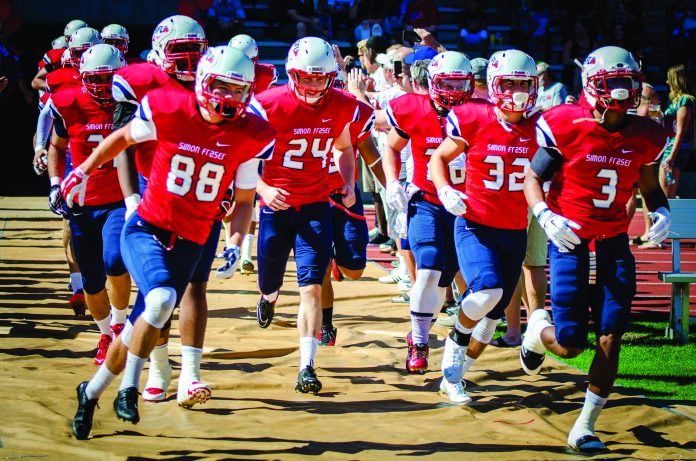
1965: SFU appoints Lorne Davies, a former assistant football coach with the UBC Thunderbirds and BC Lions, as the university’s first Athletic Director and football head coach. The “Clan”, or “Clansmen”, immediately became the first Canadian university to offer athletic scholarships and choose to play American rules football.


1966 (March 1): SFU and UBC play to a 0–0 tie in their first ever “Broomball” game, which was held during the intermission of a WHL Vancouver Canucks game.


1967 (October 16): SFU plays their first football game against crosstown rival UBC in the inaugural “Shrum Bowl” Classic. The massive event was played in front of a crowd of almost 15,000 fans at Empire Stadium and saw the underdog Clansmen trounce the T-Birds 32–13.


1968 (May 28): SFU’s Athletics department is officially accepted as the second ever Canadian member of the NAIA (National Association of Intercollegiate Athletics). The move allowed SFU athletes to become eligible for all-American honours and US national rankings.


1969 (September): The cricket club wins the BC 4th Division championship after finishing their season with 14 wins, three losses, and one draw. The win saw them promoted to Division 3 and by 1991 the club had a team competing in division 2.


1970 (November 21): The Clan football team defeats the University of Puget Sound and close out their season with eight wins and no losses, the only undefeated campaign in the team’s history. 23 of the members of that team were drafted into the CFL.


1971 (November 13): The Clan football team blowout the T-Birds 42–0 in the second straight incredibly lopsided Shrum Bowl. The severity of the loss causes UBC to cancel future installments of the game until 1978. This marked the first of many hiatuses for the Bowl, which has never reached the heights of its first installment.


1972 (March): The Men’s Swimming and Diving team win their first NAIA championship in Marshall, Minnesota. It was the first of nine consecutive championships for the Clan, who remain the most decorated NAIA Swim Team of all time with 17 total team championships and 260 individual championships.


1973 (March): The hockey club win the Pacific Intercollegiate League after going 8–2–2, which topped the records of the league’s three other teams Alaska Methodist University, the University of Alaska, and Gonzaga University.


1975 (May 17): The Clansmen Rugby team make history by becoming the only BC Division 2 team to defeat a touring English side after coming back from a 0–6 deficit to beat New Brighton by a score of 11–6.


1976 (July 19): In the first Olympic Games to include women’s basketball, the starting lineup for the Canadian team includes two Clan players: Bev Bland and Sheila Strike.


1976 (November 27): The men’s soccer team win their first ever NAIA National title by defeating the Rockhurst College Hawks 1–0 at the Rose Bowl stadium in Pasadena, California. The victory made good on inaugural chancellor Gordon Shrum’s 1965 declaration that “One day, the Clansmen will play in the Rose Bowl,” although it was obviously not exactly what he meant.


1977 (January 29): Clan High Jumper Debbie Brill takes first place at the Portland Indoor Track and Field Meet with a leap of 5’11”, beating out U.S. Olympian Joni Huntley.


1978 (May 26): After losing air pressure and having to rapidly descend down 10,000 feet on the plane ride to the NAIA national men’s track and field championships in Abilene, Texas, freshman Harold Willers wins the hammer throw with a 55.55 m toss. He would dominate the event for the next three years.


1981 (February 14): Basketball star Jay Triano becomes the first Clan athlete to have his jersey number retired by SFU. His number 12 was honoured at a time in which he held 11 school records including most career points (2,616) and most points in a single season (771).


1981 (March): The Women’s Swimming and Diving team wins the inaugural NAIA championship for women. They would repeat the following year and went on to win the competition 11 times, the most of any school.


1982 (January 22): Mike Jackel scores 47 points in a 94–88 loss to the University of Alaska Nanooks, and breaks the Clansman record for individual scoring performance previously held by Jay Triano.


1983 (November 20): The Women’s Cross Country team win the NAIA national title in Kenosha, Wisconsin. The team was led by a record-setting time for Cindy Grant and the victory would be the women squad’s first of 10 NAIA championships.


1983 (November): The men’s soccer team win the NAIA championship for the second straight year against Midwestern State at their home stadium in Wichita Falls, Texas.


1985 (March 2): Believing it to be their last meet due to budget cuts, the Women’s swimming team wins the national championship in the last race. The program is greatly reduced in size the following year, but not completely eliminated.


1987 (March): Clan hoopster Bob Hieltjes is honoured for the third straight year as an NAIA District I All-Star after the team’s then-winningest season, in which they went 24–11 overall.


1988 (March 5): The men’s wrestling team win their first ever NAIA national championship in Tacoma, Washington 11 years after they began at the competition. The unlikely victors upset four-time defending champion and number one ranked Central State Oklahoma.


1988 (November 18): SFU runner Leah Pells wins the NAIA Cross Country title winning the race in 16 minutes 59 seconds, a full 33 seconds ahead of the runner-up.


1989 (February 27): Women’s basketball freshman Michelle Hendry is named NAIA District I Player of the Year after the Clan secure their first ever playoff berth. She would repeat the feat in every season of her collegiate career.


1990 (May 16): SFU’s Varsity Golf team qualify for the NAIA national championship for the first time ever after dramatically winning District I by a single point (914 to 915) over St. Martin’s College of Lacey, Washington.


1993 (March 6): Justin Abdou wins his fourth straight NAIA National Championship, becoming only the fourth wrestler in NAIA history to have accomplished this feat as the Clan win their second nation wrestling title.


1996 (November 30): The women’s soccer team win their first NAIA championship in what was at the time the longest ever national title game. The Clan beat the University of Mobile Alaska 3–2, scoring the winning goal in the 160th minute of play.


1997 (February 1): At the University of Victoria’s annual “Beat the Beast” rowing ergometer competition, SFU fields two National Champions in the men’s and women’s Novice Heavyweight categories.


1997 (September): SFU’s field lacrosse team end their second season by defeating the Whitman College Missionaries in an overtime thriller to win the Pacific Northwest Collegiate Lacrosse League championship. It was their first of five straight titles, and the team has since added victories in ‘03, ‘08, ‘09, and ‘14 as well.


1998 (October 27): Despite being accepted as provisional members to the PacWest conference for 97/98 season, the SFU Clan are denied membership into the NCAA Division II. Considering that much of SFU’s NAIA competition had moved to that league, this is trouble. . .


1999 (March 20): The women’s basketball team advance to the finals at the NAIA tournament for the first time following a decade as an elite squad under coach Allison McNeill. The Clan unfortunately lost to South Nazarene in the finals that year, and again in 2000.


1999 (May 28): The softball team win the NAIA championship with a 7–3 win over Oklahoma City in a game held in Jupiter, Florida. They would secure three more titles in 2003, 2005, and 2010.


2000 (February 24): SFU agrees to a partial move to Canada’s university athletic association: the CIAU. The NAIA was rapidly losing teams, at the time, and SFU was unable to join the NCAA. The Clan therefore made a gradual switch to Canada with the majority of their teams leaving the NAIA to compete in the CIAU by 2002.


2000 (November 2): The women’s volleyball team made the playoffs for the first time in their history by defeating Northwest Nazarene to advance to the regional championships.


2001 (June 12): SFU wins their fifth consecutive Sears Directors’ Cup, the annual award presented to the best overall athletics institution in the NAIA. This year they were spurred to victory by three national championships, including women’s soccer and men’s and women’s swimming and diving.


2002 (March 10): The women’s basketball team cap off a 35–0 perfect season by winning their first CIS national championship in a 66–51 defeat of Laval. Their time in the Canadian league was quite fruitful, winning five championships in 10 years.


2003 (March 10): The women’s wrestling team win the CIS championship in their inaugural year. With follow-up victories in 2004, 2005, 2006, 2008, and 2010, and men’s title in 2009 and 2010, 2007 was the only CIS year without a Clan wrestling title.


2003 (November 8): In only their second season playing Canadian football, the football team wins the Hardy Cup as the champions of the league’s Western conference. It would be their highest achievement in that league.


2005 (March 13): The women’s basketball team win their second Bronze Baby as CIS champs in an undefeated 38–0 season. Dani Langford was named tournament MVP and her father, coach Bruce Langford, was later honoured as the CIS Coach of the Year.


2009 (July 10): SFU is approved as the first non-American school in the NCAA Division II and return to their roots playing primarily American schools and American rules football. After two seasons they became a full NCAA member in September 2012.


2010 (March 6): SFU senior Arjan Bhullar wins his second back-to-back 285lb NAIA wrestling championship a week after winning the CIS title, becoming the first athlete to have ever held a title in both in the same year. As a team, both men and women’s wrestling were crowned CIS champs.


2010 (November 6): The men’s soccer team become the first Canadian team to win an NCAA title after defeating St. Martin’s University 2–0 for their first GNAC conference championship. It was their first of 4 straight GNAC titles.


2011 (September 3): The Football team wins its first ever game in the NCAA, a 36–28 victory over Pacific University.


2012 (November 29): The men’s soccer Clan fall 3–1 to Michigan’s Saginaw Valley State College in their first trip to the NCAA Division 2 Final Four semifinals. They came back the next year, but were once again unable to advance to the championship match.

 
2015 (March 3): Women’s basketball star Erin Chambers is named GNAC player of the year shortly after breaking the conference’s all-time record for career points.

Twenty-five things to do during your first week of university

0
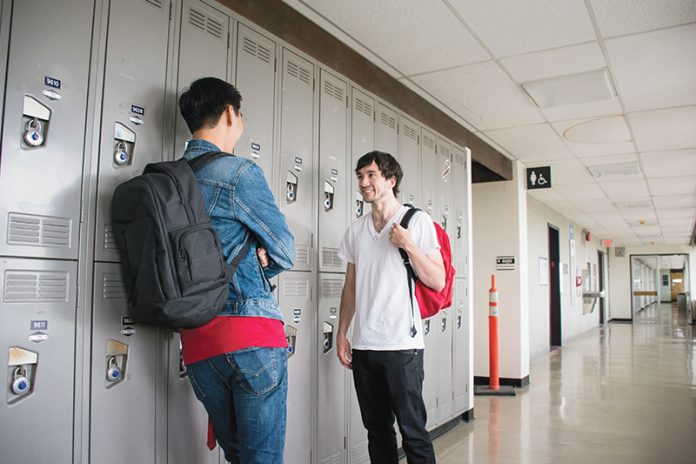
Photo courtesy of University Communications

The first week of university can be a whirlwind, but you’ll get through it: The Peak’s got you covered. Here is a list of 25 things every freshman should do in their first week of post-secondary.

  • Attend your first tutorial.
  • Personally introduce yourself to your T.A., a.k.a. your fearless tutorial leader.
  • Ensure you meet at least two people in every class (for future note taking requests).
  • Show how prepared you are on the first day of class by showing up with seven spare pens.
  • Suggest a seating chart to your fearless tutorial leader.
  • Do all your readings for the week.
  • Ask for sample test questions.
  • Ask for sample test question answers.
  • Seek out a different classmate each day and get to know something about them.
  • Wear pink on Wednesday.
  • Pursue your passion for amateur ushering by standing near the lecture hall door and then guiding classmates to their seats.
  • Answer your professor only in the form of questions.
  • Conduct idea-generating brainstorming sessions during pop quizzes as a form of protest.
  • Set up a buddy system so you can have someone to bug constantly for any minor issue.
  • Evaluate your professor’s teaching style, then provide them with constructive feedback.
  • Make a slow-motion entrance for one of your classes, so people know what a big deal you are.
  • Go to the gym, check out their operation hours, and never go for the rest of the semester.
  • Make sure the librarian knows your literary taste so they stock the “right” books.
  • Resist peer pressure by walking around with a soundproof, transparent ball around your head.
  • Attend the first pub night event to see what the next 57 pub nights will be like.
  • Write down your semester goals on a piece of paper.
  • Throw the aforementioned piece of paper into the garbage.
  • Learn where paper goes in the four-bin disposal system by spending 20 minutes in front of the garbage bins.
  • Offer to rub off the white boards after your tutorials.
  • See your fate suffer as rubbing boards becomes an expectation.

Laugh Track: Devin Mackenzie and Tom Hill

0
Illustration by Ariel Mitchell

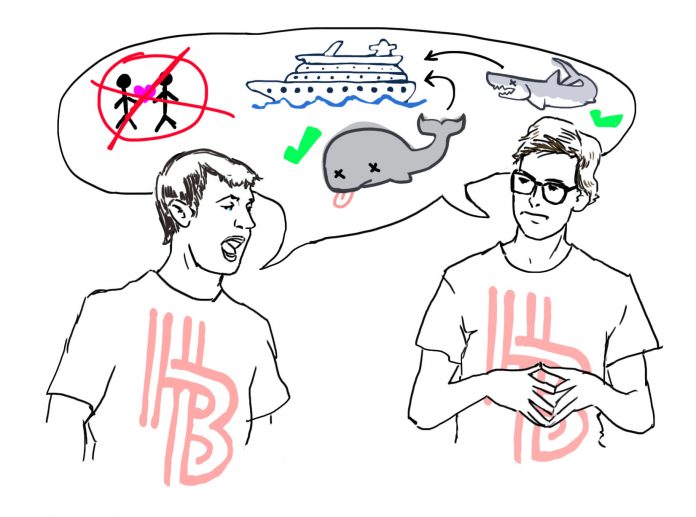
For years, Devin Mackenzie and Tom Hill have been bringing their signature style of high-speed comedy to the Vancouver scene. In addition to being part-founders of local improv and sketch comedy school Blind Tiger Comedy, the pair have also made a name for themselves through their two-man moniker Hip.Bang! The Peak caught up with Hill and Mackenzie to learn more about their upcoming Fringe show, Hip.Bang! presents WHITE PANTS, and to learn whose butt is featured so prominently on the all of the show’s promotional items.

Your show Hip.Bang! presents WHITE PANTS is about to start an eight-show run at the Vancouver Fringe Festival. First off, how many pairs of white pants do each of you own?

Devin Mackenzie: For this show, we each own two pairs of white pants.

Tom Hill: Historically though, for this show, probably closer to five each. A lot of women’s pants, a lot of pants that don’t fit our bodies correctly. But the pants we use in the show fit our bodies. Although I’d like to point out that Devin’s pants are women’s pants.

DM: We started out going to a lot of thrift stores and buying a lot of different oddly shaped pairs of white pants, and then we dialed it in to just spending the money to have the pants fit us and be comfortable. And yeah, funnily enough, the ones that are the most comfortable and actually look astonishingly beautiful on me are these long, thin, sexy women’s pants that I’m just making come alive.

TH: The poster for the show, I’m sure Devin would be happy to share, is an image of his butt in white pants.

What’s the elevator pitch for the show?

TH: WHITE PANTS is a two-man comedy show all about the idea of wearing white pants. If that sounds ridiculous, that’s because it is. WHITE PANTS is a comedy show but it also goes beyond that. We deconstruct what it is to watch live comedy while you’re watching live comedy.

One thing that people aren’t really anticipating about the white pants thing is that, yes, of course white pants are amazing and beautiful and that’s the inspiration for the show, but as much as the actual garment is the inspiration, perhaps closer to the vision is the idea that something is perfect and beautiful, but could be destroyed or imperfected by almost anything there is. That sense of tension — of something that should be great, but maybe is not or could become not — is what excited us most about the concept. So it might as well be called Hip.Bang! presents The Idea of Impossible Perfection.

Are there any noticeable differences between Fringe audiences and the audiences you usually perform in front of?

DM: Fringe audiences generally attract a wider spectrum of ages and types of people. Through our flyering and actually talking to people, we really target younger crowds. We try to get the younger person in there because, in a way, our show relates better to younger people more than it does to older.

TH: The demographic that sees shows at the Fringe is totally different from the demographic that typically sees us in Vancouver. With an improv show, you can really adapt to that. The audience is always in conversation with you on what they’re enjoying and you can do more of that for the next 45 minutes. But WHITE PANTS is written to our taste and what makes us laugh, which is deliberately not something that everyone will laugh at. We don’t like a lot of vanilla, mainstream comedy. We’re aiming for what our twisted, fun sensibility is — which is not for everybody.

What’s the hardest part of writing sketch comedy?

TH: The sheer amount of time. You take a bunch of time and then you pour it onto the show and you realize you need more. And then you pour more on it, and then more, and you just keep going until you run out of time.

DM: You’re working for 10 to 15 hours, probably more, on a two-minute bit.

TH: That strikes me as the hardest part. We love doing it, and we love performing. It’s exciting to discover what is working and isn’t working in a show. But the last 10 per cent of editing and tweaking the sketch show just the right way is a grind.

Is there anything else you want to tell our readers about Hip.Bang! presents WHITE PANTS?

TH: It’s more than just a normal sketch show. We tried to pursue ideas we thought were generally interesting in comedy and pushed them into this show.

DM: It deconstructs comedy a little bit, and builds it back up in front of your eyes. It’s very unexpected. It’s also very sharp and very funny.

TH: We had a review from the Edmonton Fringe I thought was really accurate: the show is definitely not for everybody but if you want a show for everybody, don’t go to the Fringe. WHITE PANTS is meant to be a cool comedy show for people who are interested in a cool laugh. If you want to do something safe, go do something else.

A new era for Men’s soccer

0
Photo courtesy of Hamed Yaghoubi Shahir

Last Year: 3rd

Coaches poll for 2015: 2nd

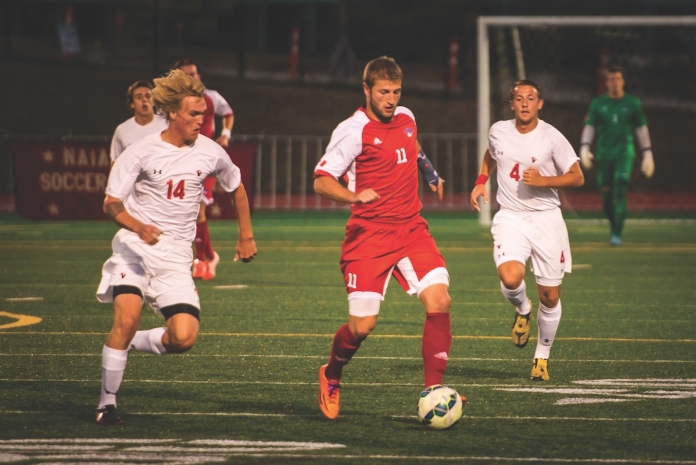
Men’s soccer at SFU has become synonymous with excitement, passion, and most importantly, success.

For eight years the men’s program flourished under the tutelage of Clan alumnus Alan Koch, who expertly led the men through a transition from NAIA play into NCAA Division II competition. Koch will be remembered for orchestrating feats such as an undefeated 2011 season and taking the clan into back-to-back NCAA Division II final four finishes in 2012 and 2013. Now, after taking the reigns as the Vancouver Whitecaps FC 2 head coach, Koch has passed the torch to former associate head coach and longtime friend, Clint Schneider.

The San Angelo, Texas native has been with the Clan for all five of their NCAA playing years, and prior to joining SFU was working alongside Koch at Baker University. As an expert in recruiting, scouting, and a specialist in goalkeeper coaching, Schneider is thrilled to take on a new challenge at the helm of the men’s team.

“I am honored to be given this once in a lifetime opportunity to lead such a prestigious and successful program,” said Schneider to SFU Athletics upon his promotion in February.

“I have had an opportunity to work with one of the best coaches in the business for almost a decade and he has helped me to develop the skills necessary to continue to build upon the foundation already in place.”

With preseason clashes already under his belt, SFU’s fifth appointed soccer coach is straight to work on building a competitive squad for the Great Northwest Athletic Conference (GNAC) opposition. Alongside Schneider will be former Canadian International and Major League Soccer player Kevin Harmse, who offers the young players a great source of mentorship at this stage of their development. Six players in total are gone from last year’s playoff run and 11–5–2 season record.

So far the Clan have had a taste of every possible result with one win, tie, and loss during a series of friendly matches in August.

Despite losing their star attacking player in Jovan Blagojevic — who scored 18 goals in 18 matches during his senior year last term — the Clan look destined to build their goal scoring exploits as a collective unit.

“I think we will score by committee,” Schneider remarked after a 2–1 victory over Kwantlen Polytechnic University. “We don’t have a guy like Jovan who will score 18 goals. I would love for that to happen but we are more likely to have a lot of guys with 5, 6 goals, or 7 goals.”

Schneider is eager to test out his fresh batch of reinforcements and is full of confidence to set the bar high.

“We have a great group of returning players and adding these incoming freshmen will enable us to compete for championships straight away.”

One thing’s for sure: the soccer fans at SFU will be ready and raring to motivate the men to victory at Terry Fox field. The Clan take on California State University San Bernardino Terry on September 9 — will you be there?

HUMOUR: The Peak presents: our new student survival guide

0
Photo by Alfred Zhang

So you’ve passed through the gauntlet of high school, and you’ve now moved on to university? Congratulations! I think. What you need now is advice from an experienced post-secondary expert, someone who’s spent the last three years mastering all there is to master and learning all there is to learn: me. I’m the experienced post-secondary expert. So that’s why I wrote this comprehensive, four-step guide for the first month of university. There’s a step for each of the first four weeks, so make sure to follow them exactly to make the most of your post-secondary experience.

(Week one) Create healthy, long-lasting relationships: perhaps the most important thing in university is meeting people. This is where life-long connections are made and true friendships are born. But most importantly, you need someone who will write your papers for you, or feed you exam answers at their own personal risk. Now’s the time in life to approach someone who looks smart and find a common interest (like taxidermy) or maybe buy a round of drinks (fountain pop, because you’re 18). These are the ways to any university student’s heart.

(Week two) Find a mentor who will positively influence you: by now you’ll have realized that not many people enjoy discussing taxidermy with complete strangers, so it’s time to move on from developing meaningful friendships. What you need is a mentor. A smart, handsome, successful mentor. If only you could find such a person, who has a few more years of university experience. . . oh wait, there’s me. I could be your mentor. But kid, I believe in hard work. I can’t just do all the heavy lifting for you — you’d learn nothing! Instead, I’d like for you to attend my lectures, write my papers, and write my scholarship applications. I guarantee it will be an educational experience.

(Week three) Perfect the art of time management: managing your time is key in post-secondary life. Now that you are going to my lectures and completing my coursework and essays, there’s just not enough time for you to handle your own workload. This is an opportunity to learn about prioritizing different responsibilities. Realistically, which lectures — of your own, since mine are mandatory — can you skip? Which assignments — again, of your own — can you afford to ignore and still pass?

(Week four) Never lose sight of the future: the honeymoon period of post-secondary is over, and the reality sinks in. Handling both of our timetables is a lot for even the most capable of freshmen, so I think it’s time for you to drop out and start a career as my full-time assistant. I’ve got lots of papers to do and plenty of books to read, and they aren’t going to read/write themselves. As a bonus, I even pay: once every two weeks, I’ll take you out for a cheeseburger (no combos though). Life will be good. Graduates of the Austin Cozicar School of Hard Knocks have gone on to illustrious careers such as dishwashers, gas station attendants, and sewage disposal cleaners — and you can too!

HUMOUR: SFU Bookstore now accepting bribes to cut long line waits

1
Illustration by Momo Lin

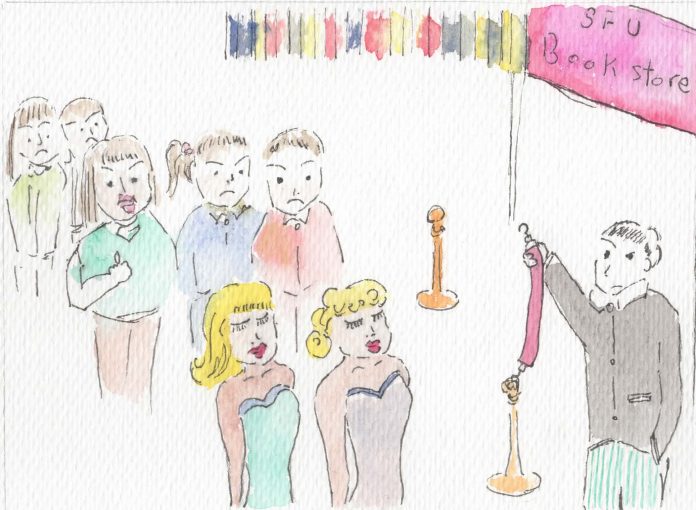
The first week of classes can be a tumultuous affair for students at Simon Fraser — a fate made all the more torturous by excessive line waits to purchase textbooks. However, starting this semester at the Burnaby Campus, line supervisors will now be accepting bribes to place cash-carrying students at the front of the line.

The initiative from the SFU Bookstore, known as “Project Jump Ahead,” was announced over social media last Friday and has been implemented with the goal of shrinking long wait times for students (or at least those from wealthier economic backgrounds). Currently, the average student waits nearly 45 minutes to get their course supplies, in lines that weave all over the Maggie Benston Centre.

Project Jump Ahead was designed by economics graduate and long-time bookstore employee Katya Lizz, who claims that the program was designed to be a component of her master’s thesis, though recent evidence may suggest that the 40 per cent commission on each student gratuity may also have been a factor. (A point made all the more viable with her recent twitter postings of purple Gucci high heels with the hashtag #Book$toremoney.)

While no set payment tier has been announced, students have been advised to use their common sense when bribing bookstore staff; line supervisors suggest that students determine suitable buyoff on the basis of the time of day and line length. It is also recommended that students bring paper money, as opposed to their younger sibling’s piggy bank, for matters of convenience.

Needless to say, the response to Project Jump Ahead has already led to outcry amongst old and new students of the SFU Bookstore; some have even gone as far as boycotting the bookstore entirely. The Peak contacted political science student Katya B. Keatings, a member of the petition, to get their side of the story.

“Since when do we treat bookstores like night clubs? Is nothing sacred in this world? And let’s not forget, this is the kind of stuff that enables the one per cent even more petty justification over the 99 per cent. I, for one, will not stand for this,” Keatings said. “I would rather wait an extra two weeks for my book to arrive through the mail than support this devious cause.”

Despite the project’s controversy, managing staff of Burnaby’s SFU Bookstore have been unwavering in their support of the new student designed program. One bookstore supervisor even told The Peak that the new line system had been in the works for quite some time.

“In the past, we’ve found that students become agitated while waiting to purchase books. They become aggressive, even getting confrontational with our staff. By offering customers a way to jump the line, we’re making the experience slightly more bearable. Still terrible, yes, but slightly less so.

“It also means we’ll have extra money to put into our staff’s semester-end pizza party [. . .] If we make enough, we’re also going to rent a magician for the wrap-up.”

Preliminary projections state that the SFU Burnaby Bookstore could stand to gain $1,000 within the first week of classes. Bookstore management are considering on accepting debit, all major credit cards and Bitcoin if the service proves to be a success.

As it stands, Lizz has met with SFU Administration, and rumours are swirling that the project might be further implemented to quell rising restroom wait times.

SFU football focused on righting the ship

0
Photo courtesy of Hamed Yaghoubi Shahir

Last season: 5th

Coaches Poll for 2015: 7th

It’s no secret that SFU’s football program has been in a state of flux the past couple of years. From Dave Johnson’s dismissal in 2013 to Jacques Chapdelaine’s sudden resignation the following year, the football team has gone through two offseasons with no head coach, and no direction. However, new head coach Kelly Bates is determined to change all that.

“I am committed,” said Bates. “I’ve laid out a four year plan, and if the administration sees fit to allow me to carry [it out], I am here for four years and beyond. Make no ends about it, I treat this as professional football. If we don’t create an atmosphere that is conducive to a great student athlete experience, they won’t allow me to be here that long.”

Coach Bates recognizes that building a stable, successful program won’t happen overnight. “To build stability you need a solid foundation,” remarked Bates.  “There’s been a lot of turnover the past three years — not just the head coach but the coaching staffs in general. To create a foundation that’s stable, you need to create long lasting relationships with your players and your student athletes, and to do that you need to have the same coaching staff.”

The Clan have recruited 20 new players into this years team, including defensive standout Jake Tumblin and running backs David Lagou and Nathan Kyeame. “[Jake] has shown some promise. Great work ethic, and very coachable. . . [David] is a local kid who is speedy, fast, strong, tough, and Nathan has shown tremendous promise. Those three guys really stick out to me right off the bat.”

This year’s coaching staff features a wealth of experience for Bates to call upon. New offensive coordinator Joe Paopao is extremely experienced, having served as the head coach for the BC Lions and the now defunct Ottawa Renegades, and having been the offensive coordinator for multiple CFL teams. Jaime Hill, the new defensive coordinator, spent two years in the NFL with the San Francisco 49ers as the secondary coordinator, as well as with Calgary Stampeders and the Ottawa Renegades.

“The great thing about both my coordinators is that they have a vast amount of experience,” said Bates. “Jaime’s familiarity with the American game and what he has to do in terms of his players gives us a distinct advantage.

“Joe has more experience in his left pinky than most of us do in our entire body. [He] is a living legend. . . he commands the respect of the people around him, and our student-athletes feel that and know that. He’s always trying to get better.”

Both coaches will have their work cut out for them. SFU’s scoring offense was the worst in the GNAC conference last year, only scoring an average of 21 points per game. Their defence wasn’t much better, giving up an average of 36.5 points per game and 447 yards per game, near the bottom for both categories.

Coach Bates is taking a patient approach with his program and isn’t judging his team in the early going solely by wins and losses.

“We always want to win, that’s why we compete. . . but I think it’s important we understand that this is a building process. I believe my veterans have bought into that, and understand that this year is their last opportunity to leave their legacy on this program.”

“It’s more important to respect the process, and create a proper process going forward to build the program, as opposed to measuring our success right off the bat with quick wins.”

The process begins for SFU in Monmouth, Oregon on September 12 when they take on the Western Oregon Wolves. Their first home game will be a week later, when they face Azusa Pacific University at Swangard Stadium.

HUMOUR: Previously-hidden N.W.A. member seeking recognition after Straight Outta Compton film success

0
Photos courtesy of New Line Cinema and Mann vor Tram (Flickr)

A previously-unknown member of iconic hip-hop group N.W.A. has come forward, following the group’s resurfacing in the public eye.

The announcement comes just after N.W.A. biopic Straight Outta Compton spent its first three consecutive weekends in first place at the domestic box office, causing a resurgence for the musical group. However, one man feels his role in the group has been left out. If you’re thinking of Arabian Prince, sorry, but no one cares about him; rather, the neglected member is Steve Johnson, a previously-unknown, Caucasian member of N.W.A..

“I was a white member in an ostensibly and overtly black group of musicians,” Johnson reminisced in an interview with The Peak. Now in his late 40s, the former rapper has mixed comments regarding his experience in the group: “I was the only white guy who rapped in L.A. back then, so it wasn’t like I had a lot of competition in being the token white guy in a group.”

Johnson went on to describe how N.W.A. member Eazy-E was interested in adding another layer of controversy to an already infamous group, and hired Johnson on the spot after hearing him freestyle. Johnson recalls the whole experience as being very strange: “From what I remember, it wasn’t really a successful night. Vanilla Ice was in the audience, and even he was booing me.”

Johnson took Eazy-E’s offer, but that was before he knew what controversial name Eazy had planned. “I was originally rapping under the name Slick Steve, but Eazy wanted to change my name to Krazy Killa Kracka or KKK,”said Johnson, with a note of coldness. Eazy thought it would be a good play on the name and a way to both attract white supremacists and shock black audiences. But the other N.W.A. members disapproved of the name and of Johnson’s presence. “The name wasn’t my idea. I guess Eazy didn’t tell them and the fact I was a white MC didn’t fit with the N part of N.W.A..”

After the group disbanded, Eazy-E promised to help get Johnson’s career off the ground, but the rapper died in ‘95 before anything was recorded. Afterwards, Johnson reverted back to his Slick Steve identity and attempted to release a series of dirty rap albums that received negative reviews. He had a few sleeper hit songs, including “Da Vanilla Thrilla,” “Slick Like My Dick,” and “Bitch Gave Me Herpes.”

Now, Johnson says he wants his story told and suggested a director’s cut of Straight Outta Compton should be made available for the home release, with a scene referencing his time in the group: “I don’t have an ideal actor in mind, but I’d take anything from Eminem to Shia LaBeouf,” said Johnson. “Man, I live out of my car right now [. . .] Couldn’t Ice Cube or at least Yella come down and bring me some McDonalds?”

Johnson still hasn’t heard back from Universal Studios on receiving a mention in the film, but he wants the rest of the group to know he’s currently in the South Central Walmart parking lot and he’s waiting on that Big Mac, preferably in a combo with fries and a drink.