Home Blog Page 98

The genocide of Palestinians is not up for debate

0
A Palestinian flag.
PHOTO: Ömer Yıldız / Unsplash

By: Amanda Taylor, SFU Student

Content warning: mentions of the Holocaust and death.

On June 16, Prime Minister Justin Trudeau attended the Ukraine peace summit and said Russia is committing “an element of genocide.” This is true, and it’s important Canada stands for peace in Ukraine. However, along with other Canadian officials, Trudeau has continually shied away from calling Israel’s ongoing violence and occupation of Palestine a genocide, which shows a double standard. While there are many factors that influence who and what receives open support from governments, political power is at the forefront — and Israel is certainly not lacking in it.

The United Nations (UN) recognized genocide as an international crime in 1946, shortly after millions of Jews were killed or displaced during the Holocaust. Two years later, the International Court of Justice (ICJ) brought forth the Genocide Convention, which has been agreed to by 153 states. Even states that have not agreed to the Convention are still bound by it, according to the ICJ. The Genocide Convention defines genocide as “any of the following acts committed with intent to destroy, in whole or in part, a national, ethnical, racial, or religious group.” Some of these acts include “killing members of the group, causing serious bodily or mental harm to members of the group,” and “deliberately inflicting on the group conditions of life calculated to bring about its physical destruction in whole or in part.” Israel is committing many of these acts in occupied Palestinian territories. And yet, the Canadian government doesn’t find the truth convenient enough to admit. 

This January, the ICJ reported it’s “plausible” that Israel has violated the Genocide Convention. They voted near-unanimously that Israel must take “‘immediate and effective’ measures to ensure the provision of urgently needed humanitarian aid and basic services.” One month later, Israel made it clear they had no intention of complying with this demand. According to Amnesty International, they “have failed to ensure sufficient life-saving goods and services are reaching a population at risk of genocide and on the brink of famine.” Since October 7, 31 of 36 hospitals in Gaza “have been damaged or destroyed.” In recent months, Israel has begun targeting refugee camps in Rafah, killing “at least 45 Palestinians” in one day and putting even more at risk of illness. The number of Palestinians killed since October 7 surpassed 30,000 in February, with reports that the actual number was likely higher. As of June 20, at least 37,431 people have been killed in Gaza alone.

This January, Canada froze arms export permits to Israel due to the risk of weapons being used to violate international law. In March, they announced they were extending this restriction until they “can ensure the weapons are used in accordance with Canadian law.” There are no excuses for supporting a militia that’s provenly committing genocide — no amount of time passed during a “freeze” will make it OK. 

Canada should also be concerned with the disturbing level of Israeli lobbying that undermines any façade of political neutrality. 

It’s unsurprising that Trudeau was willing to call the Russian invasion of Ukraine a genocide, yet avoided the word when asked about Gaza. It’s easy to criticize Russia, a country with weakening diplomatic ties to the US and Canada. Israel, on the other hand, is one of the US’ largest economic and military allies, receiving billions of dollars every year in assistance. Canada, with close military and economic ties to the US, has notably stayed silent when it comes to calling the Palestinian genocide what it is: a genocide.

Despite fewer ties to Israel in comparison to the US, Canada is not immune to anti-Palestinian lobbying. Last year, The Centre for Israel and Jewish Affairs (CIJA) hosted a conference on antisemitism which was attended by Justin Trudeau, Pierre Poilievre, and Jagmeet Singh. According to The Breach, CIJA formally requested that the Canadian government “‘officially recognize’ that anti-Zionism is a form of antisemitism.” Zionism is a “Jewish nationalist movement” that supports the forced establishment of a Jewish nation state in Palestine. Independent Jewish Voices, a Jewish organization that supports justice in Palestine, responded: “There is every reason to be concerned about the rise of Jew hatred . . . but we cannot allow efforts to combat these social scourges to be hijacked by those whose purpose is to justify and defend the racist policies of the state of Israel.” The Maple also reported that CIJA has engaged in lobbying with “at least 56% of MPs or their office assistants,” including “taking MPs on fully paid trips.” 

While the Canadian government should absolutely take action to tackle antisemitism, that doesn’t equate to unyielding support for Israel’s crimes. Canada should also be concerned with rising anti-Palestinian sentiment, and the disturbing level of Israeli lobbying that undermines any façade of political neutrality. 

For a country that proclaims its supposed commitment to Truth and Reconciliation, the safety of Indigenous Peoples in other nations appears to be a low priority. Numerous countries and organizations have condemned Israel’s attack on Palestinians, including the UN and ICJ. Nonetheless, Justin Trudeau has the gall to call attention to one genocide while undermining another that is the “deadliest rate of conflict of the 21st century” so far. The question is not if Israel is committing a genocide, but how. It’s not enough to support a ceasefire once it’s convenient, after many other nations have already done so. When the Canadian government looks back on the Palestinian genocide one day, there may be some temptation to believe they were on the “right side” of history — but silence is complicity. Delayed support is complicity. Pandering to lobbyists is complicity, and complicity in genocide is just shy of support for it. Never forget that Canada sat back when their support was direly needed.

SFU Queer Collective’s webinar tackles 2SLGBTQIA+ rights in universities

0
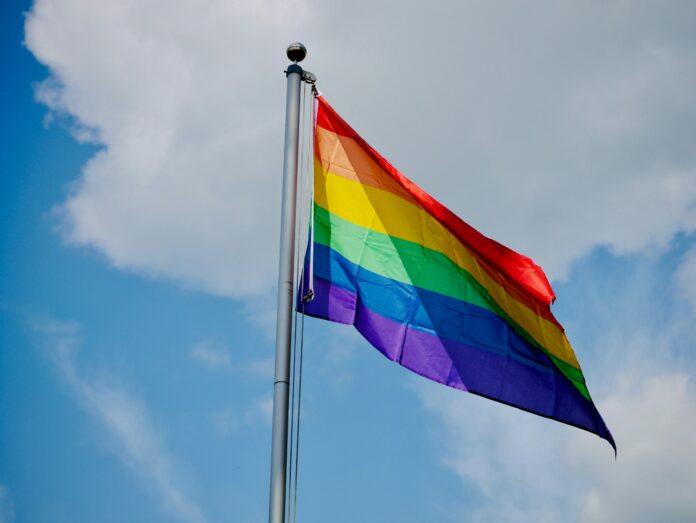
This is a photo of a pride flag, on a flag pole, blowing in the sky.
PHOTO: Sophie Emeny / Unsplash

By: Kaja Antic, Staff Writer and Kelly Chia, Peak Associate

On June 5, SFU Queer Collective held their first webinar since the organization’s revival earlier this year. The network includes SFU graduate students, postdoctoral fellows, faculty, staff, and alumni who hope to foster an inclusive environment for the 2SLGBTQIA+ community at SFU. 

The online event focused on the role universities like SFU should play in creating spaces that welcome queer individuals, and combating the recent waves of anti-2SLGBTQIA+ attitudes across the country. The panel included Jude Mah, coordinator for the SFSS’ Out On Campus department, Jen Marchbank, SFU gender, sexuality, and women’s studies professor, Norma Lize, trans activist and communications manager for Rainbow Refugee, and Mackenzie Kolton, director of learning for Egale Canada.

“We know that in other provinces, the conversations around the queer community this year is not very positive,” Lize said. For example, the Premier of Alberta, Danielle Smith, announced numerous anti-trans policies for queer youth in February 2024. This included a wide variety of restrictions for trans and non-binary youth, “banning name and pronoun changes at school,” and allowing the option to forgo discussions about the 2SLGBTQIA+ in classes.

Lize emphasized the importance of educators making classrooms safe and inclusive, and how universities should be training faculty on supporting 2SLGBTQIA+ students. 

Speakers discussed “othering” effects in inclusivity curricula. Mah cited their own experiences of being othered while learning at SFU. Othering is a dialogue of “us vs. them,” made to exclude or insult groups of people. In the context of 2SLGBTQIA+ communities, “feelings of otherness are fueled by the heteronormative structures” in society, which includes “the assumption that everyone is ‘naturally’ heterosexual,” rather than integrating the understanding that it shouldn’t be assumed whether someone is not queer.

 “We will always be here within these classes, so why is it not a normalized thing?” Mah said incorporating queer and trans experiences across curricula is more useful than confining learning to gender and sexuality classes. 

Kolton added, “Oftentimes when curriculums are developed, it’s developed about a community — forgetting that that community is often sitting in the seats that you’re teaching to.”

At the institutional level, Kolton added it’s also important for senior leadership to uplift and make changes for students. “Brock University comes to mind with their name change policy. They launched and created that pilot within a year,” she said, referring to the university’s policy that no longer charges students to change their name on their student card. It was brought forth by student organizing. “This isn’t the time to take five–six years to implement [policies protecting queer students.] We have to act now.” 

 “This is a larger systemic issue that involves partnership that goes beyond a pride presentation.” — Mackenzie Kolton, director of learning for Egale Canada.

Lize noted universities can “issue clear and strong public statements” and “engage with policy makers to provide expert testimony, research, and data that support 2SLGBTQIA+ rights.”

Lize also mentioned the need for an intersectional lens in post-secondary inclusivity efforts, especially for asylum-seekers and refugees in Canada. These communities have different accommodation needs such as specialized legal or mental health support networks, which are often inadequately supported by post-secondary institutions. 

Kolton noted where she sees these programs often fall apart is when the university is too focused on checking a box rather than long-term change. “This is a larger systemic issue that involves partnership that goes beyond a pride presentation,” Kolton said. To create lasting impacts, Kolton stressed working with and listening to queer organizations. 

“I’ve had a lot of international students who don’t necessarily have the words to talk about their identity, sexuality, or their gender, and they want to know themselves,” Mah said. “Growing up in small rural Alberta, I didn’t have the lingo that I have now, and didn’t come into my gender and sexuality until I was in university, so I think it can be really detrimental to students when we don’t offer that space for learning.” 

Mah added, “It’s really easy for universities to say they prioritize EDI [Equity, Diversity, and Inclusion] and that they’re inclusive and that they’re for the rights in supporting queer and trans students but I think it’s putting it into practice and actually acting on these in good faith that doesn’t always happen.” They also note that it’s been challenging to find institutional support through SFU given recent budget cuts. “The people we used to go to answer these complaints to fix [ . . . ] they’re no longer here, or they’re at capacity.” 

Marchbank asked, “We get a lot of flag waving, but what happens in December?” in reference to a lack of year-round support for the 2SLGBTQIA+ community from post-secondary institutions, saying combating bigotry is larger than an annual parade walk. 

“Prioritize what queer and trans students, staff, faculty are asking for,” Mah said. “At the end of the day, these are the most knowledgeable people. What their demands are, what their asks are — are pointing out the gaps in these systems. That’s where the universities should start with their policies.”

SFU Queer Collective hopes to expand the conversation regarding SFU’s role in fostering an inclusive community for 2SLGBTQIA+ people. 

Minimum wage worker doing the job of three people is excited for 65 cent wage increase

0
A hand putting money into a piggy bank but it's falling out the bottom surrounded by the words “cost of living,” “inflation,” and “rent.”
ILLUSTRATION: Victoria Lo / The Peak

By: Hailey Miller, Staff Writer and C Icart, Humour Editor

News anchor: Alexa, play “7 rings” because the minimum wage is increasing to a whopping $17.40 in BC. I sat down to interview an excited Minimum Wage Worker (MWW) about how his life will change now that he’ll be rolling in cash! Take a look at the footage. 

A clip of the news anchor trying to ask a fast food worker questions in the middle of their shift starts playing. 

News anchor: Good afternoon, Minimum Wage Worker. How are you feeling about today’s news regarding a minimum wage increase?

MWW: Ah, yes, well, I was just itching for you to ask! (to the crowd of angry customers) Order number 463! 463! Not you, ma’am, I know you didn’t order this. (to the news anchor)  I feel warm, fuzzy, and splendid after hearing about the minimum wage increase. I might be able to afford to only have seven roommates instead of eight. But only if my landlord stops threatening to evict us so his imaginary family member can move in. 

News anchor: That’s amazing! So, what will you spend your extra funds on going forward? 

MWW: I’m so glad you asked! I simply cannot wait to splurge. Instead of choosing between my favourite cruciferous vegetables at the grocery store, I’ll buy both broccoli and cauliflower next week! (to the entitled customer who is yelling even louder than the others) No, sir. I did not charge you for ice cream because we don’t sell ice cream. We keep the machine broken, hoping you won’t come back. (to the news anchor) Are you going to buy anything? 

News anchor: (ignoring the question) Talk about money bags! How would you like to thank those who made this increase possible, you know, the big wage increase bosses? 

MWW: Ah, yes, well, boy, do I have a mouthful for them! Nothing brings me more joy than finding out that I’ll get a bigger wage and then realizing that it won’t even be remotely close to liveable. At this point, I might as well just live in a shoe. The government swoops in thinking they’re the financial saviour and all, but they’re jet-setting around the world, living in mansions, and blowing money like raindrops of climate change that aren’t coming down! This broke bitch ain’t affording a house anytime soon, or even a cardboard box-converted tiny home, for that matter. (to the customer who just walked in, definitely making the building overcapacity) Ma’am, I told you last week that that rare venomous snake is not a service animal! Order 465! 465! Cheeseburger, no cheese that is most certainly not a hamburger! 

News anchor: Wow! It’s so great to hear about the joy you’re experiencing! Can you elaborate on other ways this increase is changing your life? 

MWW: Ah, yes, well, if it weren’t for this minimum wage increase, I’d still be . . . drumroll please . . . broke! Trust me, I’d love to be rolling in so much dough that I could pay off my grocery and rent debt combined, but please, that only happens in fantasy land! I guess I better fly to Disneyland, where all our livable wage dreams come true! — Excuse me, I need to go; there’s an influencer trying to clean our bathroom again. 

MWW starts running after a woman who is spraying pink cleaning foam everywhere. The camera cuts back to the newsroom. 

News anchor: Well, this heartwarming story wraps up our broadcast for tonight. Thanks for tuning in, and if you got a raise, make sure not to spend it all in one place! 

la lune rocks on with songs of disparity

0
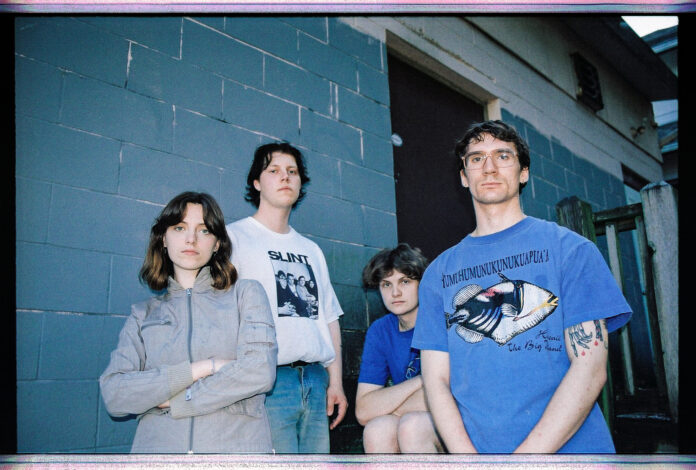
Four individuals standing in front of a blue-painted wall. Two have their arms crossed while the other two have their arms down loosely.
PHOTO: Gudrun Wai-Gunnarsson / The Peak

By: Hailey Miller, Staff Writer

Disparity is defined as “a noticeable and usually significant difference or similarity.” However, in the case of Vancouver indie-rock and shoegaze band la lune, disparity also refers to the hard-hitting soft beats of their most recent EP. Released on April 19, the EP has shown “songs that reveal themselves” as la lune plays them.

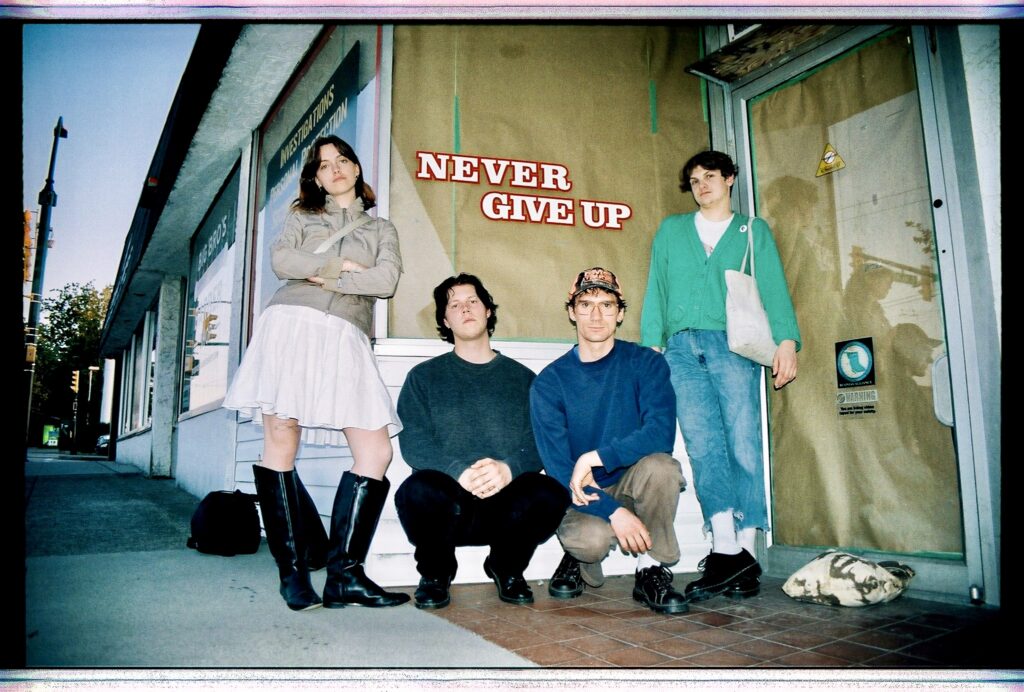
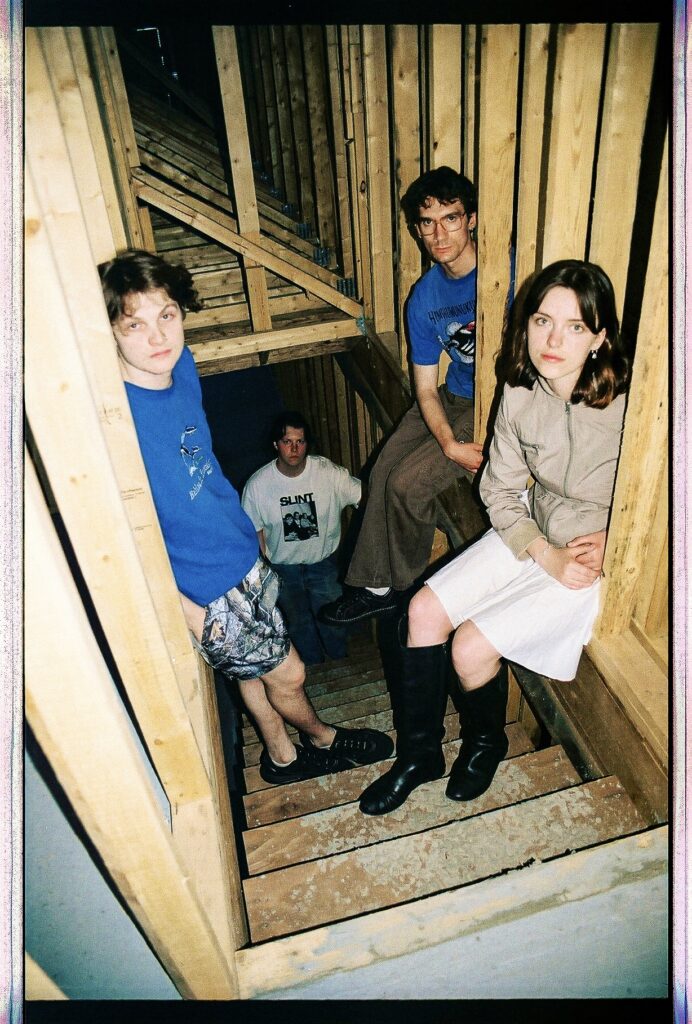
Consisting of Ethan Rebalkin (guitar, vocals), Olivia Wells (bass, backing vocals), Ben Lock (guitar), and Taylor Pawsey (drums), the band formed in 2022 after a few jam sessions among the friends-turned-bandmates. Having been roommates and coworkers, and after getting to know each other better, the band decided to embark on their passion for music.

The dreamy, vocally-obscured shoegaze element is prominent on disparity, though Pawsey told The Peak he’s “always just thought of [la lune] as a rock band.” la lune is working on more new music, which he said will be “broader,” but considers it adventurous alternative rock.

PHOTO: Gudrun Wai-Gunnarsson / The Peak

The more the band evolves, the more they draw on inspiration from other artists. “We’re constantly writing,” said Lock. They lean into the writing process and influences from artists like “electronic slowcore band” duster and alternative-rock band The Smashing Pumpkins. 

la lune is interested in pushing the envelope with genres — particularly shoegaze. disparity’s tracks drip in guitar distortion and cutting jabs of feedback that make it feel like youre floating around a starlit galaxy. The songs “despondent,” “disparity,” “spiral ((down)),” and “i feel like im pretending,” will bring you into the ethereal realm of cascading riffs and distorted feedback. 

“When you play the songs you learn so much more about them.” —Olivia Wells, la lune’s bassist and backup vocalist 

The EP lives up to its name, showcasing a plethora of guitar shreds, drum fills, and catchy bass lines. Songs like “a little life” start out slow and build up to a heavy rock vibe

It’s been really fun to reacquaint with the songs,” said Lock, regarding the time between studio recordings and now playing them live.

PHOTO: Gudrun Wai-Gunnarsson / The Peak

A unique part of the band’s musical development is how they feel out the tracks and alter them onstage. Recently, they’ve been playing an unreleased song live and have received positive reception from audiences. Wells noted that having recorded disparity months prior, and now performing the songs live, has been a good way for the band to develop their onstage presence versus what they had recorded in studio. 

“When you play the songs you learn so much more about them,” said Wells, adding that the studio is a good place for “solidifying” everything, as aspects of the tracks change over time.

disparity feels new because we just put it out, but some of these songs we’ve been playing for a long time,” said Pawsey. “We’ve been hyped on writing a lot recently,” added Lock. 

“We’ve all been pretty grateful for the reception,” Pawsey said of the release of disparity. “It feels good that people are just enjoying it and connecting with it.”

Following their two recent shows at the Green Auto this month, la lune will be playing at the Fox Cabaret on July 6 and The Pearl on August 1. They’re looking forward to the upcoming gigs, releasing more music, and hopefully planning a future tour. 

PHOTO: Gudrun Wai-Gunnarsson / The Peak

“Rock and roll evolution,” acknowledged Lock, and surely, that’s what la lune will continue to do.

Follow @lalunelalunelalunelalune on Instagram to keep up with the band.

Theatre Under The Stars’ CATS features two SFU dance majors

0
Four individuals wearing cat-like makeup with fluffy cat ears. Two on the outsides stand on one knee, while the two in the middle are slightly crouched. All four have their arms bent and posed as if they are pouncing at the camera.
PHOTO: Courtesy of Theatre Under The Stars

By: Yasmin Hassan, Staff Writer

From July 5 to August 24, Theatre Under the Stars is coming back to Stanley Park’s Malkin Bowl. One of their featured productions this season is CATS, a dazzling ensemble musical of feline characters who gather for the Jellicle Ball. This ball is held ceremoniously to decide which among them will be granted a new life in a sort of rebirth. What makes this musical so special? Two of our very own SFU dance majors, Elijah Sam (pictured, far right) and Tia Gunhold (pictured, wearing white), will be performing as Coricopat and Victoria respectively! The Peak had the pleasure of speaking with them about their musical tails (and tales).

Eljiah Sam is currently a third-year dance major at SFU, performer, and instructor who works with kids. “Coming from SFU with this training and many different dance styles has helped me jump right into the work,” Sam said. He talked about how collaboration between different departments at the school, such as theatre and film, support the ability to be adaptable to new things. His experience helped him “collaborate with a wide range of different creative people,” which is needed for a show like CATS.  

Tia Gunhold, a third year undergraduate student double majoring in psychology and dance, said that her “competition-heavy background” resulted in “a shift in movement styles and performing.” She also mentioned the differences in things like comfort with physical touch between dancers and non-dancers. 

“Coming from SFU with this training and many different dance styles has helped me jump right into the work.” — Elijah Sam, SFU dance major 

“The musical is a great musical, first of all, for dancers because it’s a dance heavy show,” Sam said when asked about his take on the show. Gunhold backed that up by mentioning how the performers “sing the entire time; there’s only one very very short monologue in the whole show, which is different from a lot of other musicals.” 

Gunhold mentioned how many people may be enamoured with the singing and dancing of the show, but often don’t understand the storyline. “The storytelling and dancing go hand-in-hand,” Sam said, emphasizing how each element plays a part in telling the tale.  

An aspect that I admire about the show is how it’s an ensemble, truly establishing every role whether big or small as a key part. “You need to have the whole tribe of the cats present on stage for the story to make sense,” Sam said. 

Not only will the impressive set design take the stage, the modernized costumes that are detailed to suit each actor as well as their character will be certain to catch the audiences’ eyes. “The way that they orchestrated the costumes is so ingenious,” Sam told The Peak, noting how the costumes suit each cast member perfectly. As Gunhold stated, “The casting was so well done, because I feel like a lot of people, the actors/our cast are so well suited for their role.” 

Support our fellow SFU stars by seeing CATS this summer! Tickets can be found at etix.com 

Protect Our Province BC holds briefing on COVID-19 infections in hospitals

0
This is a photo of the outside of Saint Paul’s Hospital in Vancouver.
PHOTO: Amirul Anirban / The Peak

By: Yashita Dhillon, Peak Associate and Petra Chase, Editor-in-Chief

On May 30, Protect Our Province BC hosted an online event where a panel of healthcare researchers discussed the prevalence of COVID-19 in healthcare settings, the lack of protective measures against its spread through the air, and its impact on vulnerable patients. 

Protect Our Province BC is an organization of scientists, healthcare workers, and community advocates calling on BC’s health authorities to enforce evidence-based policies to prevent the spread of COVID-19. 

The panellists included Dr. Victor Leung, who specializes in infection prevention. Leung explained healthcare-associated infections are acquired while receiving healthcare services, including at emergency, in-patient, and long-term facilities.

The discussion focused on the findings of a 2023 article in BC Medical Journal (BCMJ) about how highefficiency particulate air (HEPA) filtration systems could help prevent the spread of airborne COVID-19. Studies show that “A HEPA filter filters 99.97% of aerosols,” which includes COVID-19. Multiple studies indicate that “HEPA purifiers were able to significantly reduce airborne SARS-CoV-2 [COVID-19].” The co-authors of the article were also a part of the panel: anesthesiologist Dr. Susan Lee and palliative care worker Dr. Jean Warneboldt.

Lee and Warneboldt’s research found HEPA filters have the greatest impact when combined with other measures like medical masking and physical distancing. HEPA is also recommended by health authorities like the World Health Organization to prevent COVID-19 transmission in settings with inadequate ventilation.

Warneboldt spoke about how HEPA filters were initially implemented in the unit she was working in at the beginning of the pandemic but were removed when regional guidelines changed. There are no longer any “standardized indoor air quality standards,” with the Fraser Health Authority “actively removing the availability of HEPA filtration,” according to BCMJ. In a statement to The Peak, the Fraser Health Authority said, “There is no requirement from any governing body for the use of portable HEPA filters in rooms other than those with specialized use,” such as operating rooms. Mandatory masks were also removed from healthcare settings on April 8, despite community advocacy efforts from Protect Our Province, DoNoHarmBC, and Masks4EastVan, who highlight COVID-19 is not a seasonal virus.

“It’s extremely demoralizing to work to make these really frail patients better only to see them fall into worse sickness while they’re under our care.” — Dr. Jean Warneboldt, palliative care specialist and clinical assistant professor at UBC

Guidelines are still focusing on contact and droplet transmission, emphasizing handwashing rather than clean air,” Dr. Susan Kuo, a family physician and moderator stated. She said many healthcare researchers and professionals in BC “still don’t acknowledge” that COVID-19 is airborne.

“It’s extremely demoralizing to work to make these really frail patients better only to see them fall into worse sickness while they’re under our care,” Dr. Warneboldt expressed.

Lee recalled a moment at the beginning of the pandemic when Warneboldt told her several of her patients had died that day due to COVID-19 that was acquired in the hospital. “It deeply affected me that our healthcare system could be potentially putting people at risk,” she said. “For some of these most vulnerable patients, the air in the hospital can be deadlier than the diagnosis that brought them in.”

Lee said sometimes it’s forgotten that there continue to be patients who seek care in hospitals, and are vulnerable to COVID-19 exposures. Between May and June 2024, COVID-19 hospitalizations increased by 67%. While data on active COVID-19 cases is not currently available via the BC Ministry of Health, COVID-19 Resources Canada collects data from hospitals and wastewater reports of COVID-19 for weekly updates. They estimate that 1 in 73 people were infected in BC between June 8 to 21. 

COVID-19 disproportionately impacts vulnerable patients with weakened immune systems and can develop into Long COVID. Long COVID can persist months after COVID-19 contraction and can affect healthy and vaccinated individuals — the risk of Long COVID increases with each infection. Long COVID is a condition with various symptoms including severe fatigue and weakness, and immune dysregulation. It can increase the risk of heart failure and stroke. It has no definitive treatment. According to Statistics Canada, one in nine Canadians have experienced Long COVID symptoms. 

“There is increasing recognition now that the air we breathe is just as important as the water we drink,” Dr. Leung responded.

Grassroots organizations such as Protect our Province BC, DoNoHarm BC, and Masks4EastVan continue to advocate for change. You can follow their social media to stay informed on COVID-19 literature, measures, and provincial policies. 

Remembering the 2023-24 Vancouver Canucks

0
Gravestone that reads “RIP In Loving Memory of the Vancouver Canucks.”
PHOTO: Anaya Singh / The Peak

By: Kaja Antic, Staff Writer and C Icart, Humour Editor

We are gathered here today in memory of the 2023–24 Vancouver Canucks. What a season it was, starting with an 8–1 victorious roar over the Edmonton Oilers and ending with a 3–2 game seven loss against the same team. The team brought almost as much entertainment to the city this year as the Metro Vancouver Overpass Impact Counter

This team will be remembered for their miraculous achievement of finally injecting some energy into the overtired Canucks fan base after years of mediocrity, largely due to the Jim Benning regime’s passion for downward spiralling and disappointment. We at The Peak would like to acknowledge the players of this team who have reached the impossible — earning a living wage in Metro Vancouver. In no particular order, here are our final words about each notable (for good or bad reasons) member of the roster. 

Brock Boeser: By some, he will be remembered for his spectacular achievement of hitting the 40-goal mark. That man was traded by armchair general managers to nearly every team on the planet. Yet, he persevered and showed he was one of the best Canucks on the roster. But for us, his most memorable trait was his uncanny resemblance to Shrek’s Prince Charming.

J.T. Miller: We are astonished by the fact that Rick Tocchet was actually able to fix him. Gone are the days where he’d smack the tops of the net and yell at the goalie, and here are the days of him calling Brock Boeser his wife. As we bid adieu to his contribution to this unforgettable season, we are reminded of a great lesson. Change does not come from within, it comes from a $56 million contract.

The team brought almost as much entertainment to the city this year as the Metro Vancouver Overpass Impact Counter.

Elias Pettersson: Today, we use our professional yapping skills to pay tribute to his efforts and silence the haters who think the Canucks need “more Saskatchewan, less Stockholm.” The 2023–24 Canucks are dead, but through his new eight-year contract, he will carry their legacy. 

Tyler Myers: Oh, our beloved chaos giraffe. He will be remembered for his defensive skills that BC teachers could only describe as “emerging,” and the entertainment value he brought simply from being ridiculously tall. In his next life, we hope he takes the hometown discount so he can continue to expose Conor Garland’s true height by standing next to him. 

We are sure there were more players on the team, but it’s been over a month and we are beginning to forget. As we say our final goodbyes, let us remember the success of the Canucks this season was largely unexpected by many in the hockey world — including the organization itself. Our faith that the team will be reborn during the NHL Entry Draft on June 28 is what consoles us. 

Farewell Canucks.

May you rest in peace.

Horoscopes June 24 – 30

0
An illustration of a girl, stars and astrological signs strewn in her hair.
ILLUSTRATION: Marissa Ouyang / The Peak

By: Amrit Kamaal, Peak Associate

Aries
March 21–April 19
You totally fell for the Sonny Angel epidemic. You couldn’t resist the cuteness and just bought one, telling yourself it’ll be good for the economy. Soon, you thought it wouldn’t hurt to give it a friend. Now, every corner of your room, kitchen shelves, and attic are all taken over by tiny angel babies. 

Taurus
April 20–May 20
You guys will find beauty in the unappreciated, seeking out the figurines nobody wants, AKA Robby from Sonny Angels. To y’all, Robby is the only character in the Sonny Angel universe, buying over a thousand blind boxes to get him and taking him everywhere like a trophy. Good luck trying to find that chameleon mouse-rabbit thing. He’s rare because only Tauruses want him. 

Gemini
May 21–June 20
You may say you’re very “particular with your interests,” but face it, sis, the word you’re looking for is picky. You will bend over backwards, crawl through the pits of hell, and enter Narnia for the last remaining box of Sonny Angels. Gosh forbid it’s a Robby instead; you’d throw it straight in the trash. 

Cancer
June 21–July 22
Unarguably the most thoughtful sign, you guys are like mini grandparents to your figurines. Making last-minute trips to Michaels to pick up the finest markets to knit little hats and scarves to keep them from getting cold. In the same beat, you’ll keep forgetting how many you have and where you put them. I thought it was impossible to lose a Smiski when they GLOW in the dark, but y’all manage. 

Leo
July 23–August 22
Well it’s definitely a collection alright! You’re gripping at your childhood from the seams, babe. I promise you it has already run away. You’ll have a museum in your house dedicated to Monster High dolls, all in perfect condition. Any Frights, Camera, Action Operetta doll automatically puts all collectors on Leos’ “to rob” list. 

Virgo
August 23–September 22
Again, with the whole “I’m nothing like y’all.” A Virgo’s obsession will revolve around some completely different collectible that literally no one else has ever heard of. You were scrolling through Sonny Angel’s website, wondering how you could be different from everyone today, coming across their most random collection, the Animal Bakery, and deciding you needed them all. At least the competition of collecting the rarest one goes down to one to nothing. 

Libra
September 23–October 22
You’re really committed to the whole collecting thing, saving every little scrap, including the box and the receipt of the fries you bought two hours before getting your figurine. In this economy, do what you gotta do to get your money’s worth. You never know what random item you’ll need to flex on the future generations. 

Scorpio
October 23–November 21
I get that middle school, high school, university, etc., is a lonely time for everyone at one point or another, and everyone develops their own coping mechanisms. But I think you took it a bit too literally when influencers said that Smiskis are like little friends. Hiding them in each crack and crevice in your home is only dope if you notify your guests beforehand about your little “roommates.” It gives major “elf on the shelf” vibes, and nobody’s here for it, especially when the lights are off. 

Sagittarius
November 22–December 21
You have serious self-control when it comes to considering expanding your collection. No matter how amazing the new series of Sonny Angels is, you’ll go shopping to pick up the box, exclaim how adorable it is and how fundamental it is to your very being, and then place it down and exit. 

Capricorn
December 22–January 19
Your home only contains items that have Sanrio characters on them. So, it makes perfect sense that you’ll collect over a hundred boxes of each Sanrio figurines series overseas. We’re not judging though, we love to see Cinnamoroll winning. But tone it down a bit, we’re not tryna have Disney Adults part 2 over here. 

Aquarius
January 20–February 18
You guys seem to be content with anything.You just keep swimming no matter what. This is probably why you could pull the rarest Smiski on your first try and barely react while your collector friend congratulates you as they fight back tears. 

Pisces
February 19–March 20
You guys have a sense of clinginess that’s wholesomely disturbing. Those Sonny Angel Hippers have a serious chokehold on you because you bring them everywhere. If you’re sitting in your 8:00 a.m. lecture asking the person that’s half asleep next to you if you can borrow a pencil, don’t be surprised if they start freaking out by the smug pair of eyes piercing into their soul. Yeah . . . not the greatest experience to see a tiny angel staring at you when you wake up. 

Over 200 Canadian charities found funding the Israeli occupation

0
This is a photo of the outside of the Canadian Revenue Agency Building in Vancouver.
PHOTO: Elyana Moradi / The Peak

By: Hannah Fraser, News Writer

On June 3, a public letter by Just Peace Advocates and the Canadian Foreign Policy Institute (CFPI) revealed over 200 Canadian charities have been funding Israel with a collective $237.5 million since 2022. This goes against the Canada Revenue Agency (CRA)’s charity rules which note that donating money to the military or armed forces of another country is not considered charitable activity. Their letter is addressed to the Canadian government, asking them to enforce more rules on taxpayer-subsidized donations.

The Canadian petition e–4922 deems these donations “Canada’s most important contribution to Palestinian dispossession.” Recent findings have shown that Canadian organizations are receiving tax receipts, or tax-payer subsidized income tax breaks, for their donations to Israeli organizations and armed forces supporting the genocide in occupied Palestinian territories. 

The CFPI “informs people about the country’s diplomatic, aid, intelligence, and military policies abroad.” Just Peace Advocates is an “independent human rights organization promoting Just Peace/Paix Juste through the rule of law and respect for human rights in Canada and around the world.” 

Both organizations are focused on Canada’s involvement in Israel’s ongoing genocide against Palestinians, which has now killed over 37,000 and wounded 85,000. The UN noted, “In Gaza, half of the population — more than a million people — could face death and starvation by the middle of July.” 

“We’re concerned and we want taxpayers to understand that.” — Karen Rodman, executive director of Just Peace Advocates

The June 3 public letter is addressed to Marie-Claude Bibeau, the Canadian minister of national revenue, and Prime Minister Justin Trudeau. The Peak received a statement from the CRA on their registered charity rules. However, they noted, “The confidentiality provisions of the Act prevent the CRA from commenting on specific cases. As a result, the CRA cannot confirm or deny whether a registered charity is currently under audit.” They confirmed donating with “a purpose to promote a foreign military is not charitable. Beyond this, it becomes a question of fact whether a particular registered charity’s activities in any region furthers a charitable purpose or not.” 

Taxpayer subsidies are tax credits received by donors when they donate money to eligible charities. More specifically, when these donors pay their taxes, they won’t have to pay a certain percentage of their income taxes depending on how much they’ve donated.

The HESEG Foundation has raised almost $200 million, since 2007, to “assist non-Israelis who join that country’s military,” according to Just Peace Advocates. The “Canadian Zionist Cultural Association has raised $50 million since 1992.” In the last five years, over 11% of funds sent to other countries by Canadian charities were sent to Israel. 

Karen Rodman, executive director of Just Peace Advocates, told The Peak, “We’re concerned and we want taxpayers to understand that.

Niki Ashton, an MP for Churchill–Keewatinook Aski in Manitoba, wrote a letter to Minister Bibeau on May 27 asking for an “immediate investigation” into the situation and that “the status of any so-called charitable organization engaged in such activities have their charitable status revoked immediately.”

Indigenous songwriters illuminating ancestral languages

0
Elisapie: a freckled woman with black braids that wrap together at the base of her neck. Bubble-like letters surround her and sweep over her face.
PHOTO: Courtesy of Leeor Wild

By: Petra Chase, Editor-in-Chief

Content warning: mentions of colonialism. 

Elisapie

Elisapie: a freckled woman with black braids that wrap together at the base of her neck. Bubble-like letters surround her and sweep over her face.
PHOTO: Courtesy of Leeor Wild

Prolific Inuk singer-songwriter Elisapie’s latest album, Inuktitut, covers ten pop and rock classics translated into ᐃᓄᒃᑎᑐᑦ (Inuktitut). She grew up around this language in ᓴᓪᓗᐃᑦ (Salluit), a snowy Inuit village in Nunavik, Quebec. Elisapie’s gentle voice is like sunbeams over familiar melodies, making her tracks feel serene. Each song is tied to an intimate memory of a loved one. “Uummati Attanarsimat (Heart of Glass)” compiles grainy footage of Inuit children playing in the snow. In addition to this Blondie rendition, Inuktitut includes acoustic covers of other iconic ‘70s and ‘80s songs such as Fleetwood Mac’s “Sinnatuumait(“Dreams”) and Cyndi Lauper’s “Taimangalimaaq(“Time after Time”)

In the album description, Elisapie said these songs acted as “an escape.” When they were at the height of their popularity, these songs “once took over the community radio airwaves,” and also made Inuit communities feel like “we were being heard.

“They were our songs too,” she told CBC, also speaking about the painful and bittersweet memories associated with them. Finding their meaning in Inuktitut gave her a deeper understanding as to why the songs have such emotional reactions for her community. “It’s so beautiful to say that Metallica was there for us,” she said. “When we weren’t able to express a lot of things, they expressed it for us.” 

The songs were all translated intimately by Elisapie, a process which she calls “cultural reappropriation” as she “tells her story, offers these songs as a gift to her community, and makes her language and culture resonate beyond the Inuit territory.”

See Elisapie perform live on September 28 at the Chan Centre for Performing Arts.

“They were our songs too.” —Elisapie 

Jeremy Dutcher

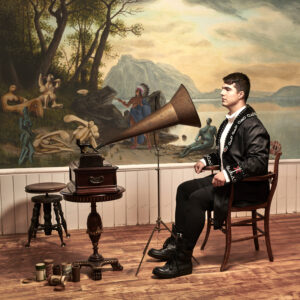
a man sitting at a wooden dining chair while facing a device that looks like a phonograph. Painted on the wall in the background is an image of humanoid shapes and colours interacting with a person wearing an Indigenous headdress.
PHOTO: Courtesy of Matt Barners

I came across Wolastoqiyik (Maliseet) “two-spirit song carrier” Jeremy Dutcher with his goosebump-inducing Tiny Desk concert. In the opening song “Mehcinut” (“death chant”) from his debut 2018 album, Wolastoqiyik Lintuwakonawa (“Our Maliseets Songs”), Dutcher’s angelic, classically-trained voice is explosive yet controlled, touching high notes and deep emotion as he pours himself into the piano. Halfway through, a wax cylinder recording of an ancestor cuts through, with their long-held notes creating a moving duet across centuries. “Mehcinut” is a traditional song to celebrate life. 

Dutcher is an ethnomusicologist who is dedicated to making music in his ancestral language and traditions of Wolastoqiyik (“wool-las-two-wi-ig”), meaning “people of the beautiful river.” The Wolastoqiyik are also referred to as Maliseet. This language has existed for many generations near the Saint John River and now has less than 100 “fluent, life-long language speakers” left. Working with Elders in his community of Tobique First Nation in New Brunswick and using archival recordings, Dutcher challenges “death narratives or the idea of Indigenous people as fading people.” He’s brought beautiful songs in his language to international ears, winning the prestigious Polaris Music Prize for his first album and bringing his Elders in the audience pride. In an interview with CBC, he stressed the importance of “frontloading [Indigenous] languages and making sure that they are centred.” 

Dutcher recently released his second album, Motewolouwok, of which my favourite track is “ᐯᒪᐧᓱᐧᐃᓄᐧᐁᒃᐧᐊᓇᑭᔭᐧᐁᓓᑐᐧᐁᒃ” or “pomawsuwinuwok wonakiyawolotuwok.”It’s a “resistance song” where the meandering instrumentation and vocals build up in volume like I’ve never heard before. The lyrics include an English translation of the song’s title: “People are rising all over the world so we stand up.” He shared that he “wanted to write a song that flowed between Wolastoqiyik language and English, in hopes of calling as many to the table as possible to witness the rising.

“Stories and music are what move our culture forward,” he expressed in his Tiny Desk performance before getting the audience to hum a backing acapella note for his final song. Meaningful connections like these are commonplace in Dutcher’s live performances. 

Catch his performance at Vancouver Folk Festival at Jericho Beach on July 19.