Home Blog Page 974

The benefits to having fewer opinions

0
If you're going to make an excuse about 'playing devil's advocate' after, then shush.

Hi, Peak reader. As one of the Ghosts of Opinions Section Past (my tenure was from February–April 2005; I replaced a guy who got fired mid-semester for kicking one of his fellow editors), I’ve been summoned back to these pages by a complex incantation involving pig-hoof potions and nicely worded emails to relay something that might be of use to the SFU student body of 2015.

Which is perfect, really, because I actually do have a piece of advice that I try to impress upon just about everyone. Better yet, it’s actually got to do with opinions.

Specifically: You should have fewer of them.

I mean, look. I get it. It’s fun and convenient to walk around casting stone-cold judgment on everything you see, hear, and read. And nobody’s going to retweet you for saying “This is a multi-faceted issue I haven’t had a chance to think through in detail yet.” But it’s a big world out there, and there’s always more information to be had. More context, more dissent. Which means it’s harder than ever to fully understand any single issue — yet people chime in anyway. Lord, how they do chime.

Have you ever challenged someone, only to realize that they were talking out of their ass the whole time?

It might not appear to cost anything to blurt out an opinion, because the Internet is basically infinite, but people’s attention spans aren’t. Every minute you force someone to engage with an undercooked yes / no verdict is a minute that neither one of you is getting back.

Have you ever taken the time to challenge someone, only to realize that they were talking out of their ass the whole time? Or, even worse, have them retreat into feeble mumbling about ‘playing devil’s advocate?’ I spent hours of my undergrad in beige tutorial rooms, staring daggers through variations of this same dipshit. No more. Be it resolved that in 2015, friends don’t let friends play devil’s advocate.

And now, some overdue atonement for my own sins. When I was in my second semester at SFU, barely 18 years old, The Peak handed me my own column. I quickly realized I had nothing intelligent to say, but scrambled to fill my pillar of text anyway. Results were, let’s say, mixed. (As one fan put it: “If you write one more column about writing a column, I’m going to stab your eyes out.”) At the time I defended myself with some vague claim to satire, but even then I knew that was some pretty weak sauce.

These days, I write another column — this one about books, for the Edmonton Journal — and I like to think I’ve learned my lesson. Just in time, too, since the literary world is notoriously bad at barfing out overly hasty opinions. That’s because books take kind of a long time to read, and the window for hot takes seems to shrink by the minute.

In the first instalment of this new column, in 2012, I took a vow of considered thought, and asked my readers to do the same. “By all means,” I wrote, “be curious. Be sceptical. Have high hopes, as well as high standards. But there’s no shame in abstaining, or in taking time to privately mull things over. In fact, it’s kind of liberating.”

Is it ever. If you don’t already know the sweet, sweet relief of not having to pretend to give a shit, I urge you to get familiar with it. As in, now. I didn’t figure out how to pump these particular brakes until well after graduation, when it became a legitimate quality-of-life-on-the-Internet issue. And the best part is that once you’ve opted out, you can use that newly freed mental RAM to be legitimately useful in that percentage of conversations in which you are qualified to run your mouth. Imagine that.

Have fewer opinions. While you’re at it, ask your friends, your date, or your mail carrier what they think. Or how about your grandma? That’s my second piece of advice: Call your grandma. She’d love to hear from you.
SFU prepares for administrative overhaul after two VPs resign

0
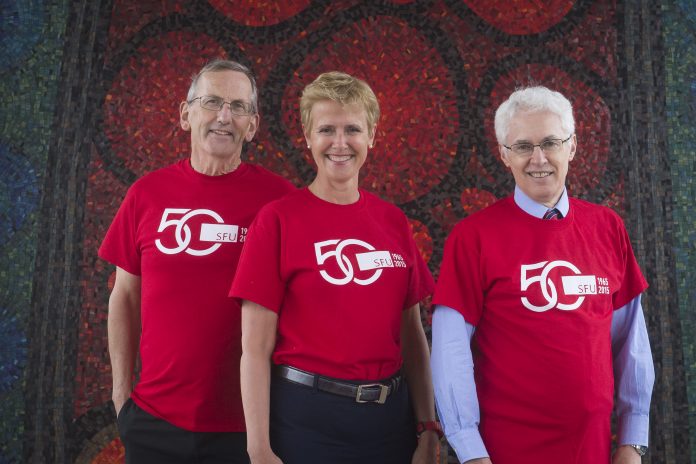
Jon Driver (left) is one of two VPs to recently announce their resignation.

SFU is only a month into its fall semester, but already the administration is facing a massive overhaul as Philip Steenkamp, VP External Relations, and Jon Driver, VP Academic, will both be leaving their posts by the end of the academic year.

The university now has to fill three of its six vice president positions: VP Academic, VP External Relations, and VP Finance, following the passing of the former VP Finance Pat Hibbitts on June 2. Vice president positions are the highest level of university administration under the president.

Hibbits passed away suddenly this June after serving as a senior executive member at SFU for 14 years. In her position as VP Finance, Hibbits supervised more than 350 staff members in seven departments.

“She was the lynchpin for all operational issues,” said Terry Waterhouse, SFU’s chief safety officer, in a statement from University Communications. “Her clarity was always a guiding force. She was brilliant, intuitive and could make the right decisions every time.”

In an internal communication circulated on Sept. 29, President Andrew Petter informed the SFU community that Steenkamp will be leaving his post as of November 30.

“I will be striking a Search Committee to recruit a new VP, External Relations with the goal of filling this important position as soon as possible,” Petter explained in the email. If the search committee does not fill the position by the time of Steenkamp’s departure, associate VP external relations Joanne Curry will assume the role temporarily.

The university currently has search committees for the VP Academic and VP Finance and Administration positions. The search committee for VP academic is comprised of 21 individuals, including SFU students, faculty, staff, and administration, as well as one external corporate representative of VanCity.

Driver is moving on after eight years in the role of VP Academic, after serving one term of five years and being renewed for another. Driver is leaving the position with two years left in his term, having decided that he has accomplished what he wished to in the role, and plans to go back to teaching in his original department: archaeology.

Said Driver, “I’m quite keen on getting back to teaching and doing more research, which is what I came to the university for in the first place.”

Steenkamp’s more hasty departure is due to his acceptance of the position of VP External at UBC. Said Petter of the loss, “When you have someone of that ability and you have other institutions that have needs, there’s always the possibility that good people have you will be recruited and enticed away by those institutions that would like to hire them.”

Looking back on his time in the position, Driver said his biggest difficulty was the university’s first attempt to establish learning outcomes. This initiative was met with resistance by many faculty members and led to a healthy debate around the ethics and feasibility of enforcing and measuring those outcomes.

In terms of successes, Driver singled out the feat of keeping the university running during tough economic times, and beginning to change the culture of teaching as his two proudest accomplishments.

“We have a much more diverse student body than we would have say, 25 or 30 years ago. That diversity means that people learn in different ways,” said Driver.

“It’s really about getting the whole university, and particularly on the academic side, thinking more critically about how we teach, why we teach, and to focus more on the learner and less on the teacher.”

Both Petter and Driver emphasized the fact that SFU administration has been very stable for the last five or so years, with not much turnover in personnel.

Said Petter, “I don’t think there’s any cause for people to be alarmed or concerned by the fact that this kind of turnover takes place.”

He continued, “It does create opportunities for change [. . .] When new people come in it brings in new ideas, it brings in new energy. Hopefully they build on the legacy that’s been left to them by their predecessors.”

Women with HIV at greater risk for cancer

0
“We were particularly interested in women-specific cancer risk, especially considering the incidence of female-specific cancers such as cervical cancer," said Salters.

A new study published by SFU researchers suggests that women who are living with HIV may be more likely to develop cancer.

Published in HIV Medicine, the study shows that compared to the general population, women who have contracted HIV are more at risk to develop certain cancers. This is despite the introduction of modern highly-active antiretroviral therapy that reduces the risk of many AIDS-related cancers.

Kate Salters, a sessional instructor in the Faculty of Health Sciences, works at the BC Centre for Excellence in HIV/AIDS. Salters is a PhD student and her supervisor, Bob Hogg, is the lead author of the paper.

According to her, the heightened risk of cancer among women living with HIV could be due to the increased risk of other viral infections.

Said Salters, “This is one of the first studies to focus exclusively on females living with HIV and cancer. We know that sex and gender directly and indirectly influence health and disease.

“We were particularly interested in women-specific cancer risk, especially considering the incidence of female-specific cancers such as cervical cancer.”

The study stresses the importance for these women to have ongoing support — such as HIV care and cancer screening processes — that is tailored to women in particular.

Currently, HIV positive women with cancer have close to a 50 per cent mortality rate; that number drops to less than 20 per cent for those without cancer.

“The reality of living with HIV is changing and people are living longer, healthier lives than ever before with sustained treatment options,” Salters explained.

She continued, “How we treat, engage, and work with individuals living with HIV, especially women in this context, needs to reflect that reality. Looking at the complete picture of women’s health is essential to this — and that often extends beyond just the biology of HIV.”

Going forward, Salters suggested they would be looking at effect of the immune system being suppressed long-term (a symptom of HIV/AIDS) on cancer risk among women living with HIV, with the aim of determining what clinical interventions can help with that.

Lunar eclipse dazzles at SFU Star Party

0
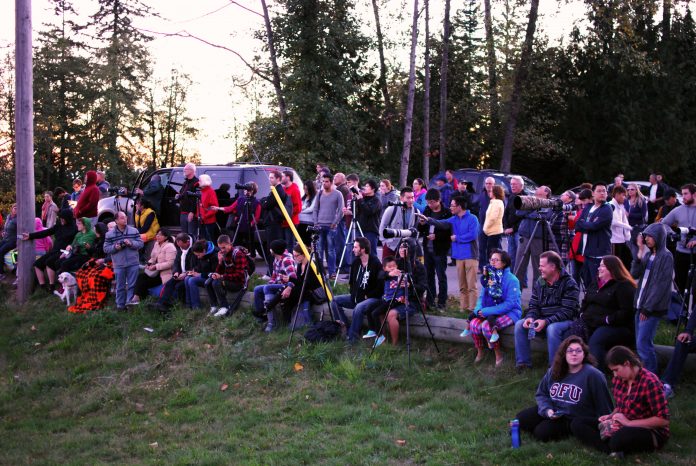
Attendees brought telescopes and cameras to observe the stars and supermoon.

Students and members of the community gathered at the Trottier Observatory for a Star Party on SFU’s Burnaby campus on September 27 to watch the supermoon and eclipse.

Starry Nights events are put on by the observatory and its volunteers once or twice a month, and are open to the public. Although the event was originally intended to be held during National Science Week on the Friday prior, it was moved when organizers realized there would be an eclipse.

“I’m on a bit of a mission against the supermoon,” Howard Trottier, SFU Professor, laughed. “It’s true, the moon’s orbit is a little bit of an oval, so when it’s at its closest it will be about 10 per cent bigger than its average size when it’s farther away. But judging a 10 per cent difference objectively is almost next to impossible, because how often do you look at a full moon and try to remember what it looked like the time before?”

The moon also looks larger because of the way light bends through the atmosphere every time it rises. Trottier emphasized that it will look big every time you see a full moon.

Trottier added, “It rubs me the wrong way because you don’t need to dress up a lunar eclipse. It is beautiful for its own reason.”

The eclipse was indeed beautiful, and dozens of people showed up, including whole families. Some chose to stay by the observatory and its equipment, while others opted to bring their own and set up next to the observatory or in the parking lot. For those who arrived early, the observatory was set up to view Saturn.

Trottier promised there will be plenty of other Starry Nights this fall and added that if you like waking up early, October is a great month for star and planet viewing.

“You can see Jupiter, Mars, and Mercury next month. Mercury is very hard to see because it never gets far away from the sun.

“On October 15, if you wake up before the sun rises, it will be in the perfect position to see,” he added.

The next eclipse will be in January 2017 and the next supermoon eclipse will be in January 2033. Starry Nights at the observatory will be announced a week prior due to the need for good weather, but the next event is planned for sometime in October.

Satellite Signals

0

Segal Building

“It’s a minority! Who gets to govern?” is a panel to be held at SFU’s Segal Centre campus (room 1420) on Oct. 7 at 5:30 p.m. that will explore the intricacies of a minority government.

Expert panelists include SFU professor of political science Andrew Heard, along with other local academics and former attorney general of BC Geoff Plant.

Harbour Centre

A panel of experts will discuss Canadian political issues surrounding conflict and national security at the event, “The Canadian Election and the Politics of Fear.” The discussion will take place on Oct. 6 at 7 p.m. in Harbour Centre, room 7000.

The panelists will “critically examine different aspects of Harper’s deliberate attempt to mobilize the electorate on the basis of division, conflict, and the politics of fear.”

Surrey

The “Central City Student Community Engagement Competition” will take place on Oct. 7 at SFU Surrey at 5:00 p.m.

Thousands of dollars’ worth of prize money will be awarded to contestants that come up with ideas to best engage the Surrey community. Each submission will be assessed on their “innovation and uniqueness, and its community, commercial, and socioeconomic significance.”

TSSU considers binding arbitration

0

SFU administration the Teaching Support Staff Union (TSSU) have returned to the bargaining table after union members voted to refuse SFU’s package deal, with over 86 per cent opposed.

In a bargaining  update  from the TSSU, there was mention of a potential lockout by SFU Administration, as the TSSU claimed that the university threatened to lock out members following the “no” vote to the deal.

SFU could not be reached for comment before press time to respond to this claim.

Last week, both parties discussed a recommendation made by mediator Vince Ready to enter into “binding arbitration.”

This would involve committing to 21 consecutive days of bargaining, at the end of which, “If [. . .] there are any unresolved issues, those issues shall be referred to Final Offer Selection (FOS) arbitration for a final and binding decision.” Ready has offered to act as the third-party FOS arbitrator.

After the arbitrator makes a decision, all job action would cease immediately and a new Collective Agreement would be put into place.

SFU stated, “After Mr. Ready had made his recommendation, the University sought to confirm the TSSU’s agreement and commitment to the Final Offer Selection process, but they declined to agree.”

The TSSU published an online update that outlined various problems they have with the FOS process as it has been proposed by the university, stating “SFU Administration has developed their own proposed process for binding arbitration which is in complete disagreement with the Vince Ready proposal.”

One concern the union expressed is that SFU would be able to appeal to overturn the arbitrator’s final decision, leading them to use the term “unbinding arbitration” to describe the administration’s proposal.

The TSSU will hold a meeting for its members to discuss the proposal on the morning of Tuesday, Oct. 6. The union’s membership will need to put it to a vote to decide whether or not to accept the university’s proposal and enter into binding arbitration.

At 50, The Peak is as immature and ambitious as ever

0
Never trust anyone under 50.

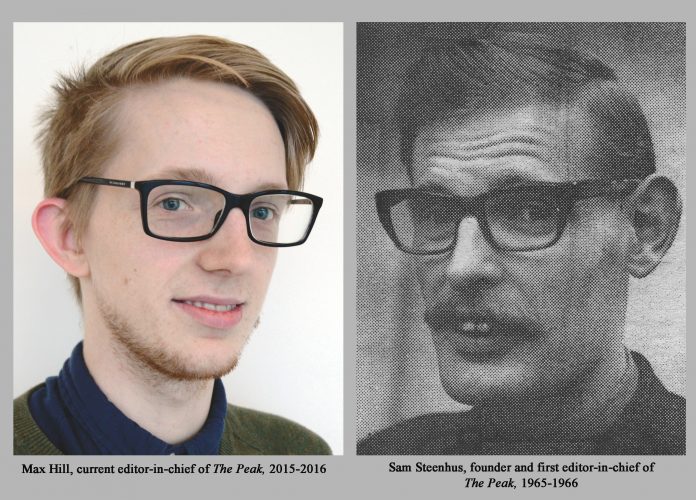
Birthdays have always seemed a little strange to me. There’s very little you have to do other than a) survive and b) show up to earn a celebration every year, and The Peak is no different. We’ve finally hit the big ‘five-oh,’ and much like the university that we cover, we’re anything but shy about celebrating it — even if the paper didn’t really do much other than stick around for a half-century.

Don’t get me wrong. I love this paper with every fibre of my body, and I think that we deserve to pat ourselves on the back every once in awhile. But with the space I’ve been given in this issue, I want to do something other than rehash the platitudes reserved for anniversary celebrations and retrospectives. Instead, I want to pay homage to the people who’ve made The Peak what it is and what it has been over the past 50 years, good and bad.

These are the students who spent their evenings and weekends editing copy and laying out pages, who stalked SFSS board members and university administrators around campus to get the perfect quote, who slept on lumpy couches next to day-old pizza boxes and knocked back beers while toiling over keyboards and typewriters.

Our archive, whose shadow looms large even today over our cramped meeting spaces, is a living testament to the thousands upon thousands of hours that students have poured into these pages. Not all of it is good, but not all of it is trash, either. Like any other student newspaper, The Peak is hit or miss. But when it hits, it really hits.

Still, celebrating 50 years in publication shouldn’t mean that it’s time to bury the paper, or to consign its glory days to a dusty history book. Even today, our offices are full of clever, talented students working 12-hour days to put this paper together for the students, staff, and faculty of this school, because it’s what they love to do. I can relate. Three years into my time here, I can tell you that the feeling of looking at a fresh stack of papers Monday morning never really loses its lustre.

Our little paper may be pushing middle age, but we’re still young at heart.

Whenever new writers or incoming editors come to me asking for advice, I always tell them the same thing: don’t worry, because all of us here are just making it up as we go along. Halfway through my tenure as Editor-In-Chief of The Peak, I’ve never been more sure of this. But I’ve also never been prouder to offer students a place to learn and to practice their craft, to make mistakes and to celebrate successes, to both learn more about their community and become far too cynical to ever look at it the same way.

In 1965, when the student body at SFU was roughly the size of your first-year psychology lecture, this paper gave students an opportunity to both be heard and to make others heard. Fifty years from now, when our satellite campuses double and our tuition fees quintuple, I hope that we are still a symbol of the power and potential of the remarkable students at this school.

At its heart, The Peak is here to give you a voice. So speak up.

Local candidates debate on SFU campus

0
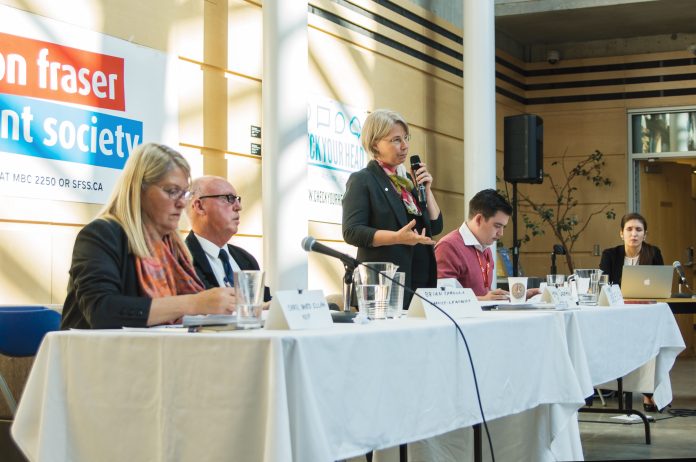
Left to right: Carol Baird Ellan, Brian Sproule, Lynne Quarmby, and Terry Beech.

Students at SFU Burnaby had the chance to see the candidates in their riding confront each other during the Burnaby North-Seymour All Candidates Debate, hosted by the Simon Fraser Student Society in the Saywell Atrium on Thursday, Oct. 1.

Carol Baird Ellan of the New Democratic Party, Terry Beech of the Liberal Party of Canada, Brian Sproule of the Marxist-Leninist Party of Canada, and Lynne Quarmby of the Green Party of Canada met to debate against each other and potentially win the support of voters in their riding.

The candidates were asked to comment on Aboriginal issues, gender equality, electoral reform, education, and the environment. Mike Little, candidate for The Conservative Party of Canada, declined to participate in the debate.

The event was held in order to engage young voters, who make up a demographic with traditionally low voter turnout. In the 2011 federal election, Elections Canada reported that just 39 per cent of Canadians between the ages of 18 and 24 voted — the lowest of any age group.

Although they disagreed on a wide variety of things, the candidates present all expressed their distaste for the current Conservative government, citing bill C-51 and the growing power of the Prime Minister’s Office. Quarmby went as far as to say, “Prime Minister Harper is essentially an elected dictator.”

However, the politics of how to defeat the Conservative party were contested. In response to Canada’s “first past the post” electoral system, strategically voting has come up in recent discussions of the upcoming election.

“Prime Minister Harper is essentially an elected dictator.”

– Lynn Quarmby,
Green Party candidate

Quarmby pushed against the idea of people voting for more popular alternatives to the current government than the Green Party. She expressed, “You’re going to hear that I should come back in four years when we have proportional representation. No. I’m here now, the climate can’t wait. We need change now.”

Ellan referenced the issue multiple times, at one point saying, “We’re stuck with [first past the post]. It means that if the vote is split, the conservatives win the riding.”

A short time after the debate, when the crowds had dissipated and the audience had time to meet with the candidates, The Peak caught up with moderator and SFU student Aleksandra Panić to get her perspective on the proceedings.

When discussing overall themes of the debate, Panić said that the candidates had to “respond to the idea of funding big plans.” Beech spoke to the merits of the Liberal’s platform and experts who support it, asking the audience to google “What do economists think about the Liberal Party plan?”, while Ellan accused the Liberal Party of having a track record for breaking promises.

Panić also offered that while some might perceive the push for strategic voting as a form of “fear mongering,” she pointed out that no candidate had dismissed it as an illegitimate strategy.

At multiple points throughout the debate, each candidate urged the audience to vote on October 19, stressing that this election is pivotal.

Ellan said, “This could be the most important election in the history of this country.” with Quarmby in agreement. Sproule also encouraged young people to become active in the election: “Democracy will come into being when the people empower themselves.”

News briefs through the decades

0
A lot has happened in 50 years.

As with any student publication, current events are the bread and butter of The Peak. These pages have always been a lightning rod for hot takes from students who are eager to flap their fledgling ideological wings, certain that they’re unearthing hidden gems of insight into what’s happening in the world. Here’s a look at some headlines past students probably “unpacked” since the first issue was printed.

1965 — U.S. troops arrive in Vietnam

Though the conflict had been escalating over the course of several years prior, in 1965 the U.S. stepped up armed conflict. The move came in response to flailing South Vietnamese troops in the face of an aggressive Viet Cong. By the end of the year, there would be nearly 200,000 American troops in Vietnam. It would be a decade before the war ended.

1975 — Beaver becomes official symbol of Canada

Associated with the fur trade since even before Canada’s first European settlers, the beaver finally got its due in 1975. On March 24, 1975, an act to “provide for the recognition of the beaver (castor canadensis) as a symbol of the sovereignty of Canada” received royal assent.

1985 — Gorbachev becomes leader of Soviet Union

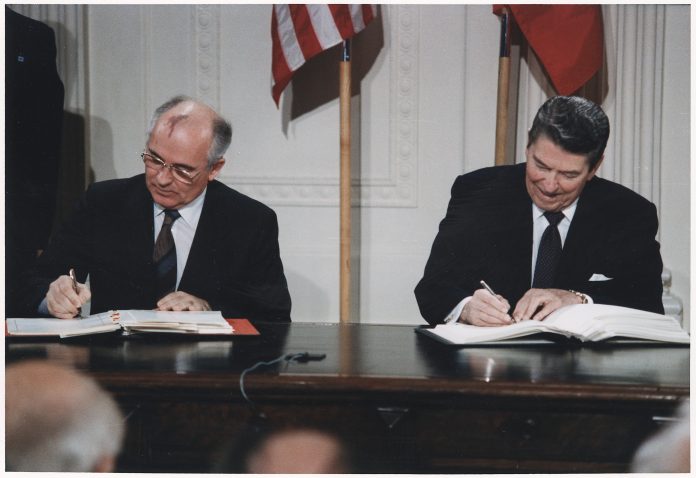
The eighth and last leader of the Soviet Union took the de facto leadership position on March 11 of this year. His reform policies of glasnost and perestroika (openness and restructuring, respectively) would play a large part in bringing an end to the Cold War. In November of 1985, he met with U.S. President Ronald Reagan. The two agreed to engage in arms control talks with a goal towards nuclear disarmament.

1995 — The first Americans are welcomed aboard the Russian space station Mir

On March 16, Dr. Norman Thagard of NASA was “greeted with a kiss on the cheek and bear hugs” by Russian counterparts, The New York Times reported. The interstellar scientists would spend the following three months together, conducting experiments aboard the space station.

2005 — Islamic terrorists hit London

In what is considered the worst attack the city had sustained since World War II, London became the target of Islamic terrorists. Reportedly, 52 were killed and about 700 injured in the July 7 bombing of the public transportation system, including three in the underground subway and one on a city bus.

2015 — Syrian migrant problem turns to crisis

The release of a photograph of a dead toddler in September served to incite a media frenzy into what has been described one of the worst refugee crises since World War II. A brutal ISIS regime encroaching on their homeland is now prompting many Syrians to relocate to the West. Many lives have been lost in a desperate attempt to cross the Mediterranean Sea.

Student App Roundup

0
Students have a host of apps to choose from at SFU this semester.

Who doesn’t love hearing the phrase, “There’s an app for that”? Shopping? There’s an app for that. Travel? There’s an app for that. School? There’s an app for that. Actually, there are several. Let’s take a look at some of the up-and-coming apps that are being made for university students, and even SFU students specifically.

Official SFU App

If you keep on top of school emails, you have probably noticed the emails about an official SFU app that has recently been released. The project began this spring through an app-developing competition for a CMPT 275 term project, and has grown into a fully-fledged app.

The app aims to provide the practical information that students may want to have at their fingertips. Some features provided include bus information, maps that allow you to search for rooms, and information about places to eat on campus.

You can also view computer availability, and it keeps track of your class schedule and provides course details. If you have already been using any student apps, you may find that a lot of these features are quite familiar. However, this app is unique from its predecessor in that it is official — meaning it comes directly from SFU. The university says that this offers a certain security, as you don’t have to worry about any third-party apps stealing your SFU ID.

The app also allows students to give feedback or suggestions to the school or the creators of the app as they continue to develop and fine-tune it. This app is not yet available for Android users.

Know School

Know School is another app that provides many similar features to the official SFU app. Know School provides a daily class schedule and campus information for all three campuses, including includes weather, computer availability, and more.
It uses your SFU login to provide direct access to your schedule, as well as secured services like SFU Connect and Canvas. It also allows you to view which other students share classes with you, and many other features that the SFU Official app covers. Unlike the official app, Know School is available to both iOS and Android users.

SFU Ingresso

A similar app designed by SFU students is SFU Ingresso. This app integrates directly with your Student Information System account, SFU Connect, and Canvas.

However, this app has a different focus that becomes clear as soon as you see the homepage. SFU Ingresso posts SFU-related news stories and keeps you posted on upcoming events. This all aims to provide what Project Manager Ahmed Medhioub describes as “a platform for the people of SFU to find the content relevant to their university and community.”

If you are looking to keep up with school news, events, and get quick access to your SFU accounts, then this app might be worth checking out.
There is another branch of student apps becoming popular — apps which focus more on the social aspect of student life.

Yero

Yero is an app for iOS designed by two SFU alumni and one graduate from UBC. One of the creators, SFU alumnus Matthew Greig, described the purpose of the app: to “create private networks around real-world locations (college campuses, sports stadiums, nightlife venues and music festivals) to let users inside connect with people sharing the same experience.”

Yero is a location-based app. What this means is that when you are in a specific places, such as on campus, you will be able to see other users in the area. The app also allows you to contact people directly and spark up a conversation. Any connections made will be erased the next day, making Yero “about tonight.”

Loopr

Loopr is an app that was also created by SFU alumni. The creators wanted to develop an app to connect students, so they approached a social media startup called Skynation, which was co-founded by Kayode Fatoba, the first VP Student Life of the Simon Fraser Student Society.

This app is similar to others, such as Yero, in that the users make posts assigned to different groups based on their location. However, users can also tag their posts with a hashtag, which can then be searched to make it easy to find the content you’re looking for.

Fatoba described Loopr as “a location-based social network [that] provides its users with the benefit of being a source for current up-to-the-minute news about what’s going on around them.” Loopr developers are currently preparing to expand to a city-wide launch.

Chitter

An app in the same vein of location-based posts is Chitter. This app has really started to take off recently, and is currently only available for three different universities.

It was created by students at the University of Alberta, who decided to make SFU one of the other two universities with access. This app allows users to make anonymous “chits,” which are just simple text posts that can then be up- or down-voted by other students.

Students can also comment on posts, but the catch is that comments are not anonymous; this app requires a Facebook login. There are also groups to which chits can be posted, such as “Advice for New Students.”

Chitter was inspired by the ever-popular “Confessions” Facebook groups that many universities have, which allow people to submit posts that will be shared by the page anonymously. A visiting Chitter developer made a splash at SFU by streaking through the hallways of the Academic Quadrangle shortly after the start of the Fall semester.