Home Blog Page 975

SFU researchers help army veteran walk again

0
Captain Trevor Greene walks with the help of an exoskeleton suit.

Captain Trevor Greene, after being severely injured in Afghanistan, has regained hope of walking with the help of Carolyn Sparrey, SFU assistant professor of mechatronic systems engineering, and a sophisticated exoskeleton technology.

Greene was on tour in Afghanistan in 2006 when he suffered an axe attack from a teenage boy; the axe was buried five cm into his brain. While he survived his life threatening injuries, he lost the ability to walk.

The captain had been working with Ryan Darcy, professor of neuroscience at SFU, for nearly five years during which Darcy used MRIs to monitor his recovery.

About a year ago, Greene was introduced to Sparrey. Said Sparrey, “We had a brainstorming session essentially where myself and several other engineers from SFU and Dr. Darcy were all in a room thinking about what the next step towards Trevor’s rehab [was] and how we get him to his goal of being able to walk.”

The idea for the exoskeleton suit, which was paid for by fundraising through the Canadian Legion’s poppy sales, came from Greene’s wife, Debbie.

According to Sparrey, an exoskeleton is “essentially an assistive device for walking.” It contains a pelvic band to attach at the waist and a metal frame that extends the length of the leg and attaches at the feet. The frame is rigid on the outside, but contains motors at the hip and joints to “drive the movement of walking,” as Sparrey outlined.

Sparrey explained that an exoskeleton was not originally recommended since it is usually reserved for spinal cord injuries and not brain injuries: “With Trevor, because of the axe being very localized to one very specific part of his brain, [. . .] it only took out primarily the motor areas of his brain.”

Greene is the first patient with a brain injury to use the exoskeleton for rehabilitation. The hope is that the suit helps take advantage of his brain’s capacity for neuroplasticity. Sparrey elaborated, “Everybody’s brain is always rewiring and making new connections. [. . .] And so what we’re hoping with this system is [that] by doing an action, by pushing his body through an action, it’s just triggering the pathways to rehabilitate the brain and redrive those connections back to the brain.”

The team of SFU researchers and engineers working with Greene intends to use MRIs (functional magnetic resonance imaging) and MEG (magnetoencephalography) to monitor whether his neural links are being established.

They are going a step further and also looking at his overall health metrics, such as blood pressure and digestion, to keep an eye on his overall quality of life. Sparrey added, “We’re also looking at his functional gains [. . .] not just in terms of walking, but in terms of things like being able to sit upright, and core strength, reaching strength, flexibility.”

What are Greene’s wishes for his recovery? He hopes to one day climb to the base of Mt. Everest by himself. Sparrey noted that it is difficult to determine a prognosis.

“Trevor, at every step, has exceeded anything that anyone expected of him,” Sparrey said. “And because it’s a new technology and it hasn’t been applied to Trevor’s kind of injury before, we really aren’t putting a limit on how much recovery we think he can get. So, if he wants to drive that hard and has that target, I would not put a limit of whether or not he can get there.”
Immersive art at SFU Woodward’s celebrates school’s 50th anniversary

0

In honour of SFU’s 50th anniversary, Hidden Pasts, Digital Futures: A Festival of Immersive Arts, a collection of groundbreaking interactive exhibits, comes alive at the Westbank Woodward’s Atrium and SFU’s Goldcorp Centre for the Arts from September 18 to October 16, 2015.

In partnership with the National Film Board of Canada, the Vancouver International Film Festival, and SFU Woodward’s Cultural Programs, the five-week project will feature work by internationally renowned artists Stan Douglas, the NFB Digital Studio, Sarah Kenderdine, and Jeffrey Shaw.

Howard Jang, Director of Woodward’s Cultural Unit, calls the collection a “good example of what art can do and how it can truly engage the community.” He also notes the appropriateness of the project in celebration of SFU’s 50th birthday: “This anniversary encourages us to look back on our history and provides a glimpse of our community. SFU has always been identified as the radical campus, and this work lives out that disruptive dialogue. [The exhibit] reflects the type of school that has been, and shows how the arts can really play a role in engaging and shaping the world.”

The festival is comprised of three experimental pieces, each of which transports participants into a richly unique multi-dimensional world. The first, Circa 1948, is an interactive storyworld co-created by the National Film Board of Canada‘s award-winning Digital Studio in Vancouver and internationally acclaimed artist Stan Douglas that tells the story of post-WWII Vancouver.

In Circa 1948 you, as the sole participant, step into a modest room, which transforms before your eyes into an interactive space where you explore two vastly different communities straight out of 1948 Vancouver. The first, the original Hotel Vancouver in the prosperous west, is contrasted by the second (now extinct) location, the culturally diverse, working-class Hogan’s Alley in the east. Complete with exceptionally detailed visuals that you can walk right up to and an intimate soundscape of the time, the experience is truly delightful. It’s like a historical video game come to life — it’s immersive and unforgettable.

According to interactive producer and creative technologist for the National Film Board of Canada Dana Dansereau, the exhibit is a “wisp of the past.” He notes the project hinges on the “idea of communicating these two neighbourhoods of Vancouver at a time that matters, using technology. [It is an] architectural documentary of parts of our history that have been eradicated, telling an important story spanning multiple mediums.”

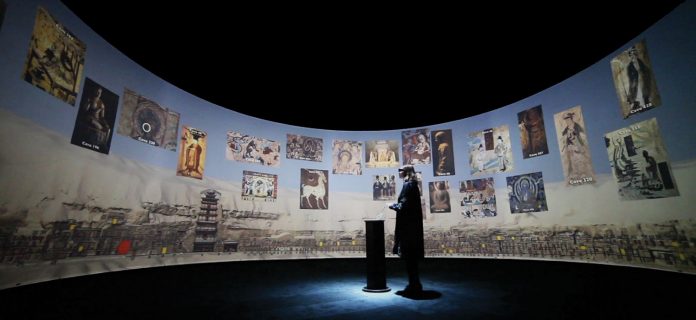
Pure Land: Inside the Mogao Grottoes at Dunhuang is an immersive installation created by Jeffrey Shaw and Sarah Kenderdine. As described on the Woodward’s website, the animated 3D experience immerses visitors in the heritage of ancient Buddhist grotto temples. The artwork features the Dunhuang Caves of the Thousand Buddhas, a UNESCO World Heritage Site that marked the gateway to China on the ancient Silk Road.

Visitors step into a room surrounded by a large 360-degree panoramic 3D projection theatre that puts them inside a cave temple, where they view magnificent Buddhist wall paintings.

Place-Hampi, created by Sarah Kenderdine and Jeffrey Shaw, is an embodied theatre of participation in the drama of Hindu mythology focused at the most significant archaeological, historical, and sacred locations of the World Heritage site Vijayanagara, South India. 

The 360-degree display (created from analog footage) of the World Heritage site brings to life the history and breathtaking scenery of the location, and the narrative events enrich the adventure through computer-graphic characters representing protagonists of the Hindu mythologies including Ganesha, Lord Shiva, and Garuda. The landscape that takes you from one sacred site to the next is mesmerizing and transformative.

These three core exhibitions are complemented by companion installations Fragmentation (Richard Castelli & Volker Kuchelmeister, directed by Robert Lepage), Fall Again, Fall Better (Jeffrey Shaw), and UnmakeableLove (Sarah Kenderdine, Jeffrey Shaw). As a whole, Hidden Pasts, Digital Futures draws us in and encourages us to ask important questions about, as Dansereau said, “what does immersive arts mean for artists and what does it mean for public experience?

“Immersive arts is something you can’t ignore,” he added.

The festival, much like SFU, is rooted in history, possibility and wonder. Jang acknowledges that SFU’s Woodward’s Cultural Unit, as well as this project, “have the opportunity to be a place for, and present, dialogue and engagement.

“We’re heading off into the a brave new world, one that puts arts on the front burner.

New recipe book proves tea is timeless

0

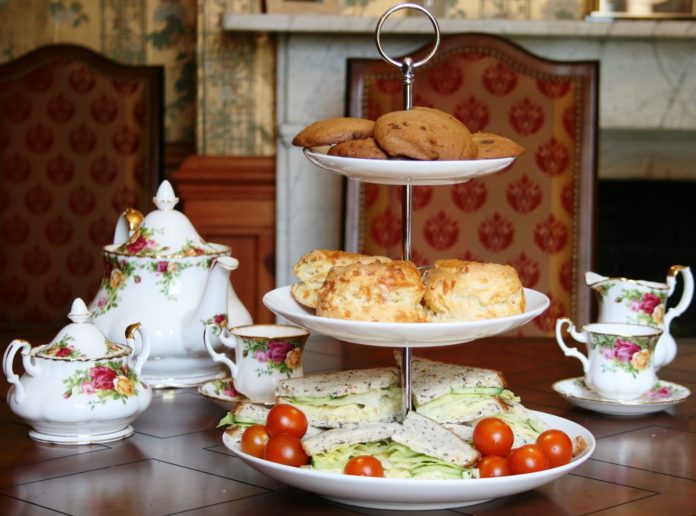
Afternoon Tea: A Timeless Tradition is so much more than a recipe book — it’s a narrative. More than half the book is a flashback to Muriel Moffat’s personal fond childhood memories and the historical formalities of afternoon tea. This process of getting to the set of simple and darling recipes in the back of the book makes them that much more special: they show the nostalgic symbolism that these recipes carry.

Although the story is charming as well as compelling, parts could easily convince readers that the book is directed towards an exclusive audience: English traditions for English families. This misunderstanding comes from Moffat’s description of what “being English” visually looks like and her emphasis on the little “English” quirks that her grandmothers had and how it set her apart.

That being said, following the second chapter, Moffat proceeds warmly to close this gap by expressing her longing to teach others about the delicate practice — so that the English tradition of afternoon tea is accessible and kept alive in all of Canada.

Moffat’s writing style is dreamy and sophisticated — so much that I can visualize her experiences at the Empress and imagine the delicacy of the fine bone china. She describes things in such a naturally focused way that the visuals lingered with me and the elegance of the tradition she so adores almost floated off the page. It might make you feel compelled to go on an immediate flight to England just for the little lemon tartelettes and cucumber sandwiches featured in the pages, or at least put on a white pinafore dress and have your own afternoon tea with the traditional recipes provided in the back.

One of my favorite quotes from this book would have to be “appreciate the surroundings and the opportunity to go back in time to when we had time and took the time!” What a lovely reminder in such an immediate, technological, mass-produced world. It’s a piece of advice to take a breather and go back in time to when you had time and took the time. Sometimes it is worthwhile to spend your time just drinking tea, eating miniature delicacies and chatting away with your friends. I think this quote brings up what I love most about this book: it unwinds time to when we weren’t always in a rush but just took time to sip tea, instead of chugging it on the speed walk to your bus stop.

There are a set of contrasting themes in the book: the immediacy of seizing this English tradition before the opportunity escapes us, and the need to just slow down and enjoy life through the smallest of pleasures. Enjoying a good cup of tea allows us to do both.

Food Fight: homemade vegan feast

0

Welcome to our brand new foodie corner of The Peak! This column is a collaboration between two friends with opposing diets: a meat-eater (Jess) and a vegan (Gems). This serves as a way of critiquing food from opposite lifestyles, and we will be focusing on local, culturally diverse eateries in Vancity as well as unique recipes to bring you feisty reviews that we hope you will find useful and enticing.

This week’s recipes:

Spicy Mango & Avocado Rice Bowl from Love and Lemons, Rainbow Spring Rolls from Minimalist Baker, and Citrus Fennel & Avocado Salad from Foodie Crush.  

Preparing a vegan feast means one thing: chopping all the vegetables. All three recipes required a sharp knife and even sharper wits to avoid the mind-numbing boredom of chopping vegetables for over an hour. That being said, don’t let the long ingredient list scare you from trying these simple recipes.

The meat-eater (Jessica)

Of the three recipes, the most surprising was the Spicy Mango and Avocado Rice bowl, not only because I was initially skeptical of the idea of just things piled on rice, but also because of the baked tofu.

As a meat-eater and tofu-hater, I was prepared to hate the texture, flavour, and pretty much everything about it. I was pleasantly surprised by the transformation of texture and flavor of the tofu. I ended up not missing the meat in this dish at all, and that is something that I never thought that I would say.

The Rainbow Spring Rolls were incredibly fresh-tasting and the perfect side to accompany the rice bowl — however, the peanut dipping sauce included in the recipe was somewhat disappointing when compared to the coconut peanut sauce of the rice bowl. This one was too thick and pulled the veggies out of the roll when dipped. The freshness was emphasized by the fact that there was no rice vermicelli in the roll, which I appreciate as the vermicelli can overpower the rest of the roll.

The citrus fennel and avocado salad was somewhat disappointing, due to the addition of the avocado. I really enjoy the slightly licoricey flavor of fennel combined with oranges, but the avocado overpowered this combination with its heavy creaminess. The dressing also prevented the two flavours from melding properly in the salad, so while the bare bones of the salad were strong to begin with, the extra additions prevented it from being a truly enjoyable experience.

The vegan (Gemma)

The rice bowl was my personal favorite because it completely overthrew my expectations. The dish was unbelievably tasty and filling. The soy sauce baked tofu had a chewy texture and did not taste as bland as tofu normally tastes — the sauces from the tofu greatly complimented the fibrous texture of the brown rice. For something that we anticipated to be quite dull and mediocre, it was bursting with flavour, extremely filling, and nutritious. The coconut peanut sauce was simply beautiful: smooth and perfectly balanced between spicy and nutty.

The vegan salad rolls were fresh and light, but I couldn’t help but miss the usual heft and texture of the vermicelli noodles. I feel that as a side dish, though, it was better that it didn’t contain the noodles. The peanut sauce was really the main struggle to get the right consistency and taste, but we eventually settled on the coconut peanut sauce from the rice bowl, and it greatly animated the salad rolls.

I did not enjoy the fennel and avocado salad. I think this was mainly because the various juicy citrus fruits clashed with the attempt to make it a savoury dish. The juice from the oranges accumulated at the bottom of the bowl and when tasting it, it wasn’t necessarily impressive. I don’t even know what the avocado was doing in there. It became lumpy and strange in the juices from the salad. We did however make the salad the night before, so perhaps making it fresh would help it from ending up closer to orange fennel soup.

Pawn Sacrifice does little to excite

0

Two adversaries, one a kid from the Bronx and the other a product of Soviet propaganda, glare violently into each other’s eyes. The sound of a ticking clock echoes as the two combatants carefully make their moves. One gracefully attacks as the other shuffles into defense. This is not an action sequence from a spy thriller, but a description of a table game stereotypically played by eccentrics: chess.

Bobby Fischer (Tobey Maguire), regarded by many as the greatest chess player in history, rose in fame during the ’60s as the Cold War and Watergate were boiling over. After dominating the US championships the previous years, Fischer’s last challenge was to become World Champion and defeat his Soviet rival, Boris Spassky. It’s a classic tale of underdog and champion, good and evil, poor and rich, USA and USSR.

The stakes should arise from the socio-political climate and the subtle impacts of the physically lethargic game, but a couple of tense and stylized sequences aside, Pawn Sacrifice fails to overcome the fact that it’s primarily a humourless look at two weird guys strategizing in ways we’re unable to understand.

Like in a sports film, the chess isn’t as important as the relationships, characters, and politics that surround them. As a lot of games are played out through unremarkable montages, and the chess sequences are clearly influenced by Rocky and Chariots Of Fire. Edward Zwick’s film is best compared to sports films rather than standard biopics of historical figures.

If Pawn Sacrifice had to be described as a chess piece, it would be the queen — she moves every which way, and yet no one is really certain how she should be used. A strong lead performance from Tobey Maguire is in service of a film that sporadically shifts from one conflict to the next. Mental and mommy issues are mostly abandoned to be picked up in the climactic match as Zwick intercuts all the forgotten relationships with a climactic duel between Fischer and Spassky. There’s little development; only a forced resolution.

Visually it’s also all over the map: constant shifts from black and white, ’70s news footage, and glossy imagery – all with no thematic through-line. Pawn Sacrifice is a lawn dug up by groundhogs; there might be depth beneath the surface but all we see are the little mounds left on top. You won’t leave feeling like you lost, yet the film is never able to express the thrill of a checkmate. Pawn Sacrifice is a bland statement; a tie that is like kissing your sister. It’s hard to get anything out of it.

Comic Connoisseur: The Dharma Punks is an explosive coming-of-age tale

0

In 2001, The Dharma Punks debuted on New Zealand newsstands and found overnight success. In a short but illustrious eight-issue run, the comic outsold the X-Men and other mainstream works before fading away into obscurity as a lesser-known indie gem. After 14 years in limbo, however, Ant Sang’s cult classic has finally been collected in a slick new trade paperback.

The Dharma Punks takes place in Auckland, New Zealand in 1994. It follows a group of anarchist punks who put in motion a plan to level a corporate fast food chain on the day of its grand opening.

The story focuses on a young Chinese punk named Chopstick, who is tasked with placing the explosives in the building the night before. However, in the process of doing so, Chopstick’s night takes a multitude of unexpected turns which lead him to face the paradox of his spiritual beliefs and his anarchistic tendencies. Skinhead Neo-Nazis, a mute girl hanging dangerously on a bridge, and the ghost of Kurt Cobain await Chopstick in one long dark night of the soul.

The Dharma Punks is story with equal parts drama and philosophical pondering. The two aspects of the narrative work harmoniously together to make a highly enjoyable experience for readers. The plot is paced provocatively with interspersed flashbacks and flash-forwards, which entices to find out what happens next. Moreover, the world and experiences of Chopstick are immersive. It features an abundance of close-up panel shots, allowing an intimate connection with the story’s lead.

Sang’s artwork for the series fits like a studded leather jacket on a punk rocker; it has a style all its own. The use of a black and white palette instead of coloured artwork contributes successfully to the story’s dark tone. Sang’s character designs are as rich as his narrative and add layers upon layers to his already dynamic cast of characters.

Perhaps the most entertaining aspect of the series is Chopstick’s interactions with the ghost of Kurt Cobain. Unlike Jiminy Cricket, Kurt Cobain’s astral presence takes the role of a blunt guardian angel who is not afraid to speak his mind. Interactions between the characters are darkly hilarious, but also poignant and thoughtful. They are among just some of best scenes in the whole comic.  

There have been a fair share of punk-inspired coming-of-age tales over the years, yet the market never feels oversaturated with their presence. Furthermore, I say that they are some of the finest allegories for growing up that exist — with The Dharma Punks as one of the best ever created. Sang proves that while fashion and attitudes may take different shapes over each generation, the same questions of existence, purpose, and spirituality are still destined to pop up.

The Dharma Punks is an engrossing cult masterwork which continues to be just as relevant today as it was 14 years ago.

Out on Campus opens its doors

0
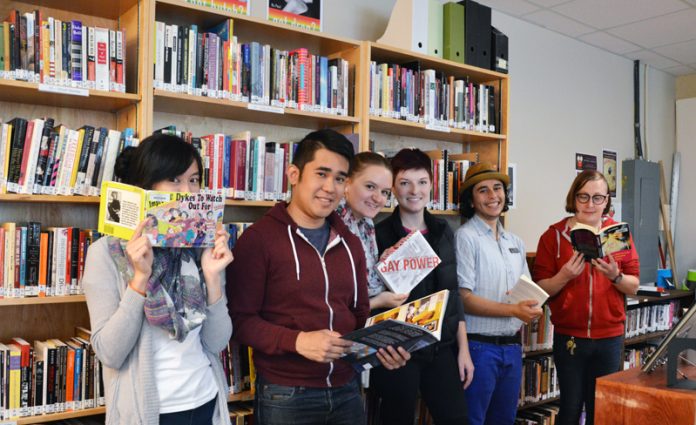
Photo by Lisa Dimyadi

SFU’s LGBTAQ+ interest group Out on Campus (OOC) welcomed students to the new school year with an Open House on Wednesday, September 23.

The event featured an informational session about the space and the upcoming events, and gave students a chance to mingle with others whom they might be volunteering alongside in the future.

OOC is a part of the Simon Fraser Student Society that works to reduce discrimination and oppression of LGBTAQ+ people within the university and greater community through a variety of programs, resources, and events.

Within the space, there is a library connected to the SFU Women’s Centre and the Simon Fraser Public Interest Research Group with over 2000 resources, as well as a variety of safer sex supplies available. The staff offer peer support and crisis referral.

This fall, OOC staff member Marion Roberts is running three workshops as part of the Positive Space Network. These workshops are open to anyone, free of charge, and designed to educate individuals on gender and sexuality topics, especially those relevant to the LGBTAQ+ community.

The safe space, free from oppressive language and behaviour according to staff member Firas Al-Tahan, is open to everyone within the SFU community. Regardless of whether or not you were able to make it to the Open House, the staff encourage students to come out to their future events and consider getting involved with their work.

Interested students can get involved through their volunteer programs. All new volunteers go through a volunteer orientation and training day, and find the volunteer commitment that fits best with their interests and availability.

From volunteering in the OOC lounge, liaising between the different Rotunda groups, and volunteering in Surrey, there are a variety of options for students to get involved this semester.

Another opportunity for students to get involved is through the decision-making body called the collective. OOC Volunteer and Program Coordinator Devyn Davies explained that there are no stringent guidelines or time restrictions in regards to joining the group that makes decisions about the space. “If you are interested in collective, there: you are a member of [the] collective now.”

SFU student unmasks eating disorders

0
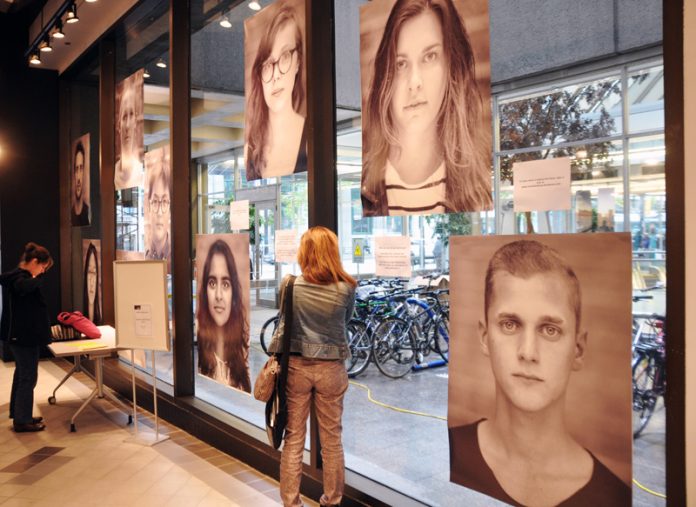
The photographs from the exhibit are displayed at Harbour Centre. - Photo by Nathan Ross

The curator for The UnmaskED Project at SFU Vancouver is so involved in her art, she is literally part of the exhibit.

Clare Sieffert, an international studies student at SFU, has put together the UnmaskED Project. The “ED” is purposely stylized as such to stand for ‘eating disorders.’

The photography collection is being displayed at the entrance to the SFU’s Harbour Centre campus. It is made up of strikingly intimate portraits of people who have a history with eating disorders.

The exhibition is designed to show viewers that eating disorders can affect anyone, regardless of how they look. Sieffert aims to help tackle the stigmas surrounding the issue.

Included in the eighteen subjects for the display is Sieffert’s own portrait.

“I really do think it was a double standard, like absolute hypocrisy, to not be willing to put myself and my relationship with food out there,” said Sieffert. “That’s very self-centered to think that my relationship with food is more complex and more difficult than other people’s relationship.”

She continued, “If I’m asking people to put themselves out there, then I should be willing to do the same.”

At first glance, the portraits can blend into the background — a striking metaphor for those who are silently suffering, Sieffert explained.

For those who take the time to observe the large faces displayed at the entrance, they’ll notice the prompts directing them to UnmaskED’s website, where all participants have answered the same three main questions: what role food has in their life, how people saw eating disorders in their life, and what advice would help best if they were currently struggling.

The photo exhibition features people from all over the world, with four continents and nine different countries represented. Everyone featured has experience with eating disorders, but has not necessarily suffered from one themselves, and so it gives a fairly complex spectrum of the views associated with these issues.

Sieffert was first diagnosed with an eating disorder as a teen, and in her responses on the website calls her relationship with food one that is love/hate.

She said that she volunteered to undertake this project because of the empathy she has towards anyone who is experiencing what she first went through, from how it shapes her patterns in everyday life to how she sees the world.

“I hope to reach out to the broader community,” she said. “It’s not just saying ‘Here are these faces,’ [instead] it’s ‘Here is myself and people I know, and we want to talk about eating disorders.’”

She continued, “It makes it more of an open invitation for people to engage with the project because they can connect with somebody. [. . .] It further helps to humanize the project by incorporating someone who is so close to the community.”

Sieffert’s is just one of the 18 stories featured, and the exhibit provides a learning experience for those who are unaware of what life with an eating disorder can mean.

The UnmaskED Project will be at the Harbour Centre from now until Oct. 5 and is being put on with the support from the Kelty Mental Health Resource Centre, SFU Health and Counselling, and SFU Vancouver Administration.

Programmed for laziness

0
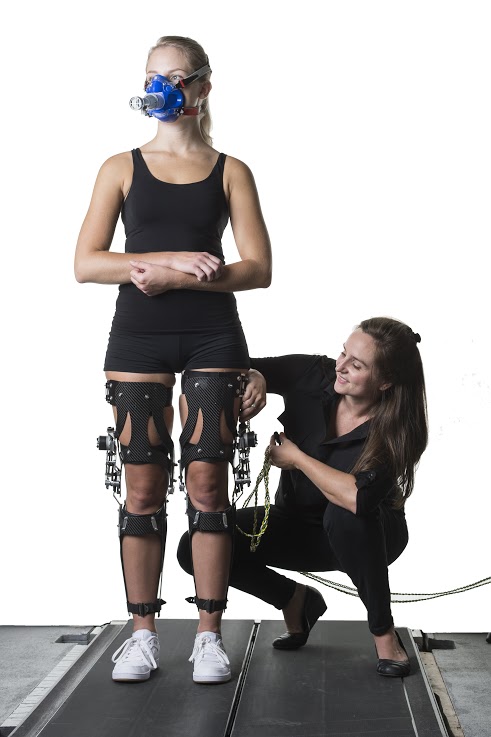
An exoskeleton was used to monitor energy use while walking. - Photo courtesy of SFU News

New research from SFU has demonstrated that the nervous system is continuously optimizing energy use, taking a ‘lazy’ approach in order to be more energy efficient.

SFU professor of biomedical physiology and kinesiology Max Donelan with his colleagues conducted experiments testing certain theories about how people learn how to move.

One theory they have generated is that the nervous system doesn’t move as accurately as it could. Instead, it is constantly monitoring movement and will often compromise accuracy in order to save energy.

Jessica Selinger, an SFU PhD candidate and lead author of the paper, described how the team tested this theory. Selinger’s research was published in Current Biology this month.

“We asked participants to wear a robotic exoskeleton that made certain abnormal ways of walking energetically easier than walking in a ‘normal’ way. They accomplished this by applying high energetic penalties to ‘normal’ ways of walking, and much smaller penalties to specific abnormal way of walking.”

The researchers found that soon after participants were exposed to the robotic exoskeleton, they changed the way they walked. They noted that the characteristics of walking are well-established in individuals, and that the speed at which participants changed the way they walked was very quick. They concluded that this indicates that the nervous system is constantly trying to optimize energy use.

Selinger spoke to the practical implications of her researcher: “The drive to continuously seek energetic optima presents challenges and opportunities for rehabilitating and augmenting human movement.”

She explained that rehabilitation of those who suffer from gait disorders (disordered walking) could, instead of focusing on restoring symmetric movement, focus on “reshaping underlying energetic landscapes” by using technology to make a symmetrical gait that is energy efficient.

Selinger added, “Our findings also have important implications for the recent and exciting push to design and build robotic exoskeletons to improve human performance.”

Selinger commented on whether the ‘laziness’ or energy efficiency of the nervous system could also apply to other characteristics such as thinking, talking, or decision making.

“We think that minimizing energetic cost is a principle that guides most of our movements. While it may play a particularly big role in walking, we suspect that the nervous system is always concerned about it, even for lower cost tasks like reaching or standing.”

Selinger hinted that the ability to optimize movements to reduce energy use may have been an important survival strategy.

While we live in a culture where calorie heavy foods are widely available, that certainly wasn’t the case for our prehistoric ancestors. She speculated that the nervous system’s goal of reducing energy expenditure may have helped stave off starvation.

Frogs can’t beat the heat

0
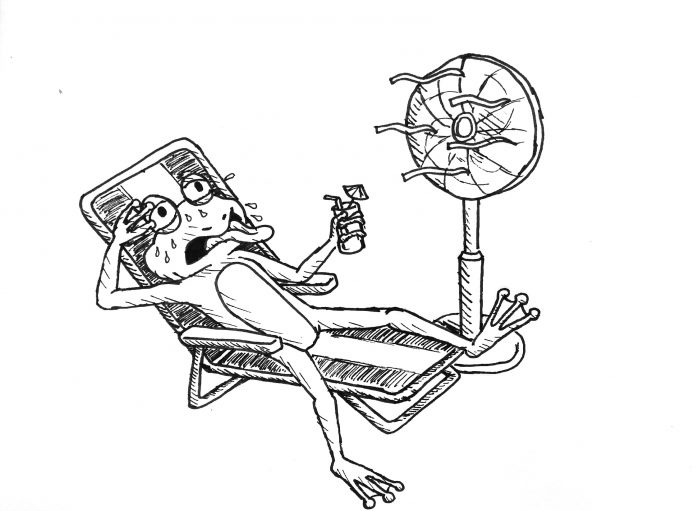
Image by Zach Chan

Research out of SFU has shown that hot and dry summers with minimal snowpack are putting pressure on the wetland ecosystems  among the Pacific Northwest mountains.

A study co-authored by SFU biology professor Wendy Palen, a long-time researcher of amphibians in the region, has developed and demonstrated a new method to project climate-induced changes in the mountain wetlands — and the projections do not look promising for the future of these delicate ecosystems or our amphibian friends.

The study collected data from 121 wetland sites and measured multiple environmental variables to learn more about the types of mountain wetlands that were sampled and the variety of life that they sustain.

Palen explained, “This year we’ve seen that the lack of winter snowpack and high summer temperatures have resulted in massive breeding failures and the death of some adult frogs.” While the ecosystems provide habitats for a wide range of plant and animal species, amphibians are one of the hardest hit groups because of their life cycles.

Mountain wetlands are categorized by how much water they lose throughout the year. This is because changes in the water level will influence the way the environments are used in the ecosystem: as watering holes, breeding grounds, and permanent habitats.

Based on the projections from the study, 58 per cent of wetlands that are currently only dry in the late summer are expected to become ephemeral (seasonal) wetlands; these do not stay wet long enough during the year to sustain animal populations.

Therefore, many fast-growing species of amphibians that depend on these climate-vulnerable ponds will be put at risk. According to Palen, “More years like 2015 do not bode well for the frog.” The Cascades frog is at a particular risk and is currently being evaluated for listing under the endangered species act.

These projection models will serve as a first step towards filling a gap in wetland research, conservation, and assessment. Using the new techniques developed for this study, land managers will be able to gather important information to track and predict the impacts of climate change on not only the amphibians, but all the other life that depend on these oases in the mountain to survive.