Home Blog Page 971

Joe Ink’s 4our showed the company’s maturity

0

4our was like a dream. Not only was the choreography, lighting, set design, and dramaturgy so expertly integrated into a cohesive narrative, but the entire show had an other-worldly, dreamy quality to it that was mesmerizing.

Joe Laughlin, returning to the stage to perform with Gioconda Barbuto, Kevin Tookey, and Heather Dotto, has crafted this masterwork that explores themes of memory, age, and the mature dancer. The paradox of artistic maturity coinciding with deteriorating bodies is also a large inspiration for the work.

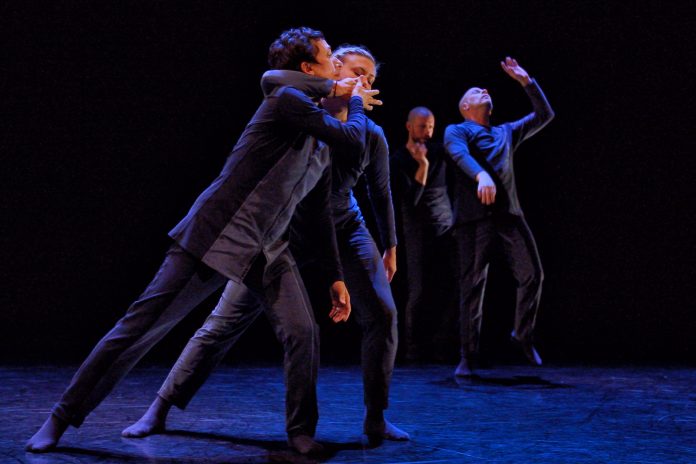
With a few props placed around the black box stage of The Dance Centre, these four dancers moved with emotional intensity to a descriptive, rich soundscape of classical music. Using the sheer white garments hanging above the stage, the dancers evoked different relationships and roles relative to each other. A romantic relationship was present, as well as siblings, parents, and children. Representative of each milestone of our lives, there was plenty of passion and anxiety on display as well.

One of the most interesting props was a chair that Tookey constructed on stage from an assortment of chair legs, tying them together to form the base. He also danced with a restrictive mask wrapped around his head, seeming to represent a feeling trapped in life’s circumstances.

Adding to the dreamlike quality was the beautiful lighting with thin strips moving across the stage or softly lighting certain areas. Video projections, including the faces of the dancers, played on the back wall to add another layer of meaning.

Humour played a large part in this work, one scene involving Dotto and Laughlin was quite funny. It was titled “The Chambermaid” and had Dotto saucily fussing around in an apron while flirting with him and the audience. This scene seemed a bit out of place in the context of the larger piece, but I took it to be a thought provoking representation of age and gender.

This emotionally full, layered work ended on a beautiful note with snowy lighting falling across the stage, the dancers silhouettes still and pensive as we took in the silence and calm. 

4our was presented by Joe Ink October 1 – 3 at the Scotiabank Dance Centre. For more information, visit joeink.ca.

Are We Cool Now? is a musical journey

0

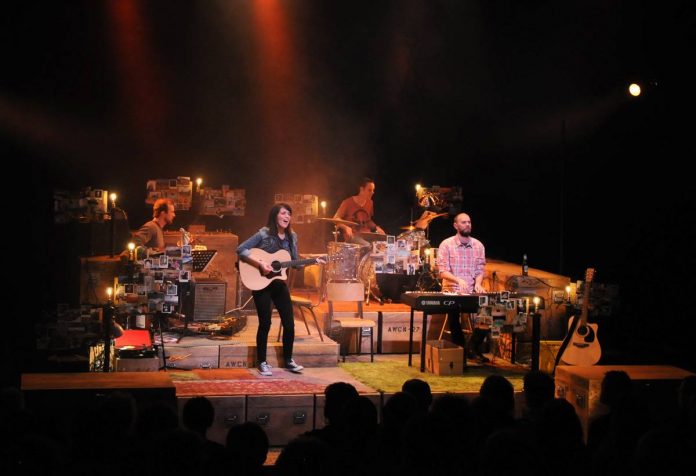
Billed as an “indie rock road trip,” this love story, performed at the Cultch, was set entirely to the heartfelt songs of Dan Mangan. The space was filled with powerful renditions and strong vocals, and the simple, versatile set was used to evoke a variety of spaces including a record store, the inside of an apartment, and the streets of Berlin.

Penelope Corrin and Ben Elliott star as a young couple trying to find their way in the world and figure out what they want out of life, all while breaking into song, often with the addition of a guitar and keyboard. Anton Lipovetsky and Spencer Schoening provide the percussion, guitar, and bass.

“Road Regrets” appropriately opened the show and set the tone as Penelope and Ben have their first awkward encounter at Ben’s dad’s record store in Winnipeg. After a few dates, Penelope drops the news that she has planned to go to Europe for a couple of years.

Ben follows her to Berlin, and they have a great time until Ben’s dad falls ill and he has to go home. Penelope feels obliged to accompany him, and then Penelope gets pregnant, putting a strain on their already rocky relationship. Ben is excited about the prospect of having a family and starting their life in Winnipeg, but Penelope isn’t ready and wants to travel and focus on her career.

While these events are relatable and the love story is heartwarming, I was a bit disappointed that the road trip part of the “indie rock road trip” didn’t come into the story until near the end. A recurring scene of the pair standing on a cliff about to jump into the water, Penelope trying to convince Ben to jump, is an obvious metaphor for their relationship. Penelope eventually jumps, leaving Ben behind.

This is a great show for date night as the two share many scenes to which I think many couples can relate. Their fights about inconsequential things and learning about each other’s idiosyncrasies will make you laugh as you see a bit of yourselves on stage.

Corrin and Elliott bring their musical talents, humour, and great onstage chemistry to this production that will leave you with warmth in your heart and a tune in your head.

Are We Cool Now? is presented by The Cultch and Western Canada Theatre at The Cultch’s Historic Theatre from September 29 – October 10. For more information, visit thecultch.com.


CJSF marks 12 years on FM dial

0

The Astoria on East Hastings Street was the place to be last weekend in celebration of CJSF’s 12-year anniversary of being on the FM airwave. With six bands blasting rock vibrations into the airspace, it was a surefire way to honour our very own community radio station on Burnaby mountain.

Walking upon the black and white checkered floors of the old Astoria pub, one can’t help but notice the charm that has been built up over the last century, with years of energy fostered from parties and music. Pinball machines and pool tables with dim lights set the scene for a lovable, grungy atmosphere to go with the gritty and alternative styles of music that were experienced throughout the night.

Free pizza was offered from CJSF at the start of the night, which paired well with the amiable staff and volunteers, not to mention the respectable selection of beer.

TV Ugly started the night off right, warming up the crowd with their rhythmic beat, as the audience grew thicker throughout their set.

Ace Martens touched a tender note, reminiscent of a rockabilly romance. The lead guitarist and vocalist sported a suit jacket and tie, while the drummer pulled back her hair looking as polished as Audrey Hepburn, transporting the crowd back in time to a ’50s prom night. They made a dramatic exit with the guitar being left on stage to ring out the concluding vibrations of the set.

Supermoon, an all-girl ensemble, was up next with a riot grrrl edge that would make their ’90s grunge mothers proud. One enthusiastic crowd member played along with them on his air guitar, revving the energy of the room up even more.

Malk didn’t disappoint playing with force and vigor. They would slow their tempo, capturing everyone’s attention, then dive in fast with aggressive riffs that got the adrenaline bolstered throughout the room.

Mi’ens took advantage of looping riffs to build upon their set, creating mesmerizing layers of drum and guitar. The mood of the room shifted to a meditative and contemplative state, allowing the jam style to leave the audience lost in the abyss of their subconscious.

But there was energy to spare as Adrian Teacher and the Subs endorsed the highest levels of energy with an in-your-face punk style. We found out just how far a cordless guitar can go as the lead guitarist hopped off stage mid-song checking out the bar, pin ball machines, and pool tables.

Ending on a sweet note, CJSF provided cake and announced winners of the raffle contest, where various band paraphernalia were awarded.

With such a great array of talent and diverse genres in sound, the night was an impressive success that can truly mark the CJSF as an accomplished group of staff and volunteers working together for the common love of community radio. If you missed this party, make sure you’re at the next, as it is guaranteed to have a special hand picked selection of Vancouver’s best home-brewed bands.

Naomi Klein rewrites the story in This Changes Everything

0

What if the real problem when it comes to climate change isn’t our human nature, but the stories we’ve been telling ourselves? Naomi Klein raises this intriguing question in this new documentary based on her book of the same name.

According to her, the story of the Earth as a machine for humans to tame and control — the story of capitalism — is one of the most damaging factors when it comes to climate change because industrial society has taught us that this is the best way to view the planet. But there is another way to view the Earth: as a living system that we need to work with instead of against.

Klein interviews many people who have been affected by climate change and spends a large portion of the film in Alberta’s tar sands region. She meets with the Beaver Lake Cree, who are fed up with the government’s inaction to ensure that the safety of their land is not jeopardized. One striking scene shows Crystal Lameman being told that she doesn’t have the proper permit to even set foot on her traditional lands that have been affected by an oil spill.

The areas affected by extreme weather events in the United States such as Hurricane Sandy show that nature is a force to be reckoned with, and as much as we think we are in control, one storm can flatten a city. In Montana, a couple who owns a ranch are devastated after an oil spill contaminates their water, and potentially their livelihood.

The Heartland Institute, a large think tank of climate deniers, are also included in the film — Klein attends one of their conferences to see what they have to say. Their vehement denial of climate change and their extremely neo-liberal economic theories are quite shocking.

One Heartland interviewee says, “If you want more trees, use more wood [. . .] if you want more elephants, market their ivory.” But Klein says that they do have one thing right: climate change has the potential to change everything about our society, and almost anything may be justified as a response to it — this is why they are working very hard to make sure it is not taken seriously and the status quo is maintained.  

Klein’s explanations of concepts like sacrifice zones and our Carbon Budget are succinct and simple enough that anyone watching this should be able to understand the severity of the situation. Directed by her husband Avi Lewis, and narrated by Klein, it’s a well-produced film that tells an important story.  

First Nations, environmental groups, farmers collectives, and citizens who are fed up with the status quo are fighting back all over the world to protest coal fired power plants, pipelines, and the tar sands, and the film ends on a hopeful note that perhaps people are starting to rewrite the story for themselves.   

For more information, visit thischangeseverything.org.

The Vancouver Art Gallery reveals the design for its new location

0

A dream 10 years in the making, the architectural proposal for a new Vancouver Art Gallery was unveiled on September 29 to a full house at the Queen Elizabeth Theatre. The current heritage courthouse location was originally leased in 1978; however, due to the small space and lacking safety standards, the gallery board of directors began discussing a new home in 2004. The goals were to expand in space as well as meet industry safety standards so that more travelling collections could choose to make a stop in Vancouver. When all the plans are finalized, the gallery expects to break ground in 2017 and finish the building in 2021.

In charge of the new gallery’s execution is Herzog & de Meuron, an internationally acclaimed architectural firm based in Switzerland noted for designing the 2008 Beijing Olympic Games stadium affectionately known as the “Bird’s Nest.” Over the year that negotiations and planning took place, the team learned much about Vancouver and the peninsula in particular. The rich nature surrounding Vancouver was taken into consideration and embodied in the rendering of the new gallery.  

Situated beside Queen Elizabeth Theatre, the gallery aims to create an environment of congregation, collaboration, and education in the arts. This will be realized by an open pavilion at the street level. By raising the structure 40 feet into the air, an open area is created for greenery, admission-free exhibitions, and community gatherings. To access the gallery itself, a staircase leads to the lobby where escalators access the building suspended above the pavilion. Complete with a sunken garden and more admission-free galleries, the lobby will include a library and the brand new Institute of Asian Art dedicated to Eastern influences. The lobby will essentially be an appetizer for what is overhead.

The building itself bears resemblance to an Inukshuk, a tribute to the Inuit. At the same time, the blonde wood panelling seems Japanese in spirit. The lower floors, which will greet visitors upon entering the gallery, will house the new 350-seat theatre intended for performance arts, art-instruction classrooms, and a restaurant that overlooks the streets. The gallery itself occupies the top three floors, boasting about 86,000 square feet of exhibition space. Divided by a common area, the space can be subdivided from one massive gallery to four dedicated areas.

Sunlight will be the primary source of illumination thanks to sunroofs and strategically placed windows. The philosophy was to place art in view of the city — in view of a bigger picture. The new Vancouver Art Gallery will host a growing community of artists both local and global. With grounds that will double the space of the old courthouse, the new gallery is well-poised to become the epicentre of artistic culture in Vancouver.

While the overall design has generated much discussion, opinions about it are still divided. The Herzog & de Meuron team and the gallery’s board of directors are invested in bringing nature back into the heart of the city, and therefore chose to clad the structure in wood, but concerns have been raised regarding the durability and future upkeep required to service the building in addition to the general aesthetic of the design. Admittedly, the digital renderings of the concept design, while realistic, are obviously subject to change.

Weekend Update: Women’s soccer drop a 3–1 decision to Concordia

0
Hamed Yaghoubi Shahir / The Peak

On a beautiful Saturday afternoon, with the sun glistening off the Terry Fox Field turf, the women’s soccer team lost 3–1 to the visiting Concordia Cavaliers. SFU and Concordia were third and second in the GNAC respectively, so with a win SFU would have been able to be level on points with Concordia. Unfortunately, a poor second half let the team down; the style in which Concordia played did not help the cause, either.

“I thought we played a team that didn’t play very nice soccer, but they wanted it,” said head coach Annie Hamel after the match. “They worked hard, they won the 50/50 [challenges], we didn’t match their physicality, and that ended up costing us. We’re too casual.”

It was a cagey start to the game until the 17th minute, where a long ball forward was controlled by Sydney Van Steenberge. She dribbled past the SFU defender and hit the ball past keeper Priya Sandhu for an early lead. Later in the 26th, SFU answered back. Off a corner kick, Carli Grosso was able to break free and head the ball in to tie the game up at 1–1. Christina Dickson had a chance to give her team the lead in the 32nd, but a bad touch let her down and the Concordia keeper made the easy save.

In the second half, Concordia tightened up their defence. No longer were the Clan able to make long runs like they did in the first half. The game-winner was scored in the 60th minute. A penalty was called against SFU for a push in the box, and Concordia player McKayla Madison made no mistake, burying it in the bottom right corner. Their second goal came just four minutes later; a cross from the right connected with Concordia’s Maddie Prehoda, and just squeaked over the line despite two SFU players trying to clear it. From there Concordia simply stayed back and played a very physical defensive game and held out for the win.

It was clear from the start that SFU was having trouble playing against a very well-organized Concordia side that, prior to this game, had not conceded in four straight games. “They’re young and they’ll learn,” said coach Hamel. “This game is played at a fast pace, you don’t always have time to be pretty on the ball and make decisions [. . .] you just gotta be willing to sacrifice.

“We didn’t do that today. We didn’t play as hard as they did and they got the win.”

The Clan’s next game will be on Thursday when they play St. Martin’s University.

Weekend Update: SFU win 1–0 against Seattle Pacific

0
Hamed Yaghoubi Shahir / The Peak

Saturday night the men’s soccer team played host to the Seattle Pacific Falcons. In recent years these two teams have developed quite the rivalry, as both teams are usually battling for top spot in the GNAC by season’s end. This time around SPU were second and SFU were fifth, but that didn’t diminish the intensity of the game, in part due to some questionable officiating. None of this stopped the Clan, though, and they eventually won the game 1–0.

“The refereeing wasn’t very good tonight, and I don’t mind saying that”, said head coach Clint Schneider after the match. “It allowed the game to go the way it went. Both teams had to deal with it unfortunately. I don’t think either team handled it very well to be perfectly honest, but rivalry games do get intense that way.”

SFU got off to an fantastic start. Mamadi Camara scored in the 15th minute, burying the ball into the bottom right corner. He is in the form of his life, scoring two goal in the last match and the game-winner in this one. From then on, the match was defined by its physical nature. Both teams traded physical challenges, and surprisingly no yellow cards were handed out. SPU’s first good chance of the game came in the 32nd minute, when the forward fired a low shot right at Watson. The half ended 1–0 to SFU.

“The refereeing wasn’t very good tonight, and I don’t mind saying that.”

The second half started with more physical play, as both teams were carried away by the emotions of the rivalry. Adam Jones almost added an insurance goal for SFU, but missed the net. The first yellow card of the game was given to Pascal Schmidt of SFU. It was surprising that the first yellow was given this late, as there were a number of hard challenges before it. After that, four more were given out. SFU held on to their win thanks in part to defender Callum Whittaker. After missing Thursday’s match due to a quad problem, he came back and effectively organized the back line against a potent SPU attack.

Schneider wasn’t done with the officiating after the match. “It wasn’t good enough. It wasn’t consistent for both sides. The referees here in Canada don’t know the GNAC rules, and it’s a huge issue. It needs to be addressed, sooner than later. It’s supposed to be already addressed, it’s embarrassing.”

Despite the scoreline, there is still room for improvement, according to Schneider. “We got to be better. We got to be able to keep the ball and play the way we want to play. Be organized, work hard, those kind of things. Things that we can control, we have to be better at. Until we get to that point, we’re not going to be a team that win the big games.”

The team’s next game will be Thursday, when they play host to Northwest Nazarene.

Stretches for the modern student

0
You're only six steps away from your beach body goals!

It’s an unfortunate reality that when school picks up and you’re multitasking like never before, the first thing to take a hit is usually your health. Things are only going to get worse from here, but we’ve got you covered with this list of quick, easy-to-do stretches that will have you feeling refreshed and like you’ve had at least four hours of sleep.

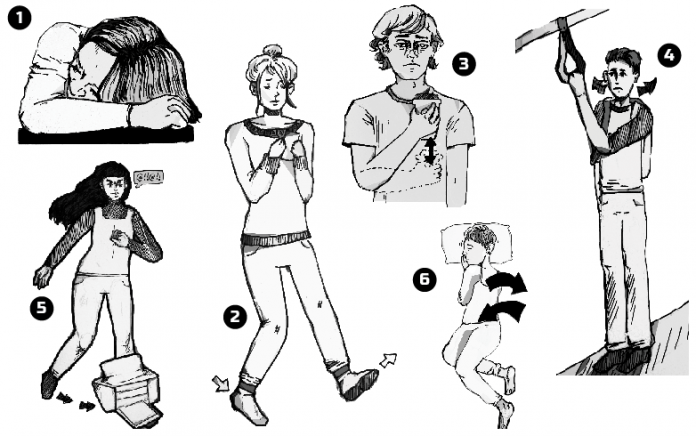
1. Anterior java lifts: The perfect way to start any day — or afternoon or night — all you need is a cup of coffee that’s big enough to comfortably seat a cantaloupe. Forming a 70 degree angle with your elbow (so that the cup is front of your lower chest), bring the cup to your mouth and slurp. Remember to let out a satisfying “aaaah” after each slurp, then bring the cup down to chest-level again. Repeat this stretch 20 to 100 times, taking time in between stretches to think about how scary society’s dependency on coffee is.

2. Horizontal body revolutions: You’ll want to lie down for this stretch, preferably on a bed, couch, futon, or some other comfortable surface where you’re planning on catching a few hours of shuteye. Laying horizontally on your back, close your eyes and begin entertaining the idea of sleep, but remember how many readings and assignments you have coming up, as well as how many shifts you’re scheduled for at work. Once the anxiety has settled in nicely, begin rolling arbitrarily from side to side, hoping that some position will offer comfortable relief from the worries of real life. Last, but certainly not least, make sure to fall asleep 15 minutes before your alarm goes off. Repeat daily.

3. The phalange flex: Using both hands, grip your mobile device on either side so that the screen is upwards and facing you. Ensure that your monthly phone bill is too high, but also acknowledge that you’re too addicted to technology to ever consider not owning one. Primarily using your thumbs, begin sending text messages to whoever is mostly likely to have the least going on and thus will text you back almost instantly. For advanced stretchers, try doing the phalange flex while also walking; not only does this give your lower muscles an amazing stretch, but you’re more likely to walk into people when you’re texting, which provides additional endurance training.

4. Public cranial rotations: Most people don’t realize they can get a good stretch in even while they’re on the bus. For this one, all of your movement will come from looking around for an empty seat for you to sit in. The constant head turning and neck craning to find an open seat stretches your sternocleidomastoid, but be careful not to overdo it. Limit your cranial rotations to three minutes and then accept the unfortunate reality that you’re going to have to stand for the entire duration of your ride.

5. The forward-back snap: A great stretch for when you’re in tutorial or lecture, rest the elbow of your non-dominant hand on your desk and clench the same hand tightly into a fist. Rotate your head slightly and bring your body forward until your cheek is resting on the fist (or “rest” position).  In your head begin daydreaming about what life would be like if your father had been action star Bruce Willis, then allow your mind to slip into unconsciousness for a brief moment. Allow your body to drift slightly forward as you briefly fall asleep, then awaken with a lurch. Return to proper rest position, then begin Willis-fantasizing again.

6. Intermediate extremity strengthening: The perfect exercise for stretching your deltoids, biceps, and patience. Locate a computer lab in the school, preferably a crowded one, and when you need to print something off in a hurry. After you’ve hit print on the computer and waited for several minutes, use your forearms and biceps to inspect the printer for anything that may be causing the delay. For this next part, remember that gradualness is key: using your flattened palm, smack the printer lightly, hoping that this will somehow resolve the problem. Repeat two more times, then clench the same hand and increase force exerted by 50 per cent for another eight hits. To end this stretch, step back with your left leg and bring your right leg up, ensuring a flat-footed contact against the printer. This will give your lower legs a bit of a stretch, while also delivering a critical blow to the technology that continues to test the patience of its creators.

Laugh Track: Angela Galanopoulos and Lauren McGibbon

0
Galanopoulos and McGibbon are a match made in improv heaven.

Just in time for your VIFF fatigue, here comes an even better V-led acronym festival: the 2015 Vancouver International Improv Festival, or VIIF. From October 6 to 10, catch over 40 different improv shows, including the comedic pairing of Lauren McGibbon and Angela Galanopoulos — also  known as L.A. We caught up with Galanopoulos and McGibbon to discuss how duo improv differs from regular ensemble improv, drawing inspiration from real-life characters, and why Vancouverites need to get off their asses and check out more improv shows.

How did L.A. first come to be?

Angela Galanopoulos: It was a text message from Lauren. I barely knew her . . .

Lauren McGibbon: Okay, I just want to talk about this moment. It was love at first sight for me because I was in Vancouver TheatreSports League Rookie League and I wanted on Mainstage badly. It was my last Rookie League and Angie’s first Rookie League and when I saw her perform, it was like in Wayne’s World when he sees Tia Carrere for the first time. I was excited to work with her in Rookie League but then I got pulled up to Mainstage. So there was a place called Rowan’s Roof where you could do amateur and I saw Angela perform there. . .

AG: Later on that week, I received a text message from an unknown number and it read: “Hey, it’s Lauren from improv. I think you’re really great and I think we should work together and if you don’t want to, then you can go fuck yourself.”

LM: As a joke!

AG: I loved it. I remember it was late at night and I looked at it and my heart melted in so many ways and I was like, “Yes, a thousand times yes.” I’d seen Lauren perform a bunch when I was starting out and I loved her style and I knew we just got each other.

There’s a quote about you two: “L.A. creates characters you’d want to be friends with.” How important is character development in improv, with so many fleeting, one-off characters?

LM: Earlier today we were talking about our format and how it’s evolved and what we want to do. For me, the way I hook in and get very present in an improv scene, and by extension the narrative and the storytelling in a scene, is through the character.

AG: The other piece to it is creating characters that are characters you want to see. No one wants to see a total douche on stage for 20 minutes, exploring Douche Town in that story. We play with characters — that are inspired by elements of people we see in our lives and we interact with — that are charming in some way. You see something weird about a person and you try to translate that onstage and make it fun. That’s the part of character that’s also sustainable in a long-form set.

You both come from sprawling improv leagues (Instant Theatre, Vancouver TheatreSports League); aside from more stage time, how is performing as a duo different?

LM: It’s just the two of you. If there’s even a third person, there’s someone who can be the outside eye of the scene and see what it needs. We have to do that while we’re in the thick of it. Duo work has to be incredibly connected to be successful, but since we’ve been doing this for two years we’re coming to the point where we’re so connected that we’re having the mischievous fun now. Like one of us will take a big, weird, non-sensical risk and we’re there for each other and connecting to the craziness of it. But it’s scary, because you don’t have that extra man on the ship; we got a captain and a first-mate and we switch that role throughout the set, but there’s no one else. We have to keep this ship going.

AG: There’s also the balance, too. Our formats follow a character or theme, so for a long time we just got a theme as a suggestion from the audience and explored that theme through different relationships. There’s this constant thing about how long do you stay in the scene for, does it have heat or doesn’t it, do you push through the uncomfortable and silent bits, or do you desert it and move onto the next thing? There’s a shitload going on in your mind while you’re still working at being present. I like it because it’s a different muscle.

How does it feel to be part of Vancouver International Improv Festival 2015?

LM: It feels amazing to be part of it with Ang for the first time. We’ve been together for two years and feels like we’ve just been developing and getting to know each other, and being on stage together and improvising. This is the next chapter or the next phase in our working relationship and friendship, in that we’re hoping this is just the beginning and it’s the launching point to doing more festivals.

AG: I love ensemble work and I love Vancouver TheatreSports League, it’s the best job in the world, but there’s something really special about doing duo work and doing it with a woman who you totally adore.

Why should more people in Vancouver go to improv shows?

AG: We have a wonderful, thriving community right now. I don’t think the improv community has ever been bigger or better than it is. So much of the great sketch comedy you see in town is derived from improvisers doing their work, because there’s a lot of obvious crossover. It’s live theatre that makes you feel good. And every show is unique. You will literally never see the same show twice.

LM: There’s something to be said for enjoying something that has never existed and will never exist again. I know for myself, because I’m seldom present in everyday life, just not in the moment, and a really great shortcut to relaxing and enjoying being completely present is to go and watch an improv show. There’s that magical wonderment of seeing something that’s gone once it’s gone. As improvisers, we get to experience that a lot, and we love it. That’s why we’ve devoted our lives to it.

Catch McGibbon and Galanopoulos perform as L.A. on October 7 at The Improv Centre, just one of the many acts participating in this year’s Vancouver International Improv Festival 2015.

Famous misquotes and the stories behind them

0
Shoddy translation: slaughtering communication since 1771.

Have you ever wondered what the story was behind the little quotes and sayings that populate our day-to-day conversations? No? Too bad, I’ve already started writing the article and you can’t stop this kind of momentum. Read on to learn more about the most commonly used misquotes and malphrases. Also note that while the Humour section is generally reserved for fake news and other funny exaggerations, these origins are 100 per cent factual. Quips aside, you may actually learn something from this piece.

“Blood is thicker than water”: this one’s a poor rehash of the quote, “The blood of the covenant is thicker than the water of the womb.” The original meaning is the exact opposite to how it is commonly used today. Evidently the blood of most people who use this phrase nowadays is too thick, since it can’t even reach their heads (that’s also how you have a stroke).

“Head over heels”: the phrase is actually an inverse of the original 14th-century saying, “heels over head,” which described doing a cartwheel or somersault. The first known usage of the phrase as we know it now was in 1771 in Contemplative Man by Herbert Lawrence. Thanks, Herb [eye roll].

“Jack of all trades, master of none”: it’s only half of the saying. Part two goes, “but better than a master of one.” Here’s looking at you, filthy casuals.

“Ignorance is bliss”: if you want to remain blissful of how this quote actually goes, then avert your eyes — the full quote is actually, “When ignorance is bliss, ‘tis folly to be wise.”

“My country, right or wrong”: quite the edit in actuality, the original quote (written by Carl Shurz in 1872) is, “My country, right or wrong; if right, to be kept right; and if wrong, to be set right.” However, the latter is tougher to use to justify going to war, so naturally it tends to go underutilized.

“Money is the root of all evil”: money might be the root of some evil, such as Ed Hardy shirts and plastic scrotum decals for the back of your truck, but it’s not the root of them all; the actual quote is “The love of money is a root of all kinds of evil,” i.e. Ed Hardy et al.

“The ends justify the means”: a very liberal rephrasing of the Niccolo Machiavelli quote, “One must consider the final result.” Ironically the final result seemed to have been the last thing on the translator’s mind when they botched the quote.

“S’ils n’ont plus de pain, qu’ils mangent de la brioche” or traditionally translated as “If they have no bread, let them eat cake”: the infamous “quote” from Queen Marie Antoinette was never actually said by Antoinette herself. It was written by Jean-Jacques Rousseau in Confessions, and was later attributed to Antoinette through anti-royalty propaganda. I think we can all agree that cake is infinitely tastier, though.

“Curiosity killed the cat”: another half quote, the second part goes “but satisfaction brought it back.” Admittedly the whole zombie trope is a bit overdone in the year 2015, so maybe we should just leave it at the feline being dead.

“I disagree with what you say, but I will defend to the death your right to say it”: many believe Voltaire to have said this in his essay on tolerance, but a more accurate translation would be, “Think for yourselves and let others enjoy the privilege to do so too.” When it comes to misinterpreting Voltaire quotes, though, I revoke that privilege. Shoddy translators don’t deserve basic human rights.