Home Blog Page 969

SFU filmmakers shine in VIFF shorts

0
Never Steady, Never Still is a complex portrait of fragility.

This year, Canadian short filmmakers threw caution to the wind. I’ve had the pleasure of seeing all the short films selected by the Vancouver International Film Festival in the Canadian Images program; some of my favourites included the social realist gaze of Star (dir. Emilie Mannering), the hilarious seventh-grade feminists in My Favourite Season (dir. Liz Cairns), and the playful portraits of Calendar Girls (dir. Lisa Birke).

Before the final shorts program premiere last week, I sat down in the lounge of the Vancity Theatre with Curtis Woloschuk, VIFF Canadian Images Shorts programmer, to ask him about what trends he noticed in 2015 shorts. “I think that, on average, things seem a little bit longer. And there’s a bit more of a freedom to the films, maybe not as much concern for traditional structure,” Woloschuk noted. “There’s a sense of ideas being pursued or tested, and it doesn’t always resolve itself in the manner that one might expect. Because of that, I think they tend to linger a little longer.”

Just shy of the 20-minute mark, one stand-out was the chilled embrace of Never Steady, Never Still. This short and soon-to-be feature sees a young man returning from the rigs to his mother’s rural home, and offers a complex and considerate portrait of fragility. Directed by Kathleen Hepburn, Never Steady, Never Still was awarded Most Promising Director of a Canadian Short Film and is also one of the many shorts at VIFF made by SFU alumni.

Woloschuk named a film directed by current SFU students Jessica Johnson and Ryan Ermacora as one of his favourites: “I think that Ocean Falls is a really special film. The feel of that film, both in terms of the aesthetic and the more formal qualities. It just takes you to a place, in a lot of ways. It’s such an immersive film.” Woloschuk is clearly a fan of the work coming out of SFU, as he regularly attends the fourth-year film screenings at the School for the Contemporary Arts.

“I think seeing the grad screenings at SFU, there’s obviously a freedom that is encouraged there,” Woloschuk continues. “I think that lends itself to some of those qualities that I was talking about, even in the submissions from elsewhere in the program, a sense of curiosity and exploration — there’s a restlessness to a lot of the films. There’s a certain compelling anxiety to them. A need to seek something out. And I think that’s what I see in the SFU films.”

It seems that SFU’s alumni have tapped into the ever-changing landscape of successful short filmmaking. “I would like to see more films that embrace a freedom,” says Woloschuk. “When looking at other festival programs, some of those films are very solid, very defined things. But I think there are also those films that allow themselves that room to breathe, and you have the potential to revisit them and they’d appear quite different — almost amorphous in some way.

“They’re open, and because of that they encourage an openness in the viewer as well, and so you can meet them on different terms.”

“Not-a-Party” election party celebrates nonpartisan politics

0
The party included several comedians commenting on the federal elections.

In what comedian Charlie Demers referred to as “the most positive use of an old porno theatre,” the Not-a-Party Election Party lit up the Fox Cabaret on Saturday night.

Put on by Gen Why Media and SFU’s Institute for the Humanities, the event featured musicians, speakers, and comedians, all offering their take on the upcoming federal election.

The party was the last in a series of events put on by Gen Why Media in order to engage students in discussion about the election. Tara Mahoney, creative director and cofounder, said that current party methods of engagement “are not capturing the attention of youth.”

Gen Why Media was founded in order to meet that need by using interactive events to engage with voters. On September 17, some SFU Burnaby students may remember there being a ‘vote’ sign that they could write on with chalk and an airstream trailer at Cornerstone where they were invited to discuss the election.

Unsurprisingly, the theme of the Not-a-Party event was voter participation, and although it was reportedly non-partisan, contempt for the current government was voiced throughout the night.

Emma Cooper, acting as emcee for the evening, joked, “You can say the statement ‘I hate Harper’ and that is not a partisan statement. It’s gotten that bad.”

Audrey Siegl opened the event with a First Nations perspective, calling the audience to action. Siegl has been an advocate and activist for years, recently confronting Shell’s Arctic drilling platform.

She explained that First Nations peoples aren’t accurately represented in the parliamentary process, and that voters should pressure the government to make decisions based on the welfare of people, not profit. “Use your vote,” Siegl challenged. “Do what you know is right.”

Leadnow, an organisation determined to push the Conservatives out of power, spoke about how they were working to get out the youth vote in this election. They also talked about how after the election, voters can still have a powerful influence on the government. The Tricities BC Field Organizer for Leadnow, Jolan Bailey, commented that “after the election is when we need to flex those muscles.”

Irina Cedric, a criminology instructor from Kwantlen Polytechnic University, also talked about engaging young people, but that she felt that media focus was pulling attention away from the real issues. “Every time I talk [to students] about real policy change, [. . .] it all comes back to the issues that have been spun,” Cedric said, referring to the niqab debate that some have accused as a conservative strategy to polarize voters.

Comedian Demers offered his take on the matter, asking the audience, “Remember when people would be privately racist in this country?”

The event also featured local musicians, and poet Meharoona Ghani, speaking to issues of discrimination and inequality in Canada.

Ghani, a community engagement specialist, recited spoken word poetry about her experiences with racism. She summarized the attitude she sometimes felt towards herself as: “Welcome to Canada. Where are you really from?”

Although the event ended with the highly unusual genre of political involvement freestyle rap and dancing, the overall sentiment was that change was not only possible, but necessary.

Mahoney explained that voting in the current system might not be enough, that “even the most ideal outcome won’t be sufficient for the problems we’re facing.”

Screw the Blue Jays

16
Sorry, Blue Jays fans. Your team isn't Canada's team.

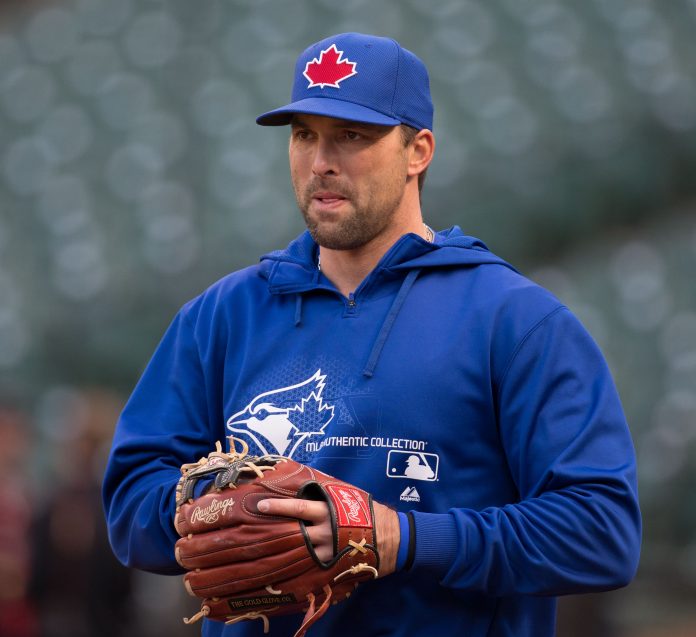
If you are a sports fan such as myself, you have probably seen on TV or online the love-in that is surrounding this year’s Toronto Blue Jays. The team recently ended its 22 year playoff drought by winning the American League East, and frankly I am getting sick of all the coverage. It doesn’t help that Rogers owns the Blue Jays and Sportsnet, the latter of which has devoted night and day coverage to the team. If you only watched their coverage, you would think they were the greatest team in the history of baseball.

The main source of my anger stems from the fact that this team is being labelled “Canada’s team.” They aren’t Canada’s team, they’re Toronto’s team. It is just that simple. No self-respecting person outside of Toronto should cheer for the Blue Jays. I highly doubt anyone from Toronto cheered on the Canucks made it to the Stanley Cup Final in 2011, so why should people out west support the Blue Jays? It just doesn’t make sense.

An even more egregious claim that I saw online from some people is that Blue Jays this year could be as big as team Canada winning olympic gold in 2010. Where do these people get off? Olympic gold in 2010 was a once in a lifetime event; the Blue Jays finally winning something is just like your underachieving kid finally getting a few good test results in a row.

That feeds into another equally annoying point about the Blue Jays. Supporting the Blue Jays also supports the belief that Toronto is the centre of the country. Every time a team from Toronto miraculously doesn’t suck, everyone from Canada is suppose to band together, hand in hand, and support their team. Now, I don’t claim to be a particular supporter of any baseball team, but if I had to choose one, I would much rather support the Seattle Mariners. Not only are they a three hour drive away, they’re not Toronto. And that’s probably the most important part.

The Toronto Blue Jays are not Canada’s team. They’re the city of Toronto’s team. If you bought some Blue Jays merchandise over the past couple of months, shame on you. Toronto is not the centre of the universe, and you are a part of this toxic attitude. I can’t imagine how much worse it will get if they make it to the World Series, or God forbid, win it. We may never hear the end of how great the Blue Jays are.

HUMOUR: Official party merchandise for this year’s federal election

0
Merchandise items as diverse as the half-truths each politician tells.

Inspired by massive sales of Bernie Sanders and Donald Trump memorabilia south of the border, Canadian politicians have climbed aboard the merchandise bandwagon and added a plethora of new items to their online stores. Support both the party of your choice and decadent capitalism by buying one of these hot new items.

Justin Trudeau wig: After learning from Portlandia that putting a bird on ugly things makes them look good, the Liberals followed suit with their Put a Wig on It campaign. By putting Justin Trudeau and his luscious flow in the spotlight, the Liberals have been able to mask their history of scandals and flip-flopping. For the low price of $29.99, you too can own a wig to hide your deep flaws and lack of experience! In support of the Liberals’ stance on marijuana, all wigs are made from Justin Trudeau’s personal hemp collection.

Price: $29.99 (Shipping will be delayed two weeks, as our machines are just not ready.)

Tom Mulcair beard: The bearded population has always been the core of the NDP voter base, and Tom Mulcair has gone out of his way to appeal to that segment of Canada. However, there are many people who have no concept of economics and would like to vote NDP, but unfortunately can’t grow a beard. Well, now on the NDP’s online store you can buy a Mulcair beard and look just like the leader of the federal opposition, and that creepy guy downtown who asks you for money to buy bellinis. This is the perfect gift for any wannabe communists, such as owners of a Che Guevara shirt, people who enjoy reggae, and your history prof.

Price: $19.99 (Sixty per cent off if you actually buy that guy downtown a bellini; he’s the NDP’s finance critic.)

Stephen Harper sweater vest: Because nothing says “strong and stable economy” like the inability to buy a full sweater. Marketed to campus conservatives who suffer from sleeve-ophobia, these vests were worn by big Steve himself while he was on a hectic campaign tour of Canada’s seniors’ residences. Made from real Canadian oil sands yarn — so absorbent, it can wipe away excess urine if you decide to piss in a client’s cup — these vests come with the Bill C-51 Inc. microphone and GPS, which always track your movements and what you say. When rolled up, this sweater also makes an excellent gag; perfect for climate scientists, or just anyone who looks at you funny.

Price: $900.00 (Though subject to change if the Canadian dollar continues to fall.)

Elizabeth May prescription glasses: Whether you’re protesting an oil pipeline or the lack of Vegan Double IPAs at your local gastropub, do it in style with these Elizabeth May prescription glasses! The Greens are currently less significant than that Alaskan goth doing slam poetry at a Chilliwack dive bar, so all proceeds will go to helping buy 30 seconds of airtime for Elizabeth May, which she will use to state her party’s policies. And then she’ll tap dance while playing the accordion and singing Timberlake’s “SexyBack,” because at this point that’s the only thing capable of bringing the Greens above five per cent of the national vote.

Price: $9.99 (Buy three, and we’ll throw in the Alaskan Goth poet’s new book, Aggressive Haiku.)

The election and Canadian sport

0
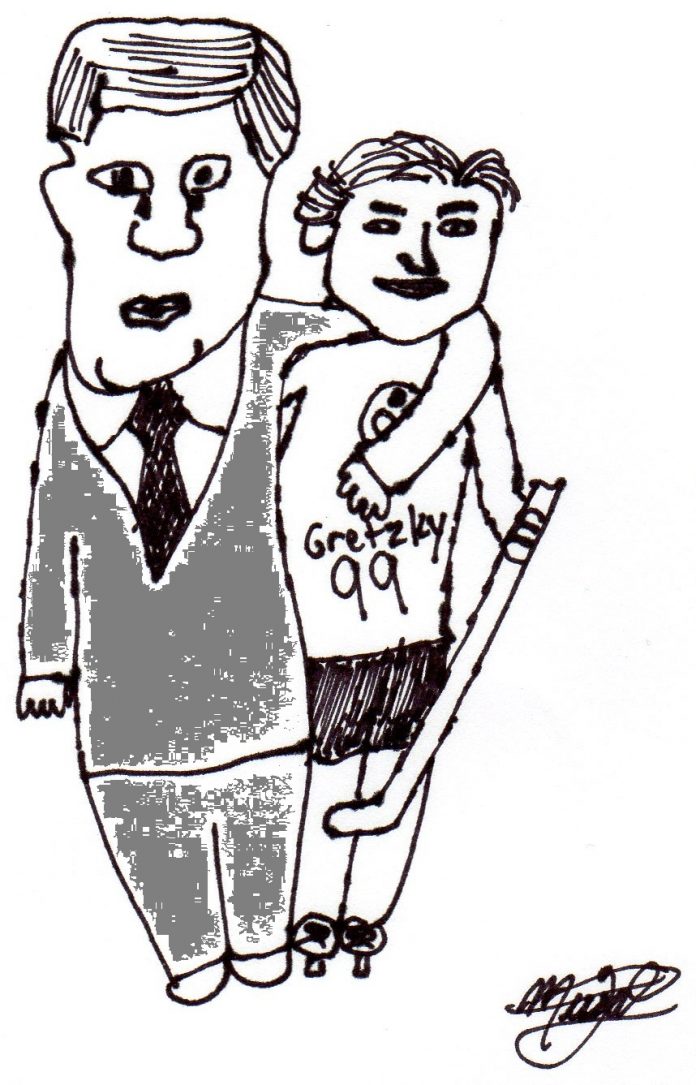
Wayne Gretsky has endorsed Stephen Harper in the federal election.

On Monday October 19, sports will take a back seat in Canada due to the federal election.  The election will still be the number-one news story, even if the Blue Jays get in the American League Championship Series.

This election has had next to no connection to sports. The only party that raised the issue of athletics funding is the NDP, who have pledged $28 million for Sport Canada to help poor and disadvantaged youth play sports. The one prominent athlete who offered their support to a party or candidate was Wayne Gretzky, who publicly endorsed Prime Minister Harper at an event in Toronto recently. Where are you, Steve Nash, Eugenie Bouchard, Milos Raonic, Hayley Wickenheiser, and Sidney Crosby? What would be the effect if Seattle Seahawk Luke Willson made a day trip to Vancouver to endorse a candidate?

Other countries have a huge connection between celebrity endorsements and the involvement of athletes in elections. In the United States, many famous athletes have served in elected office. The most famous athlete to enter the American political arena is the Terminator himself, Arnold Schwarzenegger.

The greatest athlete to ever enter the Oval Office, however, is undoubtedly President Gerald Ford. Ford had his number retired after a stellar career at the University of Michigan, where he started at center and middle linebacker as a key cog in the Wolverines’ 1932 and 1933 National Championship teams. 

One of the most famous international athletes to enter politics was the hero of the 1992 Cricket World Cup, Imran Khan. Khan is one of the most popular politicians in Pakistan and is head of a major political party. However, the Canadian track record does contain one truly remarkable story.

Normie Kwong was the first Chinese-Canadian to star in the CFL, playing for the Calgary Stampeders (1948–50) and Edmonton Eskimos (1951–1960). Star is an understatement, as Kwong was a true superstar. He won the Schenley Award for most outstanding Canadian in 1955 and 1956, and was named Canadian Athlete of the Year in ’55.

Kwong was also a three-time all-star and rushed for 9,022 yards and 93 touchdowns in his 13-year career. He is a member of the CFL Hall of Fame, Alberta Sports Hall of Fame, Canada’s Sports Hall of Fame and he received the Order of Canada in 1988. Kwong was also a part owner of the Calgary Flames in 1989 when they won the Stanley Cup.

As such he is one of only a handful of people to have their names engraved on both of Canada’s most venerated trophies. From 1988–91 Kwong also served as the General Manager of the Calgary Stampeders.

Politically, Kwong was appointed Lieutenant-Governor of Alberta in 2005 and served until 2010. He was the second Chinese Canadian to be a vice-regal and earned the title “The Honourable” for life.

So remember: Don’t forget to vote on October 19. Even if no athletes are running and only Gretzky endorsed a candidate, it still vitally important to our future as a country.

Federal election candidate profiles

0
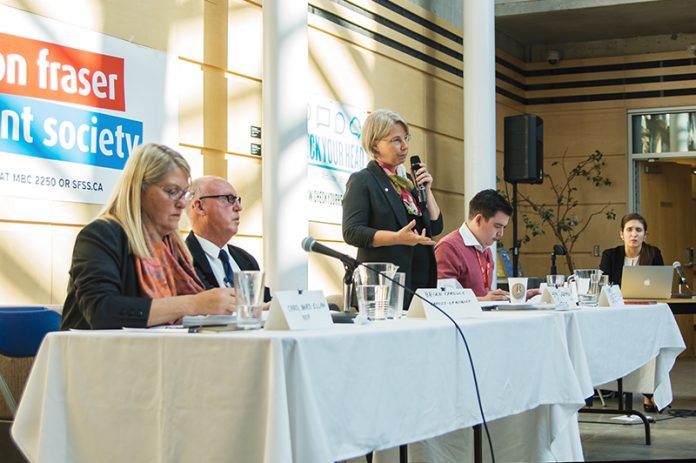
Burnaby North—Seymour candidates seen debating at SFU last week.

Canadians will elect their 2015 federal candidates on Monday, Oct. 19. Get acquainted with your candidates and inform your vote.

On-campus voting on election day will take place between 7:00 a.m. and 7:00 p.m. in SFU residence’s Shadbolt Building, room B1050. Make sure to bring identification with you, including something that qualifies as proof of address.

All candidates’ responses have been printed as received. Responses exceeding the given word count have been cut off at the mark, indicated by an ellipsis.

Questions:

  1. Why are you running?
  2. What are the the most important issues facing young people today?
  3. What will you do for SFU students?
  4. List 5 points in your platform in bullet points.

In alphabetical order.

Carol Baird Ellan, New Democratic Party

Web-Carol Baird Ellan

  1. During my 19 years as a Provincial Court Judge, I saw the gradual erosion of the quality of life of everyday people. Education, housing, child care, health care, transit, good jobs becoming less accessible and more expensive. When I left the bench I became deeply concerned about the direction that Canada was headed under Stephen Harper. I saw contempt for democracy, rights and freedoms, justice, the environment, science, the arts, immigrants and refugees. I couldn’t remain on the sidelines anymore. I chose to run for Tom Mulcair and the NDP because we will restore Canadian values and quality of life.
  1. The skyrocketing cost of education and housing. The accessibility of quality education and quality jobs. The debt burden and student loan interest rates. The cost of entry level housing, child care, and the availability of long term jobs with benefits and pensions. Just the accessibility of a decent life for our next generation – the first that will be worse off than their parents! I have 5 children aged 23 to 31, and they had way less chance of putting themselves through school, finding jobs, houses, child care, benefits, than we did when we started out. This is just plain wrong. 
  1. The NDP will provide funding for post-secondary education to make it more affordable, tackle students’ skyrocketing costs and unmanageable debt loads, lower interest rates and ATM fees, put funding into affordable housing and transit, and kick start the economy to create stable, good quality jobs. In partnership with small business, industry, NGOs and government, we will help 40,000 young Canadians get jobs, paid internships, coop placements, and infrastructure apprenticeship spaces. We will protect the safety of young workers and crack down on the use of unpaid internships. We will provide $15/day child care.

Platform Points:

  • Kick start the economy and create stable, full-time jobs
  • Create 1M daycare spaces at less than $15/day
  • Protect the environment, cut greenhouse gases and tackle climate change
  • Provide better health care,  retirement benefits and support for veterans
  • Grow better cities with stable funding for infrastructure and transit


Terry Beech, Liberal Party of Canada

WEB-Terry Beech

1) I want to live in a country where everyone is given the opportunity to succeed:

A country where new ideas and innovations not only are welcome, but are the engine of the new economy;

A country where environment protection is part and parcel of public policy;

A country that is inclusive, where citizens and their institutions are respected;

A country that we can be proud of once again on the international stage.

Canada needs all of its passion and talents. That is the Liberal principle. I have lived its legacy and I want others to live it as well.

2) Young Canadians want to live active, purposeful lives in a clean, open, and inclusive country. This means:

– Financial aid to access a good education,

– Meaningful and decently paid work at the beginning of their career

– Affordable housing especially for those who live in the Lower Mainland.

– The quality of the environment is high on young Canadians’ list of priorities, and they expect their government to formulate policies based on solid scientific information.

Last but not least, they want a reform of our outdated electoral system and make it easier for young people to vote.

3) I will make sure that SFU students take full advantage of the new Liberal financial assistance policies:

– Canada Student Grants of up to $ 3000 for full time students, and $ 1800 for part time students.

– A more flexible Student Loans system: graduates will not have to start repaying until they earn at least $ 25000 a year.

I will make sure that SFU students get their fair share of the new co-op placements created for students in science, technology, engineering, mathematics and business.

A Liberal government will re-invest in science, and fund scientific agencies adequately.

Platform Points

  • Policy decisions must be made using the best data available.
  • Environmental sustainability and economic prosperity are inextricable, not opposites
  • We must support innovation and clean technology industries
  • Education is the key to the elevation of all Canadians
  • Investing in affordable housing is crucial to help young Canadians

Mike Little, Conservative Party of Canada

This candidate did not submit responses by The Peak’s deadline.


Brent Jantzen, Communist Party of Canada

  1. I’m running in this election to voice the many problems common people in Canada face every day. Unfortunately, none of the three main leaders provide any real solutions to the multitude of problems in Canada. I believe a massive issue facing our youth today is student debt and un-employment after university. Since one of the largest universities in BC is in this riding, I plan to show students that our party is the only party talking about eliminating unemployment, tuition and student debt. We want to show the youth of today that a socialist alternative is possible.


  1. I believe that the most important issues facing young people in Canada today are debt, unemployment, and climate change. Our party proposes a strategy to help eliminate debt by raising the minimum wage and guaranteeing strong benefits. We will enact a plan to increase value-added jobs in the manufacturing and secondary industry, which will be greatly beneficial for youth, particularly those graduating from University. Our goal is to create good jobs until we reach a 0% unemployment rate. Additionally, we will be dedicated to phasing out the tar sands while working to create an environmentally sustainable Canada.   


  1. Our party has always maintained that we would be dedicated to work on student issues. As mentioned before, we are currently proposing to eliminate tuition and student debt. We want to create a system in which students do not have to fear unemployment upon graduation. We also want to stop the drive to ‘corporatize’ education, which will essentially protect freedom of speech on campuses. Furthermore, increased funding to universities would allow specialty classes, which have been previously cut, to re-open. Therefore, we intend on providing students with both an affordable and higher quality of education.


Platform Points:

  • Job Creation
  • Raising Wages
  • Expanding Social Services and Government Funding
  • Environmental Sustainability
  • Taxing the greedy and not the needy


Lynne Quarmby, Green Party of Canada

  1. I stepped up to run in this election because neither the Liberals nor the NDP and certainly not the Conservatives are proposing genuine and urgent action on climate change or social inequality – the intertwined and defining issues of our time. I am a research scientist, a Professor, a University administrator, and a climate justice activist. I understand that it is possible for us to transition to a post-carbon economy within twenty years and that there is no excuse for poverty in Canada.


  1. Young people today are faced with crushing debt, precarious employment and insecurity about how the consequences of climate change will affect their lives. I will tackle these issues with energy and compassion and my decisions will be based on the best evidence available.  Canada is a rich country and we must ensure that everyone has the opportunity to reach their full potential.  Burnaby North – Seymour deserves a Member of Parliament who will listen to and work for them.


  1. I will work toward abolishing tuition fees for students without adequate financial means, including removing the inadequate 2% annual cap on increased funding for post-secondary education for all First Nations students. I will work toward investing in the success of current students and give our graduates a hand-up by implementing a debt forgiveness program.  Our plan will eliminate any existing or future student federal debt above $10,000.  I will also work to create a national Community and Environment Service Corps, which will provide $1 billion/year to municipalities to hire Canadian youth to do work that needs to be done.

Platform Points:

  • Guaranteed Livable Income to ensure no Canadian lives in poverty;
  • National Housing Strategy based on Housing First principles;
  • Defend our coastal waters from risky pipelines and oil tankers;
  • Demonstrate climate leadership at the UN Climate Summit in Paris
  • Roll out a National Sustainable Jobs Plan


Brian Sproule, Marxist-Leninist Party of Canada

Web-Brian-Lisa Dimyadi

  1. The Marxist-Leninist Party of Canada is running 70 candidates across the country including 14 in BC to ensure that the missing voice, the independent voice of the working class is heard and to raise some concerns for discussion such as the marginalization of the vast majority of people. Citizens have no say in decision making except to vote in elections. We propose a new electoral process whereby the citizens would directly select the candidates rather than the parties. There would be no public funding of political parties. Elections Canada would be mandated to ensure a level playing field for every candidate.
  1. Conservative and Liberal governments have both pushed a neo-liberal, anti-social offensive in the interests of the rich. Youth face a bleak future of unemployment, impoverishment, environmental degradation. and the danger of war. We call on the youth to end their isolation, to get in involved in politics by voting to defeat the Conservatives and keeping the Liberals out of government,  to work for democratic renewal, a new pro-social direction for the economy,  humanizing the natural and social environment and creating  a society fit for humans where the rights of all are guaranteed.
  1. In 1968 SFU students occupied the administration building to protest the refusal of the university to accept transfer credits from the colleges. Students must seize their future in their own hands by consciously organizing to put an end to tuition fees, for adequate housing and transportation, interest free loans and a say in decision making and  course content. Students must demand that universities and colleges be fully publicly funded and corporate control ended.

Platform Points:

  • Renewal of the political process. No election without selection!
  • A new direction for the economy with environmental safeguards.
  • Stop paying the rich! Increase investments in social programs!
  • An anti-war government and respect for national sovereignty.
  • New nation to nation relations with indigenous peoples


Chris Tylor, Libertarian Party of Canada

  1. I am trying to help the Libertarian Party grow and be more successful. In just one year we have a new leader, a new executive board, an all-new public image and social media presence, new branding, and we’ve tripled the number of candidates we’re fielding since the last election. We hope to have a full-slate in four more years. We want to remind people there is a party more business-friendly and fiscally-responsible than the Conservatives, while more progressive and liberal on personal freedoms and individual rights than the Liberals and NDP, namely the Libertarians. Many of us watched Ron Paul [. . .]
  1. In Metro Vancouver, we face an out-of-control housing bubble that has sent a generation that grew up in single-family homes with decent yards into being forced to live in expensive shoe-boxes in the sky or live in half-a-house with some other family renting the upstairs or downstairs and think of that as normal. Affordability is the number one issue with people starting off their careers. We are not ‘lucky’ like the Baby Boomers and able to buy giant houses on three-years’ salary. Things can kind of suck for most people—I know!
  1. I promise I will never vote for an increase in your taxes or a reduction in your freedom. Never. I will aid all constituents in their dealings with the federal government, whether Immigration, Citizenship, Revenue Canada, or the Firearms Program. If me and 169 fellow Libertarians are elected, we will eliminate the GST (5% down to 0%) and nearly double the basic income tax credit for students from $11,500 to $21,300 leading to a modest but noticeable increase in your income. And more to come later.

Platform Points:

  • Flat tax of 15% (first $21,300 exemption for students)
  • End the war on drugs, end all Prohibition (the Portugal model)
  • Pro-Immigrants: increase the number of visas issued, cut red-tape
  • End all our wars, bring troops home & Arctic sovereignty
  • Allow polluters to be brought to court for causing property damage

University revokes Union’s health benefits amidst ongoing dispute

0
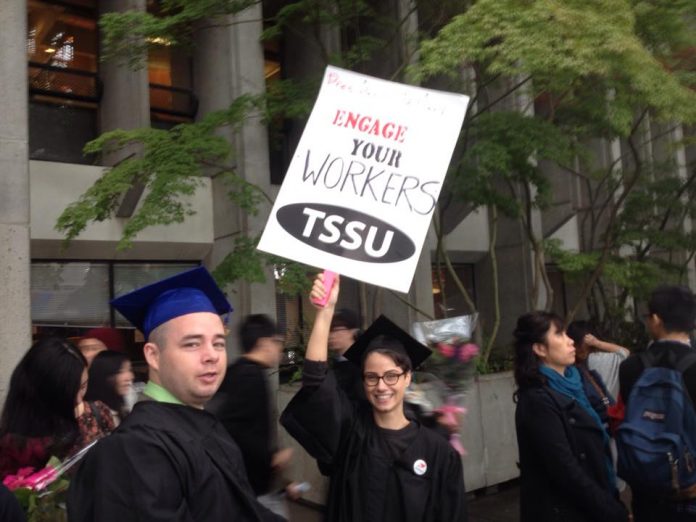
"Our members want to be in the classrooms teaching and getting back to the normal process as soon as possible."

SFU administration has decided to revoke the MSP (Medical Services Plan), dental, and extended health benefits of all Teaching Support Staff Union (TSSU) members effective on October 31.

This is in response to the ongoing deadlock over both parties accepting a form of binding arbitration called Final Offer Selection (FOS).

Said TSSU Chair Derek Sahota, “People were upset given that they’re still willing to basically do 99 per cent of their job [. . .] that the administration would revoke what are really critical benefits for people.” He continued to say that while graduate students may be eligible for an MSP exemption, international students, families, and sessional instructors may be impacted.

While the administration gave the TSSU the ability to assume the costs of providing these services to members, Sahota noted that the cost would be “more than the annual budget of the TSSU.”

Kurt Heinrich, director of SFU’s University Communications, told The Peak that this decision was made because “the University has decided that it can no longer refrain from pressuring the Union with the legitimate tools that are available to all employers during labour disputes.” He cited students grades being withheld and the “challenges” faced by SFU staff supporting students through the ongoing strike.

Heinrich went on to note that, “In such labour disputes, unions typically pay for their members’ benefits from their strike fund. Ultimately, the decision on how and if TSSU member benefits are paid now rests with the TSSU.”

Another issue of contention between the two parties is that of binding arbitration, which could be acheived through the FOS process proposed by mediator Vince Ready.

The process requires that, after 21 days of unsuccessful negotiation, both parties must submit proposals for a new Collective Agreement, after which the mediator would determine which proposals should be integrated into the final Collective Agreement.

While the TSSU hopes to proceed with FOS process, they disagree with multiple amendments SFU has made to the FOS proposal, including one which would allow either party to refer Ready’s FOS decision to the Public Sector Employers’ Council (PSEC), who would then have the authority to void the award if they wish.

The TSSU raised the concern that, in their view, “PSEC is not an independent third party. They are a body that is deeply involved with SFU administration.”

Heinrich responded to this concern: “[The] requirement to conclude an agreement within the PSEC mandate applies to every public sector union in BC.”

Another concern is that the university would like the FOS process to be one where the mediator would have to decide the award on an “all or nothing” basis, rather than by looking at each proposal on its own.

The TSSU plans to continue their job action, including marking for education, and to take additional actions in coming weeks.

Said Sahota, “Our members want to be in the classroom teaching and getting back to the normal process as soon possible, and we’re ready to bargain whenever the employer is ready.”

Who really leads in a minority government?

0
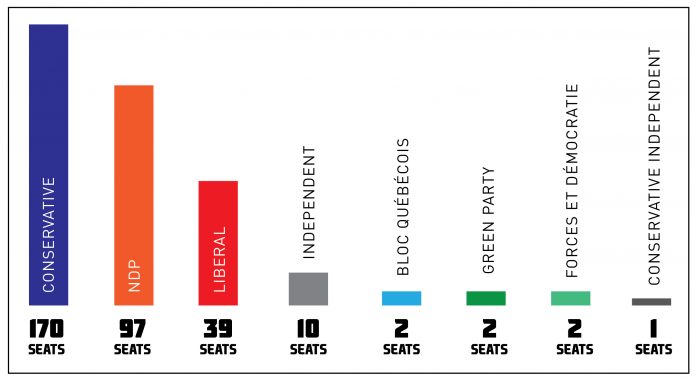
Currently, the Conservatives have a majority government with 170 seats.

SFU’s Centre for Dialogue and The Vancouver Sun co-hosted a panel to delve into what it is, exactly, that minority governments do in Canada.

The event, titled “It’s a Minority! Who Gets to Govern?” was held at Harbour Centre on Oct. 7. Prominent speakers discussed the issue of what will happen if the upcoming election results in a minority government.

Geoff Plant, a partner in a Vancouver law firm, acted as mediator between three panelists: Andrew Heard, a professor in political science at Simon Fraser University; Barbara Messamore, an associate professor in history at the University of the Fraser Valley; and Herman Bakvis, a professor at the School for Public Administration at the University of Victoria.

Plant opened the discussion by asking SFU’s Heard to speak on what a minority government is. Heard began by describing how most voters don’t quite understand how parliament works: “The idea that the largest party has won the election and therefore has a right to rule, is one that I think has been quite widely accepted by those who [study] the issues, but this is a misrepresentation.”

Heard continued, “We don’t elect a Prime Minister. We don’t even elect governments. We elect members of parliament. [. . .] And it’s those people — those 338 who go to Ottawa, it’s on their shoulders to decide who will govern.”

The rules that determine which party gets to govern are not exactly clear, and Heard explained that the issue is often solved by convention.

Said Heard, “It is often suggested that the blanket rule is the leader of the largest party has the right to form the government. This has the benefit of simplicity and the benefit of past practice.”

After Heard spoke, Messamore explained a bit about the history of minority governments in Canada. “We’ve had a number of federal minority governments in our history,” she remarked. “In fact, we had a long run [of minority governments] in 1958 between the Conservative party and the Liberal party.”

Messamore went on to cite an example of when the party that had the most votes didn’t form government. In 1925, the Liberals, under incumbent PM Mackenzie King, took second place (99 seats) to the Conservatives (116 seats), while other parties took 30 seats in a 245 seat House of Commons. Said Messamore, “Most assumed the Conservatives would form a government, but King was supported and successfully carried on governing.”

Plant then invited Bakvis to take the floor. Said Bakvis, “First, in the Canadian context, there is a lack of settled constitutional doctrine on minority government formation. There appears to be a competition between different conventions, norms, and practices.

“Second, public opinion plays a role in the behavior of political parties and decisions made by the governor general.” His remarks made clear that while a minority government is a likely result of the upcoming election, how it unfolds is a question that remains up in the air.

Why I will never be a card-carrier

0

When I returned home for a couple weeks at the end of summer, I distinctly remember a conversation my parents and I shared over the dinner table. We mulled over our lives, cracked sarcastic jokes at each other’s expense, and it was incredibly pleasant until my mother exclaimed, “I think the craziest thing Adam will do in his life is become a card-carrier!”

A ‘card-carrier’ is a slang term used for someone who has paid to be an official member of a political party; figuratively, they ‘carry a card’ emblazoned with their party loyalties.

I have a few card-carrying friends who proudly assert that they can now influence ground-level policy making, influence amendments to the party’s constitution, and feel heightened pride and purpose in taking action through their strong beliefs.

Sounds fun. But that dinner conversation left me with furrowed eyebrows and this weird little lip-sneer thing I do when I’m confused and upset. Why would an official party affiliation be the craziest thing I do?

I think it’s because politics is still very much a taboo in my parents’ household; the two rarely discuss political matters with each other, let alone their kid. Nevertheless, the discussion spurred on a thought process. Would I ever pay for the benefits of an ‘enhanced democracy?’ My thoughts lingered before I firmly concluded that I would not.

Soon after graduating high school I became a robust NDP supporter. My bedroom desk is embellished with orange. Socialist blogs unabashedly hoard my ‘frequently viewed sites’ list. And yes, I promptly voted ‘orange’ in the advance election on campus last week.

Needless to say, I’m not quiet about who I support. So, why wouldn’t I wave my wallet and pledge my allegiance to the beard?

Put simply, I will not risk segregating myself in a cage of ideological obligations and bloated party rhetoric. While my beliefs align most with the NDP, there are a definite number of orange views I simply don’t share.

To emphasize, I found myself drawn to, no — enthralled by Elizabeth May’s performance during the MacLean’s National Leaders debate. The issues she discussed, the quick, knowledgeable retorts she established with concrete facts, her overall genuine presence behind her podium; she killed it while leaving Harper to flail in his defensive bullshit, and Trudeau to speak in ambiguities on how he could feel Canada in his bones or something.

There have been numerous instances like this where I’ve felt as though I’ve abandoned my firm party allegiance, which has led me to question whether my allegiance is actually all that firm. Honestly, I’m a pretty emotional guy; the kind who is very cognizant of what he finds important. I envisioned myself as an active card-carrier, and while I know that one doesn’t have to agree with every party stance they belong to, I would have felt significant personal guilt in realizing I agreed with May for much of the debate.

Sure, Adam, you just haven’t made up your mind, you’re wishy-washy, you’re a political push-over! Well, I’d actually define myself as a strong NDP supporter, but not to the point that I risk becoming ignorant and unrealistic. The irony is that party devotion propels politics. Though if I marry myself to a single party, identify solely with that party, and argue to the ends of the earth its stances, I fear I might end up doing what many party advocates do: lie to themselves and spew bloated, useless crap all over the public sphere.

I don’t want to feel obligated to defend and argue all of one party’s positions because I’ve paid to theoretically be pitted against all the other parties. I don’t want to risk brainwashing myself into thinking that an orange label means I inherently believe everything that spills out of Mulcair’s mouth. This leads to all the petty unconscientious arguments, pandering, and thoughtless generalized rubbish you often see in the media and everywhere else.

Yes, I explicitly lean left, but I will never establish exactly where I lean even if all my beliefs do align with the NDP. Let’s be real, you never know which parties will impact you.

Your guide to The Peak‘s Election Issue

0

Are you brimming with political passion? Certain that Stephen Harper will turn this country into a dictatorship? Worried that Justin Trudeau’s good looks won’t translate into political ability? Uneasy about Thomas Mulcair’s unkempt beard and general mysteriousness? Worried about Elizabeth May’s naive environmentalism and low chances of winning? Boy, do we have an issue for you.

Check out the stories below for The Peak‘s unique take on this week’s federal election.

Candidate profiles for Burnaby North—Seymour by Melissa Roach and Jamal Dumas

Seven reasons to vote out Stephen Harper by Miranda Macfarlane

Who really leads in a minority government? by Anthony Bianco

“Not-a-Party” election party celebrates nonpartisan politics by Kevin Rey

Experts look at culture of fear in Canadian politics by Nathan Ross

Releasing the death-grip on our Canadian voice by Tamara Connor

Why I will never actively devote myself to one political party by Adam Van der Zwan

Does Elizabeth May know her shit? by Tessa Perkins and Tamara Connor

Blazing away our economic woes by Jessica Whitesel

The pros of mixed-member propositional representation by Carmen Ang

Confessions of an uninformed voter by Zainah Merani

Why we shouldn’t depend on the polls by Tim Mottishaw

The election and Canadian sport by Jason Romisher

Official party merchandise for this year’s federal election by Bartosz Wysocki

Who you should vote for (based on your opinions about hair) by Jessica Whitesel

Laugh Track: Dan Code from Shit Harper Did by Jacey Gibb