Home Blog Page 968

HUMOUR: Fall semester icebreaker a resounding success for SFU’s Introvert Club

0
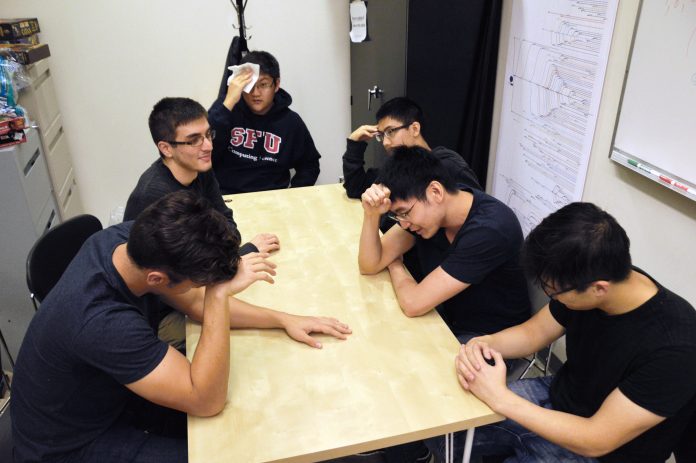
The SFU Introvert Club's first icebreaker was... awkward.

Last week SFU’s Introvert Club held their inaugural meeting of the semester, marking the largest ever gathering of people who didn’t want to be around other people in the history of the university.

“I’ve always wanted to be socially antisocial around people who are as antisocial as me,” said club member Ann Siety. “I can finally get people to ignore me as I ignore them. I feel like I have finally found my people!”

Between 20 and 25 students were in attendance at the icebreaker, with several prospective members also participating from afar. In planning the event, the Introvert Club had booked a meeting room with  plenty of large open windows so that members who desire more personal space could view the event through binoculars.

The icebreaker itself had the usual promises of free food and an exciting round of human bingo, except there were modifications to these icebreaker mainstays: the food came in to-go bags for each attendee, and participants were allowed to think of fictional characters to complete their human bingo.

Attendees then participated in a 4×100 relay, where individuals had to run while keeping their eyes focused downward on the ground; coughing loudly was also the chosen form of communication for the baton passing sequences. When asked what they thought of the relay’s design, many participants at first tried to avoid speaking to us entirely, but eventually offered up praise for the post-modern alterations.

“Looking at other people that I am interacting with is a big no-no,” reported one student, who managed to go a whole interview without giving her name or revealing any personal information about herself. “Talking to other people in general is also completely unacceptable, so I feel extremely grateful that the club executives have factored in my kind of needs for these activities.”

Club president Cerissely Shy on why she decided to form this club: “I saw a real need that wasn’t being addressed on campus. Shy people were studying by themselves or eating by themselves when they could be awkwardly studying/eating together in silence.

“This club will rectify this tragedy and bring together people who don’t want to be brought together. Our motto is: We are alone, together!”

When asked if she’d made any prospective new friendships, Shy admitted that she purposely avoided asking for anyone’s names so she could avoid the dreaded friendly-acquaintance small talk that comes with running into people on campus.

The next SFU Introvert Club meeting has unfortunately been cancelled due to crippling anxiety of its president, but members are being encouraged to participate remotely by constructing blanket forts in their own home and hiding away for the rest of the semester.

HUMOUR: SFU student hospitalized after offering seat to non-senior citizen on transit

1
The interpretive dance major is currently in stable condition recovering from his injuries.

For the average SFU student, transiting is a reality that comes with living the glorious university lifestyle. Like an excessively high-priced textbook for a garbage elective, so too is public transit a necessary evil most must endure. While taking the bus or SkyTrain can mirror the atmosphere of an unsupervised asylum mixed with a McDonald’s PlayPlace, it is still commonly regarded as a rather safe means of passage — or so it used to be.

Last Thursday morning, an SFU student was rushed to the hospital with life-threatening injuries after an altercation on a transit vehicle.

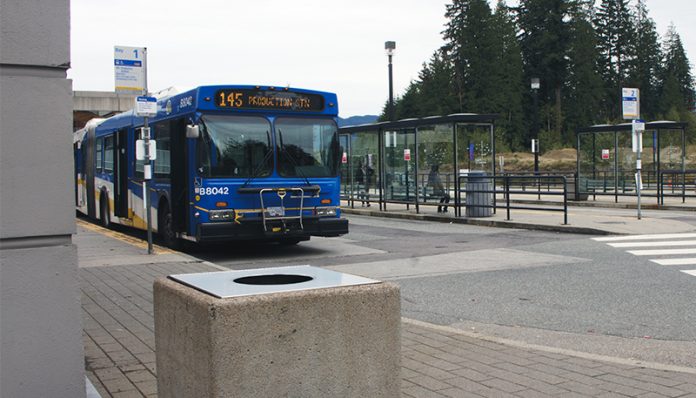
At approximately 9 a.m., police arrived on scene at the Production Way–University SkyTrain station to tend to the male SFU student who was viciously assaulted. Paramedics arrived shortly after to take the victim to hospital. When officers questioned passengers on what transpired, they were told that the student was accosted by a middle-aged woman after he offered her his seat.

“It was hilarious. Well, not really. . . but still,” cited one SFU student, who observed the whole catastrophe. “He offered his seat to some lady and she freaked the fuck out. She thought he was making a crack about her age or something and got offended. Next thing I know he’s getting curb stomped, Ryan Gosling-style.”

The interpretive dance major is currently in stable condition recovering from his injuries. The student has declined interviews at this time. However, The Peak spoke with the victim’s mother for comment.

“I’m never letting him go on transit again. I told my husband this would happen. Our transit system is overrun by psychopaths, degenerates, and women who needlessly feel self-conscious about their age. This isn’t the last you’ve heard of me or Mothers Against Unsafe Transit. It’s happening. Just you wait.”

Within a couple hours of the attack, local police issued a statement on the incident and shocked the public with a surprising bit of news.

“The suspect is known to police. Law enforcement is currently taking steps to make sure an event such as this never happens again. Until we have apprehended the suspect, we advise that all students think twice about offering their seats to someone who may need it until a time when we can deem it safe.”

Police then issued a description of the suspect for the general public. She is described as an older woman in her mid-40s with past-her-prime features. She is dressed in clothes that are two sizes too small and not at all appropriate for her age group. Suspect is also described as wearing heavy makeup applied with the tactful swagger of a three-year-old toddler.

Anyone with information is asked to contact the authorities immediately. If approached on transit, students are advised to compliment the woman on her appearance profusely and stay seated until law enforcement officials have arrived.

Why we shouldn’t depend on the polls

0
Photo courtesy of Polls (Flickr)

Ah, election season. For us political junkies, it’s the true season to be jolly. We listen to pundits, we start bad-mouthing, we see political ads taking up valuable flier space in our mailbox, and most importantly, we keep up with the polls.

Polls, while they have a place in politics, do diddly (yes, that’s the official term) when it comes to Canadian election outcomes. Polling has long been a form of gauging how a party, leader, or topic is trending among Canadians. ‘What do you think about. . . ?’ becomes the call of the political wild. Yet, not since 1984 has a poll in Canada meant more than diddly.

In countries like the U.S., which has a similar first-past-the-post (FPTP) system and only two parties, polls let these parties follow public opinion as a campaign proceeds. In places like Germany, where they have a system of proportional representation and a multi-party system, polls let parties do what they can to win over the most votes possible, and possibly change or adapt policies to work with coalitions in order to win governance.

Here in Canada, we do both. Because, well, it’s Canada. In our multi-party FPTP system, the ‘popular vote’ does not often match who rules and by how much.

As I write this, the current polls show that the Conservatives and the Liberals are tied with 31 per cent in the polls, while the NDP has 27 per cent. Pretty even, all things considered right? Well, not really. This would equate to 127 seats for the Conservatives, 110 for the Libs, and 99 for the NDP. What the fudge, right? The seats awarded are not nearly as even as the polling numbers would reveal. Wait, it gets better.

Polls are alright for observing an overall nation with a wide attitude.

My favourite election (I’m a poli-nerd) is the one from 1993, where the NDP received seven per cent of the popular vote yet attained nine seats, and the old Progressive Conservatives gained 16 per cent of the vote yet with only two seats. That election, by the way, was the start of the five-party system that exists today.

With our current set-up, there is no way that polls will tell us anything about the upcoming election, other than 60 per cent of the voting population at best will be pissed off with the outcome of an election — leaving aside the fact that a minority of the population has elected the ruling party since 1984, when Mulroney won with a majority of votes and seats. That turned out well, hey? ‘Yay’ for NAFTA and GST.

To all who vote in Canada, polls are alright for observing an overall nation with a wide attitude. They help us see that we might think the same way as people in other parts of the country, they let campaign managers track how a new tactic is responding, if we had a proportional representation system they would show us our potential government.

However, we do not, and therefore polling means diddly in the actual election.

There are lies, damn lies, and polls. All they do in Canadian elections is confuse the undecided into thinking that they are voting for something they really aren’t.

On the road again with SFU men’s hockey

0
SFU had a total of 38 penalty minutes on the night.

Through the weekend of October 3, the SFU men’s hockey team went on the road to play against two well-established NCAA Division I hockey programs from Providence College and Northeastern University. While the score lines were not flattering, the team gained valuable experience against some tough competition.

“It’s competitive and fast,” head coach Mark Coletta told The Peak. “Going up against six or seven drafted [NHL] players is a lot different than what we’re used to, so it was an experience.”

Their first game was against the Providence College Friars, the defending NCAA national champions. Despite being the underdogs in the playoff, the Friars ended up winning it all, eliminating eventual second overall pick Jack Eichel in the process. They also featured a number of players drafted by NHL teams, including Mark Jankowski, who selected in the first round by the Calgary Flames in 2012.

SFU got off to a great start when forward Mak Barden scored an early powerplay goal to put the team up 1–0. However, Jankowski scored to tie it all up,w and the Friars didn’t look back from there. They scored eight straight more to take the game to 9–1. Despite the score, Jordan Liem had a fantastic game, making a number of great saves against a talented opposition.

The next day the team played the Northeastern University Huskies. While not the reigning champs, the team featured six NHL draftees, including Adam Gaudette, a fifth round draft choice of the Canucks. Unfortunately SFU couldn’t get the opening goal in this game, as Anaheim Ducks prospect Kevin Roy scored to make it 1–0. Northeastern ended up scoring five straight, only to be interrupted by Mak Barden to make it 5–1. Forward Stephen Ryan made it 8–2 late in the game, but the Huskies added two quick ones to make the final score 10–2.

While the score lines were not flattering, coach Mark Coletta was looking at the process more than the end result.

“[I looked] at mostly our compete level,” said Coletta. “We’re at a different level than these NCAA division I programs, and they play a different style. They play a more in-your-face, pressing system with a lot of quick transition, especially between the defence and the forwards. So hopefully we can take some of these things and use them this upcoming season.

“It’s a great experience,” added Coletta, discussing the trip as a whole. “The facilities and prestige of the programs are something else. It’s all first class — it’s like a mini NHL.”

BC Place needs to figure out its roof

0
The renovation of BC Place cost an estimated $514 million.

It’s a sunny Saturday afternoon, not a chance of rain. A great day to watch some football — some Canadian football, I should note. What a great day, sitting in the sun, in one of the few summer-ish days left. Maybe pop open a cold bottle of Coke or knock back some overpriced domestic beer. What a day.

But wait, I’m watching the BC Lions at BC Place. Despite boasting on its website that BC Place has “a spectacular, one-of-a-kind retractable roof — the largest in the world,” on this bright, sunny Saturday the roof was, for some reason, closed.

The other things were still there — a cold pop, a pretty decent game of football — but one of the very reasons I looked forward to the game was for seeing it in the sun. Instead I sat inside for three hours on one of the last days of semi-summer.

It ain’t the first time I had to watch a game indoors at BC Place for no real reason. Back in the day, when the Heritage Classic came to town — a supposedly outdoor game — despite great weather outside, the roof was closed.

What’s the point of having “a spectacular, one-of-a-kind retractable roof” if you’re never going to retract it?

Down in Seattle, at Safeco Field, home of the Mariners, they’ve got an awesome system for baseball games, where if it starts to rain, their retractable roof can quickly cover the stadium. Why can’t BC Place do that? I don’t know if Safeco is “one of a kind” like BC Place, but that certainly is “spectacular.”

Apparently, the decision to close the roof comes 90 minutes before the game, so I guess it means it has little or nothing to do with the weather. But why close it? Part of the fun of any sporting event — aside from hockey — is to take in the fresh air.

Now, apparently the Lions want it closed for the competitive advantage, I suppose to keep the amplified noise trapped in. I’m not going to be delusional and say that the Lions can get anywhere near the atmosphere of the Seahawks, but come on, Centurylink Field can manage just fine without a closed roof. The Lions have also had trouble drawing fans in all year, so I’m not sure how much of a competitive advantage there could be with a very meagre crowd there making little noise.

Oh well. I suppose it’s just another reason I’d rather watch the Seahawks.

SFU loses 6–4 to UBC in pre-season scrimmage

0
The fifth inning was the Clan's downfall.

On Sunday October 4, a great fall day, the SFU softball team played host to the UBC softball team. It was a great chance to see the team in action before their GNAC season starts next February. The final score was 6–4 for the Thunderbirds, thanks in part to a great fifth inning.

“Well, it’s fall for us, and for us these are scrimmages,” said SFU head coach Mike Renney. “So we play open substitutions and stuff like that. So it’s a chance for us to get our freshman in the games. Our freshman kind of got their feet wet, and it’s good chance to play some ball in great fall weather.”

UBC got off to a quick 1–0 lead in the first, after the SFU shortstop committed an error. SFU was able to get back into a 2–1 lead in the bottom of the first, tying it with a sacrifåice fly ball and taking the lead off an error from the second basemen.

The game was looking good for SFU until the fifth inning. UBC exploded for four runs, with the rally starting off with a successful bunt. In the sixth, UBC was able to add one more run after a double sent the runner from third home.

In the bottom of the seventh, SFU made things interesting. They were able to get runners on the corners with no outs, and the runner from third was able to slide home after a single. SFU added another run, but it was too little left too late.

The game was just a scrimmage, but these games are used to determine what needs to be improved for the upcoming season. “If anything, we look for things to identify that we have to invest in in the offseason,” said Renney after the game. “For us, we’re not looking to see what we did right, we’re looking to see what we aren’t doing right. We then build upon those things, make our list, and tackle them when we head indoors.”

Renney elaborated on what the team needed to improve on heading into the season. “We’re pretty much where we expected to be this time of year. One of the things we need to get more of is experience for our freshman. So they got that today, and we continue to invest with them.

“We got a solid defensive lineup, some good pitching depth and certainly some offensive potential but they all have to be clicking on all cylinders. If we can get B+ and A games from each of those categories, we’ll be fine.”

Women’s volleyball sweeps Western Oregon

0
Middle blocker Madison Power led the team in kills with 14.

The SFU Women’s Volleyball team extended their winning streak to two games Thursday night, and put themselves over .500 with a win against the ninth-placed Western Oregon Wolves in their first game home after a four-game road trip.

“We did a good job of weathering the ups and downs,” said head coach Gina Schmidt. “Western Oregon made us earn all of our points.”

Clan setter Danielle Curtis opened the game’s scoring, giving SFU the head start. For much of the first set, SFU had the momentum on their side, with a six point lead at various occasions and one four point streak, before closing the set 25–20.

However, the second set was a much closer affair. For the first time in the game, the Wolves took the lead, and though the Clan at various points built up a sizable lead, the Wolves just kept coming back.

“I thought we could have cleaned up a few things offensively, there was a couple of times they strung a few points in our rotation, where we gave up some easy points on unforced errors,” explained Schmidt.

For a moment, the Wolves looked ready to take the second set, leading the Clan 23–20 and only two points away from splitting the series. A series of bad serves and errors in their own end, including surrendering the final point on an unforced error, gave the Clan the second set at a score of 26–24 — a commanding two-set lead.

The third set was the first in which SFU surrendered the first point. Unfortunately for the Wolves, and fortunately for the 105 Clan fans in attendance, they were plagued by the same problems — namely, a tendency to over-serve the ball and inaccuraty in their attack attempts.

The Clan then promptly took advantage to sweep the Wolves, claiming the final set with a score of 25–17.

It was a game where it seemed SFU might very well lose control, but every time the Wolves started gaining ground, the Clan were able to answer right back.

“We focus on one play at a time, the next pass, the next set, so I think that’s where you can’t get ahead of yourself,” said Schmidt.

Redshirt sophomore middle blocker Madison Power led the team in kills with 14, while the defensive effort was split amongst the team with libero Alison McKay, Jessica Young, and Curtis combining for a total of 48 digs.

Seven core reasons to vote out Harper

0
Please, please vote out Stephen Harper.

October 19 is Canada’s upcoming federal election. If you are a Canadian citizen, I implore you to make sure you have registered to vote by October 13. Regardless of whether or not you feel adequately informed on the situation, the results of this election will affect you, so please don’t be apathetic.

Information on all the parties’ platforms is available online — there are a myriad of sources available on almost any issue. It doesn’t take much time out of your day to check out some things you consider important and figure out which party best represents your beliefs.

While I won’t endorse any particular faction, I do discourage you from voting for our current Prime Minister and party: Stephen Harper and the Conservatives. Here is a compilation of reasons why I hold the opinion that it is for the greater benefit of our country to vote Harper out:

1. The Harper government has pandered to large corporations since its election. Currently, Canada has the second lowest corporate tax rate in the G7 (compared with combined rates). This kind of business-brownnosing enables a disproportion of wealth among economic classes.

2. Though Harper purports that Canada is an economic leader, he continuously cut funding for impoverished nations since his election. Foreign aid spending is now near the lowest it has ever been.

3. The New Canadian Citizenship Law in Bill C-24 changes the nature of citizenship, splitting us into first-class and second-class citizens. Essentially, anyone with an additional citizenship or the potential for one is considered a second-class Canadian. Second-class Canadians can have their citizenship revoked under certain circumstances. This impacts immigrants, people born of immigrants, Canadian-born people marrying immigrants, even people who may be completely unaware of their alternative potential citizenships.

4. Harper withdrew Canada from the Kyoto Protocol in 2012, effectively vacating Canada’s2005 promise to cut down on emissions. Since then, Canada has cut down about a quarter of the amount it had previously promised to have achieved by 2020.

5. The Trans-Pacific Partnership is a trade agreement between 12 nations whose contents have mostly been established behind closed doors. Mega media corporation lobbyists have been participants in these discussions. From what has been released of the agreement, we know that Canadian copyright laws will be expanded significantly, service providers will be able to collect users’ information without proper privacy safeguards, conglomerates will gain more power to censor content they deem unfavourable, and companies will gain the right to sue countries whose laws infringe on their expected profits.

6. Bill C-51 grants greater power to the Canadian Security Intelligence Service (Canada’s version of the NSA). Under this bill, the spy agency no longer requires a warrant unless breaching the law or Canadian charter when acting to reduce ‘threats’ to national security.

7. During the Conservative administration federal scientists were forbidden from talking with the media without going through bureaucratic loopholes. This includes Natural Resource Canada scientists having to seek permission from the Natural Resource Minister’s communications director. The media and many federal scientists find the rules frustrating, as they stifle the ability of the Canadian public to know what our scientists are doing.

These are only a few prominent reasons out of a vast archive. If any of these aforementioned issues sound questionable to you, I urge you to seek further information. Check out who the candidates are in your riding and see what they’re like. Come election day, please vote!

Experts look at culture of fear in Canadian politics

0
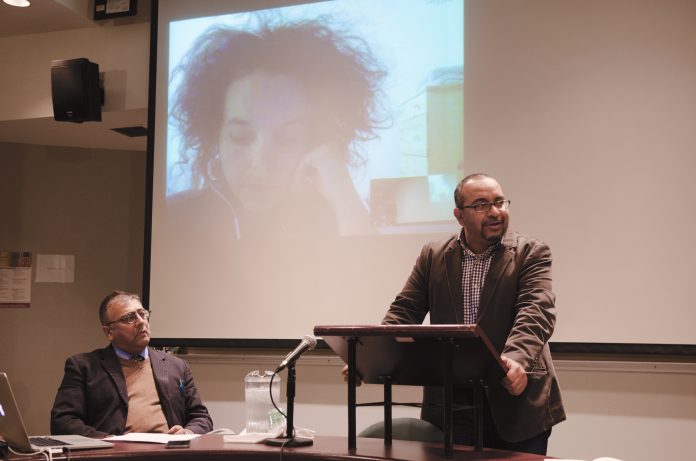
Left to right: Samir Gandesha, Fiona Jeffries (via Skype), Adel Iskander

“Yes in Canada.” That was one of the stronger statements expressed by the panelists at the SFU event, The Canadian Election and the Politics of Fear.

The event, which was put on by the Institute for the Humanities on Oct. 6, took place at SFU’s Harbour Centre campus.

The sentiment of “Yes in Canada” explores that the uglier side of fear has resulted in the federal election revolving around issues like the niqab ban, the Anti-Terrorism Act (formerly Bill C-51), and the Barbaric Cultural Practices Act has firmly taken hold here at home. The statement was meant to drive home the fact we do in fact deal with these sorts of issues in Canada.

These acts passed by the current Conservative government are part of what prompted an SFU program aimed towards election issues.

Samir Gandesha is the director of the Institute for the Humanities, and was one of the panelists speaking. He said that one of the reasons the talk was taking place was the misdirection via fear that has taken place over the course of the election.

“Those kinds of things can then be a rich and fertile hunting ground for fear,” explained Gandesha. “[These kinds of figures] can transform those anxieties that you have, which are amorphous, they’re vague, they don’t really come from anywhere in particular, and really target them onto a particular group of people that becomes a form of fear.

“And then one can mobilize against that, and it becomes quite powerful politically.”

The panel itself ranged from a variety of topics. SFU Professor of Communications Fiona Jeffries — who was participating via Skype — and SFU Assistant Professor of Communications Adel Iskandar were the other two panelists.

They kept their discussions centered around what was happening here in Canada, while Gandesha explained the social psychological standpoint, and focused on similar issues that have taken place in history

Gandesha and the other panelists painted a great picture of the fears and anxieties of some Canadians — which, for some, are currently manifesting themselves as Islamophobia — and tried to point out that what voters should focus on is what the Conservative government has done since 2006.

“The main message is [that] the niqab issue is a complete distraction,” said Gandesha. “People need to focus on the misgovernment that we’ve experienced over the last nine years of Harper in power; corruption scandal upon corruption scandal, economic mismanagement, a subversion of the democratic process through bills like the Fair Elections Act, Bill C-51.”

He continued, “People really need to really focus on the key issues, and not be distracted and not demonize people.”