SFU celebrated its 50th birthday with speeches, live music, and fireworks.
Created by Paige Smith & Eric Smith

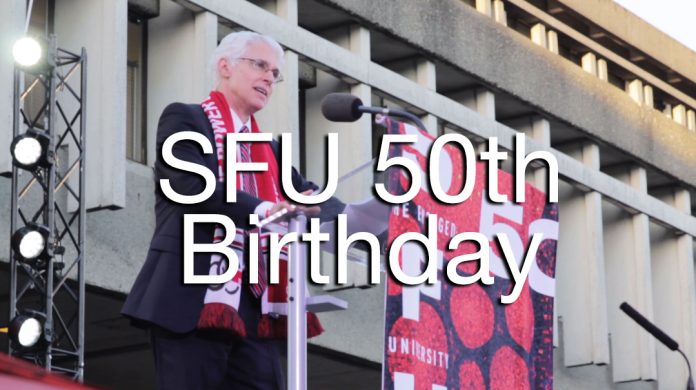
SFU celebrated its 50th birthday with speeches, live music, and fireworks.
Created by Paige Smith & Eric Smith
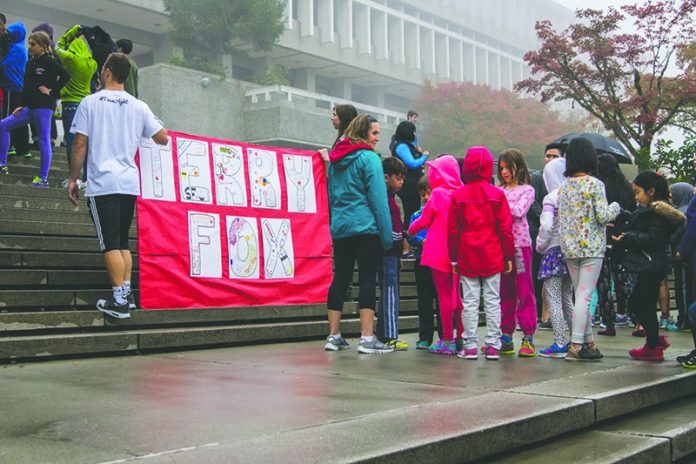
Despite the cold and foggy day weather, over 1,000 student participants and volunteers gathered at Convocation Mall on Friday, October 2 to run and walk in memory of Terry Fox, at the 2015 Terry’s CAUSE on Campus event, one of the largest yet at SFU.
The pre-event ceremony began with SFU President Andrew Petter speaking to the crowd and garnering enthusiasm from attendees. Special guests included Darrell Fox, Terry Fox’s younger brother, and Zoya Jiwa, recipient of 2015 Terry Fox Gold Medal award.
Following a short warm-up routine led by SFU fitness instructors and cheerleaders, the walk/run began. The finish line on this route was at the Terry Fox field and the post-event gathering took place at the South Terrace (Lorne Davies Complex).
In 1980, Terrance Stanley “Terry” Fox embarked on a cross-Canada run to raise money and awareness for cancer research. Although the spread of his cancer eventually forced him to end his quest after 143 days and 5,373 kilometres, and ultimately cost him his life, his efforts resulted in a lasting, worldwide legacy. Terry was a kinesiology student at SFU when he was diagnosed with cancer in 1977, making his cause close to the hearts of the SFU community.
The annual Terry Fox Run, first held in 1981, has grown to involve millions of participants in over 60 countries and is now the world’s largest one-day fundraiser for cancer research; over $600 million has been raised in his name.
In 2012, SFU and the Terry Fox Foundation created Terry’s CAUSE (College and University Student Engagement) on Campus which challenges Terry’s peers — university students — to carry on his legacy at campuses across Canada.
SFU also presents the Terry Fox Gold Medal Award each year to a student who demonstrates courage in the face of adversity. The 2015 Gold Medal Award recipient is sociology student and social entrepreneur Zoya Jiwa.
Walks and runs took place on all three SFU campuses — with some very special guests. Terry’s niece Jessie Alder launched the Vancouver event, and Terry’s sister Judith Fox was the special guest in Surrey.
Asked how the Terry Fox Run is significant to SFU, first year student and participant Sana Santosh said, “[Terry] was a student and patron of SFU. His courage, determination, and dedication to make a difference in the world was inspiring to so many people and that counts for a lot.”
President Petter, in a blog post, encouraged students to honour Terry’s memory: “I urge everyone at SFU to participate in Terry’s CAUSE on Campus. Whether you walk, run, volunteer or fundraise, it’s for a great cause and it’s lots of fun.”

Woodward’s

Reel Causes is offering a screening of the provocative film The Price We Pay on October 14 at the Djavad Mowafaghian Cinema at the Goldcorp Centre for the Arts. The film looks at how corporations avoid paying taxes by exploiting loopholes and using tax havens.
Surrey

SFU Venture Connections and VentureLabs are partnering up deliver a five-part lecture series focusing on providing skills for budding entrepreneurs.
The first lecture, “Assessing the Opportunity,” will look at ideas like market research and market segmentation; the free workshop takes place on October 13th at the Surrey campus.
Morris J. Wosk Centre for Dialogue
The Nora and Ted Sterling Prize in Support of Controversy will, on October 13 at the Morris J. Wosk Centre for Dialogue, be awarded to poet and environmental activist Stephen Collis as well as SFU professor and local political candidate Lynne Quarmby. The award, which was created in 1993, honours individuals who contribute to the understanding of controversy.

Public broadcasting is meant to be the voice of the people; it should be strong, just, and equal. The CBC was established with the intent of informing, enlightening, entertaining, and fostering discussion on a wide range of topics — it was meant to host the many diverse perspectives and encourage thoughtful debate.
The current state of Canadian public broadcasting encompasses everything but these ideals.
Over the past 10 years, the Canadian government has been starving the CBC. Simply put, the Harper Conservatives have carried out cut after cut to this beloved Canadian institution. Since 2008, the CBC has cut over 2,800 jobs, and 1,600 more could be lost by 2020, according to The Huffington Post. The recent announcement that the CBC is considering selling off its properties across the country is just one of the most recent examples of how these cuts have led to a shrinking Canadian voice.
Losing these production spaces in our communities is a truly horrifying and irreversible decision. Once they are gone, it is very unlikely the CBC would have the funds to ever re-purchase the same ones. These spaces are a lot more than just production locations; they are the roots the CBC has in our communities. Ripping them out will completely detach Canadians from their public broadcaster.
The CBC helps define Canada. It has helped build our arts and culture sector, produced countless film and TV series that explore Canadian identity and heritage, provided national news to language minorities, and helped bridge the gap between rural and urban areas in the country. We should be furious that the CBC is being forced to sell properties in order to stay afloat. It’s time to stop the cuts and restore the CBC’s funding so it can be the strong public broadcaster our country needs.
This election, I urge you to consider voting for a party that respects Canadian identity, and sees value in investing in it.
The Canadian Media Guild (CMG), the union representing the CBC employees, has come out strongly against this decision by suggesting that it “seriously jeopardizes the CBC’s ability to do meaningful production in the future.” The CMG is sounding the alarm, and quite reasonably. The CBC being absent from our communities will infringe on the production of our hard-hitting documentaries and news broadcasts, as well as our quality TV programming, and will have devastating influences on the public broadcaster’s future prospects.
In 2012, the Harper Conservatives announced that the CBC would lose $115 million from their $1.1 billion budget over the course of three years. In doing so, they have systematically tried to dismantle this beloved institution; again, as citizens, we should not stand for these cuts that tell us the Canadian voice isn’t worth sustaining.
The fact of the matter is that this sale makes no sense this close to an election, a point the NDP candidate and incumbent Andrew Cash made in a letter addressed to the CBC’s CEO, Hubert Lacroix. In just a few short weeks, Canada may have a federal government that will replenish and sustain everything that broadcaster has lost.
Both the Liberal Party and NDP have made campaign promises to help revive the CBC, so I urge all of you to consider voting for a party that respects Canadian identity, and sees value in investing in it. After all, if we don’t have a public broadcaster that is committed to telling our stories in an independent, just, and fair way, then who will?


The Crapside by Darien Lechner & Ryan Stella

Peers by Leslie Lu

Creator’s Pet by Destiny Hsu

The Adventures of Agoraphobia Man: World Defender by Jacey Gibb
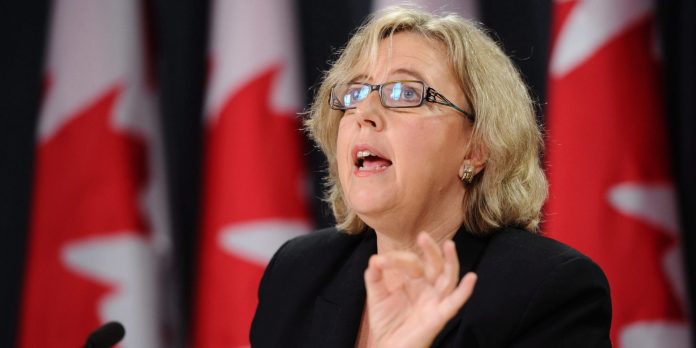
Any federal party leader who becomes Prime Minister of Canada has undoubtedly inspired millions of Canadians, but a truly great leader should inspire through hope instead of fear. They should represent the group they lead by listening to their concerns, and they should be honest, accountable, and principled. Canada deserves a leader like this. Canada deserves Elizabeth May.
May has been a Member of Parliament since 2011, and during her time there she has made quite an impression. She has twice been voted hardest-working MP by her colleagues, and she also won Best Orator in the Maclean’s 2014 Parliamentarian of the Year Awards. She is diligent, knowledgeable, and skilled at conveying that knowledge in an engaging way. Compare one of her speeches to one of our current Prime Minister, and you’ll see what I mean.
In 2014, May gave a TED Talk at TEDxYYC in Calgary titled “Canadian Innovation.” She mentioned that, while preparing for that event, she had been hard pressed to find TED talks delivered by other politicians. I think this is mostly due to the fact that most politicians have neither the innovative ideas worth sharing nor the ability to share them in an inspiring way. But Elizabeth May does.
Another quality every great leader needs is a good sense of humour. While being one of the hardest working MPs in the country, May also knows it’s important not to take herself too seriously. She recently joined Mark Critch on This Hour has 22 Minutes for a satirical interview that poked fun at the other party leaders talking over her in what he described as “pipeline measuring contest.” Appearances like these show that she has a sense of humour to go along with her conscientious nature.
May is also the author of numerous books, including Losing Confidence and Who We Are. Unlike self-serving political biographies, these books deal with important topics such as the state of our democracy and Canadian identity. May understands our governmental system better than any other politician I’ve heard speak on the subject, and she is therefore in a good position to lead a government and respectfully uphold the institution.
Finally, and probably most importantly, great leaders also know the value of collaboration. May is a strong advocate for putting aside our differences and working together across party lines in the House of Commons, and she has made many friends from all parties in the process. As she has said many times during this campaign, Canadians can achieve anything when we work together.
Canada has come to a crossroads. The past 10 years under the Harper Conservatives has led to the dismantling of Canadian democracy, social and environmental policy, and our most beloved institutions. We need a leader who has a plan to get Canada back on track, not one who panders to voters, which is what May has done with her consistent claims that Greens are of a higher moral nature than other, equally partisan candidates.
I will say that at first I was quite taken by May; she is quirky, smart, and passionate. But these qualities simply don’t make you a qualified leader. My distaste for May partly stems from a single comment she made in October 2013: “I hope that we will be able to set aside partisanship for the good of the country.”
May has implied that the Green Party is immune to playing politics, and that they’re somehow ‘above’ partisanship. These statements are both untrue and misleading. The very act of campaigning against another candidate is playing politics. Crafting messaging to persuade voters is playing politics. Making campaign promises is playing politics.
Not to mention, no government could effectively govern if they weren’t able to play politics; it’s part of the job. So either May is completely ignorant of the necessity for every party to be partisan, or she is purposefully trying to mislead voters into support by falsely advertising herself as something that she is not.
The Green Party is running top-notch candidates in battleground ridings — as any partisan party should. If they were truly above playing politics they would not campaign as hard as they are. The fact of the matter is, in this election the Greens won’t form government, and likely won’t win more than a seat or two. They’re a grassroots party that is still establishing itself in our political landscape.
The best thing that could happen for the Green Party is an NDP government, as they are the only party that has had a clear and consistent stance on proportional representation. Proportional representation would help them grow as a party and give them more power.
But unlike what May has said, her party has not set aside its partisanship to help elect a government that will usher in a system that will benefit them and forever end the need for strategic voting. They say one thing, and do another.
May has been clear that in this election, we need to get rid of Harper. But campaigning so aggressively is jeopardizing the vote in several ridings where the NDP and the Liberals are neck and neck with Conservatives. So what happened to “overcoming partisanship” to oust a common enemy?
Her head is in the political clouds. Whether she is ignorant, a hypocrite or intentionally misleading voters, she isn’t ready to do the job.

The 2015 federal election is just around the corner, and its proximity has sparked some serious discussion about our current electoral system. NDP leader Tom Mulcair claims that if elected, our current first-past-the-post system (FPTP) will be replaced by mixed-member proportional representation (MMP). This will allow citizens to vote twice: once for a local MP, and once directly for the party of their choice.
While skeptics argue that the switch to MMP will evoke havoc and mark the end of a decisive government, the pros of proportional representation outweigh the cons. MMP will give voters more power in their decisions as well as create the kind of democratic government Canada is in dire need of.
In our current system, voters are given one vote to elect the MP of their choosing. This vote is not only used to elect an MP, but is also considered a reflection of the voter’s support for a specific party. This is a problem because a voter’s favourite local MP does not necessarily belong to their favourite party. Often, voters are faced with the difficult choice of supporting their favourite MP or voting for a less ideal candidate who belongs to their preferred party.
In a mixed-member system, voters are not forced to compromise. In addition to their first vote that elects a local MP, they are also given the chance to elect a party that they would like to see in the House of Commons. This creates a mix of MPs that were voted in through local constituencies and MPs that represent a voter’s party preferences.
In a mixed-member system, voters are not forced to compromise.
The ability to separate MP and party preferences is not only beneficial to the voter, but also to MPs, who can be recognized for their individual platform instead of merely the party to which they belong. This gives MPs a level of autonomy and support that they can bring into the House of Commons, which allows them to stand up for what they believe in and better represent the people that voted them into parliament.
MMP also eliminates false majorities. In our last election, Conservatives won a majority government with merely 39 per cent of the vote, since FPTP merely sums up the individual constituency results without truly reflecting the majority’s choices. This leads to a government that runs the show with an inflated ego and an undeserving amount of power. While Conservatives govern as a majority government that is supposed to represent all Canadians, 61 per cent of voters wanted someone else for the job.
MMP is a true reflection of Canadians’ governing choices. Critics of proportional representation argue that radicals will slip into parliament and create conflict, but this problem can be tackled by setting a minimum threshold that excludes any parties that do not meet the minimum amount of supporters.
Should a party meet the minimum requirements, why shouldn’t they have a say in Parliament? Conflicting opinions in the House of Commons are not a bad thing if they are representing the views of a relatively large group of people.
I understand that people don’t like change; FPTP has been used as Canada’s electoral system for an incredibly long time, and is comfortable and familiar to us.
MMP offers Canada an opportunity to empower voters and provide Canadians with a truly democratic government. What’s the point of a conflict-free House of Commons if it’s not properly representing Canadian values?

Shameless Hussy Productions and the Firehall Arts Centre present Love Bomb, a musical written by the ever-so-talented rising star Meghan Gardiner.
This was the most incredible two-women show I’ve ever seen. I was surprised to walk into a truly minimalistic performance space consisting of only a few props. What a delightful change to have only the vitally important things on the stage: the two actresses, a small concert stage with sound equipment and guitars, and four chairs. The simplicity of the set made the audience compelled to be focused on the actresses and their expressions where the real depth of the story was found.
The artistic qualities of the musical were indescribable. This is a show about something so crushingly real in our world: the power of love, which can be devastating and beautiful — and sometimes both at once.
“Love Bomb is not your typical musical in that the characters feel compelled to sing and it’s quite unnatural,” Gardiner told The Peak. “The story takes place during a rock concert, so it would be natural to sing.” The musical was touching and riveting partly because the audience could relate to the feelings of the two characters: regret, anguish, passion, desperation, and anger all in the name of love.
“The story is a mystery and the songs are the clues,” Gardiner explained. “The songs greatly advance the story.” The show’s plot is constructed from an emotional exchange between the mother of a missing daughter and the rising rock star who has the lyrics of songs that belonged to the missing girl.
Every song and their strategically written lyrics are a huge part of the storyline — the audience was hanging off each and every word sung and exchanged between the characters. The story truly toys with the idea of love and expresses a mother’s pain and desperation so well. The connection between the two characters is obvious from the moment they meet, and eventually it becomes an exchange of compassion and humanity — an example of how unfortunate but relatable situations can crash two very different people together.
Meghan Gardiner spoke about her creative process and her inspiration found in Vancouver, and she expressed that this production was one of the best creative experiences she’s ever had and what an honour it was to have worked with Steve Charles. “I don’t like to write, but I like to have written,” Gardiner joked. “It’s tough literally trying to invent for a deadline — but when it finally comes together it is so gratifying.”
Raised in Vancouver, Gardiner feels greatly inspired by the city — especially with the support of her family. “I feel a real sense of calm in nature and in the beauty of Vancouver [. . .] it clears my head and helps me to be creative.”
I strongly applaud this beautiful musical that is unafraid to boldly call attention to an issue in our society that is often ignored or misunderstood. I can’t say much more than that, as the effectiveness of the show depends on you not knowing what to expect.
But I recommend that you all go see it, because it is captivating, heartbreaking, and, above all, important. The talent explodes off the stage and brings to life Gardiner’s essential message: “Whether it’s as an explosion of fierce adoration or as a manipulative tool, love is powerful.”

In his 1968 essay, “A Sedimentation of the Mind: Earth Projects,” Robert Smithson writes about a “climate” of sight. He talks about the “mental weather” of an individual, and how a psyche makes one view art; a “wet” mind, for instance, appreciates the fluidity of organic, or painterly, images and forms, and looks upon surfaces that can seem gaseous or foggy. This “dank brain” is considered by some to be the ideal mental climate to navigate the fluidity of an artist’s thesis.
This climate of visual perception is also the ideal one with which to approach the sister exhibitions of Phantoms of a Utopian Will / Like Most Follies, More Than a Joke and More Than a Whim. Running concurrently at the SFU Gallery and the Burnaby Art Gallery, these exhibitions feature recent and older works by Canadian artist Alex Morrison, as well as works chosen by Morrison from the respective collections of the two institutions.
The content of Morrison’s work in these exhibitions is informed by the specific sites in which his work is exhibited, namely the brutalist architecture of the SFU campus designed by Arthur Erickson, and the Ceperley House location of the Burnaby Art Gallery in Deer Lake Park. These exhibitions are intended to address how the use of these spaces changes over time and to acknowledge artistic movements such as modernism.
This approach of using the space to inform the art is ripe with potential, especially in the context of SFU’s modern concrete architecture that is slowly decaying in the damp climate of Burnaby Mountain. This campus, in its short 50 years of existence, has been host to protests, celebrations, student-organized raves, and convocations.
Unfortunately, the result of Morrison’s attempt to address Vancouver’s changing spaces is muddied at best. Certain works stand out, such as paintings by Morrison, framed prints from the archives, as well as an array of ceramic works arranged on purpose-built MDF structures. But this variety clutters the exhibition, which in turn makes it feel empty.
To include work by other artists into one’s exhibition, as Morrison has done, is similar to citing references: they should support the thesis of the exhibition — that one’s state of mind can affect how we perceive art. It is great to see Curnoe’s work in this exhibition, but it distracts from its intention. It’s a great quote that doesn’t fit the context. More supportive of the artist’s intention is the visible connection between the hard-edged forms of the structures and the architecture of SFU, and “Palomar” by Michael Morris, a lithograph of curving, modernist forms.
Of all the work on display at SFU Gallery, the strongest ones are Morrison’s 2011 paintings on linen and the flags that hang at the gallery’s entrance, works that would have fit nicely into the Geometry of Knowing series that was part of the SFU Galleries’ programming earlier this year. As pure abstraction, these works do not contain the overall ambition of the current exhibition’s focus on state of mind, but the crystalline and triangular patterns call to mind both the clean, hard edges of modernist forms while also resembling patterns that could be used on more comforting works, such as stained glass or quilts.
These quiet and modest works build a discourse between these two opposing aesthetics that could be appreciated by Smithson’s “dank brain.”

BC bud is legendary and illegal. It has been raved about, criticized, and grown in numerous basements, barns, and living rooms across the province. Clearly, it’s not going anywhere.
Growing marijuana is not limited to only BC, but this province seems to be the area of Canada where cannabis culture is strongest. With limited legalization of marijuana in certain US states, Canadian pot policy seems to be lagging behind.
This election, pot regulation hasn’t been as much of a hot button topic as in the past, due to more pressing matters such as foreign policy and the economy taking precedence. Drugs legalisation usually isn’t considered part of a solution to a problem, but in this case pot can contribute to solving one of Canada’s problems — and I’m not talking about heads of state getting baked and solving global warming while debating which flavour of Dorito is superior.
I’m talking about the economy.
Since the ‘recession economy’ has become a buzzword, you can’t visit any major news website without seeing some article related to it. Usually it focuses on oil or other resources and their falling prices on the global markets. However, there is the marijuana industry, with some estimates, as reported in The Globe and Mail, suggesting its value to be billions of dollars; billions of untaxed, unregulated, unused dollars.
This thriving industry, instead of being embraced and regulated by the Canadian government, is being suppressed through the Criminal Code of Canada. Apparently our lawmakers failed to learn from a little thing called prohibition, but what else can you say other than history repeats itself?
It looks like our lawmakers failed to learn from a little thing called prohibition.
These billions of dollars are only the tax revenue that could be generated. There would also be a significant reduction in the amount of money spent within all levels of the legal system. The current system of minimal sentences for pot-related offences not only ignores a potential source of government revenue, but also takes resources away from more important legal matters.
Those who disagree may argue that to keep laws the way they are would stop people from downward spiralling from using progressively stronger drugs. While the ‘pot is a gateway drug’ argument works as a fairly decent scare tactic for 10-year-olds, I’d argue that it ignores the larger socioeconomic and health-based reasons for addiction.
While some addicts are perfectly happy with their lifestyle, they are the minority. Most people would rather be healthy and addiction-free. The additional tax revenue being brought in would help contribute towards a more effective plan for treating addiction. These new funds could also contribute to a better affordable housing strategy.
While not a single party advocates for pot to help in fixing the Canadian economy, the four main political parties have all taken a specific stance on the legalization of marijuana. The Conservative party is not budging on their hardline anti-legalization, anti-decriminalization Nixonian view towards the drug. The NDP is pro-decriminalization, but not full legalization of the drug; not until a committee could decide on a more suitable path towards full legalization.
The Liberals are for immediate full legalization, regulating every part of the industry from production to the point of sale. The Green Party forms some form of hybrid between the NDP and the Liberals, but with more of a focus on addiction aspects, with the hope that pot will be like tobacco, and Canada can still become “smoke free.”
The thought that a currently illegal drug could help solve some of Canada’s economic woes may seem strange to some Canadians, but for me it fits with the unique history of our great nation. We are a country that has been built on the foundations laid by trailblazers, memorable characters, strong personalities, and progressives. Changing how the nation perceives pot will take time and effort, but Canadians are nothing if not willing to work open-mindedly toward positive changes.

Simon Fraser University’s independent student newspaper since 1965.
For advertising inquiries: [email protected]
For promotional inquiries: [email protected]

Simon Fraser University’s independent student newspaper since 1965.
For advertising inquiries: [email protected]
For promotional inquiries: [email protected]