Home Blog Page 910

Take national anthems out of club sports

0
Playing the national anthem over and over again diminishes its meaning.

Not many things can arouse a sense of heartwarming patriotism like a well-sung national anthem. Whenever I hear the opening notes of “O Canada” or Dabrowski’s “Mazurka” (Poland’s national anthem), I immediately envision majestic beavers or mouth-watering pierogis, and feel incredibly proud of both my heritage and the great land I grew up in.

However, like a fine cheese, national anthems should be used sparingly and only for special occasions to maximize the patriotic tears emitted during their performance. This is why I have a beef with the frequency with which national anthems are played during sporting events in Canada and the USA. It’s just too much.

Before I get assailed with accusations that I’m an unpatriotic turncoat, I’d like to assure you that nothing could be further from the truth. I’ve always believed in the concept of (multi)nation-states, and I think that celebrating one’s culture and history through the medium of music is an enriching part of the human experience. In fact, my patriotism is what makes me want to stop national anthems being overplayed.

By playing anthems all the time, their status is reduced to that of any other song that is blasted over stadium loudspeakers; and even though “We are the Champions” and “Thunderstruck” are cultural staples in their own right, they shouldn’t be treated the same as “The Star-Spangled Banner.”

Further, think about the multinational make-up of most sports teams in Canada and the USA. A prime example of this is the Vancouver Whitecaps. Their full roster features players from 16 different nationalities. There have been many games this year wherein not a single Canadian player was on the field for the Caps, yet they sung the national anthem anyways. While the anthem pays homage to where the team is from, it definitely looks awkward when not a single startling lineup member is singing along.

There is definitely room for national anthems in sports, though. Look to Europe to see how it’s done right. Rather than playing anthems before their regular season matches, soccer teams usually have their own pump up song, such as Liverpool’s “You’ll Never Walk Alone.” Doing this gives each team their own unique flair without crossing any nationalistic lines.

The only time national anthems are sung are during Cup Finals, giving the songs a greater meaning. Teams only get to earn the right to hear their anthem after they have traversed multiple grueling rounds of fierce competition.

Implementing this system in Canada and the US would be great for all sports enthusiasts. Though fans would hear the anthems much less often, when played and sung, these anthems would truly honour the best that the country has to offer.

Men’s hockey splits road trip in Victoria

0
Jono Ceci is just one point away from becoming BCIHL’s all-time leading scorer.

Last weekend, the men’s hockey team travelled to Victoria to play two back-to-back games against the University of Victoria Vikes. While the first game was a convincing 4–1 win, the second game resulted in a disappointing 5–1 loss.

“We definitely played well on Friday, [a] total team effort,” explained Head Coach Mark Coletta. “A lot of intensity, good forecheck, [. . .] but we didn’t have our whole game with us Saturday night, and the result ended up 5–1 their way.”

The loss on Saturday was made even worse by some injury news. Forward Graham Smerek is “going to be out for a couple of weeks with a shoulder injury,” according to Coletta, and Adam Rossi is out with a “mild concussion,” while Lamont is serving a one-game suspension for fighting. As well, Jaret Babych is still on the sidelines and “probably won’t be ready” for Saturday night’s game against Trinity Western.

Perhaps the biggest storyline of the weekend was SFU forward Jono Ceci tying the BCIHL’s all-time scoring record. He got three points in Friday’s game to tie the record.

“Obviously we would have hoped he got three more points on Saturday, but it’s a great accomplishment,” said Coletta. “He’s been a great player for us, he’s proven his worth in our league, and now all he’s got to do is get one more to break it. It’s a tremendous feat, and it couldn’t have happened to a better person. He’s a quality guy on and off the ice.”

Friday’s game featured a goal and an assist from forward Tyler Basham. He’s off to a terrific start this season, with 12 points through nine games, and is only a point off from matching his point total from all of last season.

“We always knew Tyler was an explosive player,” noted Coletta. “We told him during the offseason that if he can consistently put it together, he’s going to get a lot of goals and a lot of point in our league. He’s so fast, he’s got a great shot, but he’s got to get constant looks at the net, and make sure he’s taking sure he’s taking advantage of these prime goal scoring opportunities.”

Jono Ceci and Tyler Basham both led the team on the road trip with three points, with Basham scoring in both games. Both Liem and Stanwood split the starts, with Liem getting the win on Friday, stopping 30 shots.

SFU football determined to put poor season behind them

0
Head Coach Kelly Bates has already started preparing for next season and beyond.

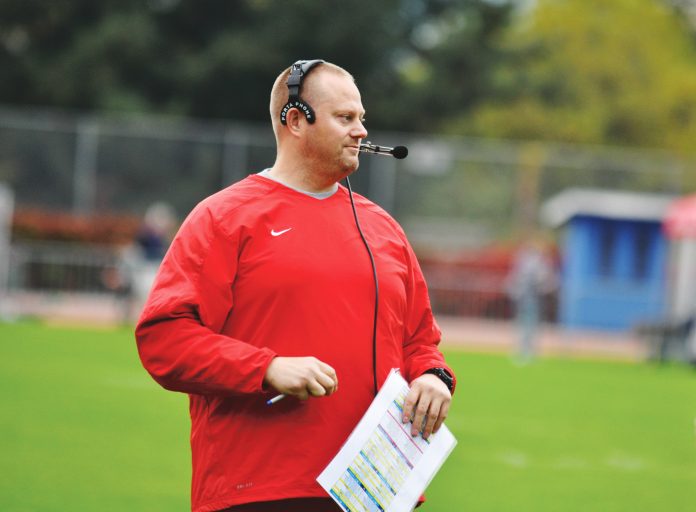
The SFU football team battled to the final whistle this season despite posting a 0–9 record on the season.

Playing football at the university level is an incredible commitment. Not only is it arguably the most physically demanding team sport, it is also the most intellectually complex.

The Clan football team practiced four times a week during the season at 7:30 a.m. and also attended regular film sessions and team meetings to correct their in-game mistakes and prep for their upcoming opponents. In the New Year, they will be back at it with three practices and two film sessions per week. Plus, there is the continuous training and weightlifting, all of which are necessary to achieve success. It is truly a year-round commitment, one that most of the players have been engaged in since high school. I spoke with Head Coach Kelly Bates, who says the 2015 roster of the SFU Clan more than met his expectations for commitment, dedication, and perseverance.

What made this team so special is how well they played and how close they came to achieving multiple victories despite operating with a distinct disadvantage. In fact, in five of their nine games, the Clan had the lead or were tied at halftime. In most games the team struggled to dress 50 healthy players competing against schools with double the roster size.

Coach Bates, who was hired last offseason, elaborated by stating, “as little as five years ago there were 110 kids on this team. That is a product of the coaching turnover.The last two off seasons there hasn’t been a coach to recruit. This year we tried to get ahead of it.  We offered 40 kids for next year and we will offer 20 more. And we [have] started on the 2017 season already.”

One of the toughest challenges in football is battling through a winless season, knowing it probably is the last time you will ever play football. Coach Bates reflected on his graduating players: “I told the seniors we won’t waste the work they put into this team. As a group they have been outstanding. There are some professional football players in that group. . . some guys who are going to be doctors [and] guys who are going to be huge contributors to society, which is really what we are aiming for at the end of the day.

“I wish I had them for two or three more years. I think they are special and it isn’t going to be easy to find new people to play where they were.”

One bright spot for the Clan was the play of middle linebacker Jordan Herdman. Jordan was able to win his second straight GNAC Defensive Player of the Year award, averaging 14.8 tackles per game to lead the GNAC.

“Back to back defensive player of the year, two years in a row is a honour,” Herdman told The Peak. “I’m very grateful.”

The SFU Clan football team should be incredibly proud of their 2015 season. “This offseason when I came aboard, every single player bought into what we were trying to do, knowing that it was a tough road ahead,” coach Bates reflected. “I preached it from the get-go that I needed them to lay the foundation for us to move forward. I feel like they have done that. Their work ethic both on and off the season has been excellent.”

SFU volleyball finishes season in style

0

SFU volleyball started the year with victories over Seattle Pacific Falcons and Saint Martin’s Saints, and they finished the year in the same fashion. Back to back 3–0 and 3–1 wins over the Saints and Falcons respectively pushed the Clan over the .500 mark, finishing the season with a 15–13 record.

In their penultimate match against GNAC cellar dwellers Saint Martins, SFU was led by Tessa May, who had 11 kills and three blocks that night. Her sister Devon also had a strong outing, with eight kills and an ace.

The season finale against the SPU Falcons proved a stronger test. After a close first set that finished 25–23, the Clan kicked it into fifth gear and smoked the Falcons 25–9 in the second. After halftime, though, SPU came out swinging and took the third 25–21. The Clan recovered in the fourth, and finished off their season by winning 25–19.

SFU only lost one set in their final two matches. Commenting on the team’s defensive dominance, Head Coach Gina Schmidt said, “this was the second time we’ve played both teams and we were able to learn and take away some things from the first time we played them, and that helped us positionally and to know who their hitters were.”

Indeed, throughout the year defense was probably the most powerful part of SFU’s game. Libero Alison McKay was a standout player in that department, and was subsequently voted GNAC Defensive Player of the Year.

“I think first and foremost, her work ethic is unmatched,” said coach Schmidt. “Her teammates have the utmost respect for her because every day in practice she pushes herself.

“She has a very calm demeanor about her, so even when the pressure is on she’s able to stay cool and collected. I think that keeps other people around her very composed as well.”

At the beginning of the season, SFU was getting mixed results. However, by the end of the season, the Clan had won six of their last seven and had become one of the hottest teams in GNAC. Much of this coach Schmidt attributed to a large amount of injuries that the SFU squad sustained in the middle of the season.

“We did have injuries to four different starters throughout the season. [. . .] We had a variety of different lineups, which is a credit to the depth on our team, that we were able to put out those lineups and still come away with victories in a lot of cases.”

Commenting on the year as a whole, coach Schmidt labelled the season a success. “We basically lost five starters from last year’s team [. . .] we had a true freshman starting, a couple sophomores, so it was a reasonably young team. Considering that we didn’t drop off at all compared to last season, I think it was a success.”

With a strong, experienced core returning next year, along with some new recruits, the Clan volleyball squad will have even higher expectations and will be looking to continue their winning ways in 2016.

Satellite Signals

0

WEB-woodwardWoodward’s 
Interested in art, music, and videos? Check out the Interurban Gallery located at the downtown at Hastings and Carrall St. on Monday, November 30. This free event will take place beginning at 7:30 p.m. and will feature different forms of art created and inspired by SFU School of Contemporary Arts alumni.

Surrey surrey

Come de-stress on Surrey Campus! Between Tuesday, December 1 and Thursday, December 3, a plethora of fun activities will be offered near the library. Not only will the therapy puppies be back, but the Surrey Campus Committee in partnership with the SFSS will be providing gingerbread cookies, candies, hot chocolate, baked goods, video games, and more!

vancouverHarbour Centre

On Thursday, December 10, SFU’s Harbour Centre campus will feature a film about the life of writer, monk, poet, and social activist Thomas Merton. It is the story of Merton’s journey across America and his search for a “fuller union” with God. Following the documentary, a formal public discussion will follow with a pane of Merton experts Donald Grayston, Lynn Szabo, and Angus Stuart.

Harvard prof on ethics of health tourism

0

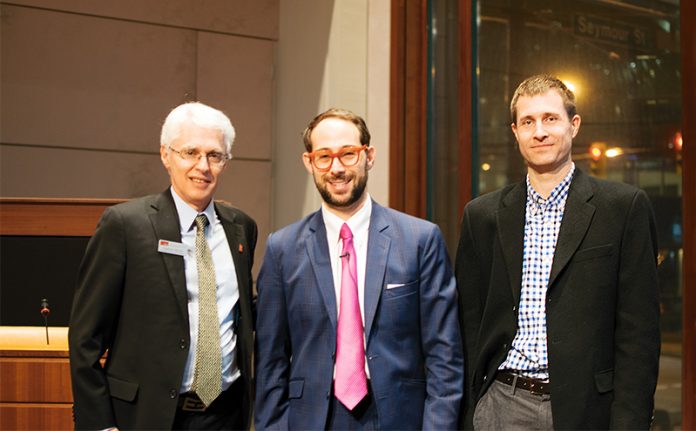
What about SFU would make a Harvard Law professor jealous? The President’s Dream Colloquium, apparently.

Professor Glenn Cohen of Harvard University conceded this just before delivering the final lecture in this semester’s President’s Dream Colloquium: Traveling for Health. The series examined the ways that the movement of doctors, medical volunteers, patients, and even organs affect healthcare worldwide.

The Dream Colloquium has seen a diverse range of topics for graduate and undergraduate students since its inception in 2012. Ranging from entrepreneurship to civil disobedience, the goal is to create a space where students can be engaged with unique topics they might not otherwise have access to.

Speakers are brought in every other week to give lectures on different facets of the topic, and students have the chance to meet with them afterwards. The topic for spring 2016 will be Engaging Big Data.

On Friday night, Cohen unpacked some of the ethical issues associated with health tourism. Cohen has extensive experience in this area, with many papers under his belt, as well as his 2014 book, Patients with Passports: Medical Tourism, Law, and Ethics.

Speaking to the dark side of transplant tourism, Cohen gave the example of countries like Bangladesh and India where low income citizens sometimes must sell their organs. The demand for kidneys in particular has increased due to an aging population and the high prevalence of diabetes.

Cohen brought up the question of whether selling your own organs should ever be allowed. He didn’t provide a direct answer, saying instead, “You have a role in determining the rules in your country.”

However far away these desperate situations may seem, they place a very real pressure on the Canadian health care system. People who have transplant operations using illegally purchased organs are much more likely to experience complications at home, taking up substantial medical resources in Canada while they recover.

The exact figures on the extent of this kind of medical tourism in Canada are hard to come by said Cohen. He elaborated, “We don’t know very much about the numbers; anybody that tells you that they do is probably not being rigorous enough.”

For accurate information on the realities of transplant tourism, Cohen has high praise for SFU researchers, saying that “the SFU health geography/medical tourism research group is terrific.” The website offers first-hand accounts of medical tourism and questions that people should ask themselves before going abroad for medical treatment.

When asked about what Canadians could do to help prevent patients from buying organs abroad, Cohen had simple advice.

“In some ways the most tangible thing you can [do. . .] would actually be to donate a kidney or to participate in the donor system.”

Our portrayals of indigenous struggle are far too narrow

0

In response to the challenges ahead, our new prime minister Justin Trudeau has promised to meet with indigenous leaders before year’s end and hold an inquiry into missing and murdered Aboriginal women. Although these are important steps in government-indigenous relations, they’re not aimed at remedying a pervasive culture of tokenism and narrow representation that saturates Canada’s conversation on Aboriginal issues.

The fleeting acknowledgement of being on ‘unceded First Nations’ territory’ or noting Canada’s history of racism, including the legacy left by residential schools, is not enough. I have serious concerns about the state of equality, multiculturalism, and ultimately reconciliation in Canada, and the TRC has not eased my apprehension.

I think there are some unpleasant assumptions held in regards to Canada’s Aboriginal history. As a result, the portrayal of the indigenous struggle in Canada is very narrow. Over my years attending SFU public lectures, I have noticed that conversations on First Nations topics invariably lead to someone injecting the lingering tragedy of residential schools into the discussion — even when the transition feels strained.

This seamless association between the indigenous experience and residential schools does little more than construct a very narrow and overwhelmingly grim narrative of the place of indigenous people in Canadian history.

The commonplace reputation of residential schools is illustrated by John Milloy’s A National Crime. This book would go on to influence a generation of anti-racism activists — however, its depiction of colonialism’s ugly legacy makes it too easy to forget that residential schools were not the pinnacle of racism for many Aboriginal persons.

Acknowledgement of being on ‘unceded First Nations’ territory’ or legacy left by residential schools is not enough.

It makes it easy to forget that some indigenous persons, such as Nisga’a chief Frank Calder, went to residential school in order to prepare to lead their nation in land claims. It also makes it too easy to forget that many First Nations — to the tune of over 60 per cent — did not even attend residential school.

There has been no large-scale effort made to uncover the ‘truth’ of Aboriginal day-schools or the consequences of relegating people to reserves in an effort to reach ‘reconciliation.’ Maybe these wider issues are not acknowledged because Canadians only want to speak about this ‘shameful’ episode in past tense.

It is possible that the dialogue focuses on specific schools in order to lay blame on the government and churches, and deny one’s role in a racializing culture. Whatever the reason, it is assumed that an innately harmful ordeal at residential schools is integral to the indigenous experience. I think to lump a diverse people together based on one identity is to discredit their experience as a whole.

Canada needs to put more effort into actually understanding current indigenous issues. The general neglect of Aboriginal communities, as illustrated by the ‘discovery’ of the substandard living conditions at Attawapiskat First Nation in northern Ontario in 2011, is something that continues to this day.

Lost within the media coverage of residential schools are those who did not feel they were profoundly impacted by their time there in a negative way. Denied by the Common Experience Payment (part of the Residential Schools Settlement Agreement) is any validation that the same abuses happened at Aboriginal day schools and to residential school attendees to various degrees.

My aim is not to discredit those who were subject to abuses in residential schools, but only to acknowledge that the scope of inequality in Canada is much larger than many would like to believe it is. Canada has a long way to go before we can reach reconciliation. We need to not assume a victimizing narrative so that we can move past what remains a dark period in Canadian history.

SFU to expand Burnaby residence

1
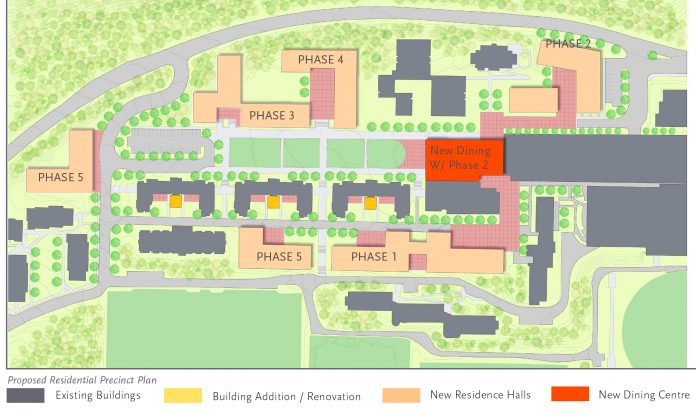
The plan includes five different phases to implemented over the next 20 years. - Photo courtesy of SFU Residence and Housing

SFU has laid out an ambitious program for the growth of its Burnaby campus residences. The new Residence and Housing Master Plan 2015–35 spans 20 years and will double capacity on Burnaby Mountain, considerably reshaping the structure of the residence community.

The 75-page report provides a five phase construction program that will raise the number of residence beds from 1,554 to 3,250 over the next 20 years through seven new buildings and an expanded dining hall.

Consultation on the Master Plan is open indefinitely, with opportunities for students to make their voices heard over email and in person. The last of four open houses will be held on Wednesday Dec. 2 between 12 and 2 p.m.

This transition includes the creation of two-story ‘living-rooms’ for the towers, the relocation of the Simon Hotel, and the consolidation of Residence and Housing’s offices and facilities.

The progressive demolition of Louis Riel House, Madge Hogarth House, and the Cowichan House townhouse block is planned to allow space for new buildings. Another portion of the plan is accommodated in the surface lot behind the towers, and the hilly forested area north of that lot.

The plan maintains the key east-west pedestrian axis of the original Erickson & Massey campus design.

In addition the plan intends to create the “ideal residence community” based on student surveys, with a variety of housing options. Currently options for living in residence consist of two varieties of single dorm rooms, four-person townhouses, and studios for graduate students.

The new plan includes the potential for single and double occupancy units, as well as suites, semi-suites, studios, and apartment units. These expansions are proposed to take place in an incremental fashion, with an initial focus on expanding first year residence capacity before moving on to upper year and graduate students.

This focus is the result of a disproportionately higher demand for first year housing — a demand that has the potential to put pressure on housing availability and push out upper year residents. Currently, SFU is unlike other universities in that it can be extremely difficult for students to remain on residence beyond first year due to high housing demand.

Through the provision of this plan, the university is presenting a drastic change in the direction for residence growth. It has been 11 years since the dining hall and towers were built, a project which itself was preceded by a near 12-year gap with Hamilton House and the townhouses. The Shell, Louis Riel, and Madge Hogarth residences date back to the beginnings of SFU.

Residence is not addressed in detail in either the 2010 Burnaby Mountain Campus development plan or the 2015–2020 SFU five year capital plan. According to Tim Rahilly, Associate VP Students, the Residence Master Plan would be utilized to fill in these gaps and update the university’s plans as it develops. Each step of the Master Plan requires additional examination, budgeting, planning, and approval through university administration.

Development for the Residence and Housing Master plan began in 2013 after the  residence’s budgetary crisis several years ago. One of the initial options explored at that point was the partial or complete privatization of the SFU residences. This idea gained traction in 2005 and was discussed for half a decade before being ultimately discarded. 

According to Tracey Mason-Innes, the director of SFU’s Residence and Housing, the plan presents a change and an acknowledgement by the university that “if we’re committing to residence, then we need to think and plan about how we should do it.” Despite the 20-year timeframe set out in the Master Plan, Mason-Innes described it as a growing plan that has to be revisited as circumstances change and new buildings are opened.

Rahilly commented on the future of family housing on campus, saying that it is a continuing conversation with UniverCity that he hopes will yield information by late spring on the potential provision of family housing in that area.

Beyond new construction, Mason-Innes noted the importance of maintaining existing facilities. Mctaggart-Cowan Hall is scheduled to begin renovations this summer and will be the last building to be updated.

According to Mason-Innes, feedback to the plan has so far been positive. With the proposed two-story ‘living rooms’ for the residence towers being a strong point.

Mason-Innes was pleased with the response to the proposed living rooms: “It’s the first step, and something that could be done quite easily in comparison.”

Residents have raised concerns about the removal of the surface parking lot north of the towers. However, the concern is more about the potential effect of its removal, and not around existing demand for parking spaces.

Aside from physical changes, the plan will have a ripple effect on how residence is structured, from delivery of services, to community programming, and residence orientation.

Male contraceptives: it’s about time!

4

[dropcap]T[/dropcap]he pill, the shot, the IUD. We women are given a range of options when it comes to methods of birth control. Men, on the other hand, have no comparable options. This is not fair.

Though it’s true that condoms can prevent semen from penetrating a woman’s insides, this is a mutual birth control method.

The mere fact that both the woman and the man involved are directly impacted by a layer of latex (or what have you) means that the control is not specific to the man. The IUD, the shot, and the pill, opn the other hand, affect women only, in the simple sense that they are inserted into a woman’s uterus, intravenously injected into a woman’s arm, and popped daily into a woman’s digestive system, respectively.

So, why is it that women have so many choices while men are limited to virtually none? It’s unfair.

Of course, there is always the point that men will produce about 525 billion sperm cells in their lifetime. Indeed, during a single ejaculation, about 40 million to 1.2 billion speedy swimmers are released from a healthy male. On the other hand, women have approximately two million egg follicles in their bodies when they are born. When they reach puberty, however, this number drastically declines to 450 mature eggs.

Why is it that women have so many choices while men are limited to virtually none?

In that sense, the idea of protecting 450 eggs as opposed to 500 billion sperm makes sense. But still, women are under the pressure of being the only ones to prevent carrying child. As making a child is a two-person job, it only makes sense that both parties involved should be equally involved in preventing this process. And with the whole idea of  equality between genders finally filling up public discourse, a male contraception is finally being produced.

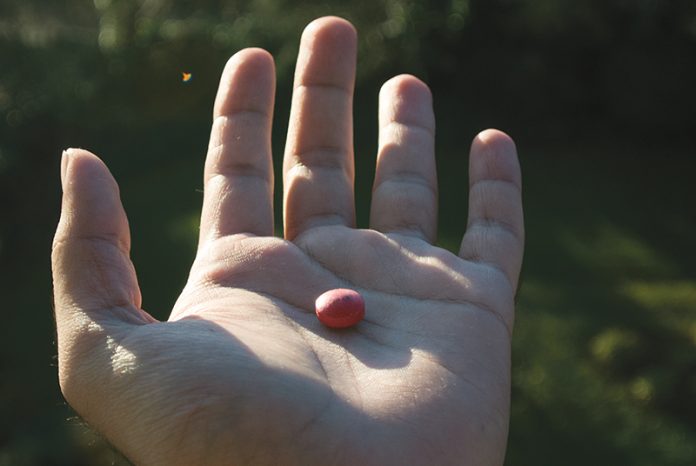
Vasagel, a method developed by the Parsemus Foundation, is a safe injection that is directly shot up into the vas deferens. For those of you who have not taken an introductory human biology course, or for those of you like me who have, but just don’t get it, the vas deferens is the fun little tube that carries sperm and passes into the penis.

The injection will be filled with a gel that prevents sperm from entering where it would normally. Because it’s a project funded by a non-profit organization, when it does hit the market (which is projected to be within two years), it should be relatively cheap. And in case babies are yearned for later in one’s life, the process is also reversible. Unlike most birth control methods, however, the shot does not prevent from all sexually transmitted diseases and infections.

The future of equality is well underway, and if you ask me, male contraceptive measures like Vasalgel are a decent step into this future.

SFU prof awarded for clean energy efforts

0
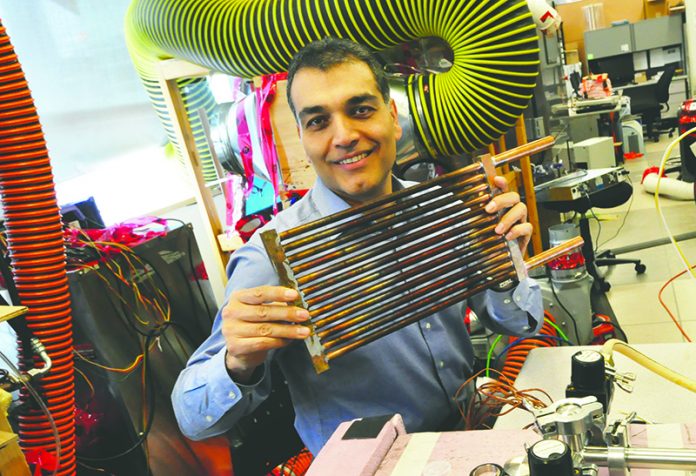
Majid Bahrami (pictured) oversees a lab with over 70 SFU students. - Photo courtesy of SFU University Communications

[dropcap]“N[/dropcap]ow in the light of global warming and reducing our environmental impact, we all need to find a more efficient way to use energy,” stated SFU Mechatronics Systems Engineering associate professor Majid Bahrami, who was recently recognized among the 2016 Canada Clean50 in the category of research and development.

The members of the Canada Clean50 are considered leaders in sustainable development who have made a measurable impact with their work.

Bahrami is the director of the Laboratory for Alternative Energy Conversion (LAEC), located at SFU Surrey. The lab focuses on sustainable cooling, thermal management, and fuel cell materials.

The LAEC is also responsible for training over 70 students in sustainable energy research. Research in the lab is conducted primarily for members of a relevant industry who are interested in sustainable energy.

Bahrami elaborated on the role that industry plays in the LAEC: “At the moment we are working with 15 different companies, providing them with the information they need. This ranges from testing, material characterization, modeling, prototyping, and fuel solution. Basically the lab is run like a startup company.”

This approach is successful, according to Bahrami, because his students gain industry-related experience throughout their schooling, and are therefore more likely to secure better jobs. The direct connection with industry also allows for a fast integration of these green technologies.

One such technology is the LAEC’s atmospheric water generator. This was created with sustainable water in mind. Bahrami noted, “This can be used in a variety of locations where there are no other water sources available.” These could be areas hit by natural disaster, areas where the aquifers have been depleted, and even arid climates where no other water is available. It works by sucking in air and extracting the moisture.

The current model can produce 20 to 30 litres of water per day, but it is scalable up to 100,000 litres per day. “It’s expensive water,” Bahrami added, “but atmospheric water is the most sustainable water you can get.”

Another example is the adsorption refrigeration system, which generates cooling without using electricity. According to Bahrami, it uses abundant low-grade heat, temperatures that are below 100 degrees Celsius, to start the cooling process. Not only does this technology avoid the energy costs of cooling, but it avoids the use of harmful refrigerants that act to deplete the ozone layer.

The team has developed yet another eco-friendly technology in collaboration with local electronics manufacturer Alpha Technology. It is a cooling system within an enclosure for telecommunication provision systems, which are used for the provision of wireless internet and cell phone service. The cooling system regulates what is termed ‘parasitic power,’ which is required for the cooling system.

Bahrami explained, “We reduced the environmental impact of these telecommunication system enclosures by 15 per cent. In a nutshell, we are removing all the parasitic power required for cooling this system.” This “parasitic power” refers to the energy wasted through the heating and cooling of various moving parts.

Bahrami holds the Canada Research Chair in Alternative Energy Conversion Systems, a government program geared to keep Canada on the cutting edge of research and development. As chair, reducing our environmental impact through practical innovations is important to him. “With the Paris convention, we are going to commit to at least 30 per cent GHG (greenhouse gas) reduction, it’s a Herculean task.”

Herculean it may be, but the efforts of Majid Bahrami and the students at the LAEC have earned them a place among Canada’s Clean50.