Home Blog Page 865

Kaylee Johnston is tough with a sensitive side

0
Johnston might not have gone to college but she never stopped learning.

When Kaylee Johnston walked into our interview a few days before her self-titled EP release party at the Biltmore Cabaret, she bypassed the handshake and headed straight for a hug.

Johnston was in the Canadian Radio Star competition early on in her career, and released her last EP, Streetlight, in 2010. Since then, aside from a single released in 2013 (“Gone”), she’s been figuring out what she wants out of her career and honing her musical abilities. Her new release is a taste of the big things we can expect from her in the future.

Johnston has known since kindergarten that music was where she was meant to be. She applied to college at her parent’s encouragement, but didn’t get in. “I knew that I was still going to do music. I remember not even feeling disappointed.”

According to Johnston, she was never much of an academic. However, her best advice is, “Just be a student of life. I’ve never stopped learning or wanting to learn and that’s why . . . if I’m having a bad day, I can always turn it around. Like, OK, this is an experience that I’m going to learn from, and my life’s going to get better because of this uncomfortable moment in time.”

It’s pretty solid advice. And just because she didn’t do well in a structured educational setting doesn’t mean she wasn’t educated. “I’ve done, probably, thousands of hours of voice training . . . and thousands of hours of song-writing with different people and styles. I’m conscious of where I’m putting my energy.” It’s easy to see that all of her hard work has paid off — the new EP is dynamite.

“Are You the One” is Johnston’s favourite song to perform, because of the bridge. “I kind of rap it, and it’s not really rap, but it’s really fast spoken word . . . Every time I do that I just feel so badass. I always get a good reaction from the audience. That one’s my sexy, sassy song so I always feel really good when I sing it.”

Another personal favourite for Johnston is “Let’s Pretend.” It’s got a slightly different feel than her other songs, stemming from the 18-month time difference between writing the majority of her EP and writing that song.

“I felt like that was the first song I’d ever written that was truly vulnerable. All the songs have moments of vulnerability, but that whole song is just me being very accepting of a situation I was in and being honest about it.”

It’s true. A lot of her other songs have a toughness to them to coat the vulnerability, and it’s great to see her expanding the realms of her emotional songwriting capacity.

Johnston’s show opened with Mathew V and Windmills — two terrifically talented acts with vocal chops and great musicality. They set the tone of a fun, celebratory night and Johnston ran with that throughout her set. Her vocals were on point, her performance was captivating, and her energy was infectious. The dancing she did on stage was amplified in the crowd, following her lead.

There were a few technical difficulties, but nothing major. Her cover of “Teenage Dirtbag” took everyone back to high school in the 2000s and turned into a massive singalong, with Windmills joining her on stage. She’s such a charismatic performer, regaling the audience with stories in between every couple of songs. It makes her feel like a friend, even though she’s up on that stage.

All in all, the party was a fantastic launch event, with more than a few people walking away with CDs. She’ll be one to watch in the years to come.


FVDED in the Park is more than just a standard music festival

1
Last years festival was hugely successful, and the organizers plan to repeat that this year.

The first weekend of July isn’t just reserved for Canada Day hangovers and camping trips. It is also when FVDED will return to Surrey’s Holland Park.

Even though FVDED is only in its second year, the idea has been around for much longer, according to Alvaro Prol of Blueprint. “We always wanted to do something that was unique to us,” he said. “We’ve seen a lot of things come and go, and what worked [or] what didn’t. We knew we wanted to do something that was more accessible, something that was a little more urban in its offering.”

Wanting to have an accessible and more urban festival location comes into play: “Once the park got refurbished for the Olympics in 2010 there was always an opportunity to do something there. When the Mumford & Sons event happened there, it was the first big kind of concert to happen [at Holland Park]. We went because our partner Live Nation was producing that show and that’s when we said, ‘OK, we are going to bring this festival here,’” said Prol.

Holding FVDED in Holland Park wasn’t just about being able to use an updated space, but also using an easily accessible one. Stated Prol, “We have a festival site right in the city where people can take a SkyTrain and be at the doors of the festival without having to worry about parking or staying in a hotel or camping and all the different kinds of costs and inconveniences that it takes to get to a festival.

“There really is something unique about the space and it spoke very much to what we do. We are a city, urban group. We wanted to do something that reflected us,” he said.

For Prol, there was also a need to keep the festival from being too much like other festivals — not only in terms of location, but also affordability. “We wanted to sound more like a gathering in a park, and portray a more down-to-earth vibe. Anybody could get on a flight and be at Coachella if they really wanted to, or go here or go there. I didn’t want to be this super expensive festival that was only accessible to certain affluent people that have all this money.

“This year I went to Coachella, I was there and you just looked at everybody and they just looked like a bunch of affluent, rich yuppies. You’re missing so much of that raw energy and vibe from other music lovers that can’t afford that type of experience. That’s what I like about this festival is that it is accessible to all, in transportation and affordability.”

Since so many festivals take place outside the cityscape, Prol wanted to focus on the urban landscape of Vancouver. “If you haven’t come to Vancouver and you are coming for the first time and you are in the SkyTrain going from downtown all the way to Surrey, and you see the beauty of our city all around. You don’t have to go and camp five hours away to see our beauty.

“So, from a Vancouver perspective, showcasing the [beauty of the] city at the forefront, and getting people over to Surrey from a visitor standpoint — that is one of [the] things that we want to achieve. For Surrey and the region, it is such a positive event in the sense of chatter and social media hits. There is so much good press that I think this is a really good thing for the region.”

For a major company, the importance that Blueprint and Prol — the creative forces behind this year’s lineup — place on local and Canadian artists is refreshing to see, especially when there are numerous festivals that would rather bring in multiple big-name acts than support the local ones.

“We are very motivated to help develop and give situations and positions to some of the local guys that are working hard and being successful. The good thing about our local music scene is that it is very healthy right now. We have a lot of great producers. It’s been a while since we’ve had so many different kinds of acts coming out of Van that are making noise.”

Prol did express some disappointment at not being able to get two Canadian artists to headline the festival like last year with the Weeknd and Deadmau5, but given that the rest of the lineup does have a Canadian focus with artists like Belly, Kaytranada, and Pomo, helping mitigate the lack of a Canadian headliner.

With a local and Canadian focus, a third stage added, and tickets already 85 percent sold, it seems safe to say that Holland Park with be a home for FVDED for years to come.

My sugar highs and lows

0

Looking myself in the mirror

“If you only stop eating so many sweets, you will definitely lose weight. Have some self-control!” I remember saying to myself in front of the mirror, the morning after a birthday dinner. Unfortunately, it was not the first time I had had that conversation with myself.

I know I’m not the only one struggling with cutting sugar out of their diet. The suggested consumption crisis is getting so large, groups like the Heart and Stroke Foundation have proposed taxation and legislation to try to regulate it. After years of riding a sugar high, we’re finding ourselves at the crash.

I knew sugar didn’t help me with my goal to stay healthy, so I decided to take control of my eating habits and cut sugar out. My biggest problem was having what you would call a ‘sweet tooth.’ Growing up in a family where eating something sweet after every meal was the norm, I didn’t even think twice about how tough it was on my health. My struggles grew as the calories from my sweet treats turned into fat. I started to become more self-conscious about how I looked, but the bad eating habits were tough to change. Even when I added regular workouts to the picture, it didn’t result in any improvements with my sugar-heavy diet.

A will to change

It was time for a change. Willpower and conscious consumption habits should help me achieve the goal, right? But the reality isn’t that simple. In fact, the more I tried to stay away from sugar, the more I understood how difficult it actually was.

My first challenge was cravings. For me, chocolate was my guilty pleasure. Staying away from sweets was very difficult, and often resulted in failure within the first week of my sugar-free pledge. The abundance of colourful candy displays in the stores and the overwhelming number of sugary goodies everywhere were not helping my case, either. I was torn between trying to keep to my commitments and letting myself indulge. I was in a tug of war with myself. Is this what you would call sugar addiction? For me, the best I could come up with was a strong ‘maybe.’ I am, after all, no dietitian.

However, there are many studies suggesting the addictive effects sugar can have on the brain, some even arguing that addiction to sweetness can surpass the effects of cocaine. This is in part because sugar triggers a release of dopamine, a hormone that is part of the brain’s “reward system.” It is no wonder then that so many people (myself included) can have very strong cravings for sugary foods.

But I don’t believe we will necessarily be enslaved by our sugar addiction in the future. If we can start to raise our dopamine levels in other ways — such as through meditation, regular exercise, and massage therapy — we can help to ease the effects of our sugar withdrawal. This is something we all need to do: as students and young adults, we have a responsibility to our bodies. All too often we forget about the importance of health in self-care. As great as it can be to indulge in a sugary beverage or treats, we need to ask ourselves if it is really worth it in the long run.

You’d think I should be able to live a sugar-free lifestyle when I subdue my cravings, right? Unfortunately, this is where the second challenge comes in. The truth is, nowadays it is very difficult to stay away from sugary foods. It seems that the high concentrations of sugar in our food renders anything other than a paleo diet hopeless.

A sugar-free future?

As consumers, we need to be aware of our choices and pick the products that we believe best fit our needs. But at the same time, it seems unfair to put full responsibility for healthy lifestyle on the consumers: so many products available to us are rich in sugar, and advertisers try to tempt us everywhere we go.

As I see it, we are currently not in a place where quitting processed sugars is achievable — they are just too widespread and prevalent in our diet. However, I believe we can all take small steps to reduce our sugar consumption by opting for healthy alternatives, such as fruits and healthy snacks. And in the meantime, we should raise a larger discussion on the dangers of sugar and call for tougher regulations on sugar in foods.

I strongly believe that SFU should also play a role in a collective approach to reducing our sugar consumption. As students, we often choose unhealthy, sugar-heavy food choices for three reasons: simplicity, availability, and pricing. Although there may not be many options for price changes, we can always add more healthy snack options to our cafeteria, or introduce healthier choices to the vending machines.  

But the first step is to spread awareness. If we have visible reminders of how much sugar we are consuming, such as displaying nutritional information to sugary treats, we would be more inclined to choose healthier options. . . there is no good reason that the next generation has to also find themselves in front of a mirror talking themselves down because of their body type.

POINT / COUNTERPOINT: Should SFU’s English department focus less on white male authors?

0

Yes, English requirements should shift to focus on more diverse literature.

By Emily Seitz, SFU Student

On June 1, Alison Flood published an article in The Guardian exploring a petition put forth by undergraduate students at Yale University. The petition calls for an end to the English department’s course requirement of canonical white male authors such as Shakespeare, Chaucer, and the like. The students argued that “it is unacceptable that a Yale student considering studying English literature might read only white male authors.”

The article also includes a comment by Katy Waldman, a writer for Slate, who states that “you cannot profess to be a student of English literature if you have not lingered in the slipstreams of certain foundational figures, who also happen to be (alas) both white and male.” Yes, as any English major will tell you, the literary canon is dominated by white male authors, perhaps none more so than William Shakespeare.

The perception of Shakespeare as a foundational literary figure can be challenged by the fact that, until the 18th century, Shakespeare was lumped together with all of the other playwrights and poets in his era; his status as “the bard” came in the 18th century through a national need to have a single author be the figure of the national poet. But this idea of a single poet representing a nation is problematic in our current global, multicultural society, as there is a need for diverse voices in literature to reflect the diversity around us.

Many Canadian universities, including SFU, have a Canadian literature requirement, and many of these schools also offer courses in aboriginal and indigenous literature. Although Canadian English departments are providing required courses outside of the white, male-dominated literary canon, the course selections are often minimal and students are often only required to take one.

Meanwhile, students are required to take two courses from a list that prominently enforces the white male canon, such as English 306 on Chaucer, English 311 and 313 on early and late Shakespeare, and English 416W on Milton, among others.

Lower level requirements focus on broad periods — such as medieval literature and 18th century literature — with very little emphasis on literatures outside of the white male canon.

There is a demand for more diverse authorship and characters in the current literary scene, as demonstrated by the Twitter call #WeNeedDiverseBooks, in children’s literature. Although more Canadian universities are offering literature courses outside of the expected white male canon, these courses aren’t typically main English major requirements — and if they are, usually only one course is needed.

I believe that English departments could shift their course requirements to focus less on the white male canon, and could provide more options for students in diverse literature, with female and non-white authors. There are many female authors in the English literary canon — Jane Austen, Margaret Cavendish, the Brontë sisters, Marie de France, to name a few — and contemporarily, many non-white authors are expanding the English literary canon.

As our society becomes more global, and since Canada is a multicultural country, our literary studies need to expand beyond the historical English canon to one that is multicultural, and English major course requirements need to diversify.

Though perhaps SFU should not go as far as what Yale students are suggesting and completely remove canonical authors from their course requirements, there should certainly be less emphasis on historical literature by white men.


No, SFU’s English department should stay as is.

By Courtney Miller, Peak Associate

As much as it sucks, studying the works of white men in their entirety is an integral aspect of studying English — especially for those historical figures. Would I love for writers who fit outside of this narrow mould to be more prominent? Absolutely, and the classes focused on later writers (particularly here at SFU) feature a wide variety of authors with a corresponding selection of backgrounds and experiences.

It would be great if that same openness could translate to the past, when most of these men were writing. Unfortunately, we can’t change the past.

Regardless of their race, gender, or age, these writers have shaped and dramatically influenced modern English. Shakespeare alone contributed more than 1,700 words to the English vernacular. William Wordsworth is the poster boy of Romantic era poetry. Charles Dickens became one of the pioneering novelists of the Victorian era.

The list goes on. Every white canonical male we study is studied for a reason. To avoid studying their work would be a disservice to the styles and eras they represent.

A sad truth of the matter is that many of these literary men lived in a far more patriarchal society than many of us Westerners do today. White men were the overwhelming majority of published writers. That’s not to say women or people of colour didn’t contribute, or weren’t integral to the formulation of the ideas that men were credited with — after all, Wordsworth’s sister, Dorothy, may have been as crucial to the development of the Lyrical Ballads as either Wordsworth or co-author Samuel Coleridge.

But these events transpired at a time when non-white men were not valued for their worth, and thus were not remembered to the same degree as white men. To not focus on the inequalities of this era would discourage us from learning and reflecting on our ongoing progress as a Western society. Besides, many of the English classes I’ve taken at SFU, which are not centred around one male author, have included literature by diverse authors.

Furthermore, the professors (at least, those at SFU) who teach canonical male-centred courses are also the ones who say, “Now, take this with a grain of salt. Thoreau’s view of the world was problematic because of X, Y, and Z. As we can see from Dickinson, there are vastly different experiences happening in the same era.” To not play the works of white male authors off of other literature hurts everybody involved because it contributes to a loss of knowledge and critical thought.

SFU’s English department should stay as is — it’s a fair representation of the historical influences of English literature through time. In the study of English literature, it is important to present information on times of inequality. It is our duty to apply our reasoning and criticism liberally to everything we evaluate, in order to decide for ourselves what is worthy to incorporate into our own lives.

SFU prof’s plain packaging project aims to kick cigarettes’ butts

0
Students can check out the display to see how different countries stack up.

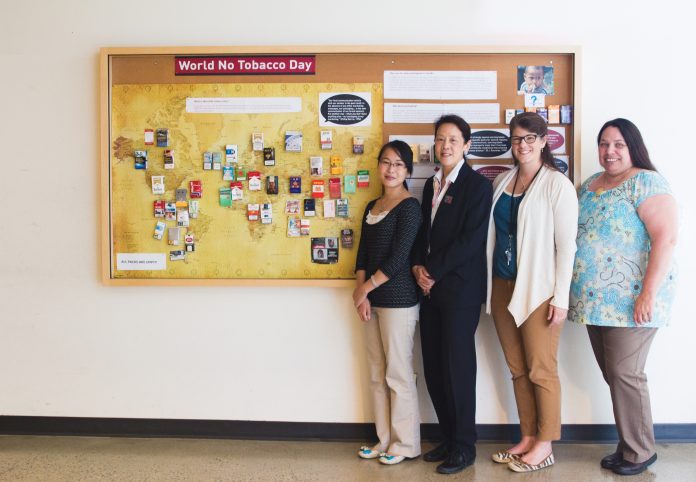
If you’ve walked down Blusson Hall recently, you may have noticed a display case featuring gruesome images of what cigarettes can do to your body, and a world map with cigarette packages from around the globe pinned to their respective countries.

These were collected by SFU health sciences professor, Dr. Kelley Lee. With World No Tobacco Day’s  global plain packaging campaign on May 31, Dr. Lee has been drawing attention to the issue locally.

“My research is around tobacco control in general, and plain packaging is one aspect of it,” she stated. The movement aims to streamline and standardize all cigarette design and marketing. Currently, about 75 percent of a cigarette package is dedicated to a graphic health warning, which still leaves some room for cigarette brands to appeal to smokers.

“Companies really find that the packaging is important to them to get their branding across,” she said. “They call them ‘mini-billboards.’ So they put a lot of emphasis on them — they spend millions of dollars designing these packages to appeal to particular targets; to young women and to young people.”

Dr. Lee first started collecting cigarette packages from around the world to use as teaching tools, some of which used hearts within the filters, candy-like flavours, pretty colours, and novelty images to entice consumers.

When asked why she believes tobacco should be treated differently by the government than other legal harmful substances, Dr. Lee stated “you can’t smoke a cigarette safely.

“Tobacco is the only legal substance that, if used as directed, will kill half of its users. You can’t say that about alcohol, and you can’t say that about unhealthy foods. It’s a substance that if you invented it today, it would not be legalized.”

An issue Dr. Lee is tackling closer to home is updating SFU’s smoking policy. The Advertising, Selling, or Smoking of Tobacco on Campus policy has not been updated since 2009. It currently states that students can smoke 10 metres away from university buildings, but Dr. Lee wishes to implement an update which would limit smoking to designated areas.

“We surveyed students, faculty, staff, community members, and 75 percent of people agreed that was the way we should do it because of the forest fires, because of cigarette butts everywhere, because of secondhand smoke wafting into people’s offices and workplaces,” she said.

As for the broader context of Dr. Lee’s anti-smoking efforts, she believes that Canada is doing fairly well with cigarette packaging regulations. However, there is definitely room for improvement.

Canada is now considering adopting a completely plain and standardized packaging policy.  “The Liberal government said they would have a three-month consultation. That means that people — you and me, anybody — can submit about whether this is a good or bad policy.”

This, however, means that tobacco companies will have ample opportunity to oppose the motion, and could potentially spread some misleading information. “Our research has also been looking into how they’ve been using third parties like think tanks to fund research that sounds independent,” said Dr. Lee.

Not everyone believes that plain packaging is the best way to disincentivize smokers. According to associate dean of the faculty of development and research at the Beedie School of Business, Dr. Judy Zaichkowsky, “fooling with the packages is a side-issue, almost. It’s not the core of the motivation to start. The core of the motivation to start is to be older; more mature, to belong.”

Both women touched on the significant correlation between puberty and starting to smoke. Dr. Zaichkowsky described it as a time when “you do everything you can to look and feel more mature.” Dr. Lee outlined 13 as the average age at which people start smoking, and the demographic to whom tobacco companies aim to advertise.

“It’s a dirty business,” she stated.

Dr. Zaichkowsky believes that though the plain packaging movement is well-intentioned, using fear tactics such as jarring imagery on packages is the wrong method. “When the fear gets too ugly or gruesome, people look away. They tune it out. [. . .] They understand it, but they don’t want to pay it any attention.”

Instead, she believes that “a moderate, social fear appeal is much more effective than ‘smoking will kill you,’ because that’s too fearful. People will say, ‘not me.’”

NOTE: Dr. Kelley Lee’s display has been moved to the casing across from the Djavad Mowafaghian Lecture Theatre.

Peak Comics: APPLE ST

0

COMIC-POOT (1)

CJSF 90.1 broadcasts test answers from fifth floor AQ bathroom

0

In a recent bid to gain listeners, SFU radio station CJSF 90.1 FM has begun broadcasting test answers. The hope is that students will finally tune in, if only to pass their next midterm.

At first the CJSF used a brazen approach, simply announcing test answers at select times. However, SFU administration was quick to crack down, and they were forced to use more subversive methods.

A complicated code language was created using Led Zeppelin as a base. Their songs were edited and looped so that the pitch and tempo of Robert Plant’s moaning noises would indicate what the answer was. However, the administration soon caught on to this new trick and the radio station was warned to cease aiding cheaters. As a result, more extreme measures were employed.

CJSF began to play edited rap songs under the guise of mixtapes in order to broadcast answers. The works of Drake, André 3000, Ice Cube, and even Meek Mill were edited together to spell out test answers, such as “Started from the bottom now the answer is muscular dystrophy,” and “Straight outta the textbook, crazy muthafucka named page 67.”

The radio station claimed these were not test results, but rather were “unreleased and experimental collaboration tracks.” The administration caught on once again. This was the last straw, and the radio station was taken off the air.

Two days later, however, the CJSF was back up, broadcasting from a bathroom at the top of the Academic Quadrangle, calling itself the true “Pirate Radio” and babbling some nonsense about ‘fighting the good fight.’

When asked about the controversy, SFU student Jordan Clemens summed up the general feeling amongst the student body, saying “I didn’t even know we had a radio station until now. Hell, I didn’t even know people still had radios. I thought they stopped making those like 80 years ago!”

Study reveals that executive student unions exist only to pad resumés

0
EPSON MFP image

SFU has over 100 clubs and student unions, all of which are excellent avenues for networking, gaining experience, and the occasional ego boost. However, a new study suggests these organized social gatherings might exist for more ulterior motives.

According to a study produced last week by SFU, approximately 70 percent of all executive members from Departmental Student Unions (DSU) and clubs hold the position purely to pad their resumés.

“We polled about 80 execs from across SFU and found that the majority felt their resumés were weak and needed some filler,” said lead researcher Dr. Doris Blankfein. Dr. Blankfein confirmed the majority of exec members “have no real responsibilities” and “don’t give a shit.”

“Our findings showed that an overwhelming majority have the position just to have the position, and don’t really do anything.”

We spoke with one executive member who wished to remain anonymous. He said, “I mean, my official title is co-vice president of external relations, or something like that, I can’t remember really . . . I guess I took the job so I could pad my resumé. It also makes me feel accomplished. It’s incredible the effect this title has had on my ego. Now, when I talk to people, I have a reason to be self-righteous and snobby!”

“It’s been wonderful,” said another DSU member. “With my new title of co-director of marketing engagement, I can actually offload my work onto the other co-director and other members of exec.

“I don’t do much, but my title does the work for me!”

The report concluded that about 15 percent held their position because they “actually do the majority of the work,” while another 15 percent had their position by default because nobody else wanted it.

The Crank Files: Was Curious George Originally About A Human?

0

Beneath the veneer of normalcy lies a world of dark shadows and the macabre. Bizarre cults, conspiracies, and creatures abound. One man seeks to get to the bottom of them. Some may call him a crank, but to others he is a truth teller. The Peak‘s resident investigator of all things strange, Tyler Knoll, is on the case over at the Crank Files!What is reality? It’s a question that keeps me up at night, although regular consumption of caffeine might also be a factor. For many, reality is merely existence in and of itself. But then again, the masses are nothing but a bunch of un-woke sheep, content to shill themselves to the secret masters who’ve enslaved their minds.

Clues exist that reality is really a mere simulation — a “Matrix” if you will — of which we humans are not in control. One of the most damning pieces of evidence is the children’s book series, Curious George.

You might think, “What a load of shit, they’re harmless children’s books.” But think again, sheeple. In these books lie the sinister secrets to the infuriating truth of our existence. On the always-reliable and factual forums such as Godlike Productions and TinWiki, many are recording their suppressed memories of Curious George being a book about a human boy with a fully-grown ape as its owner and master.

This role reversal is part of a larger phenomenon known as the “Orangutan Effect.” The Effect involves memories people have of orangutans forcing them into induced sleeps through suspended animation, which naturally hints at a larger ape-takeover of the Earth.

That’s right: the apes are running the zoo, people, and we’re all animals being goggled! Remember Harambe, that gorilla over whose death we all got outraged? Well, he’s probably laughing his ass off in an alternate reality while looking at our fake memories through a remote viewing device!

Our minds are enslaved people, and until we all wake up, we won’t be able to do anything about it. And when we wake up . . . well, I’m not exactly sure what to do then. I mean, I guess we could type in “What is the Matrix” on Google and see what happens. If that doesn’t work, then we could just get really angry and go on rants on Reddit.

Take that, you damn dirty apes!

COLUMN | THE POLITICAL EYE: Why pipeline expansion isn’t the worst idea

0

[dropcap]P[/dropcap]ipelines: they’re hotly debated, especially at SFU where major protests against the Trans Mountain Pipeline expansion have occurred in recent years. So, I will provide some arguments in favour of pipeline expansion in Canada, aside from the usual ‘growth of jobs and economy’ take.

Where does Canada get its oil? The National Post reports that the top source countries are the US, Saudi Arabia, Nigeria, Angola, and Algeria. Of these, Canada is a Western, liberal democracy with strong social programs and a commitment to human rights. When we import the $20 billion of oil, like we did in 2014, we directly support these foreign countries’ ruling governments and not our own.

Saudi Arabia, one of the top countries in world oil production, is a monarchy. There, women are not allowed to drive, and have to limit the amount of time spent interacting with men outside of their families. Contrast this with Alberta oil capital Fort McMurray, whose mayor, Melissa Blake, is a woman. Saudi Arabia also performs executions for crimes such as blasphemy, adultery, homosexuality, and even witchcraft and sorcery.

Canada also imports Nigerian oil. The Nigerian National Petroleum Corporation “manages the government’s interests in the Nigerian oil industry,” according to its website. The Niger Delta has seen immense environmental degradation and humanitarian crises as a result of oil production. Recent attacks on oil installations by the Niger Delta Avengers, a new militant group protesting the lack of resources for inhabitants of the Niger Delta, has cut production from 2.2 million barrels a day to 1.6 million a day.

Canadian oil sands are developed by private companies which, according to The National Post, are “subject to the rule of law, accountable to public shareholders, and disciplined by market forces.” Oil and gas contribute almost 11 percent to Canada’s GDP and about $20 billion in tax revenue per year. So, why don’t we reduce imports of foreign oil and move toward energy independence through projects like the Energy East Pipeline?

When we import the $20 billion of oil that we did in 2014, we directly support foreign countries’ ruling governments and not our own.

Pipeline expansion is also good for environmental reasons — wait, I’ve got to be joking, right?

This is not to say that Canadian oil development is clean and environmentally friendly. It isn’t. But our oil development is heavily regulated, more transparent, and much safer than in other countries.

When oil is extracted, natural gas flares. This gas flaring contributes an estimated 400 million tonnes of CO2 into the atmosphere yearly, and wastes about 5.5 percent of the world’s natural gas. Nigeria’s gas flaring contributes more CO2 to the environment than all of Sub-Saharan Africa. Alberta, BC, and Saskatchewan have all implemented regulations to reduce flaring. Canada didn’t even make the top 10 for gas flaring between 2007 and 2012, even though it was fifth in the world for oil production in the latter year.

How about oil spills, which are arguably the key concern for pipelines? The National Energy Board estimates Canadian pipelines move roughly 1.3 billion barrels of oil per year, and approximately 1,084 barrels were spilled each year between 2011 and 2014, meaning pipelines safely moved 99.99 percent of the oil to its final Canadian destination.

The alternative to pipelines are trucks, rails, or boats, which are far from perfect themselves. Quebec’s Lac-Mégantic rail disaster in 2013 killed 47 people and spilled or burned a reported six million litres of oil. And let’s not forget the massive Exxon Valdez spill.

Pipelines aren’t perfect. Oil and gas won’t last. We need to switch to renewables and break our dependence on the carbon economy. But ideological opposition to pipelines simply doesn’t fit into current times, because pipelines are arguably the best and safest available method of transporting oil — a necessary evil, if you will. An increased Canadian share in global energy markets would be good for our economy, and could boost global environmental health and human rights.