Home Blog Page 853

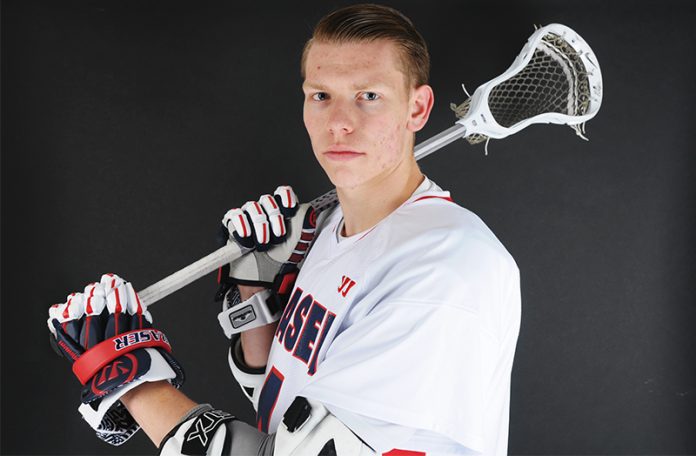
Greg Lunde leads the charge for the Clan

0
Lunde shares the team lead in goals, and is second on the team in points.

“I think we’ve just got to bare down and execute, it’ll just come down to the intangible things like loose ball, hard work, communication throughout our team,” says sophomore Greg Lunde.

He’s talking about what the team has to do to win an important conference game later in the season, one that he figures SFU will need to win if they hope to make the playoffs. The lacrosse team is 1–3 in conference play, and likely needs to win out the rest of their in-conference games (four of them) for a shot at postseason glory.

“We’ve really struggled with scoring on our chances so our defence and our goalies have been playing great so we just got to bare down and execute on our plays and make sure we score when we have the chances,” he explains.

Talking to him, though, he sounds less like a player only in his second year on the team, but a leader — a coach, even.

And perhaps that’s by design. In addition to his role as an attackman on the team, the 6’1 business student also devotes his time to coaching the game he’s played for 14 years.

He started coaching box lacrosse — not field, the version SFU plays — for his club team, the Port Coquitlam Saints. His first students were peewees — 12-year-olds.

“I had an A1 team which was the highest level at the time, so I really enjoyed that. That was my first real experience, so I wasn’t too in a serious position, which was great because it allowed me to bond with the guys, make good connections, and just be myself on the floor. So actually I still kind of mentor and see the guys I coached that first year.”

Throughout the years, Lunde has coached a variety of different teams.

“Second year I coached a bantam team, that was a little bit of a lower division, [. . .] great learning experience and they were a bit more of beginners so I got to tailor my communication and teaching style to more beginner levels,” he notes. “Then last year I had midgets which were 16 year olds, which is quite a jump. They were good guys again and they already knew the game.”

Recently, he’s been coaching with the Burnaby Mountain Selects. Lunde got to travel with the team to San Diego, and was able to specialize, teaching them how to attack.

Just because he’s caught the coaching bug, doesn’t mean he’s not an effective player on the field. Greg co-leads the lacrosse Clan in goals, and is second on the team in points.

Over the years, Greg has represented BC multiple times.

“It was awesome. In peewee, so when I was 12 years old, we actually ended up beating Ontario because Ontario and BC are kind of the two powerhouses. We beat Ontario in the final and that was the first time BC had ever won,” he says. “I played at the provincial level when I was 12, 14, and 16.”

“This season [. . .] I kind of took more of a leader role, and I think the guys saw that.”

However, BC isn’t the highest level he’s played for. That honour, he says, is reserved for Team Canada at the U19 Indoor Games last summer, an opportunity he received through former SFU assistant coach Chris Fox.

“He reached out to me and got a group of guys together. It was a really unique experience because it was more of a handpicked team, and then we got to play against Ontario — Ontario was the other kind-of Canadian team — we got to play against a whole bunch of Iroquois teams, the States, Germany, Israel, teams from all over Europe.”

The team did quite well, even beating the other Canadian team 5–4 in the finals.

“We won gold,” Lunde explains. “We beat the Americans in the semi-final, pretty handedly because the Americans are actually more field lacrosse based, it was box lacrosse we were playing, so we played them in the semi-final, we beat them, and then we actually ended up playing Ontario in the final and beat them pretty marginally, but it was awesome.”

The drive that he’s displayed playing lacrosse, and in coaching, also shows up in his academic pursuits. He entered SFU with a variety of scholarships, including the Gordon M. Shrum entrance award.

“I didn’t really get too sidetracked with social aspects,” he says with a laugh.

When he lists the reasons why he is pursuing accounting as his future career, the player, coach, and academic in Lunde all connect.

“What draws me to that is both, it’s very competitive, for the CPA background, so I’m drawn to it just from that point of view,” Lunde explains. “Also there’s the numbers side of view which I’ve kind of thrived at my entire life, but there’s also the social and client-facing aspect which I really like, because throughout my life I’ve worked in customer service and dealing with clients, so I see myself doing that in the future and helping out clients — potentially going into consulting and seeing their business and how they work.”

But for now, he’s focused on helping his team anyway he can.

“I think last season I wasn’t quite aware of what my role was, I was able to step into a great role — a starting position — and really made an impact, but I was really nervous and didn’t really solidify my role until the middle of the season,” he says. “This season, although I wasn’t officially a leader, I kind of took more of a leader role and I think the guys saw that.”

And though he admits it might be a “stretch” this year, it all comes back to one goal.

“I really want my team to go to nationals.”

Western travellers, beware!

1

[dropcap]W[/dropcap]hen news headlines around the world broke out that Otto Warmbier, 21-year-old American student from Ohio, was sentenced to 15 years of hard labour in North Korea because of “crimes against the state,” I could not feel sorry for him at all.

While the prospect of working 15 years in a labour camp where prisoners are barely fed and routinely tortured is very disturbing, why do we now suddenly care? There is an estimate of over 100,000 people in labour camps in North Korea who have spent their lives in the same country’s work camps which have been accused of housing rape, and where, according to the Human Rights Watch, people have forced labour, starvation, and guard abuse. For some reason, though, we can only think of Warmbier.

Don’t get me wrong — I’m not saying that the American student deserved the punishment he got. We all know that North Korea is a scary place, but that’s the point. If you and I (and most, if not all, of the world) are aware of the harshness of the dictatorship, from having read Escape from Camp 14 or even from James Franco’s (awful) movie The Interview, why did Warmbier put himself in that position?

It’s not too far-fetched to expect someone to research what they are and are not allowed to do in a tyrannical dictatorship before going to one for vacation, or at least to be extra cautious of what they do while in the country. Even then, even if Warmbier hadn’t bothered to research the laws of the country, stealing a political propaganda poster simply seems like the wrong thing to do in North Korea. So why did he do it?

The issue is entitlement. It seems like Westerners feel entitled to special treatment when it comes to committing crimes abroad. Because of their countries’ ‘importance,’ perhaps Westerners feel like they have something to rely on if they get caught.

Just because you’re American does not mean that North Korean laws will not apply to you.

The same is true for Lindsay Sandiford, a British woman currently waiting on the death row for carrying 10.6 lb of cocaine into Indonesia. Indonesia is known to implement harsh punishments to drug traffickers; yet every couple of months we hear of a foreigner asking for clemency.

Am I in favour of the death penalty? Not at all. I think the death penalty, especially for drug-related crimes, should be abolished everywhere. Do I feel sorry for Sandiford, who admitted having carried all that cocaine into Bali? Not really. This is especially because Sandiford has the privilege of having international news outlets covering her case, while Indonesian people don’t.

The same can be said for North Korea. While international news coverage is what North Korea least wants for its thousands of prisoners, what about the many innocent North Koreans who are unjustly arrested for crimes? The American media’s self-entitled pity coverage seems to be what Westerners rely upon when they commit crimes in undemocratic countries. Sadly, this doesn’t always work.

Even though Indonesia and North Korea are very different places — Indonesia is not a dictatorship, after all — both Sandiford and Warmbier should have known better. Both their sentences are inhumane and wrong, but why should the laws in those countries not apply to them?

How I stopped giving a fuck about swearing

1

[dropcap]I[/dropcap]magine a good little girl who always kept her head buried in a book. Throw in frameless glasses and plastic braces, and you’ve pretty much got a picture of what I looked like in high school. Along with that pious image came a pretty strict Christian upbringing and a rule that was ingrained into me from a young age: I was never allowed to swear.

In my house, F-bombs were off limits and an ass was the donkey that Jesus rode into the city of Jerusalem on Palm Sunday. For the longest time, I thought that ‘stupid’ was a terribly offensive word, and gasped when my favourite author released a novel titled Junie B. Jones and the Stupid Smelly Bus.

This mentality, believe it or not, lasted up to my senior year of high school, the period in which teenagers are some of the most foul-mouthed creatures out there as they hate everyone and everything. Despite the fact that I was surrounded by kids who gave out curses like candy, my Christian upbringing prevailed. I was determined to do well in school and make my parents proud.

All that changed when I took a creative writing class in high school, and met one of the sassiest and wittiest teachers I would ever come to know. Along with her sharp humour and blunt criticism of our work came a precise usage of profanity that was utilized to get her point across. Suddenly, swearing didn’t seem evil anymore, but an alternative means of playing with words in my writing. Profanity became the forbidden fruit that I just had to taste.

I was walking home from school one day and stubbed my toe on a rock in my path. “Ouch!” I exclaimed, hopping on one foot like a flamingo. As the pain passed, I felt an inexplicable curiosity flow through me, and I felt like I had to try saying it.

“Fuck,” I whispered in amazement, as I couldn’t believe I was really saying that word. It rolled easily off my tongue, as if it had been waiting to come off it for the longest time. I said it again. . . and again. . . and again. “Fuckfuckfuckfuckfuck!” I guess I had to make up for all of those lost years of not swearing somehow. It was in this moment that I, frankly, stopped giving a fuck about swearing (or rather, gave several fucks away freely).

The rest of the words came out naturally, as all I had to do was take in the atmosphere of high school like a sponge. I eventually learned how to curse like a sailor with the rest of them, as any high school student should.

Well, I’ve spent far too long talking about this fucking shit. Peace out, motherfuckers.

COLUMN| GUESS AGAIN, GRANDPA!: Who says millennials don’t keep up with current events?

0

[dropcap]W[/dropcap]hen I tell people that I don’t read through physical newspapers on a regular basis, it comes as a surprise to most. Yes, I know that you’re reading an article that was written by me inside something that is indeed a newspaper.

My grandfather and I had this discussion the other day, and it quickly became heated. He is the kind of person that reads his newspaper every day with breakfast, scouring through the news sections with typical looks of disapproval. His objections toward the events of the day carry into discussions with my parents. Usually, I idly listen until he brings me into the discussion, asking what I think about various issues.

There were some issues that I had opinions on, but most of the time I was indifferent. I’ll admit that my indifference is my responsibility — I don’t read newspapers often enough to be able to follow major stories that are going on in the world. However, that doesn’t mean I am out of the loop.

This is where my grandpa and I had our disagreement. He swears by newspapers, relying on print media as his window to the world. He constantly laments the consolidation of newsrooms and the death of print. For him, the advent of social media is a slap in the face to traditional newspapers. On top of this, he feels that, despite the fact that we as millennials have more access to news through social media, we really don’t take advantage of it. We just skim over headlines and don’t make an effort to learn more.

Here’s the thing: I am constantly bombarded with news. Seeing as social media has become such a big part of millennials’ lives, news corporations needed to come up with more creative ways to engage the younger audience. Being able to post and share news articles on Facebook has made it easier for millennials to see news of the day — a study by the American Press Institute in 2015 found that 88 percent of millennials get their news from Facebook. Other notable sites for news are Twitter, YouTube, and Reddit.

Grandpa constantly laments the consolidation of newsrooms and the death of newsprint.

The point that my grandfather makes about not engaging with the news is one that I disagree with completely. In this society, there are many more opportunities to receive news, and it’s much easier for us to find answers to the stories that we follow, as long as we make an effort to do our homework.

Social media has cluttered the millennials’ news media landscape. However, despite the massive flux of news stories and new corporations that proliferate on our timelines, there have been some steady trends of news consumption by millennials.

A study entitled “Generation News” by Newsworks and the University of Bath in England found that “74 percent [of millennials] turn to newsbrands to get a balanced point of view,” and a further “78 percent agree their newsbrand introduces them to stories they wouldn’t otherwise read.” With various news brands engaging on Twitter, not only are younger demographics exposed, but they are able to follow updates right from the moment the story breaks.

The biggest benefit to this model of news is that it can enable real-time followings of stories, as opposed to waiting the next day for a full recap in the newspaper. By the time the story hits print, people would have already read and reacted to it. In a digitized age where everything is quick and fast, maybe this is the solution that news needs to keep up with the millennial age.

So, Grandpa, get back to me on your debates about the pipeline and the current state of Middle Eastern politics. I promise I’ll look beyond the headlines and read the stories.

Woohoo, Boohoo

0

Woohoo: Writers

There is nothing more precious in this world than an imaginative writer (except for maybe a dancing carnival bear). Filled to brim with abundant bounties of the most richly promising stories, the writer is nothing short of a blessing to those who lack a scrap of creativity and crave the warming sustenance of entertainment at their bosom and belly.

A writer can weave stories about the human condition that inspire us to new heights of purpose. Alternatively, they can scare the living shit out of us, redefining our fears and nightmares like never before. Or they can simply get us hot and bothered with hormone-boosting erotica privy to get even the most well seasoned nymphomaniac’s rocks off (Ahh, Sylvia Day, what would I do without you?).

In closing, cherish the writers who inspire you because they are the ones who help you realize the beauty and the majesty of this weird and twisted world we live in.

Boohoo: Editors

They are the butchers of prose and the defacers of your most spirited works. Armed with red fountain pens and fuelled with the dark truth that they themselves are incompetent writers, behold the editor: the great defiler of your favourite poems and short stories.

These godless beasts will strip your work of its well-founded and whimsical intentions, and purge it of its rich vibrant sophistication. They are the very embodiment of necessary evil, as your hopes of being published are hinged on their existence. Rest assured, with the right amount of cunning, these foul odious fucks can be overcome with great tactical writing prowess.

Mark Twain himself said it best, “replace every ‘very’ in your writing with ‘damn.’ Instinctively, your editor will go in and change every ‘damn’ to ‘very,’ leaving your piece exactly how you meant it to be.”

Comics!

0

Creator’s Pet (Destiny Hsu)

CP_026_Easter2016

Magical Hot Take (Mark Britch)

original

Mystic Man (Reuben Newton)

Screen Shot 2016-03-25 at 12.16.34 PM

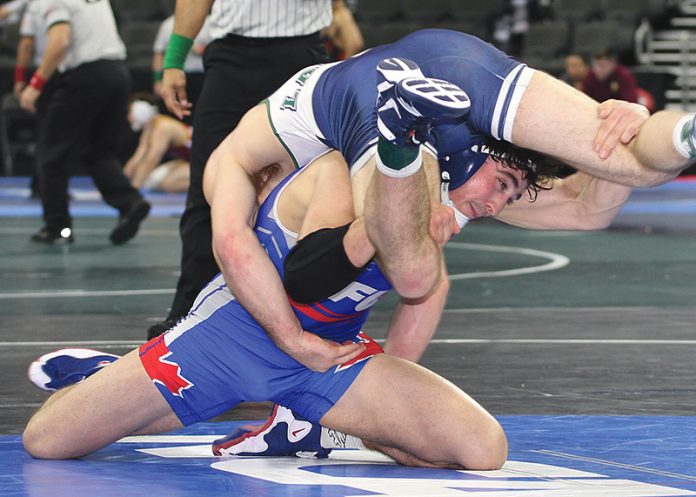
Tyler McLean named All-American

0
McLean battled back from an opening match loss to finish in fourth place.

At the NCAA Division II Wrestling Championships, Tyler McLean battled back from an opening loss to finish in fourth place in the 165 pound weight class. On top of that, he was named an All-American, becoming only the second male wrestler in the school’s NCAA era to achieve the feat.

How did being named All-American feel? “Really good,” McLean said. “It’s something that I’ve dreamed about since I was a kid. So it was really cool to accomplish it.”

Heading into the tournament, McLean was the third seed from the western region, and faced a tough challenge ahead of him in the ultra competitive 165 pound weight class.

“Yeah I was pretty worried, because that weight class had seven returning All-Americans,” explained McLean. “And I haven’t [faced] any of them before, so it was kind of nerve-wracking. I lost at regionals one match [and] I was like ‘Oh boy, this is going to be a tough weight class.’”

Still, McLean persevered. After losing the first match, one McLean argued he “should have won,” he was forced to compete on the consolation side of the bracket, where every match was win or go home.

“When you lose in the championship side, you have to battle back,” he explained. “So then it’s like, do or die. So you kind of have that comfort zone when you’re on the championship side.

“[After I lost the first match] I was like, ‘well, now you just gotta go out and enjoy it.’ Do you wanna get eight [place] or no place? Or do you want to get fourth?”

McLean credits the environment of a National Championship with helping him relax and also stay motivated.

“It was great,” said McLean. “I guess the whole experience, there was tons of fans, it’s something that I’ve never experienced before. Just the environment to have those die-hard fans travel in all across the country and come watch, I kind of got that momentum going and just started enjoying it. I was telling Justin [Abdou, Head Coach]: ‘hey, I’m just going to go out there and have fun.’ [. . .] I was able to relax and just do what I love.”

The goal from now until the start of next season is to prepare the body and mind to win a national championship.

“Lots of lifting,” said McLean on his plans for the offseason. “Got to get stronger, probably a lot of speed work as well. We have the Olympic guys in there, it’s an Olympic year, so I’m going to try and grab all of those guys and hopefully pick their mind on some [techniques].”

SFU Men’s Hockey season review

0
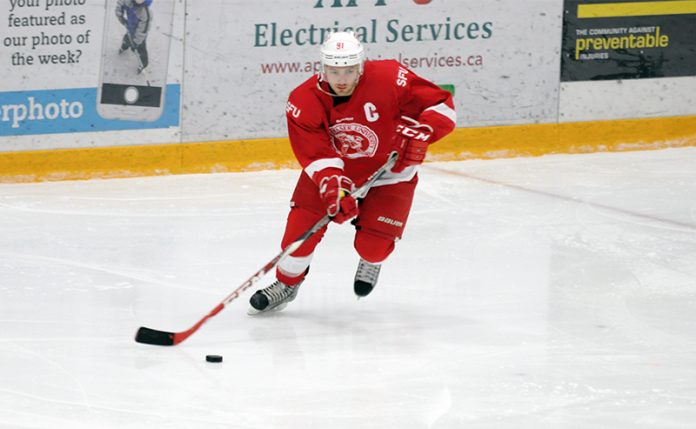
Jono Ceci leaves SFU as the program’s all time leading scorer — as well as in the BCIHL — with a staggering 177 points.

It all seemed to be looking good for the SFU Men’s Hockey team. They had won nine of their last 10 games heading into the tail end of the season, and were looking like they would clinch first place in the BCIHL.

However, they lost three of their last four games in the regular season, with two games in particular standing out as particularly tough losses; they lost 5–0 to Selkirk in a game that could have clinched them first place and the top seed in the playoffs, and suffered a 4–3 overtime loss to UVic in the final game of the season — where they blew a two-goal third period lead. When it was time to head into playoffs, the team lost the first two games of the best of three against Trinity Western, the series-winning goal coming in overtime from Burnaby boy Matthew Vela.

“Sometimes you go on a good winning streak in the middle of the season, and maybe you want to have that going into the playoffs instead of the middle of the season,” said Head Coach Mark Coletta. “I think the mindset might have been too casual within the dressing room and the player group. We prepare and work hard every week, from August right through to the end. So I don’t question their work rate or effort. There might have been a little bit of a mental lapse, let’s just say, that last week and it was tough to recover.”

In the playoffs, SFU played uncharacteristically bad defence, allowing 11 goals over the two games. They also struggled on the powerplay, going one for 19, a .05 conversion percentage.

“Right off the bat, those two things from an analytics side of things equal losing,” remarked Coletta. “From the effort level to the gameplay, I thought we did okay Friday night. I thought we got a couple of bad bounces and I don’t think [Jordan] Liem played his best.

“I thought we outplayed them [in] the Saturday night game, [but with] playoff hockey, you never know what can happen.”

One of the biggest storylines of the season was captain Jono Ceci. He broke the all-time BCIHL scoring record on November 28th, and finishes his illustrious career at SFU with 177 in 108 games through five seasons with the team. However, the team wasn’t able to reward him and the three other graduating seniors with a BCIHL championship.

“I think the mindset might have been too casual within the dressing room [near the end of the season].”

“Any time you have four seniors or one senior graduating, those guys have given a lot to the program and you feel — like I said — disappointment,” remarked Coletta. “But a part of you feels like you’ve let them down as a coaching staff, to bring them a championship. They work hard on the ice, they work hard in the classroom, and those four guys deserve a lot of credit. They [were] part of the building blocks of a program at SFU that’s getting bigger and stronger every year.”

Next year, Coletta expects to score a lot more goals and compete for the BCIHL championship that has eluded the team for the last few years.

“Up front, obviously [we] lose Jono, who’s the all-time leading scorer and led our team in scoring again this year. But guys like Callegari, Basham, Lamont, Tidy — we look to them to carry the torch and have better years. I thought Callegari could have been better, and Basham and guys like that should be full credit for getting 30 points on their own next year each.”

“The future looks bright,” Coletta said on next season. “I would suggest our standards and our goals will be very high next year.”

Album Reviews

0

Young Thug – Slime Season 3 – By Max Hill

Young Thug’s latest is more of the same, which is going to be either a good or bad thing depending on what you think of the divisive rapper’s stream-of-consciousness style.

If you’re already a fan of Young Thug (like me), you’ll find Slime Season 3 to be one of his strongest works — the production is tight and Thugger sounds more confident and flippant than ever. There’s also plenty of quotable lines that will reward repeat listens. It’s not likely to convert nonbelievers, but SS3 is a good entry-point for non-fans who want to give the rapper a shot.

Highlights include: “With Them,” “Slime Shit,” and “Tattoos.”


Radio Radio – Light the Sky – By Jessica Whitesel

Light the Sky is the first English-language album to be released by Canadian hip-hop group Radio Radio. Their earlier albums featured rapping in Chiac — a variety of Acadian French.

I will admit that I really wanted to like this album. I love supporting Canadian music when possible, but Light the Sky makes that really hard. I feel like trying to break into the English language market wasn’t the best choice they could make. They do have really good backing tracks and they clearly know what they are doing in terms of putting an album together, but vocally they sound like the bastard child of Classified and Chromeo. This vocal sound works much better in Chiac than in English.

Highlights include: “My Dance Floor,” “Happy Hustler,” and “Remodel (Mike Holmes).”

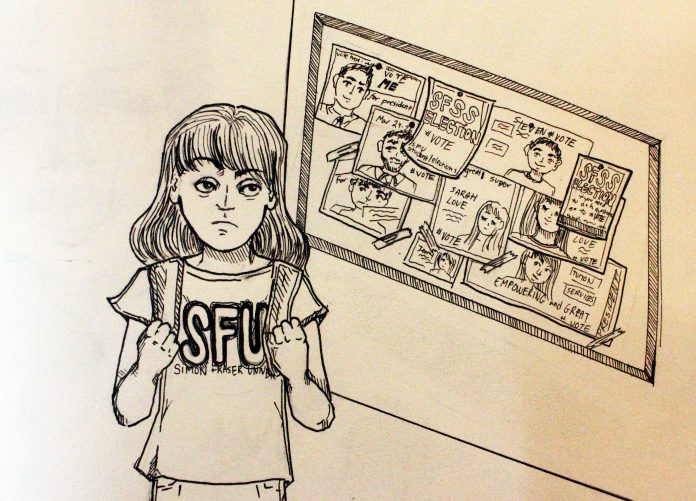
Why you should have voted in the SFSS elections

0

[dropcap]M[/dropcap]ore than four out of five of you reading this didn’t vote in the SFSS elections.

Part of me doesn’t blame you. As someone who has spent four years of his undergraduate degree trying desperately to get SFU students to care about stuff, I admit the SFSS is a tough sell. It’s boring, it’s crooked, it’s full of buzzwords and tedious meetings and overly enthusiastic students with way too much time on their hands. Getting involved is a tall order, especially when you’re not sure you even want to know what all the fuss is about.

But here’s the thing: very few of you likely understand how much power the SFSS has, and just how much money they are taking from you every semester. And that is not okay.

Again, this isn’t really your fault. The SFSS is notoriously difficult to learn about, despite its best efforts at outreach. For example: did you know that the SFSS’ budget for the past financial year was 2.5 million dollars? Or that only 24 people ran for the SFSS Board of Directors this year, a board that’s meant to represent roughly 24 thousand students? I’m guessing the answer is no.

Even if you’re not moved by statistics or inadequate attempts at democracy, you’ll probably be interested to know that, if you’re an undergraduate student taking a full course-load, the SFSS takes $458.64 from you every single semester. That’s more than it would cost to buy a new Playstation 4.

This isn’t necessarily a bad thing. Plenty of things the SFSS charges you for go towards things you probably want, like your U-Pass, funding for campus clubs, and your health and dental plan. The issue here isn’t that the price tag is too high — it’s that few students seem to understand that there’s a price tag at all.

The less students care about what the SFSS is doing, the less they will see themselves represented in its actions.

For whatever reason, even attempts by regular students to get us to care about SFU tend to fall flat. Remember No to Build SFU, the movement that voiced opposition to the incredibly expensive SFSS project to build a student union building and stadium? Despite their best efforts, the last SFSS Annual General Meeting attracted about one percent of the student population. And the project passed with flying colours, adding another 10 bucks to your semesterly fees.

Just to clarify, I’m a lot more ambivalent about the Build SFU project than many others. But this inability for people to drum up significant opposition for a multi-million dollar project — one that should have been more controversial than it is — is clearly a sign that people are not engaged at SFU.

All of this is a shame, because despite how boring and fundamentally out-of-touch the SFSS often is, they have a lot of potential. The student society is meant to represent the interests of the SFU students in a way that administration and faculty simply can’t.

They have the power to lobby government on issues that matter to students, such as clearer sexual assault policy, environmental action, and increased funding for problems like deferred maintenance. They negotiate with the university on tuition hikes, student resources, and labour disputes. They spearhead campaigns to address discrimination, accessibility, and equal rights for all students. And, like it or not, they choose how best to spend your money.

When we dismiss student politics and elections as unimportant and boring, we’re giving the SFSS carte blanche to act in whatever way they want. And the less students care about what the SFSS is doing, the less they will see themselves represented in its actions and policies.

So while you may shrug off election season as just another pathetic attempt at making the SFSS seem relevant, keep in mind that they really do have the power to make this campus a better (or worse) place for all of us. But until more than only out of every five of us is paying attention, they won’t be able to.