
Creator’s Pet (Destiny Hsu)

Seagull Square (Jill Mandrake)

Mystic Man (Reuben Newton)

Creator’s Pet (Destiny Hsu)
Seagull Square (Jill Mandrake)
Mystic Man (Reuben Newton)
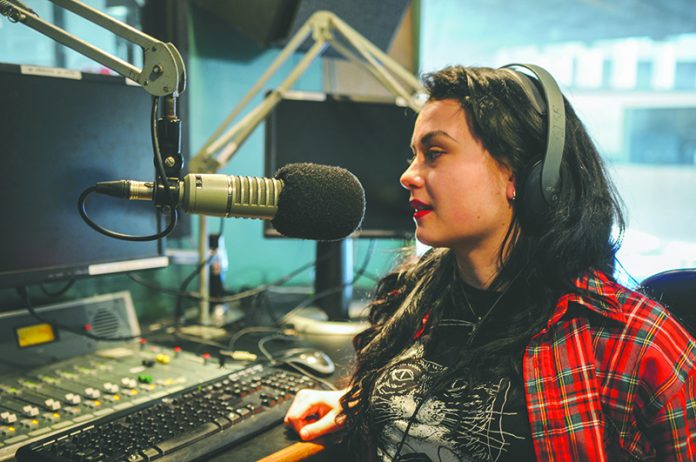
Twenty-two year old Kitty Cooke is a communication and archaeology student, DIY enthusiast, and the co-host of CJSF’s feminist radio show, IntraVenus. Sassy and smart, Kitty sees her communication and archaeology education as her pathway to educating others on culture and anthropology.
In her final semester at SFU, The Peak sat down with Kitty to talk about her experience in broadcasting with CJSF, and how she hopes to engage with world with media.
The Peak: Tell us a bit about yourself.
Kitty: I’m in my [. . .] first semester of my fifth year. I am a communication major and archaeology minor, and they go together better than you would imagine.
P: How did you first get into broadcast and involved with CJSF, and what attracted you to radio?
K: I first got into broadcast when I was in high school. I did TV production. You’re only supposed to do the class once but I took it for almost two years, just because I was good at doing the on-camera broadcast, and I’m like ‘hey, this could be a really cool career for me.’ So I also go to BCIT and I study broadcast journalism there part time, because for some reason I didn’t want to do the full-time program. [. . . if I did] I would have been there and never at SFU.
P: And how did you get involved with CJSF?
K: Well my first semester, my dad, in a weirdly insightful moment, was interested in my life and said, ‘You should do your school radio station,’ and this was back in 2012 and I’m like, ‘Okay Dad, I’ll go check it out.’ Then last year, January of 2015, my friend who had already graduated said, ‘Somebody I know needs help with the radio station show,’ and so I went and I sat in on the show and did some presenting. [. . .] I did it most weeks after that and then [Laura Scheck and I] took it over. So I’ve been doing that same show for like a year and two months.
P: Tell us about the show, IntraVenus.
K: Well, we do a lot of live stuff; my favourite segment is the feminist news update [. . .] because it forces me to be engaged with what’s happening in the world in feminism and women’s rights [. . .] It’s just such a fun show to do. I really like talking about feminism. [. . .] Because of the show, I’ve become pretty politically-engaged, like learning more about politics and reading about it, and being like ”This is actually super interesting; I wish I had been more involved my entire life so far.’
“I want to be the lady Bill Nye — but for anthropology and humanities” – Kitty Cooke
K: I probably do. I grew up living with my dad and my brother, so I was around a lot of dudes, but I was also around my grandparents a lot, and my grandma’s not really a feminist. She says she is, but she’s not. But she’s a very strong and independent woman, and I just found that pretty inspiring. [. . .] What got me into feminism is when I realized I was queer when I was in my super early teens. I was like, ‘I’m going to be treated differently about this for the rest of my life because I am a woman and because I’m also queer,’ so that’s [makes me think that] that I can’t just pretend [this] isn’t happening, because I can’t change the way I am, so I might as well become engaged.
P: Why are these topics so important for you to broadcast at SFU?
K: I want to say I chose SFU, but really this is the only school I applied to, because applications cost money [laughs] I really liked the idea of SFU because [it seemed like] a super politically-engaged and socially active school (which is not that true, but I’m not going to throw shade at a school that has housed me). SFU has got a lot of flaws, but it also has a lot of really wonderful things and a really good community, especially for women and women’s centres and queer people at Out On Campus. And at the time that I was starting university, I was going to Out On Campus a lot because I was like ‘whoa, there are people who are like me and super femme but also super queer and they’re also seen as not legitimate as members of the queer community and it’s so weird!’
P: That’s exactly it; SFU has this really interesting culture that you don’t expect to find.
K: And it’s so cool because we have so many clubs [. . .] there are so many religious groups and cultural groups, and queer people and women and it’s just such an assortment of [different groups who] all seem to get along.
P: What have you learned from hosting a radio show?
K: Radio is not my desired path in media. But I knew that before I started. I really want to get into TV, which kind of ties into all my post-graduation plans [. . .] and my life plans. I really want to have a TV show for kids — more anthropology-focused. I want to be the lady Bill Nye — but [for] anthropology and humanities — because I think that’s equally as important as science. The arts and stuff are so key to being a [well] rounded human. You can’t just focus on hard academia; you also need to learn about cultures and how they change and grow. And that’s how archaeology ties into communications, because a lot of it is about culture and societies and how they’ve changed and what made them the way they are.
P: What would you say to students who are also interested in broadcast?
K: Oh definitely do it, that’s really the main thing. [. . .] When I got involved I [was] like ‘Wow, everyone is super nice, like weirdly nice,’ and they want you to get involved, and they want to make good radio, and they want you to learn and be doing stuff that makes you happy, and be making content that makes you happy [. . .] And the other thing, you don’t actually have to be on the radio to be involved. There are people who [. . .] just want to be involved, and there’s lot of stuff you can do at the station.
“. . .with the radio, creating stuff where there was nothing [. . .] it’s so magical” – Kitty Cooke
P: What else could students do?
K: You could do PR; we have a lot of graphic stuff; we have production stuff which is really interesting [. . . like] sourcing and researching content.
P: So you’re a hard-core student and you host a weekly radio show; what do you do in your spare time?
K: I do a lot of making stuff, like my jacket. I really like DIY culture, which is a really big part of feminism, coincidentally [. . .] but I do a lot of knitting, crocheting, embroidery [. . .] So yeah, I like making stuff, I love it [. . .] It’s like with the radio, creating stuff where there was nothing [. . .] it’s so magical.
P: How do you feel your education and broadcast work come together?
K: Just the whole idea of putting information out there and media stuff is so related to communications, especially with feminism, I get to integrate a lot of what I learn in school into what I actually talk about, which is all the stuff I’m interested in, which is why I do it. One course in particular that really helped me with being intersectional in my feminism and learning more about intersectionality was Race and the Media [CMNS 452]. It was a really good course, and all the readings from that class I have used on the radio.
P: Has your time at SFU changed you?
K: I’m definitely more politically and socially engaged than I was, which was one of my goals by choosing this school, because that’s what [SFU] is known for. But it wasn’t necessarily through my studies, just kind of the environment and who I made friends with which kind of helped encourage that.
P: Is there anything else you want to add?
K: [IntraVenus] has had many iterations, transformations throughout time. Even in the past year we’ve changed focus so much just because it’s different hosts than when we first started [. . .]. So it’s really interesting how the content of the show and what we focus on really changes depending on who hosts it.
So who even knows what the next generation of IntraVenus people will be focusing on? So I am a feminist, with very strong beliefs, but I was not interested in being any form of educator or wanting people to see my point of view. I just really wanted to do entertainment news because that’s almost never depressing, so that’s one thing that’s really changed in my journeys as a university student. I wanted to do entertainment news hosting, but now I want to have a show that makes an impact on kids that they can think back on the [same] way I think back on Bill Nye the Science Guy [. . .] It’s super important to me that kids are getting quality education, but it doesn’t have to be boring.

Think back to your freshman year. Were you intimidated? Did it take you any time to adjust to your new surroundings?
It didn’t trouble Mackenzie Hamill at all. The first year business student from Oakville, Ontario won the 1,650 yard freestyle at the NCAA Division II Championships, becoming the first SFU athlete to win an NCAA championship in men’s swimming.
“It was certainly like a rush of joy, excitement — a bunch of different emotions,” said Hamill on winning the national championship. “But I think my favourite part of the whole thing was seeing all of my teammates and the smile on their faces and them cheering and how happy they were for me.
One of the other best parts was whoever wins the event, that coach gets to hand out the [awards]. So I think seeing the smile on my coach’s face and knowing that I just won and that this is my first year and hopefully I can continue to do that for the next three years, it was a huge accomplishment. It really hit home when I was standing there on the podium.”
Hamill started swimming around the fifth grade, continuing throughout high school before deciding to come here to SFU and start his collegiate career.
“I really wanted to venture outside of Ontario. [. . .] So I emailed Liam Donnelly, started talking to him, and then realized that the main distance coach here was Cory Beatt, and he’s a really successful coach. He’s coached Brittany Reimer, who’s one of the fastest females ever in Canadian swimming. I came here for a recruiting trip last year in October and really liked it, [and I] really liked the coaching staff.”
Hamill credits his teammates for helping him adjust quickly to the team and help motivate him.
“It’s a really open atmosphere,” he explained. “Coming in this year, knowing that we had one guy qualifying for [National Championships] last year, now we have six, it’s been a huge motivation for everyone. Everyone really wanted to make this year, and everyone saw it was possible.
“Every teammate really pushed each other to be the best we could possibly be this year,” said Hamill.
After a few strong performances, including the Clan Cup hosted here at SFU, Hamill qualified for the National Championships. There he raced in the 500-yard freestyle against fellow teammate Adrian Vanderhelm.
“My favourite part of the whole thing was seeing all of my teammates and the smile on their faces.”
“It’s definitely a little more competition, a little stiffer. But we’re both teammates. So if he wins or I win, it doesn’t really matter. Well — it matters to us, but we’re happy for the other one. There’s no rivalry really between us.”
The final event was the 1,650-yard freestyle.
“The one guy who won it last year didn’t have an insanely fast swim in the morning,” said Hamill. “So when I was looking over sort of the heat before the actual race, I saw that if I had a really good race, it would be possible to win. So I really set my focus and realized that it might be possible to win right before the race.”
From there, the strategy aspect took over.
“I knew the guy beside me was going to be with me the whole time. And then on the other side of the pool, I saw one guy way ahead. So throughout the race I was aiming for first, but when the other guy started to take off, I thought I’d just start racing the guy beside me and sort of stay in my race and not let that interfere. And when I saw things sort of die out right before the end I started making my push and thought that — depending on what the time is — I actually might be able to win it.”
The win and his success throughout the year means that Hamill has qualified for the Olympic trials in Toronto, where he will be competing against swimmers such as Olympian Ryan Cochrane. There, if he does well enough, he could be off to the 2016 Rio Olympics.
“There’s going to be a ton of fast people there that I’ll be racing against,” said Hamill on Olympic trials. “The 1,500 [what it’s called in meters] has been Canada’s best event ever since Cochrane made it back in 2008. It’s not really realistic to make now, but it’s definitely something that I would like to set my sight on for the future.”
So what are his future goals for here at SFU?
“I’d like to be able to continue to keep the national championship for four years. That would be pretty cool,” said Hamill. “To go undefeated at that meet and at that event [would be great]. But really, my main goal is to set the record, which is far off for next year, but I feel like by my senior year I can definitely get it.”
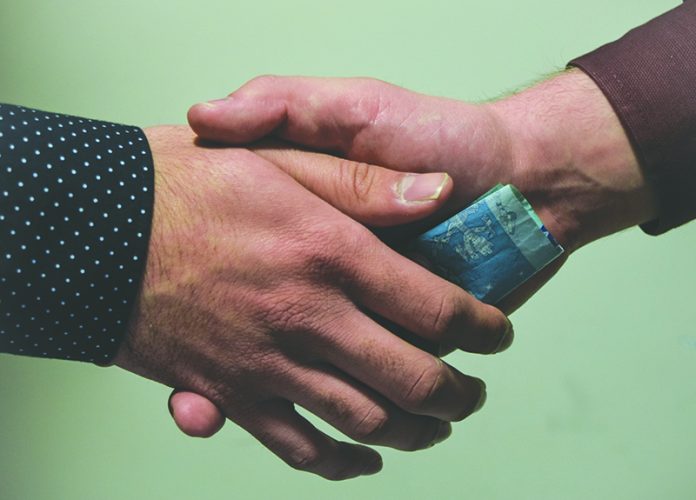
In a collection of essays titled Broken Windows: Why Culture Matters in Corruption Reform, SFU Political Science professor Andy Hara sets out to research the root causes of corruption and critically analyze why common attempts at reform remain ineffective.
The research is split into two volumes — one published in March 2016, and the second to be published this summer — that are essentially compilations of various case studies written by a number of experts and threaded together with Hara’s narrative and analysis. Each case study focuses on corruption in one country.
In an interview with The Peak, Hara spoke about his purpose for conducting the research. “The question we’re trying to answer is, if everyone knows corruption is such a major issue for development, how come we haven’t made any progress?” he asked.
What sets Hara’s study apart from previous academic literature covering corruption is that, instead of simply detailing the extent to which corruption exists in various developing countries, his research seeks to use historical information to critically analyze past attempts at corruption reform, and then suggest more effective strategies.
In his introduction, Hara writes about the World Bank’s cost-benefit type approach to corruption: “that an individual will engage in corruption if they see a benefit of taking a bribe that is less than the consequence of enforcement.” He continues by arguing that it has proven to be ineffective numerous times in the past. He counters this economics-focused approach to corruption reform by suggesting a more culture-centered reform program.
Hara’s research includes three developing countries where corruption is at a minimum — Singapore, Hong Kong, and Chile — and he detailed three commonalities between the successful case studies.
“There were decade-long efforts to not only change formal rules, but also change the values of the government and the private sector at large to be more honest [in these countries],” he said.
Additionally, all laws passed were equally enforced at higher levels of government, such as the show trials in Singapore where Lee Kuan Yew’s cabinet and union leaders were tried, reinforcing the idea that no one is above the law.
Finally, all three cases showed an ongoing effort to reinforce honest social values. In the case of Chile, the most common university degrees are liberal arts or law degrees, the entire culture is essentially based on the law and the legal process.
When asked about how his study can be applied to corruption seen in Canadian politics, such as the senate expense scandals that made headlines last summer, Hara replied that the major news coverage of the incidents serve to reinforce what his research concludes — that the nationwide concern over the “minor infractions” speak to Canada’s strong societal values against corruption.
“I would say that Canadians should take pride in the fact that their system works,” concluded Hara.
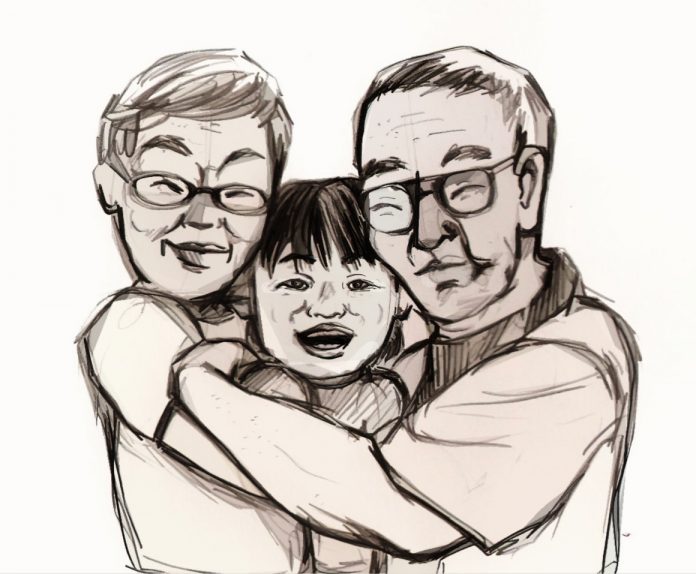
[dropcap]N[/dropcap]owadays, even your grandpa can get picked up as an Internet sensation overnight, and then turned into an online meme. Yes, Sad Papaw, I’m talking about you and your disgraceful grandchildren.
But all hilarity and memes aside, the minute that a picture was posted to Twitter of a defeated grandpa eating with only one grandchild at dinner-table after making burgers for all his six grandchildren, the Internet was awash with feelings of sympathy for him. Even though it was later revealed that there was a miscommunication between “Papaw” and his grandkids, it still sparked something deep within the hearts and minds of people that encountered this photo, including myself.
I wanted to address that throughout the course of this column, the “grandpa” I interacted with wasn’t my grandpa at all; in fact, I talked to many different people from my grandpa’s generation. With each week, I was able to address various topics and I got to see the differences between the generations — how we were the same and different, and ultimately, how things have changed over time.
My grandparents from both my mom and dad’s side have since passed on, all leaving legacies on my family and who we are. My mom’s father passed away when my mom was 16, so I never had the opportunity to meet him. My dad’s mother passed away when I was 7, followed by his dad when I was 16, and then my mom’s mother when I was 17.
One night, my maternal grandmother, before she passed away, looked at me with the endearing eyes she always had for me, and told me that she loved me. We were one month away from my 18th birthday when she said this. Then, heaving a laboured sigh, she repeated one thing that she always told me every time she saw me: “Always be thankful for your family.” She passed away a few weeks before my birthday.
Unlike many of my peers, my grandparents never lived to see the day I graduated from high school. They never saw my excitement when I received my first university acceptance letter or my first scholarship. They never got to ride shotgun in a car after I got my license. They will never see me graduate from university, get my first real job, get married, and start a family. And I will never get to hear my paternal grandmother’s singing voice, talk to my paternal grandfather about golf, or hold my maternal grandmother in a loving embrace ever again.
These simple words that I have always taken for granted, “Always be thankful for your family,” tore a hole through my heart when I saw the picture of the lonely Papaw. Even though it may have been a miscommunication and his grandchildren didn’t mean to not show up, the sentiment remains the same. You should always be thankful for everything that you have and everything that you are.
This column took me down memory lane time and time again, reminiscing of past conversations with those who have had a profound impact on my life. There isn’t a day that goes by that I don’t think about them and think about what life would be like if they still were here with me. And though I can’t turn back time, I am thankful for what they have given me: support, love, and a solid family to rely on.
Our grandparents, ever patient with us as we found our way through the world, taught us so much and showered us with unconditional love, and probably more gifts than we could ever imagine. The one thing we can do for them is to show them our gratitude and return their patience, especially in their times of need.

After the conclusion of Furious 7, it would have been safe to assume that the Fast and the Furious franchise had driven itself from our lives for good. Alas, living in a world bereft of imagination and innovation in the medium of film, it should come as no surprise to anyone with a pulse that three more sequels to this vehicular crime saga have been announced for release as early as April 2017.
While audiences may think they know what to expect from the long-standing and expedient car series, recent reports suggest the series’ new direction will be nothing short of groundbreaking with its addition of a famous Biblical icon to its prolific cast of characters.
That’s right, folks: grab your cross and hit the NOS, because the son of God has joined the race.
A year from today, Jesus Christ will be cruising his way to the silver screen with Dominic Toretto and his gang of adrenaline junkies for yet another crazy action-adventure, filled with objectified half-naked women, forgettable hip-hop singles, and enough car porn to make any gearhead spurt motor oil.
The recent details on the film’s newest cast member was made known to the public last Friday, during a press conference led by long standing Fast and Furious star and musclebound potato-human hybrid, Vin Diesel.
“This time it ain’t about being fast or furious,” claimed Diesel with a wry grin, “It’s about taking the series to a whole new level. Fans can expect high-flying action sequences and more spiritual exploration than they ever wanted to experience before.”
With the effects of the announcement still rippling through the fanbase, rumours have already begun to swirl about the film’s plot and the loony direction it seeks to take the once grounded street racing franchise.
One such rumour is that the Toretto and his daring team will find themselves in Israel tracking down an old arch nemesis hell bent on exposing the United States’ nuclear codes to a covert terrorist organization, known only as the JUDAS Corp. It’s speculated that Jesus will join the team after facing Toretto in a high-stakes street race in his sick “Holy Roller,” rumoured to be a pimped out white and gold Zenvo ST1.
Diesel also teased fans that the casting for Jesus Christ was already in its final stages of completion. A rep for Universal Studios confirmed the role of the Biblical OG was shortlisted to Academy Award-winning beardos Jared Leto and Joaquin Phoenix. Yet similar sources have also alleged that the film’s role could also go to walking consolidation of lube and pubic hair, Russell Brand.
With the Fast and the Furious franchise set to continue until 2021, it has left many to wonder whether Jesus’s addition to the cast is a blessing in disguise for the series or a sign of the times. With the fate of the billion dollar series in the balance, all fans and executives can do is pray the series doesn’t stall out.
1) Don’t google your symptoms. Ever. Or watch House. And for the love of God, do not do both simultaneously unless you want to end up in the ER at three a.m. with some erroneous phantom disease.
2) If someone hurts your feelings, don’t dwell on it. As my friend Joe always tells me, just punch them in the dick (or tit) and go get some fucking ice cream.
3) Alcohol isn’t a quick fix for problems — most of the time.
4) Don’t over think things. Keep it simple, stupid.
5) Let me be the first to tell you: your douchey crush, whom you want to believe is ‘different,’ is more than likely just a douche.
6) Sleep heals a lot of ills. Nothing good happens when you’re overtired. Seriously though, if you find yourself morphing into an angry, bitchy, evil gremlin past 1 a.m., you’re not alone. Go to bed; there isn’t a bottle of wine, genitalia, or impending assignment worth missing out on your snooze time for.
7) Just because someone doesn’t perceive the world in the way that you do doesn’t make them any less of a great person. Just because someone is a great person doesn’t mean you can’t cut them the fuck out of your life if they’re not enriching it.
8) People show you very quickly exactly who they are. Be brave and respect yourself enough to accept it. Don’t waste your time trying to change people.
9) For the love of God, go to class! You’re paying for your education, nimrod. That joint and Netflix will still be there when you get home.
10) Don’t shame yourself for speaking your mind, having feelings, or changing your mind. Don’t let anyone make you doubt yourself for doing any of these things; if they do they’re probably shitty people and you should just go rule the world or something. Peasants.
11) Don’t count your calories. Eat what you like, eat well, smile, and shut the fuck up about it. Stop torturing yourself.
12) Know when to let go. (Hint: as soon as you ask yourself if it’s time to let go, it’s probably time to let go.)
Editor’s note: The Peak recognizes Burnaby Mountain as unceded Coast Salish territory. However for simplicity we will refer to the land as Burnaby Mountain throughout this article.
On top of Burnaby Mountain, SFU could have been a shining example of the white tower of academia, looking down on the masses. It is physically separated from the world around it, and if it chose, it could keep to itself.
But over the past 50 years is the university has been a magnet for protests and controversy. Faculty and students have weighed in on issues that they care about, and regularly lend their voices to the causes that they believe in. For better or worse, SFU has become a place of engagement — but not necessarily in the sense that SFU marketing has pushed for.
The university can’t afford to remain quiet, no matter how much it wants to.
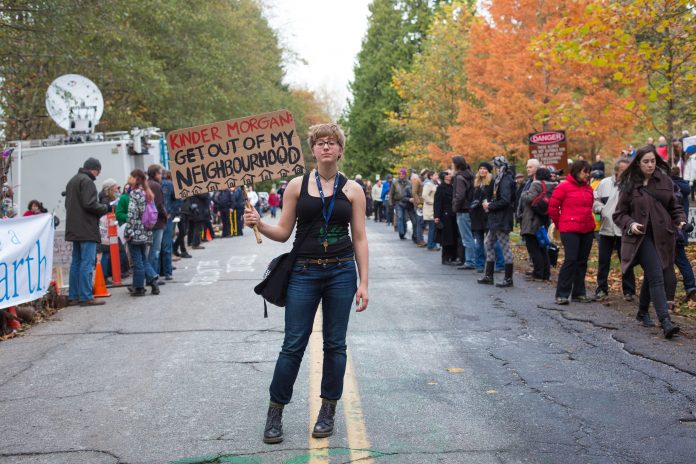
In November 2014, that kind of engagement reached a boiling point when SFU students, faculty, and concerned members of the public protested the work being done by Kinder Morgan crews on Burnaby Mountain. Kinder Morgan Canada owns the TransMountain pipeline system, which has pumped crude oil from Edmonton to Burnaby since 1953 and stores oil in a tank farm at the base of Burnaby Mountain.
The work was being done to assess a route for a new expansion to the pipeline that would add 980 km of new pipeline and almost triple its capacity to 890,000 barrels a day. Kinder Morgan claims that the project would bring in significant economic benefits to the province, but various groups have opposed its construction due to safety and environmental concerns.
Among those against are the City of Burnaby, the SFSS, the SFU Faculty Association, and SFU itself. Final arguments about the project were submitted to the National Energy Board earlier this year, and the National Energy Board (NEB) has until May 20 to make a recommendation to Governor in Council.
This story of SFU and the pipeline has taken many twists and turns, and has drawn an incredible breadth of communities into the controversy. But among all of the disagreement, posturing, and media frenzies, a theme separate from the pipeline itself has become clear: this issue is testing how SFU supports its community, and the rest of the province is watching.
The university can’t afford to remain quiet, no matter how much it wants to.
The Mountain
Even atop Burnaby Mountain, there wasn’t any real way that SFU could have ignored the pipeline completely. The original route of the new pipeline would have taken it through Burnaby streets, much like the existing one between the Burnaby Tank Farm and the Westridge Marine Terminal.
Neil Abramson of the SFU Faculty Association explained in an interview with The Peak that, as he understood it, Trans Mountain was “going to have to close one of the three major entrances to the university for a long period of time.”
Perhaps understating the situation slightly, TransMountain spokesperson Ali Hounsell explained that “one of the things we heard from community members who live in that area is that they would like us to consider alternatives.”
Whether Trans Mountain will be able to handle any potential spills remains a huge issue in approving the project.
Which is understandable, considering the damage that a spill in 2007 did when construction crews ruptured a relatively small pipeline buried under the street. The spill released 234,000 litres of oil onto houses, the street, and the Burrard Inlet. There has since been another spill at the Westridge terminal in 2009, but the oil didn’t make it directly into the Inlet.
Whether Trans Mountain will be able to handle any potential spills remains a huge issue in approving the project. The Province of British Columbia has called on Trans Mountain to have a “world-leading marine oil spill response,” in addition to four other conditions in order for it to consider the pipeline.
Hounsell acknowledged that Trans Mountain hasn’t yet met the conditions that the province has put forward, but that they are “confident and hopeful that we can do that in time to move forward with the project.” She offered that Trans Mountain has already received an award for working in “environmentally sensitive areas” when they completed an expansion in Jasper National Park in 2008.
The award was bestowed by the Alberta Emerald Foundation, an organization that boasts that it has “created a legacy of elevating the environmental achievements of our province, setting an example for all to follow.” Among its sponsors are the oil companies Enbridge, Shell, Syncrude, ConocoPhillips, ATCO Gas, Cenovus, and Suncor.
The specific route and environmental damage aside, there are still serious implications for SFU if the pipeline is built. The fact that there would be increased oil transport and an expansion to the Burnaby Tank Farm means that a spill or fire there would be more difficult to control, something that SFU has taken great issue with.
In an official statement to The Peak, SFU said that it is “concerned about the ability of Trans Mountain to respond to and resolve a major fire given the evidence provided by Burnaby’s Fire Department that they have neither the resources nor mandate to respond to a fire event at the Burnaby Mountain facility.” The Simon Fraser Student Society (SFSS) has voiced similar concerns, leading both organizations to become intervenors in the National Energy Board hearing process. So far, SFU states that it requires a more comprehensive risk assessment on the tank farm and it “is not willing to accept an increased risk to its community.”
The politics and the money
It’s clear that having a new pipeline installed near Burnaby Mountain is not without its hazards, but the process in of itself has another completely different kind of influence on SFU and the surrounding area. For one thing, Trans Mountain claims on its website that it will “maximize Aboriginal, local, and regional employment opportunities” for the project. Over the coming two years, it says that it will hire the equivalent of “37,000 direct, indirect, and induced jobs per year” the pipeline is operational.
Trans Mountain has also taken other approaches to conferring a financial benefit to whichever communities participate in their project. The company has been giving money to cities like Hope, Kamloops, Merritt, and Abbotsford in order to “compensate for the disruption caused” by the construction of the pipeline. They’ve also offered money to post secondary institutions, with Kwantlen Polytechnic University accepting an offer in June 2015 for $300,000 to be given over 20 years, only if the pipeline is approved. In short order, KPU students vowed to refuse the scholarships that would be funded by that donation, and the Kwantlen First Nation’s opposition to the project eventually pushed KPU to withdraw from the agreement just months after signing it.
Thomson River University accepted an even bigger offer of $500,000 over 20 years, though some faculty are calling the move embarrassing.
Kinder Morgan has also been named in a list of oil companies that have given donations to the BC Liberal Party.
SFU hasn’t received money from TransMountain, but its faculty have given the project a lot of academic attention. In the earliest example, Kinder Morgan hired SFU’s John Clague and Doug Stead in 2014 to conduct a study on the route the pipeline may take through Burnaby Mountain or the streets. At around the same time, SFU’s School of Public Policy published a report on the economic costs and benefits of the pipeline expansion project, finding that the pipeline might only provide a third of the jobs that it promises. The document concludes that “the pipeline project is not in the economic or public interests of the citizens of BC” and recommends that the decision-makers of BC “reject this pipeline.”
The next year, another study was published by SFU and the Living Oceans Society that found that Canada would incur a net cost of $4.1 to $22.1 billion if the new pipeline is built. The authors argue that the persistently low price of oil and the failure of the project to “provide any estimates of many of the potential economic, environmental, and social costs” causes the project to not meet the NEB criteria of being “clearly demonstrated to be needed” and “clearly found to be in the public interest.”
The vocal opposition
Throughout this development, there have also been intensely emotional moments. Concerned community members have endured personal risk to communicate just how seriously they oppose the project.
SFSS VP External Relations Kathleen Yang recalls that in November 2014, “there were so many SFU students that were camping on the mountain, [who] were actively taking a role in opposing the pipeline.” SFU faculty stepped up to the bar as well, with several members doing enough to get onto Kinder Morgan’s radar. Professors Steven Collis, Lynne Quarmby, and former professor Alan Dutton and others were the target of a multi-million dollar lawsuit for delaying the Trans Mountain pipeline. Quarmby was also later arrested with over 100 others for continuing to protest on the mountain after Kinder Morgan was granted an injunction.
In an official capacity, the SFU community has also been participating in the NEB hearings. The SFSS and GSS presented their final arguments in late January this year, with the SFSS later holding a rally outside. That Saturday, SFU students Mia Nissen and Amy Widmer were arrested along with UBC student Destiny Sharp for trying to enter the NEB hearing room. Hounsell said that she was unsure whether TransMountain knew students were arrested at the hearings.
SFU also continues to host events with an unapologetic anti-pipeline message. Only in the past month, a climate parade started at SFU Woodwards, Naomi Klein came to speak to the issues of climate change as part of the SFU Vancouver Public Speaker series, and the university hosted a “Carbon Talks” event in partnership with the David Suzuki Foundation and the Centre for International Governance.
Working together as a community?
Over the past two years, the SFU community has struggled with the pipeline expansion project. In that time, it has become clear that many different groups have a variety of reasons for opposing the pipeline. They claim the economics are unsound, there are huge questions about safety, and the environment stands to lose big time if there is ever a spill, not to mention from the increased emissions from the tar sands. So with all of this put together, wouldn’t it make sense for SFU to engage with the SFSS, GSS, SFUFA, and other groups and students who want to get more involved?
On the other side, Trans Mountain certainly feels it has been doing its part to engage the public. Hounsell explained that SFU students “were certainly included in our invitations to the open houses and the various activities that we held since 2012.” As part of the decision-making process, Hounsell said that “sitting down with people and really trying to understand their concerns and questions is the best way to approach these things.” They also note that the “offer continues to be open to sit down and meet with” the public. To address the concerns with spill response, TransMountain held an emergency response exercise at the Westridge terminal which SFU participated in.
So it’s perplexing to see that while Trans Mountain has been spending a lot of energy meeting with people who violently disagree with them, SFU has remained relatively silent; it didn’t even present an oral argument to the NEB about the pipeline. SFU could be using its influence to help community members get over the challenges of becoming more involved.
SFU Faculty Association’s Neil Abramson told The Peak that even though his association made a public statement and have asked SFU to divest from fossil fuels, he considers those to be “symbolic gestures that, in a way, are [a] very very low commitment” because they “don’t really impact the lives of the people.” For the most part, in his experience, people at SFU are averse to taking action that changes their livelihood, even when presented with an opportunity.
But students are also affected by the mountain of new responsibilities they have when they are studying. SFSS VP External Relations Kathleen Yang spoke to the fact that even though students do care, she feels “it’s been a longstanding systemic issue, where it can be really difficult to be ‘engaged’ at SFU because of all the things that students have to deal with in their lives.” In order to change that, Yang says “we need to look at starting to dismantle the structural barriers that are preventing students from getting involved and taking action on campus.”
When asked if they were contacted by SFU or TransMountain about their organization’s position against the pipeline, Yang and Abramson didn’t mince words.
Yang answered that the SFSS has not “received any correspondence from Trans Mountain or from the university.” Similarly, Abramson said that they haven’t been contacted by Trans Mountain and he “didn’t think [SFU] noticed” when the SFUFA made their statement. He also conceded that he doesn’t “think there’s ever been a gathering of the university organizations that are opposed to this pipeline.”
The role we need to play
This pipeline is about so much more than the oil it is going to carry. The controversy around it has found a way to impact institutions and cities across the Lower Mainland, and it’s clear that SFU will be inconvenienced and put at risk if it is built. All of this evidence and outcry, and SFU has not really helped its community take action.
Although the communities at SFU are incredibly diverse, and may disagree about which is the most important aspect of the pipeline project, the common themes binding them together are their opposition and their home institution. We have these various groups on campus, all pushing back against something they don’t want.
SFU has an opportunity to set an example to the rest of Canada.
But it seems like there is a vacuous gap left by SFU. It is spelled out in its strategic vision to be engaging students about civil understanding, and to develop healthier and more vibrant communities — where was that engagement? SFU has provided the infrastructure and academic freedom in order for students and faculty to express themselves, for sure, but it is reasonable to expect just a little bit more.
The university has a tremendous opportunity to set an example to the rest of Canada in the kind of engagement that it talks so much about. The West Coast has been demonized as pipeline-hating hippies who don’t care about the well-being of other provinces, but SFU could lend its voice and credibility to Burnaby’s side of the story. Whatever it does next, SFU needs to realize that so far, it’s been incredibly distant from its community. It has made some statements that might be genuine, but until it actively supports the group of people that is looking out for Burnaby Mountain, it won’t really influence what will happen next.
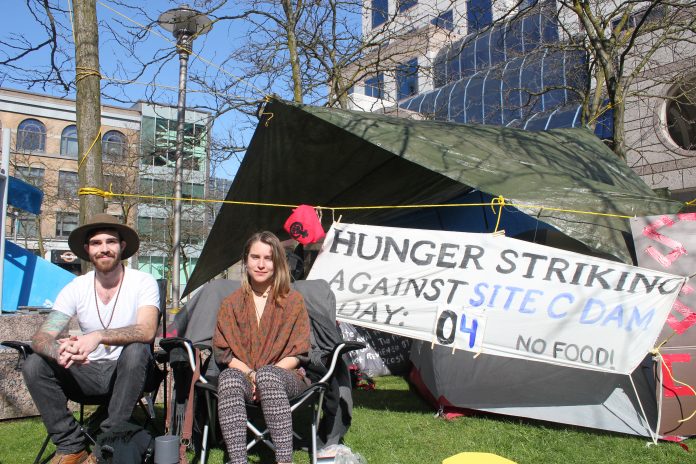
SFU alum Kristin Henry, a driving force behind a hunger strike in the wake of BC Hydro’s Site C Dam project, has broken her fast at the insistence of family and doctors according to a Facebook post. She was hospitalized on March 31, which was day 19 of her hunger strike.
Henry is still currently at the hospital, where she might stay until the end of the weekend while she recovers. According to Facebook, she stopped her hunger strike once “she was told that she was at risk of cardiac arrest, and moving forward without food would for sure start doing long term damage to her heart, kidneys and other vital organs.”
She was transferred to St. Paul’s Hospital by ambulance on Wednesday, where medical professionals are urging her to eat something so as to regain her strength. But Birley said that Henry had continued refusing to eat, saying that she is “waiting for test results to come back before she decides to eat or not”. She was also “visibly stressed and frustrated” at the lack of action that has been taken by the Trudeau government as well as BC Hydro.
The Peak spoke with Sage Birley, a farmer from the North Peace Region who has been welcome at the site where Henry set up camp. Throughout the time that Birley has spent on the site, he has become a “media spokesperson”, speaking on behalf of Henry who is still at St. Paul’s Hospital.
On March 31, Henry was on the 19th day of her hunger strike when her heart rate dropped to 35 bpm. She eventually fainted and was attended to by nurses and other medical personnel that were present at the site.
“[Kristin] is frustrated that Trudeau and BC Hydro are unwilling to sit down and have a serious conversation with all the impacted groups regarding this issue,” Birley said. “She is facing a lot of stress right now.”
Despite the inaction from the federal government and BC Hydro, Birley says that the amount of support that has come about from this hunger strike is “incredible”. Birley, whose family has a long history of farming in the North Peace Region, has great concern for the issue of food security especially in that region. The construction of the dam, Birley says, will have a serious impact on accessibility of food.
To date, the Birley and other members of the camp have collected signatures and have written thousands of letters to the Trudeau government, asking for construction to be discontinued.
At the time of the interview, Birley noted that other movements were taking place, and that earlier on Friday, Green Party leader Elizabeth May had visited the site. With growing support and seeing new faces every day, Birley has hope that this fight for food security is not over.
“[Henry’s efforts] have definitely revitalized the dialogue on this issue,” Birley said. “People have been fighting this issue for 30 years, so it is great to see that all of that effort was not done in vain.”
Even though Henry’s strike is over, the group involved in the hunger strike, who have dubbed themselves “tent city” plan to continue the protest. According to their Facebook post, they “continue to grow and have no intention of ending this campaign. The hunger strike was the start of a beautiful grassroots movement, but it’s certainly not the end.”
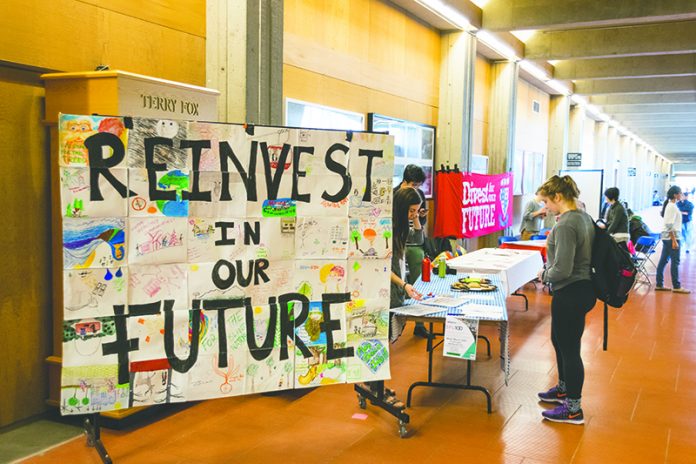
In the AQ hallway, SFU 350 and Embark’s Divest SFU campaign invited students to help their university decide where to keep its money.
The campaign, which calls for SFU to divest within five years from fossil fuel companies, is part of a movement that has had growing support. Many universities, colleges, and other organizations have pledged to divest, including Stanford University and Glasgow University. In a shocking development, the Rockefeller Brothers Fund also declared that it would divest its $860 million fortune that famously originated from the fossil fuel industry.
Closer to home, this “SFU 100” event encouraged SFU students to think of the future of their institution, and how it should use its financial weight.
SFU 350 president Raaj Chatterjee told The Peak that “divestment is a sizeable impact that the university can make in terms of the fight against climate change and holding companies accountable to their actions.”
Chatterjee explained that so far, the Divest SFU campaign’s petition has collected almost 2,000 signatures, and that SFU has been “responding in [an] appropriate way” to pressure from Divest SFU.
In the past, the university has announced that it has signed onto the UN Principles of Responsible Investment and the Paris Pledge for Climate Action, which both call for signatories to consider building resilience and social responsibility with their investments. Chatterjee was cautiously optimistic that SFU has agreed to create a divestment policy of some sort, but at this stage the idea is still “pretty vague.”
However, three Canadian universities have recently rejected divestment despite student pressure. McGill, the University of Toronto, and the University of British Columbia have all cited the limited effectiveness of divestment from influencing fossil fuel companies, as well as the responsibility to maintain financial returns as their reasons for not divesting.
If SFU decides not to divest, SFU 350 has also been circulating another petition that will become relevant. Chatterjee said that the group has collected over 300 signatures of students that have pledged to take some form of “direct action” in the case SFU does not divest. He explained that this might include “some sort of rally or sit-in.” Earlier this week, McGill students, dissatisfied with their university’s decision, staged a sit-in in the administration building and camped outside, catching the attention of the university’s Principal and Vice-Chancellor.
Rather than just gathering signatures, the event was a way for the Divest SFU to have a conversation with students. Said Chatterjee, “I think all students know about climate change, they all know about global warming [. . .] but students often feel that they don’t have a voice where they are.”
There is currently no timeline for the Board of Governors to elaborate on their divestment policy. However, after lobbying the Board for three years to get to this stage, the Divest SFU campaign has certainly proved that its members think of it as a responsible investment of their time.


