Home Blog Page 836

School breakfast helps kids learn: Beedie researchers

0
School breakfast can offer pupils opportunities for positive social interaction.

Poverty among school-aged children remains an ongoing concern in Canada. However, positive results from a breakfast program at a local Burnaby elementary school could indicate an important step towards resolving this problem.

From October 2014 until June 2015, Douglas Road Elementary in Burnaby has offered the Breakfast Club program for all students.

During this period, 83 out of 255 students were enrolled in the program, and roughly 1,820 meals were served.

Andrew Gemino, associate dean, and Ben Tan, research assistant of the SFU Beedie School, conducted a study into the cost-benefit of this program.

“Initially, a lot of folks were under the impression that everyone was well-fed,” said Gemino.

Unfortunately, even in Canada children are often coming to school hungry or without having eaten a proper breakfast. Canada is the only G8 country that doesn’t have a national school meal program. Education is managed on a provincial level. As a result, breakfast programs are typically funded by private, corporate, and public donors, Gemino and Tan explained.

The Breakfast Club program at Douglas Road Elementary was founded with the support of Mary-Ann Brown, principal of the school, and Burnaby School District 41, along with The Vancouver Sun‘s Adopt-A-School program and a private donation from Ryan Beedie and the Beedie Development Group, led by Mason Bennett.

When they conducted their survey in December 2015, there was positive feedback from both the staff and the students. With the Breakfast Club in place, there was a 22 percent increase in participating students’ attendance — likely due to students arriving early for breakfast, and as a result arriving on time for class.

About 86 percent of staff members said they would recommend the breakfast program to new students and staff who come into the school.

Many students have commented they were excited to be a part of the program, and enjoyed the fact the there was another option for food. The openness of the program for all students also meant that many students were able to bring friends to join them for breakfast.

In an interview with The Peak, Gemino and Tan mentioned that the Breakfast Club was an excellent way to bring people together, get them to talk to each other, and ultimately make them feel welcome within the community.

In their report, a summary of other research studies have indicated that breakfast programs offer positive effects on the students’ nutrition, cognition, and behaviour.

“[But] there was more to this than just nutrition,” remarked Gemino.

They found that this program has the potential of changing the way students viewed themselves and interacted socially.  Furthermore, the program could help generate a more positive attitude towards the school environment, making the school seem less intimidating, and ultimately helping the students determine what school means for them.

Gemino and Tan both agreed that people should be aware of and support programs such as the Breakfast Club.

“There’s potential for this to be greater than it is,” said Gemino. “The program is a good start and probably the best start.”

SFU prof creates guidebook for cultural appropriation

0
n 2015 Dr. George Nicholas gave a presentation at TEDx Yellowknife, a symposium that focused on indigenous issues.

Borrowing pieces of other cultures has become common practice in popular culture and even in literature. This leads to an important question: what is the line between cultural appreciation and cultural appropriation?

SFU professor of archaeology Dr. George Nicholas — in collaboration with academics, students, individuals in the community, government, and indigenous organizations — have been working over a period of a seven years to help answer this question.

Their initiative, the Intellectual Property Issues in Cultural Heritage (IPinCH) project, is an international project to tackle cultural appropriation and the imbalances of power that accompany it.

One of the ways Dr. Nicholas and his colleagues are tackling this issue is by creating a guidebook on the ways to avoid cultural appropriation, called “Think Before You Appropriate.”

The goals behind the guidebook and the IPinCH project are to develop ways to avoid or confront these issues, or to eradicate them and limit their impact. Another main goal for the project, according to Dr. Nicholas, is to develop resources that indigenous people, policy makers, academic researchers, and the public can use to make more informed decisions to avoid appropriation.

One of the key messages in the guide is how to differentiate between borrowing from a culture and respectfully appreciating it, or disrespectfully appropriating it in ways that are harmful. These harms can be cultural, social, or economic.

“We were not trying to curtail research or put restrictions on knowledge, but knowledge needs to be used respectfully or with permission,” said Dr. Nicholas.

The guide spells out the difference between appropriation, which “means to take something that belongs to someone else for one’s own use,” and misappropriation, which is a “one-sided process where one entity benefits from another group’s culture without permission and without giving something in return.”

“Not only do indigenous peoples have little control over their own affairs, but their ways of life and traditional knowledge have been largely viewed as public domain, free for the taking. Concerns about the exploitation and appropriation of their culture are rampant,” Dr. Nicholas said in a TEDx Talk.

Along with the cultural appropriation guidebook, according to Dr. Nicholas, IPinCH also features a multitude of other resources, including the “Appropriation (?) of the Month” blog series. This series works to illustrate that appropriation comes in many forms, and that it is not always easy to discern cultural borrowing from appropriation, which explains the “?” in the title.

For individuals looking to be aware of appropriation while shopping, Dr. Nicholas explained that “If you’re interested in buying certain objects or clothes it’s so easy to Google search and see if this design has been created with any kind of input from the native artists or indigenous community, and it’s just a matter of asking a few questions.”

For those with positive intentions, there are a few precautionary steps that should be taken: “If nothing else, a lot of people want to wear or have items that have native or First Nations designs on them [. . .] Indigenous communities do want to share their heritage [but] they want it to be done respectfully and used appropriately.”

In 2013, those involved with the project received the first Partnership Award from the Social Sciences and Humanities Research Council for their work. They continue to spark dialogue regarding intellectual property rights and cultural appropriation.

A Dead Forest Index embraces the storytelling nature of song

0
They only look like a Swedish electro-pop duo, they are actually experimental.

A Dead Forest Index is a musical duo formed by brothers Sam and Adam Sherry. The two worked independently as solo artists, collaborating when the opportunity arose, until 2010 when they decided to officially join together.  

“Everything just fell into place when we chose Melbourne as a new base, and our project has been at the forefront ever since,” explained Sam in an interview with The Peak.  

Sam is the percussionist of the two. He fills in the rhythms, as he dances with drums and piano through the undulations of Adam’s voice. Adam, the vocalist and guitarist, weaves a visual melody within the pulsing waves of Sam’s rhythms.

Currently, the duo is on a world tour with labelmate Chelsea Wolfe. Their recent performance at the Imperial was an amazing evening, as the two groups performed back to back. Chelsea Wolfe and her crew were a maelstrom of beats drumming through the body. A Dead Forest Index was an undulating wave of shifting sounds that ring true of their gentle and subtle voices.  

“It has been an amazing and incredible journey so far, and actually our first time travelling around the US and Canada,” said Sam. “It would be hard to pick one place from so many cities, but travelling through a place like Memphis really stands out — so much history. Chelsea and crew are beautiful people, and it’s an honour to share the stage every night.”

A Dead Forest Index revisits the traditional and the simple, merging the techniques of looping and drones, to create a sound that evokes both thought and feeling.  

As Sam explained it, the key elements in the writing process are hard to define; but imagery and words form a collection, or a kind of song cycle, that all comes back to inspiration from travelling, and something ancestral.

The duo released their debut album In All That Drifts from Summit Down in April 2016. Prior to that, they released two EPs: Antique (2012) and Cast of Lines (2014). Antique was an important starting point for them, and the recordings still hold a special place in their history.

According to Sam, Antique carries a denser and heavier atmosphere. Certainly there seems to be a more solemn tone on the EP; however, the tracks of In All that Drifts from Summit Down are equally surreal and memorable.  

When asked what his favourite track from their debut album was, Sam replied with “Homage Old.”

“It’s a very special one for us and was written at the end of our period of living in Melbourne,” he explained. “The cello drone is played by our dear friend Nicholas Jones, and hearing that cello always brings me right back to watching him play in the studio, such an amazing style.”’

For their next steps, the duo is looking forward to working on their next album, while continuing to tour and travel as much as possible.

“We really love being on the road, but also look forward to finding somewhere isolated to start finishing new ideas,” said Sam.

The voices of A Dead Forest Index are clear and beautiful, but also powerful and moving like the drifting waves hinted at by their song titles. Their unique presence is sure to leave a distinctive mark in the evolving stage of contemporary music as they continue on their journey.

CINEPHILIA: The Nice Guys ultimate dumb buddy cop film

1
Gosling (left) and Crowe (right) prove their acting abilities despite the nostalgia overload.

Ryan Gosling, as famous for his abs as for his acting, can mount character-driven indies on his ripped shoulders like a nouveau Brando. He can be charming like Clooney or evoke an existential crisis with the mere words “I drive,” like a wounded, introverted De Niro.

The heartthrob from The Notebook has developed into one of the best actors of his generation, actively transcending his on-screen persona and seeping so far into characters we forget that he’s a movie star. Somehow, even as his past roles have been iconized, Gosling has reinvented himself, peeling off yet another layer of skin to reveal a new one. His work in Shane Black’s The Nice Guys, where he plays a bumbling PI, is another testament to his versatility.

Fermented in nostalgia, The Nice Guys gets you high on ‘70s Los Angeles’ smoky air. A porn industry party is uncannily similar to that of a corrupt automotive company later in the film; a very un-PC educational video is shown in a classroom; and a haze of paranoia from Watergate and the Cold War looms over everything.

Shane Black (Iron Man 3, Kiss Kiss Bang Bang) seems to have shaped his narrative and set-pieces around the era’s weirdness, guiding us through a time when porn was in bed with politics and a hippy’s experimental porno was the only way to save the birds from a car company’s pollution. The world of shaggy carpets and open shagging is the villain, making it difficult for our very flawed and very groovy heroes to solve the case.

This is the rare Hollywood comedy that is vulgar and clever, and accessible without pandering. I appreciate The Nice Guys as much for what it is as I do for what it isn’t. Here is a groovy comedy with an engaging plot that doesn’t rely on dick jokes to keep our attention. It’s an accessible film that is about something, and doesn’t make a big fuss.

The Nice Guys is drenched in nostalgia and fantasy, but at times it feels soiled by it. In an opening vignette — which works as an effective short film on its own — a young boy steals his dad’s porno mag, only to find the naked body of the porn star he was ogling dead in the backyard moments later. What was once titillating becomes grotesque. The corpses pile up at the edge of the frame during the funny action scenes. Black’s camera takes a second longer to process what Holland March (Gosling) and Jackson Healy (Russell Crowe) are actually doing. March’s tween daughter, who seems to find herself in the middle of everything, is the human character at this film’s heart, a voice of reason in a sinful cesspool.

The humour is mostly performance-based. The story climaxes with a loud shoot-out that forgets the central theme. In this bleak world, even the nice guys have a rough edge. Healy and March are only heroes because they’re slightly better than everyone else. Russell Crowe — who plays the straight man — and the script by writer-director Black elevate this buddy action-comedy to a level that is respectable, yet hardly original. This is mostly a silly, entertaining film, and Gosling uses it to forge another tool for his toolbox: a mode of physical and improvisational comedy that is erratic yet calculated.

With daring choices and a consistent track record, Gosling, a sex symbol with a pretty face and pretty abs, has proven to be a pretty great actor as well. He is a Hollywood stud whose films you can go to for the brawn, but stay for their brains. Although you could be deceived by what seems like dumb slapstick in The Nice Guys, it’s a film with more on its mind than your average coked-out comedy.

Kaylee Johnston is tough with a sensitive side

0
Johnston might not have gone to college but she never stopped learning.

When Kaylee Johnston walked into our interview a few days before her self-titled EP release party at the Biltmore Cabaret, she bypassed the handshake and headed straight for a hug.

Johnston was in the Canadian Radio Star competition early on in her career, and released her last EP, Streetlight, in 2010. Since then, aside from a single released in 2013 (“Gone”), she’s been figuring out what she wants out of her career and honing her musical abilities. Her new release is a taste of the big things we can expect from her in the future.

Johnston has known since kindergarten that music was where she was meant to be. She applied to college at her parent’s encouragement, but didn’t get in. “I knew that I was still going to do music. I remember not even feeling disappointed.”

According to Johnston, she was never much of an academic. However, her best advice is, “Just be a student of life. I’ve never stopped learning or wanting to learn and that’s why . . . if I’m having a bad day, I can always turn it around. Like, OK, this is an experience that I’m going to learn from, and my life’s going to get better because of this uncomfortable moment in time.”

It’s pretty solid advice. And just because she didn’t do well in a structured educational setting doesn’t mean she wasn’t educated. “I’ve done, probably, thousands of hours of voice training . . . and thousands of hours of song-writing with different people and styles. I’m conscious of where I’m putting my energy.” It’s easy to see that all of her hard work has paid off — the new EP is dynamite.

“Are You the One” is Johnston’s favourite song to perform, because of the bridge. “I kind of rap it, and it’s not really rap, but it’s really fast spoken word . . . Every time I do that I just feel so badass. I always get a good reaction from the audience. That one’s my sexy, sassy song so I always feel really good when I sing it.”

Another personal favourite for Johnston is “Let’s Pretend.” It’s got a slightly different feel than her other songs, stemming from the 18-month time difference between writing the majority of her EP and writing that song.

“I felt like that was the first song I’d ever written that was truly vulnerable. All the songs have moments of vulnerability, but that whole song is just me being very accepting of a situation I was in and being honest about it.”

It’s true. A lot of her other songs have a toughness to them to coat the vulnerability, and it’s great to see her expanding the realms of her emotional songwriting capacity.

Johnston’s show opened with Mathew V and Windmills — two terrifically talented acts with vocal chops and great musicality. They set the tone of a fun, celebratory night and Johnston ran with that throughout her set. Her vocals were on point, her performance was captivating, and her energy was infectious. The dancing she did on stage was amplified in the crowd, following her lead.

There were a few technical difficulties, but nothing major. Her cover of “Teenage Dirtbag” took everyone back to high school in the 2000s and turned into a massive singalong, with Windmills joining her on stage. She’s such a charismatic performer, regaling the audience with stories in between every couple of songs. It makes her feel like a friend, even though she’s up on that stage.

All in all, the party was a fantastic launch event, with more than a few people walking away with CDs. She’ll be one to watch in the years to come.

FVDED in the Park is more than just a standard music festival

1
Last years festival was hugely successful, and the organizers plan to repeat that this year.

The first weekend of July isn’t just reserved for Canada Day hangovers and camping trips. It is also when FVDED will return to Surrey’s Holland Park.

Even though FVDED is only in its second year, the idea has been around for much longer, according to Alvaro Prol of Blueprint. “We always wanted to do something that was unique to us,” he said. “We’ve seen a lot of things come and go, and what worked [or] what didn’t. We knew we wanted to do something that was more accessible, something that was a little more urban in its offering.”

Wanting to have an accessible and more urban festival location comes into play: “Once the park got refurbished for the Olympics in 2010 there was always an opportunity to do something there. When the Mumford & Sons event happened there, it was the first big kind of concert to happen [at Holland Park]. We went because our partner Live Nation was producing that show and that’s when we said, ‘OK, we are going to bring this festival here,’” said Prol.

Holding FVDED in Holland Park wasn’t just about being able to use an updated space, but also using an easily accessible one. Stated Prol, “We have a festival site right in the city where people can take a SkyTrain and be at the doors of the festival without having to worry about parking or staying in a hotel or camping and all the different kinds of costs and inconveniences that it takes to get to a festival.

“There really is something unique about the space and it spoke very much to what we do. We are a city, urban group. We wanted to do something that reflected us,” he said.

For Prol, there was also a need to keep the festival from being too much like other festivals — not only in terms of location, but also affordability. “We wanted to sound more like a gathering in a park, and portray a more down-to-earth vibe. Anybody could get on a flight and be at Coachella if they really wanted to, or go here or go there. I didn’t want to be this super expensive festival that was only accessible to certain affluent people that have all this money.

“This year I went to Coachella, I was there and you just looked at everybody and they just looked like a bunch of affluent, rich yuppies. You’re missing so much of that raw energy and vibe from other music lovers that can’t afford that type of experience. That’s what I like about this festival is that it is accessible to all, in transportation and affordability.”

Since so many festivals take place outside the cityscape, Prol wanted to focus on the urban landscape of Vancouver. “If you haven’t come to Vancouver and you are coming for the first time and you are in the SkyTrain going from downtown all the way to Surrey, and you see the beauty of our city all around. You don’t have to go and camp five hours away to see our beauty.

“So, from a Vancouver perspective, showcasing the [beauty of the] city at the forefront, and getting people over to Surrey from a visitor standpoint — that is one of [the] things that we want to achieve. For Surrey and the region, it is such a positive event in the sense of chatter and social media hits. There is so much good press that I think this is a really good thing for the region.”

For a major company, the importance that Blueprint and Prol — the creative forces behind this year’s lineup — place on local and Canadian artists is refreshing to see, especially when there are numerous festivals that would rather bring in multiple big-name acts than support the local ones.

“We are very motivated to help develop and give situations and positions to some of the local guys that are working hard and being successful. The good thing about our local music scene is that it is very healthy right now. We have a lot of great producers. It’s been a while since we’ve had so many different kinds of acts coming out of Van that are making noise.”

Prol did express some disappointment at not being able to get two Canadian artists to headline the festival like last year with the Weeknd and Deadmau5, but given that the rest of the lineup does have a Canadian focus with artists like Belly, Kaytranada, and Pomo, helping mitigate the lack of a Canadian headliner.

With a local and Canadian focus, a third stage added, and tickets already 85 percent sold, it seems safe to say that Holland Park with be a home for FVDED for years to come.

My sugar highs and lows

0

Looking myself in the mirror

“If you only stop eating so many sweets, you will definitely lose weight. Have some self-control!” I remember saying to myself in front of the mirror, the morning after a birthday dinner. Unfortunately, it was not the first time I had had that conversation with myself.

I know I’m not the only one struggling with cutting sugar out of their diet. The suggested consumption crisis is getting so large, groups like the Heart and Stroke Foundation have proposed taxation and legislation to try to regulate it. After years of riding a sugar high, we’re finding ourselves at the crash.

I knew sugar didn’t help me with my goal to stay healthy, so I decided to take control of my eating habits and cut sugar out. My biggest problem was having what you would call a ‘sweet tooth.’ Growing up in a family where eating something sweet after every meal was the norm, I didn’t even think twice about how tough it was on my health. My struggles grew as the calories from my sweet treats turned into fat. I started to become more self-conscious about how I looked, but the bad eating habits were tough to change. Even when I added regular workouts to the picture, it didn’t result in any improvements with my sugar-heavy diet.

A will to change

It was time for a change. Willpower and conscious consumption habits should help me achieve the goal, right? But the reality isn’t that simple. In fact, the more I tried to stay away from sugar, the more I understood how difficult it actually was.

My first challenge was cravings. For me, chocolate was my guilty pleasure. Staying away from sweets was very difficult, and often resulted in failure within the first week of my sugar-free pledge. The abundance of colourful candy displays in the stores and the overwhelming number of sugary goodies everywhere were not helping my case, either. I was torn between trying to keep to my commitments and letting myself indulge. I was in a tug of war with myself. Is this what you would call sugar addiction? For me, the best I could come up with was a strong ‘maybe.’ I am, after all, no dietitian.

However, there are many studies suggesting the addictive effects sugar can have on the brain, some even arguing that addiction to sweetness can surpass the effects of cocaine. This is in part because sugar triggers a release of dopamine, a hormone that is part of the brain’s “reward system.” It is no wonder then that so many people (myself included) can have very strong cravings for sugary foods.

But I don’t believe we will necessarily be enslaved by our sugar addiction in the future. If we can start to raise our dopamine levels in other ways — such as through meditation, regular exercise, and massage therapy — we can help to ease the effects of our sugar withdrawal. This is something we all need to do: as students and young adults, we have a responsibility to our bodies. All too often we forget about the importance of health in self-care. As great as it can be to indulge in a sugary beverage or treats, we need to ask ourselves if it is really worth it in the long run.

You’d think I should be able to live a sugar-free lifestyle when I subdue my cravings, right? Unfortunately, this is where the second challenge comes in. The truth is, nowadays it is very difficult to stay away from sugary foods. It seems that the high concentrations of sugar in our food renders anything other than a paleo diet hopeless.

A sugar-free future?

As consumers, we need to be aware of our choices and pick the products that we believe best fit our needs. But at the same time, it seems unfair to put full responsibility for healthy lifestyle on the consumers: so many products available to us are rich in sugar, and advertisers try to tempt us everywhere we go.

As I see it, we are currently not in a place where quitting processed sugars is achievable — they are just too widespread and prevalent in our diet. However, I believe we can all take small steps to reduce our sugar consumption by opting for healthy alternatives, such as fruits and healthy snacks. And in the meantime, we should raise a larger discussion on the dangers of sugar and call for tougher regulations on sugar in foods.

I strongly believe that SFU should also play a role in a collective approach to reducing our sugar consumption. As students, we often choose unhealthy, sugar-heavy food choices for three reasons: simplicity, availability, and pricing. Although there may not be many options for price changes, we can always add more healthy snack options to our cafeteria, or introduce healthier choices to the vending machines.  

But the first step is to spread awareness. If we have visible reminders of how much sugar we are consuming, such as displaying nutritional information to sugary treats, we would be more inclined to choose healthier options. . . there is no good reason that the next generation has to also find themselves in front of a mirror talking themselves down because of their body type.

POINT / COUNTERPOINT: Should SFU’s English department focus less on white male authors?

0

Yes, English requirements should shift to focus on more diverse literature.

By Emily Seitz, SFU Student

On June 1, Alison Flood published an article in The Guardian exploring a petition put forth by undergraduate students at Yale University. The petition calls for an end to the English department’s course requirement of canonical white male authors such as Shakespeare, Chaucer, and the like. The students argued that “it is unacceptable that a Yale student considering studying English literature might read only white male authors.”

The article also includes a comment by Katy Waldman, a writer for Slate, who states that “you cannot profess to be a student of English literature if you have not lingered in the slipstreams of certain foundational figures, who also happen to be (alas) both white and male.” Yes, as any English major will tell you, the literary canon is dominated by white male authors, perhaps none more so than William Shakespeare.

The perception of Shakespeare as a foundational literary figure can be challenged by the fact that, until the 18th century, Shakespeare was lumped together with all of the other playwrights and poets in his era; his status as “the bard” came in the 18th century through a national need to have a single author be the figure of the national poet. But this idea of a single poet representing a nation is problematic in our current global, multicultural society, as there is a need for diverse voices in literature to reflect the diversity around us.

Many Canadian universities, including SFU, have a Canadian literature requirement, and many of these schools also offer courses in aboriginal and indigenous literature. Although Canadian English departments are providing required courses outside of the white, male-dominated literary canon, the course selections are often minimal and students are often only required to take one.

Meanwhile, students are required to take two courses from a list that prominently enforces the white male canon, such as English 306 on Chaucer, English 311 and 313 on early and late Shakespeare, and English 416W on Milton, among others.

Lower level requirements focus on broad periods — such as medieval literature and 18th century literature — with very little emphasis on literatures outside of the white male canon.

There is a demand for more diverse authorship and characters in the current literary scene, as demonstrated by the Twitter call #WeNeedDiverseBooks, in children’s literature. Although more Canadian universities are offering literature courses outside of the expected white male canon, these courses aren’t typically main English major requirements — and if they are, usually only one course is needed.

I believe that English departments could shift their course requirements to focus less on the white male canon, and could provide more options for students in diverse literature, with female and non-white authors. There are many female authors in the English literary canon — Jane Austen, Margaret Cavendish, the Brontë sisters, Marie de France, to name a few — and contemporarily, many non-white authors are expanding the English literary canon.

As our society becomes more global, and since Canada is a multicultural country, our literary studies need to expand beyond the historical English canon to one that is multicultural, and English major course requirements need to diversify.

Though perhaps SFU should not go as far as what Yale students are suggesting and completely remove canonical authors from their course requirements, there should certainly be less emphasis on historical literature by white men.


No, SFU’s English department should stay as is.

By Courtney Miller, Peak Associate

As much as it sucks, studying the works of white men in their entirety is an integral aspect of studying English — especially for those historical figures. Would I love for writers who fit outside of this narrow mould to be more prominent? Absolutely, and the classes focused on later writers (particularly here at SFU) feature a wide variety of authors with a corresponding selection of backgrounds and experiences.

It would be great if that same openness could translate to the past, when most of these men were writing. Unfortunately, we can’t change the past.

Regardless of their race, gender, or age, these writers have shaped and dramatically influenced modern English. Shakespeare alone contributed more than 1,700 words to the English vernacular. William Wordsworth is the poster boy of Romantic era poetry. Charles Dickens became one of the pioneering novelists of the Victorian era.

The list goes on. Every white canonical male we study is studied for a reason. To avoid studying their work would be a disservice to the styles and eras they represent.

A sad truth of the matter is that many of these literary men lived in a far more patriarchal society than many of us Westerners do today. White men were the overwhelming majority of published writers. That’s not to say women or people of colour didn’t contribute, or weren’t integral to the formulation of the ideas that men were credited with — after all, Wordsworth’s sister, Dorothy, may have been as crucial to the development of the Lyrical Ballads as either Wordsworth or co-author Samuel Coleridge.

But these events transpired at a time when non-white men were not valued for their worth, and thus were not remembered to the same degree as white men. To not focus on the inequalities of this era would discourage us from learning and reflecting on our ongoing progress as a Western society. Besides, many of the English classes I’ve taken at SFU, which are not centred around one male author, have included literature by diverse authors.

Furthermore, the professors (at least, those at SFU) who teach canonical male-centred courses are also the ones who say, “Now, take this with a grain of salt. Thoreau’s view of the world was problematic because of X, Y, and Z. As we can see from Dickinson, there are vastly different experiences happening in the same era.” To not play the works of white male authors off of other literature hurts everybody involved because it contributes to a loss of knowledge and critical thought.

SFU’s English department should stay as is — it’s a fair representation of the historical influences of English literature through time. In the study of English literature, it is important to present information on times of inequality. It is our duty to apply our reasoning and criticism liberally to everything we evaluate, in order to decide for ourselves what is worthy to incorporate into our own lives.

SFU prof’s plain packaging project aims to kick cigarettes’ butts

0
Students can check out the display to see how different countries stack up.

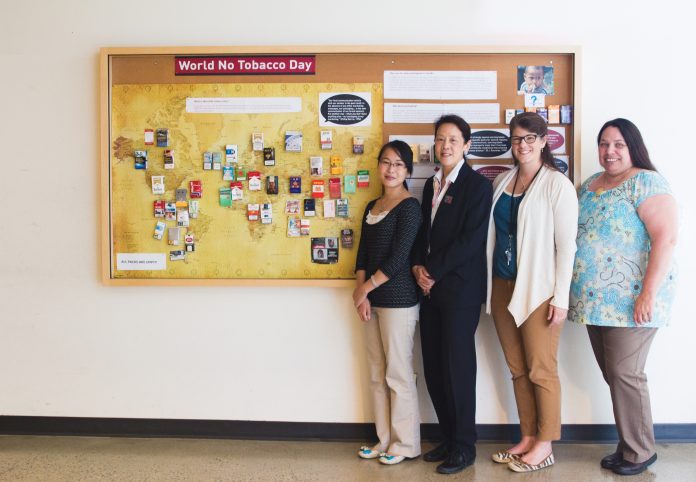
If you’ve walked down Blusson Hall recently, you may have noticed a display case featuring gruesome images of what cigarettes can do to your body, and a world map with cigarette packages from around the globe pinned to their respective countries.

These were collected by SFU health sciences professor, Dr. Kelley Lee. With World No Tobacco Day’s  global plain packaging campaign on May 31, Dr. Lee has been drawing attention to the issue locally.

“My research is around tobacco control in general, and plain packaging is one aspect of it,” she stated. The movement aims to streamline and standardize all cigarette design and marketing. Currently, about 75 percent of a cigarette package is dedicated to a graphic health warning, which still leaves some room for cigarette brands to appeal to smokers.

“Companies really find that the packaging is important to them to get their branding across,” she said. “They call them ‘mini-billboards.’ So they put a lot of emphasis on them — they spend millions of dollars designing these packages to appeal to particular targets; to young women and to young people.”

Dr. Lee first started collecting cigarette packages from around the world to use as teaching tools, some of which used hearts within the filters, candy-like flavours, pretty colours, and novelty images to entice consumers.

When asked why she believes tobacco should be treated differently by the government than other legal harmful substances, Dr. Lee stated “you can’t smoke a cigarette safely.

“Tobacco is the only legal substance that, if used as directed, will kill half of its users. You can’t say that about alcohol, and you can’t say that about unhealthy foods. It’s a substance that if you invented it today, it would not be legalized.”

An issue Dr. Lee is tackling closer to home is updating SFU’s smoking policy. The Advertising, Selling, or Smoking of Tobacco on Campus policy has not been updated since 2009. It currently states that students can smoke 10 metres away from university buildings, but Dr. Lee wishes to implement an update which would limit smoking to designated areas.

“We surveyed students, faculty, staff, community members, and 75 percent of people agreed that was the way we should do it because of the forest fires, because of cigarette butts everywhere, because of secondhand smoke wafting into people’s offices and workplaces,” she said.

As for the broader context of Dr. Lee’s anti-smoking efforts, she believes that Canada is doing fairly well with cigarette packaging regulations. However, there is definitely room for improvement.

Canada is now considering adopting a completely plain and standardized packaging policy.  “The Liberal government said they would have a three-month consultation. That means that people — you and me, anybody — can submit about whether this is a good or bad policy.”

This, however, means that tobacco companies will have ample opportunity to oppose the motion, and could potentially spread some misleading information. “Our research has also been looking into how they’ve been using third parties like think tanks to fund research that sounds independent,” said Dr. Lee.

Not everyone believes that plain packaging is the best way to disincentivize smokers. According to associate dean of the faculty of development and research at the Beedie School of Business, Dr. Judy Zaichkowsky, “fooling with the packages is a side-issue, almost. It’s not the core of the motivation to start. The core of the motivation to start is to be older; more mature, to belong.”

Both women touched on the significant correlation between puberty and starting to smoke. Dr. Zaichkowsky described it as a time when “you do everything you can to look and feel more mature.” Dr. Lee outlined 13 as the average age at which people start smoking, and the demographic to whom tobacco companies aim to advertise.

“It’s a dirty business,” she stated.

Dr. Zaichkowsky believes that though the plain packaging movement is well-intentioned, using fear tactics such as jarring imagery on packages is the wrong method. “When the fear gets too ugly or gruesome, people look away. They tune it out. [. . .] They understand it, but they don’t want to pay it any attention.”

Instead, she believes that “a moderate, social fear appeal is much more effective than ‘smoking will kill you,’ because that’s too fearful. People will say, ‘not me.’”

NOTE: Dr. Kelley Lee’s display has been moved to the casing across from the Djavad Mowafaghian Lecture Theatre.

Peak Comics: APPLE ST

0

COMIC-POOT (1)