Home Blog Page 809

Canadians, the Trump travesty isn’t a joke

0

Six months ago in my hometown of Eugene, Oregon, then-presidential candidate Donald Trump spoke at our community centre. Protesters turned out from all over the state, bringing posters, banners, noisemakers, and solidarity. I went alone to the rally, a little nervous and shy, unsure of how the Eugene Police Department would react to the protest.

We shouted “Black Lives Matter,” “Muslim Lives Matter,” “Fuck Your Wall,” “No Donald Trump, No KKK, No Fascist USA,” “Women’s Rights Are Human Rights,” and other chants. It was a beautiful night of solidarity in an extremely diverse group of people.

Tensions were certainly high. Trump supporters called us lazy, called us all welfare “leechers,” called the Hispanic and Latinx protesters “illegals,” called the Muslim protesters “terrorists,” and frequently used the N-word and other racist slurs. One man sporting a “Make America Great Again” hat yelled that he hoped I got raped.

When I tweeted about the experience later, I was accused of lying, of trying to make Trump “look bad.” As if he needed any help in that department. But I still had hope. At that point, there was still widespread disbelief that Donald Trump would become the GOP candidate, let alone the president-elect.

But this is our reality now.

On November 8, I watched a map of the United States turn red one state at a time. I watched as Texas, Florida, Ohio, Iowa, Wisconsin, and others all chose Trump over Clinton. I began crying as Trump reached 250 electoral votes, needing only 20 more to win the election.

I cried for my friends living in poverty, as the country voted for a man who doesn’t believe they deserve access to food or shelter in hard times, who calls them lazy, whose supporters call them “leeches” of “the system.”

I cried for my fellow woman-identifying humans, watching America choose a man who’d mocked sexual assault, a highly gendered act of violence. I cried for my friends on the queer spectrum, as the country which hasn’t even had marriage equality for two full years yet voted for Mike Pence, a man who has argued in favour of funding conversion therapy.

I cried for my friends who don’t have the privilege that comes with white skin. I watched the country vote for someone who’s openly xenophobic towards Muslims, who supports harsher punishments for minor crimes that disproportionately affect black Americans, who disrespects native land both politically and environmentally.

I cried for those who haven’t completed their immigration process, watching as the country their parents came to in an effort to escape violence — that the US military often had a hand in creating — voted to “send them back,” as if they have anywhere to go. I cried for those still living in the Middle East, who almost undoubtedly now await even more violence in their region in the interest of oil.

I didn’t stop crying until Thursday morning.

That morning, I woke up angry. At the brokenness of the Electoral College and the absurdity of the two-party system, and at how despite the majority of voters choosing Hillary Clinton, Donald Trump had won the election.

Plenty of my Canadian friends laughed at what a “joke” this election was, trivializing it as if it didn’t affect them, and that especially stung. If you don’t care about the lives of people living in the States, then let’s talk about how your lives will be affected. No, I’m not talking about an influx of American refugees.

Air pollution produced in the States does not stop at the 49th parallel. Neither does water contamination and, in an increasingly globalized world, nor does soil contamination. The transportation of food across borders means that the increased levels of pollution that will arise out of Trump’s grotesque lack of regard for climate change will affect the entire world, and it would be foolish to brush this off as an American problem.

When Trump incites violence worldwide, whether that’s through construction of a wall on our Southern border, or through xenophobic foreign policy, refugee crises will be exacerbated. Millions will be displaced. This is a global problem.

When Trump’s tax policies and blind faith in trickle-down economics, which has been proven time and time again to be ineffective, create another massive recession, the Canadian economy will go down with us. Our economies and politics are inextricably tied together, and the US is a major consumer of Canadian exports.

Canadians, what happened on Tuesday night isn’t a joke. Stripping away fundamental human rights has never been and will never be a joke. A Trump presidency is dangerous for all of us economically, politically, and morally. It’s a danger we need to take seriously.

SFU loses to Cal Poly Pomona on penalty kicks

0
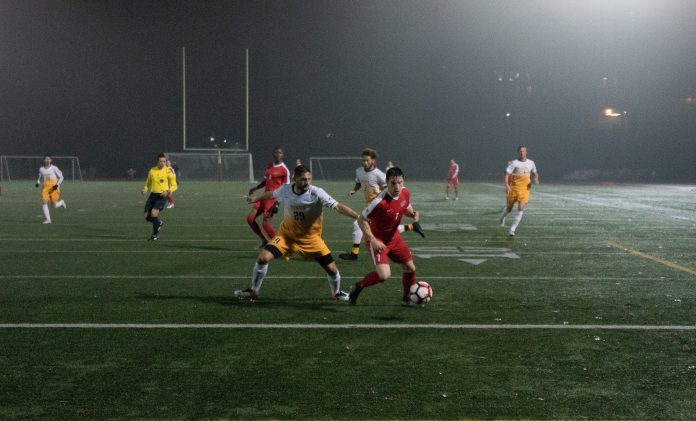
SFU outshot the Broncos 12–4 and had five shots on target compared to only two for the Broncos.

It was a game that, on paper, would have been worthy of a matchup much further along in the tournament.

SFU was the Great Northwest Athletic Conference (GNAC) champion, coming off a 14–1–2 regular season in which the team outscored opponents 46–13. The opponent, Cal Poly Pomona, was the Division II finalist the season before, and had a 12–5–3 record this season. The two had also played each other earlier this season, and SFU won 2–0 on goals from Erik Morden and Rahid Raheim.

But in a win or go home situation, anything can happen. The Clan outshot the Broncos 12–4, but despite that, SFU was forced to go to penalties. When they got there, they weren’t able to convert, despite senior goalkeeper Brandon Watson saving the first two Broncos kicks.

It marks the end of a fantastic season for SFU, albeit probably a lot sooner than they would have liked. The Clan was undefeated for most of the regular season, the lone loss coming November 3 against Western Washington. Adam Jones was named GNAC Player of the Year, a year after winning GNAC Freshman of the Year. Magnus Kristensen was named Defensive Player of the Year, and Riley Pang was named Freshman of the Year. All those players will return next season.

However, the elephant in the room is the situation of hosting their half of the bracket on the road in Seattle at Interbay Stadium, home of the Seattle Pacific Falcons. Despite earning home field advantage, SFU had to play the game in the United States, being the only Canadian team in the National Collegiate Athletic Association (NCAA). One has to wonder how different this game would have been had SFU played this at Terry Fox Field. The Clan had an amazing home record this year, not losing a single game. The last time they lost at home in fact, was October 16, 2014 against Seattle Pacific.

Would the team have won if was a true home game? We’ll never know. But if the NCAA values SFU as an integral member, this is going to have to change sooner rather than later.

Birth Control: The good, the bad, and the hormonal

0

What is birth control?

The most commonly discussed form of birth control is the male condom. Male condoms are a thin sheath of material, typically latex, that slides over the penis to prevent sperm from reaching the vagina.

Close behind in popularity is the Pill. The Pill is a small maleate tablet which contains hormones to alter the body’s chemistry. Pills contain progestin and, in combination birth control pills, estrogen as well. It depends on which brand or type is prescribed. Progestin is a synthetic progesterone, and progesterone is a hormone that helps the uterus prepare for pregnancy. Estrogen affects the sexual development of females and regulates some metabolic processes.

But other than these two popular contraceptives, not a lot of people know what their options are. Other forms of birth control include female condoms, contraceptive sponges, cervical caps, diaphragms, implants, intrauterine devices (IUDs), patches, shots, the morning after pill, and vaginal rings. And those are just the methods for females.

There are also methods for males, but they’re far less numerous. In this article specifically, we’re referring to the female methods, and particularly the methods which alter the body’s chemistry. Not to say male contraceptives aren’t worth conversation — they certainly are — but currently women are the ones being the most affected by contraceptives on a hormonal, day-to-day basis.

Who takes birth control and what does it do for their body?

People with the reproductive organs necessary to carry a human child to term are the ones who are prescribed birth control. Generally, the people who get these prescriptions are also having vaginal sex with a person who has a penis, but it’s not uncommon to take it for health reasons. Because the Pill contains hormones which serve more than one purpose in the human body, preventing pregnancy is not the only reason it can be prescribed.

The main reason most women use birth control is to prevent pregnancy. No method is 100 percent effective, but some method is generally better than nothing. Of course there’s abstinence, but that’s not for everybody.

My old roommate took birth control for a while to help with her acne. It worked wonders: her face was as clear as a cloudless sky. But the side effects that came with her prescription were enough to have her welcoming back the acne. It was preferable to the killer migraines the pills gave her, which would interfere with her work.

My girlfriend takes birth control to deal with her menstrual cramps. They’re worse than the average menstruating person’s, and her doctor even designated abdominal migraines — and yeah, they’re as awful as they sound. One of her side effects is depression, a mental illness that research has discovered may be related to taking the Pill.

Other issues that birth control may help with include irregular periods, menstrual migraines, endometriosis, and polycystic ovarian syndrome.

What are some of the side effects?

Some side effects include anxiety, nausea, weight gain, tenderness of the breast, spotting in between periods, headaches, and mood changes. These all affect different patients in different ways, and the severity of whatever side effects you experience will largely affect whether you continue to use them, as my girlfriend has, or if you stop, like my old roommate.

Will birth control give me depression?

Not necessarily. As mentioned before, a recent study from the University of Copenhagen found a correlation between the birth control and depression, stating that those taking the combination oral pill were 23 percent more likely to be diagnosed with depression, while those taking the progestin pill were 34 percent more likely.

As many scientists (and my psychology professors, at least once a week) will tell you, correlation does not imply causation. However, it seems more likely that the depression stems from the use of the Pill (with the aforementioned mood changes as a listed side effect) than it is likely that people who are at a greater risk for depression opt to use the Pill.

So it’s not guaranteed that the Pill will cause you to develop depression, but it is a possibility nevertheless.

How can the side effects be minimized?

There’s no easy solution for this. Side effects will probably happen to people who take a form of hormonal birth control. However, because there are different types of birth control, and different brands and mixtures within those types, sometimes you just have to shop around to find the birth control option that gives you the best results with the lowest number of side effects.

It can be a long and difficult process — not to mention expensive if you don’t have insurance that helps to pay for your prescriptions — but if you can conquer all of the obstacles in your way, you can find a birth control method that gives you the results you want.

Is birth control worth it?

Only you can answer that question. Whether birth control is “worth it” depends on the user and what kind of trade-off they’re looking for. If birth control stops or at least mitigates some seriously violent cramps, but in return the side effect is a major headache, only the person using the birth control can decide if that’s an acceptable trade.

Just because it’s your decision doesn’t mean you have to go it completely solo. Ask others about their experiences with birth control, and do your research. Don’t forget, one of your best resources is the person who prescribes the methods for you; get your doctor to help you figure out what works for you and what doesn’t.

How to flirt with your cute tutorial partner

0

University classes offer students the perfect window to find that special somebody, yet they don’t teach you how to effectively flirt with your tutorial or lab partner. So listen up and take good notes. You might not have a stellar GPA, but hey, winning the heart of that cutie is much more important than paying attention in tutorial.

Debate theory

Girls dig guys who can debate a theory or two at any time. Plus, it really shows your “academia is my soulmate” side. Get her eating out of the palm of your hand while you debate about theories, like whether it hurt when she fell out of the sky, or how possible it is for her hair to look this luscious all the damn time.

Arrange a library date

The sexiest thing to do with your tutorial partner? Just stare. It’s kinda tough to do in tutorial with so much noise and chatter, but in the silence of the library, you can study the colours of his eyes, the bone structure of his jaw, and the curve of his lips. Whoever said anatomy was boring?!

Get the professor’s approval

Show your lady who really dominates the lecture hall by getting in on some witty and intellectual banter with your professor. If your prof springs a 10-point quiz on you, spring back with a confident “I don’t need to study this quiz because I got a perfect 10 right here,” while gesturing at your girl beside you. If she doesn’t get in on that, maybe your prof will swoon at it.

Share your notes

Notes are a coveted part of studying, so show your guy that you care about them by sharing some of your own notes with him. Notes can include the ones that you took when you paid attention in lecture for all of five minutes, as well as doodles of your future family, an ode about how great his hair looks in the morning, or graphs that chart out exactly how perfect his eyebrows are. You’ll both pass this class with flying colours!

Do your research

Ladies love it when you pay attention to their life, interests, and likes — wait, you haven’t been paying attention? You better hit the books and study her social profiles and networks pronto tonto! Be sure to cite Best Friend et al. when talking about how great last night’s episode of The Bachelorette was, or discuss how Ex-Boyfriend (2014) was a real sleazeball. You’ll definitely melt her heart with how much you pay attention to her!

Quotes to hang on small artsy canvases in your middle-class suburban home

0

Bakers gonna bake

White, middle-class, suburbia.
With a fair degree of certainty, I’m going to assume that the only activity you partake in more than listening to Tay-tay is whipping up a fresh tray of chocolate chip cookies.

So this quote is a perfectly apt Venn diagram which outlines your life philosophy: there are always going to be people out there who judge you for loving One Tree Hill. Let them.
It’s their loss for never having known the joy of estranged brothers being united through basketball.


Who needs friends when you’ve got casserole ?

Got some leftover asparagus and cheese? Casserole that bitch. Tuna and hummus? Looks like it’s casserole o’clock. Banana and chives? All aboard the casserole express — next stop, my tummy.

Finally made a friend? For the love of God, please don’t casserole Margaret.  

Good things come in small packages, except a small package

You don’t need to get a four by four — nor do you need a 24-inch cheeseburger pizza. That’s right, put down the 60-pack of single-ply toilet paper and slowly back away from Costco. Size isn’t everything. Well, most of the time. (Yes, I’m alluding to micropenises here.
Mircopenisi? Regardless, no offence intended towards those who have a micropenis.)

Having an orgasm is a state of mind

Sure, technically it’s a physical sensation. But if you tell yourself, “You know what? Today, I am going to have an orgasm,” chances are you will.

In a similar vein, if you put your mind to being able to rap every verse to Eminem’s “8 Mile,” that’s
exactly what’s going to happen, Marshall.

Aspire for greatness, expect mediocrity

You made a good go of it with high school football. But that inevitably led to a saIes job at a local car dealership. I know you go by your middle name, Joe, but your parents named you “Average” for a reason. Embrace it; there’s no shame in it.

When life gives you lemons, get out 50 cents. You’re at a grocery store. Stop fucking stealing, you kleptomaniac

Life doesn’t just give you lemons. This isn’t a fucking Disney movie. You want some lemonade? Get your good for nothing ass to Walmart, buy some lemons, and make it yourself. Or if you’re a lazy son of a bitch, just buy some lemonade. It’s really not that difficult. While you’re there, maybe see what their return policy is on other bullshit proverbial phrases.


Tips for millennials on getting hired

0

Much like how humans need air to breathe and the Internet needs cute cat videos for us to look at, it is a well-known fact that millennials need jobs. But who wants to write a resume or cover letter? Or sit through an hour-long interview with a businessperson in a stiff pinstripe suit?

We’ve got five easy (and much more enjoyable) tips to make that hiring process go by in a breeze instead.

1) Start an underground prosthetics lab in order to make yourself look older and wiser.

I mean, if you can’t get a job because you have a baby face and no experience, then add that experience to your face. Simple math: wrinkles = wisdom, which will reel in the ka-ching!

2) Face the world of unpaid internships by brushing up on your Starbucks knowledge.

Not only is doing coffee runs an essential life skill, it is also a rite of passage. Everyone deserves the experience of muttering, “I’m getting experience,” while gritting their teeth and juggling 15 different coffee orders in their hands.

3) Don’t ever graduate.

With enough sleep deprivation and dorm room cup noodles, it is easy to convince oneself that being a student is a full-time job. The cycle of papers, exams, and stress becomes the sole purpose for existence and fills the void that a job would. This is why I’m doing a double major in communication and kinesiology with a minor in fine arts and am currently starting a masters degree in philosophy — because I love school so freaking much.

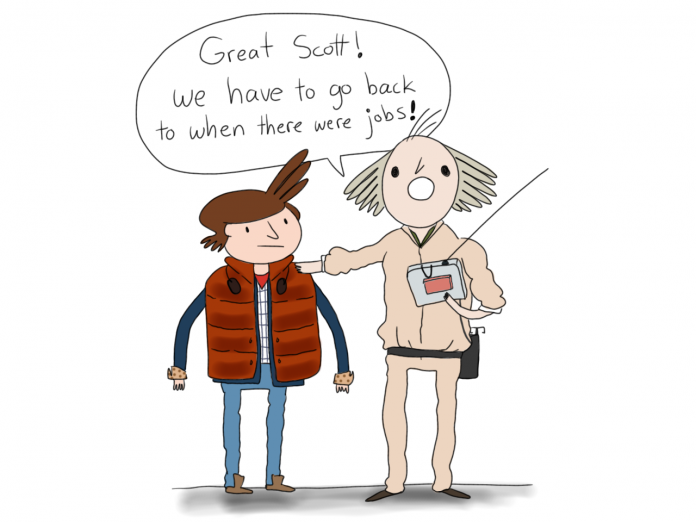
4) Go back in time to when there were actually jobs available.

Legend has it that time travel machines exist in generation X’s closets. Us millennials can jack them, go back in time, take the jobs that they speak so fondly of, and come back to the present cultured and successful while they drivel in penniless despair.  Great Scott, we have to go back!


5) Create a YouTube channel to complain about millennial problems.

All you need is a degree that you have no use for and a camera. Set the camera up in your bedroom. Complain about life. Mention said useless degree at least twice in every video you make. Cash in on advertising dollars when you inevitably become famous for being so #relatable.

Interview with Deepak Sharma

2
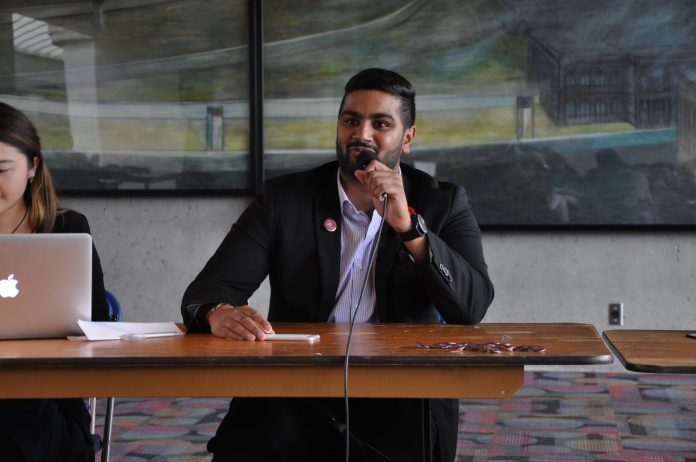
Deepak Sharma speaks at Wednesday's debate at Burnaby campus. Having stepped down as president after his election last spring, Sharma is hoping to regain the confidence of the student body and return as president-elect.

With the SFSS byelection this week, The Peak sat down with all the presidential candidates for a more in-depth chat than the timed responses at the debates. To find the other interviews, click here for Larissa Chen and here for Darien Lechner

Ashley Fraser: Why should students give you another chance after you essentially caused the byelection?

Deepak Sharma: I have never really shied away from why the byelection is taking place in the first place. After I left after being in the first month in office, originally I planned to just walk away from it all. I think the biggest reason why I decided to come back and why students should trust me again and have their confidence in me again is beyond the personal growth and development that comes from any candidate, which I never shy from acknowledging, the biggest thing is, I want to come back and fulfill the various commitments I made and fulfill the various confidence and trust that membership had already earned in placing me in the first place. In addition to that, because one may say you want to fulfill commitments, that’s pretty big isn’t it? What I generally mean by that is apply my experience and knowledge of being a member of the executive for at least over a year and a member of the board for over the past two years. I think that February, March, April, is when I want to apply all that knowledge that I have acquired during the transition period. I think being a part of the SFSS for two years now with very different boards, I think I can take the board to a place where we can prioritize all of the commitments we have made. I have over a year’s experience working with senior management; however, I have essentially been nonexistent with this current board for the almost past six months. I believe it’s very easy for me to potentially basically pick up where I left off with this board, because of the rapport I would have with them.

AF: How is your relationship with everyone who is on the SFSS board since you stepped down?

DS: Up until the Surrey debate I assumed that I had no negative relationship with a single board member, or individual board member. I think you may recall one board member did question my inclusivity at the debate, but I think I have discussed it and perhaps resolved it, and apart from that I would assume they are all my friends still — I would say so, maybe they might beg to differ. Ten out of the 13 people remaining are the people I run alongside, people who I have been working with on projects and initiatives prior to even being on the board. I think it’s a fair question for the membership to ask “Why we should trust you again when you just left us hanging,” however, I believe that’s a non-issue of me working well with the board just because I have that rapport and experience with the board and know their strengths and weaknesses. They know me personally as well. I think that is why it is fairly easy for me to just slide in there and continue to support them.

AF: You claim your resignation was forced. Did anyone at the SFSS actually force you?

DS: I think ‘force’ may be misinterpreted — forced means, forced by SFSS bylaw. So I think in my first public post that I made, where I wanted to explain what I did: take responsibility, apologize to the membership, specifically the board who is affected even more than the membership. I was supposed to be their support team and be that assertive leader; however, I wanted to acknowledge that there was no specific individual that was to blame for my forced resignation, which would be forced due to the bylaws from the previous eight years that we had to follow.

AF: On that note, you waited four months to make a statement after you stepped down. How can students trust that you will be transparent as potential president of the SFSS?

DS: Personally, I was never in denial, but there was a big cloud of regret, sadness, and embarrassment. Since I had vacated that seat, I believe that I let the membership down. It was more sadness that I let down individuals who were very confident in me. The question of transparency, the fact that I was able to be open and honest and acknowledge my mistake, on a personal level — although the timeline was four months later — I think that should provide the membership significant reasoning to believe my transparency and my ability to communicate with what takes place in the workplace. I think that when I look at it professionally, I would be representing a place of over 20,000 members on a day-to-day basis, I think it would be my fiduciary duty to ensure that anything is communicated in a timely manner.

AF: In terms of being transparent, earning back students’ trust, what is one big thing that you would like to accomplish if you were to be elected?

DS: I think we have a great relationship with SFU Health and Counselling, with High Five, our president last year did a great job of building that rapport, as well. I think this year we have some very interested board members who are passionate about this issue although, due to my vacancy they never really got to get to it. I would want to prioritize creating a peer support network, going across all three campuses, going towards, the stigma of mental health in addition to supporting members’ mental health and well-being. That is something that is big that I would like to prioritize that would have a direct and immediate impact on students.

AF: You said you did not decide to run until the last minute. Why should students believe that you are taking this election seriously?

DS: I think students should believe that I am taking this election seriously. The fact that I am willing to take that first step forward to put my name out there and make myself vulnerable to criticism and questions — and very fair criticisms because nothing had been answered in the last four months — letting them know that I have that passion and drive and that commitment that I had made to them, and I am not just simply running some sort of joke campaign, or running a campaign where I may come across as uninterested, however those are sort of secondary reasons. The fact that I went from thinking about transferring from this post-secondary institution, to wanting to not run away from my problems. I think I stress that I directly want to resolve my problems.

AF: At the Surrey debate you challenged candidates to go paperless. Why did you challenge candidates to go paperless if you now have posters up?

DS: I think at that time, I think if we had all committed to go paperless, I think that would have been fair and equal. I think if you take a look at the posters that I have put up, a large majority of them are 8.5×11 rather than 11×17 that other candidates have put up.

I feel really at fault that this election is taking place in the first place so I hope that using a smaller paper size, in a very miniscule way, still reduces the cost of this byelection in addition to obviously the sustainability factor. I think if we were all able to commit to that, it would all be fair and even playing field, but I did put posters up, because going back to your last question, I don’t want to look like I am not taking this seriously and putting in the time and commitment into having a strong campaign.

AF: If you are elected, what do you plan to do about the stadium?

DS: Although this does not gain any extra support or does not strengthen me as a candidate, I have always been, a much bigger supporter of the stadium over the Student Union Building. Although it is not a regular practice to have a student society funding a stadium, as it has always been traditionally viewed as a university or alumni business item, I see this as an opportunity to have our DNA directly imprinted on the stadium, and more accessibility to it. I was very disconnected from the board this past summer, however when I did find out that the stadium was being cancelled, I was very disappointed. At Burnaby, I don’t know the conversations behind why, although it may have been after doing all sorts of research, having it be over three times the amount it was budgeted for and then working towards reducing it, to potentially reduce the cost, but this was upsetting. However, one of my platform points is to find alternative means to a community-based stadium project. I think the first step towards that, even before we start talking about an infrastructure of that stadium is that rapport with the university administration and members beyond athletes, because I think that will be directly beneficial to the stadium as well.

AF: What is your favourite SFU memory?

DS: My favourite SFU memory was how I got involved with the SFSS in the first place. My favourite memory was being part of the marketing campaigning that led to the gathering of almost 2,000 students from all campuses that were able to attend the first-time Fall Kickoff event, which sparked my involvement with the SFSS back in 2013. Since then, I have had many great memories at SFU.

All eyes on GNAC Player of the Year Adam Jones

1
Jones led the GNAC in both points and assists, and was also named to the conference First Team All-GNAC.

Describing an athlete as a “superstar” can often be overused, but it is hard not to immediately think of the word while looking at junior Adam Jones’ achievements. For Jones, soccer was already running in his genes.

“I grew up in Port Coquitlam. My father played football for the Vancouver Eighty-Sixers. I’m a big Manchester United fan because my great-grandfather played for the club. Paul Scholes was a model for me when he was still playing.

“Football was never forced upon me. I just fell in love with it.”

The Port Coquitlam resident travelled a long way playing soccer before returning home. Jones modestly recalled his achievement overseas.

“I was part of an academy in Burnaby, and every year they took a group to Europe to play. There was a cup in Denmark and another one in Sweden. I went to both. It was unbelievable. It was an experience that affected me in so many ways. You don’t realize it at 12, but as you [get] older, you realize the magnitude of this achievement. Around that time, I started thinking I want to become a pro. It gives you a little bit more hope.”

A few years following his journey overseas, Jones felt that it was necessary to go back to his roots.

“I can still live at home here and my family can come and watch my games. The NCAA [National Collegiate Athletic Association] aspect of SFU was also the big reason. I liked the thought of playing in the NCAA; I think it’s pretty prestigious. SFU [is a] good school soccer-wise and it fits me very well. Again, if you look at the financial side, it costs so much more in the [United] States. I spent one year in England during my academic year residence. I went there on trials and I was able to learn self-confidence. When you go over there on your own, you have to be confident.”

With a brilliant regular season performance from the Clan, Jones took home the award for GNAC Player of the Year. The midfielder scored 10 goals and had nine assists. “I think I was in the library writing a paper,” he laughed about how he found out. “It was exciting and it was actually beside Mamadi [Camara] in the ranking.

“Football was never forced upon me. I just fell in love with it.”

“Among all these achievements, I think the message that no one really had to say was the fact that in 20 years it will be great to look back on this. As of right now, none of this will matter to us right now unless we do well in the tournament.”

One could learn a few lessons on how to boss the midfield from Jones. He revealed how his own identity fits into his role.

“My skills are more applicable to a midfield role. I like to set the tempo. I like to pass and create occasions and when someone gets the ball and dribble right away, I don’t have breakaway speed. Midfield is somewhere where I can play my role within the game.”

Jones’ ally in the midfield is none other than his brother Kyle Jones. The Jones pair has been shining on the pitch this season. With his little brother on the team, one might think there is an ongoing competition between the two. The storyline is different from Adam Jones’ perspective, though.

“It’s really fun, to be honest with you. Being two years apart, if he ever wanted to come and train with my team, he would. If I had some spare time, I would hang out with his team. We’re very close that way. There’s no real competition. We understand that we have different attributes that will help the team. We know how to push each other’s buttons the right way.”

While Canadian athletes often get less exposure to Major League Soccer (MLS) drafts due to the absence of a local league, the future is set to be bright for Jones, who ends the interview on an optimistic note.

“I would love to get drafted in the MLS. Being Canadian, I don’t know how much opportunities I would have. If an American team invited me for a preseason trial, for example, I would definitely be open to that option.”

Fun fact:
Which professional team would you want to play for?

“I would play in the Premier League for Manchester United.”

Interview with Larissa Chen

3
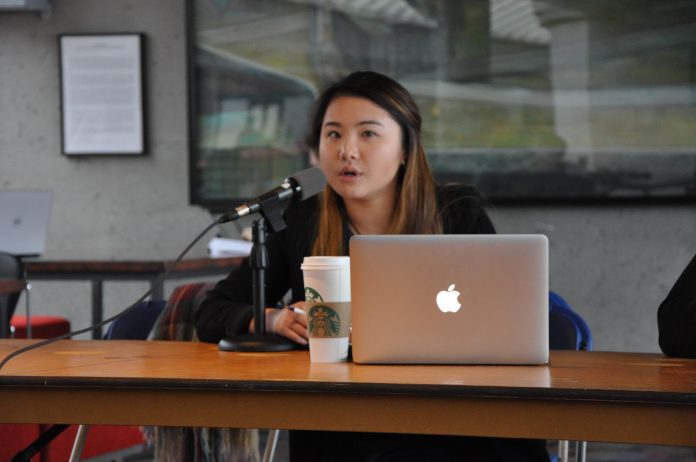
Larissa Chen speaks at Wednesday's debate on Burnaby campus. Chen's campaign is focused on continuing her tenure as interim president.

With the SFSS byelection this week, The Peak sat down with all the presidential candidates for a more in-depth chat than the timed responses at the debates. To find the other interviews, click here for Darien Lechner and here for Deepak Sharma. 

Nathan Ross: You mentioned on Surrey that one of the reasons you were running was so that students weren’t faced with the same option as they had in the general election. Can you elaborate on why you feel that way?

Larissa Chen: During the spring election, students had two options for president. I am currently running alongside those same individuals during this byelection. Given that I have been serving in the role of interim president from May to October 2016, I have the experience that neither of them possess and that is six months of direct experience in the presidential position. Additionally, I have established strong and respectful relationships with the current board and SFSS staff, that will ensure collaborative and successful outcomes for students.

NR: This was asked at the debate, and has been touched on a lot by Darien, but I’d like to give you the chance to answer it without a time limit or anyone in your face. How come you chose to step down as president of the SFSS after the nominations were announced? Follow-up question: If you had stepped down earlier, could VP student services have been a position on the byelection ballot?

LC: It was a difficult decision to step down as VP student services. The bylaws do not indicate it to be mandatory, but I felt it would be an unfair advantage to run a campaign for the role I have direct resources for. Originally, I was hopeful a diverse range of individuals would put themselves forward for the presidential role. Since this was not the case, I decided not to withdraw my name and handed my resignation after the nominations were announced. I was also unsure of my own readiness to run until the second week of nomination period.

For the VP student services role to be added onto this by-election ballot, the position must undergo transition, be vacated and announced “at least two weeks before the opening of the nomination period” (Bylaw 15). It would be challenging for anyone to vacate their role early October, as this remains amongst the busiest times for the SFSS. I focused on fulfilling my VP student services and interim president duties and I welcome everyone to view our board minutes and my individual work reports for that duration (available on the SFSS website).

NR: How would you convince voters that haven’t been happy with the SFSS in the past few months to elect you as president if they didn’t enjoy the board when you were the interim president?

LC: Contrary to popular belief, the president isn’t the sole individual who decides on the direction of the SFSS. The president is the support for other board members and staff who represent and receive feedback from the students. A leader is only as strong as their team and respectively, I know the strengths of this board better than my fellow candidates. The SFSS Board operates as a whole and sometimes, as an individual voice, I didn’t agree with the direction set by the board. But given my transition, experience, and knowledge built over the past six months, I am ready to lead. I understand the concerns expressed and I am the ideal person to listen and address them.

I was faced with an unprecedented situation: transition into an executive role, as well as demands of the president role. This is not easy for anyone. Simply put, it is professional development and SFSS commitment on acceleration mode. But as I have been faced with obstacles, concerns, and support, I’ve realized the value of maintaining such a challenging role as you support your colleagues amd act as the comprehensive knowledge broker for everyone. I’m hopeful students will vote #Lari4President due to my experience, but also recognize that I can be the strong and empathetic voice for my fellow undergraduates.

NR: You’ve been in the role of president now since June. What are you proudest of what you have accomplished in this time?

LC: Assuming the role of president was definitely unexpected. As I ease into being the most interpersonal VP student services students have ever seen, I suddenly assumed the added responsibilities of president. A lot of my summer days were spent in meetings, reviewing files and researching. The transition period into president is a daunting, complex, and difficult process, especially when one does not see themselves worthy of the role; it’s a very vulnerable and insecure place to be in. Gradually, I shifted my focus from perfection to my very best and good intentions and grew confident and began to speak up, concisely and honestly. I began to set expectations before all else, resulting in constructive conversations and effective problem-solving. I shifted my focus towards the intent, rationale, and outcome of anything I did. Much of this can be seen behind the scenes, but the realization of representing my team, students, and the SFSS, my voice became bolder and stronger than ever.

I’m also proud that I was able to maintain the dual responsibility of VP student services and interim president. I continued to actively participate in meetings about U-Pass, Health and Dental Plan, Food and Beverage Services, Ombuds office, sexual violence policy and support services, mental well-being, accessibility, communications, strategic engagement, governance, bylaws, etc. I didn’t lose sight of my campaign platform and personal values. For this, I am glad.

NR: On that subject: if you could have a do-over on anything, would you take it? Which instance and how come?

LC: This is an interesting question as I’m highly critical of myself and tend to identify areas of improvement all the time. If I had an opportunity to “do-over” anything, it would be to have a stronger voice in the Build SFU stadium outcome. The process, communication, and interactions with students would’ve gone much more smoothly had we done the subsequent first. If elected president, I would have a greater say in Build SFU process than I did as interim president. This comes from the discussions and gradual knowledge gained about the logistics and details, but more importantly, the structural process [and] limitations and interpersonal respect established between SFU and SFSS. As my platform emphasizes, I will be the continuity piece for the SFSS, if elected.

NR: Your platform points to a lot of great work that you have done and will continue to do. But if you had to sum it up without telling people to check out your platform for more information, why should students vote for you over Darien and Deepak?

LC: My platform aims to highlight the continuity role I will play as SFSS president, if elected. However, if I were to summarize the value I can bring to the role and society, it would be that I am ready. I have the experience, relationships, and personality to make an immediate impact on the SFSS and its students. I’ve witnessed the process firsthand and have openly received criticisms as areas for improvement. Furthermore, I want students to realize that the SFSS is theirs and I aim to ensure the organization remains approachable, informed, and receptive to student feedback. I feel I will be successful in promoting this as these align with my own personal characteristics and values.

NR: What is your favourite memory from your time at SFU?

LC: I’m currently in my fourth year at SFU, as a health science student, and that in itself still boggles me. I feel I’ve had quite a diverse range of experiences by spending my entire first year at SFU Surrey, living on Burnaby campus, and hanging out at Harbour Centre for my gerontology courses. However, my favourite memories are always those times when you reach a point in life when you can say “Wow. Good job, past Lari. That was a doozy.” These only happen after the inevitable breaking points in university and the only way through is to pause, look at the bigger picture, reassess priorities, and work towards improvement. It’s OK to not be OK! Life will be overwhelming, but if you have a supportive network (and an occasional beer), facing your challenges will always be the best choice.