Home Blog Page 7

Embark Sustainability expresses solidarity with the Global Sumud Flotilla

0
Greta Thunberg speaks among a close crowd of reporters and people holding up Palestinian flags. In the background, the ocean and a couple of boats are pictured, implying that this photo was taken sometime during the flotilla’s journey.
PHOTO: Brahim Guedich / Wikimedia Commons

By: Niveja Assalaarachchi, News Writer

On October 7, Embark Sustainability released a statement of solidarity for the Global Sumud Flotilla, a civilian-led convoy of activists from 47 countries aiming to provide humanitarian aid to Gaza. The flotilla is the largest of its kind in history and seeks to “break Israel’s illegal siege.”

Embark is a non-profit organization that operates at SFU, advocating for food justice and climate equity. The Peak corresponded with the organization to learn more about their support for the flotilla.

Embark’s director of development, Serena Bains, wrote that the flotilla’s goals align with the organization, as Embark’s vision “is a just, equitable, and sustainable future for all.” They also stated that given the organization “operates within a colonial institution,” it has a responsibility to empower all Indigenous Peoples, including Palestinians, through non-colonial activism.

According to the BBC, the United Nations estimated in August that a quarter of Palestinians were facing famine, and one in five households in the territory were facing “an extreme shortage in their consumption of food.” Advocates argue that the situation in Gaza comes as a result of Israel systemically destroying the strip’s food networks

Effective October 10, a ceasefire agreement was agreed to provisionally by both Israel and Hamas. Though the ceasefire has allowed previously inaccessible aid to trickle into the territory slowly, there have been violations of the ceasefire.

Embark’s director of engagement, Marie Haddad, said, “The global flotilla’s mission embodies food justice in action. At Embark, we understand food justice as a collective effort to dismantle barriers to equitable food access while affirming communities’ rights to control their own food systems, and to access culturally relevant, affordable, and sustainable food.”

Haddad pointed out the fragility of the ceasefire as a reason why the flotilla’s work is essential. “While a ceasefire is critical, Israel has repeatedly violated several of these ceasefires, including several this month,” she said. “This makes the work of the flotilla, statements of solidarity, and collective actions like protest continue to be important.” These actions “accumulate pressure to enable those in power to take action to stop this genocide,” she continued. 

Bains condemned the university’s links to the Israeli state and called on it to divest from organizations that have contributed to the genocide. They alleged that the university was “complicit in the surveillance and the suppression of those who speak in favour of the liberation of Palestinians.” They continued, “Universities do not have a crisis of conscious, there is no number of Palestinians murdered during this genocide that will convince them to take action.”

Haddad also encouraged other student organizations at SFU to take a public stance on the genocide in Gaza and groups like the flotilla.

“Solidarity is not symbolic — it is an active refusal of oppression.”

 — Marie Haddad, director of engagement at Embark Sustainability
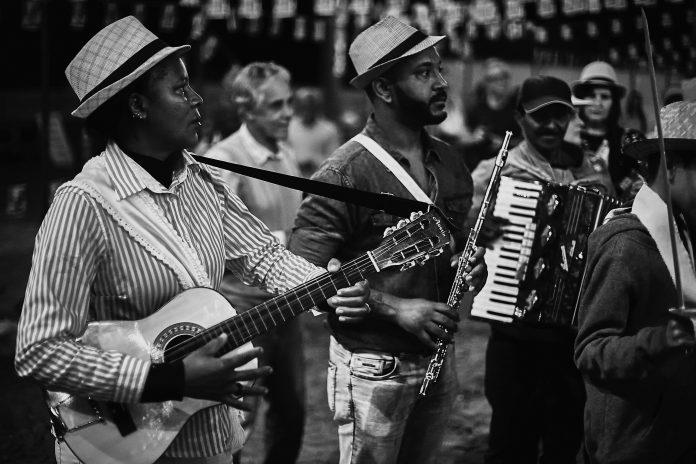
 

We must acknowledge the Afro roots of Latin music

0
a group of musicians performing latin music.
PHOTO: Roberto Silva / Unsplash

By: Ashima Shukla, Staff Writer  

I remember the first time João Gilberto’s voice filled my room. It was soft, unhurried, a secret being told in half-light. “Chega de Saudade” flowed as simply as breath. What I didn’t know yet was that this serene sound, often celebrated as the birth of bossa nova, carried with it older rhythms: the pulse of samba de roda from Bahia, and Candomblé chants where enslaved individuals came together to create art. Before bossa nova’s subtle harmonies reached Rio’s middle-class apartments, its spirit already lived in the percussive heartbeats of those at the margins. 

This history reminds us that Latin and Afro-diasporic music have never been just entertainment; it is also a site of struggle between cultural erasure and reclamation. The story of bossa nova, and later of reggaeton, reveals a continuous cycle in which the voices of the marginalized are reinterpreted for mass consumption. Only to be reclaimed again by artists who remember where these rhythms came from.

Gilberto’s sound, though beautiful, contributed to the softening of samba’s communal energy into something more introspective and urbane. Several cultural critics have called this a process of “whitening,” sanitizing the ongoing inequalities from which this music emerged for Brazil’s white, middle-class audiences in the 1950s. And its ascent was clearly tied to the machinery of the music industry itself, where radios, record labels, and elite patrons determined which voices would represent Brazil to the world. 

Yet hegemony always breeds contestation. By the late 1960s, artists such as Gilberto Gil and Caetano Veloso reinfused Brazilian popular music with rebellion. Through tropicália, they consistently credited the Afro-Brazilian and folk roots of their music, using their influence to amplify marginalized traditions within national and global contexts. Their music became an act of resistance — where the polished surface of this culture was cracked open to reveal its spiritual and social ancestry that bossa nova had polished away. 

We are witnessing similar tensions today, as Latin music increasingly shapes global pop. The reggaeton you are familiar with is far removed from its Afro-diasporic crosscurrents: of Panamanian reggae en español echoing Jamaican dancehall, later fused with Puerto Rican hip-hop in the barrios of San Juan. However, as the genre has globalized, its imagery and sound tend to gravitate toward lighter-skinned, non-Black performers, like J Balvin and Maluma. Meanwhile, Afro-Latinx pioneers like DJ Playero, Tego Calderón, and Amara La Negra, who foreground Afro-diasporic identity in their work, receive far less attention and recognition globally. Again, this imbalance reflects a music industry that continues to be structured by colonial patterns of extraction and profit. The glossy videos and festival aesthetics sold to global audiences mask the reality that the neighbourhoods birthing these sounds remain sites of systemic neglect and racialized inequality

To love Latin music, then, is not just to move with its rhythms in our dance clubs but to honour its deep roots of rebellion.

As listeners, we can choose to feed an industry that packages culture as spectacle, or we can seek artists who keep the lineage alive. Like Luedji Luna, who not only celebrates Candomblé as part of her music and identity but also founded Palavra Preta, a movement aimed at bringing together Black women composers and poets across Brazil. Or iLe, who was an active voice in Puerto Rico’s resistance against its corrupt administration. Or Renata Flores pushing back against underrepresentation by singing in Quechua

These artists remind us that Latin music’s future does not lie in the algorithmic pursuit of virality, but in the deliberate act of honouring the people and places, and all their complexities, from which these irresistible rhythms are born. We must challenge the industry’s appetite for aestheticizing suffering. Because our playlists are political, and each stream is a choice to either sustain erasure or amplify the voices that kept these rhythms alive.

Creativity is the ultimate (monster) mash

0
a kid dressed as a ghost, with a white sheet covering their body. They’re standing in a kitchen. With decorative pumpkins around the kitchen.
PHOTO: Olga Simonova / Unsplash

By: Noeka Nimmervoll, Staff Writer

Halloween just happened, and thank god! I was getting tired of pretending to be a human. Just kidding — but there is something to be said about the creative freedom that Halloween provides. The holiday’s embrace of creativity is evident through its encouragement of costumes, decorations, and spooky events. Through it, we can see that “everyone can be creative.” It’s a fun, limitless holiday. For a few hours, you can be anything you want to be! I’m sorry, what did you say? You’ve shown up to school in a real boat with a cutout, filled with stuffed animals? Your costume was Noah’s Ark? Awesome. It was fun to see!  

Expressing yourself is easy on Halloween. The festivities of the holiday make space for us to showcase our creativity without judgment. In fact, the bolder, the better! Halloween is the one time a year when you can wear that exceptionally strange purple striped suit in the back of your closet down the street without anyone batting an eye. No matter how ridiculous your costume is, you’re bound to get more admirers than judges, as long as you commit to the bit. It’s never overdressing if it’s for Halloween. Let your inner monster loose!

Beyond that, we can all work with the theme: spooky scary hilarity. Contrary to popular belief, having a focus is a great way to bolster creativity. Halloween provides a ground to work on, from which you can be inventive with your costume! There are a million and one directions to take Halloween, but you always have the Halloween presence in mind as a starting point — you know you will be around fog and skeletons at some point in the night. If you have no original ideas, you can turn to a basic one and make it your own: a witch costume can be just as good as an original costume idea if you dress it up right. 

I feel a little bitter when I think about the fact that I’m no longer cute enough to dress up and ask strangers for free candy. However, there are consolations. You get to express a part of yourself to the world that isn’t always easy to show in everyday life. You can show off your clown makeup. You can carve a brilliant jack-o’-lantern. You can throw a ghoul-themed party. There is much less that you can’t do than what you can do during this holiday, and isn’t that what creativity is all about?

The SFSS’ proposed financial restriction bylaws are not clear enough

0
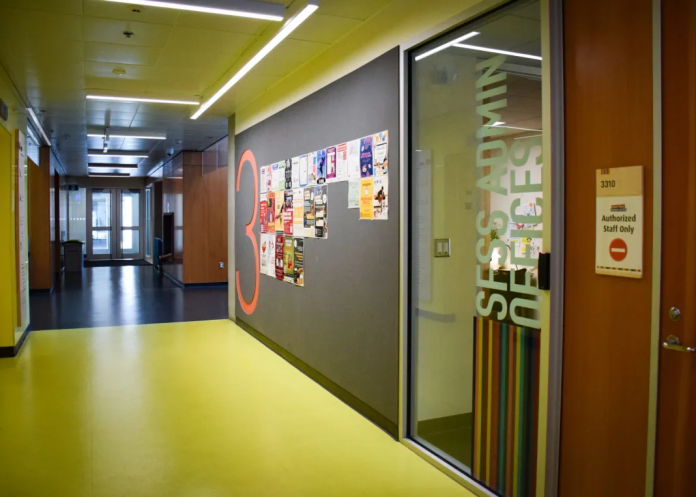
a photo of the SFSS’s admin office on the third floor of the Student Union Building on the Burnaby campus. The photo is taken from the outside of the office, from the hallway. The hallway is empty of people.
PHOTO: Audrey Safikhani / The Peak

By: Corbett Gildersleve, Project Assistant

The Simon Fraser Student Society (SFSS) held its annual general meeting on October 29, where undergrads discussed and voted on two bylaw proposals put forth by the SFSS. Both proposals passed, including the “Financial Responsibility and Investment Restrictions” bylaw, which aims to restrict investments for “long-term financial sustainability.” It has some good ideas overall, but the wording for certain clauses will cause problems. 

Bylaws define things like who the members and directors are, and what powers they have. Changes to bylaws can only be approved by members either through a referendum or at a general meeting. Non-profits like the SFSS also have policies, which are rules that Council can change on their own. They are used to guide the organization, and the SFSS has numerous policy documents that help set rules around its finances, member services, student issues and other day-to-day operations. 

The SFSS has a history of turning large budget deficits into a surplus by the end of the year, as shown by the audited financial statements. For instance, in 2017, the SFSS sold The Highland Pub and MBC cafeteria space back to SFU. In other years, there was underspending, especially between 2020 and 2022. It’s only been in the last few years that the final audit has been financially concerning. So, it’s no surprise the Council has recommended placing some restrictions on budget deficits. 

One clause says, “The Society shall not approve an annual operating budget that projects an operational deficit exceeding 20% of the Society’s projected annual revenue.” On the surface, it’s a good thing to put a constraint on how much of a deficit the Council can approve. The issue is that it refers to “annual revenue,” which is an ambiguous term. Annual revenue includes the General Fund, Build SFU Fund, Space Expansion Fund, and the Health Plan Fund. In the 2023–24 fiscal year, annual revenue totalled over $16 million. A 20% deficit would be over $3 million, which is significantly larger than any of the past operating budget deficits. I assume the SFSS meant 20% of their projected operating budget, which would be around $3 million according to their 2025–26 budget. A 20% deficit buffer would be around $600,000, which isn’t much different than most of SFSS’ projected operational budget deficits historically. 

Another concern is what happens if the Council approves a budget deficit that exceeds 20%? Clause 3b says, “Any deficit exceeding this limit must require approval by two-thirds of Council and ratification by the membership at the next general meeting.” This can be interpreted in two ways: either that two-thirds of Council members approve the new budget in the summer term, and in the fall, members approve it at the AGM, or that two-thirds of Council and the regular membership have to approve it at the AGM. The SFSS doesn’t have the best track record of reaching quorum at its AGMs, with only five in the last 10 years reaching quorum. Last year’s is being challenged at the Civil Resolution Tribunal. If Council approves a budget similar to this year’s but the AGM doesn’t reach quorum, would the SFSS be breaking its bylaws? If so, what kind of legal liability would they be in?

Another clause says, “The Society shall maintain fiscal practices that prioritize student activities, ensuring that costs allocated to student union funding, club funding, constituency group activities, and Council committees constitute at least 30% of revenue in the Operational Fund budget.” This is a good thing to prioritize funds towards. I have a few questions, though, like what is the Operational Fund? The SFSS’ audited financial statements have a General Fund and the SFSS has an operating budget, but those two things don’t completely match. 

To be technical (the best kind of picky), almost anything the SFSS does would be considered operations, including costs for the SUB, buying furniture for student union common rooms, and wages for student-facing staff. So, if the Operating Fund continues to be at $16 million, 30% of that would be just under $5 million. Will they start putting that towards “student union funding, club funding, constituency group activities, and council committees?” I don’t think so, because much of that revenue has to be spent on specific things like the health plan, the SUB, and other areas.

However, again, if by operating fund they meant operating budget, which is around $3 million, 30% of that is $900,000. Looking at the 2025–26 operating budget and totaling up the student union and club funding, constituency group activities, and council committees, that works out to be around $1,422,147 assuming you’re not counting staff costs. If you are, then it’s well over the $900,000 mark. It’s hard to tell now because the SFSS moved a bunch of staff costs into one Human Resources line. Not very clear or transparent. 

Finally, clause 7 says, “Council shall seek to maintain diversified revenue streams such that no more than 85% of total annual revenue derives from mandatory student fees.” Because it says total revenue, again, we’re talking $16 million. How much is 15%? Just under $3 million. Good luck, future Council members. Or not, because it says, “Council shall seek to maintain diversified revenue streams,” and that’s not enforceable by the members. Council can just say “Oh, we tried, but couldn’t quite maintain it.” 

When it comes to bylaws and money, it needs to be crystal clear or else the Society is inviting legal challenges from its members. Many of these clauses are more likely to be found in a strategic plan or policy. Other questions are: Where did these numbers come from? Why 85% of mandatory fees? Currently, almost all SFSS revenue comes from mandatory student fees. Is this even achievable and if so, where’s the report from senior staff with a plan? Since these bylaws have been passed, they will significantly restructure the SFSS and I’m concerned that there’s no plan in place. 

Club Profile: The Association of Latin American Students

0
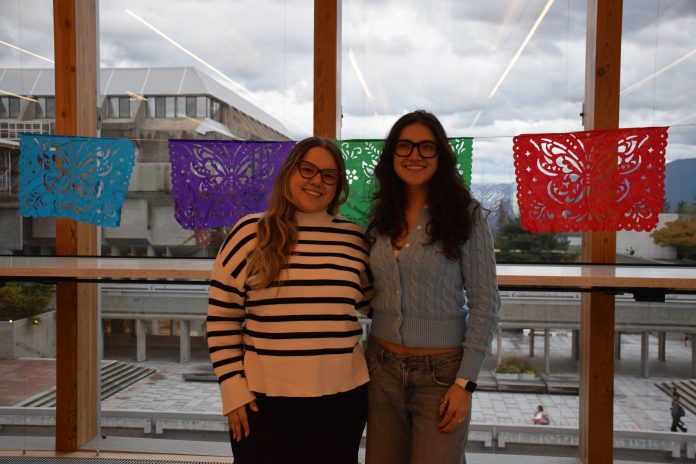
A photo of ALAS president Maria Clara Rezende (left) alongside Vice president Regina Zamira Sierra (right), smiling in front of the window from the SUB overlooking the Belzberg library. A string of papel picado (perforated tissue cut in intricate designs) hang along the width of the window behind them.
PHOTO: Audrey Safikhani / The Peak

By: Petra Chase, Features Editor

SFU’s Association of Latin American Students (ALAS) has represented students from the region since the early 2000s. On October 1, they hosted the Latin Street Food Fest Icebreaker in the SUB ballroom. From walking through the doors, I felt welcomed and immersed in cultures.

Maria Clara Rezende, whose favourite Latino song is her homeland’s classic “A Banda” by Chico Buarque, was looking for a sense of belonging when she discovered ALAS a few semesters into her communication degree. Rezende began to feel connected when she joined ALAS and the Brazilian Students Association. Both associations now frequently collaborate. Now, as president, she hopes to continue building community, which is “something we sometimes lose when we move countries,” she told me in an interview.

Vice president Regina Zamora Sierra, who moved here from Mexico City to major in economics, shares the same passions: “make [ALAS] bigger and also share my own culture,” she shared, speaking alongside Rezende. Each food on the menu had its own booth run by executives, serving their favourite street foods: Brazilian coxinhas (chicken croquettes), dulce de leche churros, tortilla chips with salsa, and pineapple/mango with chamoy (pickled fruit sauce) and Tajín (a blend of chilli peppers, lime, and salt). 

“We tried to recreate a street festival — even though we’re limited to the space and resources we have. Just try to be as authentic as possible,” Rezende said. “I think it’s a great example of our culture,” Sierra added. “We’re showing a little bit of how we interact socially with other people.” 

A photo stand with characters in Mexican attire, a string of papel picado hanging on the wall, and tables covered with ponchos are some of the details that reflect the commitment to bringing a sense of home to the approximately 4% of SFU students who are Latin American. 

As people played darts and corn hole, there was also a booth for purchasing club tote bags. These feature an array of illustrated animals associated with Latin American countries, including a llama (representing Peru), a cuy (or guinea pig from Ecuador), and a gallito de las rocas (Andean cock-of-the-rock).

“From Mexico, which is in North America, to Chile or Uruguay, which are the very bottom of South America, there’s a lot of culture in between those countries,” Rezende explained. ALAS provides a “space to share culture and learn more about other people’s culture, and we’re always trying to be as inclusive as we can.”

Prior to the street fest, ALAS hosted an exec night to welcome the mostly new executives.

“It was like witnessing the beginning of friendships and connections and something really great and [ . . .  ] it was like a warm hug,”

— Maria Clara Rezende, ALAS president

“There’s a big cultural diversity at SFU, even outside of ALAS, and I think that’s really nice,” Sierra added. “I’ve met a lot of people who don’t know about the club but are part of the Latin American community, even if it’s just because of one of their parents, and it’s really nice to always share our community with them, and have them celebrate their culture with us.”

Rezende also pointed out the value of “higher education knowledge” for Latin students, “for those of us who grew up here, and those who moved.” While there are courses geared towards Latin culture, language and history, they are not promoted enough, she added. “The Latin American students here, we still want to know things about our countries that we don’t get to experience in our regular classes.” For example, Portuguese-language literature (The Hour of the Star by Clarice Lispector is a favourite of hers). 

A significant part of ALAS is bringing people together through events. Sierra described a soccer match last semester, where people who weren’t part of the club happened to be playing on the same field and joined in. “We found out that they were Latin American as well and that’s how they found out about the club,” she said. “It was nice to see that game that’s such a big part of my culture represented,” and for new members to join that way.

“Our main goal is just to increase peoples’ knowledge about ALAS because sometimes we feel like people just don’t know we exist, we are here,” Rezende said.

Sierra emphasized, “Our memberships are not exclusive to Latin Americans, it’s just people who want to enjoy the culture as well.” The street fest concluded with competitive rounds of musical chairs against the backdrop of everything from salsa, reggaeton, Brazilian funk, and bachata, to Shakira.

Reconciliation and You: a talk with Indigenous authors

0
ILLUSTRATION: Yan Ting Leung / The Peak

By: Noeka Nimmervoll, Staff Writer

On October 22, the Vancouver Writers Fest hosted a talk with David A. Robertson, member of the Norway House Cree Nation and author of 52 Ways to Reconcile, and Bruce McIvor, member of the Manitoba Métis Federation, SFU alum, and author of Indigenous Rights in One Minute. Moderated by Michelle Cyca, “Reconciliation and You” hosted a multidisciplinary conversation at Performance Works about Truth and Reconciliation, and the role every individual has to play in the process. The Peak attended the event to learn more. 

During the talk, Robertson described reconciliation as an “act of building a community,” not rebuilding what was there, but building something better and stronger, together. McIvor, in contrast, believed reconciliation to be “Canada’s way to try to justify its ongoing colonization of Indigenous People.” The writers spoke about many systems that maintain inequity and colonialism in this country, including healthcare and foster care. McIvor spoke about people living on reserves dying on transit while travelling to receive healthcare that they don’t have access to on-site. Robertson shared the view that foster care is a contemporary form of residential schools, with Indigenous children accounting for a disproportionate 54% of children in the Canadian system, compared to Indigenous children representing only 8% of the child population. 

As Cyca highlighted, reconciliation is the second stage of a two-part process: Truth and Reconciliation. To begin, everyone, especially non-Indigenous folks, should learn about the colonial history of Canada — “its legal foundations as a country and the agreements it signed with Indigenous People,” she specified. Further, she shared that residential schools and their impacts on Indigenous survivors and their descendants will always be a part of Canada’s history, which is essential to learn. The speakers expressed that the feeling of discomfort is an integral part of the learning process. 

“One of the most accessible ways” to learn the truth, Robertson shared, is through listening to Indigenous voices. Many media outlets provide ways to do this, including literature such as True Reconciliation by Jody Wilson-Raybould, podcasts like Missing and Murdered: Finding Cleo by Connie Walker, and television series like the comedy Reservation Dogs

Moving forward, McIvor shared that everyone should stand up when racism, misinformation, and bigotry are at work in the country. With the Canadian education system, everybody was likely taught about “Canada, the good.” One virtue of the country that separates us from the US is the protected rights of Indigenous Peoples. “Be proud of that,” he said, “and be proud enough to pick up the phone and call your government reps!” Furthermore, Robertson added, “Part of the process of growth and reconciliation is to make mistakes. It is to do the wrong thing, because we have to grow.” He emphasized the importance of giving yourself grace while you walk this path. 

For Indigenous Peoples, Robertson outlined that one key component of their role is to heal from their pasts. “You can’t heal brokenness with brokenness.” He suggested that if everybody does the work individually, they may be able to heal together and then have the capacity to examine the “larger relationship.” Robertson believes that another role of Indigenous Peoples in this process is as storytellers: broadcasting their truth and voice to spread understanding. He encourages such communities to share more of their stories because people are listening. 

Robertson shared a sentiment of his father, which spoke to a community’s ability to create change.

“I can’t do everything, but I can do something, and if everybody does something, then we have a community of people taking action, and we get to where we need to go. It’s not a sprint.”

— David A. Robertson, author of 52 Ways to Reconcile

Purchase 52 Ways to Reconcile and Indigenous Rights in One Minute at Book Warehouse

What we must confront: Living with Long COVID

0
PHOTO: Elliott Marquis / The Peak

By: Ashima Shukla, Staff Writer  

The first winter of the pandemic, I was in Shanghai visiting my family when the first news reports began circulating — something about a new pneumonia, a city in lockdown. Within days, my family and I had boarded a flight to India, seeking temporary refuge. Three days before our flight back, India closed its borders. Airports emptied. Around the world, our lives shrank to the size of our homes. For millions around the world, it meant grieving in isolation, watching suffering multiply. It meant exposure to the deep inequities of our world, where access to safety, care, and health depended on privilege, geography, and luck.

Over time, things seemed to return to normal. However, the virus, though silenced, persisted, reshaping bodies and altering lives long after the headlines moved elsewhere. 

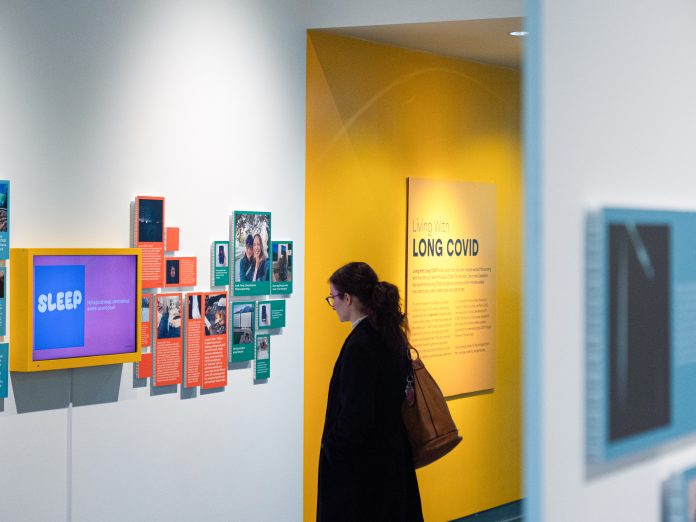
That collective amnesia of normalcy is what Living With Long COVID, a photography exhibition co-hosted by the Museum of Vancouver, SFU’s Faculty of Health Sciences, and the Post-COVID Interdisciplinary Clinical Care Network (PC-ICCN), attempts to break. On view at the museum from October 4, 2025, to March 22, 2026, this exhibition invites visitors into the often-overlooked world of the reality of COVID-19, asking us to confront what our systems and empathy have failed to care for. 

Long COVID affects one in nine Canadians. Its symptoms, numbering over 200, range from fatigue to organ damage and dysautonomia. Those living with it continue to fight for recognition, often gaslit by health systems unprepared to treat chronic conditions and dismissed by workplaces that equate productivity with personal worth. As the exhibition’s co-organizer, researcher, and long-hauler (those who are suffering from Long COVID), Kayli Jamieson reminds us, “The impact of Long COVID is not just medical — it’s economic, social, and deeply personal. We are isolated not only by our symptoms, but from lost relationships. The suffering compounds when we face silence, disbelief, and doubts from friends, family, employers, and even healthcare providers.” 

But the exhibit resists the cruel narratives of ableism that demand a so-called “post-COVID-19” reality. Its community-based participatory arts approach allows it to transform research into solidarity. 46 participants from across Canada responded to a call to document a day in their lives as long-haulers, contributing over 240 photographs and reflections that make the immense impact of the virus all too real.

These images clearly portray adaptation, despair, persistence, and quiet revolt of these participants.

A rare outing in someone’s new wheelchair. A medical journal documenting continuous pain for dismissive doctors. A table top full of medications. A makeshift work station to accommodate life with Long COVID. Each picture insists: we are still here. 

But the exhibition is more than about suffering. It is also about connection and community. Near the end, one finds a wall for handwritten notes from visitors. “Feeling seen,” one reads. “Mask up,” another encourages. These words, fragile and immediate, form a counter-archive to the erasure we see around us. In a society eager to return to “normal,” Living with Long COVID asks what normal ever meant, and who it served. 

Thus, it reclaims the politics of visibility. It reminds us that art, when rooted in care, can hold what medicine and policy too often fail to bring to light: the human complexity of survival. Visit the exhibition and wear a mask as a gesture of solidarity, a recognition that healing should be a collective responsibility. 


Speaking to Ashlyn Tegos about The Way That I Am

0
Courtesy of Ashlyn Tegos

By: Noeka Nimmervoll, Staff Writer 

Ashlyn Tegos is a queer independent recording artist based in Vancouver. Her music is a soft pop orchestra of gentle yet intentional vocal layerings over lyrics that explore love, heartbreak, and identity. On October 1, Tegos released “Garden Ghost,” a tender song she wrote by weaving her emotions into a story that became a tangible emotional soundscape. Additionally, two of her singles, “Feels Like” and “Autumn Lover,” are out on all platforms in anticipation of her debut album, The Way That I Am. This album, which has been in the works since 2020, is scheduled for release by the end of 2025 and focuses on love, breakups, and above all, self-acceptance. The Peak spoke to Tegos to learn more about her music journey.

“The album has had many different lives and many different names over the past few years,” shared Tegos. The original album, titled Hiraeth, contained six songs. “And then I got my heart broken for the first time,” she recalled. This formative breakup served as the initial catalyst for change in the album, which was then renamed, reworked, and reimagined with every breakup in Tegos’ life. “But in the past year, it’s evolved and changed into more of an album of this is just who I am.” Although the album is very “breakup centred,” Tegos said:

“It contains an undertone of acceptance and self-love and finding the magic in the mess that is you. And so, the album is called The Way That I Am.”

Even for solo artists, releasing an album is a group project. Tegos released a music video for her single “Autumn Lover” on September 5, enlisting some close friends and artists she had previously worked with to make the vision come to life. “I’m really lucky that I have such talented, amazing friends who are so willing to help,” she expressed. Her debut album is now fully recorded, but requires mixing and mastering before release. Her main producer is Mac Ramsay, who she met six years ago, outside an Ariana Grande concert. “He walked me and [my friend] home and was like, we’re gonna make music together one day . . . and now here I am, releasing my first album, and he is the main producer. It’s so cool and full circle,” shared Tegos.

Tegos’ influences are not simple, and neither is her songwriting. “It’s a mixture of folky pop meets musical theatre, harmonies galore.” Citing songwriting and lyrical influences from the likes of Phoebe Bridgers and Adrianne Lenker, Tegos said, “I write the best after I’ve listened to their music a lot.” For her sound, she focuses on vocal layering, inspired by the likes of Imogen Heap. Tegos added, “A lot of the songs don’t have the typical format of a song. A lot of it is kind of free verse . . . and not as predictable as some other songs.” Despite this, she reassured me that “there’s going to be something for everyone in there.”

Find @AshlynTegos on YouTube, Instagram, and TikTok for up-to-date information on her album.

The Mush Hole comes to Vancouver

0
Courtesy of Ian R. Maracle

By: Niveja Assalaarachchi, News Writer

Content warning: Mention of residential schools

The Kaha:wi Dance Theatre (KDT) will, for the first time, bring their show The Mush Hole to Vancouver. The Toronto-based studio will be performing at Vancouver Cultch’s Historic Theatre from November 14 to 16.

The show is centred on the experiences of those who survived Canada’s first residential school, the Mohawk Institute, also known as “Mush Hole,” which operated from 1828 to 1970. The performance incorporates multiple lived experiences of what happened at the site, spanning across generations.

The Peak interviewed Santee Smith, the artistic director of the Kaha:wi Dance Theatre and the Chancellor of McMaster University, to learn more about the group itself and the background behind The Mush Hole.

The show will be a vignette that incorporates body storytelling into the theatrical performance. Smith said the set would include settings like the boiler room, cafeteria, and solitary confinement rooms, where much of the brutality of the institution was on full display.

Smith explained the name came from the fact that students at the Mohawk Institute worked on a school farm, where they were not allowed to eat any of the produce, and were restricted to only eating the mushy gruel served to them.

This level of detail was something Smith focused on when developing the script for the theatre production. “My family attended so it’s a personal story,” she said, “I did a lot of cultural research at the Woodland Cultural Center, which is a museum organization that oversees the Mohawk Institute, and they had a lot of work with survivors.” She went on to say that the work of the Truth and Reconciliation Commission helped reveal facts on what happened at the Mohawk Institute, and thus played a key cultural part in this production. The militarized nature of the education institution and symbols in the school was also on full display in the show, “So, throughout the piece, there’s very specific imagery [and] gestures—it was, at one point, a very militarized program.”  

Founded in 2005 by Smith, the Kaha:wi Theatre Company has focused on giving a platform for Indigenous voices and ideas. Smith told me the company emerged from her prior work as an independent dance artist and has now produced over 14 major works for various media sources. 

This is the first time the show has come to Vancouver, with most other theatrical performances mostly taking place in the east of the country.

“This is important for us, because we wanted to reach audiences across the country, and knowing that the similar history of Indian residential schools and the long-term impacts are still relevant,”

— Santee Smith, artistic director of the Kaha:wi Dance Theatre

Smith also saw her show as an important learning platform for all Canadians on the horrors of the residential school system, “I think it’s really important, it would be a great way to access, to understand that history . . . often people are coming to Canada because it’s safe and it has all these opportunities, which it does. But people don’t understand the extent of [its] colonial history and the impacts that are still happening.”

See The Mush Hole at the Cultch Historic Theatre from November 14 to 16.

Starbucks CEO addresses store closures and layoffs

0
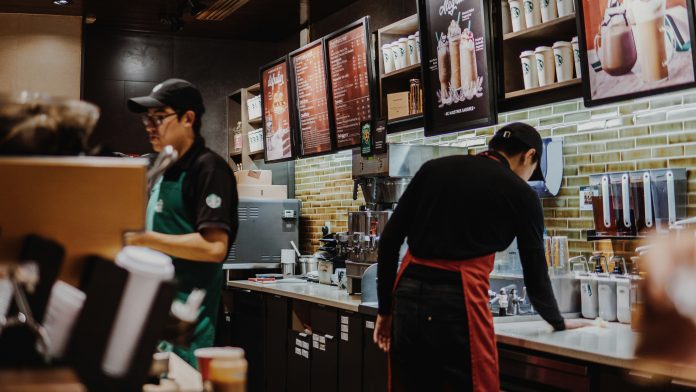
Employees working inside a bustling Starbucks.
PHOTO: Asael Peña / Unsplash

By: Persephone Alexander, Your CEO’s Underpaid Secretary 

Subject: Brewing Change Together: A message from the heart of your dear CEO

Dear Starbucks Partners (and soon to be “former partners” — semantics, really), 

I hope this message finds you well, or at least six blonde shots deep to even care about what is happening. As you may have heard, we will be closing a select number of stores and parting ways with approximately 900 partners across Canada and the United States. 

I would like to personally reassure all of you that this decision was made with deep compassion, rigorous analytics, and an Excel spreadsheet that analyzed your stations’ key performance indicators. Such indicators definitely do not weigh unionized stores any differently! This is just for the benefit of everyone. Really, we are doing this for you, our valued partners. Trust me!  

To those affected by these changes, we want to say: thank you. Thank you for not calling in sick when you actually were, and thank you for showing up with your own shovel when our stores were knee-deep in snow. Your tireless service is rewarded with freedom — from work. 

We will be offering a severance package consisting of an array of absolutely necessary heartfelt thoughts, a reusable cup to promote our efforts of sustainability, and one free drink voucher for your last working shift (which is already offered to all of our partners as a perk).

For those who remain, congratulations! You have been promoted from “partner” to “leftover.” Included in your new benefits are added shoulder tension from the newly implemented mandatory speed checks. The new system of work monitors will proceed as follows: your floor leader will ensure you are caught up with the four streams of orders (drive-thru, cafe, mobile, and delivery orders) by asking you if you are preparing the drinks — while standing over your shoulder. If you find yourself concerned over who is monitoring their monitoring, do not fret. Our executive team pulled an all-nighter to solve this dilemma. The solution is that store managers will be standing over their shoulder, while floor leaders will be standing over yours. Senior managers will be standing over the shoulders of store managers, while an AI-generated hologram of me will be watching over their shoulders. 

I can further anticipate your concern regarding the efficiency of this monitoring system. Do not worry, my team has gone on a month-long retreat to Las Vegas to rectify this problem. The solution is as follows: we will have our newly installed AI inventory system perform the job that humans have been doing since forever. Does the AI always count correctly? Um, not really. But who cares? We are cool. We are hip. And we are hiphopping all over the place. Just do not ask why we are doing this. Focus on the progress we are making by relying on AI. And do not fret, when that system makes errors, we will find a human to blame!

As a last note — I would like to repeat — this has nothing to do with unionization!  

Warm regards (as warm as a forgotten mobile ordered Venti Americano),

Brian Niccol, CEO of Starbucks Inc.