Home Blog Page 682

SFU alumni develop innovative wristband that simulate haptic sensations

0
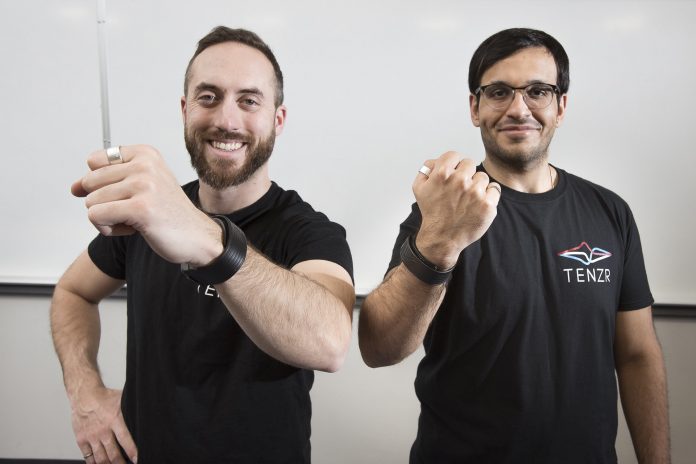
The prototype will be competing in the Coast Capital Savings Venture Prize. (Photo courtesy of SFU)

A pair of Simon Fraser University alumni have developed an innovative wristband that recognizes and understands hand gestures. The product, which is branded as TENZRTM, allows users to perform virtual actions, such as pausing a video or scrolling down the page, without the need of physically touching a computer mouse or a controller. When an individual uses the wristband, their hand in a sense becomes a controller because their hand motions emulate the haptic sensation of clicking on a computer mouse.

Lukas-Karim Merhi and Gautam Sadarangani, co-founders of BioInteractive Technologies, showcased their new product to the community last week at SFU Surrey. Merhi and Sadarangani have spent the last three years developing the gesture recognizable wristband, TENZRTM, and the product is currently gaining traction in the virtual reality and augmented reality world.

The wristband is currently designed to recognize six hand gestures: up, down, left, right, hand open, and hand close. In addition, the wristband does not need a camera to operate — it uses Bluetooth technology instead to transmit and receive signals.

“Its algorithms can predict and detect [finger movements and hand gestures] by using machine learning algorithms. The sensing technique does not measure electrical signals therefore it is accurate and reliable,” according to its website.

The wristband is currently sold for CAD$199 and its battery life lasts approximately 12 hours. The device also has the possibility of being used in health-care settings. For example, physicians are trying to determine the wristband’s potential in helping stroke survivors who suffered a motor deficit in their upper extremities. The wristband could potentially help these patients restore their hand movement, as stated on its website.

In fact, the innovative wristband can also be used to monitor the way berries and grapes are picked via haptic feedback. Users can customize their wristband for different applications, from recording motor movements to movement rehabilitation, with the latter still being explored.

Moreover, Merhi and Sadarangani’s company was shortlisted as one of the 10 companies accepted into the highly competitive Techstars Anywhere program, according to a media advisory by the university.

The program has an acceptance rate of less than 1% and applications were received from all over the world, according to its website. Companies who are accepted into Techstars Anywhere program receive mentorship from one of the US’s top tech accelerators, Techstars. This allows them to gain expert feedback so that they can start selling their product on the market.

The Peak reached out to Merhi and Sadarangani but did not receive a response by our print deadline. However, the duo will be competing in the upcoming Coast Capital Savings Venture Prize for their new prototype.


With files from PR Newswire.

Lack of support for First Nations Studies at SFU, says Senate

0
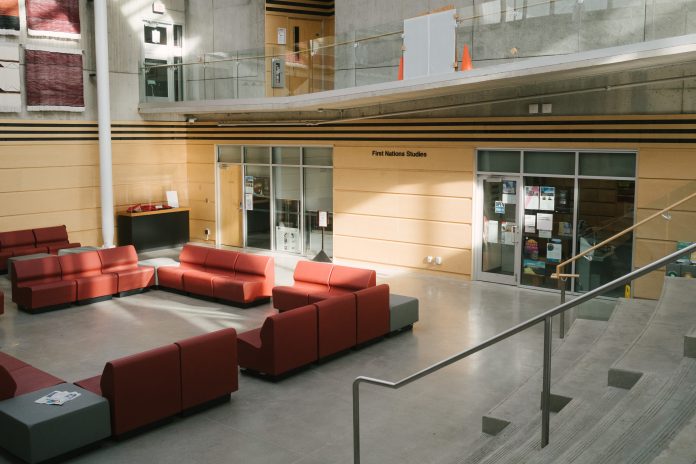
Concerns over the small size of the department was noted when it was created in 2012. (Chris Ho / The Peak)

Discussion regarding the current status and role of SFU’s department of First Nations studies (FNS) broke out in the latest SFU Senate meeting on February 5.


Single-digit faculty

When a motion to approve the action plan for the department resulting from its external review was proposed, senator David Burley began the discussion by commenting that he had noticed in the Dean’s summation and commitment of resources that the faculty consisted of only 3.5 members.

“I don’t know if any department in any university on the scale of SFU would have a department of 3.5 members,” he said. Senator Burley also expressed concern regarding the proposed action plan for the department, particularly the three limited-term appointments suggested.

“I am really concerned about how the program became a department six or seven years ago, and why there has been no support since that initial transition from a program to a department. [. . .] And it really makes me angry seeing how First Nations studies has been treated over the years, and how it’s being treated at this present time in terms of a commitment of resources to allow the department to move forward. [. . .]  I note that it’s an extremely difficult challenge to recruit First Nations individuals, and you’re not going to get them with limited-term appointments,” he ended.

The decision to convert the First Nations studies program at SFU to a full-fledged department was noted in the minutes of the March 2012 Senate meeting. As quoted by senator Colin Percival from the 2012 minutes: “A concern was raised regarding the small size of the department. It was clarified that members from other departments and faculties will be recruited when necessary to help meet the requirements of the department.”  

In place of First Nations studies chair Deanna Reder, dean of the faculty of arts and social sciences Jane Pulkingham represented the department, and she agreed that while FNS was currently SFU’s smallest department, it was not by a long stride. She also noted that since the development of the action plan, she had committed one continuing faculty position to First Nations studies. Pulkingham also indicated to the department’s three fairly new multiple-year term appointments as an indicator of progress within the department, as they are an improvement over the sessional appointments the department used to hold.


Graduate program plans thrown into question

Further on in the discussion, the viability of a graduate program in First Nations studies, which has been recently talked about within the faculty, was brought into question. “Even with one continuing-term position and two limited-term positions, the plan as it’s been laid out by First Nations studies in terms of a graduate program, in terms of all other things they want to do, is virtually impossible to implement,” commented senator Burley.

Pulkingham agreed with this observation and noted that the faculty currently has a priority on expanding capacity to move towards making this goal more realistic. “The graduate program is an aspiration, it’s not a commitment,” she said, “And it’s a commitment that would not see its feet hitting the ground for several years should it happen.”

“I agree with you that it cannot be done with that complement [of faculty], but we are looking at how we might get there.”


Ethical implications for reconciliation 

Senator Daniel Laitsch broadened the implications of the discussion when he motioned to speak. “I’m just a little trouble by lumping the [FNS] department in with all the other departments, as if there’s not an ethical imperative at this time and in this place and at this university to support reconciliation, to support our Indigenous faculty and colleagues,” he said.

Pulkingham commented that, to this end, there had been discussion among the chairs and directors of the faculty that “perhaps the faculty should adopt a stance that all hires will be Indigenous,” but it was too early to make a comment concretely on the possibility.        

On the same vein of the university’s broader ethical commitment, senator Jamie Scott said, “The intentions are not clear, and I don’t think the vision is either at SFU for this idea of ‘indigenization.’ [. . .] And then having a unit that is, no offence or anything, that is wimpy, and it’s small, and it’s not moving ahead, and yet there’s this large vision that we’re supposed to indigenize the university.”    

“It seems to me that this idea that we’re going to indigenize the faculty is not run by Indigenous people, it’s not from an Indigenous point of view necessarily.” – Senator Jamie Scott

Senator Scott agreed that the issue was a catch-22, but she emphasized that “if you don’t have a strong group of Indigenous scholars that are somehow working together [. . .], it’s going to be real hard to attract those folks, and to actually accomplish the end that we’re envisioning.”

 Vice-president, academic and senator Peter Keller commented for the record that “increasing the number of Indigenous faculty at Simon Fraser University is a strategic priority.” He referenced a financial obligation placed upon himself as VP, where he has agreed to pay the first few years’ salary of any Indigenous appointment. “That is to incentivize all of you,” he said towards the Senate members present, “to do your absolute best to try and attract Indigenous faculty to Simon Fraser University.”


SFU President Andrew Petter wrapped up the discussion after the motion on the action plan was approved by saying, “Our concerns are about a single department and its capacity, but the need for a more Indigenous faculty across the university is [. . .] certainly one that I think the university has a high priority on.”

Play Animal Crossing: Pocket Camp for the aesthetic, if nothing else

0
Pocket Camp is only as cute as you want it to be; you can build a prison, because why not? (Image courtesy of Nintendo)

By: Natasha Tar

In November 2017, Nintendo released the free mobile game Animal Crossing: Pocket Camp, and it was one of the motivators that got me through finals. I had been looking forward to it, since the other Animal Crossing games across consoles are usually entertaining. For those who’ve never played one before, you start most Animal Crossing games by arriving in a place that’s inhabited by talking animals. From there, depending on the game, you can alter the place by completing tasks for the animals, planting stuff, decorating your house, and creating monuments and amenities. They’re simple games to begin with, but Animal Crossing: Pocket Camp takes it a step too far.

     A few plays in, I was somewhat disappointed. Animal Crossing: Pocket Camp is almost nothing like its predecessors. Sure, it has the same kind of bizarre charm you get from Wild World and all the characters you love from New Leaf, but much of the substance has been removed. In this game, you arrive at a campsite and are told you’re the manager. From there, you can customize the space and invite the aforementioned talking animals over once you unlock their favourite pieces of furniture. Everything is adorable, but everything is also simplistic. You basically complete the same tasks over and over to level up; it’s like any other addictive mobile game.

     One thing that’s great about it, however, is that the developers are incredibly receptive to consumers and are trying to improve the game based on their feedback. It’s cool seeing how with every update, Pocket Camp grows into something more user-friendly and dynamic. Things as small as being able to put down more than one rug at your campsite have been updated based on feedback.

     That said, nothing but an entire revamp can prevent this game from becoming monotonous. As I write this, I haven’t actually touched Pocket Camp for weeks. Just thinking about it makes me want to play one of the older Animal Crossing games, but not Pocket Camp itself. While I do like the new details and events that come with this mobile game, to me it just doesn’t have the options other Animal Crossing games had in the past and it becomes mindless quickly.

     If you’re into collecting furniture and meeting anthropomorphic sheep in sweaters, this game will probably keep you entertained for a while. For newcomers to the Animal Crossing series, Pocket Camp will definitely have more of an ability to charm you. I’ve seen creative souls like you make your campsites into elaborate gothic weddings, knitwear shops, and lamp cults. As for the old fans, you might want to play just to see some of your favourite characters again and put your decorating skills to the test in this strange new world.

Animal Crossing: Pocket Camp is available at the App Store and Google Play for free.

Clan comes up just short on Seniors Night

0
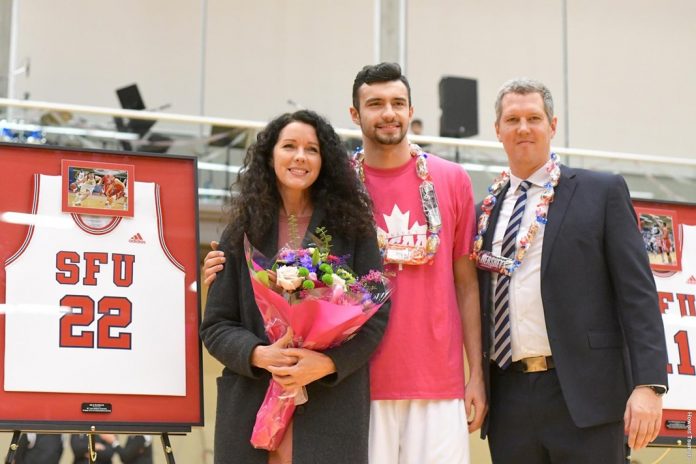
JJ Pankratz spent played all four seasons with the SFU Clan. (Photo courtesy of SFU Athletics)

On Saturday night, the men’s basketball team hosted Alaska Anchorage on Seniors Night for the Clan. The team and fans paid their respects to seniors N’Kosi Kedar Salam, JJ Pankratz, and Iziah Sherman-Newsome. The game went down to the last second, where SFU had a chance to tie, and then win the game, but ultimately fell short and lost 66–64.

Pankratz, who has been struggling with injury as of late, started the game in an attempt to reach 1,000 career points. Unfortunately, he went 0–2 from the field in two minutes of play, and would not return to the game, leaving him at 998 career points. As long as he is healthy, he should have no problem reaching the feat, as the team will play two more games in Oregon next week.

Similar to Pankratz, the Clan as a whole struggled mightily out of the gate. Alaska pulled ahead early with a 13–0 run to start the game, and would get ahead by as much as 16 at the 10-minute mark after a three from Drew Peterson. Despite these early struggles, however, Simon Fraser would bounce back to put themselves within striking distance by the end of the half. A 12–0 run by the Clan, in which Othniel Spence scored 10 points and assisted a basket, cut the deficit to three, before a buzzer beater jumper by Alaska’s Josiah Wood would put the score at 37–32 heading into the half.

In the second half, the Clan did everything they could to stay in the game, tying the score twice, but were never able to take the lead. Despite this, the ending could not have been more exciting. Down three points with less than a minute to go, Spence hit a huge three-pointer to tie the game up at 63 with 50 seconds left. Alaska responded with a jumper by Malik Clements to go up by two, and then extended their lead to three after hitting a free throw. This put the Clan down three with possession of the ball at 13 seconds to go. They would not be able to get the three-pointer needed to tie the game after two missed attempts by Michael Provenzano separated by a free throw from Tyrell Lewin. The game would end with the Clan coming up just short, and losing 66–64.

The story of the night, however, was that this was the final game that the seniors will play at the SFU Burnaby campus. All three seniors were major pieces for the team this season and in years past, and were all regular starters as well as the three highest scorers for the Clan this season. Salam currently leads the Great Northwest Athletic Conference with 19.7 points per game, while Pankratz and Sherman-Newsome are first and second in rebounds and blocks for the team. Sherman-Newsome did not play in this one, as he is out for the rest of the season with a hand injury.

The team will next travel to Oregon for games on February 22 and 24 to wrap up the season. The first will be against the winless Concordia Cavaliers. Tipoff is at 7 p.m for both games.

A Southside reunion: Coming face to face with one of my queens

0
Image credit Chris Ho

Michelle Obama. Former first lady of the United States. A vision of Black excellence. Beginning as a lawyer and eventually working at the University of Chicago for many years, Mrs. Obama has remained focused on supporting the voices of marginalized communities in any area where she is present. Gracefully, she served her country for eight years as her husband led the United States through some of the most difficult and turbulent times of its history. She raised two incredible children along the way, and advocated for the rights of women and girls all over the world. Plus she beat America’s sweetheart Ellen DeGeneres in a push-up contest in 2012 which she will not let DeGeneres live down. She doesn’t really need an introduction.


Who am I?

Soon to be former student of SFU. An attempted vision of Black excellence. Just as the southside of Chicago is fundamental to who Mrs. Obama is, so it is to me. As a matter of fact, I grew up in the same neighbourhood, Hyde Park, where Mrs. Obama and her family lived before her husband ran for office. My father is a southside of Chicago native and after my parents married, that is where they chose to settle down and raise their three children. Like Mrs. Obama, I grew up in church, spending long and sticky summer Sundays in a hot cathedral on 79th and Racine, right next to Chicago’s most dangerous neighbourhood, Englewood.

It was this city that taught me the value of social justice. It was where I was taught to speak up for what I believed in and to never let societal limits dictate what I could and could not achieve. As a writer and a musician, much of my art is shaped by the gritty streets, the cacophony of cultures and sounds, and my love of blackness. Despite being away from the city, I still trace much of who I am to Chicago and the vibrant Southside community.  

When I was twelve, there were whispers amongst the adults that a young, local politician with a unique name was going to make a run for the presidency. We had seen him around the neighborhood at various times buying breakfast from the local diner Valois, playing basketball at the rec centre, and my mom even recalls spotting him sneaking a cigarette in an alley near our old house. My family ended up moving to Canada just before former president Barack Obama began what would become a historic political campaign, but I like to think that even back then I knew something special was brewing.


Who is Michelle Obama to me?

It wasn’t until her husband’s historic acceptance speech in Grant Park that I developed a personal connection to Mrs. Obama. As my family cheered, cried, and celebrated in our living room in Vancouver, I distinctly remember the moment when Mrs. Obama walked onstage with their children to wave to the crowd. I realized that the first lady was black, and that she and her family reflected my own reality.

As the years went on and I matured with the presidency, I began to realize the significance of Mrs. Obama’s presence in the White House. She invited black authors and musicians to play in the halls of the White House which is, as she so brilliantly put it, “a house that was built by slaves . . .” As the racialized attacks grew against her family, she continued to press ahead, emphasizing the importance of helping other people and remaining motivated by love. She supported and encouraged young women to pursue higher education starting within the Southside she called home.

As I progressed in my degree, I found myself hoping to follow a similar path to Mrs. Obama’s. Perhaps not to the White House, but to instead inspire others to be their best selves with elegance, grace, and a little swagger. You can imagine how stoked I was when I found out that Mrs. Obama was coming to Vancouver.


Who is Anne Giardini?

A writer and a lawyer, passionate about sustainability and trade. The chair of the Greater Vancouver Board of Trade (GVBT). Also, the chancellor of SFU. The chancellor’s responsibility at SFU is conferring degrees to graduates in addition to representing the university on a uniquely global scale.

Upon discovering this SFU connection and Giardini’s creative background as a writer, I considered this: here was a person at my very own university, who has done a lot of what I aspire to do in my own career and I had had no idea whatsoever. As a student, sometimes you can be so wrapped up in your own little world. As we walk to and from classes, chatting with our friends, rushing around jobs and extra-curriculars, we can forget that there are those who have gone before us on this same journey who have now built their own connections, careers, and communities beyond Burnaby Mountain.

What does this have to do with Michelle Obama? Well, it turns out that the GVBT was the organization inviting Mrs. Obama to Vancouver. There was someone, not so far away from me, who had built this connection that I could only dream of building several years in the future. And suddenly came this crazy idea . . .

Now if there’s one thing that my parents taught me, it’s that the best way to make something happen is to ask; the worst that can happen is getting a ‘no.’ The Peak took a leap and sent an email making our case to Ms. Giardini.  But not before having at least five different people crowd around the desk to proofread the simple three-paragraph email, asking for an opportunity to attend the GVOT’s event and report back to the student body. Our message needed to be perfect. This was one of the biggest appeals that I had ever made in my 20-something years of life and I got a black momma who often needs a five paragraph essay explanation of my requests and a lawyer father who can poke holes in any argument.


“Are you ready to fangirl a bit?”

That was one of the first questions my new friend Anne asked me. Because fast forward nearly a month of planning, and I was sitting right next to her in the Queen Elizabeth Theatre on a cold and chilly Thursday afternoon. I had prepared myself as best as I could for what was bound to be one of the best moments of my life. The crowd was a wild variation of people from all over the Lower Mainland, and even further. Young professionals mingled with older established business figures as high school students chatted away with excitement. After a short delay and a brief introduction, the crowd rose to its feet to applaud the guest of honour.

I could have sworn there was a glow around Mrs. Obama as she walked onstage, greeted by the applauding crowd. The same grace and elegance that emanated through my TV was right there in front of me. She waved and smiled to the crowd as they cheered and cheered. It sounds silly now, but in that moment, I realized that she was real. Like, really real. She was a person right in front of me and we were able to share in this moment together. As she chatted with the crowd, it felt significant that she really focused on connecting with the young people that were present in the room. She shared the heart behind her initiatives that were focused on supporting post-secondary education and the education of young women and girls, while simultaneously sharing how the leaders present in the room could begin to make a difference in the world around them.

One of the most significant moments was when she gave the audience a peak behind the curtain of what it’s like to parent as the first lady in the age of social media. As the moderator asked her about her children and social media, she took on a character very rarely seen in the public eye — a mildly annoyed mother. The crowd laughed as she shared her own challenges with social media from fumbling with her iPhone to gently poking fun at people that post pictures of their food because, and I quote, “I don’t wanna see a picture of your food. Just eat it.”

The authenticity of the moment reminded me of why she is so loved. Perhaps it is because it reminds me so much of my mom and her foray into Instagram, but mostly it was because she is unafraid to challenge perceptions while simultaneously being aware of the joys of living life in this day and age. She so believes in the power of being kind and working hard, reminding us that living a life of excellence and balance doesn’t just happen but instead requires constant effort.


“I believe in you”

As the afternoon came to a close, I really couldn’t see it getting any better. That was until Anne turned to me and said, “Now, come along. You gotta go get your picture!”

Colour me SHOOK.

It turns out that she had arranged for me to be a part of the post-event photo op, which meant that I was going to be able to come face to face with one of my queens. I nervously stood in line, praying that I wouldn’t embarrass myself. But all of my worries evaporated as Mrs. Obama greeted me with a smile and a big hug. There we were. Two black women from the southside of Chicago sharing a moment together. I’d like to think that we bonded a little bit but more importantly as I left she took a moment to say:

“You’re gorgeous, babe. You keep working hard. I believe in you. Now go get it.”

She didn’t have to do that. Yet even in our short, two-minute encounter, she took the opportunity to see me, encourage me, and to tell me that she believed in me. Moments like this are the ones that reveal who a person really is. Beyond the lights and the glitz of being a former first lady, she created a personal moment for the two of us to share. She lived out what she shared just moments earlier: reminding a young person that their voice mattered and seeing them for who they are capable of being.

This whole experience has truly made me realize the power of having other people come alongside you to support you. To open doors that you could not have opened and to see opportunities to reach out and take a risk. From the gritty Southside streets to the glittering halls of the Queen Elizabeth Theatre, a little black girl from the southside of Chicago got to meet one of her biggest heroes. And it all began with a simple ask.

SFU marches for missing and murdered Indigenous women

1
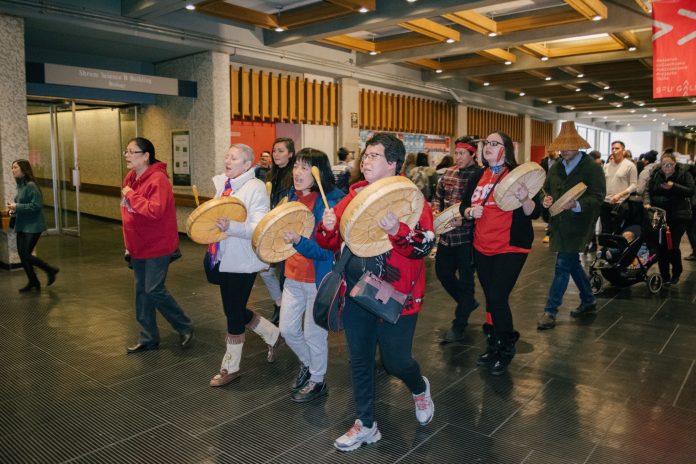
Marchers gathered in the AQ to remember 4,000 missing and murdered Indigenous females. (Cecile Favron / The Peak)

By: Cecile Favron, Peak Associate 

SFU students and community members turned out in large numbers for a march to bring awareness to missing and murdered Indigenous women and girls on February 9.

The second-annual event brought together dozens of people to march in the Academic Quadrangle and Convocation Mall to remember the estimated 4,000 Indigenous women and girls who have gone missing or been murdered in Canada.

“I instantly got so emotional,” said Maddi, a member of the First Nations Student Association and organizer of the march. “It was just crazy, there are no words for it. I couldn’t believe how many people came and it felt really good.”

The march was part of a week-long vigil held on campus to honour Indigenous women and girls and included student participants and some of the organizers of the Women’s Memorial March which takes place in the Downtown Eastside every February 14.

“That is probably the most support I’ve seen for anything in a long time,” explained Matt, another event organizer with the First Nations Student Association. “Having other people that aren’t even part of the campus be a part of it, that really means a lot to me.”

The increased turnout at the campus march this year can likely be attributed to a growing awareness in the community, according to Maddi.

“I think people are just waking up more to the issues and becoming more aware of what’s going on, especially since a lot of it happens in Vancouver.” – Maddi, First Nations Student Association

Indigenous women and girls make up approximately 4% of the population but represent nearly a quarter of all homicide victims, according to Statistics Canada.

“This is an epidemic that has been going on since contact, the issue with Indigenous women going missing,” Matt explained.


Missing prayer ties

The vigil included pieces of coloured cloth called prayer ties placed around campus as a form of offering to honour missing and murdered Indigenous women and girls. However, to the dismay of the organizers, many of the ties went missing during the week.

“It was really frustrating,” Maddi said. “For me, I really just think of it as a really perfect example of how ignorant the society still is, especially at this school.”

It was troubling for the volunteers who took the time to put up the broadcloth ties only find a large portion of them taken down overnight. The organizers faced the same problem with people taking the ties during the vigil last year.

“People need to be more aware and respectful of some of these things,” Matt said. “The thing that bugs me the most is not the fact that they were taken down, but that I don’t know where they are, or who took them, or for what purpose.”

The remaining ties were collected and brought home following the march.


An empowering event

The march culminated in a moment of silence for missing and murdered Indigenous women and girls. The event also represented an opportunity to show support for the women on campus and for women to take on a leadership role.

Matt recounted how the spirit of the event inspired him to lend his drum to another member of the campus community to lead the march.

“I gave her my drum because she should be up there singing and drumming,” Matt said. “I put her ahead of me.”

“When we get to have these women and these voices — I just feel like it is more empowering,” he added. “It was really awesome to see them leading where we’re going with the songs and the drums.”

Maddi explained that the issue of violence against Indigenous women is something that people are hesitant to address and said that the march was inspiring.

“I feel that this is an issue that needs to be brought up constantly,” Maddi said. “It is an ongoing issue.”  


Full names were not published at the request of the interviewees.

I, Tonya is a compelling account of a controversial story

0
(Image courtesy of Neon)

By: Jennifer Russell

With the 2018 Winter Olympics now underway, there is no greater time to watch the movie I, Tonya and learn about the former (controversial) Olympic athlete, Tonya Harding. The film itself deserves a gold medal for its successful combination of comedy and drama.

     I, Tonya is based on the life of US figure skater Tonya Harding and the attack on her competitor, Nancy Kerrigan, prior to the 1994 Olympics. Writer Steven Rogers and director Craig Gillespie took an artistic and entertaining approach to telling Harding’s story. The movie constantly flips back and forth from a chronological telling of Harding’s youth leading up to the attack to (acted) interviews with characters in the present day. This mode of storytelling also allows Tonya to break the fourth wall and correct any information she disagrees with from her ex-husband Jeff Gillooly’s interviews. The various interviews and the fourth wall breaking they allow are genius on their own because they capture the difficulty of one person trying to tell their story while close friends and family, the media, and entire nations overpower them and tell the story from their own contradicting perspectives.

     While the movie touches on how the media may have abused and manipulated Harding’s story, there is a greater focus on Harding’s difficult home life, as well as exposing the unfair judgment she received in skating competitions strictly because she was not the idealized image of the American woman. Harding’s home life and marriage is often shocking and devastating, yet the blend of comedy amidst the drama made this movie feel more realistic. The witty lines bring the personalities of various characters to life.

     The costumes and casting were also incredible for this film. Every single one of the skating outfits used in the film matched Harding’s outfits she used in her actual performances. Beyond Margot Robbie’s incredible performance as Tonya, it became clear how good Paul Hauser’s role as Shawn Eckhardt, Tonya’s bodyguard, was when the real interviews came on screen during the credits.

     I, Tonya is also a great watch for anyone who enjoys great camera work. There is a wonderful long shot that moves from room to room in Jeff’s house and shows him moping in each place.  On the whole, this movie is both visually pleasing and masterfully written. Even if you’re someone who remains convinced Harding was more involved with the attack on Kerrigan than she claims, this movie can still entertain you and make you sympathize with the injustices Harding surely faced.

Album Reviews

0

By: Neil MacAlister

Amen by Rich Brian

When a dorky teenage YouTube comedian from Jakarta made a rap video with a few friends, a bottle of cognac, and a fanny pack not many expected him to rise above the level of brief viral fame — but “Dat $tick” turned out to be just the beginning. With his debut album, Amen, Rich Brian (formerly Rich Chigga) broke records as the first Asian solo artist to top iTunes’ hip-hop chart. It’s a huge debut for the 18-year-old Indonesian artist, and while the album itself is something of a disappointment, it’s nevertheless both an impressive achievement and a solid enough debut.

     His signature monotonous, machine-gun flow rarely offers variation from his typical sound, and Amen ends up being a bit of a sleeper because of this. The writing and production are both extremely solid, but like Offset’s verse on “Attention,” the whole album seems to stagnate on a level of detached disinterest. Brian still has plenty of room to grow, however, and hopefully this album will serve as a foundation for him to build upon his art.

Seven Sekkonds of Silence by Spark Master Tape

Spark Master Tape is one of the strangest rap acts to emerge in a long while; he’s an anonymous artist who hides his identity behind masks and voice-pitching. He presents himself as being a gun-hoarding, drug-trafficking (and consuming) figure with a dark and troubled past, who holds derision for the rappers and technology of the present, and a belief in his own supremacy in the future. This presentation, combined with a series of catchphrases and obscure name-dropping, makes Spark something of a gimmick rapper (an accusation that has, perhaps rightfully, plagued him for his entire career), but there’s no denying his ability. Spark is an impressive rapper, spitting punchlines and worldly observations in rapid-fire raps formed from densely packed rhyme schemes. The production is always a strong point on his albums, mixing obscure samples with industrial drum patterns. While this album (specifically the second half) takes some unconvincing experimental directions, it’s nevertheless one of this year’s most fun and interesting projects to date.


Huge win for SFU hockey over rival Selkirk as potential playoff matchup looms

0
Selkirk College is the only team in the BCIHL with more championships than SFU. (Photo courtesy of SFU hockey)

By: Dylan Webb

At the Bill Copeland Sports Centre on Friday night, SFU hockey bested the visiting Selkirk Saints to secure their playoff positioning and increase the likelihood of home ice advantage in the first round of the playoffs for the Clan. With the win, SFU can now only finish third place or higher, which almost guarantees a match up with the Saints in the first round. The 4–1 win itself demonstrated the importance of home ice advantage in the BC Intercollegiate Hockey League (BCIHL) playoffs, especially against a team like the Selkirk Saints who are much harder to play against in their own barn as demonstrated by the fact that the season series between the two teams thus far has seen the home team win every game. SFU will seek to break this trend and take a key step toward securing home ice advantage next weekend in Castlegar when the Clan face the Saints for the final time this regular season in what is undoubtedly the most important matchup of the BCIHL season thus far.

The first period saw the Clan set a tone of dominance over the Saints that would be enough to carry them to victory. Breaking a trend of allowing the first goal of the game early, the Clan immediately jumped out to a 2–0 lead early in the first period on goals from veteran forwards Spencer Unger and Mak Barden. This was a lead the team would not relinquish at any point in the game as a total team effort on the defensive side of the puck, led by one of starting goaltender Lyndon Stanwood’s best efforts of the year, would suffocate the Selkirk offence and limit them to one goal in the game. The win sets up an epic showdown next Saturday night as the Saints will host the Clan for an all important matchup that will preview the likely first round playoff series for both teams as well as determine which team enjoys home ice advantage in the series.

The second period of the game was marred by a litany of whistles and questionable officiating that resulted in the pace of play being slowed to that of a snail. There was no scoring in the period as SFU’s team defence kept chances to the outside and rebounds controlled, as the disjointed nature of the period prevented either team from building much momentum. The Clan cemented their winning effort early in the third period with goals from Austin Adam and Mathew Berry-Lamontagna. Adam sniped a beauty from the point top corner with one of his signature floating, precision point shots. Berry-Lamontagna’s goal, a quick hard shot off the back bar and out, was initially ruled a cross bar and no goal until minutes later, after the play had been whistled down, the referees decided the puck had actually entered the net. This offensive contribution from the back end gave the Clan all the separation they would need to secure the win as they defeated the Saints for the second time in four games this year. While SFU’s domination in time of possession and shots was not as pronounced throughout the rest of the game as it was in the first, a strong team effort resulted in SFU’s 15th win of the year.

Between the pipes, Stanwood, starting for the 21st time this season, had one of his best games of the year as he held Selkirk at bay throughout the evening. Stanwood will need to continue to perform at this level as the Clan faces the likelihood of playing the Selkirk Saints in the first round of the playoffs. Without question, he will be a key ingredient in any recipe for playoff success that the Clan cooks up in the coming weeks.

The win over Selkirk sets the Clan just one point back of the Saints for second place in the league. On top of this, the two teams will square off once more in the remaining three games of the season. Playoff positioning is likely to be decided in this game as, barring an extraordinary collapse by the league-leading Trinity Western Spartans, the Clan and Saints are likely to finish second and third with second place and home ice advantage in the first round on the line in Castlegar on Saturday night.

Forward Tim Chow, scratched for the game due to a nagging injury, agreed that this was one of the Clan’s best efforts throughout the season. “The boys, as a whole, played really well, especially on the defensive side of the puck,” he said, adding that it was unquestionably a huge win that sets up another huge game next weekend. When asked about the likely matchup with the Saints and the enormous implications for playoff positioning the game Saturday in Castlegar holds, he emphasized the importance of securing home ice as the Castlegar Recreation Centre is considered the hardest building in the league to play in. The next game for the Clan is in that very building, a showdown with the Saints, on Saturday February 24 at 4 p.m.

The final home game of the season for the Clan is scheduled for March 3 at Bill Copeland Sports Centre vs. the University of Victoria Vikes. As it is the final home game of the regular season, it will be seniors night at the Bill Copeland Sports Centre as the Clan celebrates the contributions of its graduating players. Come out and support the Clan and their graduating seniors as they chase a BCIHL championship. Puck drop is 7 p.m.

The Takashi Murakami exhibit shocks and delights Metro Vancouver

1
(Photo courtesy of Adam Reich)

By: Yelin Gemma Lee

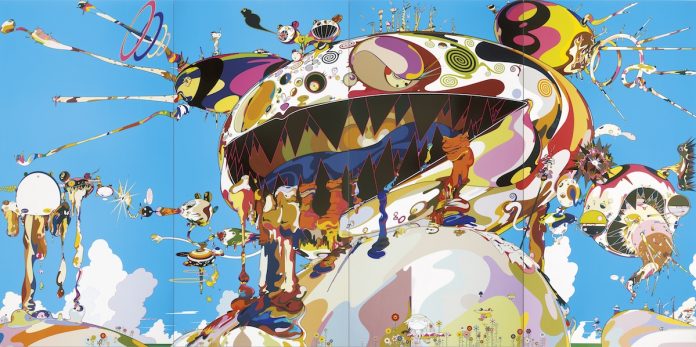
Takashi Murakami’s The Octopus Eats Its Own Leg exhibition, which is running at the Vancouver Art Gallery from February 3–May 6, is extraordinary. It’s a loud anthem-like calling to all artists of any kind to go home and vicariously practice their craft, and throw all the passion and strangeness from inside their souls onto the canvas. Walking through the exhibit was unlike any other Vancouver Art Gallery experience I’ve had — I felt goosebumps wash over my skin in waves while viewing each piece. Although surrounded by a massive amount of people in a sweaty and suddenly too-small space, I felt like I was being swept away into a different dimension. All of his works depict the chaos and carnage of our world, but in the most vibrant, innovative, and obscure way — most with political or social critique behind them. Each Murakami piece is a statement, and each demands your full attention.

     Murakami fuses together traditional Japanese methods and European influences to compose his creations. He has to be one of the most daring and fearless artists in the world. He welcomes controversy and the obscure by playing wildly with textures, shapes, colours, and by collaborating with brand names. For example, he was the creator behind the Kanye bear and produces his own product lines featuring his art on them. “Murakami considers his collaborations as ‘disruptions’ to the expectations of a highly stratified art world system that prizes exclusivity and elitism,” according to the Vancouver Art Gallery’s website. In other words, I think he’s saying a big “FUCK YOU” to conventional standards of the art world and the idea of art being inaccessible. It’s as though he is breaking down the fences of the elite art community and calling all people to own the right to the art world, whether it be to create or to experience it.

     The website further describes that Murakami is trained in “the Nihonga style of Japanese painting, which uses mineral pigments for vivid colours and meticulous craftsmanship.” He also plays around with the ‘superflat’ concept a whole bunch, but somehow it never gets repetitive or tiresome.  His paintings all portray animatronic, robotic, inhuman, grotesque creatures and sceneries, using the texture to convey the horror. Still, all of his paintings use vibrant colour and details to boggle the mind and create a sense of fantastical illusion.

     Most of his work focuses on the “dangers of nuclear power and global consumerism,” as described on the Vancouver Art Gallery website. The Octopus Eats Its Own Leg is, in short, an exhibit of the horrifying and dangerous parts of humanity. Ladies and gentleman I’m talking about monsters! Trolls! Skulls! Gore! Flowers! Spirals! Robots! Cute and creepy creatures! All paraded around the gallery’s neutral walls in explosions of colour and texture. There’s nothing like this exhibit. I must urgently dare you to go and revel in it.