Home Blog Page 664

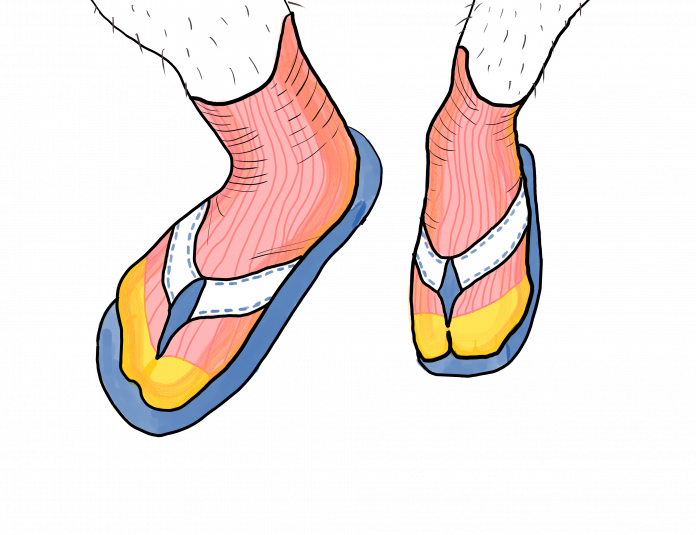
Things that are worse than wearing socks and sandals

0
Illustration by Emma Wu


  • When a super attractive person is the biggest douche

Right, so you meet this super attractive person on Tinder (or . . . in real life) and you think you’ve hit the jackpot because, aesthetically, this person is 10/10. If they were a maple tree, you would have tapped them already. But after you mistakenly give out your phone number to them, they do a one-eighty faster than Donald Trump can send out a Tweet full of lies. Their trifling ass is definitely worse than sporting socks and sandals.


  • That friend who’s late for everything

Whenever you plan a hang-out with your crew, you always have to schedule it half an hour early for that ONE friend, just to make sure they arrive on time with everyone else. You know their excuses all too well by now — “the bus was stuck in traffic,” “my mom wanted me to help with an errand,” and “I had to walk my dog” — even though their mom doesn’t even live on this continent and their “dog” belongs to the next door neighbour! See, I don’t know about you, but I would much prefer a friend who makes bad fashion choices but actually has an internal alarm that functions.


  • Being forced to go to expensive bars

There are two types of pub-goers that exist. The first will scope out the cheapest happy hour possible and refuse to drink if they have to spend more than three entire bucks on a beer. They’re the equivalent of old ladies who spend hours clipping coupons from seven different newspapers. The second type probably doesn’t even have “budget” in their vocabulary. Being university students with very little money, spending $10 on a drink is soul crushing. Who wants to have to live off instant noodles for the rest of the month? I’ll tolerate your Birkenstocks and socks . . . just let me get drunk off my ass for cheap.


  • High school classmates who try to initiate conversation at bus stops

First of all, if I have headphones on, it’s a clear sign of “I like my music better than I like you, so leave me alone.” Second, just because we went to the same high school doesn’t automatically make us best buds. I’m pretty sure I only remember you from that one biology class, and you skipped a solid 30% of said class. The teacher harboured a deep hatred for you. This awkward chat will start with “Hey, how are you? I haven’t seen you in [insert required number of years]” and end like a cringy soap opera. There are only so many “did you hear that [insert name here] got engaged/pregnant/married?” before it gets weird. I would gladly stare at someone’s socks and slides for a thousand years (forever waiting for an empty 145) instead of talking about high school with you.


  • Guys who hog squat racks for far too long

If you take more than half an hour to do your squat routine, you’re spending too much time flexing for the ‘gram and not enough time actually getting those gains. There’s resting between sets and then there’s “I got abducted by Pennywise three days ago and now I’m back to finish my set.” If you’ve been doing the latter, then you can also bet that everyone in the gym wants your head on a stake. Gym-goers in white sport socks and dad sandals are a million times more tolerable than these assholes.

SFU women’s soccer lose to MSUB, ending three-game win streak

0
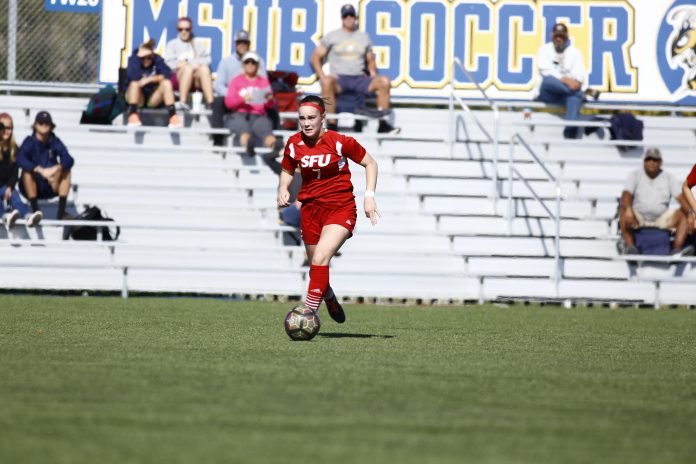
SFU's Katelyn Erhardsen had two shots on goal, both saved by the MSUB keeper. (Photo courtesy of SFU Athletics)

Coming into Thursday afternoon’s away game against Montana State University Billings (MSUB), the Clan had won their last three games by a combined score of 12–2, with two of the games being played on the road. This brought their Great Northwest Athletic Conference (GNAC) record to 3–2 after losing their first two games of conference play to the two top seeded teams. However, even with this positive momentum on their side, the Clan lost a tough game to MSUB, by a decisive score of 4–1.

SFU found themselves trailing early, as Alycia Wright scored not even three minutes into the game for MSUB, assisted by Jessica Spang. The two combined for a goal again in the 15th minute, this time with Spang finishing off a pass from Wright, giving MSUB a 2–0 lead with half an hour to go in the first half.

The Clan was able to respond, however, as Tanis Cuthbert scored her first goal of the season in the 44th minute, right before the end of the half. Her long shot, off of a pass from Jenna Baxter, was too much for MSUB keeper Erinn Harder to handle as it ricocheted off her hands and found its way into the back of the net. The teams would go into the half with a score of 2–1 for the home side.

Whatever momentum SFU had gained from their late first half goal would not be enough to overcome the deficit. While the Clan was able to sustain some pressure on the MSUB defence to start the second half, they were unable to find the back of the net. Recent NCAA national player of the week award winner Emma Pringle took two shot attempts early on in the second half, but sent both over top of the net. She is second in the NCAA with 11 goals this season, but ended Thursday’s game scoreless.

The day would prove to be Wright’s, as she completed her hat trick with two goals in the final ten minutes of play. The first came after she had her initial attempt blocked, before slotting the rebound into the far corner from 15 yards out. The second came via a tap-in after Jordan Devoto put in a through ball from the right side of the field. These two goals gave MSUB a 4–1 lead, which would end up being the final score.

SFU led the game in both shots attempted (16–10) and on net (7–4). While SFU’s offence pushed hard, however, MSUB’s goalkeeper pushed back ‘Harder’ with six saves.

Fraser Valley floodgates are compromising salmon habitat

0

Methods used to protect cities and farmland from flooding in the province are having an adverse effect on salmon, according to new research.

A report by researchers at Simon Fraser University found that dikes and floodgates can compromise salmon habitats in the Fraser Valley. The study of more than 20 tributaries in the region found that upstream habitats were negatively affected where floodgates remained closed for longer periods.

“The findings of this study highlight an important opportunity to change how we operate floodgates and improve conditions for salmon and other native fish species,” said Rebecca Seifert, the lead author of the study. “Upgrading flood infrastructure is an ongoing discussion in the region and there are opportunities in this planning process to consider impacts to fish.”

Using time-lapse photography, the researchers recorded the amount of time that the floodgates were open at each location and found poorer oxygen levels and biodiversity in the areas where access was more restricted.

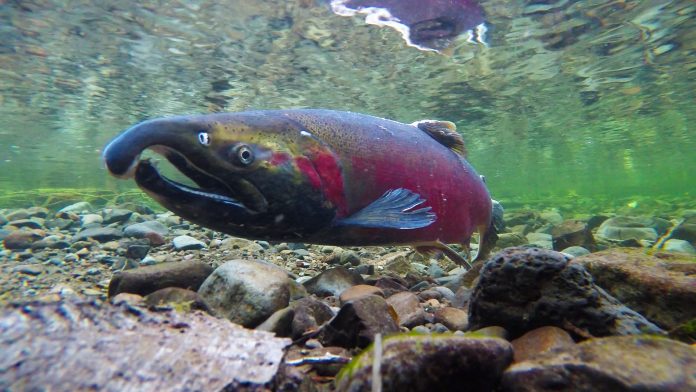
The floodgates not only prevented fish including trout, coho, and chum salmon from passing through, but they also cut off the flow of fresh water in the streams. The researchers observed that nearly half of the floodgates in the study were open for less than 20% of the day.

Low oxygen levels in the water can have an effect on the vitality of sensitive fish species like salmon, according to Seifert. The pumps that accompany the floodgates can also pose a lethal risk to some of the fish.

The Fraser Valley is a major source of agricultural production in the province and the regional district reports that nearly half of the area is prone to flooding. There are over 400 floodgates and more than 600 kilometres of dikes used to protect homes and farms from seasonal flooding.

“It is possible for salmon, farms, and cities to co-exist,” said Tanis Gower, a biologist with the Watershed Watch Salmon Society, adding that many salmon species are in trouble and freshwater habitats are one of the few factors that people are able to control.

Gower recommends opening the floodgates for longer periods and using fish-friendly water pumps that won’t grind the fish to improve the habitat in the Fraser Valley.

“People should know that there is a vast amount of salmon habitat that we’ve cut off, and that while it will never be the way it once was, that there is a lot of room for improvement,” Gower said.  

However, another report out of the University of Victoria commissioned by the Watershed Watch Salmon Society suggests that monitoring of the habitats in close proximity to floodgates and dikes is also being neglected.

“No one is effectively overseeing the more than 1,400 km of salmon habitat behind floodgates in the lower Fraser Valley,” said Deborah Curran, a law professor and author of the report, in a press release. “It’s quite startling to see.”

The report suggests that the local, provincial, and federal government all have responsibility to oversee the health of salmon populations that are affected by flood-prevention methods.  

“We are working with all levels of government for change,” added Gower. “This is good timing, as all the flood infrastructure is being studied to determine priorities right now.”

The Fraser Basin Council — a collaboration between government and local organizations — is currently leading a six-year review of flood systems in the Lower Mainland to better protect the area from coastal flooding.

Director Noah Baumbach has a career that would be a shame to miss

0
(Photo courtesy of Goerges Biard)

Despite rarely experiencing much attention, writer and director Noah Baumbach has received critical acclaim for his movies for over 20 years. Noah Baumbach made a name for himself in 1995 with his directorial debut film Kicking and Screaming. A film about the lives of a group of students just out of college, Kicking and Screaming made it clear just how much promise Baumbach had in store.

     Though he continued to write and direct movies and shorts for the next 10 years, his next big step was in 2005 when he directed The Squid and the Whale. It was a movie that earned him an Oscar nomination in the category of Best Original Screenplay. Starring Jeff Daniels, Laura Linney, Jesse Eisenberg, and Owen Kline, The Squid and the Whale tells the story of a family going through a divorce. Both deeply comical and emotional, it’s no surprise that the film earned him an Oscar nomination.

     One of his more well-known works came from a partnership with acclaimed director Wes Anderson — whose movie The Grand Budapest Hotel, won four Oscars. Fantastic Mr. Fox, the 2009 film adaptation of Roald Dahl’s novel was written by Anderson and Baumbach. This was their second collaboration. Their first was in writing The Life Aquatic with Steve Zissou in 2004.

     Baumbach’s next movie, The Meyerowitz Stories, starring Dustin Hoffman, Emma Thompson, Ben Stiller, and Adam Sandler, is set to be released on October 13. A story about an estranged family recently reunited, The Meyerowitz Stories has already received critical acclaim praising both the script and the performances by the cast.

     Noah Baumbach blends the comedic with the emotional in an undeniably unique way. His movies often focus on a very specific time in a character’s life. In Kicking and Screaming, he takes a look at the time just after graduating from college, when students try to figure out what they’re doing in life. In The Squid and the Whale, the main characters are struggling through their parent’s divorce. In Margot at the Wedding, Margo attends her estranged younger sister’s wedding.

     His stories are often short, and although they rarely end having tied up all the loose ends, it is that exact quality that makes them so evocative and realistic. There is no story in life that can neatly be divided into a beginning, middle, and end. During any significant moment in life, there is a short period of time surrounding it that is deeply emotional and will be remembered for years to come. The effects these moments have on life don’t dissipate once an arc has been completed, or once the story is ‘over.’ They linger. Their effects are sometimes hidden, and sometimes incredibly obvious.

     In his movies, Baumbach doesn’t try to show all the effects that these important moments have on his characters’ lives. Instead, he shows the short but important moments that will linger for years to come. His stories might not be neat and tidy. But neither is life. It is that messiness that he captures in a brilliantly unique way. With a talent in making emotionally gripping moments funny, and undeniably hilarious moments strikingly serious, Noah Baumbach is a director well worth your time.

Album Reviews

0

Highly Intoxicated by Juicy J

It’s easy to look at Juicy J as a simple party rapper, the guy responsible for songs like “Bandz a Make Her Dance” and “Dark Horse,” but he’s had a long and impactful career in hip hop.

     Three 6 Mafia, the Memphis-based rap group in which he originated, was a major influence for many modern underground fringe-rappers. Juicy J’s recent string of mixtapes have mostly consisted of his typical club-ready sound, but for Highly Intoxicated, he grabbed New Orleans rap duo $UICIDEBOY$ as executive producers, and their edgy, horror-esque vibe serves as a perfect callback to Juicy J’s early Three 6 days.

     Admittedly, it’s strange hearing Juicy rap about “Instagram . . . hoes” over beats that sound like being murdered in a graveyard, but it’s his ability to work within these unconventional conditions that remind us to take Juicy J seriously. There are some excellent features on this tape as well, with Cardi B, A$AP Rocky, Rick Ross, Project Pat, and even Wiz Khalifa delivering some quality contributions. – NM

Laila’s Wisdom by Rapsody

Getting signed by Roc Nation is no small thing, and neither is having your album entirely produced by production veteran 9th Wonder, but if any up-and-coming rapper deserves this kind of attention, it’s Rapsody.

     If she hasn’t already proved herself through her last three projects (and she definitely has), Laila’s Wisdom solidifies the North Carolina native as a remarkable MC. Rapsody’s verses are filled with expert turns of phrase and well-executed punchlines which tell personal stories of love, death, and personal growth. Her expert abilities and powerful delivery are buoyed by delightful, soulful contributions from Anderson .Paak, BJ the Chicago Kid, and Lance Skiiiwalker. The album is also peppered with incredible verses from Kendrick Lamar, Black Thought, and Busta Rhymes.

     9th Wonder’s production is really something to be marvelled at. Using elements of jazz, funk, and soul, they craft expert beat switches between verses and divert off into instrumental interludes and outros. Rapsody’s one of the most impressive rappers going right now (there’s a reason she had the only guest verse on To Pimp A Butterfly), and Laila’s Wisdom is one of the most artful, intricate albums you’ll hear all year. – NM

Broken Machine by Nothing but Thieves

This album is a meticulous work of art that will make you feel the feelings you forgot about. The entire album is unflinchingly centred on the themes of mental illness and addiction. Each song has so much feeling, whether it be shame and lust in “Sorry,” or finding strength in “Broken Machine,” and even self-loathing in “Soda.”

     One of my favourite tracks is “Particles,” especially the piano version for it’s pure emotional rawness and accurate depiction of the heartbreak in addiction. My other favourites include “Broken Machine,” “Hell, Yeah,” and “Afterlife.” The album manages to be collective and smooth in it’s themes while not compromising the originality of each song nor finding itself repetitive. Although the deluxe version is a longer album, every single track is unique and worth a listen. You should definitely get it. – YGL

Wildlife and you at SFU

0


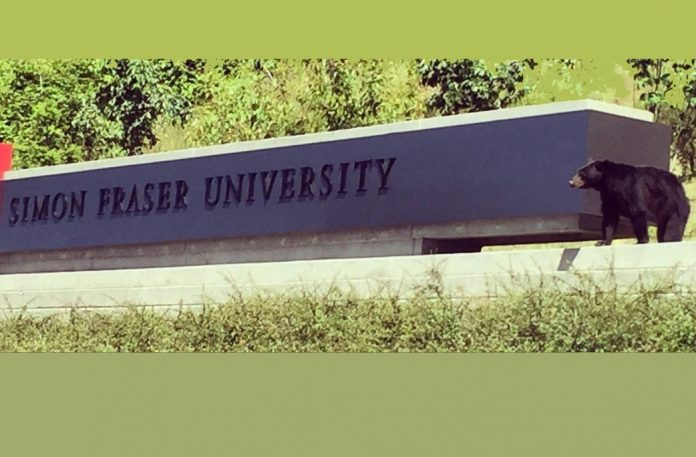
All of British Columbia is considered bear country. There are between 120 and 150,000 black bears across the province, according to Wildsafe BC — which means that if you’re in BC, you’re sharing living space with the real life Winnie the Pooh, although bears aren’t so cute when they’re strolling through residential areas. The City of Burnaby is home to deer, birds, fish, coyotes, beavers, and bears, and SFU is no stranger to wildlife, either. Though the raccoons make for cute pictures, the bears have the potential to cause damage.    

The North Shore Bear Society states that “black bears are a highly misunderstood species,” which is why many people have a disproportionate fear of them. Here are some facts from WildSafe BC to help you get a better understanding of bears:

Bears are solitary creatures who inhabit a ‘home range,’ where they may tolerate the presence of other bears if food is abundant. About 80% of that diet will be vegetation, though bears also snack on salmon, carrion (dead animals), insects, rodents, and sometimes bigger game like young moose or elk. From November to April, bears go through a ‘denning period,’ meaning that in the spring when they wake up, they need to replenish about 30% of their weight. Luckily for them, bears can smell food from over a kilometre away. Their sense of hearing and sight are also incredibly well-adapted, contrary to popular myth.

The trouble is what biologists call anthropogenic food — food that comes from human sources. Between 2009–13, Wildsafe BC noted that in cases where a black bear attractant was observed, garbage was the attractant in 19,501. Pets, composts, freezers, barbecues, and birdfeeders were other common human culprits.  

Since BC is bear country, it’s quite normal for bears to pass through communities. But when a community is integrated into a bear’s foraging area, the animal has become food-conditioned, which will lead to it being human-habituated.  Which is to say that it will lose its natural fear of humans, especially if it has been exposed to and fed by humans as a cub. Once that fear is gone, bears start letting humans get too close for its comfort, which maximizes chances of conflict.

To make matters more complicated, there is virtually no way for a human-habituated bear to unlearn those behaviours. And unfortunately, relocating animals isn’t as durable of a solution as it seems. Aside from being stressful to the animal, relocating animals into each others’ home ranges or into a new ecosystems can lead to to competition and social conflict. Additionally, research has shown that adult bears almost always return to their former homes, “. . . generally . . . within a month, and regardless of the distance [that] they are moved.”

The Get Bear Smart Society, a group which aims to minimize the amount of bears killed as a result of human-bear interactions through policy and community management, maintains that preventing bear-human interactions altogether is what communities should be focusing on.

On their website, SFU Safety and Risk Services provide a few tips for wildlife safety on campus:

  1. Dispose of garbage properly.
  2. Do not feed any wildlife, including bears. It’s against the law to feed dangerous wildlife.
  3. Make noise, use a bell, or go with friends when on campus trails. This can help to alert wildlife of your presence so they can avoid you.
  4. Avoid, avoid, avoid. If you see wildlife in the distance, do not approach and give it as much space as possible.

According to Grady Ott, operations supervisor for SFU Facilities Services, there are two kinds of bins used on the SFU Burnaby campus: 11 compactors which are considered bear-safe, and eight front-dump bins, which are not located in high-use areas. On the residences, there are four compactors and five front-dump bins.

“SFU has moved to a compactor called a Vertipack for the residences and [Discovery 1] where most of the bear [sightings] happen and these units are completely sealed when the door is properly closed. For the front dump bin and [Discovery 2], SFU mandates that it be locked when not in use. The totes [which collect paper, recycling, and compost on all loading docks] do not have any lock on them,” he says.  

Depending on whether bins and totes are located in high-use areas (such as the residences) or secondary sites, waste is collected once or twice a week.  

“I do not think SFU can be 100% secure as there are human factors that can throw garbage beside the compactor or put food waste in the wrong stream. SFU tries to act quickly when this happens and has a great team of labourers, [a] custodial contractor, BEST Service Pros, and [a] landscape contractor, Popular Landscaping, who all play a critical role in keeping the campus clean and a deterrent for pests.”

Dan Mikolay, the WildSafeBC community coordinator for Maple Ridge, agrees.  “Right now, bears are consuming 20,000 calories a day. They will not expend energy looking for food if they are not rewarded. Securing garbage and compost [and] removing food from cars are a [couple] examples of unnatural food sources that could bring wildlife into urban areas.” According to him, this is the biggest mistake that leads to bear-human encounters.  

He also advises to be aware of your surroundings; “I have seen people walk by ‘caution: bear in area’ signs with headphones on and looking at their phones. If they had encountered a bear, they would not have heard the warning signs most bears give out.”

These little gestures all contribute to a wider picture. “We all are stakeholders in keeping wildlife wild and our communities safe. Individuals can control attractants like bird feeders, outdoor pet food, barbecue grease, and fruit. Landowners can reduce conflict by reducing invasive blackberries [and] create bear-resistant barriers for livestock and crops. Cities design plans to create wildlife corridors and provide education for their residents . . .”

Keeping this in mind, it is doubly important to keep the environment and your surroundings in mind while on the Burnaby campus. In the event that you actually do run into a bear on Burnaby Mountain, the North Shore Black Bear Society recommends that you keep in mind “the four S’s”:

  1. Stay calm
  2. Stand still [—] [d]o [n]ot [r]un!
  3. Speak calmly
  4. Slowly back away

Always make sure to give the bear plenty of space and a clear exit from the situation, to give it the chance to engage its flight, not fight, instincts.  

If you see bears or other wildlife on SFU campuses, you can call Campus Security at 778-782-4500.

Dear Instacrush part three

2
Illustration by Tiffany Chan

read Dear Instacrush part 1 here!
read Dear Instacrush part 2 here!

Dear Dumb @InstaCrush,

You know, right as I think we take a step forward, we take like twenty steps back. Am I placing too much faith in you? Probably, but you know they say that sometimes a little faith will take you far. I have no idea who ‘they’ are, but all I know is that “they” were dumb.

See . . . we started strong. You followed me on Instagram, liked one of my selfies, I lost my mind, and then immediately sent screenshots to my group chat with my girls. We were excited this was happening. Then it got even BETTER — I responded to your InstaStory (which for all intents and purposes is sliding into your DM’s). You would think this would be great.

Nope.

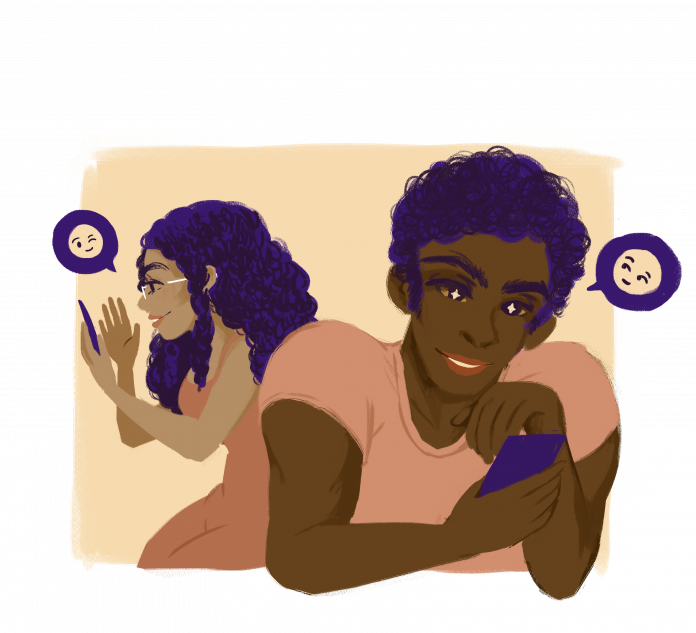
This is where the illusion started to crumble. Your (ahem) “flirting” is essentially the equivalent of an eighth grader fumbling to ask their crush to the dance. I don’t even wanna call it flirting. Why? Because right after I try to respond, you usually just send back emojis. EMOJIS! EMOJIS? AREN’T I WORTH MORE TO YOU?! WE HAD A CONNECTION, DAMN IT! I can see right through you — you’re probably so used to having girls all up in your DM’s that you have formulated some standard responses. A heart. A winky face. A cowabunga hand. Just stupid.

OK, but keeping it all the way one hunnit (pronounced one-hun-it), I got a little tickled when you responded. It’s kinda nice having a super hot guy’s attention. I mean, I don’t base my worth on it because that’s just dumb. But it was nice for a brief moment. In some delusional corner of my brain, I thought, “Maybe . . . just maybe.” But then I came back to earth, reality hit, and in the words of B.B. King “The Thrill Is Gone.”

I can’t lie. You’re still incredibly attractive and that’s not gonna change. But what is gonna change is the amount of attention that I give you. You don’t deserve it, bruh. I mean, you’re attractive and talented and you’ve got a lot going for you — but if you’re gonna keep flirting around with all these other girls, I’m not clamouring for your attention. I’m too busy. I have an empire to build and you clearly cannot come on board. I don’t have time for a man-baby; you gotta be able to handle your own business. I’ll help you, but I sure as HECK am not going to do your work for you.

Oh well, it’s been fun, but time to go back to reality . . . unless you make some major changes before you come calling me again.

Maybe I’ll consider it.

With great apathy,

@TheGraceRose

World News Beat

0

SPAIN — Spanish police intervene as Catalans hold independence poll

More than 760 people have been injured after Spanish police attempted to stop Catalans from voting in an illegal independence referendum earlier this week. There have been ongoing tensions in the country as Catalonia seeks self-determination. The culturally distinct region in the northeast of Spain already enjoys a semi-autonomous status. Spanish Prime Minister Mariano Rajoy has said that the referendum is unconstitutional because it threatens to cause a split in the nation.

With files from BBC News.

FRANCE — Fatal stabbing in Marseille connected to terrorism

Two women in the French city of Marseille were killed in a stabbing attack at the Saint Charles train station on Sunday. The attacker was killed by a French soldier who was at the train station at the time of the attack. As of this time, the police have not determined the reason for the attack. French parliament is considering expanding security and having identity checks around stations as permanent security measures this week.

With files from BBC News.

USA — North Korea claims American president has declared war

In a spate of recent tweets, US President Donald Trump made a threat towards North Korean regime leaders saying that they “won’t be around much longer.” North Korea’s foreign minister Ri Yong-ho said that North Korea sees the Tweet as a “declaration of war” by the United States and threatened retaliation.

However, while both parties continue to talk about military action, neither seems to have taken steps towards actually starting a conflict. The UN spokesman Stéphane Dujarric said a diplomacy is the only way to solve the problem between the two nations.

With files from The Guardian.

GERMANY — Germans are now able to enter into same-sex marriage

This month marks the first time that same-sex couples will be able to get married in Germany after the parliament approved same-sex marriage in a vote of conscience this past summer. While many are thrilled that Germany will have this equality in marriage, there remains issues with the government registry. The system will not officially recognize same-sex marriages until next year and, in the meantime, couples will still be recorded as husband and wife.

With files from US News.

Car drives into pond on SFU Burnaby campus

3

The SFU Burnaby campus was the site of two car accidents on Monday night.

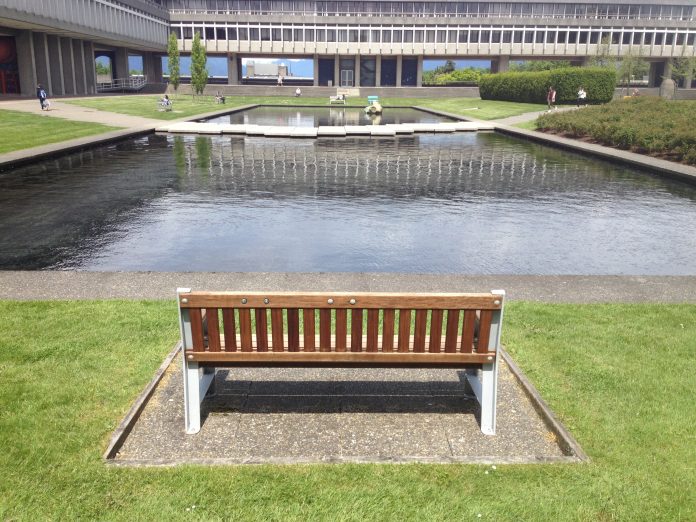
In one incident, a lone driver ended up in the Academic Quadrangle (AQ) reflecting pond in the centre of the campus.

“An elderly driver unfamiliar with Burnaby Mountain and the campus made their way inadvertently onto University paths late last night and accidentally drove into the AQ reflecting pond,” SFU spokesperson Kurt Heinrich told The Peak.

Apparently someone drove their car into the AQ Pond. from simonfraser

The driver was not injured and campus security responded within minutes, also notifying Burnaby RCMP, according to Heinrich. The vehicle was towed from the pond and did not cause any damage or spill oil or gas into the pond which is home to a number of koi fish.

“A full review of vehicle access to the area and safety measures is underway,” said Heinrich.

Worker struck while directing traffic

A section of road on campus was also closed after a vehicle struck and killed a deer and a second vehicle hit a university worker who was directing traffic near the accident scene.  

The incident occurred on University Drive East and the driver who hit the deer was not injured though damage was sustained to the vehicle, according to Heinrich.

A worker with facilities services who stopped to assist campus security with traffic control that night was also struck and injured by another vehicle. Heinrich said the worker received first aid on scene and was transported by ambulance to hospital and released later that night.

The road was closed while Burnaby RCMP conducted an investigation. The deer was removed from the roadway the next morning by the local parks service.

Threads: From the Refugee Crisis: Kate Evans discusses her latest graphic novel

0
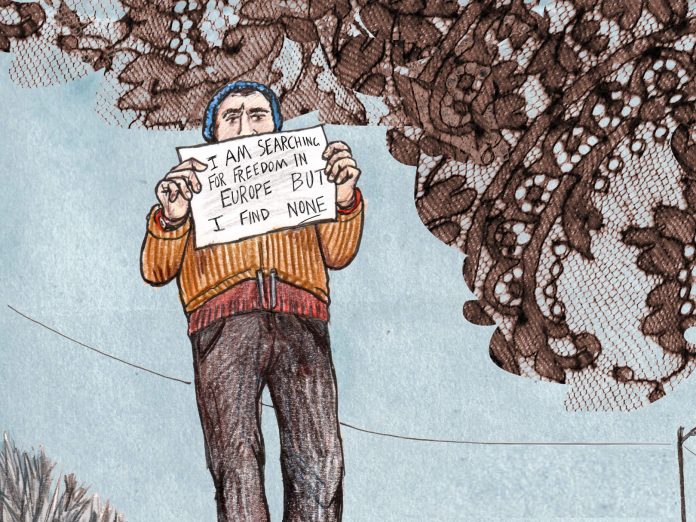
Kate Evans’ work seeks to emphasize the human side of every situation. (Image courtesy of cartoonkate.co.uk)

The Peak sat down with UK-based graphic novelist, Kate Evans to discuss the inspiration behind her new book Threads: From the Refugee Crisis. It is a graphic novel about the stories of the many people who have been forced to seek refuge in Europe and elsewhere due to events such as the ongoing situation in Syria. Kate doesn’t fully consider herself a journalist, although she has worked on what has been called graphic reportage. As she explains it, it walks a line between simple reporting and art that is suggestive or brings to light a specific message.

      Evans started as an activist with a healthy skepticism of journalism and, as she put it, “[the] extreme lines that are often presented by British newspapers.” She writes graphic novels, which give her the freedom to structure her stories in order to “take the reader on a journey, similar to how a film . . . or a novel would.” While she does make sure to depict the events she witnesses accurately, the way that she tells them allows for artistic license. She emphasized that this allows humour to be injected into stories in a way that wouldn’t be possible in other storytelling forms.

—

The Peak: I understand that you volunteered in the Calais Jungle refugee camp?

Kate: Yeah . . . [It was] a very brief amount of time that [I] spent there. There are other people who, you know, have dedicated their lives to this project. Basically, the entire graphic novel describes 10 days of activism [over] three trips . . . By writing a graphic novel, I can bear witness to events, even though I can’t claim to have given [them] a huge amount of practical support.

P: You mentioned in an interview on your website that the book would almost be a historical document by the time you finished it, so what would you say is your role as an artist and a journalist in history, and how does this fit into [today’s] journalism?

K: It is a historical document already, but I was panicking when I was writing it because news events were overtaking my representation of what was happening in the book, and my husband just went, “Look, there’s still going to be refugees when this book is finished.” So it is a historical document [on] an ongoing situation which is only going to get worse . . . [There will be] more and more pressing and extreme reasons for us to reevaluate the way that we think about migration . . . Given the impact that climate change is gonna have on people’s ability to live across large swathes of the planet, we’re going to have to [m]ake a philosophical and economically humane, and pragmatic decision about national borders because the current system we have [is going to become] unsustainable.

P: I hate to be the guy to bring up Brexit, but how do you think that it connects to the events in your book and the strategies Europe is adopting?

K: . . .At the moment, the British border is effectively on French soil. So British border guards are standing around in ports at Dunkirk and Calais and preventing refugees from [getting] onto lorries [trucks]. If we crash out of the European Union, France is not going to continue with that arrangement and there will not be refugees at Calais. France will wave them onto the boats, they will get out in Dover and then the Brits can actually deal with their own problem . . . it’s quite ironic . . . that the xenophobia that fueled the leave vote could then backfire and result in a large influx of refugees.

P: Speaking of the role of government in these kinds of situations, you had your phone searched by border guards [at Calais]?

K: Yeah, they made me delete photos from [my] phone, which I thought . . . was quite funny because I can remember what everything looks like in my head so I don’t need photos . . .

P: What do the changes [in journalism that has been occurring] mean for people who are telling these stories through less conventional means, like you are?

K: It means good things . . . but we’ll still be poor.

P: Of course it’s not as simple as just one idea, but what was the main message you were trying to get across with your latest graphic novel, Threads: From the Refugee Crisis?

K: Something that applies to this work that applies to quite a bit of my work . . . [is] the old adage of the person as political, and you flip it on its head when you look at my work. I try to make personal stories out of political events . . . People read about refugees, certainly in Britain, [and] the tabloid press presents this — frankly rabid — image of the [Calais Jungle] . . . I think David Cameron used the word “swarm.” It’s a very dehumanizing other. Yet if you read a comic about a real person, doing real things, showing actual examples of honesty, integrity, vulnerability, and generosity . . . That explodes the myth of the other, the migrant, the invading horde, the dangerous terrorist, or the African savage. [It explodes] all those racist tropes that are used to keep people out because they are from poorer countries. I hope that that can . . . literally break down borders.

P: Social activism is prominent in your work . . . what would be your advice to a student that wants to get into activism in a meaningful way?

K: That’s a very good question . . . it depends on what kind of activism you feel inspired by . . . All I can say is just start. If you feel like you want to actively get together to do something to change the world, get off your smartphone and have a conversation with somebody else today — in real life — about how to change the world for the better . . . We can all do something to help.

—

Kate Evans spoke at the Chan Centre on September 29, about her new graphic novel, which is available through her website, Amazon, Verso Books, and elsewhere.