Home Blog Page 65

The British Museum’s new digital experience: Theirs spiritually, but ours legally

0
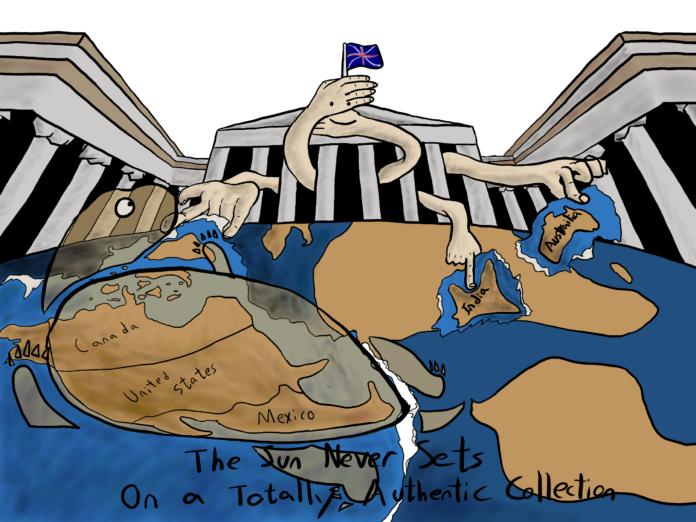
Hands sticking out of the exterior front of the British Museum, reaching out to Turtle Island, India, and Australia. At the bottom, the text reads “the sun never sets on a totally authentic collection.” A small British flag is perched at the top of the museum.
ILLUSTRATION: Yan Ting Leung / The Peak

By: Zainab Salam, Opinions Editor

British Museum website update

Preserving our history

In a bold leap into the 21st century, the British Museum is proud to unveil its brand-new website, designed to educate, inspire, and preserve everything we had the foresight to collect everywhere we went. We are thankful to have attained these artifacts before they could be ruined by weather, war, or heaven forbid, people

Every artifact has a story, and a British collector

We offer a dazzling array of interactive features: panoramic views of Mesopotamian skeletons, AI-generated reconstructions of plundered cities, and a soothing voiceover by Dame Judi Dench explaining why none of this is technically theft if you write it down in a ledger. 

Visitors can browse curated collections such as: 

Mediterranean Memories” — celebrating how Roman sculptures and Greek marbles found eternal rest in the calm, non-seismic embrace of London.

“Treatures of Turtle Island” — a moving tribute to the sacred items of Indigenous North America, acquired during “diplomatic conversations.” 

“Auspicious Australian Afternoons” — a breathtaking VR experience, taking digital visitors on a tour of our 39,000 artifacts from down under. Can you believe we just found them in the woods? Finders keepers, I guess! 

“Private Indian Palace Collection” — Suddenly gifted to us by destiny, a collection of Islamic-ish or Buddhist-ish art (we’re not actually sure, and we don’t care). Plus, a massive diamond that might be seen on the ring of a lucky gal: catch it on the next season of The Bachelor UK.

Luckily, our ancestors had the good sense to place them here, in our little sanctuary. We are the proper guardians of such treasures.

British hands

The addition of a new feature that allows visitors to trace the journey of each artifact from its point of origin to its proper display behind reinforced glass. 

Haida Totem Fragment (British Columbia → “Diplomatic negotiations” → Ship Hold → London) 

The museum assures visitors that every item is photographed, and kept in a glass display, away from the possibility of local mishandling and inconvenient spirituality.

Cultural preservation, the British way (the superior way)

All the items on display were in danger of being lost to time, fire, or Indigenous use. The new “Cultural Guardianship” tab outlines the museum’s deep commitment to ethical artifact holding. 

Looking ahead 

Our future website update will include the following: 

A message from the museum 

We’re not just curating history, we’re preserving the very soul of global culture — by removing it from its source and polishing it with a microfiber cloth.

As the site loads in all its glory — powered by Wi-Fi, and centuries of confident audacity —  we remind you of one timeless, universal truth: History belongs to everyone, as long as it is nailed to the floor in London

For kids!

  • Colour your own empire!
  • Match the artifact to the continent!
  • Draw a treaty and ignore it in real time!
  • Looting simulation! 
  • Digital hide and go seek (can you find the 1,500 cultural items that we’ve lost? Oopsies!). 

“Indigenous Voices” Tab

. . .  Is Currently Under Construction . . . 

(We reached out, but people keep asking about repatriation. Strange, weird, and hogwash!) 

Our stellar reviews: 

“A triumph of digital colonial hospitality.”

The Telegram

“An impressive monument to not reading the room.” 

The Conservator

“Is it satire or is it real? Either way, I’m exhausted.” 

— Dr. James, founder of the cultural artifact repatriation squad
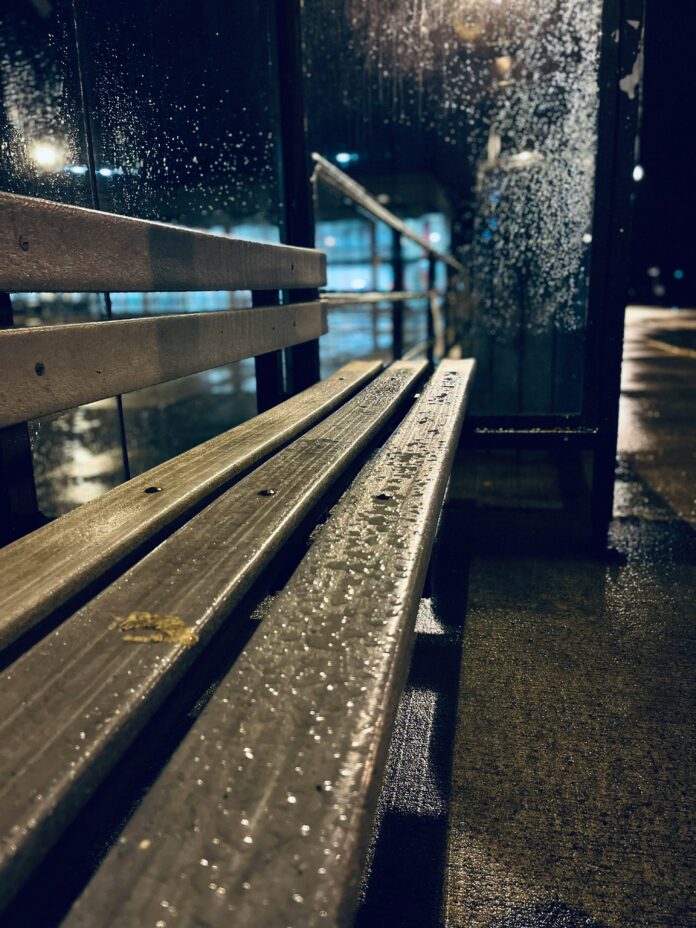
What Grinds Our Gears: Wet SFU seats

0
A photo of a drenched bench under the rain.
PHOTO: Ujjwal Arora / Unsplash

By: Corbett Gildersleve, News Writer

SFU has completed multiple outdoor renovation projects over the last five years: updating the convocation mall, the top of the Rotunda, the applied science building, and the AQ gardens

You’ve spent millions of dollars to make bench-shaped art sculptures.

So much money was spent redoing the tile, putting in new cement, stone, new lighting, and repairing the grass. Do you know what wasn’t installed anywhere? Fucking rain covers! What good is it to build, ship, and install these visually interesting and (generally) comfortable benches, when you can only use them when it’s dry out! You know, in a city that gets a shitload of rain throughout the year? On a mountain with its own weird climate? Where the only decent amount of dry weather is in the summer when there are few classes and half the number of students? Great job SFU! You’ve spent millions of dollars to make bench-shaped art sculptures. But maybe that’s the goal. Who needs to maintain something that’s never used? These seating areas will last for 50 years, having never touched a butt. Even the avocado, SFU’s historic place to have bad sex, has seen a year-over-year decline due to the worsening weather. Bad sex is an integral university experience that is just not being invested in by the construction planners in SFU Facilities Services. I know SFU is having budget and revenue issues, but this is just getting sad.

Grieving the Lapu-Lapu festival tragedy

0
A photo of several lit candles
PHOTO: Mike Labrum / Unsplash

By: Yildiz Subuk, Staff Writer

Lapu-Lapu Day — a day to celebrate resistance — traces its roots to when Datu Lapu-Lapu defeated Spanish colonial rule during the 1521 Battle of Mactan in the Philippines. Since 2023, Vancouver has held a festival honouring Lapu-Lapu, which serves as a vessel to bring the community closer, through music, food, and stories. 

The 2025 Lapu-Lapu Day tragedy was devastating; however, the Filipino community’s resilience, care for one another, and strive towards collective healing is emblematic of the day’s significance.

Local musicians Chanel Barcelon and Helen Dejene, both members of the Filipino community, attended the festival. The Peak spoke with them about using music as an outlet for grief. 

Helen Dejene

The significance of the day drew Dejene to attend the festival. Lapu-Lapu was a hero fighting against Spanish colonization, an aspect that resonated with Dejene. It was a celebration of her community, an acknowledgement of the fight towards liberation. 

From children to grandparents, “everybody was just there wanting to turn up and celebrate the culture, celebrate being Filipino. Because, for a lot of us, [there isn’t an event like this] on a grand scale. 

“I left five minutes before the tragedy struck. I was with my cousin, but we had seen a lot of our friends that were there.” Dejene’s first reaction was to call everyone to ensure their safety. “I could feel in my heart that I would not be the same since that Saturday.”

Prior to the tragedy, the festival was a joyous occasion. Dejene felt validated seeing all the Filipino representation at the event. Being a musician herself, the role of art and music has been prevalent throughout her life. The environment surrounding her at the festival was lively, and the excitement of seeing headliners made the experience feel more grand. Dejene expressed deep appreciation for the two Black-Eyed Peas stars Apl.de.Ap and J.Rey Soul. “Whether people realize it or not, [they] were probably one of the biggest Filipino representations out there, starting from the early ‘90s, going into the 2000s.

“Music is there for you. It’s an outlet for me and for so many. I’ve already been seeing so many musicians writing songs about what happened.” Dejene shared she’d admired seeing her community come together and express their grief and tribute those lost to the tragedy through song and poetry. “You do have to write lyrics. But sometimes it’s easier to just put it in a melody, attaching lyrics to a melody than to explain it to a person.” 

We are all grieving as one and we will all move forward as one.

Dejene shared she felt proud of her community’s resilience. “We are all grieving as one and we will all move forward as one.”

Chanel Barcelon

Barcelon brought her friends to the festival, who were not of Filipino descent, to share her culture with those she was close with. The festival felt like home to her. From eating Filipino barbeque to enjoying taho, a street food she remembers fondly as “soft tofu, a brown sugar syrup and then sago,” Barcelon was transported to her homeland.

“I felt bad that I brought my friends who I wanted to celebrate my culture with,” expressed Barcelon. “A risk of harm is not something that I had in mind. I wanted it to be like showing them a piece of my heritage. 

“I was feeling a little guilty, that I was mourning and grieving, even though I didn’t witness the traumatic event.” It wasn’t till the next day when she attended the vigil that the reality of the situation manifested. “I was a little anxious because I was like, this is like where it happens. What if something happens again, and I’m putting myself at risk?”

To grieve with the community, not just fellow Filipinos, but also friends, became important in Barcelon’s healing process. She went to a counsellor for support, someone who offered his time freely to those affected by the tragedy, “I’m lucky enough to have a resource that was free,” said Barcelon. A safe space free of judgment allowed Barcelon to process her emotions. “There’s something called pendulation in therapy, [in which you sway] between good moments and the grief.” This process can help alleviate the feeling of being stuck in one constant low. It allows a person to authentically feel a range of emotions, instead of leaving certain feelings undealt. 

Along with therapy, Barcelon also surrounded herself with communal activities. From working out with her roommate, to embracing spirituality with others. “To cope, I prayed a lot. We went to church and I haven’t gone to church in many years. We lit candles at home, at the vigil, and brought flowers. I wrote a song to process my own grief.”

Barcelon knew she wanted to write music as it has been an outlet for her. She has “leaned on [it] in the past for things like anger, sadness, trying to process things that have happened.” Barcelon performed her song at a vigil that took place in Minoru, Richmond. 

Writing music wasn’t just an outlet but also a learning experience. “I learned a word like kapwa, which is the word for interconnectedness.” The experience of being around a community was woven into Barcelon’s song as the community “think of each other as family, we call each other tita, tito (aunt and uncle), kuya, ate (brother and sister).” Barcelon’s song was a prayer for those who were affected by the tragedy. Processing emotions is one part of the journey, but to articulate that grief is also another battle within itself. “At the time I didn’t really have words to express what I was feeling, so I just posted the song.” Knowing others resonated with it brought comfort to Barcelon.

Monday Music: Mythologies of the self

0
sketch of a woman looking at the mirror
PHOTO: Frederic Dorr Steele / Loc’s Public Domain Archive

By: Zainab Salam, Staff Writer

There is a strange beauty in the in-between. We often resist it — when life doesn’t offer clear beginnings or endings, where you are neither who you were nor who you will be. But as cultural theorist Homi Bhabha has explained, it is in this third space — the borderlands between identities, cultures, and selves — that new meanings emerge. This “in-between” is not a void, but a fertile terrain where hybrid selves are formed, where contradictions coexist and evolve. It’s where the rigid categories of identity begin to blur, allowing space for transformation. 

That’s where this playlist begins, in that quiet threshold. It is a soundtrack for those shapeless moods and soft reckonings — for when you’re lying on your back in the afternoon sunrays, pondering all that might seem relevant in the moment. 

The songs I present to you don’t offer answers; they hold space for our complexities, whether it is our desire that flickers, confidence that falters, or joy that aches. These songs remind us that clarity and contradiction often live side by side. Our experiences — including those within our realm of imagination — shape us. 

“The songs I present to you don’t offer answers, they hold space for our complexities.”

“Mythologies of the self” is not a playlist for productivity or resolution. It’s a sonic mirror for your untidy thoughts and intimate reimaginings. Let these songs accompany you as you drift in the in-between. Write new personal myths and rediscover the beauty of being ever-changing and undefined. 

Catch and Release by Tia Wood

Tia Wood, a Plains Cree and Coast Salish artist, blends voice and spirit in a song that reminds us that identity is both inherited and reimagined. It’s a quiet reckoning of the interrelated contradiction between letting go and holding on. The song inhibits the liminal space where memory meets transformation, reminding us that becoming oneself requires releasing what doesn’t benefit us and allowing the new to flood in. 

Just Fine (Ft. Kiana Ledé) by Kitty Ca$h

Kitty Ca$h, a DJ and sonic curator, crafts immersive emotional landscapes. Featuring the tender vocals of Kiana Ledé, “Just Fine” is an anthem for graceful survival. It captures the strange confidence of vulnerability. The track lingers in emotional liminality: that tender space between hurt and healing, where strength doesn’t mean having all the answers. 

Sanctuary by Tamino & Mitski 

Two genre-defying artists, Tamino and Mitski, weave their singular sounds into this aching duet. “Sanctuary” is a slow-burning invocation of longing. With operatic melancholy and lyrical restraint, the song cradles the listener in a space that feels scared and unsettled. 

Hooked by Zeina

Lebanese Canadian singer Zeina channels sensuality and strength in “Hooked,” a track that pulses with desire and disorientation. A slow sip of chaos, Zeina captures the high of a new crush — a song for the moments when craving overtakes caution.  

in my bag by thủy 

thủy infuses her Vietnamese heritage with an R&B style in “in my bag,” a playful yet grounded affirmation of self-worth. Beneath its confident groove lies a quiet resilience. It’s an ode to staying soft and self-possessed in a world that asks you to choose between strength and vulnerability.  

te acuerdes de mi? by Ivana

In this dreamy reflection, Mexican artist Ivana asks, “Do you remember me?” The song is wistful and wandering, full of ghosted emotions and delicate yearning — a lullaby for memories that won’t quite leave you.

The crisis in education isn’t AI — it’s meaning

0
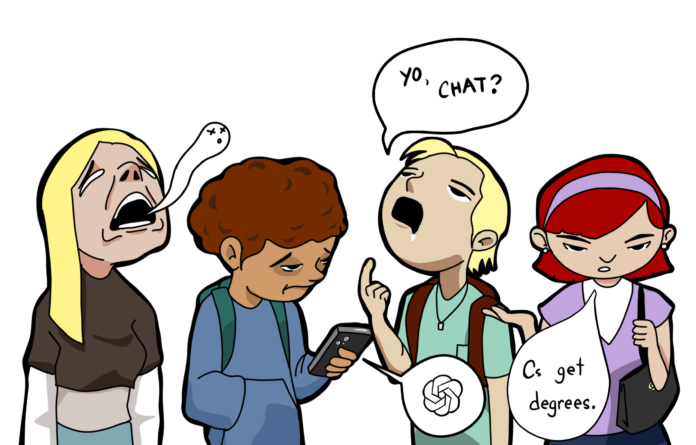
A group reviewing assignments saying short things like ""hello, ChatGPT!"" or similar sentiments. They are only interested in getting their degrees. They look rushed, disheveled.
ILLUSTRATION: Cliff Ebora / The Peak

By: Ashima Shukla, Staff Writer

In the age of AI, effort has become optional. As students, we no longer need to flip through textbooks or reread chapters. As one homework app asks, “Why scroll through 100 pages when AI can summarize the most important things in 10?” Across classrooms and countries, education is being reshaped by the insistent buzz of generative AI models. But AI didn’t just appear in the classroom; it was invited in by institutions eager to modernize, optimize, and compete. 

For instance, the International Artificial Intelligence in Education Society (IAIED), founded in 1997 and now including members from 40 countries, has long positioned itself “at the frontiers of the fields of computer science, education, and psychology.” Through organizing major research conferences, publishing a leading journal, and showcasing diverse AI applications, IAIED is critical to the discourse and development of AI in education. It also reflects a broader trend: between 2025 and 2030, the AI industry is expected to grow from $6 billion to over $32 billion USD. 83% of higher education professionals from a diverse range of institutions believe “generative AI will profoundly change higher education in the next three to five years.” Silicon Valley giants aren’t just innovating these tools. They are also lobbying for their integration into the school system. This is a transformation backed by capital, coded by corporations, and endorsed by institutions desperate to keep up. 

And it’s working. A McKinsey survey found that 94% of employees and 99% of C-suite leaders are familiar with Gen AI tools, while 47% of employees expect to use AI for nearly one-third of their daily tasks. And universities are listening. Offering courses for students to become prompt engineers and AI ethicists, institutions are preparing them for jobs that didn’t exist five years ago but now reflect the priorities of an efficiency obsessed corporate world. But who does this transformation benefit, and at what cost? 

This isn’t just a pedagogical, labour, or environmental issue, as important as those are. It is something more fundamental to human nature: the erosion of curiosity and critical thinking. As dopamine-fuelled thumbs dance to infinite scrolls, we lose the quiet patience needed to parse meaning from a paragraph. The problem isn’t AI’s capabilities but our willingness to let corporations dictate the goals of education — and life. When our only objective is maximum productivity and minimal resistance, we strip learning of friction, and therefore, its meaning. After all, if anyone can “generate” a paper, what is the point of writing one? 

In this reality increasingly enmeshed with technologies, we’ve come to expect answers — and dopamine — to be delivered to us immediately. Students begin to internalize that if something isn’t fast, it isn’t worth doing. However, education should be a practice to cultivate, not a credential to purchase.

As a recent study found, the more confident people are in AI’s abilities, the less they rely on their own critical thinking. Similarly, a study on “cognitive offloading” showed that frequent use of AI correlated with weaker problem-solving skills. This suggests that as people grow more accustomed to immediate answers, they lose the memory of mental struggle. Younger students are especially vulnerable, growing up in an environment where boredom is pathologized, curiosity is optional, and learning is gamified. What we are learning is not how to think but how to shortcut. 

For all the content and knowledge at our fingertips, we are lacking the time to sit alone, to ask good questions, to chase rabbits down holes without knowing where they will lead.”

Even before ChatGPT, researchers warned that students fail to benefit from homework when answers are readily available online. Now, when entire assignments can be completed without thought, Stanford professor Rob Reich asks whether what is at risk is AI displacing the very act of thinking. Writing, after all, is not just a means to communicate but also a way of creating knowledge. The very act of wrestling with an idea, sitting with uncertainty, failing, rephrasing, and trying again, is what shapes the intellect. 

And yet, the platforms profiting from this are preaching empowerment. They claim to democratize access, support learning, and save time. But time saved from what exactly? From the very moments that develop intellectual resilience? We have mastered the art of never being bored, and in the process, forgotten how to wonder. 

This comes with a heavy psychological toll. As Stanford assistant professor Chris Piech shared, a student broke down in his office, convinced that years of learning to code were now obsolete. The anxiety isn’t about incompetence, it is about irrelevance. When we are told our skills are rendered useless, we don’t just lose confidence, we lose a sense of purpose. Because, what is learning worth in a world of infinite answers? 

We’re told to be productive, efficient, optimized. As if the real value in being human comes from what we can produce and how fast we can do it. But the best ideas often come from wandering, from play, from slowness. Real understanding takes time. Sometimes, it takes failing. Sometimes, it takes boredom. 

We are drowning in data but are starved for connection. For all the content and knowledge at our fingertips, we are lacking the time to sit alone, to ask good questions, to chase rabbits down holes without knowing where they will lead. In this environment, perhaps the most radical thinking we can learn to do is to slow down. To reimagine education not as a product to be consumed, but as a process of becoming. Perhaps it is time for fewer lectures and more labs, fewer tests and more conversations. Perhaps it is time to value peer collaboration, iterative writing, reflection, and the kinds of assessments that ask students to apply knowledge in solving tasks.

The antidote to the crisis of AI in education is to remember that education is not a product; it is a process. Models like the Four P’s of Creative Learning (Projects, Passion, Peers, and Play) offer a blueprint. Instead of treating students as users or consumers, we must see them as co-creators of meaning. How might our relationship with learning change if we were encouraged to fail better, not just succeed faster? The goal shifts from producing measurable outcomes to cultivating a deep curiosity and adaptive thinking. 

Learning shouldn’t be about acquiring answers. It should be about learning to ask better questions. ChatGPT can help you answer questions, but it cannot teach you how to understand or apply that in the real world. In the face of Big Tech, reclaiming learning as joyful, frustrating, and meaningful is a radical act of resistance. To learn to learn and love it. To recover our passion, we must unlearn the narratives sold to us by billion-dollar companies and build new ones rooted in slowness, struggle, and the sacredness of thought.

Peliplat and the patchwork future of film discourse

0
A photo of someone using the Peliplat website on their laptop
PHOTO: Campaign Creators / Unsplash EDIT: Gudrun Wai-Gunnarsson / The Peak

By: Ashima Shukla, Staff Writer

Once, reviews were handed down from the altars of broadsheets and bylines. Today, film opinions are filtered by algorithms, taking the form of Letterboxd one-liners, TikTok edits, Reddit debates, and YouTube video essays. In this fractured landscape, platforms take on an interesting hybridity — not quite media outlets, libraries, or fandom hubs, but something in between. 

Case in point? Peliplat, a self-described “exclusive film buff community” which keeps its gates wide open. I joined this platform and spent a week exploring its corners. At first glance, it is a patchwork: reviews of Marvel and Miyazaki, analyses of cultural appropriation and red carpet fashion, and writing competitions with monthly prizes up to $2,400 USD. Part forum, part watchlist tracker, Peliplat boasts a significant Spanish and Portuguese language user base across Latin America. Now, with a new office in Vancouver, it is looking to grow its English-speaking community. 

Beneath its cinephile charm, Peliplat reflects a broader shift in media culture, where the line between users and creators is dissolved. Platforms no longer ask us to merely consume content, they ask us to become it. To review, recommend, like, and post in exchange for the possibility of money, visibility, and validation. Everyone is a critic, and an unpaid labourer

On the one hand, platforms like Peliplat decentralize critique by creating spaces for new voices across languages and lands. On the other, they often replicate the same extractive logic they are trying to subvert. A writing contest becomes a content pipeline. A user review becomes data. Marketed as liberation, it distributes the labour of cultural production across more hands, more screens, more time. 

Platforms like Peliplat hold potential, but only if its fragmented multilingual publics carve out the space for something deeper — to build a vocabulary of resistance inside systems built for speed and mass consumption.

And then there is the platform itself. In trying to do everything from movie and TV show libraries with personalized recommendations to video feeds, does Peliplat risk being nothing in particular? If Letterboxd is a diary and Rotten Tomatoes a consensus, Peliplat aspires to a public square — messy, multilingual, still figuring out the rules. But to do that, it needs more than activity. It needs intentionality, a reason to linger, meaningful dialogue. Otherwise, it risks becoming yet another busy interface. To be more, Peliplat must cultivate depth and curiosity.

Because if everyone can have a voice, those voices must not be collapsed into content. When critique becomes a style, clickable and algorithm ready, it becomes a performance, not a reflection. And the language we build around films becomes thinner, less careful. Designed for engagement, not understanding. 

What Peliplat really is remains to be seen. A cinephile haven? A decentralized media experiment? Or just another site capitalizing on our hunger for connection in a world starved of physical third-spaces? It gestures towards something promising, a global commons of cultural conversations, but hasn’t figured out how to sustain that promise without feeding the same content engines with Search Engine Optimization friendly articles. 

Perhaps more importantly, it offers us a moment to reflect about what we want our cultural spaces to be. When everyone is a critic and every space is a stage, what happens to criticism as a practice of care, curiosity, or dissent? Can criticism still disrupt, or does it now serve to decorate the scroll? Are we still making meaning — or just feeding into the ever-enlarging world of content creation? 

Platforms like Peliplat hold potential, but only if its fragmented multilingual publics carve out the space for something deeper — to build a vocabulary of resistance inside systems built for speed and mass consumption.

Need to know, need to go: Events in June

0

By: Lucaiah Smith-Miodownik, News Writer

Indigenous Women’s Full Moon Ceremony
REACH Community Health Centre, Vancouver
Thursday, June 12, 5:30–7:30 p.m.
Cost: Free

On Wednesday, June 11, the moon will appear full and bright in the night sky. The following evening, REACH Community Health Centre is holding a ceremony “for Indigenous women to connect, honor our ancestors, and celebrate our strength.” Many Coast Salish cultures follow a 13 moon calendar, with each moon helping to mark shifts in nature and signifying corresponding changes in way of living. The event is a space “to share stories, songs, and prayers.”

“Without Limits” Banksy Art Exhibition
1 Alexander St., Gastown, Vancouver
Until Sunday, June 22
Cost: From $28

Despite fame and worldwide recognition, Banksy’s identity remains anonymous. The street artist is behind infamous images like Love Is In The Air, Girl with Balloon, and more. Now, those interested can see 200 pieces of Banksy’s work, all in one place. The gallery contains nearly every art medium imaginable, from sculptures, to photos, and video.

Queer performances at Rio Theatre
Rio Theatre, Vancouver
Throughout June 
Cost: $8 to $30, depending on the film/performance

In celebration of Pride month, Rio Theatre is hosting a variety of queer “films, parties, and performances that bring people together to celebrate love, identity, and community on the big screen and the stage.” Featured on its list are classic movies such as Brokeback Mountain and Call Me By Your Name, but also performances like the Burlesque & Variety Show — all lined up throughout June! Be sure to check out any one of these screenings and performances (or all).

Port Coquitlam Garage Sale
Throughout Port Coquitlam
Saturday, June 14, 9:00 a.m.–1:00 p.m. onwards
Cost: Free

The city of Port Coquitlam is organizing a city-wide garage sale in a touching moment of community building and cooperation on Saturday, June 14. Not too much to say here — go check out the garage sale and see what hidden treasures you can find!

The Herons are Here: Colony Tour
Nature House at Stanley Park, Vancouver
Wednesday, June 11, 5:30–6:45 p.m.
Cost: $12$30

For the great blue herons, Stanley Park is more than a picturesque place to gather with friends — it’s where they lay their eggs and raise their fledglings. Bird enthusiasts, biology students, or those who are simply curious in learning about the process can attend the tour and “learn all about how these beautiful and large birds navigate the canopy,” as well as “discover how Stanley Park Ecology stewards and supports the heron colony.”

Brighter Side: a love letter to children’s books

0
generic books on a bookshelf
PHOTO: Robyn Budlender / Unsplash

By: Ashima Shukla, Staff Writer

I first met The Little Prince as a child, but it feels more accurate to say the book met —  and saw through me. It told me that imagination was not foolish, that love and grief were bound together, and that growing up doesn’t mean surrendering wonder. I wept when the Little Prince left, but I also learned that love lives on in the stars and memory. 

That was the beginning of a lifelong love of children’s books. It returned when I needed it most, during my fourth year of undergrad, overwhelmed by deadlines and anxieties about my future. As a volunteer at a children’s literary festival in Hong Kong, I was tasked with accompanying authors to schools and one morning, I met Zeno

I watched as he read his book, My Strange Shrinking Parents, to a room full of wide-eyed fourth graders. His voice was gentle but steady, and somewhere between his beautiful illustrations and the children’s wonder, I forgot I was supposed to be taking pictures and found myself blinking back tears instead. 

Often, children’s books hold truths too large for us to grapple with otherwise. They talk about things many adults want to run away from. They make space for loss, joy, play, and transformation all at once. These books, and others like Goopy Gyne Bagha Byne, continue to colour my world. They remind me not to trade magic for “matters of consequence,” and to keep looking up at the stars and hear them laugh back at me. 

These books taught me how to sit with fear, how to forgive, and how to hope. Long before I knew the language of therapy or philosophy, I had these stories. And sometimes that’s still enough. 

The University Act is being misused to conceal the responsibilities of academic institutions

0
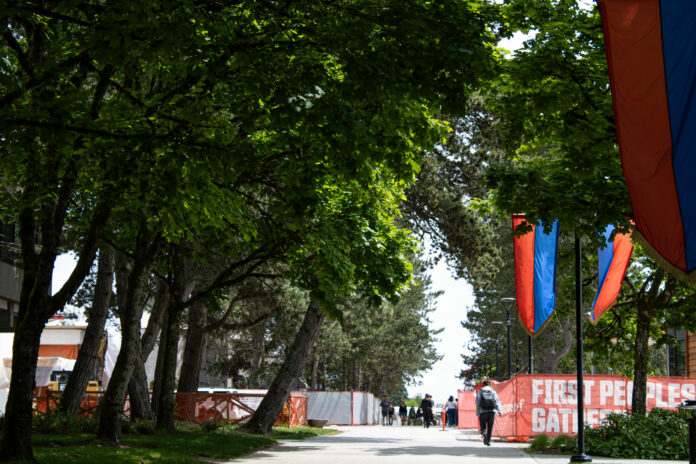
A neutral hallway or outside a building at Burnaby campus featuring student(s) walking
PHOTO: Prerita Garg / The Peak

By: Corbett Gildersleve, News Writer

On September 9, 2024, president Joy Johnson released a statement explaining why SFU abstains from commenting on “partisan political matters and current events.” This statement came after sustained pressure from students and faculty for SFU to take a stance on Israel’s ongoing genocide of the occupied Palestinian territories. According to the statement, “universities need to be a place where people can freely engage in academic inquiry, share ideas, learn from each other, disagree constructively, and peacefully protest.” Apparently, taking a stance would violate section 66 of the University Act, requiring universities to be “non-sectarian [non-religious] and non-political in principle.” 

What Johnson failed to acknowledge is that politics is not just opinion, but the application of opinion through a wide variety of means. She’s yet to acknowledge that the university has already taken its stance on Palestine, by investing $7.2 million in companies that supply arms to Israel, including BAE systems, Booz Allen Hamilton, and CAE Inc. SFU must take accountability for how their actions are political.

Section 66 of the Act has been raised again with a recent petition filed in the BC Supreme Court on April 7, against UBC by four professors and one graduate student. In this case, their targets are the university’s land acknowledgments, EDI statements in the hiring process, and resolutions passed by faculty and administration in support of Gaza. They argue that these items are either political or are still being hotly debated in academia. In their view, these things are violating university members’ academic freedom to freely engage in “controversial” topics. 

The administrative work of the university is political. It doesn’t suddenly become political once the communications department posts a public statement.

As the BC Civil Liberties Association called it, this petition is a “perverse interpretation of the University Act.” Section 66 exists to ensure universities do not become “tools of indoctrination for state-sponsored religions or ideologies.” The issue is that the Act doesn’t define “non-political.” Looking at its history, the Act was first passed in 1908 and has had amendments throughout the years. Both the 1908 and 1963 versions only spoke to universities being non-secretarian. This has always been part of the Act and prevents universities from being religious schools. It also regulates university involvement with theological colleges. It wasn’t until 1974 when the Act was revised significantly, that the words “and non-political in principle” were added.

Both universities and churches in Canada are charities, and similarly, the advancement of education and the advancement of religion are classified as charitable purposes. The Canada Revenue Agency restricts charities’ political engagement, banning them from supporting a party or candidate (being partisan). However, engaging in public policy dialogue and development activities (PPDDA) is allowed. PPDDAs generally involve efforts to influence laws, policies, or decisions of a government. Additionally, there’s no limit on the amount of resources a charity can devote to this work, as long as that activity furthers the charity’s purposes. The university, through its administration, is free to engage in public policy discussions and development. The very work of a university is to advance education and advocate for students, staff, faculty, and administrators. They have a responsibility to provide them support in times of political crisis, such as the ongoing genocide, or for marginalized identities. They also must take accountability for how they respond to their political environment.   

The petition and Johnson’s statement want to limit the university administration’s public statements to only being directly related to the university’s business. This business would include research produced, courses being taught, and other activities specific to their mission. The fundamental problem with this is that the administrative work of the university is also political. This includes decisions made by the Senate, the Board of Governors, the deans, directors, and their relevant committees. It doesn’t suddenly become political once the communications department posts a public statement. 

Politics is not just an opinion on taxes, laws, or whether Indigenous sovereignty exists; it’s the actions and activities to implement those opinions.

Politics is not just an opinion on taxes, laws, or whether Indigenous sovereignty exists; it’s the actions and activities to implement those opinions. By making and voting on policies, budgets, and plans, the university decides what research gets funded, who receives bursaries and scholarships, what department gets additional support staff, who goes into a new building, what programs get created or cut, and so on. These actions are not neutral. The university does not just create a place to “freely engage in academic inquiry [ . . . ] where people can have robust conversations” when they literally determine not only if there is a stage, but who gets to stand on it, and who gets to attend. 

The petition also cites section 47 of the University Act, which instructs universities to pursue “all branches of knowledge.” This is overly simple. These branches imply a tree with a central, unmoving trunk rooted in the ground, supporting all this work. A more accurate metaphor would be that a university is a forest in all its biodiversity, supporting not only the growth of different trees, bushes, and plants, but also animals, insects, and creatures that live within it. As some areas of knowledge are found to be incorrect (like the flat earth theory), those plants wither away. As such, there is no fixed center to the forest, instead, it shifts as the forest changes and grows. The administration, as the forest’s caretakers, have a responsibility to use this knowledge gained through scholarly work, to move along with it. 

All “partisan matters and world events” are the business of the university. President Johnson had that opportunity and instead, she has abdicated her responsibility and chosen silence forevermore.

Unpacking the India-Israel alliance and its global implications

0
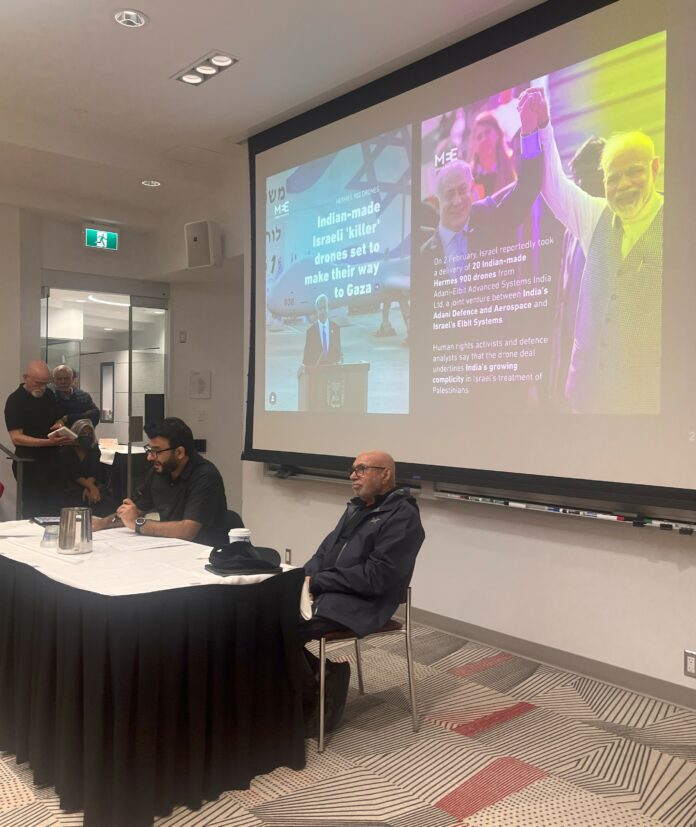
This is a photo of two men sitting at a table, one with a mic in his hand, in front of a slides presentation about the India-Israel alliance.
PHOTO: Sarah Moore / The Peak

By: Sarah Moore, SFU Student

In an address at the Annual Dr. Hari Sharma Memorial lecture on May 17, journalist and author Azad Essa critiqued the deepening alliance between India and Israel. Framing his lecture within the legacy of Hari Sharma, a fierce critic of US imperialism and Hindu nationalism, Essa painted a grim picture of a world increasingly shaped by authoritarianism, neocolonialism, and corporate greed. Sharma was also a professor emeritus of sociology and anthropology at SFU. 

Opening with a sweeping overview of global conflicts, from Sudan and Yemen to Congo and Chhattisgarh, Essa argued these crises are connected by a common thread of imperialism, environmental destruction, and the unchecked expansion of capital. In Congo, for instance, imperialism takes the form of multinational mining companies extracting cobalt and copper with little regard for local communities or ecosystems. Linking these to the global rise of the far-right over the last two decades, he warned how Israel’s occupation of Palestine serves as a model for repression everywhere. 

The Palestinian genocide “lies at the intersection of the building of a new world order in which the powerful are able to pursue expansion, domination, and the exertion of hard power over peoples, domestic or otherwise — with impunity,” Essa declared. “And the beating heart of this new pursuit is burgeoning India and Israel ties.”

Essa traced this alliance back to as early as the 1960s, when India first bought weapons from Israel during the Sino-Indian War. Since then, this relationship has deepened not just through continuing arms deals and surveillance tech, but also through a shared playbook of ethnonationalism. Drawing parallels between Zionism (Jewish nationalism) and Hindutva (Hindu nationalism), Essa emphasized their dependence on myths of civilizational superiority and existential threat. This also has severe domestic consequences for India, Essa noted, such as the normalization of Islamophobia and increased state violence against minorities in the country. 

The Palestinian genocide “lies at the intersection of the building of a new world order in which the powerful are able to pursue expansion, domination, and the exertion of hard power over peoples, domestic, or otherwise — with impunity. And the beating heart of this new pursuit is burgeoning India and Israel ties.” — Azad Essa, journalist, author

Essa also critiqued India using the Pahalgam attack as justification for deploying Israeli drones in Pakistan while adopting Israeli-style settlements in Indian occupied Kashmir. The Pahalgam attack occurred on April 22, with armed terrorists killing 26 tourists as they vacationed in Kashmir, the world’s most militarised zone. Building on a rich historical and geopolitical analysis from his book Hostile Homelands: The New Alliance Between India and Israel, Essa outlined how India (long portraying itself as pro-Palestinian and anti-colonial) has pivoted to embracing Israel not just in arms deals and military trainings but also in policy and tactics of surveillance, demographic reengineering, and suppression of dissent. 

As Essa explained, the India-Israel alliance is emblematic of a broader shift in global politics where authoritarian regimes shield one another from accountability. Despite these “incredibly distressing and heartbreaking” times, Essa emphasized the need to imagine different futures. Reflecting on Sharma’s legacy that framed the lecture, he concluded that the unequivocal present reality is stripping away global illusions: “Whereas it would have been very tough for South Asian scholars, activists, like professor Sharma, to speak about India in an academy that has largely valorised India, the road has been cleared now to speak and examine the Indian state,” he said. “The lack of ambiguity saves a lot of explanation.” Sharma’s political work extends more than 50 years, with his work related to India beginning in the ‘70s.

He also paid tribute to Malcolm X on the 100th anniversary of his birth: “As Michael E. Sawyer said last month, South Africa’s effort to take Israel to the International Court of Justice is Malcolm’s dream of a colonial entity being dragged to an international institution manifest.” 

Following the lecture, he was joined by Sid Shnaid of Independent Jewish Voices in a dialogue focusing on solidarity, resistance, and the role of diaspora communities in challenging oppression. The conversation touched on the complicity of Western institutions in legitimizing Benjamin Netanyahu’s and Narendra Modi’s regimes while calling for a unified global response.