Home Blog Page 571

Board Shorts

0
Irene Lo / The Peak


The board approved an agreement with the Alma Mater Society (AMS) of UBC regarding the Welcome Back BBQ

Many details of the SFSS-AMS partner event were elucidated through this agreement. SFU students are set to pay $37.50 per ticket, compared to the $35 that UBC students pay and the $50 that non-UBC students pay, according to vice-president student life Tawanda Masawi. Masawi hopes to be able to roll out ticket sales starting this week.

Masawi stated that he is “looking into” the idea of organizing transit vehicles to transport students.

“This is not a replacement for Fall Kickoff,” noted Masawi. The vice-president aims to use the student life budget towards “a bunch of other events on campus.”


The board approved extending the lease agreement of StudentCare

StudentCare, the body on campus responsible for disseminating health and dental care services to students, was set to have their sublease in Maggie Benston Centre terminated on August 31. The SFSS has confirmed that StudentCare will continue to manage health and dental care on campus, and the student union building (SUB) is not yet complete and so cannot serve as a space for them. Therefore, StudentCare’s current sublease is to be extended monthly, until such time as they can move into the SUB.


The board approved the movement of $10,000 to the SFSS emergency aid fund

The SFSS emergency aid fund is in place for “students in significant need, if something happens to them,” according to CEO Martin Wyant. Contributions from the student society are matched by the provincial government; for the 2017–18 year, the SFSS is expected to provide $10,000 no later than August 31, 2018, while the government of BC will contribute $9,982.

Board Shorts: a recap of the SFSS presidential impeachment discussion

6
Irene Lo / The Peak


At the SFSS’s August 14 emergency board of directors meeting, the board approved a motion to  place a resolution to impeach SFSS president Jas Randhawa onto the agenda of an upcoming annual general meeting (AGM) or special general meeting (SGM).

The proposed motion underwent “elaborate discussion with the entire board” prior to the meeting, according to vice-president student services Samer Rihani.

“We’ve looked at all the options that we felt would be best going forward — for the team, for the student society, and for the students,” said Rihani, who submitted this motion. “We felt as if going through with an impeachment is just simply the best option as of right now for us.”

Specific reasons for the move to impeach the president were not made explicit during the ex-camera portion of the meeting. However, while responding to the motion, Randhawa alluded to what he called multiple “accusations of incompetency” having been recently leveled at his work performance.

“I’ve pushed for a better social media strategy, I’ve pushed for more student life on campus, reformation of the very by-laws that we’re arguing for, strong transition into the [student union building], new initiatives like the advocacy support office, and above all, I support everyone individually here on this team,” Randhawa stated.

Randhawa claimed that other directors on the board were guilty of violating SFSS policies and by-laws, as well as the BC Societies Act, due to their conduct throughout their move to impeach him. He also addressed the board’s faculty representatives who were present, claiming that some had “specifically stated to [him] that they do not agree with what’s going on,” but were “still following through with this process of impeaching [him].”

Board members did not respond to these allegations during this discussion, and the board moved to the vote, where the motion to recommend impeachment carried.

As a result, the board is set to make the aforementioned recommendation to SFU’s students at the SFSS’s next AGM or SGM in September. While the date for the 2018 AGM is set for September 24, Rihani mentioned that the SFSS’s financial reports may not be ready by that time. Should that be the case, it is possible that the AGM will be rescheduled and an SGM be called for the same date.

Following this, the board introduced a motion to approve up to $1,000 as funding for any legal counsel the SFSS president may seek in light of the potential impeachment. Rihani added this item to the agenda — however, he noted that Randhawa requested that the motion be removed. Randhawa himself reiterated that he had never indicated a desire for such a motion to be brought forward, and that he does not wish to use the student society’s dollars towards “his own personal legal pursuits.”

The position of chair of the SFSS board, previously held by Randhawa, changed hands earlier in the meeting, and is to be filled by at-large representative Mohammed Ali for the remainder of the summer. When putting his name forward, Ali cited a by-law which allowed the board to appoint a new board chair through a vote.

Randhawa opposed the motion to change chairs when it was brought forward, claiming that the board policies declare that the SFSS president will also be the board chair. Aside from this, he further claimed that to have a director besides the president act as board chair would contradict and infringe upon the president’s power to convene board meetings and council meetings, a power assured by the SFSS’s other by-laws and policies.

Applied science representative Kia Mirsalehi argued against Randhawa’s points, claiming that the president’s ability to convene board and council was separate from the board chair’s power to do so, and therefore that the president does not need to be board chair to retain that capacity.

“There has been a vote of non-confidence discussed by the board in terms of sending out the agenda prior to staff, at least for this meeting [and] Friday’s, as well as proper timely notification of the meeting,” said Rihani, regarding why this motion was being brought forward at this particular time. “Board felt as though there hasn’t been confidence in the way that these meetings have been conducted or sent out [ . . . ] You are allowed to call forward the changing of a chair if you feel as though there’s a movement of non-confidence.”

Randhawa responded, “These meetings have been called on petition, within two days. If there are staff concerns on calling these meetings, I think that there’s a rationale behind that.”

The SFU student’s guide to scholarships

1
Image courtesy of CTV News

Editor’s Note: Make sure to check the scholarships’ official websites for their exact wording, eligibility, and conditions! Good luck getting rich.


Value: $1,000

Description: This annual scholarship is granted to four students planning on careers related to working with senior citizens. Recipients will be selected based on their submission of a video that effectively captures the scholarship’s theme of “The Value of Seniors in Our Lives and Benefits to Society.”

Eligibility: Must be citizens/permanent residents of the U.S. or Canada, currently enrolled and taking classes in a medical/nursing/social science program at a recognized post-secondary institution (graduate and undergraduate).

How to apply:


  • Submit a cohesive and original 2–3 minute video featuring a story or an interview with a senior/group of seniors that positively impacted your life, and outline the benefit these kinds of relationships have on society. Some prompts and questions are available on their website, as is a full list of requirements.  


Deadline(s):

  • There are four deadlines throughout the year (divided in four “quarters” of entries). The next one is September 30. The scholarship will be awarded by October 12 2018.
  • Applications for the Fourth Quarter are due December 31, 2018. Scholarships will be awarded by January 15, 2019.
  • Another $1000 “Best of 2018 Scholarship” will be awarded by January 30, 2019 to a recipient selected from the previous year’s scholarship recipients.


Value: $2,700

Description: This scholarship is awarded to a well-rounded FASS student with at least 90 units, who demonstrates community involvement and is in excellent academic standing.

Eligibility: Must be a Faculty of Arts and Social Sciences (FASS) student with at least 90 units, is very involved in the SFU or larger community, and demonstrates academic excellence.  Applicant must also fulfill the requirements outlined on the SFU Student Services website.

How to apply:

  • Complete the Student Application: Apply online through the Student Information System (go.sfu.ca).
  • Submit a one-page cover letter describing recent unpaid volunteer/community service in the past two years, and a minimum of one reference letter.

Deadline: Applications run from August 27 to September 14, 2018.   The scholarship will be awarded by the Senate Undergraduate Awards Adjudication Committee by the week of October 22, 2018.

More info: Scotiabank Student Scholarship in the Faculty of Arts and Social Sciences

Note: Scotiabank offers other scholarships to SFU students in other departments.


Value: $1000

Description: This annual scholarship is awarded to an undergraduate student enrolled in a bachelor’s degree program in the Beedie School of Business, chosen based on exceptional academic standing.

Eligibility: Must be a Beedie School of Business student enrolled in a bachelor’s degree program and demonstrating academic excellence. Must fulfil the requirements outlined on the SFU Student Services website.

How to apply: Complete the Student Application through the Student Information System (go.sfu.ca).

Deadline: Applications due August 27 to September 14, 2018. The scholarship will be awarded by the Senate Undergraduate Awards Adjudication Committee by the week of October 22, 2018.


Value: $1900

Description: This annual scholarship is granted to a science undergraduate demonstrating academic excellence and completing their final year of a recognized major or honors degree in Molecular Biology and Biochemistry.

Eligibility: Must be a science undergraduate student who is in the final year of a major or honors degree in Molecular Biology and Biochemistry. Must fulfil the requirements outlined on the SFU Student Services website.

How to apply: Apply online through the Student Information System (go.sfu.ca).

Deadline: Applications due August 27 to September 14, 2018. The Scholarship will be awarded by the Senate Undergraduate Awards Adjudication Committee by the week of October 22, 2018.


Value: $2000

Description: This scholarship is awarded to a Faculty of Education undergrad with particular interest in developing skills for assisting students with reading difficulties.

Eligibility: Must be a third- or fourth-year student who is interested in becoming a teacher for children or youth. Must fulfil the requirements outlined on the SFU Student Services website.

How to apply:


  • Submit a write-up discussing your interest in issues related to reading capabilities in children and youth.


Deadline(s): Applications due August 27 to September 14, 2018. The Scholarship will be awarded by the Senate Undergraduate Awards Adjudication Committee by the week of October 22, 2018.


Value: $3000

Description: This scholarship applicable to students worldwide and in any faculty! It is granted to a third- or fourth-year student to help them save money on tuition costs.

Eligibility: Must be a third- or fourth-year student who demonstrates strong school community involvement and is in excellent academic standing. Recipients are required to maintain a minimum GPA of 3.2 every semester.

How to apply:

  • Complete the required student application form found on the website
  • Submit an original essay that discusses helpful tips on how you can save money in everyday life.

Deadline: December 31, 2018


Some other helpful resources:

https://www.scholarshipscanada.com/, a Canadian scholarship database

Scientists look at communication for education and for emergency purposes

0
(Image assets from Thomas Noble and Twitter, photo illustration by Chris Ho/The Peak)

SFU scientist examines her Twitter followers

As a conservation and marine ecology professor at SFU, as well as an active user and science communicator on Twitter, Isabelle Côté was particularly interested in knowing “if my followers are mainly scientists or non-scientists – in other words was I preaching to the choir or singing from the rooftops?”

    Côté worked with Emily Darling, a PhD student, and analyzed the Twitter accounts of more than 100 ecology and evolutionary biology faculty members from various academic institutions in 11 countries. By determining if the followers of these faculty members were other scientists, classified as “inreach,” or members from a non-scientific field, classified as “outreach,” Côté and Darling found that around 55% of followers were other scientists.

    However, Côté and Darling also found that when the number of followers went beyond the threshold of around 1000 followers, the fields that the followers were in became more diverse. As Côté and Darling discuss in their article, this in turn would enable the messages of these faculty members to reach a wider audience noting that there is “a lot of room for scientists to build a social media presence and increase their scientific outreach.”


Researchers look into design consideration of video-calling for 911

SFU’s Dr. Carman Neustaedter, an associate professor in the School of Interactive Arts and Technology, took on the challenge of implementing video calling in the emergency response system. Since the 1960s, 911 services have been accessed by North Americans via a telephone call.

    In collaboration with the University of Calgary and Microsoft Research, the team led by Neustaedter explained that “[we] see a huge need but also a really challenging design space.

    “We need to think about emergency video calling along a continuum of visual modalities, ranging from audio calls accompanied by images or video clips, to one-way video streams to two-way video streams, where camera control and camera work need to be carefully designed,” Neustaedter stated.

    By collecting data from three 911 call centres, the researchers were able to observe work practices, listen to 911 calls, and conduct interviews with 911 operators. While concerns about the ability for the 911 operator to control the call and potential work stress and post-traumatic stress disorder arising from viewing difficult scenes were expressed, the researchers also heard that video calling could make it easier for the 911 operator to understand the situation.

    For those responsible for creating the design space for future emergency calls, this research will be very informative.  

SFU’s master plan: A look ahead to the next 50 years on Burnaby campus

0
(Image asset courtesy of SFU, photo illustration by Chris Ho/The Peak)

Over the coming years, SFU Campus Planning and Development, along with planning firm Urban Strategies, will be designing a new vision for Burnaby campus, and they are looking for student input.

     The plan, titled SFU Burnaby 2065, will provide a framework for the buildings, landscapes, public spaces, and on-campus movement of the next 50 years.

     The planning process began in early 2018 and will conclude in the summer of 2019. It will involve a series of open houses as well as an interactive survey students and faculty can use to provide their input.

     The survey, which takes approximately 10 to 15 minutes to complete, asks respondents how they get to and around campus, which places they enjoy on campus, and which aspects of the campus should change. SFU faculty, students, and employees are invited to fill out the survey at sfuburnaby2065.ca/survey until August 3. According to Urban Strategies representatives during an email interview with The Peak, there have been approximately 950 responses so far.

     The Peak conducted its own informal survey of two SFU students to see what they liked about the Burnaby campus and what could be improved. When asked what should be changed on campus, fourth-year history student Charlotte Scott replied that the school should implement “a more safe and direct passage from the SFU transportation centre bus stop to the school, one that doesn’t make you cross the street, or go through an underground parking, and more outside seating areas.”

     Her concerns about pedestrian safety were echoed by Urban Strategies, who identified “the Transportation Centre at Gaglardi Way and University Drive; the experience at the edges of the campus along the ring roads; or accessing the campus from parking” as areas needing improvement.  

     Second-year business student Omar Rasheed felt that “more paint and brightness on the university buildings, not just concrete” would make the campus nicer. Both Scott and Rasheed said that the area they liked most on campus was the reflection pond and surrounding area.

     According to Urban Strategies, the plan will address potential transportation improvements on the Burnaby campus by “better supporting the central spine with new secondary connections across campus,” as well as to and from campus by supporting projects such as the long-awaited gondola up Burnaby Mountain.

     While the effects of these larger-scale changes may not be felt by current students, the plan developed by Urban Strategies will also look to address issues that can be improved on a shorter time-scale, such as a lack of spaces for arts, culture, and recreation — “the spaces to support day-to-day community life.”

     SFU’s Burnaby campus design has won numerous awards, including the 2007 Royal Architectural Institute of Canada’s Prix du XXe siècle (20th century prize).


Provincial government provides work-integrated learning funds for 25 BC institutes

0
(Photo courtesy of Drishti)

On July 23, minister of advanced education, skills and training Melanie Mark announced that the provincial government would be providing $1.9 million in funding to all of BC’s 25 public universities, colleges, and institutes. The funding is meant to support co-op and work-integrated education opportunities for post-secondary students in B.C.

     When broken down, the total investment injects $75,000 in one-time funding for each of the 25 institutes, including SFU. Mark made the announcement during a visit to the SAP Labs Canada in Vancouver, where 175 co-op students and interns presently work.

     “Work-integrated learning gives students the opportunities to build the best future for themselves and their families,” said Mark. “These co-op opportunities allow students to apply what they learn in the classroom in the real world. Employers get the chance to identify new talent and benefit from the fresh ideas and energy students bring.”

     The funding is in support of the mandate commitment for the Ministry of Advanced Education, Skills and Training, and the Confidence and Supply Agreement with the BC Green Party caucus. The provincial government has pledged to support co-op, apprenticeship, and work experience programs through a four-year investment for both high-school students and undergrads.

     “We keep hearing around the province, particularly in the lower mainland, is that it is a challenge to find well-trained people ready to go, especially in the tech field,” says MLA Spencer Chandra Hebert. “Businesses want to expand and it’s hard to find people.”

     “As education is the great equalizer to success, and if the opportunity for all is created, we can create the best B.C.,” said Mark. From 2012 to 2016–17, student co-op work placements have gone up by almost 40%, with 86% of these increased placements originating from SFU, UBC, and UVic.

     According to the Ministry of Advanced Education, Skills and Training’s press release, although students can find co-op placements anywhere in the world, most of them are actually placed in British Columbia (82% in 2016–17), generally concentrating in their local region (71% in 2016–17). Thus, this funding is to be used by public institutions to support outreach to more employers, increase awareness of the benefits of work-integrated learning to employers and students, and improve the capacity to place students in meaningful workplace-based learning opportunities.

     Mark commented, “Our government will continue to work with post-secondary institutions to expand opportunities and lift up students across B.C.”

     Shauna Tonsaker, director pro tempore for work integrated learning and co-operative education at SFU, commented that “SFU’s Work Integrated Learning department is very pleased to receive funding from the provincial government supporting increased Co-operative Education work term opportunities and other forms of work-integrated learning for students in the areas of non-profits, sustainable energy and technology.”

     She continued, “Our programs will also be better able to support Indigenous and other culturally diverse students successfully gain work experience and job skills through embedding cultural sensitivity within our curriculum, programming and services.”

POLITICAL CORNER: The power of diplomacy

0
Photo courtesy of Alkis Konstantinidis/Reuters

In today’s world, it’s easy to get discouraged by what we see in politics. From extreme partisanship to the destructive, useless rhetoric and empty promises, it sometimes feels like politicians behave more like children than leaders.

For the final Political Corner of the term, I’d like to end on a happier note and point readers towards the southeastern corner of Europe — the Balkans. Exciting news has been coming out that I think would be refreshing to share.

This region is infamous for being involved in Franz Ferdinand’s assassination, which helped spark World War I, and towards the end of the last century and the beginning of the present century, the region had been beset with various conflicts, such as the war in Croatia (1991-1995) and the war in Bosnia (1992-1995). But now it seems the region’s leaders are showing encouraging signs of progress through their use of diplomacy to solve their differences.

The leaders of Macedonia and Greece have formally signed an agreement that could end an almost 30-year-long dispute about the usage of the name “Macedonia,” which both Greece and Macedonia claim as theirs. Meanwhile, in recent years, the leaders of Kosovo and Serbia are holding meetings to try and resolve their differences and to normalize relations.

Readers familiar with the two nations will know that Kosovo declared independence from Serbia in 2008 after years of tension, and that Serbia still doesn’t acknowledge this. While there is still a long way to go, and there are still various other issues to resolve, this often-forgotten little region of Europe is displaying the potential for a more diplomatic way of doing things, and giving the world a much-needed lesson on what happens when we choose to talk things out instead of pointing fingers.

AI summer camp aims to encourage high school girls to get involved in STEM

0
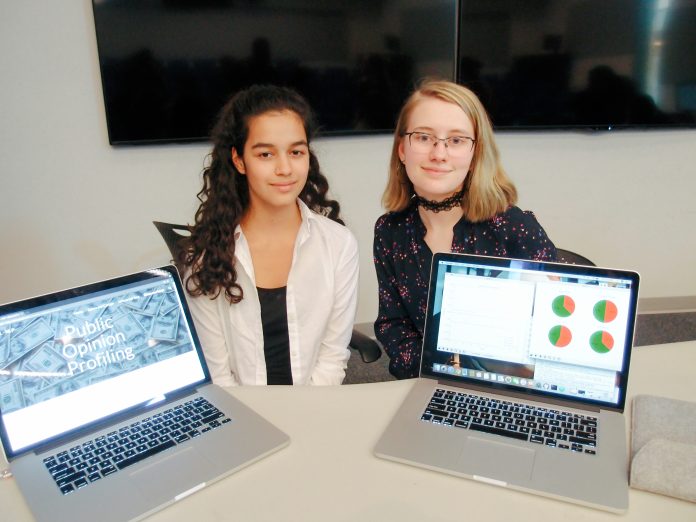
Sara Cadder (left) and Eileen Wallgrove (right) completed a five-day research project and real-time visual graphic on public perception of billionaires. (Amal Javed Abdhullah / The Peak)

The SFU Faculty of Applied Sciences held Invent the Future, an Artificial Intelligence (AI) summer camp, to encourage girls to pursue science, technology, engineering, and mathematics (STEM) fields.

     During the two weeks of the camp, 24 eleventh-grade girls from all over the Lower Mainland, Vancouver Island, and even two from as far as Toronto, gathered to learn about AI, experiment with STEM, and work with mentors to create their own AI projects.

     In the first week, the girls learned about computer vision, natural language processing, and robotics. They also heard from a variety of speakers who gave talks on topics such as coding, innovation and pitching, and leadership in technology. In the second, they broke off into smaller groups, each taking on a topic and creating their own research projects in five days with the help of their mentors.

     Sara Cadder and Eileen Wallgrove, two participants from Vancouver and Mill Bay respectively, worked on a research project about the public perception of billionaires and their correlation to altruism. They used online libraries to look into their chosen topic, then created visual graphics that change in real-time to reflect their findings.

     Both Cadder and Wallgrove say that, though the program was close to home, they heard about it “on a fluke.”

     Both say that it was not adequately advertised, and that they both heard it through word of mouth outside their schools. They posit that this may be because the program is still in its infancy, being the first year that it has been launched.

     Wallgrove commented that “we have alumni now, so having people graduate gives the program credibility. [We can say] this is what we did, what we could do. . . so next year, more people will see value in it.”

     Cadder viewed the variety of the activities and different range of topics as a strong point of the program. “The first week, we had educational lectures. We had a college advisor, [speakers from] Microsoft and Amazon… one person talked about finding your purpose as a woman, or a woman of colour in the technology field. There were a variety of things that were specifically tailored, especially to diversity and self-worth.”

     Wallgrove added that the reason why this program was launched was because there is a need for representation in in the industry. “The general consensus is that people who are running it saw a need for it because the computer science and AI industry is basically all white men.

     “There’s little diversity . . . there’s 15% women, and people of colour are less than 10%. It’s pretty bad because AI is going to dictate everything.

     “Bias is not intentional, [it’s who you are] that gets put into the work. So we need diversity [in the industry] to show AI as a copy of ourselves.”

Calling Queer Eye’s Jonathan Van Ness “too gay” is homophobic

0
Photo by Ben Ritter)

Netflix’s reboot of Queer Eye is our TV equivalent of heartwarming chicken soup, only with avocado and patterned shirts. The fresh new hosts feature a variety of personalities, and more importantly, a diverse range of queer men.

Like any charming boy band, everyone has a favourite — and while Jonathan Van Ness isn’t mine, he’s one of the most beloved members of the cast and is the resident grooming expert. Of the Fab Five, Van Ness is not only the youngest but also the most flamboyant of the group. He is charismatic, a cornucopia of gay slang, and tagged as the most stereotypically gay one of the group.

Van Ness is criticized for leaning too heavily into such stereotypes, and being “too gay.” Some Twitter users have given him backhanded compliments on his demeanour by appreciating his positivity while at the same time, asking if he could “tone it down.”

With such critique, is Van Ness really “too gay,” and should he tone it down?

While he isn’t my Fab-Five-Fave, to criticize him as “too gay” is homophobic. To judge his personality and outward expression as excessive implies that there’s an “acceptable” amount of gay he is allowed to be. To limit someone’s expression of their sexuality is narrow-minded. There is absolutely no need for him, or any other person in the queer community, to tone down how they convey their gender or sexual identity.

First, we should unpack what acting “too gay” may mean. I’m assuming it includes a possible lisp, a certain tone of inflection in your voice, being sassy, dressing well and being flamboyant. All of these are just a litany of gay stereotypes. To act “gay,” which is to say, to act overly flamboyant, both in and outside the LGBTQ+ community, holds a certain stigma.

Van Ness stands as one of the many men that may be ridiculed, criticized, or mocked due to his “too gay” self expression.

The fact that acting “too gay” is even an issue brings up the issue that there is an issue; the implication that there is even a concept that is “too gay” implies there’s an “appropriate” amount of gayness one can be. By trying to implicitly control someone’s expression of their sexuality, it acts as a form of gatekeeping in the community.

I remember scrolling through my Twitter feed and feeling hurt when I saw an old friend from my first year of university tweeted that yes, he was gay, and no, he did not do drag or watch RuPaul. He continued: “People act astonished when they find out I like to shoot guns and don’t participate in that queeny bullshit.” I tried to understand why he wanted to distance himself from other gay men in the community, as well as try to undermine them.

I realize now how homophobic his statement was for referring to conventional gay behaviour/interests as “queeny bullshit.” This distaste is shared not only by gay men like him, but by others, in and outside the gay community.

Because what’s wrong with liking “queeny bullshit”? I’m guessing that the only problem people may see with it are those who have a skewed vision of what it is to be a man — that it’s acceptable to be gay, but only if you still adhere to toxic ideals of masculinity. Apparently, acting sassy or feminine is mutually incompatible with masculinity. God forbid that someone be gay like Van Ness, and be interested in “queeny bullshit.”

To further understand how terms like “queeny bullshit” hurt the gay community, we also need to talk about how misogyny and homophobia overlap when criticising gay men about their self-expression. If any gay men like Van Ness were to act sassy, speak with a lisp, or to perform a valley girl accent, they’d be performing traits that are associated with being feminine or a woman.

And to be criticised for expressing themselves in a similar way to that of women could be constituted as “queeny bullshit” on the basis that they’re not acting masculine, implicity implying that to be feminine, or to act/dress like a woman is demeaning. To reject valid forms of self-expression for gay men is not only homophobic but also a tad misogynistic.

Writer Garrett Schlichte for Harper’s Bazaar wrote on how effective Queer Eye is at combatting ideas of toxic masculinity and conventional ideals of masculinity within straight and gay men alike. As Schielte wrote, “. . . the Fab 5 are actually exemplifying and encouraging positive, healthy adult relationships based in authenticity, empathy, and vulnerability,” traits that should be noted are often associated with femininity.

No matter the community, toxic ideals of masculinity which dictate a man shouldn’t act too feminine, too flamboyant, or too gay remain prevalent and hurtful.

In a Mic video on misogyny within the LGBTQ+ community, writer Gabe Gonzalez says, “A feminine man is no less of a man; he’s just not performing gender the way our culture expects him to.”

While the gay community isn’t only made up of “yas” shouting and RuPaul-loving men like Van Ness, to put down his mode of expression of his sexuality and self is homophobic and hurtful to the community.

Comedic Poetry: The customer is always right (part 1)

0

It was another average Tuesday.
The day teems;
a welled glass holding the frustration in,
levels rising drip by drip.
That’s how Tuesdays are: patience thin,
weekend energy gone, Friday too far.
And on this damned day,
nothing is out of the ordinary,
so, neither customer nor cashier would have felt so
trapped in their spilling irritation,
had it not been Tuesday.

It was the same woman.
Stopped by twice in half an hour. Strangely,
she’d been pleasant to me, it was usual,
caring,
the first time around. Feeling daring,
I was curious come the second:
“why did you black out the VISA
symbol on your card, ma’am?”
I asked, because it looked dumb,
as if done in an angry rush.
She doesn’t look up, card pressed flush
to her thumb. Rather, she heaves
a long-suffering sigh. I gathered this woman
carried the weight of the world
in her teeming, teeming cup. I knew then,
I’d fucked everything up.
“Are you suggesting I’m stupid?”
I found I couldn’t say anything
a dull “uh” escaped my lips
I was so confused, but refused
to let this woman leave
without exorcising whatever
demon, from its rude hole
had oh-so-suddenly
grieved her poor, unsuspecting soul.
So, I sputtered some apology, or
some explanation, I really
can’t recall; I just know I wanted
to say nothing at all.
Then she finally left with a “thank you”
and a smile, and I, all the while,
feeling lost, and a little through.
Feeling I should say,
this only seems to happen, on
every average Tuesday.