Home Blog Page 551

Venom is an entertaining symbiosis of shortcomings and satisfying success

0
Image courtesy of Sony Pictures


Attention Marvel Comics fans! Venom’s origin story is finally told in director Ruben Fleischer’s latest movie about the iconic supervillain. Fleischer (best known for Zombieland) delivers a film that will easily elicit mixed reactions, but overall, it entertains with its original storytelling about one of Spider-Man’s most fearsome adversaries.

        The film’s most captivating aspect is Tom Hardy’s exceptional performance as Venom and Eddie Brock. Hardy shapes these characters’ relationship as a fun brotherhood to watch through their riveting interactions with each other. Layered with light-hearted humour and impressive yet unsettling visuals, Hardy instills their complex bond with authentic depth that surpasses Topher Grace’s portrayal of Venom from Sam Raimi’s Spider-Man 3. Hardy also develops his characters’ unique dynamic as a metaphor for the instability of power and control, but humanizes these characters through their shared pain as outcasts of their own worlds.

       Although Fleischer’s slow start affects the story’s rhythm, the film’s fierce action sequences offset this drawback through fast-paced thrills and raw brutality that builds up momentum. Fleischer makes these sequences thoroughly enjoyable, especially during a frenetic car chase that gives a Mad Max: Fury Road dimension with its edgy guitar riffs and stylized stunt choreography. He subsequently employs the film’s action to evoke frightening realities from a violent world deprived of any superheroes to save it. Fleischer also structures the story’s devastation as ominous set pieces that, when balanced with gloomy wide shots of the film’s cityscape, further reinforces the metaphysical destruction of Brock’s identity as an ordinary person and the disturbing creation of the film’s titular supervillain as his alter ego.

         Despite the film’s fresh approach to Venom’s origin story, the narrative still suffers from numerous shortcomings. Without Spider-Man to contrast with Venom, the movie is unable to push beyond its themes about identity. Given the film’s special focus on the ethical ramifications of corporate ambition, the story transforms into a mad scientist archetype that has already been explored by previous sci-fi films. Otherwise, these themes are adequate enough for the narrative, even though they offer nothing new to the movie.

         Aside from themes, the lack of chemistry between actors impedes the film’s flow. Hardy’s interactions with co-star Michelle Williams (Anne Weying) are bland, except for a few moments of heartfelt closure between them. As for Hardy’s brief scenes with Riz Ahmed (Carlton Drake), they create a better dynamic than the one Hardy has with Williams. Ahmed is a satisfying villain in the film, but his chemistry with Hardy still falls short due to their constrained screen time together.

Despite how mixed one can be about the film’s quality, the story reimagines Venom as a complicated anti-hero living in an equally complicated world. Whether you are a Tom Hardy fan or just want to watch Venom in his glorious solo appearance, Ruben Fleischer still delivers a worthwhile origin story about one of the most iconic super villains from the Spider-Man comic book universe.

QUIZ: Let’s Find The Best Crying Spot on Campus for You!

0

We know the turmoils of university education can weigh you down, but have you ever wondered where is the best spot to cry on campus?

[typeform_embed type=”embed” url=”https://peakmultimedia.typeform.com/to/DFh37m”]

Beyoncé and Jay Z: On top with On the Run II tour

0


On October 2, at BC Place, Beyoncé and Jay-Z brought their album Everything is Love to Vancouver with their On The Run II tour. While watching Beyoncé effortlessly sing some of R&B’s most defining songs, and Jay rap some of hip hop’s most imperative tunes, I found myself travelling through their discographies to remember how both of them became the accomplished artists they are today.

      In 1996, Jay-Z dropped his debut LP, Reasonable Doubt. As the prodigy of the legendary Notorious B.I.G., the young Jay impressed music-industry titans and fans alike with tracks like “Brooklyn’s Finest,” “Can’t Knock the Hustle,” and “Dead Presidents II.” The swagger, impeccable flow, and sharp lyricism of this record let the world know that the new MC was not to be overlooked.

      Within the next two decades, Jay-Z would drop a number of classic rap records, including 1999’s Vol.2…Hard Knock Life, 2001’s The Blueprint, 2003’s The Black Album, and 2017’s 4:44. In the span of these 20 years, Jay-Z ascended to the top of hip hop’s industry. By becoming the president of a record label (Def Jam in 2004, and now ROC Nation), and through signing some of contemporary music’s biggest names (Rihanna, Kanye West, and J.Cole), Jay-Z has become the most successful MC of his generation.

      Beyoncé’s musical legacy is also one which none can match. As the lead singer of the highest-selling female group, Beyoncé was first introduced to the world through Destiny’s Child’s 1998 debut. Beyoncé proceeded to write some of the group’s most defining anthems, including “Independent Woman (Part 1)” and “Survivor.”

      In 2003, as she released Dangerously in Love along with the global hit singles “Crazy in Love” and “Baby Boy,” Beyoncé began her solo career. With each subsequent album release, her singles and deep cuts challenged her pop counterparts by sparking conversations about the social and systematic constructs that continue to plague America. Her last two visual albums, 2013’s Beyoncé and 2016’s Lemonade, are her most notable works to date. In addition to releasing these albums by surprise, and forever altering the way contemporary musicians release music, Beyoncé has carefully crafted her music to embody both feminism and the celebration of African-American culture. As a result of the integral messages laden throughout her art, Beyoncé has manifested into the most prolific performer of her time.

      Through reviewing both these artist’s musical journeys, I reflected on the state of music today. Musicians emerge, smash the music charts for two to five years, then fall into obscurity because they find themselves more concerned with current trends and fads than establishing a timeless discography or a respected legacy. It seems that someone’s number of #1 pop records, or their ability to emulate what’s trendy, has taken priority over their drive to make impactful art.

       Seeing Beyoncé and Jay-Z come together to perform an impressive catalogue of music was much more than an exciting concert experience. On the Run II shares the story of how a Black boy from Bedford-Stuyvesant and a Black girl from Houston used their talent, innovative art, and resilient work ethic to reach the top spot of the music industry.

       More than just social media exposure, record sales, or even chart placement, Beyoncé and Jay-Z have redefined what it means to be successful in an industry where everything but the music has taken precedence.


The bigger picture part three: art abounds at SFU

0
Heads of State, photo courtesy of Natasha Tar

Written and photographed by: Natasha Tar

Welcome to yet another SFU art walk! After reading the other two that The Peak wrote up, I’m sure you folks are all ready for another one. Art is as rampant as the common cold on our campuses, and it’s about time we gave it a nod and some undergraduate-student analysis. This time around, we will be looking at five pieces, including one that has literal chunks of rose quartz embedded in it.

Theatres of the World, photo courtesy of Natasha Tar

Theatres of the World by Buell Mullen

Where? In the Leslie & Gordon Diamond Family Auditorium at Burnaby campus

When? Given as a gift from the International Nickel Company of Canada Ltd. in 1965

Sometimes I like to think people steal the koi in the reflecting pond and sell/eat them. I mean, c’mon, if SFU gives out free stuff, you take it, right? So when I saw the bright murals that are Theatres of the World for the first time, my fingers were itching to cross the defenseless velvet rope that separated me from the piece and yank off a chunk of precious mineral.

Buell Mullen’s two murals look like intricate and abstract world maps, though SFU Galleries’ public art guide states that the inlaid rocks, such as quartz and gold, were all unearthed from within the vicinity of the school.

The Chicago artist has done similar steel murals for other places, and some publications such as Arts Education Policy Review comment that her work has a hardiness that will easily allow it to outlast canvases. This may be another reason that SFU embraced this piece; the murals’ tough nature suggest that the university and its impact will also last a long time. The stainless steel pieces were also built specifically for the auditorium.

Theatres of the World, to me, symbolizes connecting the world together in the lecture halls of SFU. After over 50 years, this has happened to an extent, but we’re still working on the “friendliness” part of being together.


Steptease, photo courtesy of Natasha Tar

Steptease by Sorel Etrog

Where? At Saywell Courtyard at Burnaby campus

When? Created in 1976, given as a gift in 2009 by the artist

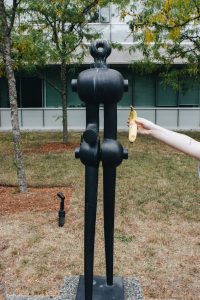
Steptease is one of three strange-looking statues that grace the Saywell Courtyard. When I first wandered up to these things, I definitely thought their names were sexually suggestive. Steptease can easily be misread as “striptease,” and Ritual Head . . . well . . . I’m sure you can make what you will of that one. (Can you see the two hand-like objects grasping a long rod?)

Sorel Etrog is a Romanian-Canadian who started his artistic studies in Israel. SFU Galleries explain that “his forms register as levers, hinges, and blades, but also resonate as limbs and lobes . . .” After reading this, I realized that these sculptures make sense on a university campus because students are definitely part-machine. At least, schools work us as if that were the case.

I would say that Steptease doesn’t really evoke teasing for me. There’s definitely a compass (the math kind, not the “I’m lost, help” kind) and a human body in the statue’s shape, but it’s taking a very non-sexy step. Perhaps Etrog meant to tease us with an inhuman sculpture that our minds interpret to have a curvy, female form. Either way, and despite being covered in bird crap, these statues make for a nice visit on rare sunny days.


Sey̓em̓, photo courtesy of Natasha Tar

Sey̓em̓ (Musqueam Welcome Figure) by Brent Sparrow

Where? In the lobby at Vancouver campus

When? Created in September 2017

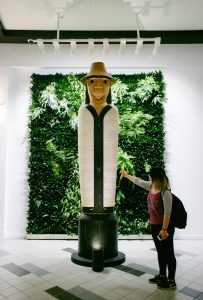
It’s always enjoyable to walk into a building and immediately be greeted by art. This figure is especially remarkable because it was built specifically for welcoming, and it reminds people of the traditional land they live and work on. Sey̓em̓ was carved from a Vancouver Island cedar log by Musqueam artist Brent Sparrow. According to the informational plaque beside the piece, sey̓em̓ means “noble, influential, and wealthy members of the community.” The plaque also explains that the figure is wearing the clothes of a noble, such as a wool blanket and a woven red cedar hat.

For me, Sey̓em̓ definitely gives off a powerful vibe. It stands out boldly from the living wall installed behind it, and there are bright lights shining on its tall figure. It’s impossible to miss if you are entering the campus, and I believe that having an immediate Indigenous presence in a university, or anywhere really, is an important step towards acknowledgement and reconciliation.


Heads of State, photo courtesy of Natasha Tar

Heads of State by Gu Xiong

Where? In the quiet study space of Belzberg Library at Vancouver campus

When? Created in 1992, given as a gift from Russell Precious in 1995

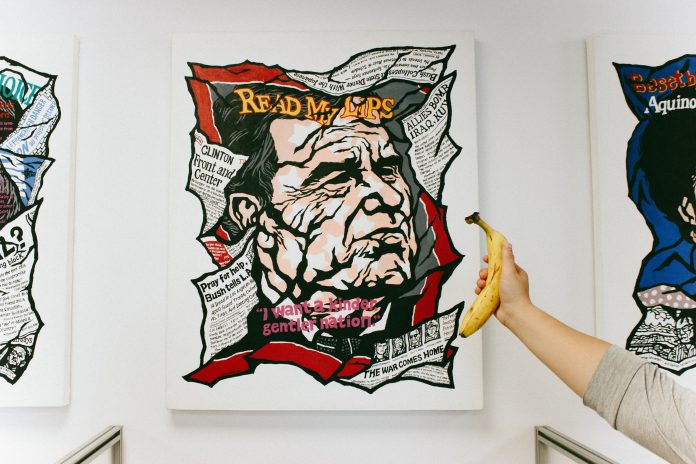
The Belzberg Library at the SFU Vancouver campus is pretty unassuming, until you walk into the quiet study area on the second floor. There, you will find a variety of infamous political figures staring at you from the walls, such as George Bush, Saddam Hussein, and Fidel Castro. The acrylic paintings by Canadian-Chinese artist Gu Xiong feature political figures on crumpled magazines, usually with one of their famous quotes and a few news articles. I’m not a political person, but these paintings immediately struck me.

My favourite is the one of Bush, with his famous quote, “I want a kinder, gentler nation,” alongside article scraps from his presidency that mention war and bombings. This piece, like the others, features Bush as crumpled, but not completely torn up. Could the crumpling be a result of him, a powerful person and icon, being discarded? Or was he crumpled, thrown away, but somehow found and uncrumpled? There are multiple meanings you can draw from these pieces, which is part of what makes them great and fun to look at.


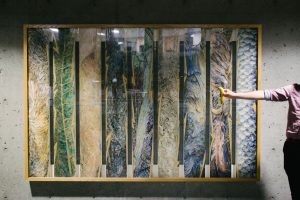
Skins, photo courtesy of Natasha Tar

Skins by Gloria Massé

Where? In Maggie Benston Centre at Burnaby campus

When? Created in 1989, given as an unspecified donation

Hailing from Gibsons, B.C., Gloria Massé’s art focuses on one of her greatest loves: nature. Most of her art also has a strong focus on texture, and Skins is no exception. The name reflects the simple images the painting provides: the skins of different things is nature. The “skins” are separated into individual boards.

When you hear “skin,” the first thing that comes to mind is probably human skin. However, Massé’s piece does not feature human skin, but rather the “skins” of nature we don’t think as much about. Some of the skins I can recognize right away are fish scales, feathers, and leaves. The others are a bit more ambiguous, but one can interpret a bug’s wing or bark depending on how they look at it.

The piece might be reminding us of our close ties to nature, or that we should try to reflect more on nature because we all share this world together. Skins is also a beautiful examination of texture which contrasts nicely with the plain cement walls of MBC.

The Canucks Fortnite ban is well-meaning, but useless

0
Photo courtesy of Epic Games

The Vancouver Canucks made for an interesting headline recently, when the team introduced a video-game ban for the players during away games.

While this affects all games, Fortnite, a massively popular battle royale shooter, has been mentioned as the primary target. Bo Horvat, a centre for the Canucks, defended this ban as being about ensuring the team is bonding and spending time together, but the targeting of video games and Fortnite specifically is probably not worth the time.

This isn’t the first time Fortnite has been named in a news headline about people shirking responsibilities. Last month, an article on a U.K.-based divorce blog noted that nearly 200 divorce cases in the U.K. cited Fortnite as a reason for the divorce (with general online-related addictions being cited in about 5% of all divorces). While there are always some video games garnering a lot of attention and a lot of popularity, Fortnite’s name pops up in very bizarre places.

Why this game specifically is getting mentioned so often? These headlines rope it back to a problem with video games as a whole, but I think it’s a lot deeper than that. There are a few traits of Fortnite and its presence in culture that make a ban seem unnecessary to me.

Just a game

Athletes are often treated as being larger than life, but the fact is that the Canucks’ players are employees. At their core, like retail workers or office clerks, they have a routine to which they have to adhere if they want to get paid.

The day-to-day events and expectations differ in certain ways, but if these players value their jobs and respect their teams, then freedom to play video games shouldn’t get in their way. If they don’t meet their job’s standards, then they’ll likely be removed or singled out for their job performance.

There’s some debate between certain players on whether there are actually players skipping their responsibilities to play Fortnite or other games, but if they were, the headlines should be about the obsessed players being fired or approached about it. Gaming in general is like any other hobby; some people get too into it. But it’s a worldwide industry and pastime, making this ban feel archaic and equivalent to banning books or movies.

Free and accessible

For those who have never played Fortnite, it’s beyond easy to get started. The game is free to download on most gaming consoles, and starting a game is as easy as hitting a “start” button. Doing poorly in the game has no consequences besides losing experience points, so you have nothing to lose by trying it. When you see a friend or a popular streamer playing it, there’s little reason not to try it if you find it interesting.

To me, this is a big part of why so many people are playing it. I’ve chosen not to purchase certain games solely because I can’t find others to play them with, and I also don’t feel comfortable spending $80 for a game I might not enjoy. For Canucks players, $80 might not be an issue, but the game being free and quick to download has still likely contributed to its presence among them. Banning something that’s free and easy for them, while also having no real harm besides taking their time, is a hard sell.

Beyond popular

This is probably the main reason the game has been brought up in so many circumstances. This isn’t to say I think news headlines are using it to get hits, because Fortnite is a specific character in these stories. Rather, the popularity is a cause of the obsessive nature some players have.

At the time of writing, Fortnite is the most viewed game on streaming service Twitch, and videos about Fortnite pass around YouTube with millions of views very quickly, even when it’s just celebrities imitating the game’s dance emotes.

This couples with the game being constantly active; it has patches released nearly every single week, with new content and changes to the game’s balance. When a game has this much activity, it’s easy to invest a huge amount of time and energy into it. However, this is just inherent to the game’s design and marketing and a video game ban anywhere can’t change that it’ll be in people’s minds way more than some other hobbies.

Entertainment and competitiveness

There’s also something to be said for competitive athletes finding new ways to spend time with each other. Not every hangout needs to be team dinners and movies with the boys. It’s fully reasonable for teams to spend time with each other staying in and playing something cooperatively could be just a safer (and possibly more intimate) activity.

Even last year’s Stanley Cup winners, the Washington Capitals, spent much of their downtime playing Mario Kart 64 in their hotel rooms to unwind and bond between games. Fortnite likely can fill this same void.

This game also fills a niche of being simple, hugely competitive fun. Fortnite is played by a huge population, but it has a clear winner of each round (whoever’s the last player alive) and a growing competitive scene.

Competitive hobbies like this seem fairly appealing for athletes, who live off of competition and — I assume — can appreciate it in a less consequential environment such as gaming. Football player Cassius Marsh has talked about how he thinks this is a very healthy and appealing quality of gaming for athletes, and is a big factor of his enjoyment of trading card game Magic: The Gathering. Fortnite has a lot of the same qualities.

So is Fortnite a problem? Probably, but it’s not because it’s a video game or because it’s a new craze that people want to wag a finger at. It’s because it’s an entity that’s popular for reasons that we don’t really have a comparison for, and we don’t know how to properly understand and work around that. The Canucks can ban Fortnite, and it may or may not help them, but it won’t fix the reasons they got hooked on it in the first place, and it’ll still be a major obsession elsewhere.

What If: The upcoming student union building suddenly disappeared

0
Photo by Chris Ho / The Peak

If anything plagues students’ eyes as they venture to Burnaby campus each week, it’s the endless amount of construction. It’s become so normal that we don’t think about it as we walk. We just accept that nothing will ever be finished and treat the hum of power tools and construction vehicles like the sounds of nature.

So with the student union building disappearing, we would finally rest — wait, never mind, they’re repairing something in the AQ. There returns the sound of construction workers earning their rent again, and all we have is a better view of the road where that one old construction project used to be. We’re a university campus, every building that’s finished or cancelled just lets another one roll in. For all we know the student union building will start anew somewhere else on the mountain.

At least without this building, we’ll finally have that building fee struck from our tuition. But being $50, and with most students not knowing what that was even for, many people won’t even notice or appreciate it being gone. We still have more than plenty of fees, and some similar fee is bound to replace it when another inevitable construction project comes along — sooner or later, the school or SFSS is going to feel the need to expand again.

Would it be a better world if the eternally in-progress building were to disappear? Probably for a semester or two. But this is post-secondary; paying for buildings that we only get to see open in our last year is just part of the job. We’ve waited this long for the SUB, we might as well bear through the last few months (ideally).

SFU women’s soccer extend unbeaten streak to six games

0
Carmen Brown got her first goal of the season. (Photo courtesy of SFU Athletics)

The SFU women’s soccer team recorded a resounding 3–0 victory Saturday afternoon against Montana State University at Terry Fox Field.  

The first half of Saturday’s matinee game featured an abundance of chances for the Clan. MSU were under the cosh from the off as SFU fiercely drove through their defensive lines while finding vast space in the offensive third of the pitch. SFU created many genuine opportunities; however, they frustratingly failed to find the back of the net until a moment of pure madness.

With 10 seconds left in the first half, the crowd began counting down to half-time. SFU captain Samantha Donald picked up possession 30 yards from goal. The skipper put her laces through the ball and sent a looping strike towards MSU’s goal. Judging the bounce wonderfully, striker Emma Pringle rose and challenged MSU’s keeper Erinn Harder. The ball bounced over both players, clipped the bottom of the crossbar and fell into the net.

These scenes, playing out as the game clock displayed just three seconds remaining, sent the crowd into a hysterical state. Teammates surrounded captain Donald, hailing her ambitious effort. The senior had occupied a defensive midfield role throughout the game, breaking up play and shielding SFU’s defenders.

“Sam Donald is one of the best players in the conference. Tactically, there is nobody better than number 8,” coach Annie Hamel said of her captain’s importance to the squad after the game. “If you don’t know soccer, she will fly under the radar. If you understand soccer, you will see everything that she does on and off the ball.” Donald’s spectacular goal was her first of the season.

The second half saw SFU’s freshmen shine as Hamel rotated her entire squad for the second consecutive game.

“It’s an immense relief to be able to use your freshmen,” commented Hamel. “To give breaks and manage a season when you trust them. Not only the coaching staff trusts them, but the players on the field trust them. We’re getting to that place where we can use anybody and everybody.”

Danae Robillard produced an impressive display in the second half. Her best chance came when she hit the crossbar on a powerful strike. Robillard also picked her passes well and wasn’t fazed when defending.

If Robillard was great, then Teagan Mackay was superb. Mackay was deployed on the wings and she ripped through MSU’s defenders. Speed, strength, pressing the defensive line, and an eye for the goal: all of this made Mackay invaluable in the second half, accompanied by Emma Pringle, Katelyn Erhardsen and Jenna-Lee Baxter for a deadly SFU attack.

Mackay was crucial to the second goal, winning the ball up the pitch and firing a strike on goal that the goalkeeper parried away. The rebound fell directly to fellow striker Carmen Brown who tapped in her first goal, and Mackay’s fifth assist, of the season.

“What Teagan did today was extraordinary,” Hamel said, touching on Mackay’s campaign. “It has been a long time coming.”

SFU’s defence held firm for the duration of the match as Carli Grosso, Emma Lobo, and the rest of the squad steadied the ship. Many SFU moves started from the passing ability of SFU’s defenders. Goalkeeper Nicole Anderson was confident throughout, earning SFU’s second clean sheet in a week.

SFU added a third goal late on in fabulous fashion. Clair Bareilles sent Baxter through on goal with a perfect through ball. With defenders surrounding her, Baxter took the ball on the fly and shifted the ball onto her right foot before unleashing an absolute thunderbolt upon goal. It struck the bottom of the crossbar and flew in, shaking the frame of the MSU goal. That beautiful goal was Baxter’s eighth tally of the season.

After six games unbeaten, Coach Hamel is looking forward to what is to come, but she wants to keep the team grounded.

“We keep stepping on the gas pedal,” she concluded. “If we want to achieve what I think this team can do, it’s about being a professional, being focused, and taking care of business. Don’t let the blood get too hot or too cold. It’s all about keeping them level-headed.”

What’s next:

SFU’s next match is at Terry Fox Field against Saint Martin’s University. You can catch the game on Tuesday, October 16 at 5 p.m.

Peak Player of the Game: Teagan Mackay

Mackay was energetic all day, and her direct attacking play was integral to SFU recording another victorious result. She’s expected to continue building on these performances; keep an eye on her.

SFU hockey drop home opener to rival Trinity Western Spartans 4–1

0
The Clan are now 1–2 on the season. (Photo courtesy of SFU Hockey)

The Simon Fraser University hockey team lost their home opener and the second game of their first three regular season games last night. At the Bill Copeland Sports Centre, they fell 4–1 to the Trinity Western University Spartans.  After defeating the Spartans in a thrilling 4–3 overtime win late in the preseason, with both teams dressing close to opening night line-ups, SFU simply could not repeat the effort and discipline that allowed them to overcome the defending league champs in September. The Clan are now 1–2 on the season.

The first period saw a significant amount of grinding in the neutral zone, with few high-quality chances traded either way, and the Spartans were the only team to strike, taking a 1–0 lead into the second period on a goal from Travis Verveda. The Spartans continued their usual grinding style in the second period, repeating the tone and outcome of the first to double their lead to 2–0 on a goal from Brandon Potomak heading into the third.

SFU briefly injected some enthusiasm into the Bill Copeland crowd and some energy into the legs of the Clan skaters with a powerplay goal from Darnel St. Pierre that momentarily cut the Spartan lead to one. However, the wheels fell off for the Clan halfway through the third period. Despite only allowing one goal on 10 powerplay attempts for the Spartans, the timing and nature of the Clan’s parade to the penalty box destroyed any momentum that may possibly have been brewing for a home team comeback.

One silver lining for the Clan is that, once again, the team outshot their opponents, and appear to have no problem getting the puck towards the net. The team will need to carry positives such as this and build on them with finish and a net-front presence if they want to turn around their BCIHL season.

In goal, Michael Lenko, making his first start at home as a member of the Clan, allowed four goals on 25 shots and took the loss despite earning second star honours. Having made all three starts for the Clan so far this season, Lenko now holds a 1–2 record in his BCIHL career.

Coach Mark Coletta acknowledged positives that the team could take from the game, but discipline and cohesiveness were the major area where the Clan “beat ourselves tonight,” he pointed out.

“We need to improve our discipline and come to the rink with a commitment to make sacrifices for each other if we are going to take advantage of our skill and speed this season,” he added.

With the loss, Simon Fraser now find themselves four points behind Trinity Western for top spot in the BCIHL standings. While it may seem early in the season to have an eye on the standings, the combination of relatively few teams being in the league and a condensed university hockey schedule (24 regular-season games) means that the two points up for grabs against rivals such as the Spartans are very important to the playoff race — which will surely shape up in the spring, regardless of when in the season the games occur.

For this reason, the Clan need to regroup quickly, build off the positives from the first two weeks of games, recalibrate their team discipline, and start playing more cohesively as a unit if they hope to stay in the race for playoff position.

What’s next:

The Clan will take advantage of a week free of league action to work on conditioning and team systems before heading to Vancouver Island to face off against the UVic Vikes on October 26, and then returning home the next day for the third of five games this season against one of their other main rivals, the Selkirk Saints.

Peak player of the game: Michael Lenko

While giving up four goals on 25 shots isn’t pretty to the stat sheet, it doesn’t show the saves that Lenko made. He consistently stopped quality chances, and was a big reason the scoreline wasn’t worse than it was.

Board Shorts

0
Irene Lo / The Peak


Finances regarding AMS Welcome Back BBQ settled

The Simon Fraser Student Society (SFSS) approved a total of  $13,388 to pay for the unsold tickets of the initial release of the Alma Mater Society (AMS) Welcome Back BBQ.

The money was approved in accordance with section 3.C of the agreement between the SFSS and AMS Events, which stated that the SFSS would accept any unsold tickets of the initial release of the event.

The SFSS Events Committee has a remaining budget of $36,797.85 for the rest of the board year.


Board discusses campus safety concerns

The discussion was prompted after a student posted on Facebook about an incident of classroom violence. Vice-president university relations Jackson Freedman introduced the discussion and asked the board how they feel the Simon Fraser Student Society (SFSS) should respond to the situation.

“I feel like, if SFU is not stepping in, we should probably step in at this point,” said vice-president external relations Jasdeep Gill

SFSS CEO Martin Wyant noted that, if the board has the contact information of the students who witnessed the incident, the society should reach out them directly to offer support. “As a student society you are rightly concerned about this,” he said. “And if we need to advocate with the university or any particular group on how they can better support in circumstances like this, then that’s a very appropriate role to play.”

Wyant also noted that this incident could be combined with pre-existing concerns current and past SFSS boards have had regarding safety and security on campus and jointly presented to the university.


Board discusses accessibility and health and safety concerns

Vice-president student services Samer Rihani brought forward a concern raised during the last SFSS Accessibility Committee meeting regarding current protocol for students with accessibility needs in cases of emergency.

According to Rihani, if a student with accessibility needs is on the fifth or sixth floor of the AQ during a fire or other emergency, the current protocol for them would be to wait by the staircase and “hope that somebody gets you.” Rihani expressed concern over this policy, and motioned to invite SFU into a conversation regarding accessibility.

Wyant connected Rihani’s concern to other concerns brought forward by current and past board members, as well as other SFU students, such as the need for an updated accessibility map, lighting on campus, and the emergency plan in the case that the Kinder Morgan pipeline bursts.

“If that tank farm goes up, the health and safety concerns are large. You could strand thousands and thousands of people on this campus and the strategy right now is you shelter in place, which basically means you just stay and wait for instructions,” noted Wyant.

Wyant also relayed student concerns regarding how long it took to for the university to formulate a coherent response when smoke bombs were set off at this year’s AGM.

“There’s an accessibility conversation, and there’s also a broader issue with respect to health and safety on campus,” said Wyant. He suggested the board look into inviting SFU representatives into a bigger conversation about health and safety on campus with all SFU students.


SFSS works with FNSA to plan Pow Wow event

Vice-president student life Tawanda Masawi was appointed to work with the First Nations Student Association (FNSA) to provide SFSS support to the planning of the association’s Pow Wow event. The event is scheduled to be held on the weekend of February 22 to 24.

FNSA member Matt spoke on behalf of the association during the board meeting, stating that the event “would be helpful to build the cultural relationship between the SFSS and the FNSA.”

“Through Indigenous methods, the best way you can learn is to build a relationship with someone,” said Matt. “I know the FNSA wants to work with the SFSS trying to rebuild a lot of these relationships.” He noted that the event would help provide “first-hand cultural knowledge and understanding about both Indigenous students and the community” to the SFSS.


Board revisits Surrey space agreement

Freedman noted that a significant concern raised during the previous SFSS Council meeting was the fulfilment of the Surrey space agreement which was announced in March. The agreement aimed to expand available study space for students at SFU Surrey through actions such as leaving classrooms on Galleria 3 unlocked until midnight for students to occupy, and enhancing studying spaces with additional power outlets, seating, and overhead lighting.

The board discussed concerns that these actions were not being effectively executed. Applied sciences representative Kia Mirsalehi noted that there had been no significant work done towards the agreement’s commitment of a mobile cart holding project tools. At-large representative Mohammed Ali recounted his experience when security personnel told him that they would not open a classroom unless a class had previously been booked in that space.

The board agreed to meet with SFU to discuss the progress of the agreement’s implementation.

Mirsalehi also mentioned that SFU Burnaby students were currently not able to enter the Surrey campus after hours by themselves — they must contact security and ask for entrance.


Board discusses approach to hostile communications

Business representative Jessica Nguyen brought the discussion forward following a hostile interaction she had with a group over the Thanksgiving long weekend.

“I completely understand when clubs have concerns which are valid, but being rude and disrespectful and abusive is not fair and I think this has happened many times in the past,” Nguyen said.

“There has been unfortunately — over the years I’ve been here — this jump to being judgmental and hostile in some situations. And we’ve seen it with a number of clubs in particular,” said Wyant. Wyant continued that the current manner in which the SFSS deals with hostile groups is to invite them to meet with the SFSS and discuss the relationship between the society and the group.

“You don’t have to sit and take abuse as a person, as a member of the Simon Fraser Student Society, as anybody in life,” he reminded the directors. “Just because you ran for political office doesn’t mean that others are entitled to that approach.


SFSS plans fall lobbying trip

The society approved $1,535.55 to send Gill, FCAT representative Amrita Mohar, and environment representative Russell Dunsford on a fall lobbying trip to Victoria at the end of October. The trip is a follow-up to a prior trip done by Gill and Mohar which involved provincial budget consultations.

The board discussed sending SFSS campaign, policy, and research coordinator Sarah Edmunds to accompany the directors on the trip. Wyant noted that the idea of involving staff more heavily in lobbying was one that surfaced last year: “We came to the conclusion that we weren’t necessarily lobbying effectively as an organization, we were kind of riding the coattails of others,” he said.


Board approves up to $1,300 for pumpkin-carving event

Nguyen clarified that the budget was decided by budgeting $10 per pumpkin (with a total of 100 pumpkins), as well as pumpkin-carving kits, which would be safer than knives.

She noted that she wanted to “have the motion because the event is coming up real soon so I’d like to have it up to [$1,300] but I probably will not use all.”


SFU and UBC honour the lifework of the Aga Khan

0
(Photo courtesy of Aga Khan Development Network)


In a first-of-its-kind event, SFU and UBC are each conferring an honorary doctorate of laws degree to His Highness Prince Shah Karim Al Husseini Aga Khan in a joint ceremony.

The Aga Khan founded the Aga Khan Development Network, a global network of development aid agencies working through post-secondary institutions, hospitals, and school programs. This network is particularly active in underdeveloped and war-torn nations. The Aga Khan, who is the 49th hereditary Imam of Shia Ismaili Muslims, founded this network as an expression of the social conscience of Islam.

The awards mark both universities’ recognition of the Aga Khan’s lifetime of philanthropy.  “His Highness has demonstrated an exemplary international commitment to address the needs of others,” said SFU president and vice-chancellor Andrew Petter to SFU News.

The award ceremony will also honour Aga Khan’s collaborative work with UBC and SFU. Petter expressed gratitude for the Aga Khan’s support provided to programs at both universities. “We are grateful for his generosity in promoting positive change in the lives of young people and in advancing the well-being of the communities we serve.” said Petter.

The Institute for the Study of Muslim Civilisations at the Aga Khan University worked with the Centre for Comparative Muslim Studies at SFU to set up a world-renowned summer school on Muslim diversity called “Expressions of Diversity.” This program helps participating students understand Muslims in a diverse framework and larger context in a critical and historical manner.

“Expressions of Diversity opened up many windows into the historical heritage and contemporary relevance of Muslim peoples globally,” stated Derryl MacLean, founder of SFU’s Centre for Comparative Muslim Studies. Maclean praised the program for its large role in making current research on Muslims and Islam accessible to all.

The Aga Khan also works with the Canadian government on projects increasing inclusive and sustainable development. His contributions through institutions like UBC have helped impact students from around the world.

For instance, UBC’s International Baccalaureate (IB) education team of faculty and adjunct faculty, in association with The Aga Khan Academies’ Teach Preparation Programme, offers mentorship to and assessment of interning teaching candidates seeking IB certification in Mombasa, Kenya.

“We applaud His Highness the Aga Khan’s outstanding humanitarian contributions,” said UBC president and vice-chancellor, professor Santa J. Ono.

The joint conferral ceremony by SFU and UBC is to be held on October 19 in Vancouver.