Home Blog Page 449

Coming Up at SFU: February 10–14

0

Reading in the Arts and Social Sciences

The Student Learning Commons is hosting a 50-minute workshop on reading strategies for students in the Faculty of Arts and Social Sciences (FASS). It will introduce four reading strategies for writing essays, research papers, critical analyses, and the like. 

The workshop is free for all students, and requires registration — participants can register through the event’s page. It will take place in the W.A.C. Bennett Library, Room 3008 on Tuesday, February 11, from 12:30 p.m. to 1:20 p.m. 

Climate Emergency: The Citizen’s Guide to Climate Success

In this talk, Mark Jaccard, author of prize-winning book The Citizen’s Guide to Climate Success, 

will discuss how people can overcome climate myths, as well as climate-friendly actions they can take. He will also explain the effectiveness of such personal consumption decisions in relation to the process of electing climate-conscious politicians. Another speaker, Matt Horne, Climate Policy Manager for the City of Vancouver, will share policies that Vancouver is implementing to mitigate climate change.

The event is free and reservation is not required, but organizers recommend arriving early as they anticipate a full-house. It will take place at the Vancouver campus, Room 1900, on Tuesday, February 11 at 7 p.m.

Valentine’s Day But Not Really

The Global Student Centre is hosting a two-day drop-in style event where participants can hand-paint and decorate messages of love and gratitude. Snacks such as cookies, berries, and chocolate will also be provided.

The event is free and registration is required, with attendees able to register on the event’s page. It will take place in the Global Student Centre (AQ 2013) from Thursday, 13 February 3:00 p.m. to Friday 14 February, 2:00 p.m.

Speed Friending with Out On Campus

This event provides an opportunity to make new friends on campus. There will be several five-minute rounds where participants can converse . In these rounds they can write the names of people they would want to stay in touch with on their ‘speed-friending card.’ A post-event email indicating matches will be sent out to students.

The event is free and requires registration, which includes providing social media information. It will take place in MBC 2294, on Friday, February 14, from 1:30 p.m. to 3:30 p.m.

Board of Governors and Senate Elections

SFU’s Board of Governors and Senate are holding their annual election from February 11–13. There are sixteen elected student positions on the Senate, with one student from each faculty, and at least three positions each for undergraduate and graduate students. There are 25 candidates for the student Senate positions.

There are two elected student positions on the Board of Governors, one for an undergraduate representative and one for a graduate representative. The undergraduate position is contested by four students, and the graduate position is contested by two students. 

Students will receive instructions in their SFU email on how to vote in the election.

Grad Student Society AGM

SFU’s Graduate Student Society is holding its 2020 Annual General Meeting (AGM) on February 11 from 5 p.m. to 6 p.m. in MBC 2290. Dinner will be served from 4:30 p.m. to 5:00 p.m. and a social will be held at Club Ilia after the event. The meeting is open to all members of the society in good standing (currently enrolled graduate students at SFU). The AGM is the most important annual event for the society, and an opportunity for members to hold their elected representatives accountable.
 

Valentines to give your favourite plagiarizers

0
Siloam Yeung
Siloam Yeung

“Are you on exchange from Tennessee? Because you’re definitely not getting a 10/10 from me”

Siloam Yeung

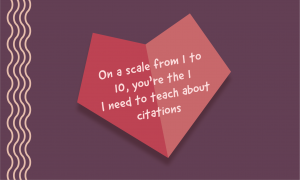
“On a scale from 1 to 10, you’re the 1 I need to teach about citations”

Siloam Yeung

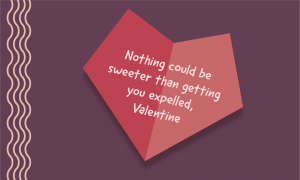
“Nothing could be sweeter than getting you expelled, Valentine”

Siloam Yeung

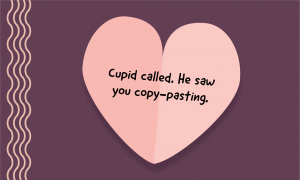
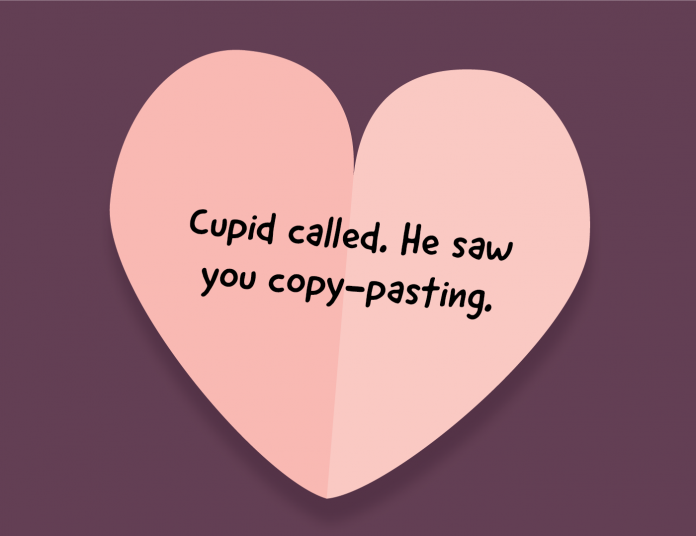
“Cupid called. He saw you copy-pasting.”

Siloam Yeung

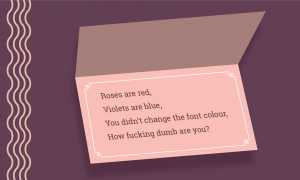
“Roses are red,

Violets are blue, 

You didn’t change the font colour, 

How fucking dumb are you?”

Your weekly SFU horoscopes: February 10–16

0
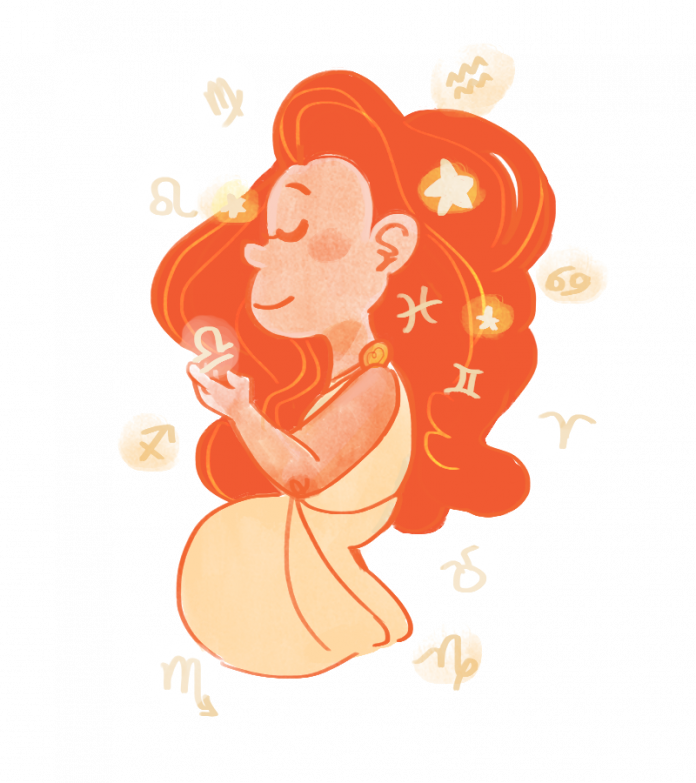
An illustration of a girl with long flowing hair. Astrological signs and stars shine around her.
ILLUSTRATION: Marissa Ouyang / The Peak

Aries — March 21–April 19

This week, tell your suitor that it’s French kisses or nothing — and you really do mean French kisses. If your date’s lips can’t whisper Jean de la Fontaine’s “Le corbeau et le renard” to you from memory, start to finish, then there’s just no future there.

Taurus — April 20–May 20

You can’t go wrong with a nice romantic seafood dinner this week. The tanked lobster at Superstore scuttling away from the cashier’s tongs loves you almost as much as you love him . . . or so agriculture has raised you to blindly believe. 

Gemini — May 21–June 20

You will spend this Valentine’s Day extremely unsatisfied. It’s hard when no one understands you like you do. As Sartre said, hell is other people — your best bet is to spend the night cuddling a big fluffy strain of coronavirus. 

Cancer — June 21–July 22

The one you love will get you very hot this week. And you’ll love it. Thank God you’re pining after someone who’s not afraid to rack up a heating bill on that thermostat in this death weather.

Leo — July 23–August 22

Beauty is your sword and shield this week. When a classmate raises their hand to steal your participation marks, cut them down with an alluring look and cut in with the exact correct answer to whatever question your instructor asked — or a super BS answer that will make people take pity on you and lull them into a false sense of security, your call. 

Virgo — August 23–September 22

You do many different kindnesses for your partners, but this week, you should consider letting them reciprocate. If anyone deserves to be sweetly serenaded in the middle of the night with “Turn Down for What,” it’s you and your martyrdom.

Libra — September 23–October 22

You and those close to you need to find a place to confess this week, where you can confess to the sinful nights you’ve all shared. Getting together via group chat to scour the embarrassing Instagram of that old classmate you all hate is just not something you do out of wedlock. 

Scorpio — October 23–November 21

You’re gonna rock someone’s whole world this week. They will never be the same when they find out you can pour classic and maple pecan syrup into coffee. 

Sagittarius — November 22–December 21

There’s no week like this week for you to do with yourself that thing you like with your persecution complex. 

Capricorn — December 22–January 19

Romance is exhausting. Spend this week in bed whenever you can manage it. Let your freshly laundered bedding and Godiva chocolates protect your virtue, constitute your vice, and imitate your valium.  

Aquarius — January 20–February 18

Punish yourself this week with whips. Cool Whip, Miracle Whip, Cheese Whip, and whatever other gross commercial brands you’ve been buying and then promptly shoving to the back of your family’s fridge to rot. Disgusting. 

Pisces — February 19–March 20

You are a pure innocent daffodil and you shouldn’t be reading The Peak. ~x~Drink water and transfer to Pigfarts~x~

QUIZ: What form of birth control are you?

0
Reproductive Health Supplies Coalition via Unsplash

From gutting public school sex education classes to threatening to decrease access to abortions, our sexual health is constantly being policed by the government. Let’s turn the lens back on the institution that’s put us in this position. Answer these bureaucratically afflicted questions to figure out to which federally controlled genetic roadblock you are intrinsically connected.

    1. Which do you consider the greatest political mistake?
      A) The assassination of Archduke Franz Ferdinand
      B) British Columbia’s confusingly worded 2018 electoral referendum ballot
      C) Napoleon Bonaparte’s decision to invade Russia during the winter of 1812
      D) Julius Caesar trusting way too many friends 
    2. How do you choose who to vote for?
      A) Whichever party gives me the most free swag on campus
      B) I do meticulous research, watch the debates, introspectively evaluate my beliefs, and then panic and vote for the party I’ve always voted for 
      C) I accidentally voted for the Libertarians because I thought that was the Latin spelling of Liberals
      D) Communist
    3. Which one of these men has been a Canadian prime minister?
      A) William Michael Brown
      B) Gregory Pincus
      C) Brian Mulroney
      D) None of the above
    4. Should the legal age to vote be lowered?
      A) Absolutely! The more people accessing the freedom of democracy, the better
      B) Absolutely not! The fate of a country’s political future is way too big a responsibility
      C) If a younger person wants a vote, they can just use my ballot — I almost never remember to go
      D) I don’t care. It’s not like our choices are that great anyway
    5. Will you commit high treason?
      A) Listen, I may have assisted an enemy state, but I was having so much fun at their house party
      B) Yeah, I’ve been planning on it for months, and now that Harry and Meghan are moving here, it’s never been easier
      C) Bro, smoking weed is legal now
      D) I could commit high treason . . . as a treat
    6. How did you find out about the 2019 Canadian federal election results?
      A) John Oliver didn’t do a segment on it, so I didn’t know it was happening
      B) The CBC
      C) I got drunk for the sole purpose of NOT finding out who won that night
      D) I literally haven’t processed the 2016 American election yet; you can’t expect me to keep track of Canada too
    7. Scariest political figure in Canada?
      A) Still Stephen Harper . . . always Stephen Harper
      B) Andrew Scheer
      C) Every individual with political alignments based on unexamined biases and dogmas
      D) The ghost of William Lyon Mackenzie King that haunts me all afternoon
    8. When will the government collapse?
      A) With my help, any day now
      B) I won’t let it collapse until we get our first elected female prime minister
      C) It’s going to naturally happen no matter what we do. I’m content to wait it out 
      D) The SFSS hasn’t collapsed yet?


If you got mostly As – Condom 

You’re unabashedly confident enough to be yourself at all times. You’ll talk to anyone, go anywhere, and are always down to make a quick joke to break tension. Unfortunately, your authentic self is so well socialized that you’ve gotten comfortable only ever putting in 80% effort into all activities. That missing 20% can have some seriously intense consequences if left unaccounted.

If you got mostly Bs – The Pill

While your ideal world would be filled with bullet journals, meal plans, and five-year goals, you’re distinctly aware that having every day mapped out is incredibly unsustainable. You know what you believe, even if you’re not entirely certain what the long-term ramifications of these beliefs will be. Thankfully, you’ve managed to strike a balance with the chaos of life, and for the time being, you’re committed to it. 

If you got mostly Cs – The Pull-Out Method

This should be a real wake-up call for you. 

You need to take some responsibility over your existence before your negligence starts a new one.  

If you got mostly Ds – Abstinence

You’re not just abstinent from sex — you’re abstinent from everything. There’s no freer spirit than the one who truly doesn’t give a fuck, staying out of everyone’s sordid business. The entire world might be ripping itself apart, but as long as no one drags you into their drama, you’re content not dragging anyone into yours. Well, besides the fact that you do have the ghost of Canada’s tenth prime minister to deal with. Ironic that the guy who talked to ghosts has become one.

The next step in women’s sexual freedom is access to free contraceptives

1
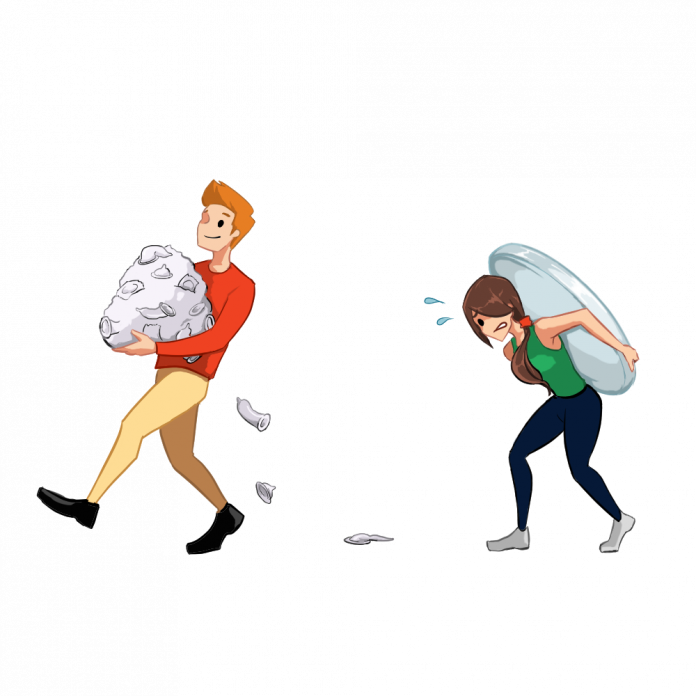
The most effective forms of birth control end up costing women much more than men. Illustration: Anthony Liao/The Peak

As someone who has had the experience of having my birth control switched up about seven times due to side effects, I’m well aware of the cost of prescription birth control. Each switch has increased the cost until it went from $20 to $80 per month. There is an egregious gender bias apparent in many aspects of consumerism, and sex is no exception. In order to enjoy safer sex, women and those with uteruses are unfairly tasked with the cost and responsibility of obtaining contraceptives, as well as having to deal with their side effects — from spotting to mood swings to depression. Men, comparatively, face none of these barriers. If women are going to be saddled with so much of the social burden of sex and family planning, then at the very least they need access to free birth control.

Currently, if women and people with uteruses want to use the most effective methods to prevent a pregnancy, then they require costly prescriptions that their male counterparts don’t. Take intrauterine devices (IUDs) for example. According to the Candian Paediatric Society, IUDs “are the most effective forms of birth control available and doctors should recommend them to adolescent girls before any other method.” They are, however, also the most expensive, with a cost of up to $380. While oral contraceptives on average are attainable at a lower cost up front, they are also subject to greater human administration error. If doctors are advocating for IUDs over oral contraceptives, these options need to be made financially feasible.

With the system we have now, the burden is on women to navigate the medical system, and in many cases, to shoulder the cost of contraceptives. Young women especially have to either come up with the money themselves, or rely on their parents’ health plans — something that requires giving up their privacy. Obtaining contraceptives tailored for men, on the other hand, is as easy as a trip to the grocery store for a pack of condoms. 

The likelihood of a male oral contraceptive coming our way anytime soon is incredibly low. Previous attempts to introduce the “male pill” have been unsuccessful due to concerns surrounding side effects such as acne and severe depression. Men just aren’t motivated to risk these side effects, especially since they’re not at risk of becoming pregnant themselves. Besides, they have access to condoms, which are already cheaply available, if not downright free. 

However, condoms have a higher risk than other contraceptives of not working, and don’t protect from external pressures to not use one. Women who aren’t able to afford more effective forms of contraceptives may then be forced to rely on condoms and their partners’ willingness to use them, increasing their risk of an unplanned pregnancy.  

During the time my doctor was experimenting with different oral contraceptives for me, I was privileged enough to have full-time employment and took advantage of extended health benefits. While I no longer have full-time employment, I still have the SFSS Health and Dental Plan which offers coverage for up to 80% for oral contraceptives. However, most youth, low-income, and marginalized people with a uterus do not have these options. 

In order to combat this, AccessBC, a grassroots campaign started by young activists based mainly in Victoria, is advocating for free contraceptives for everyone with uteruses. Their campaign seeks to decrease the number of unplanned pregnancies (experienced by 61% of Canadian women) by making prescription contraceptives free for all women and people with uteruses. The group notes that this will significantly decrease the number of annual unplanned pregnancies, and the associated financial burden this places on women. 

We currently occupy a privileged position of being able to attend post-secondary education (although it might not feel that way because of all the debt). Studies have shown that for women and people with uteruses, access to contraceptives hugely increases the ability to attend and remain in a post-secondary institution. If financial barriers to contraceptives are unfairly gendered, then isn’t the simple solution to remove them? As university students, shouldn’t we be trying to uplift everyone to our level, not letting sexist policies derail access to higher education, among other things? It’s time we all join AccessBC in their fight. Write to your MLAs today — free contraceptives should have been a thing yesterday!

Making room for asexual folk is more important than awkward representation

0
ILLUSTRATION: Maple Sutontasukkul/The Peak

I’m not going to lie: being asexual is like being the weird kid sitting in the back of the queer bus who gives a little too much intense eye contact and has an odd obsession with collecting bugs. We don’t quite fit in on the rainbow, which explains why our flag is predominently greyscale with a little bit of queer purple thrown in there like, “I don’t know, I guess?” 

And don’t get me wrong, it’s great to have a little niche place under the rainbow. But when you make your home within an umbrella identity defined by sexuality, and you yourself have none, occasionally the thought bubbles up: “Do I belong here? And if not here, then where?”

I know on the representation scale ace folk must be a pretty low priority — in no small part, I suspect, because allosexual people (those who experience sexual desire) don’t know what to do with us. Honestly, I don’t know what to do with me half the time, either. Personally, recognition is more important to me than representation. I don’t need to see myself clumsily represented on TV or in movies or books. What I need is to feel like I belong to something. That I have a place and a people.

I’m not going to use this space to comment on ace erasure or exclusion within the LGBTQ2+ community. Although I’m sure it exists out there, it has fortunately not been a part of my experience. My queer friends are some of the most accepting, loving, and generous people I know. I couldn’t ask for a better found-family than this one. So I’m not going to complain. What I’m going to do instead is express how gratifying it is when someone — anyone — actually notices and recognizes us ace folk. Because in a society that feels over-saturated in sex and sexuality, having no sexual attraction makes one start to feel invisible — and no one likes that feeling.

A lack of ace representation in media, specifically, representation that doesn’t border on the pathologic, is rare. How do you represent a lack of something in a casual and organic way? In particular, how do you represent a lack of sexual desire when so many of humanity’s staple plots revolve around the active quest for romance or sexual intimacy? It feels as though there is very little space in the modern media landscape for narratives that don’t make sexual desire a foundation for plots and characters.

I don’t have an easy answer for this. Even having a character casually drop, “Oh, yeah, I’m not attracted to anyone,” opens up the narrative doors to inspect, dissect, and overanalyse such a character as a supreme oddity in a context where sexuality is the norm. This creates the feeling that, even within the LGBTQ2+ community, being asexual is like being the queerest of the queer. 

In the end, I don’t mind listening to my friends talk about their latest Tinder adventure, or dish about a classmate who sits three rows up that they would just die to bump uglies with. I find sex to be a fascinating subject, even if I don’t feel attraction personally. But at the same time, I also get a little thrill of excitement whenever I hear someone mention asexuality positively — when someone remembers that we exist and makes the effort to talk to us as asexuals. 

I know that we don’t often make our voices heard on the queer bus, but know this: whenever anyone mentions asexuality kindly, they are making at least one weird asexual kid out there smile a little more brightly at their bug collection.


From dilDOs to dilDON’Ts: a look at Vancouver sex shops

8
Photo credit to Wikimedia Commons

A lot of fear goes into entering a sex shop, and I would know as a former sex shop virgin. Not once have I desired to venture into the depths of dildos and sex dolls. This week, however, I decided that the only way to combat this fear was to visit not just one, but FIVE stores all around Vancouver. And what better way to celebrate than by broadcasting my experiences to the world? That being said, here is a list of sex shops I’ve compiled from my wild sex shop adventure, ranking them from worst to best.

  1. Happy Paradise Adult Store | Hours: 10 p.m.–11 p.m. | 4713 Kingsway, Burnaby, BC

At the very bottom of my list is Happy Paradise. With a name that seems largely promising, I knew as soon as I walked in that this was NOT it. Right away, I was greeted by the distinct smell of cardboard boxes infused in sweat — a rather unpleasant scent to set the mood. Inside was a long hallway, with all of the items displayed along hooks on walls that were painted in an off-putting green colour. At first glance, it appeared as if the store had a wide range of items. Unfortunately, it might have just been the large stock of identical sex toys on display that gave off this illusion. 

Overall, their selection felt bland and unexciting, offering nothing more than your typical dildos and vibrators. Even their so-called BDSM (an acronym that commonly refers to: bondage and discipline, domination and submission, sadism and masochism) section left me uninspired from the limited mix of pink duct tape and basic ropes — things you could find at any hardware store. While the vintage adult films and playboy magazines were a nice touch, it wasn’t enough to compensate for the all-around basic experience.

  1. Fantasy Factory Adult | Hours: Open 24 hours | 1109 Royal Ave, New Westminster, BC

If you’ve ever taken the SkyTrain and passed by New Westminster, then you’ve definitely seen the brightly-lit neon signs and large placard displaying the words “Fantasy Factory.” As vibrant as it is from the outside, the same could be said inside. From the black-and-white checkered floors to the vivid fluorescent lighting, it’s hard not to spot every item and customer that walks into the shop. While this works well for more of a department store type of setting, I found that it worked to its disadvantage in this kind of atmosphere, especially when most people may prefer some privacy when browsing. As for the selection of products, nothing really stood out to me — at this point, I’d already been accustomed to seeing various sex toys from other stores, and in this one, there was nothing outside of the ordinary. I should note, however, that this store is open for 24 hours, which is an ultimate game changer.

  1. Male & Female Harmony | Hours: 10 p.m.–12 a.m. | 4554 Kingsway, Burnaby, BC

Just a block away from Happy Paradise is Male & Female Harmony, the slightly better option if you’re hoping to stay within the Kingsway area. Easily visible even from across the street, the storefront is painted in a bright yellow and has a neon-lit arrow sign that reads “Adult Store.” Branded as a sex shop inclusive of needs of both men and women, the shop had a wide array of dildos that came in various shapes and sizes, as well as an abundance of vibrators to choose from in different styles and colours. Aside from your traditional sex toys, they also offered inflatable sex dolls and plenty of BDSM-oriented products. I was particularly impressed by their fun bachelorette party items and sex-related card games — a section that I rarely found in the other sex shops. That being said, the only downside to the store was how cluttered and stiff it all felt. There were empty racks that were left in the middle of the store, which felt out of place. Some random cardboard boxes were also dispersed around the space, which made it slightly difficult to move around.

  1. Womyns’ Ware Inc. | Hours: 11 a.m.–6 p.m. | 896 Commercial Dr, Vancouver, BC

Now, I’m no avid goer of sex stores, but walking into this shop definitely had me thinking twice. It had an all-around wholesome atmosphere, as they had plants lining their wooden-paneled walls, giving off that cozy cabin vibe. Women-centric magazines and literature also decorated the space, which made for a unique yet visually pleasing aesthetic that I didn’t get from the other shops. As promised, they boasted a large collection of women’s sexual products, from bullet vibrators to remote-controlled sex toys. However, what made it even better was how they also had each product displayed outside of their packages for customers to see how they worked before committing to a final purchase. Overall, I found myself spending the most time in this store simply because it made me feel the most comfortable and relaxed — feelings that I never would have expected to have walking into a sex shop.

  1. Honey Gifts | Hours: 10 a.m.–7 p.m. | 350 Water St, Vancouver, BC

While Womyns’ Ware was a close call to being number one on my list, I’d have to say that Honey Gifts was the farthest from your typical sex shop experience in the best way possible, landing it at the top spot. Located in the heart of Gastown and doubling as a lingerie store, the storefront presents itself more as a cute and lavish little boutique. While other sex shops don’t spend too much time displaying their products with any intention, it was clear that Honey Gifts put extra effort in how they laid theirs out in order to induce a luxurious feel. Their BDSM pieces were enclosed in glass cases, making them look bold and expensive. Their dildos were also carefully propped up onto display tables, pairing them with other lingerie products that matched each item perfectly. From the friendly staff to Kings of Leon’s “Sex on Fire” playing in the background, Honey Gifts had all the right things going for it to give you the ultimate sexy shopping experience.

SFU textbooks shouldn’t be inaccurate about sex, sexuality, and gender

0
The misconceptions in this textbook were debunked in high school health class. Screenshot: Gabrielle McLaren/The Peak

I know that waiting until your last year to hit your Q/B-Sci requirements is the ultimate Arts-student crime, but I paid for it dearly by ending up in BPK140 C200: Contemporary Health Issues. I thought this online class would be easier to balance with my two summer jobs and relate to topics I cared about. I was wrong.

Every week the assigned reading, from a textbook written specifically for the class by professor Stephen Brown (an SFU alum), and published by SFU Publications, had me gawking in disbelief. For the purpose of this piece, let’s just look at some things that made me cringe from the chapters about sex, sexual health, and intimacy. 

  1. On page 262, the textbook claims that the diaphragm protects against sexually transmitted illnesses (STIs). This is something that a quick confirmation check in an all-uterus-bearer group chat and a trip to Planned Parenthood’s website confirmed as incorrect.
  2. A list of “Variations in Sexual Behaviour” that starts on page 219 lumps together rape, sex with children, masturbation, oral sex, anal intercourse, and homosexuality. I had to take a break when I saw this. Brown acknowledges that homosexuality used to be legally persecuted, but doesn’t see the problem with listing queerness alongside “rape” and “sex with children”? Not differentiating between healthy sex and criminal sexual behaviour, especially when a marganialized community is thrown in the mix, is tone deaf, foolish, and unacceptable. 
  3. While I’m at it, Brown has no business discussing the biological determinism of queer desire and linking “low blood levels of testosterone and other male hormones” to gay men’s development. Studies looking for a “gay gene” have faced significant criticism as early as 1995, and the politics surrounding them are too crucial to ommit. Plus, at surface level, why would you just drop in a textbook that gay men are gay because they’re less manly than other men? Come on. Think of the top five existing prejudices against gay men and tell me why you’re reinforcing this without providing appropriate context.
  4. As you can probably tell, the book was the most cisheteronormative thing I’ve seen since Catholic school. The in-depth discussion of the mechanics of penis-vagina sex has no queer equivalent. Asexuality is never addressed as a normal, healthy sexuality. Even language such as “female condom” instead of the inclusive (and frankly more accurate) “internal condom” constantly flags to students whose sexuality is cared about most.
  5. Pages 263 to 265 are dedicated to showing how to respond to a partner who doesn’t want to use protection. The catch? The person giving excuses was always “Your Boyfriend,” implying the “You” to be a woman. The implication here is that safer sex is a heterosexual affair and a woman’s responsibility, especially since the text finishes with: “If your partner refuses to wear a latex condom, you use a female condom. Some men have said that sensation is not so reduced with a female condom.” 

This isn’t a comprehensive list. We literally don’t have space and I’m not strong enough to relive that class. I haven’t even touched on how uncomfortable I was with the chapters on mental health or substance use. Additionally, someone from the Gender, Sexuality, and Women’s Studies department should have helped write the chapters about pornography, sex work, and abortion.

I understand this class is designed as a survey, but that simply can’t be an excuse for presenting simplistic, incomplete, or dated information to a university-level class. This class is the poster child for all those pesky claims that science can’t function without its social equivalent. I was anxious about having to repeat some of this content on an exam, for my GPA’s sake, knowing that it was wrong, incomplete, or problematic. As a queer woman with strong politics and outside knowledge, I worried about the first years who would trustingly internalize this class’ implicit messages. 

I have no idea who oversees the content, tone, and quality of online classes and how or why they possibly let this happen. All evidence points to this class being spat out, packaged, and distributed to students for $192.03 a credit without a second thought.  This class wasn’t boring or difficult — it was inaccurate and disrespectful. It needs to be pulled from course offerings and reworked; right now, it reflects poorly on CODE, BPK, and SFU as a whole. 


Menstruators just wanna have fun, even during that time of the month

0
Don’t knock it until you’ve tried it. Illustration: Marissa Ouyang/The Peak

Saying the words “period sex” is like opening up Pandora’s box. It’s bad enough having a woman openly talk about a healthy and normal bodily function — throw the desire for sexual pleasure into the mix and it’s like an invitation for the world to go berserk. But what really is the big deal when it comes to period sex? We shouldn’t be perpetuating stigmas surrounding women who bleed, especially when sex during a period actually has some benefits.

Studies on the health of menstruating women show that having sex during periods can help relieve menstrual cramps and headaches. It could also cause them to have shorter periods. This is the ultimate bonus considering periods can be painful and unavoidable for many women. Why not flip a difficult, inescapable time of the month on its head and make it something pleasurable? 

Of course, these advantages are not exclusive to the biological female body. For all parties, having period sex can actually increase the overall sexual experience. Menses acting as a natural lubricant can make for a rather smooth and easy-going session. At the same time, most biological women’s sex drives reach an ultimate high at this time, intensifying the crave and energy to really get it on. 

So if period sex is safe and may even have some added benefits, why is it that people are still so quick to dismiss it?

The problem boils down to how periods have historically been framed as wrong — and therefore shameful — in nature. Stigma over period blood is ingrained in our history, from the Ancient Romans who thought that women who menstruate were actually dark witches, to the French who believed that monster babies would be born out of those who consummate while on their period. 

While these ludicrous myths may long be forgotten (or at least, I’d hope so), notions of shame and embarrassment surrounding menses continue to linger to the present day. Further complicating the open enjoyment of period sex is the fact that women are also reprimanded for openly expressing their desire for sexual pleasure. While men are free to do so — and are sometimes even praised for it — women instead experience backlash for asserting such a natural bodily instinct, and are deemed as lewd and unladylike. 

Perhaps the true biggest downside to period sex is how messy it can get — easily leaving a bedroom looking like a bloody crime scene. Even I — as an advocate for this forbidden act — would not want that. However, there are plenty of ways to get around this issue. Placing a towel onto the bed is a small price to pay for the amount of bloody pleasure that can be had between partners. And if that’s not sanitary enough, shower sex is also an option — just clean yourself up as you go.

The second most common argument against period sex after “it’s messy” is usually that it’s “unsafe.” This is a complete misconception. But don’t just take my word for it; Healthline confirms that there is actually nothing wrong with getting it on during this period of time (pun intended). 

Of course, period sex is not for everyone. If someone generally gets squeamish from seeing blood, then by all means, they should stay away from this activity. However, shaming women for wanting to exercise their right to sexual pleasure — at any time of the month — is inexcusable. At the end of the day, period sex is completely healthy and normal, just like any other form of consenting sexual expression.


Gendered washrooms are redundant for our needs

0
There’s is no reason for washrooms to not be gender neutral. Photo: Izaz Zubayer/The Peak

Imagine this: you’re walking in the AQ after a long, boring class. Suddenly, you’re hit with the urge to relieve yourself. You scan your surroundings, desperately hoping to spot one of those little square signs with a tiny person on it, indicating your renal freedom. You finally catch sight of one, but it’s designated for a different gender. You curse the gender-binary and its restrictions on your bladder before waddling off to find the toilet symbol that best fits your unique body.

Situations like these emphasize the need to abolish gendered washrooms, especially when gender does not play a factor in one’s ability to use toilet facilities. Gender, to be clear, is the set of attributes associated with one’s appearance that are expressed socially and culturally — through clothing for example. In contrast, sex is defined by biological charactersitics. Neither sex nor gender have clear-cut binary definitions, and both male and female washrooms currently have toilet stalls which can accommodate a range of genitalia. So why do we have separate rooms for peeing?

There are so many advantages to having non-gendered washrooms over gender-divided ones. It would be wholly inclusive of transgender and non-binary people. People who don’t fit into traditional social categories should have the right to pee without fear of dysphoria, ridicule, or the pressure to decide which of two categories they best fit into on any given day. It would also dispel the stigma around gendered washrooms and their intended users. 

Students would also not have to pause their hallway gossip sessions, because their differently-gendered friends would be able to go into the washroom with them. In addition, cleaning staff would be able to shut down entire washrooms to clean while leaving another one open nearby and free for all students to find relief. 

The popular argument against gender-neutral washrooms is that men would be able to spy on or otherwise victimize women more easily if the binary isn’t strictly enforced. And while creepy behaviour is a valid concern, what’s to stop people of any gender presentation from doing that now? It’s not like there’s a physical barrier that stops men from entering women’s washrooms. This argument only serves to hold up gendered barriers and perceptions of false difference.

To those who may still be really skeptical about this idea, imagine having two times the places to do a #2; two times the number of stalls during after-class rushes; two times the accessible stalls for the people who actually need them. Best of all, no out-the-door lineups for the women’s washroom.

SFU currently has a few gender-neutral washrooms scattered around the Burnaby and Vancouver campuses, but they’re tucked away in hidden hallways and only known by word-of-mouth or accidental discovery. It’s time to expand our gender-neutral washroom options at SFU and beyond. There are people everywhere who just need to pee. We shouldn’t let dated social systems police our right to relive ourselves in a comfortable and category-free environment. When nature calls, a gender-neutral washroom should be the answer.