Home Blog Page 439

The Dead Poets Reading Series offers an alternative to your traditional in-person poetry reading

0
Couresty of The Dead Poets Reading Series

by Isabella Wang, Mahtab Kundan, and Claudya Leclerc

If you look anywhere on the news, very likely, the top stories these days are about COVID-19 — how the government and World Health Organization are both working to raise effective methods of overseeing the pandemic. However, the students of World Literature 105 — Isabella Wang, Mahtab Kundan, and Claudya Leclerc — are taking an alternative approach by addressing the worldwide community of writers, poets, literary teachers and professors, and in turn, fostering a sense of community through the online Dead Poets Reading Series. 

The Dead Poets Reading Series is a bi-monthly reading series in partnership with the Vancouver Public Library, where at each event, four local poets are invited to read and speak about the works of a dead poet. Sharron Proulx-Turner, Wallace Stevens, Maya Angelou, and Rainer Maria Rilke are just some of the dead poets that have appeared in the past. 

Unfortunately, due to the recent COVID-19 outbreak, the reading event for March had to be cancelled in order to protect the safety and well-being of the series’s readers, organizers, and audience members. This event was not the only one to suffer. Across Canada, book launches and literary festivals, including two of Vancouver’s largest annual festivals, The Growing Room Literary Festival and Verses Fest, were all cancelled. These circumstances resulted in huge economic repercussions for the community of non-profit literary organizations and artists alike. It has also created a void where writers are numb by the feeling of not being able to socialize or contribute to the normally vibrant environs of literary production and community building.

All in-person gatherings seem to have been postponed indefinitely, but that doesn’t mean that poetry cannot continue. In order to bridge the community and bring the Dead Poets Reading Series to an audience at home, Isabella (who is one of the coordinators of the series) started reaching out to writers over social media, asking them if they would be interested in recording a video of themselves sharing the works of a dead poet. In under three days, she received over 100 responses, from poets not just across Canada, but internationally. Together with Mahtab and Claudya, they are working to bring a multilingual dimension to the series as well. 

Traditionally, the Dead Poets Reading Series has always encouraged bilingual or multilingual readings. For instance, in the summer of 2019 poet Benjamin Hertwig read the works of Rilke in both German and the English translation. In many more instances, poets have shared the works of a dead poet in translation, where the original source text is not in English, but in Japanese, Korea, Mandarin, and more. 

Nevertheless, being a local reading series means that they are limited in terms of their audience members and readers. To be present at the VPL event, after all, one has to be situated in Vancouver. The online series, in turn, has allowed for the collapsing of geographical borders and limitations. To this extent, the virtual realm of internet sharing has opened up the series and its capacity to reach audiences and readers in an ever-widening horizon. 

A poet residing elsewhere in Canada, no longer has to make the expedition to Vancouver in order to take part in the series. Likewise, when poet, writer, and translator, Sandile Ngidi, sent over a video of himself reading the works of Benedict Wallet Vilakazi in Zulu, on WhatsApp from South Africa, it seemed as if social distancing and technology had brought a small gathering of the world’s poets closer than ever before. 

For the World Literature students, it is inspiring to see folks engaging with the idea of multilingualism, and embracing their own diverse linguistic and cultural backgrounds in the process of finding creative ways to give an online, literary reading. Many poets who are proficient in more than one language, asked if they could read a poem in Farsi or Mandarin, and to share their own translations of that poem. As well, there have been poets from Brazil and Syria, who wanted to share a poem but did not feel comfortable reading poetry in English, but loved poetry in Portugese, Russian, or Arabic, etc. They were encouraged to share a reading that is purely in their mother tongues. 

Additionally on the channel, there has been a reading by Iranian-born, Toronto-based poet, Khashayar Mohammadi, who read his original translation of Ahmad Shamlu’s “The Crimson Bloom Of A Shirt” from Farsi into English. The World Literature students, in turn, provided Farsi subtitles so that speakers of both Farsi and English can appreciate the ingenuity of Mohammadi’s translations, in concert to the beauty of the original source text. Other readings, such as Toronto poet, Jack Osadebamwen’s upcoming reading Francesco Petrarca & Dante Alighieri in Italian, are bilingual, with the reader code switching between their paratext–introduction to the reading–and the actual reading of the poem in another language itself. Meanwhile, Nanjing-born poet, Emily Lu, read a montage Li Qingzhao’s “die lian hua” in both Mandarin and her original translation, as well as two English translations of Julio Cortázar’s poetry, with their source text in Spanish. 

In an attempt to make the videos as accessible and clear as possible to both language learners, native language speakers, as well as viewers with hearing impairments Isabella, Mahtab, and Claudya are working to provide subtitles in the appropriate language, where suitable. For instance, anyone can follow along to the Italian subtitles of Osadebamwen’s reading, while an English translation will only be provided for one of Petrarca’s sonnets. Likewise, there will be Mandarin subtitles to go with Lu’s reading in Mandarin, followed by the English, while a contrapuntal streaming of both Spanish and English will be available, with line breaks, for Cortázar’s poems. Finally, as speakers of Punjabi and French respectively, Mahtab and Claudya will both contribute a bilingual reading of a poet in their mother tongues.

This initiative was in part, led by professors, Dr. Melek Ortabasi and Joel Heng-Hartse from World Literature 105, a course taught on translations. The class encourages students to explore their identity through the languages they speak, and in turn, has shifted the students’ perspectives, strengthened their views on language mixing, and pushed their creativity when thinking about world languages. 

For many students, such as Claudya herself, their views and perspectives on the usage of language was very limited. As she writes, “I grew up as a bilingual young woman, always enjoying language mixing whilst talking with my other bilingual friends and family but I never knew it was acceptable to do so. Whenever I would try an audacious creative essay and attempted to include language mixing, my feedback would be deconstructive. It came to a point where I felt that it was wrong to mix languages, that it lessened my right to be a native speaker and for that I felt as if the system’s views portrayed me as a stranger from my own native tongue… I challenge the educators to change their narrative, to think about the intersectionality of language and finally, to reflect on how they treat plural-ingual speakers in their classrooms. As one may be tricked into underestimating their intelligence, adaptability and skill.” 

Mahtab shares a similar perspective, struck by the fact that language mixing was being made acceptable in a university setting. Being able to communicate in all three languages, English, French, and Punjabi, she grew up mixing English and Punjabi when she spoke to family, and English and French to her friends; yet, as she says, “it was ingrained in me to never do this in the “outside world”.’

Thus, upon being asked to conduct a community project — one that activates a mode of translations to a community setting, the students of World Literature 105 were able to apply what they have learned in class to a timely event. As Isabella adds, “For five semesters, World Literature has taught me enough about the way that language structures peoples and the world’s power dynamics to make me want to reach beyond just a purely English-speaking setting. I wanted to create something that  responds to the community at a time of need, and in a way that represents the plurality of languages and the cross-cultural perspectives that we have in our community right here. I didn’t have to look for it. It’s the people who made this happen.” 

Within a week, the series has attracted the attention of prominent news media outlets, such as  the Vancouver Sun, The Tyee, and The North to Northwest with the CBC. The series features one new video reading a day, and with over 50 video submissions and more coming in, the spots are filled to the end of April. Who knows? By then, World Literature 105 will have concluded, but the students are hopeful that at this rate, the poetry might just outlast the virus.

Readings take place from 3 – 5 p.m. on the second Sunday of every odd-numbered month (i.e. January, March, May, etc.), and are run out of the Vancouver Library’s Central Branch (Alice McKay Room) in Downtown, Vancouver. 

5 Britney Spears Bops That Were All About Class Consciousness, All Along

0
Photo courtesy of Chief Warrant Officer 4 Seth Rossman via Wikimedia Commons.

By: Zach Siddiqui, Humour Editor

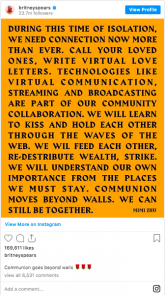
Ever since Britney Spears’ iconic post about wealth redistribution went viral on Twitter, long-time fans have been scouring her past music like The Da Vinci Code looking to retroactively uphold their idol’s woke honour. 

Luckily for you, we at The Peak have done the work for you! Ready to tear down a politicized economy from the comfort of your own home? Do it to the tune of these historic bops.

Toxic

Britney whispers, “A guy like you/should wear a warning,” and we all know who she’s talking about: a guy named Canada. That’s right: she’s making social commentary on the continued patriarchy of this country and our failure to warn outsiders that inequality does exist here. “With a taste of a poison paradise” is an apocryphal malaise of a future where Canada “guarantees economic stability” with pipelines, tank farms, and a second-rate oil sands industry. 

“You’re toxic/I’m slippin’ under,” Britney ultimately belts as she drowns in the rushing flow of what used to be the Arctic Circle.

Gimme More

So enraptured were we with “It’s Britney, bitch” that we all missed the real point of the song: sustainable public transport. When Britney sings, “Every time they turn the lights down/Just want to go that extra mile for you,” she’s obviously talking about switching to the bus for that last mile to the grocery store, once the sun is blotted out by CO2 emissions from the corporate world. And that refrain of “Gimme more”? She means she wants more electric vehicle infrastructure. 

“. . . Baby One More Time

In this iconic song, Britney once again tapped into her inner Delphic oracle to talk about representations of romance and social relations in media. “Oh baby, baby, how was I supposed to know/That something wasn’t right here?” is a dramatic re-enactment of how Grey’s Anatomy showrunner Shonda Rhimes probably felt after stepping back to let others take over the writing. “I never should have let you go” refers to what we like to imagine Rhimes felt after seeing Krista Vernoff force us through 1000 Grey’s Anatomy/Station 19 crossovers.

Conversely, “Boy you got me blinded” comes from the perspective of the fans. Many of them have been blindfolded by Derek Shepherd’s hair for years, never noticing that he basically workplace-harassed Meredith into dating him, repeatedly. Yikes!

Oops! I Did It Again

Here, Britney makes a scathing critique of food service middle-management. “I made you believe we’re more than just friends” highlights the common practice of squeezing extra labour from low-income employees — by promising promotions that just never materialize! Her refrain of “Oops! I did it again” caricatures the words silently spoken by franchise coffee shop managers, repeated every time they fire someone and guzzle up their last two weeks’ tips. 

“I’m not that innocent,” she concludes over and over, proving that shift-leaders everywhere know and relish their own darkness.

Piece of Me

If the other songs were critical, then “Piece of Me” is Britney’s Utopian vision. Becoming the avatar of the 1% — “Miss American Dream, Mrs Lifestyles of the rich and famous,” Britney asks the public again and again if they would like “a piece of [her].” Does she mean a piece of her net worth for the bank, or a piece of the rich’s flesh to be eaten like blueberry pie? We might never be sure, left in a longing mystery.

An open letter to the Forum Chamber musicians

0
Photo: Flickr

By: Gabrielle McLaren, Peak Associate

Dear Forum Chamber musicians, 

You’ve never met me and I’ve never met you, but I’m familiar with your work. See, The Peak’s office is located right next to Forum Chambers and over my four years at SFU I’ve spent quite a bit of time there — working, studying, slacking off, writing, fuming, pondering, conducting interviews . . . and because of that, the rotating cast of Forum Chambers musicians has been a constant of my degree. 

I’ve heard some of you guys sneak in early morning practices, squeeze in songs between classes, and stick around campus late at night to take advantage of the piano in the room. I’ve heard Korean drumming, acapella rehearsals, “Flight of the Bumblebee,” the theme songs to your favourite anime, Disney tunes, Christmas carols, K-Pop, classical symphonies and odes, pop music covers, and more. I’m sure some of you wrote your own songs that I just didn’t recognize as brand new additions to the music world, too. Sometimes, it was the same song over and over again as a musician tried to get the melody just right; other times, I’d overhear someone soar through ballads as if it was as easy as breathing in and out. 

On a campus where we always talk about a lack of student connection and a lack of student support, you saw a space that could be filled with creativity, talent, passion, and hard work. Like I said, you’ve never met me and I’ve never met you, but hearing you fill campus with just a little bit more art has made me feel more in touch with the community I’m in. I can only remember one late Friday production night in which I didn’t hear anybody play, and it was uncanny. I got annoyed whenever construction drowned out your work or made Forum Chambers impracticable. While social distancing and working from home, the quiet has definitely been one of the strangest adjustments to make and get used to. 

I’m on my way out now, as finals and convocation approaches. That also means that I’ll be turning in my office key after three years. I’m going to miss a lot of things after leaving SFU, even if that was the goal all along and I’ve often said that I couldn’t wait, and strangely enough you guys are one of them. And so before I went, I did want to say thank you for the music.


Best,

Gab

Add CANADALAND’s accessible and entertaining media criticism and news beats to your podcasting diet

0
Courtesy of CANADALAND Facebook

by Gabrielle McLaren, Peak Associate

Hear me out: CANADALAND is a podcast about Canadian politics, current affairs, news, and media. 

Wait, no, don’t leave, come back! It’s good, I promise. You don’t have to hate it just because it’s Canadian-centric. You know why? CANADALAND . . . kind of also hates Canada . . . 

Well, “hate” is a strong word. But Canadaland minces no words about the failures of our patriarchal, heterocentric settler colonial state and its aftertaste of expired mayonnaise. Take, as a recent example, Episode #251: Heard it Through the Pipeline — which saw host Jesse Brown and guest Rick Harp (an Indigenous journalist and co-founder of Media Indigena) tear apart media coverage on the blockades and protest.  

“Last week, the title for our Short Cuts episode was ‘Wet’suwet’en coverage is still pretty bad,’ I don’t know if we should use that as the running title of this show every week [ . . . ] or update it to ‘Wetsuwet’en coverage is now explicitly shitty,’” Brown says to his guest’s amusement to start the show. 

This sums up CANADALAND for me: critical, straightforward, entertaining, and continuously diligent with its stories. Where media criticism can often end up sounding bulky or tiring when Foucault is inexplicably pulled as a theoretical crunch, CANADALAND gives you the tools to understand what they’re talking about as they talk about it. If your current thesis or string of assignments has shanked your ability to read the news as thoroughly and diversely as you would like, this podcast is definitely for you. 

If daily news coverage isn’t your thing, CANADALAND has also adapted long-form journalism and writing to an audio format in my favourite way. Check out the five-part series Thunder Bay (on the city’s broken justice system and high murder rates) or Cool Mules (a new series “investigating the cocaine-smuggling ring inside Vice Media,” because why wouldn’t Vice Media have had a cocaine-smuggling ring?). 

Courtesy of CANADALAND Facebook

CANADALAND shouldn’t replace your own critical readings, but it does a good job at picking pieces from various national and international media to share, promote, or criticize. The ‘Duly Noted’ segment allows hosts to bring attention to news stories that the hosts feel are underrepresented. In the brilliantly named Episode #253 Panic! At The Discoronavirus, Brown duly noted a conflict of interest in a CBC documentary’s production while guest Garth Mullins criticized the brutally flawed methodology of a report looking into safe injection sites in Alberta. 

Mullins’ voice on air gives me an opportunity to highlight another strength of CANADALAND’s, which is its rotation of guest speakers. Brown’s media criticism background makes him a good, consistent presence on the show but CANADALAND’s guest speakers allow for the show to practise what preaches — diversity in media. Mullins, whose pinned Tweet identifies his experience with “drug user journalism,” was uniquely placed to point out how COVID-19 especially and differently affected those affected by the overdose crisis. Meanwhile, in Episode #252, audience members got to hear firsthand about Anita Li’s experience as co-founder of Canadian Journalists of Colour and media professor. 

My entire nerd brand was absolutely shattered as a result of how profoundly I’ve been sleeping on listening to CANADALAND. Seriously, where did all this melatonin come from? Don’t be like me kids, subscribe today.

Indoor climate control measures at SFU need an overhaul

0
Walking from one hall to another is like teleporting through climate zones. Illustration: Tiffany Chan/The Peak

By: Connor Stephenson, Peak Associate

Why is it that people feel the need to travel to the sands of the Sahara or the glaciers of Antarctica for a change in climate, when they could save themselves the arduous journey and visit our campus here in Burnaby? Walking into a classroom at SFU is like opening a box of chocolates, you never know what you’re gonna get. It seems as though, from building to building and classroom to classroom, there are significant variations in temperature that make for an uncomfortable experience on campus. This leads to windows being opened and space heaters being summoned, and an unnecessary amount of energy wasted. 

This huge range of temperature differences between classrooms is concerning since SFU has as one of its goals the conservation of energy — specifically with a target to reduce total emissions by 2% from year to year. To be clear, SFU has taken measures to address its impact on the climate. These include replacing halogen bulbs with LEDs to reduce the need for climate control devices, and installing carbon dioxide sensors in some classrooms that adjust the climate based on the presence of large numbers of students, according to Bernard Chan, Energy Manager. However, given that many classrooms still feel inhospitably intemperate, the issue of classroom temperatures versus climate impact seems to be presented as a false dichotomy; i.e. SFU can either reduce emissions or students can learn comfortably. In reality it is not unreasonable to ask for both. 

The automation of climate control in classrooms — even with the best carbon emission intentions — just isn’t working. Walking into any classroom that has its windows open to release some of the stifling heat proves that. By just keeping rooms a consistent, comfortable temperature, or allowing people to adjust temperatures on their own, the university could save all that energy which is currently being vented out the windows.

Chan states that SFU’s classroom temperatures are set based upon a “central control system.” This system is adjusted through “a preventive maintenance program” that “requires space temperatures to be checked diligently and regularly.” In addition, he also recommends that “students and staff [ . . . ] report temperature issues to [the] Facilities and Services desk.” This will then prompt a member of the Facilities Services team to “first check the temperature to see if it is meeting the target settings” before any adjustments are made. 

The obvious flaw in this system is that information regarding the need for students and staff to report inconsistent temperatures is poorly disseminated in classrooms around campus, let alone information on who to call at what number. This entirely nullifies the reporting aspect of the classroom climate control strategy. 

Furthermore, the “diligence” of the maintenance program itself could be called into question considering the magnitude of temperature variations felt by students. All of this culminates in students and staff looking for alternative strategies for regaining control of classroom climates  — such as keeping windows open, bundling in too many layers, or furnishing offices with space heaters This opens the door to an incredible amount of wasted energy, as well as wasted time.  

We are quick to call out politicians when we feel they are not making the best decisions in terms of climate action. As climate concerned students, we should also hold SFU accountable for the ways it needlessly wastes energy on inefficient classroom climate control systems. If the university is serious about mitigating the effects of climate change, it should look to better integrate students and staff in addressing the sweltingeringly warm and numbingly cold classroom environments.


Dr. Paul Budra gives a fascinating talk on The Shakespeare Conspiracy

0
His talk is part of the ongoing President's Faculty Lecture Series. Courtesy of SFU Public Square

by Lubaba Mahmud, Staff Writer

Sometimes I wish that I were an English major, which is what I thought I would be back in middle school. Attending Dr. Paul Budra’s talk titled The Shakespeare Conspiracy gave me a small glimpse of what that would have been like. He carries a contagious enthusiasm, and his ability to connect with the audience through humor made for a delightful evening at the Shadbolt Centre for the Arts.

Dr. Budra specializes in Shakespeare and early modern literature, and he is an English professor at SFU. In his talk, he discussed how Shakespeare has been the subject of many conspiracy theories, and he argued that such theories provide valuable insight into the “modern conspiratorial imagination.”

He started the talk by saying, “It’s very Shakespearean of you to be here during a plague year.”

A professor with a dark sense of humour? I’m sold. 

Dr. Budra then went on to analyse, and perhaps debunk to an extent, the conspiracy theories about Shakespeare. One particularly interesting example involved Thomas Looney, and yes, he did pause over this surname. Dr. Budra explained that Looney did not find any historical facts that could prove his theory that Shakespeare of Stratford-upon-Avon was not the real writer of his plays. So he wrote down a list of attributes that he thought the real Shakespeare must have had, and then proceeded to look into history to match that made-up description. Looney argued that the plays and poems are “disguised autobiography.” Dr. Budra explained that this illustrated the classic strategy of allegory that conspiracy theorists used, such that “the received narrative points to the real underlying narrative that they, as expert critics, see.”

Further, he argues that conspiracy theorists are reductionists. “They reduce Shakespeare’s writing to a puzzle, they solve it, turning it into an Agatha Christie novel, revealing the hidden clues and shouting ‘Aha! Got you!’” as he eloquently put it.

He states that conspiracy theorists “flatten out reality and impose upon it a simplistic moral rhetoric.” But that’s not the way to be. Because, ultimately,  “Great literature, great art like Shakespeare is important because it continually makes us imagine imagine another time, imagine another culture, imagine understanding reality in a different way, it tricks us into imaging what it must be like to be the other. And that’s our Shakespeare conspiracy.”

Mic drop.

If you missed the lecture on March 10 you can watch the whole thing online at the SFU Public Square YouTube Page

Political Corner: Heralding frontline nurses for working while pregnant hides systemic labour abuses in China

0
Extreme working conditions and shaved heads among female nurses are being propagandized by Chinese state media. Photo: /Gansu Daily

By: Tianyi Wang, Graduate Student

The World Health Organization declared that coronavirus was a global pandemic as of March 11. In addition to the increasing number of cases of viral infection, many social issues have been exposed during this extraordinary time that are also worthy of attention — particularly those involving the work of frontline women.

As the first country to find and take action to control the novel coronavirus, China has received the most attention from the world on the pandemic issue. Among all the media reports about COVID-19 in China, those that praise the sacrifices of female nurses have been particularly criticized as a form of propaganda. For example, one nurse was reported to be nine months pregnant but still working, another  returned to work just ten days after a miscarriage. These reports, as well as others showing nurses “sacrificing” (cutting) their hair before going to work on the frontlines, take advantage of the labour situation of many women in China, and humiliate medical staff based on their gender. 

Propaganda is nothing new for stories in Chinese media. But what prompted the recent wave of criticism is that the sacrifices of the nurses are being propagandized as heroic efforts. In reality, their labour rights have never been acknowledged. Going to work while pregnant or medically compromised is expected as normal for many women in China.

Reporting the story of a woman who is still working hard just before giving birth is not illustrating a single heroic act that is worthy of praise, but rather is exploiting the everyday economic situation of these women in an unprecedented and stressful situation. Unfortunately, this kind of exploitation is quite common in China. Many young women are discriminated against because of the possibility of future pregnancy. About one-third of Chinese women report having lower wages or being demoted after giving birth. For new mothers it is even harder to find a job if she is fired or leaves her current employment. As a result, most women will still work dangerously hard during their pregnancy, not because they are born with the spirit of “dedication” but because they are afraid to lose their jobs. 

Although it is a good thing to care about the state of female medical workers in China during the fight against this pandemic, it is just as important to continue to practice such concern when our lives return to normal. This applies not only to the context of China; protecting women’s labour rights should be a common goal for the whole world. Women have contributed a lot of important work in the global market. However, this work is often  degraded as unskilled, and many of their basic rights and benefits (such as minimum wages, reasonable rest periods, and even personal safety, etc.), cannot be guaranteed.

As SFU students, no matter where we come from, we all need to be aware of and care for women in the workplace, speaking out for them, and taking action to protect them. Because every woman we love — our friends, our family, or even ourselves — may face similar struggles when going to work. When we help other women in the world, we help everyone.


Feel Good Hour: People are helping each other through COVID-19 and we should celebrate that

0
We're all in this together. Photo: Branimir Balogović/Unsplash

By: Madeleine Chan, Staff Writer

Look, I know our current situation seems grim. A global pandemic isn’t something that we should be happy about. But we also shouldn’t be blind to the kindness and compassion sprouting from these difficult circumstances. They have the ability to lift us up when we need it the most. 

Social media is ripe with examples of the generosity of the human spirit. Take my neighbourhood’s Facebook group (yes, they somehow still exist). What is usually a page where middle-aged, nuclear-family parents complain about how “the homeless are taking over” is now a space where communal help is found in spades. People in the group are making themselves available to go out and get supplies for older or immunocompromised folks, for example.

This selfless behaviour is not just relegated to our corner of the world, either. I’ve seen countless videos of people lightening the mood in quarantine by singing and playing instruments from their balconies, restaurants giving away free food, and even breweries around the world taking the time to help alleviate the hand sanitizer shortage. This trend of “caremongering”  — organized acts of kindness and generosity — is almost as infectious as the actual virus. Dispelling fear and bringing people together through the power of compassion is something that is sorely needed right now to focus and to break through the existential panic of the pandemic. 

Sure, there are also people who’ve had not so great reactions to this crisis — people like toilet paper hoarders and resellers, ignorant, rich celebrities, and people going outside acting like nothing is happening. But these people are a small blip in the population. The majority of people are finding ways to connect and care for one another in seemingly impossible conditions. It’s almost as if humans aren’t as inherently horrible as we think. Like we’re beings who want to help each other, to care, and to love one another. Who would have thought?

I hope these words give you some comfort in these uncertain times, and that you and your families are safe. As the 2008 graduating class of Albuquerque High once said, “We’re all in this together,” and once people recognize and embrace this wholesome and connective fact, then our time indoors will surely seem a bit less lonely.


How SFU and representatives of the disability community came together to improve the Re-use for Good initiative

0
Photo: Chris Ho / The Peak

Written by: Paige Riding, News Writer

In the Fall 2019 semester, SFU rolled out the Re-use for Good initiative across its three campuses. The initiative focuses on reducing single-use plastics in various areas, including dining locations and the SFU Bookstore. Its ultimate goal is “To implement and promote reusable alternatives to single-use plastics and disposable products (SUPPs),” according to their website. The Peak previously covered this initiative in the fall. 

As stated in previous coverage,  although a representative of SFU’s Sustainability Office advised that those requesting straws and other tools do not have to justify their requests, some students scrutinized this approach. They questioned whether these plastic products are truly accessible if they must be requested rather than just being readily available. Secondly, they asked how students with disabilities could be involved in the decision-making, to avoid unknowingly harming or segregating those who depend on these products for their daily lives. Since the fall semester, there have been changes made to the approach of the Reuse for Good campaign.


Single-Use Plastics around Canada

Under the Canadian Environmental Protection Act, the Government of Canada is seeking to ban “harmful single-use plastics” by 2021. According to the Prime Minister’s website, the Act will work to ban single-use plastics that are considered detrimental to the overall health of the human population and the environment. The page mentions that all plastic bans will only occur following extensive research. This research includes socio-economic considerations and public consultations. Examples of these plastics include, but are not limited to: plastic bags, cutlery, straws, and stir sticks. 

On a wider scope, the City of Vancouver continues to roll out its Single-Use Item Reduction Strategy in 2020. Beginning with foam containers and progressing to banning straws, disposable utensils, and plastic bags in the future, the program mentions an “accessibility requirement” for vendors to provide SUPPs such as straws and utensils. The website notes that “Anyone who asks for a flexible plastic straw, individually wrapped in paper, should receive one. People are not required, and should not be asked, to provide any medical information to prove their need.”

SFU is not the only university reducing their SUPPs. The University of British Columbia began charging students for single-use coffee cups with the minimum price at 25 cents. The university swapped out plastic straws for compostable, bendable ones for accessibility purposes — available upon request.


Re-use for Good Phase One outcome

While the initiative continues at SFU with environmental impact in mind, for students like Sanam Prasad, a fourth-year history major at SFU, such actions can be harmful if proper training is not provided for staff.

“I had a severe allergic reaction to one of the biodegradable straws that the Re-use for Good Initiative replaced the plastic straws with [ . . . ] I became extremely paranoid of the biodegradable products that have been put in, particularly since I have been told by my doctor that it is likely that I might go into anaphylactic shock the next time I have a reaction like that,” Prasad noted in an emailed interview with The Peak. Prasad requires straws due to severe hand pain and other concerns that compromise her ability to drink. 

“Personally, I just started trying to get plastic straws from other places because it’s far easier for me to do that rather than have to deal with that constant worry,” she continued. “I do wish that they had listened to us when we stated that training of staff should happen before this initiative is rolled out because it would have likely prevented me from experiencing that particular medical emergency.” 

Prasad’s experience led the Re-use committee to reconsider their approaches to accessibility. Kayla Blok, Manager of Campus Sustainability noted that, “Since the launch of the first phase, there were some challenges that we faced in terms of communication around accessibility [ . . . ] What we wanted to do right away was listen and chime in, hear what students had to say: what are the concerns, what are we missing?” 

She noted that the task force listened to recommendations from the Disability and Neurodiversity Alliance (DNA) and the SFSS Accessibility Committee. Representatives of the initiative tabled at StreetFest, a street festival held at UniverCity, and in Convocation Mall in an attempt to get student feedback. SFU’s Sustainability’s website also lists an email that students can provide feedback to as well, include accessibility concerns.

The Re-use for Good task force also hired Serena Bains as a paid student employee. Bains acts as a liaison between the Re-use for Good initiative and both neurodiverse students and students with disabilities on campus. Blok stated that one of Bains’ main tasks is ensuring appropriate, inclusive language is used throughout all advertising and messaging of the campaign. In this way, Bains is working to close the gap between the task force and the students with disabilities on campus. 

“A big piece of that really has been around the training with Chartwell staff,” said Blok. She added that Bains helped to train the Chartwells staff, including explaining how it may impact a person with a disability if they are unable to get the required straw.  

Blok stated that the task force took suggestions for what should be used to replace plastic straws as the primary option. As recommended by the DNA, a toolkit with utensils, a medical-grade silicone-tipped metal straw, and a foldable straw are available at SFPIRG, the SFSS office on Burnaby, and the Centre for Accessible Learning. According to Blok, the kits will become available at the Surrey and Vancouver campuses in the future.

While Prasad believes that a better training procedure may have helped to avoid her situation, she wrote, “I personally think that the instigators of the initiative have been at least been trying to speak [to] the disability community more [ . . . ] I have personally met with the people involved in the initiative and I do think that they are trying, as they seem to be receptive to the suggestions and ideas of SFU’s disability community.”

Bains mentioned that the feedback for the initiative thus far has been “mostly positive” from those who contacted her during Phase One, other than with matters around training concerns and the initiative’s fast-paced rollout. She noted that training for this initiative should occur “at a speed where it’s not too fast where everything’s being taken away, but also at a speed where people aren’t being injured or having their needs not met.”


Phase Two of the initiative: what’s to come

According to Blok, SFU will be holding an open forum in the spring semester about the Re-use for Good initiative. “It’ll kind of be like a ‘lunch and learn,’ so [students] can find out more about the project,” Blok explained when asked about the future for the initiative.

She adds, “We want to learn from any mistakes that we’ve made and make improvements going forward, particularly on the accessibility side of things. And the big one for that really is the training that Serena mentioned.” She further emphasized that training for staff will be a key focus of the initiative in the future.

There is a survey available online for SFU patrons to provide feedback on the initiative and its future directions.

Bains touched on training as a matter to consider in the future efforts, as well.

“Once you get the point across that straws are needs [for some] to be able to live and it’s a necessity, most people are understanding. And it’s just about educating and training the staff appropriately,” Bains said.

“Moving towards the future, I think the difference between Phase One and Phase Two will be that instead of being reactive, we’ll be proactive — especially with the plastic bottles on campus,” she said. “

“I’ve given Kayla and the team some notes about any concerns or what we should look out for in the future to avoid what happened with the straw ban, and to renew the culture at SFU where disabled and neurodiverse people have a voice at the table.”

Love is Blind is semi-entertaining watch but has zero substance

0
Courtesy of Netflix

by Meera Eragoda, Staff Writer

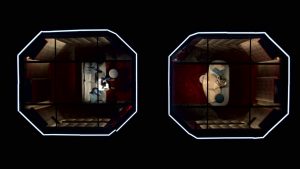
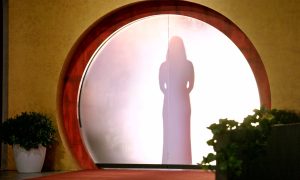
“Will you form an emotional connection or will you walk away from each other forever?” These are the often repeated words of Netflix’s newest reality TV show Love is Blind. The premise of this show is that people are divided and placed into pods where they have to try and find someone to marry without ever having seen them. This is all done as an “experiment” to judge whether love is blind and unaffected by race, class, age, etc.

Reality shows are not usually my thing. I have nothing against them and actually think it’s ridiculous that they are usually trashed because they’re consumed mainly by women. But the show seemed to want to explore some real issues, so I ended up jumping in — it was a wild ride.

Courtesy of Netflix

The show really drags out the first half of the season and I found it incredibly unnecessary. The amount of repetition of the phrases “emotional connection” and “is love blind” is . . well, let’s just say . . . if you were to play a drinking game where you took a sip for every time they were uttered, you would be sloshed in the first 15 minutes. But these phrases end up being empty words as the show never shows us anything of real substance to base the couples “emotional connections” on.

The second half of the show takes place after the couples have met each other face to face and this is where things get much more entertaining. They are all sent off to a resort in Mexico where they have some time to get to know each other, and then back to the real world to meet friends and families. The second half is where the show gives us a little more depth. Of course, this is done in the form of the dysfunctional interactions couples have with each other, with drama-free couples getting much less screen time. 

This show had the potential to explore some really interesting ideas. They present it as an experiment to see how much race, age, class, etc impacts someone’s dating choice. Overlooking the fact that sometimes you can tell all of these things by the way someone sounds, I really wished they had actually explored these issues. The reunion episode would have been the perfect episode to do that in but they missed that opportunity.

Courtesy of Netflix

SPOILER ALERT:

Carlton, a Black bisexual man, is on the show specifically to find a wife. I cannot think of an example of a show where a Black bisexual man was positively represented but it definitely was not on Love is Blind. Diamond (the woman he proposes to) does not handle Carlton’s coming out in the best way, something she addresses in the reunion episode. However, Carlton’s internalized homophobia and his misogyny are apparent, but the show does more to reinforce these views than to challenge or address them.

As well, Lauren (a Black woman) after getting engaged to Cameron (a white man), reveals to us that the Black struggle is important to her and she hopes he’s OK with that. With both of these couples, could they not have talked about it in the pods? They didn’t need to reveal their identities to ask questions about how they each feel about issues of equality. Or did they and the show just never revealed it to us?

All in all, this show could have done new things with the reality TV format. It could have actually explored how much of our desires are politically constructed, but instead it remained very flat. Compared to other reality shows I’ve seen in passing, I don’t even think I can say it’s that entertaining. All this show does is repeat key phrases over and over and over. I guess it’s good for a drinking game?

Courtesy of Netflix