Home Blog Page 431

Anti-lockdown protests ignore social responsibility for egotistical “freedom”

0
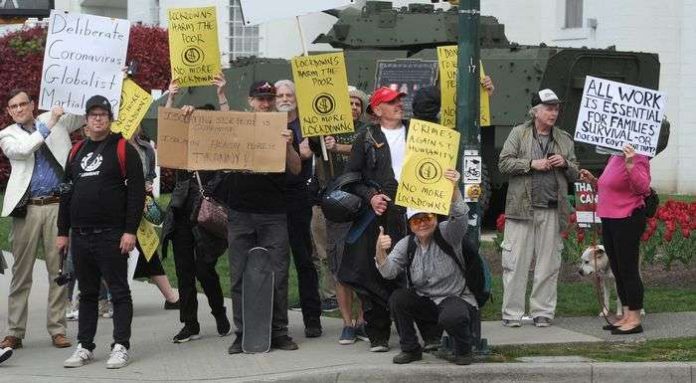
Protestors in Vancouver put themselves at risk by ignoring social distancing guidelines. Photo: Nick Procaylo / PNG

The COVID-19 pandemic has transformed many bustling routines into dull days. People have been advised to stay home, avoid non-essential travel to “flatten the curve,” and ensure COVID-19 doesn’t overwhelm the healthcare system. While a small minority, some in BC feel that these measurements are oppressive. In April and May, these protestors marched the streets of Vancouver, flailing their signs and screeching for BC to reopen. This is a dangerous and egocentric response to the COVID-19 outbreak and the public health measures meant to keep people safe.

While the anti-lockdown protests may be a result of mere ignorance or misunderstanding, they have tangible, negative effects on the containment of coronavirus. Not only do they fail to consider the capacity of our healthcare system and endanger the health of others by ignoring social distancing recommendations, these protests are also providing a platform that actively encourages others to do the same. 

Studies have shown that coordination amongst individuals is necessary for quarantine restrictions to take effect. While the Vancouver protest in mid-April consisted of only a few people, a video of it received over 21,000 likes on Twitter. This gives a voice to those who are already skeptical of the COVID-19 pandemic and increases confirmation bias — a rejection of any information that disagrees with the preconceived notion that COVID-19 isn’t a threat. The resultant inability to gather information objectively normalizes doubt in health officials and creates further unrest about the perceived “oppressive” measures of the government. 

Concerns about government overreach during these times aren’t necessarily unfounded. However, the belief that legitimate quarantine restrictions for public safety violates citizens’ rights to freedom is a fundamental misunderstanding of how our society functions. 

“Freedom” doesn’t entail simply doing as one pleases. All societies need to have limitations on freedom for them to successfully operate — and there will always be a component of responsibility attached to democratic freedom. That includes the responsibility of caring for others’ health and wellbeing in times of crisis. The anti-lockdown protestors have simply decided that their needs and “rights” are above others’ rights to wellbeing. This fundamentally disregards the fact that the virus has no concept of “freedom” or “rights,” and can infect and possibly kill anyone within transmission distance.

Unfortunately, many will simply believe what they want to believe. However, that shouldn’t stop the rest of us from doing our due diligence in better understanding the current situation surrounding COVID-19. As a society, it is necessary for individuals to act according to pandemic response guidelines because we are all responsible for the health of one another. Protesting the quarantine restrictions is not only counter productive, it’s dangerous. The rhetoric used by protestors not only causes harm — it can cost lives. 

 

Fake friendships to reopen on “optional, part-time basis”

0
Photo courtesy of Helena Lopes via Unsplash

Forget the economy: it’s time to bring back an even more arbitrary part of our lives, authorities say. The British Columbian government has recommended that throughout the province, fake friendships begin reopening, possibly as early as next week. 

“It’s time to get back to business as usual,” says BC Premier Don Morgan.

Friends are advised to alternate which types of fake friends they visit at a time. For example, provincial health officer Dr. Connie Penry recommends reserving Mondays for friends you use as human selfie sticks, Thursdays for annoying friends of friends who always show up to things uninvited, and Saturdays, of course, for the boys. 

“So the mantra goes: uglier faces, bigger spaces.”

However, Morgan emphasized that the return to fake friendships is strictly optional.

“It is your choice to be children and waste time with shallow and unfulling acquaintances now that these forced relationships are reopening,” the premier stressed. 

For those who do choose to reopen, all fake friendships must have safety measures in place, Penry says. Options include wearing masks in public, whether they be medical or psychological.

“Me wearing a social mask and you wearing a social mask helps us keep our total boredom to ourselves.”

Above all, physical distancing is king, Penry says. So the mantra goes: uglier faces, bigger spaces.

When physical distancing isn’t feasible, Penry recommends alternate measures. She suggests telling these people how little you enjoy their company, instead of farming gossip off of their drama and circulating it for social capital.

Your weekly SFU horoscopes: May 25–31

0
An illustration of a girl with long flowing hair. Astrological signs and stars shine around her.
ILLUSTRATION: Marissa Ouyang / The Peak

Aries: You’re en route to make a better comeback than all the ice cream trucks randomly reappearing. Like a phoenix, you continue rising from the ashes. But why did you set that ice cream truck and yourself on fire in the first place?

Taurus: The idiom “benefit of the doubt” has a greater meaning to you this week. You’ll doubt everything around you — the government, the weird celebrities making singing compilations about sticking together while quarantined in their multi-million dollar mansions, and whether or not your family can smell your fourth-day hair.

Gemini: It must be hard for you now that the transit system has limited its services. No, not because getting around may be harder. You just depended on the Compass part of the Compass Card to guide your confused ass through life.

Cancer: Get in touch with nature this week. Go for a walk around your neighbourhood, taking photos of the cats watching out the window. If that doesn’t spark inspiration, consider keeping your door open to let the bears inside your home and heart.

Leo: Did you know that a method to fight off tears is to perform mathematical equations mentally? It takes up much of your mental capacities so your brain is too distracted. Try that next time the professor responds to your answer over Zoom with, “Hmm, not quite. Anyone else?”

Virgo: Listening to “lofi hip hop radio – beats to relax/study to,” opening your textbook, and then going on your phone is not studying. You also don’t need to send a photo of the corner of your laptop and textbook to your friends and say that this semester is already killing you. The only thing dying here is your phone’s battery.

Libra: This week poses challenges for your relationships now that Venus is moving into retrograde. Basically, the planet of love is— Oh, look at you ignoring this conversation because it doesn’t line up with your interests again. Will the planet moving backwards harm your relationships, or will that mentality do it for you?

Scorpio: How has it been chasing that same feeling of bliss as what you would feel when your elementary school science teacher would wheel in the TV for the class? It’s hard thinking about simpler times. Mind you, it’s also hard seeing all the fun things Bill Nye the Science Guy talked about now written formally in a $300 textbook.

Sagittarius: Here’s some comforting news for you this week. You’ll finally catch the attention of the neighbourhood cutie. It’ll be when you run through the fence when you finally get sick of being confined for too long. But mind the rose bushes.

Capricorn: For the hundredth time, Yoda said “do or do not, there is no try” not “do or do not, or just cry.” You’re getting your tears all over your already wrinkled sweatpants. And these are part of your nice quarantine fit! Come on.

Aquarius: This week, if you find yourself having trouble falling asleep, try heading to YouTube and playing the first video that pops up. Whether it’s calming ocean waves or a Final Fantasy VII Remake walkthrough, you’ll be too busy really listening to your own internal screaming to pay much attention.

Pisces: This is a week of learning more about yourself. For starters, try recalling your old internet username. There’s truly something poetic and self-realizing about ~dreamlaughdance98~ and the history the two of you share.

Opening of Student Union Building again delayed to Fall 2020 semester

0
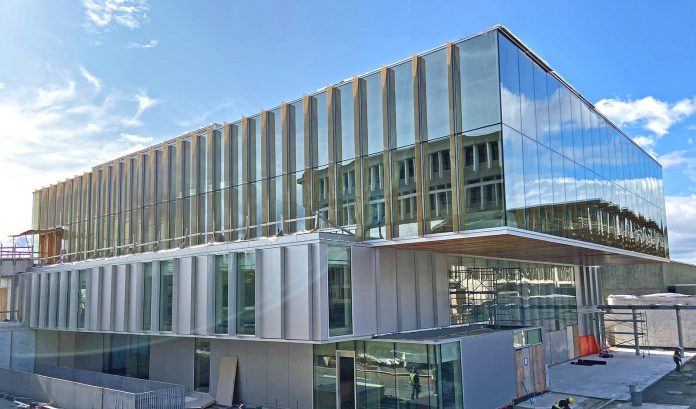
Photo courtesy of RDH Building Science

The long-anticipated Student Union Building (SUB) has once again been delayed, with the current projected opening date pushed to Fall 2020. 

Initially slated to open in Fall 2018, then pushed to Summer 2019 due to weather and staffing issues, and then again delayed to March 2020, the SUB finds its projected opening date again set back. 

The $55-million dollar project started in June 2016 and, almost four years later, still stands incomplete near Convocation Mall on the Burnaby campus. 

The Peak reached out to the Build SFU General Manager Marc Fontaine over email for an update on the SUB’s construction. Fontaine noted that construction continues during the pandemic with some additional challenges. 

Some of the setbacks they have faced so far include the inability of some tradespeople to attend the site, a reduced amount of consultants on the site, and delays in the shipments of some international materials. Despite this, Fontaine said that most work on the building continues as usual. 

As such, Fontaine expects to see the building go through the City of Burnaby’s inspection process and be handed over to the Simon Fraser Student Society by the end of July this year. Once this occurs, some construction in the summer and fall will allow the crew to finish the 111,000-sq-ft project. When asked about procedures during the pandemic, Fontaine explained new measures implemented for the safety of workers.

“New safety precautions were put in place by the general contractor for people working in the building. These precautions include opening washrooms for hand washing and implementing requirements for physical distancing. Additionally, consultants have reduced the frequency of their attendance on site and are instead attending meetings by telephone,” said Fontaine.

“We will be regularly assessing the opening of the building and will be strictly adhering to the BC Provincial Health Officer’s orders. With the university’s recent announcement that most classes will take place remotely for the fall semester, we are expecting that the building will be open during the daytime with students following all physical distancing requirements that are in place at that time.”

What Grinds Our Gears: The WiFi in SFU Residence ghosts me more than my dates

0
The only high speed my laptop gets is the velocity with which I throw it out the window. Illustration: Maple Sukontasukkul/The Peak

When I lived on Residence this past school year — you know, before the world went to shit and everything closed or went online — I shared a common enemy with hundreds of SFU students. And no, it’s not finding your TA on Tinder. It’s the WiFi in that concrete box I called home for six months. 

Picture this: you’re writing up an assignment on Google Docs (unless you’re a sociopath who writes on Microsoft Word, or even worse, PAGES) and all of a sudden, the dreaded “Trying to connect” graces the top of your document with its burning, misanthropic blue box mid-sentence. Fantastic. The only thing saving my laptop from being chucked out of Towers are these tiny windows that wouldn’t let me if I tried.

In a sick, ironic twist of fate, after all the money I spent to study here at SFU I don’t actually get to do the damn studying. I had hoped that the statistics wouldn’t lie and that living on campus would actually help my GPA. That’s kind of hard to do when the WiFi here is so poor that getting through one YouTube video about the literature I didn’t read for my exam the next day won’t load. How rude.

Yes, the WiFi is bad everywhere at this university. SFU Secure hurts everyone. But on SFU Res? It’s like a rain cloud on a sunny day. And it ends up causing a lightning storm. And that lightning strikes your house. And your house gets set on fire. And, well, you get the point — your paper still isn’t finished 

SFU, fix your WiFi. We have family and friends at home to FaceTime. We have Fullmetal Alchemist: Brotherhood episodes to stream. Oh, and we also have homework to do. Make use of those Residence and Housing fees you rack up each semester, hmm?

It’s time for government intervention against the spread of false information

0
Freedom of speech should stop at the point that it endangers people’s lives. Illustration: Reslus/The Peak

As the total number of coronavirus cases in Canada rises to approximately 79,112 (at the time of writing) people are increasingly looking to social media for news, information, and entertainment. While the increased use of social media is positive in the context that people are using it to get the latest information regarding the pandemic, it is also being used to disseminate fake news online regarding COVID-19. To counter fake news, the Canadian government is considering introducing fake news legislation. This is a necessary measure to protect people from misinformation, especially as more and more Canadians rely on social media as their primary source of news.

Misinformation on the COVID-19 pandemic takes many forms. According to some Facebook posts, consuming cocaine and methanol is the ultimate solution to coronavirus. As examples of fake news, these remedies are increasingly disseminated by people online. Moreover, some manipulators are misleading people by creating conspiracy theories regarding COVID-19, such as the now infamous “Plandemic” video. While some social media platforms like Facebook are taking measures to curb the spread of COVID-19 misinformation, it is long past due for our government to step up and do its part. Misinformation is a global issue that needs to be countered by legislation, as it puts the lives of many people at risk. 

No example of this danger is perhaps more pertinent than the recent protest in Vancouver that called the coronavirus pandemic “fake news.” Both the protest and the misinformation that fueled it were spread on social media to help gain participation and coverage. If the fake news legislation were to be in place, it would be a criminal offense to knowingly spread misinformation and conspiracy theories — including those regarding the pandemic. This would have contained the misinformation to small pockets of communication, and limited the number of protestors at the event in close proximity with the potential to spread the virus. 

Given the current COVID-19 circumstances, government intervention in the spread of fake news is necessary in order to prevent people from harmful activities based on dangerous misinformation. In Iran for example, nearly 500 people died after following inaccurate advice on social media to ingest methanol (a poisonous industrial alcohol) as protection against catching coronavirus.

There is of course a valid argument to be made that legislation against what can be shared on social media might curb freedom of speech. People may be hesitant to express their thoughts on coronavirus for fear of being criminalized for accidentally sharing something untrue. Similarly, we shouldn’t uncritically allow the government to determine what is and isn’t good for us to consume in terms of media. However, there comes a time when the government must be responsible when the citizens obviously cannot, and the issue of public health and safety is definitely one of those times. If the focus of elected officials should be on protecting people with more hospitals and personal protective equipment for healthcare workers, then it should also be their focus to protect citizens from dangerous misinformation. 

Protecting peoples’ lives should be the top priority of the government. Part of that is recognizing that providing an authentic, truthful, and objective news sharing environment is just as essential as building hospitals.


CONFESSIONALS: Yoga taught me to let go and steal my neighbour’s mail!

0
Illustration of a closed envelope, with the text, “Confessionals”
ILLUSTRATION: Marissa Ouyang /The Peak

Cat pose, Sphinx pose, Ragdoll . . . I inhale and exhale, and I feel all my negative energy leave me. Exiting through my palms, slipping through my fingers — just like my career has. I become nothing, everything. 

During quarantine, we’ve all turned to different coping mechanisms. I started doing yoga. And I am liberated — seriously. You can do anything when you’ve moved on from the crushing guilt of stealing all your neighbours’ mail!

Let me start from the beginning. Like my online YouTube instructor says, my yoga practice means following in the footsteps of Zaheer (that bald anarchist man from The Legend of Korra), fluttering away from all my worldly desires. Any time I had an issue with this, I knew the cure: more yoga. Feeling overwhelmed by my shortcomings? I would do yoga and be instantly at ease, reminded that I didn’t need talents, just Mountain pose. 

Soon I added mediation into my routine. Rapidly, I could feel the change in the bedroom air — it smells pungent. Of course, constantly meditating and focusing on my breath did cause me to miss a few deadlines. In fact, I’m now being charged with tax evasion. 

However, through my heavily appropriated and whitewashed yoga journey, I learned to accept my failings and allow the stars to carve the path that’s meant for me. Because I’ve realized now, I’m not in control. And that’s why I don’t have to regret compulsively stealing my neighbour’s packages. It’s not me, it’s the universe working its magic through me.

Taking the Amazon packages was strictly about cleansing my neighbours’ bad vibes, a kindness. The UPS ones were harder to justify, but I told myself that the delivery items were just more compatible with my aura than theirs. Eventually I realized that it’s OK to have just one worldly desire. I mean, my instructor is asking his subscribers to Venmo him $500 per video. 

Recently I began shopping for celestine and selenite crystals to cleanse the energies of my filched products. So many bad vibes bouncing around with COVID-19 on the loose . . . We need to protect ourselves and each other. I have also urged my friends and family to examine their own auras during these trying times and use essential oils to boost their physical and spiritual health. However, they have completely dismissed my wisdom and told me I should return my hoarded pile of stolen mail. How rude! 

Upon further examination, I decided to cut their negative energy out of my life. I have dropped out of school, too, as they wouldn’t let me pay tuition with my priceless energy-cleansing crystals. Even so, I have placed my fate into the hands of the stars — just as they’ve placed my neighbours’ expedited parcels into the hands of me. 

It’s scary, as I really am on my own now. My instructor went to prison last week, just like Zaheer. In the comment sections of his videos, they’re saying that what he was teaching us wasn’t even really yoga, since he didn’t have his “300-hour certification” or any knowledge at all beyond what wikiHow said.

Board Shorts: May 15, 2020

1
Image: Irene Lo

Disputes over new role of Legal Liaison Officer 

Mohamed was appointed as Legal Liaison Officer (LLO), a newly created role designed to work with the executive council to process and approve SFSS staff requests to seek legal advice. Staff members’ legal advice would, as per the motion,  “be sought through the Legal Liaison Officer with the approval of the Executive Committee, prior to a lawyer being contacted.” 

During discussion of the motion, staff present raised concerns about the motion’s practicality and intent. Aside from concerns about the timeliness of approving requests, Edmunds and SFSS Executive Director Sylvia Ceacero questioned whether the motion was in line with the union collective agreement; included in staff job descriptions is the authority to seek legal advice autonomously in the course of SFSS work. 

Board members stressed that the motion was about keeping the Board informed, not about any distrust of staff. 

“This is more a matter of, as our responsibility as a board of a student union, we need to make sure that we’re intertwined with the decisions being made,” says Balqees Jama, At-Large Representative. 

Board reinstates vote tracking for board resolutions

Effective immediately, the Board resolved to once again list in their meeting minutes how specific members voted on each issue: for, against, or abstention. According to the motion, this move is rooted in the Board’s desire for transparency and accountability as per the SFSS’s guiding principles, allowing “the membership to better hold Board members to account for their individual and collective decisions.”

Vote tracking at the SFSS has had a somewhat tumultuous history. In February 2019, the 2018–19 Board of Directors voted to begin listing individual directors’ votes, only to reverse the decision in April of that year — a move then-incoming president Giovanni HoSang called a “slap in the face.” A motion to restore vote-tracking was lodged in May 2019, only to be referred to the governance committee, who discussed the issue in meetings through July and August 2019. In February 2020, the Board moved to list numerical ratios of how the Board votes on motions, without disclosing specifically which directors voted for what. 

Board departs from Carver model, looks into more hands-on governance model for directors

The Board resolved to work on transitioning the society away from their current policy governance model, based on the Carver model: a governance system that works by delegating all day-to-day operations to staff while having boards focus purely on governance and management. “This model resulted in a continued decline in useful knowledge and skill sets of Board members,” reads the motion.

The motion that was carried mandates the governance and executive committees to look into a new administrative model, with their findings to be presented to the Board within 30 days.

The SFSS originally committed to following the Carver model in 2015, a move which Corbett Gildersleve, currently the Vice-President Finance and previously the Applied Sciences Representative of the 2015–16 Board, now believes to have been a mistake. 

“Under policy governance, the divide is too stark,” says Gildersleve. “In the resulting years, Board members know very little about their own organization, how it works, and what problems it’s having.” He further elaborated that this effect cascaded through successive years, as directors would have progressively less information to pass on to their successors.

Board appoints new directors to committees and liaison, chair, officer positions 

Of the 19 motions on the agenda, nine involved appointing the new 2020–21 Board members to serve on various pre-existing committees. Under current SFSS policy, directors are each required to serve on at least two committees while in office. 

The Board also appointed Osob Mohamed, SFSS President, and Shubhangi Jain, SFSS administrative services manager, to be the two new Staff Liaison Officers (SLOs). 

Several new roles were created. Gabe Liosis, Vice-President University Relations, was appointed as Vice-Chair of the Board, authorizing him to convene and chair Board meetings in the absence of Mohamed, the main chair. Jennifer Chou, Vice-President Student Life, was appointed as the official Board Liaison to the Council. (While serving in a liaison role between Board and Council was already included in the Vice-President Student Life’s duties, it was not previously treated as a distinct position.) 

An homage to the stuck-at-home heroes: how neighbours have helped a lonely person feel a little less lonely

0
Illustration: Cora Fu

Dear neighbours,

I have to admit, I haven’t really made the effort to know you too well. I’ve moved a few times since coming to Canada, and this feels like the first time my family has really settled into a neighbourhood. It’s probably because of all this moving that I’ve never really made the effort to get to know you better. I had always thought that my family wasn’t the kind of household to deliver baked goods and host neighbourhood parties anyways, and I was content with that.

Thinking about it, I probably know you best through your cats. Surprisingly, they tell me how tight-knit you are. I’ve learned things like how Tommy, the tabby cat, probably constantly visits because he used to live in this neighbourhood. Finnigan, Coven, and Luna, the black cats that look like they’ve formed a band, are all from the same litter and adopted by different owners here. It’s clear that you’ve been here for a lot longer than I have, which made it really intimidating to get to know you better. To be fair, it’s not like I tried to change that, since I spent most of my time in school or with my friends.

Then, when I started self-isolating during COVID-19, things changed, to say the least. Every day seemed monotonous, and as I’m sure many people can relate to, the parts of my life that I had taken for granted as nothing more than background noise were gone. There were no more neighbourhood kids running up to my dog when I walked him. There were no more yard parties, or kids screaming as they played tag with each other. There was something eerily melancholy about the caution tape decorating the playground swings and slides. 

Truly, I felt out of touch with my reality. I expected to feel the emotional pressure of the pandemic sooner or later, but I had not expected it to come from where I lived. For all the rationalizations and Zoom calls in the world reassuring me that what I felt was normal, I didn’t know how to start grounding myself when everything around me looked so different. I knew that I needed to process these complicated feelings, but I could not have anticipated the tidal wave of anxiety in the face of a world that had become so foreign so quickly.

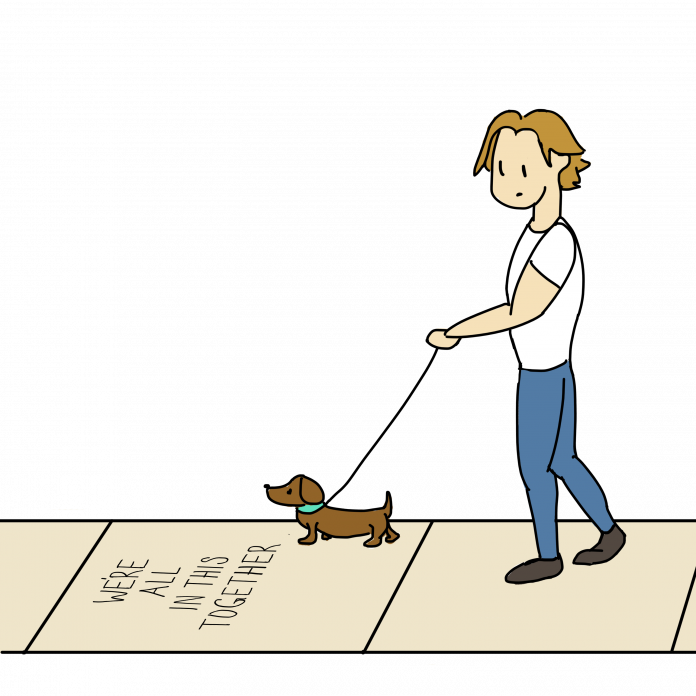
That’s when you gave me something real to hold on to — I started seeing encouraging messages messily rendered in chalk on sidewalks and driveways reassuring me that I was not alone. “We’re all in this together,” one message would read. “You’ll be okay,” another read. I had seen all the same sentiments on social media before, but something about knowing that someone went out of their way to make another stranger feel good with their own hands made these messages feel so much more special. It sounds dramatic, but looking at something tangible that I could touch and feel right in front of me pulled me out of the pool of social media and bad thoughts that I had been stuck in for weeks. “That’s right,” I thought. “These people are going through the same thing I am.” 

Photo: Kelly Chia

Of course, the whole world was going through this and worse, but this grounded me. It made me feel like I had something in common with this community and that I belonged here more than anything in the two years I had lived here. When days came and went in a city that had never been quieter, you gave me the solidarity and honest hope that could only come from a group of people also desperately trying to come to terms with what we were facing. You coloured my unnaturally quiet world in chalk, and I could not be more grateful for that.

After that small epiphany, my days were a little less monotonous. When I walked my dog, I started looking for updates to the community project posted on the elementary school walls, and I smiled at the large caricatures playfully calling a neighbour an old fart on their birthdays. These were small but important reminders that there was still life hustling around me, they were just more creative about it.


So, thank you. I know you don’t know me, and I don’t know you either. All I know is that I will always remember how in a time when everything felt like too much, your small action of goodwill helped me get back on my feet.

Love,

Kelly

Political Corner: Political discourse should be focused on pandemic response, not opportunism

1
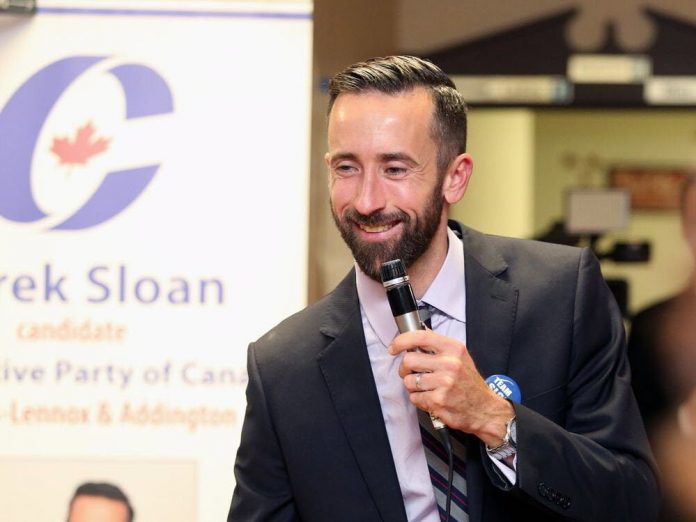
Conservative MP Derek Sloan has been called out for racist comments. Photo: Meghan Balogh/The Whig-Standard/Postmedia Network

The Hall & Oates song “Out of Touch” is definitely not a reference to a certain subset of 21st century Canadian politicians, as the song was originally released in the 1980s. But if we ignore the temporal incongruities, it definitely could have been. The rhetoric that is being deployed by some Canadian Conservative politicians to attack the Liberal government in general, and its handling of the pandemic response specifically, is definitely out of touch with our new reality. 

A select few of Canada’s federal Conservative MPs have opted for a hyper-prejudice approach at a time that demands cooperation and critical evaluation of protocols. These are opportunistic, partisan attacks that undermine the Liberal response to an ever-evolving crisis. Derek Sloan is one Conservative in particular whose comments have exemplified the disconnect between political talking points and the general public’s need for non-partisan cooperation. 

Sloan, an MP for Norfolk County in Ontario, has recently questioned whether Canada’s chief public health official Theresa Tam was working for Canada or China, in reference to her comments in support of the World Health Organization. The answer to that question is obvious to anyone not engaging in divisive politics, but Sloan’s inability to suppress his partisanship at this current time perhaps speaks to petty political ambitions rather than the good of the nation. It is relevant to keep in mind that Sloan is amongst the candidates currently vying for leadership of the Conservative party.  

Initially, Sloan’s comments received no condemnation from the leader of the official opposition, Andrew Scheer. Only after extensive criticism, both from members of opposing parties and his own, did Scheer address and condemn Sloan’s comments. 

Although Scheer will not be the leader of the official opposition for much longer, this is in no way stopping him from personally launching his own irrelevant attack on the Liberal administration that anyone of similar political status would balk at. 

Scheer feels it is appropriate during a pandemic to revert back to his old talking point about eliminating the federal carbon tax. This is in spite of the fact that most Canadians are OK with a carbon tax now that a rebate has been tagged on, and the fact that the government has much bigger issues to deal with right now. The irrelevance of his comments during this public health emergency seem to be lost on him. This leaves me wondering what political advantage he perceives he could gain with this rhetoric. 

The aforementioned comments are by no means the only hyper-partisan politics used by some Conservatives. Retrospectively, it might have been ignorant of me to think that unprecedented times such as these would evoke political cooperation. However, it is now apparent that partisan rhetoric is a habitual tool that is not easy for some to consciously overcome.