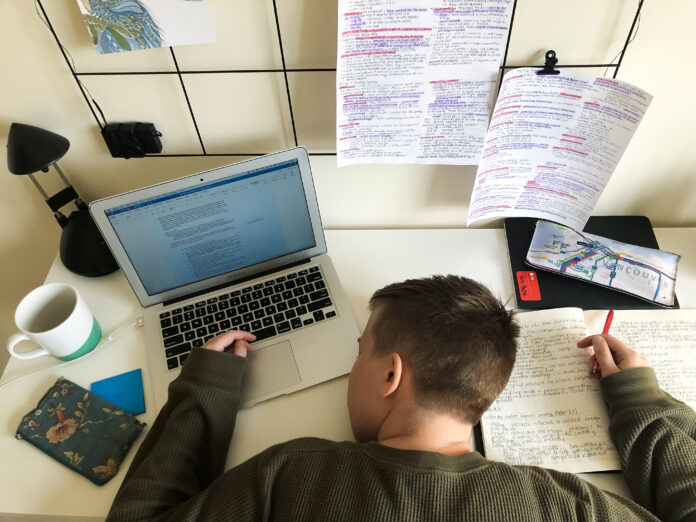
Math, Science, Philosophy — our tutor knows it all! Allyson Klassen / The Peak
Q: Define the following 1) what it means to have neutral financial distress and 2) capital structure. When is financial distress neutral with regard to capital structure?
Neutral financial distress: When you’re stressing out about how much money you’re dropping on streaming services, but your coffee addiction neutralises the pain.
Capital structure: The instance of using spare change as a means of creating an extravagant, large palace. While these tall towers of pennies are often complex, their total value approximately averages $5.
Financial distress is neutral when building the palace of pennies calms you down long enough to watch Friends again.
Q: What is a mechanism of an anterior cruciate ligament (ACL) sprain?
The most common mechanism of an ACL sprain is when someone tries doing the YMCA dance at their cousin’s bar mitzvah but amidst the panic and confusion, end up doing the letters “ACL” instead. Out of embarrassment, they decide to fake a sprain on the dance floor and make their aunt Tracy drive them to the hospital. At least they got one letter correct . . . right?
Q: What is one of the reasons the sun does not keep “mean solar time?”
Are you kidding? The sun’s schedule is jam-packed. You can’t expect the sun to handle all of its solar obligations all the while keeping mean solar time too. And for what? Personal satisfaction? If you want to know the mean solar time so badly, try using shadows sometime or maybe even consider using this great new thing called a clock. Just leave the sun alone. Geez.
Q: Let T:ℝn→ℝm be a linear transformation.
Suppose the nullity of T is zero.
If {x1,x2,…,xk} is a linearly independent subset of ℝn, then show that {T(x1),T(x2),…,T(xk)} is a linearly independent subset of ℝm.
42
Q: What’s the difference between an anabolic enzyme and a catabolic enzyme?
An anabolic enzyme is an enzyme ants drink to get their super strength. Whereas a catabolic enzyme is an enzyme put in cat food to help your cat’s metabolism. Once your cat takes a bite out of its bowl, it transforms into a bodybuilder cat with ripped cat muscles. Who needs a guard dog when you can have a guard cat?
Have a class you need to pass? Send your homework to [email protected] today!
It’s impossible to say yes to everything and have time to look after yourself. PHOTO: Annie Spratt / Unsplash
I had a friend — let’s call her Willow. This friendship progressed to the point where we confided in each other regarding difficult topics — like any other close friend. But, over time, I became less of a friend and morphed into her (100% unlicensed) therapist. Of course, I wanted to support her, but not to the extent she expected. I tried to rationalize my therapist-esque role in her life by telling myself she needed my support. But, there is a fine line between being supportive and full-on therapy sessions — that line is called a healthy boundary.
The day I realized this friendship did not possess healthy boundaries also happened to be one of the most significant days of my life. Without going into too much detail, this was a day I needed Willow’s support the most. I went to her house and she, knowing I had just experienced a hard day, didn’t ask me how everything went and decided to use me for another “therapy session.” I tried telling her I was in no position to support her but she started venting anyway. When I reiterated that my mental state was pretty poor she instantly got aggressive and said I was being a bad friend.
This is where I should have reasserted my boundary. Instead, I internalized her words and genuinely believed I was not living up to my mandate as her friend. Was I a bad friend? How could I have navigated the situation differently to make her feel more supported? My rumination was interrupted by a text apology from Willow and, without hesitation, I forgave her.
I have since learned that apologies without change are manipulation, something I wish I knew before the following incident.
A few months later, I went over to her house again one evening. My mother and I have a ritual of watching reality TV shows together and I eventually decided to leave to do just that. As I got up to leave, Willow told me I couldn’t. I thought she was kidding and I laughed, but her face remained serious and I realized she wasn’t kidding. She physically blocked me from leaving her living room and it took me a solid 10 minutes to convince her to let me go. Then, like a mature adult, she proceeded to steal my shoes.
After yet another five minutes, she gave me my shoes back. That meant that I could leave, right? Wrong. Willow stood in front of her front door, physically blocked me from leaving, and asked, “Are you not going to hug me before leaving?” For context, Willow and I never had a friendship that included physical touch and she knew I wasn’t comfortable with it. I said no and I had to ever-so-lightly slide her over to leave through her front door.
I sprinted to my car, promptly left, and I never returned.
During my reflective drive home, I had tears streamed down my face. I realized I was not valuing and asserting my own boundaries and had let Willow walk all over me, resulting in a toxic friendship. In the weeks following that experience, I struggled with asserting the final boundary of ending my friendship with her. After weeks of dry-texting Willow, and failing to respond enthusiastically, I finally conjured up the courage to send a lengthy text detailing how I felt. I expressed a lack of interest in continuing the friendship, especially considering the numerous incidents that appeared to escalate in nature. It was difficult, but I finally communicated this boundary and have consistently held it for the past year and a half. I do still see Willow occasionally, but I have remained firm on my decision to end the friendship.
I allowed Willow to drain me when I already felt empty. In hindsight, I should’ve heeded the warning that a former colleague and friend used to tell me. She would say, “You can’t pour from an empty cup.” I would shrug it off as if my cup wasn’t experiencing a full-on drought due to my lack of boundaries. I just never knew a person who I considered a close friend would be the one to stretch me paper-thin.
Shortly after resolving my situation (and attending numerous therapy sessions), I had an epiphany. I was always checking in with others, but I never had the self-compassion to check in with the most permanent person in my life: me.
I started journaling as an opportunity to check in with myself and I started communicating my boundaries to loved ones. You cannot expect others to read your mind — you need to take charge of your boundaries and communicate your needs. I found this to be quite challenging but, nonetheless, I needed to take care of myself first.
If you need to cancel plans with a friend because you need the day to yourself, that’s completely valid. Just try your best not to do this last minute. Take the time to regroup and rest. This will likely feel daunting — I know it did for me — but what’s the harm in placing boundaries? If someone doesn’t respect the boundaries you place, then they are not someone you want to be associated with. You deserve to have your boundaries honoured. I didn’t lose Willow. I let her go.
While my experiences were difficult, they further provided me with perspective and a sense of empathy. Before venting to my friends, I always ask if they are in a good, safe mental state to be on the listening end of a rant. And, at the end of my rants, I always end on some sort of positive note.
And, on that note. . .
My dear readers, here’s to setting healthy boundaries and filling our cups.
The event featured readings from both speakers’ books and their insight on non-fiction and activism. PHOTO: Gudrun Wai-Gunnarsson / The Peak
On January 20, 2022, the SFU Library and SFU Public Square hosted a virtual reading and Q&A event with award-winning authors and journalists, Eternity Martis and Kamal Al-Solaylee, to launch the non-fiction Writer-In-Residence program.
The program began last year and aims to celebrate and emphasize “the power of non-fiction writing to share knowledge beyond academia.”
The event began with Martis and Al-Solaylee doing short readings from their books. “Writing in itself is radical resistance,” Martis said. “It is a triumph. People can try to stop you from speaking your truth but no one can take your words away from you.”
When asked about navigating vulnerability when sharing your own story, Martis said, “Writing about yourself is really scary because you’re putting your heart, soul, your tears [into it].” She added, “Putting that into your book and living in the world that we live in where people can tear it apart so easily, that scared me a lot.”
Martis connects non-fiction writing to different resistance movements and its importance in enacting change.
“If we think about slavery, if we think about Jim Crow, if we think about residential schools, that has come from a lot of non-fiction,” Martis explained. She added the importance of non-fiction stems from documentation of these events so that we don’t replicate them. “I think it plays a massive role in resistance movements,” she added. “We get people reading, consuming, and then being so outraged, so touched, or so anything that they go out and act.”
She recalled being told in her early writing days, “You don’t know whose hands your work is going to end up in.” Her work has been read in institutions and by police forces, lawyers, politicians, and decision-makers. “They get to make that change. The change comes from everywhere and resistance starts with words.”
When writing her memoir, Martis combined sharing her personal experiences with statistics on the commonality of issues surrounding race, gender, and gender-based violence on university campuses.
Martis questioned how she could make the issue so visible that people could not look away. She said writing about her lived experiences as a Black student at Western University navigating predominately white spaces was a tool to show that such systemic issues are not isolated, but are very common.
“When we look at the political [and cultural] climate that you’re in today, personal writing and sharing our stories has never been more important.”
Al-Solaylee added non-fiction writing is a bridge between fiction and journalism. Its writers bring in fictional elements, such as scene-setting and storytelling, and journalistic style.
This year’s Non-Fiction Writer-in-Residence program will feature a series of workshops on topics including non-fiction book proposals, memoir and personal essay writing, and how to write about trauma.
Martis’ work has been featured in The Huffington Post, CBC, and Maclean’s, among others. Her best-selling debut memoir, They Said This Would Be Fun: Race, Campus Life, and Growing Up, describes “what it’s like to be a student of colour on a predominantly white campus.”
Al-Solaylee is the director of the UBC School of Journalism, Writing, and Media. He authored the best-selling memoir, Intolerable: A Memoir of Extremes, and is a two-time finalist for the National Magazine Awards.
For more information on the non-fiction Writer-In-Residence program and the event recording, visit the SFU Library’s website.
BC Black History Awareness Society hosted Dr. June Francis, associate professor at the Beedie School of Business, for their Black History Month opening event. Her lecture, “History of Anti-Black Racism in Schools and Universities,” focused on historical and current case-study examples of institutional anti-Black racism in Canadian education.
“We were intentionally erased from the history of this country in the same way that we have been erased from the history of the world in many areas because it was an intentional part of the colonial strategy,” said Francis. “From the time that we were liberated and before, we know slaves fought for the right to be educated. So this fight is not a new one, but it continues.”
Francis explained how the myth of white superiority shaped colonial education logic. She said the narrative of an advanced and enlightened Europe was made possible by ideologies of white superiority by scholars such as Voltaire and David Hume.
“Anti-Black and anti-Indigenous racism were intentionally there to support colonization. It was there to promote ideologies to dispossess Indigenous communities globally [ . . . ] and to justify Black subjugation and slavery,” said Francis.
She emphasized Canadian curriculum at all levels of education needs to stop teaching Black inferiority, which is “not only done by exclusion, by who tells the story, but by how we tell a story.” Francis explained she was not taught the historical significance of Black success. “When I grew up, I thought William Wilberforce was who ended slavery. That was the narrative I was taught,” she said. Francis explained she later learned about Sam Sharpe, who “led one of the major slave rebellions globally.”
She called for stories of Black heroes, resistance, and excellence to be embedded into education. “When I look at these beautiful young children seeing [Sharpe] as their hero, it just makes my heart glow.”
Francis also noted key names who are a part of Canadian history such as Leonard Braithwaite, Canada’s first Black member of provincial parliament who moved the motion to end segregated schools in Ontario.
She reminded the audience that the last segregated schools in Nova Scotia closed in 1983, only 39 years ago, and still exists today in the form of de facto segregation. She explained de facto segregation takes place when there is a high concentration of white and wealthy students in certain areas. Francis called for an examination of what these schools teach such as offering ballet versus African dance.
Francis also noted contemporary news stories of racism experienced and condoned in schools. She cited the fight to have the Cecil Rhodes sign removed from a Vancouver elementary school yard and said, “What’s missing behind these stories is the work and advocacy that still primarily rests on the backs of the Black community.” Cecil Rhodes was a 19th century politician and businessman in Southern Africa whose white supremacist beliefs and policies gave him the title “architect of apartheid.”
She brought to attention the field of marketing and its history of racism in the form of advertisements that promote racism to a mass audience.
“I entered a field of marketing and realized my own education did not address the ways in which advertising promoted racism as part of the foundation of the very discipline I was a part of,” said Francis. “I collected this work myself because I wanted my students to understand that when you see racism in advertising, it’s because it was foundational to its intellectual origin.”
Francis said the Scarborough Charter is a source of hope and opportunity as “it calls on universities and colleges to commit to promoting intersectional Black flourishing.” Some of the commitments include collecting “race disaggregated data,” supporting Black research, Black representation across all university levels including senior administration positions, and support for Black caucuses and student organizations. On November 21, 2021, SFU signed onto this Charter.
“We need to go up a steep hill because we have a long way to go and a short time to get there. Let’s make this as steep an incline as we can. We must go on and build on the work and remember the work that has been going on for decades in this province,” said Francis.
The recording of this event can be viewed on the BC Black History Awareness Society’s Youtube. For more information and upcoming events by BC Black History Awareness Society, visit their website.
President Joy Johnson announces SFU will be receiving shipments of rapid tests
SFU president Joy Johnson emphasized SFU values community perspectives and is working closely with public health to ensure a safe return to campus. In response to concerns of rising cases on campus and poor communication, Johnson said although there have been positive cases on campus, they “have not heard any reports about large clusters of infections.”
Johnson reported SFU will soon have limited access to rapid tests. Due to the current limited supply, they will be following public health guidance which means these tests will only be given to symptomatic individuals.
“Based on the guidance from the BC Centre for Disease Control, we’re going to be allocating the first shipment of rapid tests to priority groups. These groups are students living in residence and housing, Indigenous students, and faculty and staff working in-person on our campuses including front-line food service, janitorial, and security contractors,” said Johnson.
Johnson said as more shipments of rapid tests arrive, they will be looking into wider distribution and access.
Senate discuss concerns about course deadline extension
Former SFSS president Gabe Liosis said UBC Vancouver Senate had recently approved an extension of course drop deadlines “to extend a compassionate and flexible approach to students during the unusual start to the Spring semester.”
According to Liosis, the Senate committee of undergraduate studies (SCUS) had discussions of implementing similar measures but ultimately decided against it.
Liosis asked for a “thorough overview” of the committee’s argument for and against the measure, and the committee’s reason for not implementing these measures.
Elizabeth Elle, vice-provost and associate vice-president learning and teaching responded. Elle said the question of whether or not to extend course drop deadlines was mainly due to the concerns of students not knowing what to expect of their courses within the first two weeks of online learning.
“Course expectations, the assessment mode, the content, and even information about the instructor would have been clear during the first two weeks of term,” said Elle. “The student members of SCUS helped the committee understand that a major concern they were hearing from other students was the uncertainty regarding how the term would unfold.”
Elle said to address this uncertainty, SFU sent out an announcement on January 11 of a definite return to campus on January 24. The in-person return to campus was met with resistance from students, staff, and faculty. A walkout took place on the first day of in-person classes, and multiple petitions and student groups called for remote options for the Spring semester.
She explained another reason to keep the current course drop deadlines was an issue of fairness for many students being put on waitlists for courses — keeping the current deadline would allow these students to add themselves to classes should others drop the course within the start of the semester.
Senate approve motion for Master of Science in Professional Cyber Security
Vice-president academic and provost Catherine Dauvergne moved the motion for Senate to recommend the proposal for Master of Science in Professional Cyber Security in the School of Computing Science to the Board of Governors for approval. Senator Eugene Fiume seconded the motion.
Senator Colin Percival raised his concerns on the motion.
“Although I think this is a wonderful program, I am slightly concerned by the fact that it seems to be taught entirely by people on the academic and theoretical side of the field,” said Percival. “I think it would be very advantageous to the students going through this program if they had some contact with people actually working out there in the field.”
School of Computing Science professor Uwe Glässer clarified the program is training and application-oriented, featuring two six-credit lab courses in collaboration with industry partners.
The motion was passed and the program is expected to take effect in Spring 2023 or later.
One of the most accomplished professors at SFU is Dr. David Chariandy. A professor who teaches creative writing and literature, Chariandy is also a well-known writer for his fiction and non-fiction works. His first novel, Soucouyant, was nominated for over 11 literary awards. Additionally, he won the Rogers Writers’ Trust Fiction Prize for his second novel Brother, which deals with themes of masculinity, race, and identity.
Both in and out of the classroom, Chariandy aims to highlight Black authors. With the help of Student of Caribbean and African Ancestry (SOCA), he organized an event last December which platformed writers such as Dionne Brand, Christina Sharpe, and Canisia Lubrin. In the classroom, Dr. Chariandy told The Peak he teaches Black Canadian literature, for the “rich, complex, and historically deep body of texts” they offer.
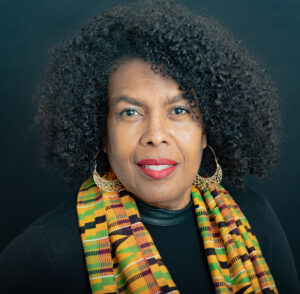
Dr. June Francis
PHOTO: Waltraud Greif
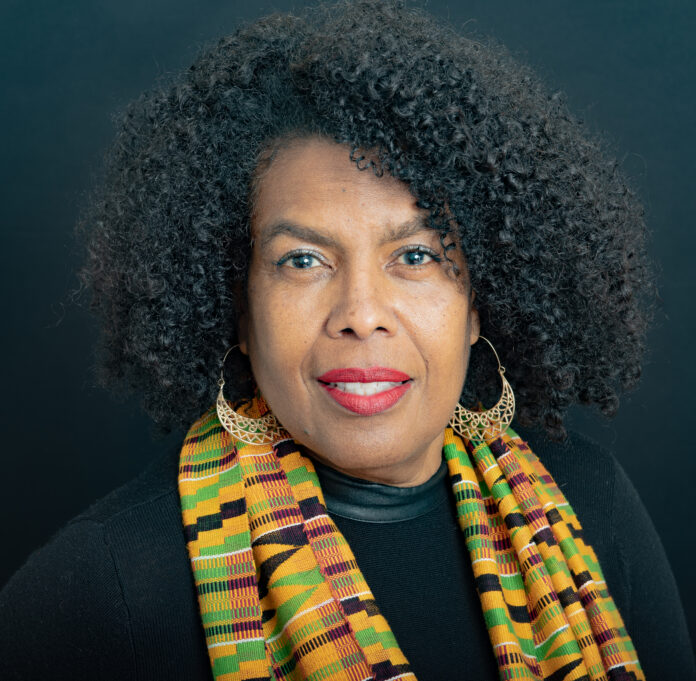
Dr. June Francis is an associate professor in the Beedie School of Business and teaches marketing. In an interview with The Peak, Francis explained, “My work at SFU has always been about creating spaces of flourishing, particularly for those most often disadvantaged by our structures, policies, and practices. As a Black professor I am painfully aware of the ways in which some racial groups are erased from research, teaching, and near absent from decision-making roles.”
Francis is also the co-founder of The Co-laboratorio, a project which works to encourage collaboration between different sectors and create “resilient solutions” with policymakers and local governments. Additionally, she is the director of the Institute for Diaspora Research and Engagement at SFU. Francis’ involvement doesn’t stop there. She was also a key member in the motion of SFU hiring more Black faculty. Her myriad list of accomplishments includes being Chair of the board of Hogan’s Alley Society, which works towards the advancement of people of African descent.
Her research focuses on “amplifying the perspective of those whose voices are usually at the periphery, particularly those who are Black, Indigenous, and racialized.”
Dr. Yabome Gilpin-Jackson
Photo courtesy of SFU
Dr. Yabome Gilpin-Jackson is a scholar and organizational developer who works towards equity, diversity, and inclusion (EDI). She was recently named SFU’s first vice-president, people, equity, and inclusion and has worked in leadership roles at many organizations including Fraser Health.
In an interview with ROOM Magazine, she said, “What my work is centred around is this passion for human development. No matter where we are, we can all develop further, and there’s always possibility for our thinking and our persons to expand. That expansion, for me, is about furthering our individual and collective potential as humanity, and I’m super passionate about that.”
Balqees Jama
Courtesy of Simon Fraser Student Society
Balqees Jama is the president of SFU Students of Caribbean and African Ancestry (SOCA) and actively promotes inclusiveness and equality of international and Black students of SFU.
“Black and Indigenous people are the backbone of community care and advocacy at SFU. We’ve achieved historic milestones, many of which benefit the wider community,” she said in an interview with The Peak.
Currently pursuing a degree in international studies, Jama has previously served as a member of the Board of Directors in Simon Fraser Student Society (SFSS) as well as the Simon Fraser Public Interest Research Group.Jama has had an important hand in SFSS’ fight for inclusivity. Among other initiatives, she penned and brought forward the motion of hiring more Black faculty at SFU. “Black people are not activists by choice; it’s a matter of survival. It’s hard to put yourself out there, as being Black and vocal often means having a target on your back. However, I’m learning the importance of organizing in Black love and joy. So in 2022, that’s exactly what I’m doing!”
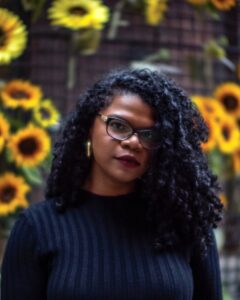
Eternity Martis
PHOTO: Corey Misquita
Eternity Martis is SFU’s current Non-Fiction Writer in Residence. Hailing from Toronto, Martis is an award-winning journalist whose work has been featured in multiple magazines and newspapers, including Vice, CBC, and Huffington Post. She is also a critically acclaimed author for her bestselling memoir — They Said This Would Be Fun: Race, Campus Life, and Growing Up.
In an interview with Ryerson University about They Said This Would Be Fun, Martis said, “I don’t think that race gets talked about enough — it’s quickly dismissed as ‘not everything is about race’ or ‘talking about race is divisive.’ The fact that systemically, people of colour continue to be precariously employed, have poor health profiles, are victims of state violence, among many other issues, means that everything is about race — we just don’t want to admit it, or perhaps we don’t even see how. Writing this book, I didn’t want to sound like a broken record, what I wanted to show was the ways that race permeates every institution around us — university, police, media, even our own families.”
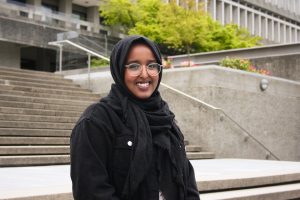
Osob Mohamed
PHOTO: Gudrun Wai-Gunnarsson / The Peak
Osob Mohamed, a recent graduate from the Faculty of Health and Sciences Bachelor program, is an important part of the SFU community. She was the SFSS president amidst the pandemic, from 2020–21 and worked diligently towards developing SFSS’ Issues Policy on reproductive rights. She had an integral role in helping students navigate the first year of the pandemic, prioritizing student mental health when anxiety and uncertainty were at their highest. During her time with the SFSS, Mohamed accomplished many feats like leading the charge on the elective grading scheme and supporting the marginalized communities.
In an interview with The Peak, Mohamed said through her experience on the SFSS, she’s had the chance to “improve the student quality of life at SFU academically, financially, and health-wise.”
Currently, Mohamed is “an alumni member of the SFU Black Caucus, and is working as a consultant to the university in the creation of a Black Student Centre.” She envisions this to be “a space for Black students to gather, receive tailored support, enjoy events and programming, and enjoy a space just for them!”
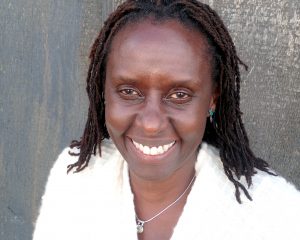
Juliane Okot Bitek
Photo courtesy of Seasmin Taylor
An Acholi poet, Juliane Okot Bitek was the 2020–21 Ellen and Warren Tallman Writer in Residence with SFU’s Department of English. Her book titled 100 Days dissects the effect of the Rwandan genocide on memory. It was nominated for multiple awards and won the INDIEFAB Book of the Year award for poetry in 2017.
In an interview with PRISM internationalon 100 Days, Bitek said “As a Canadian, Ugandan, and Kenyan-born person, I cannot honestly draw political borders around where my responsibilities lie. Others can write about what they will but I must write about issues that affect all my ways of being, all of them.”
Bitek’s other poems like “Migration: Salt Stories” and “Gauntlet” were nominated and shortlisted for various awards, and more of her works have been widely popular online and have been anthologized in Love Me True. She has also held the title of the Poetry Ambassador of Vancouver.
Tricia-Kay Williams
PHOTO: Metamorphosis Counseling
Tricia-Kay Williams is a clinical counsellor working with SFU’s Health and Counselling. Her expertise lies in trauma, relational issues, anxiety, and career issues. She has previously worked as a residential youth worker and as a social service worker.
Williams is an advocate for anti-racism which directly affects Black communities and is working actively with organizations to adopt an anti-racist approach in their policies. She has her own counselling practice, Metamorphosis Counselling. She also runs a YouTube channel, Meta Transitions, to promote growth in many areas such as career, mental health, and physical wellness.
I would sacrifice my well-being for an A.
PHOTO: Allyson Klassen / The Peak
You knew my type in high school. I always sat in the front row and was a part of too many student councils and clubs to remember. I was a multi-sport athlete. I was the valedictorian of my graduating class. I was the person who believed a 90% on a test was a definite nail in my academic coffin.
In short — I was your textbookoverachiever.
As the first person out of my immediate family that went directly to university after graduating high school, I felt an immense amount of pressure to continue my legacy as the “golden child.” This isn’t because my family placed any sort of emphasis on academic accomplishment — they couldn’t have been more proud of me — but I felt the need to prove I wasn’t a fraud (the imposter syndrome was real).
This is the mindset I carried into my first semester here at SFU. Of course, my grades didn’t magically drop since I kept my good work ethic from high school. However, I found myself obsessing over my grades to the point where I would get sick to my stomach over every email notification from Canvas.
One year ago, I had a 1,200 word essay and I decided at the last minute my writing wasn’t good enough. I deleted the entire paper (yes, every single word) and started all over again at 1:00 a.m. the day it was due. It wasn’t because it was a bad paper — I just didn’t think it was perfect. It had to be perfect, or else my world would obviously implode. This behaviour was positively reinforced because I ended up with an A+ on that paper. So, I continued to do this exact routine of deleting and editing and obsessing until my perfectionism caught up to me.
Last semester was the worst for this, but it taught me an invaluable lesson I will carry with me for the rest of my academic career. Each assignment and exam — no matter how small it was — was accompanied by debilitating anxiety that resulted in me being bedridden. I would get so ill I thought it had to be COVID-19. My signature academic drive ironically drove me to physical illness. Sitting in front of my computer during one of my online midterms, accompanied by a half-used box of tissues and a bowl — just in case — was a truly humbling experience.
My life lacked balance. My Google Calendar was filled with my school and athletic training schedule, but I failed to take care of myself first. I always preach balance is key and there I was willingly prioritizing school over my own well-being. I wanted to believe I could do everything and, while I could try, doing everything under the sun cost me my well-being and happiness. I knew something had to change.
That same semester, I made a friend in my upper-division psychology course. We sat next to each other in lecture and became fast friends purely because of our shared nerdy tendencies. We would make jokes using material from the class, which were thoroughly appreciated by the professor (I definitely cannot say the same for the students in the class). We also shared the same academic drive and similar experiences with school-related anxiety. Because we identified so heavily with one another, we were able to help each other through the semester.
By the time our final rolled around, our typical nausea-inducing anxiety was not nearly as severe. Not only that but, the night prior to our final exam after three weeks of studying together, we decided to have fun. We went out to Lafarge Lake to walk around and see the lights. It was truly an en-light-ening experience. I would’ve never dared to go out the night before a final exam, but I’m glad I did. My newfound friend and I leaned on each other and ultimately taught one another this: you can be a stellar student and have fun. Just because I am going to schedule more time for myself doesn’t mean my grades will drop.
I started to realize my worth isn’t limited to a grade I receive in some class whose contents I will likely not recall. What matters most is making memories with loved ones. Prioritizing my well-being. Living as opposed to barely surviving.
Long story short, I survived last semester, but I am not going to merely survive this semester. I’m going to enjoy it.
Midterms aren’t as scary as you think. Illustration: Maple Sukontasukkul/The Peak
Stop procrastinating
If I have just called you out, my sincerest apologies. I just thought: why procrastinate delivering the best study tip? Although it is easier said than done, how can you cram half a semester’s worth of information in the days leading up to an exam? Short answer — you can’t. Your professors and TAs spent approximately three hours per week teaching you content for six weeks. By that logic, how can you possibly expect yourself to review and memorize that much information in a few days? Instead, try reviewing class content weekly and cumulatively. For example, review week one content at the end of the week, then, the next week, review weeks one and two. Continue this pattern until your exam and you’ll be more than prepared. Even if you think you put the pro in procrastination, this strategy may help to ease some exam-related stress.
Assume the role of the professor
When I study, I like to imagine what I would test students on if I were the professor. This prompts me to reflect on the major points delivered in lectures and assigned in course readings. If there is a concept that appears in lecture and in the readings, chances are you will be tested on it.
Pro tip: if your textbook or syllabus has learning objectives, consult them. These are the “big ideas” your professor wants you to know after having read the chapter. If you cannot answer the questions or prompts detailed in the learning objectives, that’s a sign those concepts need to be reviewed.
Constantly test your knowledge
Self-testing is one of the most effective study techniques — and it’s a method I use all the time. You can tailor this tip to your style of studying, whether that be via mind maps, cue cards, homemade practice exams, or some other self-testing method. I prefer making physical cue cards as they are portable. I test myself whenever I can — during my bus ride to campus, in between episodes of Criminal Minds, and in between sets at the gym (yes, I am that person). This is your cue to start self-testing.
Having a hard time making cue cards for anything other than definitions or formulas? Refer back to tip #2 and assume the role of the professor. What potential questions do you anticipate will be asked?
Utilize study groups — with caution
One major benefit of using a study group is it allows for every individual to share unique information. Three brains are better than one . . . right? While this may be true, there are also challenges associated with groups. Namely, if people fail to share unique information or are too concerned with making friends as opposed to the group’s shared goals. Ensure all members of your potential study group have the same goals as you and are willing to put in their share of effort.
Pro tip: schedule weekly or bi-weekly study sessions and test each other’s knowledge at the end of every session.
Teach anyone who is willing to listen
I mean it — teach absolutely anyone what you have learned in your courses. This option is not limited to your family. Annoy your friends, your stuffed animals, or the entire 145 bus to SFU with your knowledge. After all, teaching others has been shown to be extremely effective in retaining information. Teaching others also acts as a feedback system. If you are in the middle of explaining a concept and completely blank, you should review that topic. Conversely, if you find yourself teaching a concept with ease, chances are that you have mastered it.
Do not neglect your well-being
Exam season is rough, but neglecting your physiological and psychological needs will only make it worse. Make sure to fuel your body by drinking water and eating some food. Your brain needs fuel to study, after all.
Schedule breaks and time with your friends — even if it’s a quick phone call or Zoom meeting. Make sure to get a proper amount of sleep (which is approximately 7–10 hours a night for post-secondary students).
Thinking of pulling all-nighters leading up to your exam? That wouldn’t be wise considering pulling an all-nighter results in effects similar to a blood-alcohol content (BAC) of 0.10. Driving with a BAC of 0.05 is illegal in BC, and you wouldn’t take an exam while under the influence, so why take an exam with comparable impaired cognitive function?
Be creative
Studying doesn’t have to be a dull experience — get creative. Find a way to study that renders it less of a chore and more of a creative outlet. Make a TikTok. Draw a comic. Write a short story. Write a song. There may or may not be an audio recording of my friend and I singing about DNA to the tune of “Story of My Life” by One Direction floating around in the universe. But I will say I still remember all of the words. If you connect with the material in a way that is meaningful to you, chances are you will remember it.
Out of sight does not necessarily mean out of mind. PHOTO: cottonbro / Pexels
Long distance relationships are actually quite pleasant. Before you throw hands, no I’m not bitter and neither am I trying to avoid my partner — we’ve been together for almost five years, one of which was long-distance. I’ve gotten used to the instant doubt and curiosity every time I tell people we did long-distance. Most are apprehensive at the thought of being apart from someone they love, and are doubtful that people can remain committed.
Long-distance relationships shouldn’t be frowned upon or be the deal breaker of a perfectly good and healthy relationship. I’m not saying that all long-distance relationships work. It takes a lot of commitment, compromise, and maturity to make it work. I know how freaking hard it is. The lack of physicality can be a painful experience when you or your partner are going through some form of conflict, and can add a barrier to building trust. Long distance relationships might not be worth it for some.
I speak for the merits of long-distance because I’ve been there. My partner was still in Canada when we were doing long-distance — but there was a three hour time difference! He was in Toronto and I was in Vancouver, which is well beyond the realm of a weekend visit. I consider that pretty substantial. I had to constantly hear from friends and family that it might not work out.
Being in a long-distance relationship put a lot of things in perspective for me. Imagine being in a relationship where your connection is still palpable even after months of physically not being together.
Maintaining any relationship takes great effort, and long-distance is no exemption. But long distance builds a bond more heavily rooted in trust and commitment. Because you can’t rely solely on your physical chemistry, you get to know your partner at a deeper, more emotional, level. You build trust by working out conflicts through communication, compromise, and genuine support. It feels great to know that someone out there willingly prioritizes staying connected with you despite being miles away.
Long distance relationships can also be more conducive of independence and character development. The distance really develops your individual ability to grow independently of your significant other. Being able to focus on your own studies, career, and working towards your goals — while not unheard of in traditional relationships — is certainly accentuated by the distance. In turn, you also learn to respect your partner’s time, and the effort they make to achieve their own goals. Most importantly, you learn to find your own happiness without having to rely on your partner.
The time you spend apart also makes the times you do spend together truly valuable. You anticipate the days you finally get to be together. When you finally see them, even the smallest moments become special. Food starts tasting better, you laugh and smile easier, and you cherish the days that you’re in their presence. Absence really does make the heart grow fonder.
If you think you’ve found someone who’s worth it and you’re both willing to make it work — give it a chance. Long distance relationships take effort, but can also be rewarding. If your relationship can survive the test of time and distance, then surely you can withstand anything.
McFogg — as sexy as ever (toes too sexy to picture). ILLUSTRATION: Sara Brinkac / The Peak
Just in time for Valentine’s week, the votes are in and former mascot, McFogg the Dog has been officially voted SFU’s sexiest representative for 2022. This news will come as no surprise to most SFU students as it would be hard to deny the tight assed beauty that is the Scottish terrier. However, select student groups across campus are furious their candidates were overlooked for the position.
In a recent statement, SFSS president Kay Ninelove assured students she took “every measure necessary to assure a fair decision was reached” and “took a personal interest” in each candidate in order to confirm the right choice was made. To maintain complete transparency with student groups, Ninelove cited the following criteria as the basis for her judgement:
Hot bod
Dreamy eyes
Luscious hair
A jawline that could cut glass
Best smile
Cutest toes
One simple look at McFogg and you know he delivers on all of these qualities paw over fist. No student across the SFU campuses can deny that they haven’t had at least three daydreams about being held in McFogg’s burly arms. Just the two of you, twirling his luscious moustache, eating strawberries off each other’s bodies, and making love on various white sand beaches in the summertime. It’s also not uncommon for students to have consistent wet dreams of McFogg building you a warm log cabin on Burnaby Mountain during the snowstorms with nothing but his cute toes keeping you warm.
While student advocates for other sexy candidates admit they each have had these dreams multiple times, they refuse to agree these qualities beat the sexual relevance of their canditates.
“It’s a complete outrage” says Charles Sexsmith, advocate for a rat they found in the dining hall. “This rat is the complete package, I don’t think anyone can deny that, much less McFogg.” Sexsmith argues that while McFogg and the rat equal in much of the decision criteria, this dining hall rat’s chiselled jawline and “eyes you could swim in for weeks on end” surpass McFogg’s sexual credibility entirely.
Other student groups, such as the advocacy group for “that one giant seagull in the AQ,” have taken to a campus wide petition in order to demand a revote. Their petition cites Ninelove’s personal involvement with the candidates clouded her judgement and ruined the sanctity of the award. “Look at this bod and try telling me McFoggs is hotter,” enraged student Dixon Chix demanded, shakily holding a picture of a massive seagull deep-throating a Donair Town wrapper.
When asked to comment on her involvement, Ninelove refused to acknowledge that the objectivity of her decision was compromised in any way. She once again restated the decision criteria and pulled out various pictures of McFogg highlighting how each of the previously listed attributes were more than present in this candidate.
Amongst the many photos and between long pauses in her speech, Both Ninelove and The Peak seemed to forget an interview was being conducted. Instead, they both sunk deeper into the pictures of McFogg’s dreamy eyes and were whisked away from the SFU office to an Italian Riviera. They found themselves in a shared vision of shirtless McFogg with a red scarf feeding them fresh grapes on a boat, while softly bag-piping Whitney Houston’sI Will Always Love You. Each of them softly embraced each other for a moment, shed two tears of complete satisfaction and went on their respective ways.