Home Blog Page 213

SFSS has mass resignations, new executives on staff

0
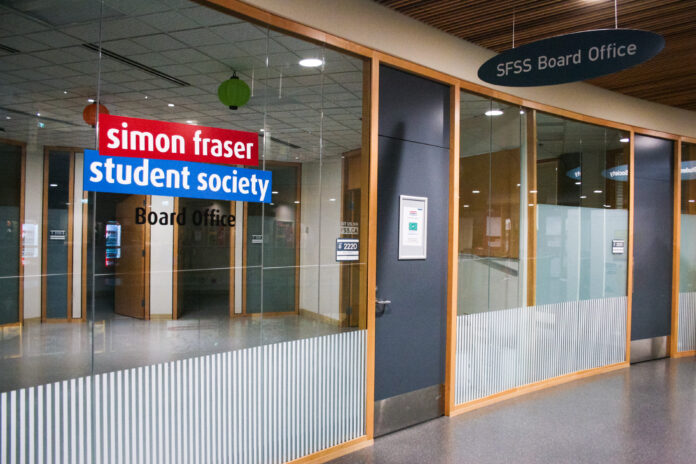
This is a photo of the SFSS office. On their window is the SFSS logo in big print.
PHOTO: Gudrun Wai-Gunnarsson / The Peak

By: Karissa Ketter, News Editor

Editor’s note: Chloë Arneson, who was interviewed for this piece, is a former Peak employee. The Peak acknowledges and has taken steps to prevent conflicts of interest or potential bias from influencing the article. 

Helen Sofia Pahou has resigned from her position as the Simon Fraser Student Society (SFSS) president. Former vice-president internal and organizational development, Judit Nagy, also submitted her resignation. Both executive members resigned on November 23. Recently, on January 11, Nicole Kirigin, former vice-president university and academic affairs, also resigned from the SFSS. The SFSS acting president released a statement announcing these resignations two months later, on January 18, 2023. 

The SFSS executive team is made up of the following changes: 

  • Acting president: Abhishek Parmar replaced Pahou
  • Acting vice-president finance and services: Rastko Koprivica replaced Parmar
  • Acting vice-president internal and organizational development: Peter Hance replaced Nagy
  • Acting vice-president university and academic affairs: Chloë Arneson replaced Kirigin

Parmar will serve as acting president until March 18. Koprivica and Hance will serve as acting vice-presidents until March 17, and Arneson will serve until April 30. The SFSS executive committee is made up of seven positions: the president and six vice-president positions. With the turnover of four roles, the acting president Parmar asked for “patience as newly appointed individuals and staff settle into their roles,” in the press release. 

The replacement process was based on nominations. Councillors nominated themselves or others and their appointment was voted on. In an interview with The Peak, Arneson noted their “election was a surprise.” They were nominated during the Council meeting on January 11. 

“As you can probably tell from the historically quick turnover rate, this job is far from easy,” said Arneson. Arneson noted “Abhishek and Rastko both had plenty of experience in Council” and took over the positions smoothly. 

In regards to Pahou’s and Nagy’s resignations, the executive committee is left to carry out the term with many new staff members. Koprivica told The Peak, “Burnout is huge in this position. Helen and Judit regularly put in long hours in their position and it wasn’t sustainable.” 

In an interview with The Peak, Hance said Pahou’s resignation made sense to him because “she was overwhelmed.” However, he was confused as to why Nagy resigned, because he felt “a lot of [Nagy’s] blame was towards Helen.” He believed Nagy’s challenges with Pahou were a “scapegoat” for another cause. “That’s what made both resignations leave a sour feeling in all of the councillor’s mouths because it felt like a lot of bullying,” said Hance. 

Others feel their resignations will be good for the community. Arneson noted, “I have followed both Helen and Judit’s journeys through Council closely and I believe Helen and Judit made the correct decision in stepping down. From what I understand of the information the student body has, their choices when handling Rea Chatterjee’s resignation left the executive in a difficult position and lost a student activist who has done incredible work in this school.” 

Chatterjee had resigned as vice-president equity and sustainability on August 17, 2022 citing harassment from councillors and being ignored in decision making processes. Sunghyun Choi was appointed acting vice-president equity and sustainability in their place. 

Nagy also spoke to The Peak on her resignation, “At the SFSS, rules don’t apply uniformly to everyone, so had I said half of what others did, I would have gotten into serious trouble — I expect I still will.”

Nagy noted her reasons for resigning “was being overworked, compensating for other executives’ shortcomings, with no relief in sight.” Nagy said she found most of the executive councillors “weren’t pulling their weight.” She added, “With the exception of a few, the organization had no interest in addressing this, so by November, I knew I could either stay and be complicit, or cut my losses; I chose the latter. 

“Given all that happened, the only thing I’d do differently is to be more assertive. I was too permissive when the SFSS needed a strong hand,” said Nagy. “The SFSS made it very difficult for me to do my job, and fought me for every inch of ground I gained — which wasn’t a deal-breaker, but its unwillingness to address its issues, will eventually lead to its extinction, and I refuse to play a part in it.”

Nagy is also concerned with Hance taking over her role. “Peter was only on Council for a month prior to his appointment, he’s unqualified and untrained.” She noted her concerns are with the job duties now assigned to Hance. “The internal portfolio oversees how this multimillion dollar society governs itself, so an untrained person could cause issues.” 

In an interview with Hance, he said the allegations of him being untrained “are pretty big attacks.” According to Hance, the previous vice-president internal has been refusing to contact him. 

“Usually during the on-boarding process, the previous vice-president helps you,” said Hance. However, when he replaced Nagy, this was not his experience. “The previous vice-president was very uncooperative with me. I tried multiple times to contact them in-person, they kind of walked away. Through online means they would not respond to me at all.” Hance noted this added complications to his role such as inability to access his email and important documents pertaining to his duties. 

In response to the allegations that he is underqualified for the role of vice-president, Hance referenced the progress he made during his time on Council as the First Nations, Métis & Inuit student association (FNMISA) councillor. He previously proposed a motion at the September 28 Council meeting calling on the SFSS to apologize for their behaviour during discussions about the Indian Residential School Survivors Society. Hance also noted he has worked to consult with student constituency groups in his current role. “I can say the previous vice-president internal didn’t do that. 

“I did put the effort through, even though I’m a relatively new student to the organization,” said Hance. “I’ve done my best to be very polite with the previous vice-president internal. I feel like I haven’t gotten that respect in turn.” 

In regards to the resignations, Hance extended understanding that “it’s a stressful position,” and a councillor may resign for a number of reasons — to focus on school, mental health, among other responsibilities. “We will all respect that, and hope you move on. We just don’t want any bad blood or animosity towards anything.

“These kinds of things hurt the entire student society and student body as a whole,” said Hance. 

The Peak contacted Helen Sofia Pahou, Nicole Kirigin, and Abhishek Parmar for interviews, but did not hear back by the publication deadline.

New Music: Kid Koala releases single and announces new album, Creatures of the Late Afternoon

0
Photo of Kid Koala making music with a turntable and a cardboard cut-out of a recording studio. Two bright-colored monsters with headphones sit outside the recording room, operating the recording settings.
PHOTO: Corinne Merrell

By: C Icart, staff writer

Nearly three decades after the beginning of his career, Vancouver turntable legend, Kid Koala is releasing his ninth album. The established artist is also “a respected performer, film composer, theatre producer and visual artist.” His upcoming album is called Creatures Of The Late Afternoon and is the soundtrack to an accompanying board game about creatures coming together and using music to protect their habitat. The board game is played on the vinyl case for the album. 

Kid Koala, also known as Eric San, has been honing in on his sound for years. He incorporates elements of hip-hop, blues, classical, ambient, and alternative. He is incredibly creative and the album is like  “the score to an action film-inspired love story.​​” The second single, “Once Upon A Time In The Northeast,” has been released on January 10 and it’s an instrumental electronic track.

I don’t typically listen to electronic music so I wasn’t sure what to expect. I let myself get transported by the beat. The song was reminiscent of a western film. It is described as “a pensive and patient turntable plod, the instrumental track slowly builds from scratched textures to arid Ennio Morricone-like guitar with great canyon reverb.” It’s the perfect background track for any chill evening. 

Kid Koala describes the album as “playful.” The first two singles are available to listen to now but the full album release is scheduled for April 14, 2023. The multi-talented artist also painted the art on the board game. I am looking forward to seeing how all the pieces of this album come together to tell one cohesive story through the visuals and the game. 

The double album and board game are available for pre-order. Those interested in seeing Kid Koala live can attend his show with Lealani at the Biltmore Cabaret on February 9, 2023. 

Hannah’s tips to survive SFU

0
PHOTO: Windows/Unsplash

By: Hannah Kazemi, Staff Writer

I’m in my last semester at SFU and looking back, there are many things I wish I had known when I started. There’s small stuff, like waiting to buy books or pay tuition until after the first week of classes, but there’s also big stuff that would have probably made the first year or two of my degree a bit more fulfilling.

Do: Try all the food!

This is one of the simplest ways to spice up those long days of back-to-back lectures. I made it my mission to do as much exploring as possible whenever I had a break, and the best way to do that is to go on a food tour. Become a campus food snob and you’ll find some kickass places to eat. I stumbled upon a great pho place called Pho 99 (which I realize is probably not a hidden gem but it is to me) at Cornerstone during my fourth year. Also, they give you ice cream at the end of your meal!

Don’t: Try to sit through a 3+ hour lecture without snacks!

Listen. You have to be prepared. Sometimes profs don’t give breaks to run and grab a snack from a vending machine or a café. I promise you that the day you start bringing snacks to class is the day your life will change. I stopped caring about munching on things and making noise with snack wrappers after I watched someone in my POL 100 class crush a family-sized bag of Cheetos. They crunched Cheeto after Cheeto during the whole two-hour class and then proceeded to lick the orange dust off their fingers. If that person was brave enough then you can be too. It’s better to be over-prepared than under-prepared. Just bring the snacks. Stop by the convenience store in the SUB or Nesters in Cornerstone or better yet, grab a snack at Renaissance and munch on something sweet during class.

Do: Go to office hours!

Ask for help! Do it! Immediately! Sooner than you think you need it!

The first time I ever went to office hours I was so nervous. I remember shaking like a leaf in the elevator up to the sixth floor of the AQ. I remember standing outside, about a door down the hall, and texting my mom, “omg I’m so scared what do I say????” But I did it and it was fine! Now, in my last semester, I waltz into my professors’ offices like I own the place. I address most of them by their first name (if they tell me it’s allowed) and ask questions about their dogs, their jobs, and if there’s anything they regret about their lives. I realized very quickly professors are human and not that different from me! They also get paid to pay attention to you, so make use of them! I remind myself of that when I feel like my questions are very simple. Repeat after me: Professors get paid to pay attention to you.

Along these lines, make good use of the resources SFU offers to students. I’ve personally had great experiences with Health & Counselling, and I encourage everyone to seek help when they need it. Some other resources include the Centre for Accessible Learning (CAL), financial aid, the Ombudsperson, and the Sexual Violence Support and Prevention Office (SVSPO). University is hard and students go through so much both within and outside of school. Remember, these resources and people are literally being paid to support you.

Don’t: Send panic emails! Verbalize the panic instead!

This is half-baked advice. I have typed up probably dozens of 2:00 a.m. panic emails to professors requesting extensions, trauma-dumping my anxiety onto the screen, only to delete them instead of hitting “send.” I find that I’m able to get all of my shit out and into the universe that way, and then I become so much more productive. I express myself best in writing, so writing out the most dramatic email on earth helps me get a handle on how exactly I’m feeling. 

This isn’t to say that asking for extensions is bad. Ask for help when you need it, and be honest with your professors (and yourself!) about a timeline that can be reasonable for you to get your work done. It’s been much better for me to verbalize or write out my feelings before acting on them.

Do: All the things!! Be open! But also stubborn sometimes?!

This sounds so cliché, but I don’t care because it’s true: you have to take ownership of your learning and yourself in university. Nobody cares if you show up or not unless participation is part of your grade. It’s up to you to decide how much effort you put into your classes. It’s also up to you to decide how diverse and fulfilling your university experience is. Go to puppy therapy! Take a random course about dinosaurs because you think they’re cool! Join a club! Quit that club and join a new one! Study abroad! Or don’t! It’s all about you, you’re the star. 

But also set boundaries; be social and pack your schedule if you want to, but take time for yourself as well. Self-care and alone time is important, so be stubborn when it comes to giving yourself enough you-time. You’re not too selfish by setting boundaries and saying no! If your schedule doesn’t allow for a day off from campus, change up your environment often. Walk the trails on Burnaby Mountain or find a quiet spot on the bottom floor of WMC to decompress and remove yourself from the busyness of school for a little while. Your brain and body will thank you for it.

Don’t: Waste your time comparing yourself to others!

This one is short and sweet because you’ve definitely absolutely certainly heard this one before: don’t do what other people do! Do what you want to do! Everyone is the star of their own show and if you compare yourself to other people you’ll never get to where you want to be. And that’s not a slay.

Do: Take time off!

I was able to get my degree done in four years — it’s been a great accomplishment and I know I sound like a privileged asshole saying this. Not a lot of people can graduate in four years and so many socio-economic factors impact the pace at which people can finish their degrees. But, if you can afford to, take time off. 

I took last summer off because I could feel the burnout seeping into my brain. It caused such an intense mental block that it was challenging to pay attention in class and absorb new information. My sister and I booked a trip together exploring four different countries. I had the best summer of my entire life seeing places I never thought I would see and I would do it again in a heartbeat. I just wish I had done it sooner.

Taking time off might look different for everybody, it could mean taking a summer off, or it could mean reducing the number of classes you take in a semester. However, make sure you listen and give yourself time to rest and recharge. It’s not a bad thing — it’s healthy, in fact — and you definitely need it.

Don’t: Put others first!

This is all connected to that “take a break and set boundaries” bit that I’ve talked about like three times now. You are the person taking care of you. You will be you for the rest of your life. So why wouldn’t you put yourself before anyone else? Do what makes you happy and enjoy the ride, it’ll be over before you know it. It still feels like I just graduated high school and started university, but in reality, I’m 22 and graduating with a university degree. Shit’s wild.

That’s all, folks.
Cheers,
Hannah xoxo

Professors with arbitrary limits on grades.

0
Teacher grading papers
PHOTO: Scott Graham, UnSplash

By: Nercya Kalino, Staff Writer

Ever leave a negative review for a professor on Rate My Professors? There are only a handful of legitimate gripes on the site, but near the top of the list would be the professor who’ll come out and tell you they don’t believe in awarding students anything higher than a B+. Is it because they’re a jerk? Or is it because they suck as a teacher? It’s hard to tell but usually, it’s both. 

During those cursed semesters with those profs-of-the-damned, you’ll be sitting at your desk, your mind screaming and your eyes hurting after staring at some assignment that you’ve put your all into knowing fully well that your prof will never allow it to rise beyond their rectally-yanked grade cap. 

What’s even worse are the professors who guarantee, on the first day of lecture, that half their students will fail the course, or fall below 70%, or some other dire warning about where most of the class’ marks will fall. If it’s true, then they’re not a very good teacher, are they!?

One of the most heart-wrenching things a student can do is study hard, work hard, and produce good work, only to be swatted down by an out-of-touch professor who’s looking for a way to make their course more important than it is. Give me a mother forkin,’ goddamn A-. Or higher. But the A- would be nice. 

Two-Minute Drill: Carly Seemann

0
Photo of track and field runner Carly Seemann
Photo: SFU Athletics

By: Izzy Cheung, SFU Student

Carly Seemann is a third-year science and art major who is training to compete in SFU’s track and field season this March. Her love for running blossomed in grade five and has remained a constant source of pride in her life since. She previously spent eight years running for the Coquitlam Cheetahs in hurdles and high jump events. 

Editor’s note: This piece has been edited for clarity and length.

Q: What do you like to do in your free time?

A: I’ll watch some TV or some Youtube. I just watched Glass Onion last night, it was so good! I do like baking, it’s methodical. You can’t mess it up . . . until you mess it up! 

Q: Favourite songs to warm up or run to?

A: Usually people listen to rap, or hard music, but I listen to R&B. It’s a great tempo to run to, and I find that I zone in if I’m listening to that music. 

(Check out Carly’s go-to running playlist: R&B Favourites on Spotify!) 

Q: If you could compete in any track event with any athlete, who would you pick and why? 

A: Honestly, I’m going to say Jerome Blake because he used to be on the Cheetahs, and I used to train with him. He’s a fun guy — and now he’s an Olympian! 

Q: Do you have any rituals or superstitions?

A: It’s so hard to find a routine that works every time, because each place you go to compete is just so different. You really have to focus on yourself; you can’t let anybody else psych you out. 

Q: What are your favourite courses you’ve taken at SFU?

A: There’s one art course [CA 262] I really loved. It’s called “Practices in Drawing.” I guess I really liked that because it tied into biology in a way, and it was just a really good way to look at things differently. I just took Vertebrate Biology. The course load was intense. We dissected a cat, pigeon, turtle, a fish, and a mudpuppy, which is kind of like an axolotl

(Fun fact: a mudpuppy is NOT an actual dog.) 

Q: Do you have any go-to restaurant recommendations?

A: I really love burgers, so Romers is really good. They actually have good gluten-free buns. Red Robins has really good flavoured burgers. There’s one sushi place in Maple Ridge called Wasabi Grill, and half of their menu is gluten-free. 

(If you didn’t catch on, Carly is celiac, and she’s politely requesting more gluten-free sushi restaurants.) 

Q: What’s your favourite track memory?

A: BC Summer Games in 2016. I was elected for high jump, long jump, and hurdles. I didn’t win anything, but I got a personal best in high jump. My personal best at the time was 1m 55cm; my mom told me to “get over 160.” I think it was my third attempt. I just barely skimmed it.

Visiting the old athletics graveyard

0
Photo of someone holding a candelabra in dim lighting.
PHOTO: Laura Chouette / Unsplash

By: C Icart, Staff Writer

Content warning: mentions of animal abuse in the second paragraph. 

Auto polo

Picture polo with cars instead of horses. Each car had two players: one to drive and one to hit the ball. It was popular in the United States and Europe at the beginning of the 20th century. The sport, unsurprisingly, was incredibly dangerous and caused several accidents. It was so bad, that each car had its own nurse and doctor. Racers died, and people ate it up. I’m not kidding. Audiences would complain about a lack of bloodshed. It wasn’t until the Great Depression made the sport too expensive that auto polo began fading out. However, it was briefly revived as “motoball,” where cars were replaced with motorcycles and mallets were replaced by rackets. 

Considering how much faster cars are today, I’m going to have to agree with leaving this one in the sports graveyard. However, tuk-tuk polo has been taking off in Sri Lanka since 2016. Tuk-tuk refers to the vehicles participants drive. It gained popularity as a replacement for elephant polo after animal cruelty accusations, and a rampage of a “polo” elephant hospitalized two players in 2007. Wow, that’s a lot of variations of polo.

Fox tossing

During the 17th and 19th centuries in Europe, members of the Victorian aristocracy would join teams to launch an array of live animals — not just foxes — in the air with a giant sling. Whoever sent their animal up the highest would win. It was ideal to toss the animal high enough so it wouldn’t survive the fall, because when it did, it often attacked the participants. Go get your revenge! When the aristocracy died down, so too did the game. Obviously the animal cruelty  involved would prevent this sport from being revived nowadays.

Baseball

Okay, baseball isn’t dead, but it may as well be. Major League Baseball (MLB) viewership has significantly declined. While 44.2 million people tuned in to watch the World Series in 1978, less than 12 million people watched the 2022 World Series. Many blame the slow pace of the game that just doesn’t keep up with the attention span of the average 57-year-old MLB fan. This is something the MLB is actively trying to solve by introducing two major time-saving changes this upcoming baseball season: a pitch timer, and a pickoff limit. The pitch timer will force pitchers to cut down on time between pitches. While a pickoff limit will allow more players to steal bases by limiting how many times a pitcher can try to catch a runner taking off to the next base. To be honest, I think this sport is boring, changes or not, and would much prefer it if the MLB started playing soccer baseball instead.

Jewish Book Festival presents a collection of vivid graphic novels

0
lllustration from But I Live book cover of two boys holding blankets in a forest with a blue colour scheme.
PHOTO: University of Toronto Press

By: Aditi Dwivedi, News Writer

Every year, the shelves of the Cherie Smith Jewish Community Centre’s Jewish Book Festival, one of Vancouver’s “leading cultural and literary events,” are filled with powerful narratives, knitting together a community of prominent and emerging writers dedicated to vocalizing the lived experiences of the Jewish community. This year’s festival features But I Live: Three Stories of Child Survivors of the Holocaust, a collection of graphic novels that recount haunting experiences in vivid detail.

But I Live is a unique curation of graphic memoirs, historical essays, and lived experiences. Edited by Dr. Charlotte Schallié, chair of German and Slavic studies at the University of Victoria, it’s a collaborative attempt to approach testimonies of Holocaust survivors in a rich way. Dr. Schallié believes “graphic novelists are not just illustrators” and insisted they “actively co-creating the history with the survivors.” Three graphic novelists were paired with people who were children during the Holocaust to help interpret their memory into art that leaves a legacy.

In an interview with The Peak, Miriam Libicki, who developed the illustrations in the story, A Kind of Resistance with David Schaffer, opened up about how the production of the novel was very different from her usual process. Unlike her solitary explorations of artistry, Libicki embarked on a creative journey, interpreting Schaffer’s vivid recollection of his harrowing childhood. The story recounts how his family was “deported to Transnistria in the Ukraine and how [they] struggled to survive.” Using murky watercolours, Libicki helped develop the visual narrative of their long journey towards home in Vama, Bukovina, after Ukraine was liberated by the Russian forces in 1944. 

Invoking the fantasy art style of Edmund Dulac, Libicki aimed to “immerse the reader in the past,” and constructed a world unique to Schaffer’s voice, juxtaposing the visceral reality of his life with surreal nature imagery. What captivates her readership is not just her unique illustrative technique, but the subtle shadows of But I Live co-creators, Barbara Yelin and Gilad Seliktar’s artistry imprinted on the pages of her work. Her gratitude towards her co-creators reflects in every panel, like Yelin’s lesson to “take up more space.”

According to Dr. Schallié, “Visual storytelling in graphic narratives is especially effective for life stories of survivors who were children during the Holocaust, as images often tend to be deeply imprinted in a child survivor’s memory.” But I Live presents a colourful alternative to the faded black-and-white film reels of distant, faceless figures of millions of Holocaust survivors, captured in a “dehumanizing light” by cameras in the hands of their oppressors. It re-claims their narratives and gives them a space to express their lived experiences. 

In the preface to this woven net of memory and evocative history, Bernice Eisenstein quotes an old Yiddish saying: “Ink dries quickly, tears do not.” 

Some moments of human experience need to be kept alive, no matter the passage of time. But I Live is proof that our legacy is marked not only by wars, loss, and grief but also by hope. 

But I Live is available for sale at Indigo. Attend the But I Live panel discussion on February 12 at 12:00 p.m. at the Jewish Community Centre of Greater Vancouver to find out more about the novelists’ “unusual artistic process.” Tickets are available on the Eventbrite page. Find out about other exciting events for the JCC Jewish Book Festival on their website.

No, queer curriculum in schools isn’t “grooming” students

0
PHOTO: Gudrun Wai-Gunnarsson / The Peak

By: Bhavana Kaushik, SFU Student

Despite years of progress on LGBTQIA2S+ rights in Canada, the last couple of years have seen a resurgence in naked bigotry towards queer people. One of the most dangerous tactics used to demonize the community has been to reduce teachers to “groomers,” with bigots condemning the involvement of queer narratives in the classroom as being tantamount to pedophilia. 

Before we talk about such an important topic, we need to establish a legitimate definition of grooming. According to a 2001 Criminal Code provision, “preparatory” steps taken to “groom” children under 14 is considered a criminal offence, even before an actual sexual crime is committed or attempted. Grooming is when a person builds a relationship with a child for the purpose of future abuse. It’s a real phenomenon that, especially online, has been on the rise in Canada.

What grooming is not, is education that includes the mere mention of queer people. 

In the past few years, the idea that issues around gender and sexuality shouldn’t be taught in school has been gaining steam in far-right circles. In Florida, the so-called “don’t say gay” bill forbids educators from teaching anything related to sexual orientation or gender identity in kindergarten through third grade. Florida’s Republican Governor and conservative allies have accused opponents of the bill of being “groomers,” themselves. 

Canadians aren’t immune from this demonization of queer narratives in schools; during the 2022 municipal elections in BC, the Parents’ Voice party ran, partly, on a platform opposing the inclusion of LGBTQIA2S+ topics in school curriculum. During that election, three of the party’s 28 candidates were elected to school boards, where they now serve, contributing to critical decisions about inclusive curriculum. 

An inclusive curriculum is critically important. As of 2021, 4% of Canadians aged 15 and older identify as members of the LGBTQIA2S+ community. Growing up, that population having a curriculum related to sexual orientation and gender equality will help them feel safer and valued in their learning environment. It also helps students outside of the queer community. Students who grow up learning about what it’s like to be a member of the LGBTQIA2S+ community do a better job at being there for students and adults who are different from them. And early, age-appropriate sex-ed discussions make all students safer from actual grooming. 

The LGBTQIA2S+ community and its allies have fought for decades to create a safe space for queer Canadians. But for this to continue, any notion of a link between an inclusive curriculum and the terrible practice of “grooming” has to be shut down before it causes more damage to the LGBTQIA2S+ community.

Connect the Lingo

0
Illustration of a character connecting the words “connect the” and “lingo” with a pencil.
ILLUSTRATION: Alyssa Umbal / The Peak

By: Natalie Cooke, News Writer

Word Bank: goalkeeper, airball, shank, 19th hole, double dribble, muff, cut shot, bunt, meet, nutmeg

  1. When a player stops dribbling and then begins again, or dribbles the basketball with two hands, they commit a ________ dribble.
  2. This soccer player usually wears a different colour than their teammates on the field.
  3. Time to relax and grab some lunch at the ________. 
  4. When a football player makes contact with the football without successfully maintaining possession of it. 
  5. When a softball batter chooses to tap the ball instead of swing.
  6. A volleyball attack where the player spikes the ball “at an extreme angle across the court, making it nearly parallel with the net.” ________
  7. The libero received the serve but their pass was a  ________. The ball flew out of bounds!
  8. You ________ an opponent in soccer when you kick the ball through their legs, instead of trying to go around them.
  9. She tried to make a three-point shot, but instead hit an ________. 
  10.  Another word for a swim competition.


Answer Key

  1. double
  2. goalkeeper
  3. 19th hole
  4. muff 
  5. bunt 
  6. cut shot 
  7. shank 
  8. nutmeg 
  9. airball 
  10.  meet

Public universities should be free

0
Letter blocks spelling “school”
PHOTO: Oleksandr Pidvalnyi / Pexels

By: Victor Tran, SFU Student

In Canada, the cost of higher education has become a topic of increasing concern. In response, the question of whether Canadians have the right to access higher education has come to the forefront. In recognition of universities’ fantastic benefits to society, it’s time to eliminate their greatest barrier to higher learning: tuition.  

Education is one of the best strategies for raising people out of poverty. Reducing the cost burden associated with higher education is a critical part of levelling the playing field among students from all income levels

In Canada, lower-income teenagers are less inclined to attend universities. According to a report by Statistics Canada, only half of 19-year-olds from low-income families’ decided to participate in post-secondary education, compared to almost 80% from higher-income families. 

This trend is a barrier to financial stability. Statistics Canada reports that 73.3% of people with a bachelor’s degree had a job in 2022, while only 53.7% of those with just a high school diploma were employed. This leads to massive differences in average income over a long-term period. By age 35, Canadian men with a bachelor’s degree are earning an annual average of $64,000, compared to $44,000 for their high school graduate counterparts. At age 35, Canadian women with bachelor’s degrees are earning an annual average of $37,000, compared to just $20,000 for high school graduates. Removing the financial burden posed by tuition will increase the attendance rate among all citizens and help more Canadians break out of a cycle of poverty. 

Austria is a prime example of the benefits of free public universities. In 2008, the Austrian government erased all education fees for EU citizens; by 2015, the university attendance rate reached 81%, from 51% before the education reform. The resulting increase in bachelor’s degree holders should contribute significantly to the economy. The same is the case for other regions; the University of Minnesota’s graduates contribute $8.6 billion to annual GDP, while the University of Illinois’ graduates contribute $9.5 billion. In 2008, Austria’s GDP reached $432 billion — a 28% increase within 2 years of providing free education. 

Before we get too enthusiastic, we have to consider the potential pitfalls, starting with the problem of paying for free public schools. Free public school is not “free” the cost is borne by the taxpayer. Germany,  which provides free university education for national and international students, has a 49.4% tax wedge, which means an average worker in Germany has to give up half of their income. Canada, on the other hand, has a tax wedge of only 31.4% in comparison. 

It’s not easy to raise taxes as a politician. To fund free public education, the government could face enormous backlash when raising the tax bracket. But public education pays back. It’s one of the best investments a country can make, fueling competition, innovation, and economic growth. An educated population is a benefit, too. University graduates are more likely to vote and less likely to subscribe to conspiracy theories. It’s a great investment, but we have to be patient. 

Free higher education in Canada might seem far-fetched despite its outstanding benefits, but other countries are making it work. It’s time for Canada to join their ranks and prioritize its citizens’ development.