Home Blog Page 191

Dating shows aren’t about love

0
a sunset proposal on a rocky hilltop
PHOTO: Louis Watson / Unsplash

By: C Icart, Staff Writer

I love reality TV competitions. I’m currently in my Drag Race era, but I’ll watch pretty much anything. Don’t believe me? I watched Dance Monsters on Netflix. But if there’s one kind of reality show I refuse to watch, it’s dating shows. 

This was not always the case. After school, I used to turn on MTV to watch Next, Room Raiders, and Parental Control. So what happened? Clearly, I didn’t outgrow my love for cringey TV. Am I now too queer to subject myself to hetero nonsense? The topic of inclusion in dating shows often excludes representation of queer, racialized, and plus-size contestants. But I think a more profound issue is that dating shows are fundamentally not about helping people find love; they’re about making money. 

Participants are not in scenarios where they can comfortably build connections and get to know each other. Instead, producers generate situations where contestants constantly compete against each other and watch the person they’re interested in date other people. The premise of most dating shows is more conducive to generating drama than healthy relationships — probably because drama is more exciting to watch. 

So why do so many of the most popular dating shows these days center around marriage? The American versions of The Bachelor, The Bachelorette, and Married at First Sight have aired a combined 62 seasons. Most of the folks who have gotten married on or as a result of these shows are now divorced. And yet, producers continue to wash, rinse, and repeat the same formulas selling us their heteronormative ideals of monogamy and marriage. 

Dating shows “often feature the common romance tropes of ‘soul mates,’ ‘prince charming,’ and ‘love at first sight.’” Not only does this provide a very narrow understanding of love and dating, but it also does not align with dating trends among millennials and gen Z. For instance, “fewer and fewer are looking for a relationship that will end in a marriage.”

So should we get rid of dating shows altogether? Well, I think they can be a fun distraction, and I’m going to guess that the millions of people who watch these shows agree with me. However, we need new concepts with more diverse casts, and less of an emphasis on dating only for marriage featuring monogamous relationships. Let’s put the dating back in dating shows, and showcase more people having fun dates and enjoying each other’s company regardless of whether or not they want to be together for life.


Letter to a Legend: My mentor Jason Botchford

0
Photo of the late Jason Botchford.
PHOTO: Jason Botchford / Twitter

By: Isabella Urbani, Sports Editor

I have a unique relationship with my mentor, Jason Botchford. We never had the chance to meet, but I can only hope he sees the impact he’s made not only on me, but the entire Vancouver Canucks community. 

Botchford, or Botch as people came to call him, helped me for the first time without even knowing it. I was in the midst of finishing grade 10 and was still completely undecided on what career I wanted to pursue. On the one hand, I wanted to become a pediatric doctor. On the other, a sports journalist. 

I spent my fair share of nights in hospital rooms with immunocompromised siblings. On those occasions, I promised myself that the next time I stepped foot in a hospital, it would be to take care of people in my brothers’ situations. After burying myself in my studies and extracurriculars in high school, I had the marks to get myself into a reputable school. 

Problem was, I was head over heels in love with hockey. Study sessions weren’t study sessions without a hockey game on the TV in front of me, and another being broadcasted through my headphones. My parents tried to convince me it was nothing but a hobby — something I shouldn’t make a career of, especially when I had early acceptance offers for science waiting for me. 

Botch’s writing helped me make up my mind. Before stumbling upon his work, I had an idea of what sports journalism was in my head. It was dry articles overflowing with analytical information that you kind-of-sort-of know, but couldn’t actually articulate into words if someone asked you to. If that was what sports journalism was, I knew I had no business writing. That also wasn’t Botch’s style. He was a true storyteller. You didn’t have to watch a single Canucks game in your life to read Botch’s work and feel confident that you knew the full story. He was just that good. 

Storytelling was what sold me on hockey in the first place. The fact that each game has its own unique story, despite being played under the same rules, was something that made watching any hockey game, at any level, magical for me. Knowing there was a market for this type of writing was all the confirmation I needed to spend my spring break watching Toronto Blue Jays games and crafting articles as practice. 

Another practice I developed was waiting for Botch’s articles to be published in The Athletic. One moment I was reading his article, and the next day, the Canucks community, myself included, were mourning his death.

Messages poured in online. Through them, I was introduced to the full scope of Botch’s legacy and the kind of person he truly was. Botch was all about paying it forward to the next generation of writers. From what I’ve heard from my fellow coworkers, he loved showing upcoming writers the ropes. That didn’t change after his passing. When the next hockey season came, the Canucks announced The Botchford Project: an annual opportunity for six inspiring journalists to get to experience a day in the life of a hockey journalist. 

I was one of the lucky six recipients hand-selected for the 2022 Botchford Project, by none other than Botch’s wife, Kathryn Botchford. To this day, I can’t help but smile when I think about it. Nothing has come close to topping that experience. Getting to rub shoulders with some of the most influential Canucks writers has opened up so many opportunities for me. It’s given me something to sink my teeth into and create a career from. Having the honour to sit in Botch’s spot in the media booth and peer down at the game unfolding in front of my eyes was the confirmation I needed that I made the right choice in pursuing hockey.

I am eternally grateful to Kathryn, who continues to give back to BC in more ways than one. Through her, Botch’s legacy can continue to be everything that made him a beloved writer and person. I may not have met Botch, but he’ll forever be present in each sports article I write. I’m so glad to have the privilege to call such a person my mentor.

New Music: Singles and music videos from February

0
A woman with a pearl necklace, hoop earrings, and cornrow braids wraps her arms around OK Naledi, who is wearing a tan collar shirt. Both of them are smiling with their mouths wide. A basketball hoop is seen blurred behind them, and the rest of the background is a gray-ish blue sky.
PHOTO: Quest

Editor’s note: This article was updated on March 8 to correct the release date for Witch Prophet’s album.

By: Petra Chase, Arts & Culture Editor

A woman with a pearl necklace, hoop earrings, and cornrow braids wraps her arms around OK Naledi, who is wearing a tan collar shirt. Both of them are smiling with their mouths wide. A basketball hoop is seen blurred behind them, and the rest of the background is a gray-ish blue sky.
PHOTO: Quest

“INtrlD” by OK Naledi

Released on Valentine’s Day along with a music video, “INtrID” is your new go-to soundtrack for sapphic longing. Naledi Sunstrum, a.k.a. OK Naledi, is a Motswana-Canadian Afro House musician bringing a “queer, gender diverse presence to the Afro House genre — something that is still lacking in this genre.” In this deeply vulnerable track, Sunstrum recounts “falling in love with a woman at a time when homosexuality was illegal in Botswana.” Building anticipation and intensity through the lyrics and uplifting piano, it’s the type of song you put on a loop as you daydream for hours. The beautiful video that accompanies the song feels like a hazy, joyful memory, pulling you into mise en scène of Sunstrum’s storytelling. OK Naledi’s debut LP, Bones, was released on March 3 as the “first chapter” of their storytelling through music.


This is a photo of the five members of VERTTIGO looking fiercely to the camera. They are all wearing black clothes. Two members sit on a brown couch wearing leather and three members stand behind them. The image is a shadowy interior of an antique-looking room with carpet, a painting on the wall with an antique frame, a window, and a light shining from behind them.

“Autumn” by VERTTIGO

With a synth sound as crisp as an autumn breeze, Edmonton-based band, VERTTIGO, shows off a unique blend of punk rock and dream pop in their debut track. Citing influences such as Cocteau Twins, Alvvays, and Beach House, the intensity of lead singer K A R Í M A Hs soaring vocals also draw comparison to Evanescence. The song captures feelings of longing with dark undertones, reflected in the stunning music video’s gothic aesthetic. It’s shot in a cabin built in the ‘30s which has long been a “hidden gem” in Edmonton’s arts scene. Stay tuned for their upcoming album, which is set to be released this year. You can also watch them live in Vancouver at Verboden Music Festival in May.


A closeup image of Witch Prophet wearing steampunk accessories, including round sunglasses with eyeballs with metallic lining decorating one lens. There are paperclips all over Witch Prophet’s long hair and a thick silver chain at the crown of their head. They have a black leather choker with a metal star pendant and more thick chains hanging from it.
PHOTO: Francesca Nocera

“Energy Vampire” by Witch Prophet ft DillanPonders

Energy Vampire” has a commanding energy. The laid-back hip-hop beat is built for strutting in self-assured bliss. The term “energy vampire” to describe those who drain your energy is a powerful revelation; this song will empower you to recognize and block energy vampires in your life. Witch Prophet is a “queer, East African singer-songwriter” based in Toronto. The music video feels psychedelic, with steampunk-like visuals showing off their unique style.

Her new album, Getaway Experience, comes out on May 1. It’s named after a “CIA report where they studied the use of sound tapes to manipulate brain waves with a goal of creating altered states.” “As a neurodivergent artist who struggles with focal seizures (Déjà vu, out of body experiences, lucid dreaming, memory loss etc) I feel like; sharing my experiences through my music is one of my paths to healing,” she said. “Gateway Experience is an album focused on the connection with the human brain, seizures, god, and otherworldly abilities.” 

Listen to The Peak’s regularly-updated “New Music” playlist on our Spotify profile.

ChatGPT presents new challenges

0
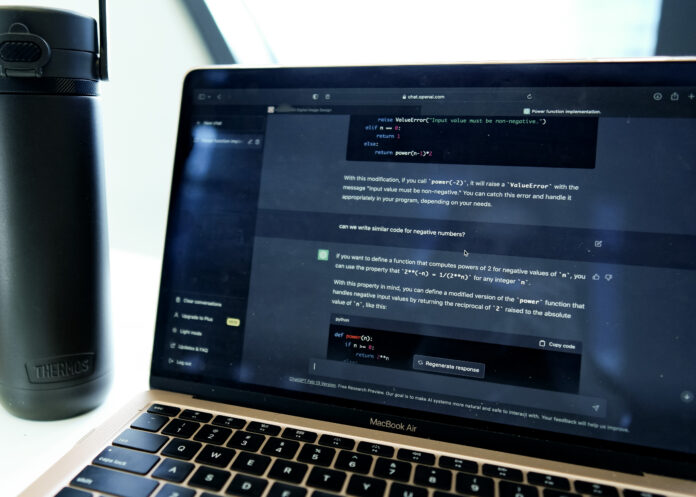
This is a photo of someone at a laptop. ChatGPT is on screen.
PHOTO: Manmeet Sagri / The Peak

By: Hannah Kazemi, Staff Writer

ChatGPT, a new AI chat bot, has quickly become known for its ability to answer questions and write assignments based on prompts from its users. Users can input almost anything into the chat box, and ChatGPT has an answer. With the rise of smart tech like ChatGPT, the risk of plagiarism and cheating increases along with a perceived “threat to higher education.” The Peak reached out to SFU Administration to learn about the university’s response to ChatGPT. 

ChatGPT works by generating content following a question or command inputted by the user. Depending on how detailed the prompt is, ChatGPT tailors the length and depth of the response to cater to the user’s request. The output could be as short as one line, or it could generate a five-paragraph essay responding to a specific prompt.

In an email statement, SFU said technology such as ChatGPT gives universities “both challenges and opportunities.” As reported by Global News, it seems that many Canadian universities are in the process of crafting specific policies relating to the use of AI such as ChatGPT. Sciences Po, a university in Paris, has issued a complete ban on the use of ChatGPT in academic work submitted by students. Reuters reported Sciences Po students found to have used ChatGPT to complete their work may be expelled from the school. Canadian universities predominantly have yet to release concrete statements on how they plan to handle this situation. However, individual SFU professors are making their own policies to account for ChatGPT’s rise. 

Since its launch, there have been varying opinions on the usefulness of ChatGPT: some are saying it is a positive advancement in technology due to its ability to help students understand particular concepts. Leanne Ramer, SFU senior lecturer of biomedical physiology and kinesiology, is asking students to use ChatGPT to “synthesize results of several studies [because] ChatGPT and other tools like Perplexity.ai can provide a very high-level summary of a field.” 

Others are alarmed by the AI’s capacity to churn out entire university essays and research assignments simply by inputting the assignment prompt into the chat. SFU told The Peak that while ChatGPT poses “a new challenge to academic integrity,” they are also “looking for ways to leverage artificial intelligence platforms, like Chat GPT, to support learning and research activities in an educational environment.”

When asked about SFU’s plans to mitigate the increased risk of plagiarism that comes with AI such as ChatGPT, they said the “fundamental approach remains the same” to other such cases of plagiarism — they aim to “closely monitor for signs of dishonest behaviour, while educating students about appropriate use of technology, policies, and potential penalties for violating them.” 

SFU noted students have “responsibilities as members of the academic community, as well as consequences for inappropriate student behaviour,” should they be found of academic dishonesty or plagiarism through the use of ChatGPT and otherwise. The current Student Academic Integrity Policy dictates that students who are found to have plagiarized their work are subject to consequences such as receiving failed grades, getting a “formal reprimand,” or being required to redo their work, among other consequences. “Interim measures” while awaiting the investigation of plagiarism allegations include preventing students from enrolling in courses or graduating.

The Peak contacted SFU’s Centre for Educational Excellence to ask about how SFU students might be affected by the new AI, but did not receive a response by the publication deadline. For more information on SFU’s Academic Integrity Policy, visit their Policy and Procedures website.

Reclaiming disability narratives through art

0
Photo of Alice Wong, an Asian American disabled woman in a power chair, against a background of bamboo trees. She is wearing a blue cardigan and sitting in a power chair. She is holding a copy of her memoir, Year of the Tiger, a paperback in yellow and red with a fierce tiger on it designed by Madeline Partner. She is wearing a bold red lip color and a trach at her neck.
PHOTO: Eddie Hernandez Photography

By: Olivia Visser, Opinions Editor

Photo of Alice Wong, an Asian American disabled woman in a power chair, against a background of bamboo trees. She is wearing a blue cardigan and sitting in a power chair. She is holding a copy of her memoir, Year of the Tiger, a paperback in yellow and red with a fierce tiger on it designed by Madeline Partner. She is wearing a bold red lip color and a trach at her neck.
PHOTO: Eddie Hernandez Photography

Alice Wong

Alice Wong is an Asian-American “disabled activist, writer, editor, media maker, and consultant.” She founded the website Disability Visibility Project, a platform to share and connect disabled voices. Wong is well-known for her writing on topics like disability justice and culture. Her work has been featured in publications such as the New York Times, Vox, and Radiolab, and covered across multiple news publications. Some of her most notable publications are the books Year of the Tiger: An Activist’s Life and Disability Visibility: First-Person Stories from the Twenty-First Century. Wong’s writing emphasizes the need for better support and representation among disabled communities. She’s also an active member of Twitter’s disability community @SFdirewolf and on Instagram @disability_visibility

A 40ish mixed race Sri Lankan, Irish and Galician nonbinary femme with curly brown silver and purple hair, lying on a couch looking at the viewer horizontally. They have rose gold aviator frames, thick eyebrows, red lipstick and sand colored skin, and are looking at the viewer with a kind of tired but hopefully crip wonder. They wear a blue denim vest with a pin that says Neurodivergent Universe above a pink and blue image of a ringed planet, and a black tank top with yellow lettering that read Talk To Plants, Not Cops is barely visible. They have a tattoo of the words "We begin by listening" in magenta cursive script on their left arm.
PHOTO: Syrus Marcus Ware

Leah Lakshmi Piepzna-Samarasinha

Leah Lakshmi Piepzna-Samarasinha is a “nonbinary femme disabled writer and disability and transformative justice movement worker of Burgher and Tamil Sri Lankan, Irish and Galician/Roma ascent.” On top of their poetry, they’ve authored and co-edited ten books and have won multiple awards for their writing. Their latest publication, The Future is Disabled, asks the question: “What if, in the near future, the majority of people will be disabled — and what if that’s not a bad thing?” The Future is Disabled highlights the necessity of disability justice in the age of COVID-19 and systemic barriers that exacerbate or lead to disability. They can be found on Instagram under @leahlakshmiwrites.

Yo-Yo Lin

Yo-Yo Lin is a “Taiwanese-American, interdisciplinary media artist” who uses innovative techniques like animation, performance, and sound. According to her website, her work “reveals and re-values the complex realities of living with chronic illness and intergenerational trauma.” Yo-Yo’s art has been shown at Lincoln Centre, New York Film Festival, SXSW, and many other galleries and conferences. She blends futuristic, trance-like visuals with emotive elements like nostalgia and isolation. Her online portfolio showcases some of her art, and is definitely worth checking out. 

Sharona Franklin

Sharona Franklin is a Vancouver-based “multidisciplinary disabled artist, writer, designer, consultant, and advocate.” Her work has been featured in Vogue and Pinup Magazine, among other publications. Franklin largely works with sculpture, textiles, and other visual mediums to conceptualize topics like bioethics, disability justice, and life as a chronically ill person. She publishes her artwork under the social media handles @paid.technologies, @star_seeded, @hot.crip, and @disabled_personals.

Michel poses for a selfie with a joyful expression on his face and a paintbrush between his teeth. He is standing in front of a fiery painting with vibrant yellows and reds with a touch of blue swirls.
PHOTO: Michel Dumont

Michel Dumont

Michel Dumont is a “Métis, Two-Spirit artist descended from the Robinson-Superior Treaty Area.” He’s known for his “wearable art” which has been featured in multiple art shows and exhibitions. He also uses vintage tiles to create colourful upcycled mosaics. Dumont wrote a piece for Canadian Art that describes the challenges of Canada’s “tokenization” of BIPOC and queer creators. He stated it was only until recently that funding agencies moved beyond requiring traditional materials like “leather, sinew, and beads” for Indigenous artwork. Dumont also stresses the need for better representation of Indigenous and disabled creators. You can find him on Instagram at @madbear67.

Playing 4D chess with bus seats

0
Illustration of a person chasing after a bus.
ILLUSTRATION: Angela Shen / The Peak

By: Emily Huang, SFU Student and Professional Transit User

Waking up early is overrated. Self-care is important! Unfortunately, the limited amount of bus seats, and genetics have cursed my height so I will get thrown around more easily. The bus seats and my height aren’t the boss of me, and I will perish on this hill to defend the honour of that statement. After a few days of playing four-dimensional chess, I have managed to beat the bus bot on medium difficulty with a game-changing hack — having Lougheed Town Center as the closest station to home. Let me explain my big brain strategy.

Two bus routes and three train routes. That’s all I need to be able to wake up forty minutes before class. The walk to the station is the most crucial part of the commute — it’s important that I’m not too slow, but given the number of train lines I get to choose from, I am allowed a five-minute leeway. One trick I like to use is to download songs that are at least 130 bpm so I can trick my body into becoming Sonic the Hedgehog. I add them to my don’t-be-late playlist before beginning my daily journey to the school on top of a mountain. 

Once I reach the station, I take a quick glance at the monitor showing the train arrivals. I methodically calculate three routes: the 143 from Burquitlam, the 145 from Production, and the mysterious VCC-Clark secret — which I will disclose later. The advantage of taking the 143 bus from Burquitlam Station is that there is a higher chance of getting a seat than if I took the 145 bus from Production Station. Because the train has less carriages, be prepared to run towards the front of the very first carriage. “Why so?” I hear you ask. Why, my bus-taking Watson, the staircase leading to the exit of Burquitlam Station is closest to the front of the first carriage. Getting downstairs faster than everyone else on that train increases your odds of getting a seat in the bus. It’s a competition, remember?

The standard route involves the 145 bus line. Standing near the hind doors in the third carriage or the front doors of the fourth carriage of the Production Way University train grants the nearest access to the stairs leading to the exit. It is important I keep a quick pace during my descent, because everyone else has the same goal in mind — getting that sweet, sweet seat and taking a fat ten-minute nap. One drawback of this route is that the Expo line train has much longer intervals between trains. I cannot guarantee that it would be the most foolproof route, but that’s where the emergency third route comes into play! Instead of taking the Production Way University train, take the VCC-Clark train. Trust me, it’ll work in a pinch. Since Millennium line trains have less carriages than the Expo line trains, make sure to stand at the furthest end of the carriage. The process after stepping out of the train remains the same: hurry. Cartwheel to the front of that line if you have to. I recommend the middle doors, but if you enjoy a challenge, the front doors will be ample. 

All that’s left is to enjoy the fruits of my hard work: that mildly uncomfortable upholstered seat and getting to scroll on my phone without having to worry about splatting around and accidentally showing someone my fanart-filled timeline. Once I reach the campus, I thank the bus driver for the enjoyable ride and take a deep, victorious breath of the fresh mountain air. Once I reach the lecture hall, my mood  always sours at the lack of seats near the charging ports. Unfortunately, I no longer have the brain juice to play four-dimensional chess with the world.

The reflection pond is going to waste

0
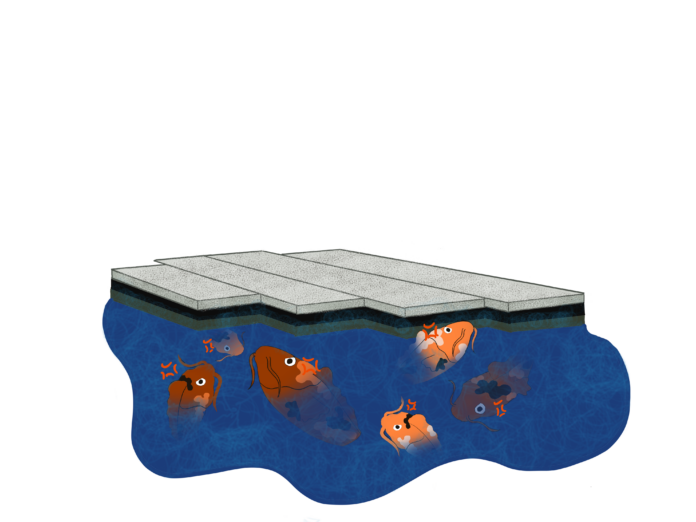
Illustration of the koi fish in AQ, looking visibly angry.
ILLUSTRATION: Raissa Sourabh / The Peak

By: Nercya Kalino, Staff Writer

Dear SFU,

One would think that the reflection pond has a sense of purpose, considering its name. I have never come across such oblivious humans in this concrete confinement I’m obliged to call home. As the oldest fish in this pond, I find it baffling — almost jaw dropping — at how the students in this university seem to be unaware of the purpose of the reflection pond. It’s in the name!

I don’t get that many visitors, you know. No one wants to talk about how they feel, or even just come out and sit in silence looking back at the reflection of their images casted on the serene, still water. I will say this: as I’m getting closer to kicking the bucket, I find that my skills as a master of self-reflection are quite redundant. I didn’t ask for this, you know. I just wanted to be like the rest of the fish with no worries — except for plastics in our waters — but no! I was given this job to listen to a person’s thoughts . . . and when the moon is full, I ought to pray to it as a way of helping. I am special! But what is it good for if none of you brave opening up to me?

And don’t get me started on why the Avocado is a waste of space! Just the most useless statue among the rest. It is ludicrous that everyone is in love with the Avocado. People have reflected more on its existence than they have pondered my glorious presence. I used to wonder what the fuss was all about. One day, out of curiosity, I leapt out of the water and landed on the pavement. Yes, I risked my life to unveil this mystery. I stared hard at the Avocado and thought to myself, “I don’t understand these people — this is pathetic.” Before I knew it, raccoons thought I was dinner and scrambled towards me! Luckily, my old friend, Crow the Might, pushed me back into the water. I was bedridden for weeks before I could comfortably swim again. How I loathe the Avocado. Yet, you would rather stare at that . . . thing and ask each other the least philosophical questions. 

Let me tell you who among you is the most perceptive. The daycare children! Every once in a while we hold a festival for them as they walk on by. We gather at the pathway and cheer at the bumbling creatures. The children smile and applaud at our performance! They gather at the edges of the water. Some of them receive insightful foundations of self-consciousness. You can see the glimmer in their eyes when they find themselves within the reflection of the water. We call them the beholden ones. They are my favourite, because they appreciate my existence. You students, on the other hand, leave me speechless. 

You would think that maybe the professors are not the same. This is true, but not in the way you think. They gossip, I can tell by their laughs. They cackle and snort as they walk around the pond during their breaks. They call it, “Getting some fresh air!” Ha. Here in the pond, we call them chatterboxes. Like a radio, you simply have it on for background noise. 

As for you students, we do not have a definite name for you yet. Sometimes, we call you “zombies” because of your eye bags, to others we call, “happy litterers” but that’s a smaller demographic. On good days, we call you strangers because never have we seen you look back at yourself from the pond. Maybe you ought to give it a try. Screw this place.

Diving back into the ocean floor,

An Angry Koi

The rivalries of SFU men’s basketball team

0
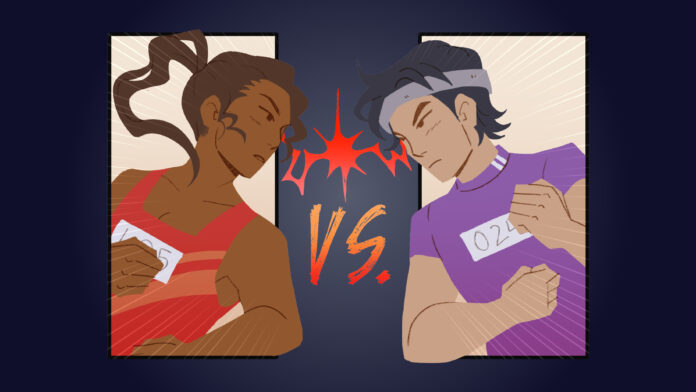
Illustration of two runners intensely staring at each other.
ILLUSTRATION: Jill Baccay / The Peak

By: Simran Sarai, Sports Writer

Everyone loves a rivalry. 

Rivalries, between teams or players, are a big part of what makes sports so thrilling. No matter what level of competition you’re at, a high-stakes match against an age-old foe will always get your heart pumping. And since rivalries are as transitional as relationships, their circumstances change. Some rivalries are one and done, and momentarily spark after tensions run high in a game. But others seem to be written in the stars. Like a cross-town rivalry. 

The Peak sat down with SFU men’s basketball player Victor Radocaj to discuss what rivalries are unique to SFU’s men’s basketball team. Radocaj, who’s majoring in computer science, boiled down the essence of a lively rivalry to its history. 

He cited SFU and UBC as a “good example.” He added, “They’re both in BC, they’re the two biggest universities in BC, and there’s a history of us playing each other, even though we’re not in the same league. The only reason we play that game is really because of the rivalry.”

The annual game between SFU and the UBC men’s basketball teams, coined the Buchanan Cup, packs the bleachers every year, irrespective of which school hosts the game. Radocaj said the support from fans has a circular effect, bringing supporters in, and further amplifying the rivalry between the two teams.

“SFU sold out the gym and it was overcrowded — they had to turn people away — which you generally don’t see,” the forward shared in reference to this year’s turnout. “So, it definitely gets the crowd and the people watching the teams more invested, because it’s really easy to rally behind a team when you have something to fight for.”

While some of the most quintessential rivalries in sports occur between two superstar athletes trying to outdo the other, Radocaj said that individual rivalries at this level are kept to a minimum. If anything does occur, it’s “usually interpersonal stuff.” The lack of one-on-one competitive rivalries is due to the constant influx of players coming in and out of the league, which makes it hard to establish and sustain a rivalry. “Without the history, the rivalry can die really quick,” Radocaj added.

Although UBC is an obvious foe for SFU as a whole, with the two schools drawing constant comparisons, the Red Leafs men’s basketball team also has a lengthy history with a nearby stateside school. “I know that Western [Washington University] we consider kind of a rivalry because they’re pretty close,” said Radocaj.

Recently, SFU has been successful against Western Washington. After losing eight games in a row since 2012, the Red Leafs toppled Western Washington both times they played last season. Although, coming up short to their southern rival this year, wins against a tough opponent like Western Washington seem to be frozen in time. So much so, that a single win can make a world of a difference. 

Another difference maker between rivalries is intensity. Radocaj shared that no matter which rival the team is preparing to play, those high-stakes match-ups amp up the energy for the team and individual athletes. “UBC was one of the games we were most excited to play as a team. We were super hyped up, even though half of us aren’t even from BC,” Radocaj joked. 

On the surface, players may treat a rivalry game like any other match, but with history on the line, there’s always extra preparation that goes into playing these types of games. “When a rivalry game is coming up, there’s no messing around. You’re focused on one thing; you’re focused on your goal.”

SFSS election results: new executive committee announced

0
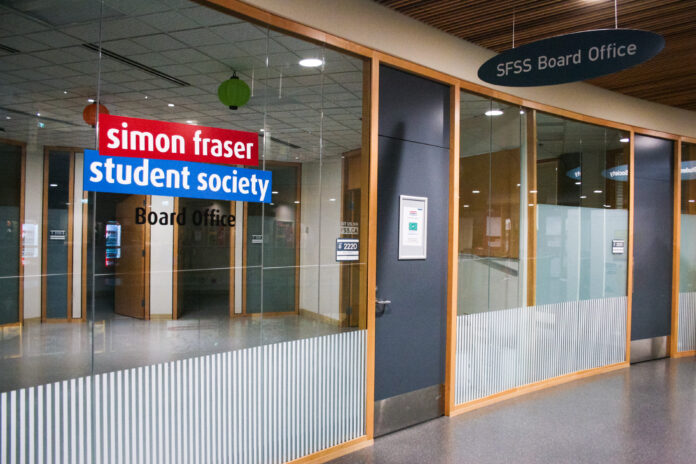
This is a photo of the SFSS offices. Their logo is printed in large letters on the window.
PHOTO: Gudrun Wai-Gunnarsson / The Peak

By: Vee Babbar, Peak Associate

The Simon Fraser Student Society (SFSS) provides the SFU undergraduate student body representation, support, community, and extracurricular opportunities. The recent voting period has revealed the new executive committee and referendum vote results. 

Newly Elected Executive Committee

The SFSS is made up of representatives from each undergraduate department. They also have the executive committee, made up of the president and six vice-presidents. As the previous executive committee’s year-long term is coming to a close, the elections to elect the new executive committee has now closed. The voting period ran from February 14–16, and the results were announced the next day. 

Liam Feng was elected the president with 430 votes in favor and 255 against. The vice-presidents elected are as follows:

  • Vice-president of internal and organizational development: Leonarda Ognjenovic (430 votes in favour, 203 against)
  • Vice-president of finance and services: Jadvinder Bolina (431 votes in favour, 200 against)
  • Vice-president of the university and academic affairs: Thomas Lueth (354 votes)
  • Vice-president of external and community affairs: Nancy Brar (466 votes in favour, 162 against)
  • Vice-president of equity and sustainability: Priyanka Kaur Dhesa (394 votes)
  • Vice-president of events and student affairs: Ayooluwa Adigun (435 votes in favour, 171 against)

Referendum Results

The referendum upheld four questions in total. The first referendum was to increase the SFSS Student Health and Dental Plan to keep up with inflation. If passed, the fee would have increased by $31.92 and given the SFSS permission to increase by another 5% every year. The updated plan would have given students access to unlimited mental health counselling and psychology services. 

The SFSS attempted to make these changes at the previous referendum in November 2022, but the vote failed to reach quorum — not enough students participated in the vote so it did not pass. During this voting period, the vote also failed to meet the 50% majority required to pass: there were 307 in favour and 498 against. 

The second referendum proposed a revision of SFSS bylaws to correct minor typographical and grammatical errors. Although it received more votes in favor (526) than against (180), it still did not meet the required threshold of two-thirds of the total majority. 

The third referendum asked for bylaw updates to clarify, safeguard, and democratize the current regulations. This referendum also failed to meet the required voting threshold, with 508 votes in favor and 163 against. 

Finally, the fourth referendum proposed updating bylaw six to allow e-voting in council meetings. It received 509 votes in favor and 174 against, but this was still not enough to pass.

The SFSS was unable to meet the required voting threshold to pass any of the four referendums.

Duo disaster with Canvas

0
A cropped illustration of Duolingo’s mascot, a green owl named, “Duo,” peering at the viewer.
ILLUSTRATION: Amanda Eng / The Peak

By: Hannah Kazemi, Staff Writer

SFU’s latest Canvas update has students and profs fighting for their lives. The new feature brings the worst of popular language app Duolingo to motivate the way students study and get their work done. Casey Aoibheann Doyle, a third year Criminology student, can’t take it anymore. If you ask me, her story is not a hoot . . .

Upon opening her laptop, Casey is prompted to say “hello” to Duo, the iconic and notoriously chaotic green Duolingo owl. Duo’s job is to make sure Casey stays on track with her school work. Duo will live on her computer to provide short messages of encouragement and remind her what she has left to do. Casey accepts the terms and conditions of installing the Duolingo x Canvas update and closes her laptop. “Finally, something useful SFU’s decided to spend their money on,” Casey remarks.

The next day, Casey is writing an essay when she decides to take a break and watch videos on YouTube for a few minutes. Little Duo pops up at the corner of her screen blaring “Don’t Start Now” by Dua Lipa, catching Casey off guard. The word “start” is replaced with “stop,” so she jokingly thinks Dua Lipa is reprimanding her for taking a break from the paper. Casey does not care for Duo’s tastes for Dua, really, but wants to be polite. Of course, she is also impatient.

Duo gets halfway through the song before Casey finds a way to cut the music off. She doesn’t particularly care for the song, and Duo looks offended. “Duo is sad . . . but not as sad as Casey will be if she turns off Dua Lipa again! Dua Lipa is Duo’s favourite. Don’t make Duo mad.”

Just like that, Duo disappears into the ether. Casey brushes off the snide comment as a stereotypical reflection of Duo’s love of Dua Lipa. It would be more accurate to say that Duo is obsessed with Dua Lipa. Casey remembers this from TikTok. She makes a mental note to expect more Dua Lipa than she’s ever heard before, so long as Duo’s around.

Casey goes back to her essay and takes another break, this time to scroll through Instagram for a while. A reel from Duolingo’s account comes across her feed featuring Duo dancing to a mashup of Dua Lipa songs. Text that says “Duo is Watching” appears at the end of the reel just before Casey scrolls past it.  Duo pops up in the corner of her screen and starts screeching “Prisoner” by Miley Cyrus and Dua Lipa as her phone turns to static. “You’ve barely written anything! Two hours wasted flipping between apps . . . and you don’t even follow Dua Lipa. Duo is watching you . . .”

As quickly as Duo appeared, Casey’s screen went black and Dua Lipa’s version of “Cold Heart” started playing at maximum volume from her laptop. She’s spooked once again by the vague and mysterious presence haunting her. Casey turns the song off and mutes the entire laptop. Casey decides to uninstall the Duolingo x Canvas update because she’s over it and doesn’t like the idea of a cryptic bird stalking her every move.

But before she can hit the “uninstall” button, a low and hazy fog begins to roll into her bedroom. She hears a mishmash of Dua Lipa songs faintly playing in the background. One by one, “One Kiss,” “New Rules,” and “Levitating” all consume and surround Casey in a soundscape of Dua! She searches her room for a way to make it stop. Casey is crouched over with her hands covering her ears and her eyes squeezed shut as a grizzly bear-sized Duo comes crashing into her room, flapping massive green wings at her. 

“YOU DISOBEYED DUO! DUO TOLD YOU TO NEVER TURN OFF DUA LIPA AGAIN! DUO WILL MAKE YOU PAY!!”

The volume of the music intensifies as Duo flies through the window in Casey’s room, smashing it to pieces. Casey’s laptop bursts into flames. Now she knows: more important than her assignments is a cultivated love for Dua Lipa (not sponsored). She will never disobey Duo ever again.