Go back

Reclaiming disability narratives through art

By: Olivia Visser, Opinions Editor
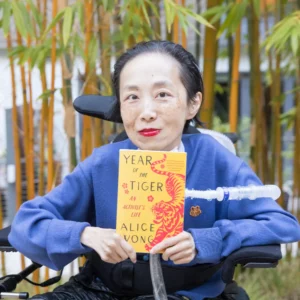
Photo of Alice Wong, an Asian American disabled woman in a power chair, against a background of bamboo trees. She is wearing a blue cardigan and sitting in a power chair. She is holding a copy of her memoir, Year of the Tiger, a paperback in yellow and red with a fierce tiger on it designed by Madeline Partner. She is wearing a bold red lip color and a trach at her neck.
PHOTO: Eddie Hernandez Photography

Alice Wong

Alice Wong is an Asian-American “disabled activist, writer, editor, media maker, and consultant.” She founded the website Disability Visibility Project, a platform to share and connect disabled voices. Wong is well-known for her writing on topics like disability justice and culture. Her work has been featured in publications such as the New York Times, Vox, and Radiolab, and covered across multiple news publications. Some of her most notable publications are the books Year of the Tiger: An Activist’s Life and Disability Visibility: First-Person Stories from the Twenty-First Century. Wong’s writing emphasizes the need for better support and representation among disabled communities. She’s also an active member of Twitter’s disability community @SFdirewolf and on Instagram @disability_visibility

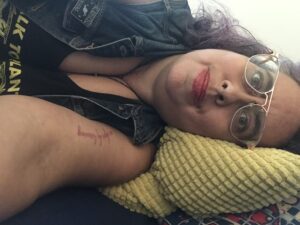
A 40ish mixed race Sri Lankan, Irish and Galician nonbinary femme with curly brown silver and purple hair, lying on a couch looking at the viewer horizontally. They have rose gold aviator frames, thick eyebrows, red lipstick and sand colored skin, and are looking at the viewer with a kind of tired but hopefully crip wonder. They wear a blue denim vest with a pin that says Neurodivergent Universe above a pink and blue image of a ringed planet, and a black tank top with yellow lettering that read Talk To Plants, Not Cops is barely visible. They have a tattoo of the words "We begin by listening" in magenta cursive script on their left arm.
PHOTO: Syrus Marcus Ware

Leah Lakshmi Piepzna-Samarasinha

Leah Lakshmi Piepzna-Samarasinha is a “nonbinary femme disabled writer and disability and transformative justice movement worker of Burgher and Tamil Sri Lankan, Irish and Galician/Roma ascent.” On top of their poetry, they’ve authored and co-edited ten books and have won multiple awards for their writing. Their latest publication, The Future is Disabled, asks the question: “What if, in the near future, the majority of people will be disabled — and what if that’s not a bad thing?” The Future is Disabled highlights the necessity of disability justice in the age of COVID-19 and systemic barriers that exacerbate or lead to disability. They can be found on Instagram under @leahlakshmiwrites.

Yo-Yo Lin

Yo-Yo Lin is a “Taiwanese-American, interdisciplinary media artist” who uses innovative techniques like animation, performance, and sound. According to her website, her work “reveals and re-values the complex realities of living with chronic illness and intergenerational trauma.” Yo-Yo’s art has been shown at Lincoln Centre, New York Film Festival, SXSW, and many other galleries and conferences. She blends futuristic, trance-like visuals with emotive elements like nostalgia and isolation. Her online portfolio showcases some of her art, and is definitely worth checking out. 

Sharona Franklin

Sharona Franklin is a Vancouver-based “multidisciplinary disabled artist, writer, designer, consultant, and advocate.” Her work has been featured in Vogue and Pinup Magazine, among other publications. Franklin largely works with sculpture, textiles, and other visual mediums to conceptualize topics like bioethics, disability justice, and life as a chronically ill person. She publishes her artwork under the social media handles @paid.technologies, @star_seeded, @hot.crip, and @disabled_personals.
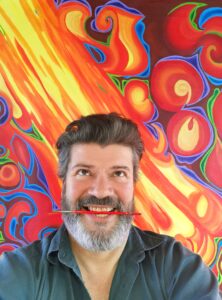
Michel poses for a selfie with a joyful expression on his face and a paintbrush between his teeth. He is standing in front of a fiery painting with vibrant yellows and reds with a touch of blue swirls.
PHOTO: Michel Dumont

Michel Dumont

Michel Dumont is a “Métis, Two-Spirit artist descended from the Robinson-Superior Treaty Area.” He’s known for his “wearable art” which has been featured in multiple art shows and exhibitions. He also uses vintage tiles to create colourful upcycled mosaics. Dumont wrote a piece for Canadian Art that describes the challenges of Canada’s “tokenization” of BIPOC and queer creators. He stated it was only until recently that funding agencies moved beyond requiring traditional materials like “leather, sinew, and beads” for Indigenous artwork. Dumont also stresses the need for better representation of Indigenous and disabled creators. You can find him on Instagram at @madbear67.


Was this article helpful?
0
0

Leave a Reply

Block title

New immunotherapy treatment provides hope for aggressive cancer

By: Lucaiah Smith-Miodownik, News Writer Surgery, chemotherapy, and radiation therapy are often recognized as the three most common forms of cancer treatment. Sometimes, the latter two approaches become no longer effective when cancers become drug resistant, allowing the cells to further spread. At the University of Calgary, however, promising developments in immunotherapy intervention seek to provide alternative treatment when common therapies are not viable.  Cells continually divide to replenish dying cells, but certain gene mutations can create cancer cells, which divide and spread in an uncontrolled manner. The human body naturally defends itself from cancerous cells, though sometimes they can “hide from the immune system and avoid being destroyed,” according to the Canadian Cancer Society. Immunotherapy seeks to help strengthen the ability to recognize and fight...

Read Next

Block title

New immunotherapy treatment provides hope for aggressive cancer

By: Lucaiah Smith-Miodownik, News Writer Surgery, chemotherapy, and radiation therapy are often recognized as the three most common forms of cancer treatment. Sometimes, the latter two approaches become no longer effective when cancers become drug resistant, allowing the cells to further spread. At the University of Calgary, however, promising developments in immunotherapy intervention seek to provide alternative treatment when common therapies are not viable.  Cells continually divide to replenish dying cells, but certain gene mutations can create cancer cells, which divide and spread in an uncontrolled manner. The human body naturally defends itself from cancerous cells, though sometimes they can “hide from the immune system and avoid being destroyed,” according to the Canadian Cancer Society. Immunotherapy seeks to help strengthen the ability to recognize and fight...

Block title

New immunotherapy treatment provides hope for aggressive cancer

By: Lucaiah Smith-Miodownik, News Writer Surgery, chemotherapy, and radiation therapy are often recognized as the three most common forms of cancer treatment. Sometimes, the latter two approaches become no longer effective when cancers become drug resistant, allowing the cells to further spread. At the University of Calgary, however, promising developments in immunotherapy intervention seek to provide alternative treatment when common therapies are not viable.  Cells continually divide to replenish dying cells, but certain gene mutations can create cancer cells, which divide and spread in an uncontrolled manner. The human body naturally defends itself from cancerous cells, though sometimes they can “hide from the immune system and avoid being destroyed,” according to the Canadian Cancer Society. Immunotherapy seeks to help strengthen the ability to recognize and fight...