Home Blog Page 14

Inmate blames prison time on éclair shortage

0
A woman holding a coffee cup and an éclair in her hands, enjoying her bites.
PHOTO: Pvproductions / Freepik

By: Noeka Nimmervoll, Staff Writer

My university life was garbage. Except for that time of the day when I’d find myself in front of my favourite place, Café Pour Moi  — where heaven meets my mouth, where I’d get my little treat of choice, an éclair. That cream that oozed out as soon as you took a bite, the chocolate that crunched just enough, the treat that was carried by the most perfect vessel of pastry encasing a velvety soft egg custard. My éclair was the one perfect thing in my life. 

So, one day, after a morning of boring classes filled to the brim with boring people, I made my way over to the bakery, as usual. I was thinking about it all day. It was the only thing that kept me going. When I got there, there was a sign on the door. 

HEALTH CODE VIOLATION: PERMANENTLY CLOSED. 

Oh no. NO, no, no. This couldn’t be true. Not now. I felt faint. I heard a scream, and then — darkness. I came to, about two hours later, in the driving seat of a car I didn’t recognize. But I knew what I had done. I had stolen a car. Damnit. Don’t ask me how I know. I was a woman depraved. I was capable of many evils.

I thought to drive home in this car, but I realized too soon that there was no way I was going to get away with my crime. I parked the car on the side of the road and pushed it into a nearby ravine. I know — I’m super strong and a crook. What can I say? Without my one dependable, I was running on pure anger. 

The next day, I walked to class despite all the voices in my head telling me to give up. There were flyers pasted everywhere on campus. “HAVE YOU SEEN MY CAR?” they read. God, get a life. Some of us have real problems. 

I finished my morning classes and took one step towards the bakery — and stopped. My heart crumbled as I remembered my bitter reality. I fell apart like a day-old éclair tossed around in my backpack. But there are no more éclairs. No joy. Nothing good anymore. 

I started trying to think of things that could bring me back to life. Something that could provide me with even a fraction of the joy that my dear éclair would give me. I remembered I had a real fondness for a cat I had met once. It lived on the outskirts of Richmond, near the airport. I remembered something from a YouTube video I had seen. Lasers attract cats. I would drive over and find that cat if it was the last thing I did. 

So I drove over to Richmond, laser in hand. It was dark when I got there, and I didn’t really remember where I had met this cat. I wandered around with the laser, shining it here and there. I heard the loud whoosh of a plane taking off from the runway. I startled up and followed my laser on it. The plane lights flooded my vision and I felt faint. I heard a clamor of screams from above. My éclair was the last thing on my mind before I passed out.

I woke up in a jail cell, that’s how this story ends. Apparently, it’s a federal crime to shine lasers at pilots. The judge sentenced me to three years in prison. And prison? It’s shit. Turns out there’s no fucking éclairs in here either. How am I supposed to survive three years in this place? Life’s a tragedy.

SFYou: Steven C. Gull

0
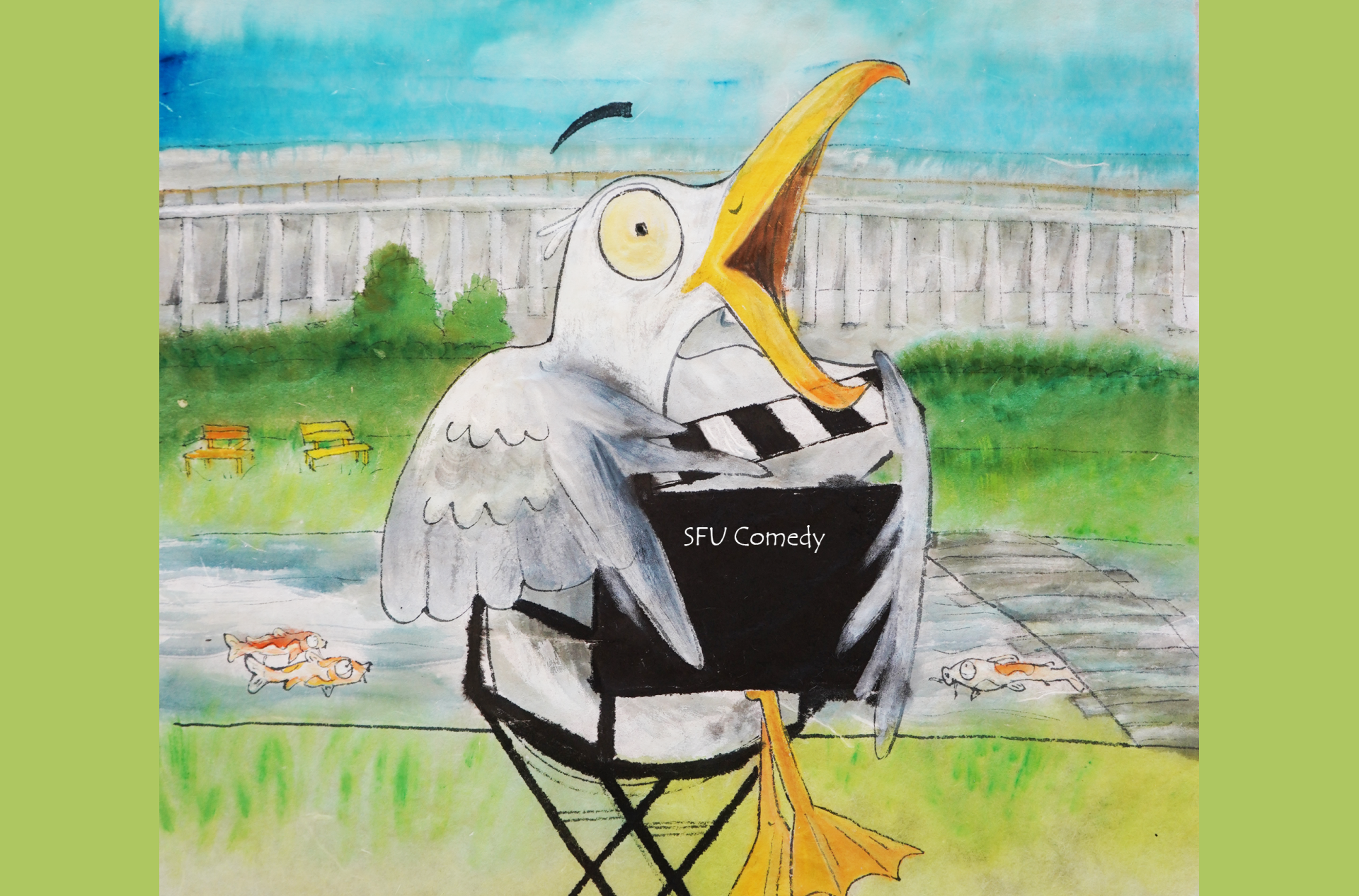
A seagull sitting in front of the koi pond. He’s holding a director’s clapper.
ILLUSTRATION: Angela Shen / The Peak

By: Lucaiah Smith-Miodownik

If you’ve taken some time to explore around SFU, you’ve likely stumbled upon the reflecting pond. This aquatic tapestry is home to many creatures, including koi fish, herons, and even the occasional automobile. The Peak sat down with Steven C. Gull, a local resident, to get the scoop on what life at the pond is truly like.

Please note that this interview has been edited for concision and abundance of squawking. 

Can you start by introducing yourself? Who are you, and how long have you lived at the pond?

“You can call me Steve. I’ve been around for about five years now, but I just officially moved into the pond full-time. I recently wrapped up my English degree here at SFU. I’m a big fan of the classics, you know — FrankenseagullA Christmas CarGull, A Tale of Two Seagulls, those kinds of things.”


What brought you to SFU?

“I grew up about two hours from here as the gull flies. When it came time for university, I wanted to leave the nest and see the world — plus I heard that SFU had a great selection of stray french fries and various bugs. Since graduating, my parents have kind of just been bankrolling me while I try to get my new original screenplay picked up. Listen, it’s not easy being a creative. That’s actually part of the reason I moved down here to the pond from the roof of the library. I needed to get away from all those comforts and really reconnect with nature. My story is about a young crow who falls in love with a robin, but their families have this whole feud thing going on and yada yada . . . I won’t spoil the ending for you. It’s an original plot, one of a kind.

“I thought about migrating down to LA, because my buddy Jonathan Livingston has some connections around there, and he said he could hook me up. But I just couldn’t leave the pond like that. I mean, what can I say? It’s home.”


And you’ve lived here for how long?

“Well, technically, it’s been only two days. I would’ve gone earlier, but I needed the movers to bring in my portable sauna and my cruelty-free, ethically sourced latte espresso machine. Because I’m chill like that. Just the essentials, you know?”


So, how are you liking the pond so far?

“It’s good man, no complaints. Well, maybe just one little thing. I like to get up early and take a dip to start my mornings. It’s supposed to be good for the brain and body, gets the juices flowing. So, the other day, I had my earbuds in and was listening to NPR’s Wait Wait . . . Don’t Tell Me! You know, I love Peter Seagull. Great host. Anyways, I get in for a quick plunge and all of a sudden I bump into this koi fish out of nowhere. Totally messes with my vibe. So I tell him like, ‘C’mon dude, I’m clearly doing something important here.’ 

“Next thing I know he’s got this whole, ‘Hey buddy, I’ve been doing the same commute for 20 years, just trying to get to work and keep my kids fed’ shtick. It’s like, some people really just don’t care about their community at all, you know? Anyways, I’m hoping they could maybe tear down some of these older spots around the pond and bring in something like a Whole Foods or a hot yoga studio. That would really fix things up.”


Thanks for taking the time to talk with us, Steve. Is there anything else you’d like to add?

“Yeah, just keep an eye out for when my new work, Romeo and Gulliet, drops. It’s going to be a real tearjerker.”


Book Nook: A selection of political books from Southeast Asia

0
Books
Photo: Gülfer ERGİN / Unsplash

By: Phone Min Thant, Arts & Culture Editor

From the protests against corruption happening in the Philippines and Indonesia, to armed struggles for democracy in Myanmar, Southeast Asians are exposed daily to the importance of political expression. In a region where authoritarian forces limit such expressions both physically and online, one way these political expressions have been made visible to the outside world is through books. Although there is a huge variety of such books, as someone who has lived through the region’s many turmoils, here are a few of my favourites.

No Bad News for the King by Emma Larkin

Cyclone Nargis is remembered among the Burmese as one of the country’s most destructive natural disasters. In No Bad News for the King, Emma Larkin, an American journalist operating in the Burmese underground, wrote about her experiences travelling around the country in its aftermath. Using first-hand testimonies of victims, eye witnesses from herself and other concerned citizens, and through collaboration with various aid organizations inside Myanmar following Nargis, Larkin documented the Burmese military government’s heavy-handed neglect towards the suffering of its own citizens. Written against the backdrop of massive censorship inside Myanmar, the book is both eye-opening and saddening, and a lot of painful parallels could be drawn from the book towards how the incumbent military government horribly handled the recent earthquakes in Myanmar.

Blood and Silk by Michael Vatikiotis 

Blood and Silk is an underrated gem of a book that, in my opinion, successfully condenses the maze that is modern Southeast Asian politics. Through both scholarly research and his own experiences as a journalist during the region’s many tumultuous periods — from the Indonesian occupation of East Timor to military coups in Thailand — Vatikiotis explores how concepts of power and conflict have been a part of everyday life in Southeast Asia. His analysis is accessible and detailed, looking at historical and cultural processes of conceptualizing power in attempting to explain authoritarian resilience in most of Southeast Asia. He also dedicated a few chapters to explaining how conflict — both intra- and inter-state — works in the region in the 21st century, although I personally preferred his studies on power. I mainly liked how the book did not take a discrete country-by-country analysis but cross-cuts similar themes such as corruption and democracy across multiple states simultaneously.

In the Dragon’s Shadow by Sebastian Strangio

It is almost impossible to talk about Southeast Asia today without taking China into account. A work that inspired my undergraduate Honours thesis in International Studies, the book is the most up-to-date account of how Southeast Asian states interact with their increasingly powerful neighbour. Extremely readable, Strangio’s years of lived experience of correspondence in the region — and its myriad of interviews from village pastors to government bureaucrats — combine masterfully with research and analysis. Strangio shows that diplomacy is not always a simple binary of good vs. bad nor strong vs. weak by looking at the nuances of how smaller Southeast Asian countries manage their relationships with China, each side attempting to take advantage of the other despite objective power asymmetries. 

Revolusi by David van Reybrouck

The Netherlands still struggle with coming to terms with its colonialism. If other works have not proven Dutch colonialism’s horrors enough, Revolusi nails them down. Not sparing the details of the violence that surrounded the Indonesian war for independence, van Reybrouck relied on testimonies of survivors of this tumultuous times — both Dutch and Indonesian — to paint a vivid portrait of the human sacrifices that went towards “the birth of the modern world” in Southeast Asia. While its central focus is on the struggle for Indonesian independence, a caveat is that it is inevitably a heavy book that not only explores colonialism and Japanese occupation, but also the history of the Indonesian people from prehistory

The White Umbrella by Patricia Elliott

A book different from others in the list, The White Umbrella follows the life of the family of Myanmar’s first president through British colonial rule, Japanese invasion, and Myanmar’s path of prolonged military rule. The book dives deep into Myanmar’s conflict-ridden history from the perspectives of the ethnic minority Shan people, from the old palaces of its royalty to government offices of a newly independent nation, to insurgent camps all the way through to Vancouver. While most of the story is based on extended accounts by Sao Hearn Kham, the wife of the first president turned rebel leader and then refugee, The White Umbrella is both tragic and inspiring, offering an intimate outlook on a hopeful nation plunged into an authoritarian disaster bred by colonial legacy. I have spent many evenings following Myanmar’s 2021 military coup, rereading and reflecting on the pages of this book.

A first look at the Gibson Art Museum at SFU

0
PHOTO: Audrey Safikhani / The Peak

By: Noeka Nimmervoll, Staff Writer

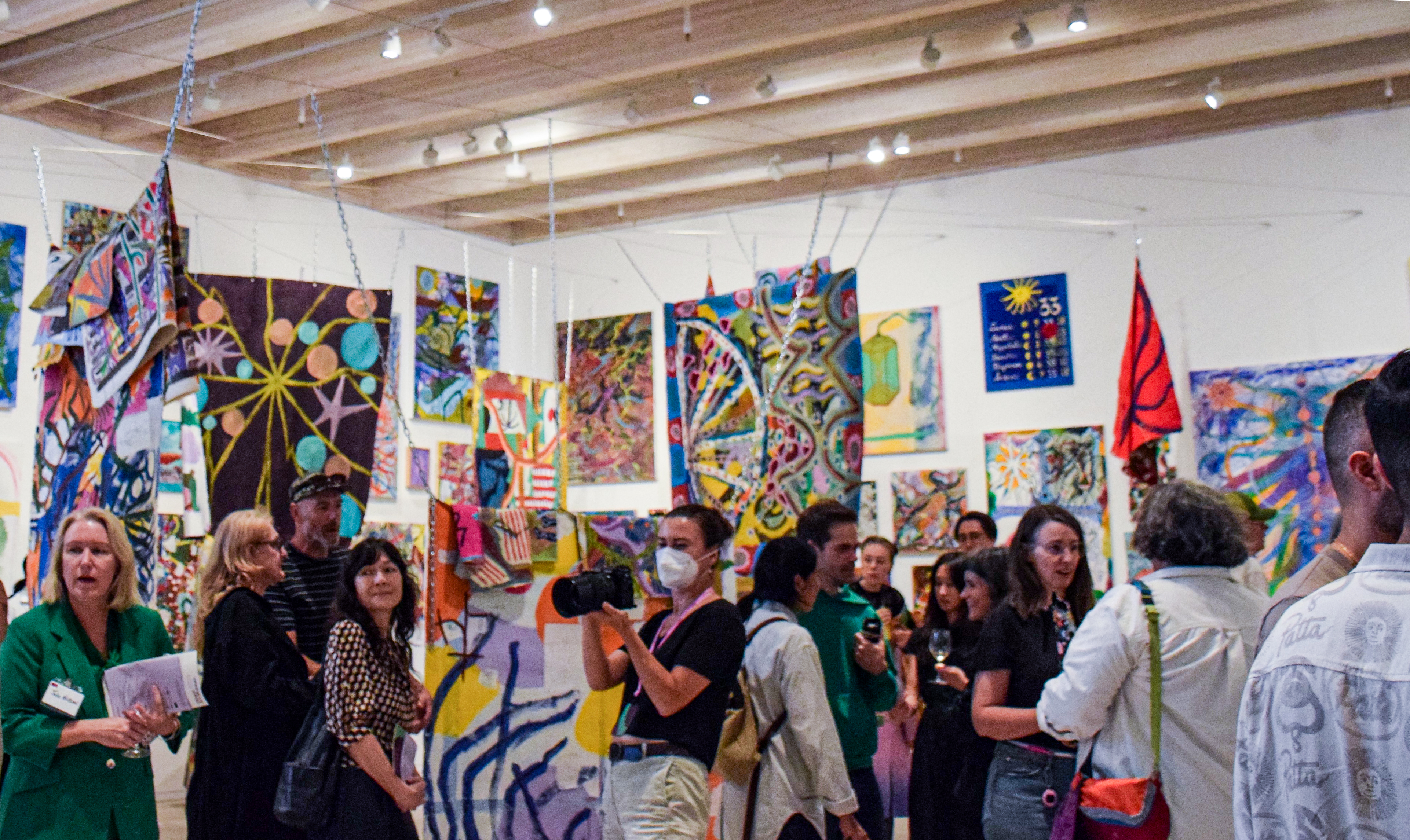
On September 20, 2025, the Marianne and Edward Gibson Art Museum opened its doors to the SFU community and the broader public. Pleasantly, admission to the Gibson is always free, and its operating hours are from 11:00 a.m. to 5:00 p.m., from Wednesday to Sunday. 

The museum is situated directly beside the SFU Transit Exchange, near Strand Hall. The building, an award-winning design by Siamak Hariri, was under construction for 18 months and resulted in an open and beautiful space that encourages movement and curiosity. The forum, which currently features the work Blue Students/Alumnos en azul (1997) by Liz Magor, is visible from the outside through the large glass panels. The inaugural exhibition, Edge Effects, refers to a term in geography describing the change in biodiversity and its subsequent community relationships at the convergence point of two different ecosystems. For the museum as a whole, the concept is a nod to its positioning at the edge of an academic institution and the unique community and exchanges it fosters through its presence.

15 different artists feature their work in the inaugural exhibition, with ten of them commissioned. On the wall of the building’s hearth, a collection of over 40 captivating porcelain creatures and pine preserves make up a forest of tree spirits, or kodama. This commissioned work, is Arboreal Time (2025) by Cindy Mochizuki, is an exploration of trees’ perception of time. In Edge Effects, I enjoyed Lucien Durey’s Dish Rack with Plates, Towel, Rag and Brush (2025), which explores the often gendered task of dishwashing within the context of community support. 

Marianne and her late husband, Dr. Edward Gibson, shared a vision of art’s ability to connect people through culture, ideas, and knowledge. This gallery expands their vision into a lasting legacy. “Our aim is to create a new kind of art museum that lowers barriers to those who have historically felt excluded, embraces intergenerational, decolonial learning, and encourages cross-disciplinary inquiry and meaningful encounters with art,” stated the Gibson.

Opening day at the museum seemed a bustling success. The staff were kind and well-informed. The museum shop, a must-see, is filled with unique ceramics, bags, and other lovely knick knacks. I was intrigued by their eclectic collection of literature: reasonably priced and so niche. A personal highlight of the exhibit was Soupson: eating borscht, an Eastern European beet stew in the gallery’s foyer. It was served in beautiful ceramic bowls, on a food cart/table made by Germaine Koh — what a delicious work of art. I left the opening party excited about the new gallery:

The Gibson team seems to be cognizant of its impact on its surroundings, and aims to be a place of learning as well as teaching.

I was impressed by the level of care they put into the inauguration of this exhibition, and I look forward to visiting again soon. 

Edge Effects runs from September 20, 2025, to February 15, 2026. 


El Jockey blends dark comedy and absurdity

0
IMAGE: Courtesy of Rei Pictures, El Despacho, Infinity Hill, and Exile Content

By: Gurnoor Jhajj, SFU Student

On September 14, the 23rd Vancouver Latin American Film Festival wrapped up its ten-day run full of movies, music, food, and a collective enjoyment of Latin American cinema and its charms. The festival’s closing night featured El Jockey, a peculiar dark comedy by Argentine director, Luis Ortega, featuring music from Collective SUR, a Latin American band consisting of local talent. I didn’t know what to expect walking into the VLAFF for the first time, but by the end of the night, I left with a story, a new perspective on the city I have lived in for the past 19 years, and a newfound love for vintage Latin American music.

Before the screening, the organizers reflected on the festival’s closing night, highlighting all the movies and short films shown from over 15 countries. The Consul General of the Argentine Republic in Vancouver, Ricardo Arredondo, also spoke about Argentine culture, referencing El Jockey in the process. Awards were also presented to shorts and New Directors competition, with Welcome taking home the prize for the former category, and My Chest is Full of Sparks being honoured by the Youth Jury for the New Directors category. These conversations and awards set the scene for the closing film and encapsulated the festival’s celebration of Latin American cinema and the community. 

The film itself is a story set in the world of horse racing, but it quickly shifts into a surreal, complex and absurd dark comedy that makes you rethink everything. Ortega doesn’t follow a simple flow in the movie; instead, he mixes humour and absurdity that makes the audience laugh, yet also unsettles them. The film stars Nahuel Pérez Biscayart, one of Argentina’s most famous actors, as Remo Manfredini, a legendary Jockey, and Úrsula Corberó, famously known for playing Tokyo in Money Heist, as another Jockey and his girlfriend, Abril. After a life-threatening accident, Remo disappears from the hospital and roams the streets of Buenos Aires, leaving his past behind and discovering who he really is. The movie, at its core, is about ambition, morality, and ever changing and unpredictable human nature. 

What stood out to me the most about the movie was the way it mixed comedy with dark undertones. The theatre was frequently filled with laughter at moments, proving that Ortega’s humour struck a chord even across cultural and language differences. These shifts between dark humour and absurdity often left me wondering whether I should laugh, feel uneasy, or both. Biscayart and Corberó also portrayed their complex characters beautifully, depicting the slightest emotions through their eyes. The music score was a major contributor to the film’s mood. It featured Argentine songs from the 1960s, ‘70s and ‘80s, mixing the vintage music with newer sounds from different languages, creating a contrast of both nostalgia and absurdity, matching the scenes. As I went home afterwards, I added the soundtrack to my playlist and logged onto Letterboxd to write a review. This small act reminded me that some movies just don’t end when the credits roll, but they leave the theater with us sneaking into our lives.

The end credits rolled, and the theatre buzzed with a final sense of laughter and conversation, the festival coming to an end. Latin American storytelling shone throughout its ten days, and El Jockey ended it with an unexpected yet memorable twist.

Through humour and sophistication, the film served as a physical reminder of why festivals like this matter. They bring global voices to Vancouver and give the audience a chance to learn, laugh, and live across borders, all on the big screen.


SIGGRAPH 2025: a retrospective

0
ILLUSTRATION: Yan Ting Leung / The Peak

By: Jin Song, Peak Associate

SIGGRAPH (Special Interest Group on Computer Graphics and Interactive Techniques) is the largest computer graphics conference in the world, bringing together scientists, artists, and other professionals working on cutting-edge technologies in the field. It has hosted guest speakers like Mark Zuckerberg and Jensen Huang. This year, it was held in August in Vancouver.

I learned about the conference’s existence and the fact that it would be local in CMPT 361 (Introduction to Visual Computing), which I took last year. I heard about it once more in CMPT 466 (Computer Animation), and my professors — who were also in attendance — encouraged the class to apply to be student volunteers if we were interested. 

Indeed, from a young age, I had been interested in computer graphics (specifically, animation), so I was naturally intrigued. I applied to be a student volunteer and was accepted. It was one of the coolest weeks of my life, and I interviewed three other SFU students about their experiences with the conference.

Michael Xu, a computing science PhD student, gave a presentation on his contribution, PARC: Physics-based Augmentation with Reinforcement Learning for Character Controllers. He said he was motivated by his desire to “have a physically simulated character that can traverse a Minecraft world,” which was not present in past research. PARC is a physics-based method for iteratively training an animation machine learning model. It uses the model’s output as the input for the next cycle, progressively improving and expanding the motion dataset. 

My other two interviewees were my classmates from my computer graphics courses, Tyrus Tracey and Peter Soava. Tracey — who presented a poster at SIGGRAPH — is a fourth-year computing science student like myself, while Soava, a fourth-year software systems major, was another student volunteer.

Tracey described his contribution to the conference, titled Physically-Based Compositing of 2D Graphics, as follows: “It is basically a new type of image editing technique. Given an image, you can insert a new image onto that image. It will conform to, say, the contours of the table or the wall or lighting present, that sort of thing.” He and his classmate built a tool on top of prior work to “process a bit more usable for average people.”

Attending Xu’s presentation, looking at Tracey’s poster, and seeing all of the other SFU contributors at SIGGRAPH 2025, I was hit by a profound sense of awe. On one hand, I was incredibly impressed by the work, on a technical level. These cutting-edge innovations were truly spectacular. On the other hand, I felt proud to be part of the SFU community, and was astonished to see its influence. Having grown up in Vancouver, I had always considered it familiar and homey, so seeing it in this new, influential light was pleasantly surprising to me. 

Soava said, “I think it was really cool bumping into a bunch of industry people. It seems kind of unique because Vancouver is such a VFX hub, like you have ILM, Sony Image Works, Coalition, CD Projekt Red, EA, also headquartered here. It’s just like, you asked somebody who has worked on all these big projects, and it turns out that they were local.”

When asked if they would recommend attending, Soava said, “If you find the stuff even mildly cool, you just spend a week with a bunch of extremely cool people just talking about extremely cool stuff.” Xu said

“If you’re just interested in animation, graphics, and art, SIGGRAPH is a good place because it’s more than just a technical conference.”

— Michael Xu, SFU Computing Science PhD Student


SIGGRAPH 2026 will be held in Los Angeles from July 19 to 23.

Performative Man Contest brings more than just irony to Vancouver

0
A dude carrying a tote bag, holding an iced matcha latte and the bell jar book in another hand. He is wearing basic jeans and a Tshirt that says "Clairo #1 Fan," and a sache hanging around his neck says "Vancouver's most performative man."
ILLUSTRATION: Abigail Streifel / The Peak

By: Jonah Lazar, SFU Student

The night of September 4 saw dozens of Gen Zers adorned with tote bags, carrying vinyls and books, wired earphones, Labubu keychains, and menstrual products, gathered at Fortune Sound Club in Chinatown. Hosted by IN-D-DANCE for free, these were the competitors for the grand title of Vancouver’s Most Performative Man. Along with winning the hearts of all who spectated the competition, the winner was also presented with a matcha kit, a copy of The Bell Jar by Sylvia Plath, and, of course, a Clairo vinyl.

If you don’t know what all of this means, you probably don’t spend a lot of time online. Esther Tóthóva, organizer and club promoter at Fortune Sound, told The Peak she drew inspiration for this competition from the growing internet culture surrounding the performative man meme. “We have been seeing the trend all over and wanted to find a way to bring it to Vancouver, and do it our way,” she said. 

The performative man represents a new archetype recognized in society, especially among Gen Z and those acquainted with their online spaces. Like the hipster trend of the early 2010s, where men in plaid shirts, man buns, fedoras, and suspenders crowded local craft breweries, the identity label is a reaction to a wave of men seemingly straying from gendered expectations of traditional masculinity

As Guinevere Unterbrink, one of the organizers of New York’s performative man contest, put it: “It’s men who are trying to cater to what they think women who are feminist like. This is a criticism that is frequently made of performative men, as many people believe their superficial interest in feminism actually does nothing more than alienate themselves from the women who they are so keen to impress. Their over-eagerness to be perceived as sensitive and trustworthy often comes across as aggressively insincere. 

Almost as soon as the term emerged in the cultural zeitgeist, it became a trend to poke fun at it, especially in a self-deprecating way, by dressing up as a performative man in public and creating tutorials to help others maximize their “performativity.” This eventually evolved into the first wave of performative man contests, which took place at the start of August, mainly in public places like city parks, with the first one believed to have taken place in Seattle. Similar events have been popping up globally into the start of September, with cities such as New York, San Francisco, Berlin and Jakarta having their own iterations. 

“The turnout honestly exceeded our expectations [ . . . ] the fact that ours drew a crowd into a music venue on a Thursday was very special,” Tóthóva described the night at Fortune. “Quite a few women competed for the title, which made the night feel way more expansive and culturally relevant (because who knows these men better than the women who tried to date them, ha!)”

Similarly, on September 20, the sapphic dating/friendship app Cherry FLFM hosted a “performative lesbian contest” at Sunset Beach, and UBC students hosted their own iteration of the performative man contest. Clearly, performative identity seems to resonate in many communities.

Irony and sarcasm have been a hallmark of our generation’s humour and ways of relating to each other. This trend often represents the confusing tension between serious critique and a fun ironic meme that has everyone hopping on the bandwagon. But if identity is performance anyways, is downplaying men reading feminist literature and embracing sensitivity counterproductive? Or perhaps these contests are a way of popularizing these aspects through a trend, while being aware of the ones who take it too far and appropriate feminism for personal gain?

While the performative man contests have only been around for a couple months, the trend of young people meeting up for ironic, appearance-based contests has a history that began last October. 

Lookalike contests took the internet by storm last fall. These were originally popularised by a Timothée Chalamet lookalike competition in New York last October, before sweeping around the globe with contests popping up in Ireland, Brazil, England, and, of course, most major cities in the USA, according to Vulture. These pop-up contests often had hundreds of spectators and competitors, even attracting the attention of some of the subjects of the lookalike competitions themselves.

These two trends have highlighted an interesting phenomenon which is becoming more commonplace among our generation — a grassroots mission to create and establish third places where young people can find a sense of belonging and form community. 

Since the start of COVID-19, third places — which are areas like cafés, public squares, parks, and more — have been consistently shut down, with online forms of connection, such as social media, seeing large gains in both usage and popularity among young people. Social theorist Dr. Sarah Stein Lubrano writes in her 2025 essay, The Perils of Social Atrophy, “Public green spaces are being shut down around the world. In the UK, a pub closes each day; music venues are similarly dwindling [ . . . ] clubs and associations are [also] at a low point.”

Isolation from one another has been more and more prominent among young people for the last few years. For example, in 2023, the American Psychological Association reported that young people spend a massive 45% more time on their own than people of the same age did in 2010, which is a strong indicator of our dwindling social lives.

It can be hard to look beyond the rather harrowing statistics of our generation’s physical and social isolation from one another. However, it also means online cultures have become so intricately developed and solidified in the lives of so many young people that memes are beginning to swell beyond the confines of the internet and build physical community around them. 

This brings about an interesting new development in the way that Gen Zers socialise and form community — a splicing of online, ironic meme culture with a genuine interest in feeling a sense of belonging within a physical community. Perhaps our generation’s days of solitude and isolation are finding ways to fade, ushering in a new wave of genuine attempts to build community and sociality, masqueraded behind our familiar veil of irony. 

While it does seem as though the performative man contest trend is beginning to crest the wave of internet popularity, it seems as though this sort of event — whether it be lookalikes contests or personifications of internet memes — are here to stay.

Remembering Kulbir Kaila

0
An illustration of a closeup of a group of cleaning workers gathered at a table sharing Indian dishes.
ILLUSTRATION: Yan Ting Leung / The Peak

Interview and translations by: Ashima Shukla, Staff Writer

Written by: Petra Chase, Features Editor

Kulbir Kaila worked at SFU for 17 years. On July 28, she died at the age of 61 while working a cleaning shift on the Burnaby campus. Many of her co-workers never knew SFU without Kaila. She had one son, who visited her twice a week at her home in Surrey. Her coworkers said she was funny, hardworking, caring, and deeply valued her friendships and family. She visited her brother and sister often. Her brother, Hardeep Johal, remembers Kaila for her big heart. “She was very generous and loyal, one of the most honest people you’ve ever met,” he told The Tyee

Since her passing, her loved ones have been grappling with life without her. Memories of Kaila’s life were shared with The Peak by two of her coworkers, who were “like sisters,” Ravneet and Noorpreet. These names have been changed for anonymity.

“I still can’t believe Kulbir is gone,” Noorpreet said in Hindi. She passes by the place of Kaila’s death every day during her shifts. “It always feels to me as if Kulbir is still there, just around the corner.”

Only a few days prior to her passing, Kaila had come over to Noorpreet’s house. She described Kaila’s playful and comfortable relationship with her family, how she’d tease Noorpreet’s husband by saying he looked “worn out” and jokingly ask her daughter when she was going to get married. Noorpreet’s son, upon seeing Kaila in their home, would scold her: “Auntie, you didn’t tell me [you were coming]. I would have brought something for you,” he’d say. 

“That is how we would joke,” Noorpreet said. “She was like family to us.”

“The two of us had the same story,” is how Ravneet described their friendship. “Work together, take breaks together, leave together. We used to share everything with each other.” She explained how they’d often vent to each other over the phone about work, sometimes calling each other 10 times a day. 

A group of five of them would eat lunch every day, becoming closer over the years of working together. Like a family, “we used to sit at one table, and everyone would show what they had brought,” said Noorpreet. “We all ate together, roti and all kinds of dishes.

“Sometimes I brought gajar ka halwa [a carrot dessert]. And sometimes I brought tomato chutney. Then Kulbir would say to me, ‘Sister, how do you make this? How do you make this?’” 

“She treated everyone kindly,” Ravneet said. “If they were younger, she treated them like kids, and if they were older, she would joke with them like adults.”

For Noorpreet, Kulbir’s generosity always stood out. She recalled when she was running late for a meeting, and had to drop off her lunch bag in the staff room: “Kaila said, ‘Sister, I’ve left the generator room door open. You put your bag there, I’ll come and close it afterwards.’ This kind of conversation used to happen every day. “Sometimes I used to leave my bag there because I had to go punch in. She’d say, ‘Don’t rush, go slowly, I’ll come slowly too.’ That’s how she was, always caring. We shared a lot between us.”

On the day of Kaila’s death, Noorpreet was not at work. She received a call from Kaila in the morning, who was “very tense” about the workload expected of her that day. Kaila was increasingly scared due to the strained work environment with management and the fear of surveillance. “She wouldn’t even sit for two minutes to drink water,” Ravneet said. “She was always afraid.” In a statement to The Peak, Chris Moore, the CEO of BEST Service Pros, said, they “unconditionally refute” they foster a culture of fear. 

When Noorpreet called Kaila again that day at 4:00 p.m., there was no reply. Instead, she received a call from another colleague a little later. “I said, ‘Tell me what happened,’” Noorpreet recalled. “Then she said, ‘Auntie, Kulbir has passed away.’ Oh my God! I can’t even tell you.

 “She passed away on Monday, and when I came to work on Tuesday, I cried so much.”

The two also described their frustrations with their management as they tried to advocate for better conditions for Kulbir. For example, they encouraged Kaila to get a doctor’s note so she didn’t have to clean the stairs with an injured leg. For a long time, she had asked to be transferred to Surrey, as her daily commute was two hours long, but her requests were denied. 

“Punjabis understand a little that there is such compulsion [to work] in our culture,” Ravneet said, explaining the struggle to afford living expenses in Canada. “[We feel like] the work should not be missed. People are afraid [to speak up.] Many times, we feel obliged/forced because we are afraid to lose our jobs. We feel very helpless. And we suffer a lot.”

“There’s no one you can complain to who will actually change things. Nowhere, even after so many years,” Noorpreet added. “Things were so bad, and then someone died. What’s the use after that? Now, poor Kulbir is gone. She can’t come back. She had been with us for so many years.”

So, they would turn to each other when they didn’t receive support from their employers. “When I would arrive, Kaila would already keep the cart (with cleaning supplies) ready for me,” Noorpreet continued.

“She worked for such a long time, did such hard work, and even lost her life at work,” said Ravneet.

“She truly deserves a lot of recognition. It should be written about.”

— Ravneet, friend of Kaila

Noorpreet’s message for Kaila’s family is this: “Whatever happens, I’m with you.

“Kulbir is gone, but I stood with her. I want justice for Kulbir.”

Noorpreet, friend of Kaila

Read more about the fight for justice for SFU’s cleaning staff in the news article.


We need to persist beyond symbolism

0
a day calendar showing September 30. The 30 is small in the corner, and an orange shirt takes up most of the space on the page.
ILLUSTRATION: Victoria Lo / The Peak

By: Zainab Salam, Opinions Editor

Every September 30, since 2021, we see public statements made by institutions and corporations that are still operating on unceded land — statements to remind us to observe the National Day for Truth and Reconciliation. This day is also known as Orange Shirt Day, a grassroots movement that began in 2013 and has grown into a national day of remembrance and accountability. But one day of acknowledgment isn’t enough to alleviate the weight of centuries of colonial harm on Turtle Island and its peoples

I feel like I’m stating the obvious, but the colour orange goes beyond symbolism. Phyllis Webstad’s experience, of having her new orange shirt stripped from her, on her first day of being forced into a residential school, showcases the erasure, violence, and trauma that Indigenous children endured — and still endure. We need to make sure that Orange Shirt Day extends beyond a single date on the calendar. In a metaphorical sense, Orange Shirt Day should be every day!

An aspect of this is cultivating sustained mindfulness — an insistence that the truths of Canada’s history should remain present in our daily lives, especially if we’re settlers on this unceded land. The violence of residential schools is not a closed chapter, but a living, breathing legacy that still harms Indigenous children

This means confronting hard truths about ourselves as well. It’s easy to participate in symbolic gestures, but much harder to ask: how does my workspace, my university, my neighbourhood, and even my family benefit from the displacement of Indigenous Peoples? How do my taxes, my voting choices, and my silence reinforce colonial structures? These are uncomfortable questions, ones that we must ask ourselves to fight injustice. True reconciliation isn’t about easing our conscience but about understanding how power is distributed and how resources are stolen. Moreover, it’s about actively working to materially improve Indigenous lives — by focusing on each community’s wants and needs

Of course, no single person can dismantle centuries of colonial violence on their own. However, if history teaches us anything, it’s that collective action matters. When we come together with honesty and humility, when we recall, daily, the children who never came home and the survivors who continue to heal, we begin to build a different kind of future. One where Indigenous children are better provided for, and protected. Instilling that yes, every child does matter!

So, let’s wear orange on September 30 — and carry its significance into October, November, and every month thereafter.

We shouldn’t consign remembrance to a single day of symbolism. The children who were lost, and the survivors who remain, deserve more than just a day of recognition. They deserve their voices to be heard, their rights to be upheld, and their futures to be safeguarded. To honour them is to act daily, to live in ways that challenge colonialism rather than quietly sustaining it. By doing so, we would be donning an orange shirt every day and embodying its meaning. 


The myth of a “correct” English keeps us policing ourselves

0
Two people standing side by side, speaking to one another. Speech emerges from them. One person says “Hello! How are you?” in capital letters, while the other says “Fine, thank you” in italics.
ILLUSTRATION: Cliff Ebora / The Peak

By: Ashima Shukla, Staff Writer 

When my family moved out of India a decade ago, I landed in an American school in Dhaka, Bangladesh. It was a bizarre reality to comprehend: students with MacBooks connecting to Apple TV projectors in air-conditioned classrooms, while rickshaw drivers cycled passengers through the humid heat outside. My classmates talked about their first-class flights to the US, while many in the city struggled to afford a daily meal. Meanwhile, I was a 14-year-old with tear-stained journal entries, trying to make sense of where I belonged. Hating myself for not sounding right, I was suddenly confronted with the reality that, regardless of English being my first language, I would never be considered a native speaker as long as I held on to my Indian accent.

In journal entries from that year, I reflected on all that stood out to me. In one entry, I wrote about my friend, who had a more pronounced Indian accent, being constantly dismissed as less capable. At the same time, I was praised for similar ideas — once I had softened my sounds enough for the American standard. Later, living in Shanghai, I would witness servers being confused by my mother’s accent as she asked for water. Even today, when my partner orders coffee, baristas instinctively glance at me to repeat it in the presumed proper accent. 

What felt shameful at 14 was never about me at all; it was about linguistic imperialism.

Accent-based discrimination is not harmless, it shapes who gets heard, hired, and respected. In classrooms, students speaking non-native varieties of English are treated as less intelligent or even suspected of plagiarism. In workplaces, candidates are judged not by their skills but by how professional they sound. In daily life, speakers of World Englishes face constant microaggressions: jokes, corrections, backhanded compliments, and the “your English is so good!” The message is clear: a person’s voice is only valued when it adheres to colonial standards

At the airport immigration checkpoint, I watched an officer berate an East Asian woman because of how she spoke. Just last week, as I sat on the bus going down the 20 route, I heard slurs shouted at strangers whose accents marked them as foreign. These moments repeat the same story: the problem isn’t comprehension but prejudice rooted in the myth of a neutral English accent. We are told there is a correct way to speak English, but this usually means white, middle-class American or British speech. They reflect how institutions, from schools to immigration counters to algorithms, reproduce the same prejudice. And it forces third-culture kids like me to self-police our voices and mannerisms, to give up our cultural identities if we want to be taken seriously. 

The reality is that English is a living language, with varieties evolving across the world. Their voices are not broken versions of English but legitimate expressions of it. Today, more people speak English as a second (or third, or fourth) language than as their mother tongue. Each foreign accent carries a rich story — of migration, colonization, trade, exile, resilience. My auntie’s voice, misunderstood by Siri or Alexa, is not a failure to speak correctly but a reminder of the paths she has walked and the worlds she straddles. Celebrating voices like hers is not just a matter of courtesy; it is an act of resistance against neocolonialism

If we continue to measure people against a fabricated neutral accent, we erase the richness of our shared language and reinforce the hierarchies that keep racialized speakers at the margins.

But if we embrace the diversity of Englishes as they are actually spoken, we can begin to dismantle the idea that belonging is conditional upon sounding white, Western, or elite. I wish I could hug my 14-year-old self and tell her accents are not mistakes to be corrected or flaws to be erased. They are living histories, and it is high time we give them the respect and admiration they deserve.