Home Blog Page 1185

Planet perjurers

0

flickr-jpstanley

Would you drop everything to go live on Mars? Yesterday, my younger brother informed me that a not-for-profit Dutch foundation, Mars One, is accepting applicants from around the world to be the first human colonizers of Mars.

I chuckled. Yes, I watch Doctor Who, and I love Star Trek, but the actual reality of another human civilization on Mars — is that really so close in our future? The organization claims it is.

The Mars One mission will send crews of four every two years starting in 2024, with the first unmanned mission starting in just four years — 2018! Applicants have been submitting and posting videos of themselves stating why they feel they should go to Mars, all of which are visible on the organization’s website, www.mars-one.com.

Funding is being provided by donations made to the organization through an independent fundraising site, and potentionally by the creation of a reality television series based on the lives of the first Mars colonizers. A living environment will be built on the planet for the soon-to-be martians by rovers and cargo missions being sent up in coming years.

I feel a bit skeptical about this whole movement, however. Massive groups of people are donating money to fund a propagated mission to Mars via an independent fundraising site? Why have I never heard of this before?

In addition, their fundraising goal is currently only $400,000 in total. That would be nice to personally receive, but is hardly feasible for a credible space exploration. So who would apply to a recently created and generally unknown space trip with a guaranteed no-return agenda?

$400,000 would be nice to personally receive, but is hardly feasible for a credible space exploration.

Apparently Joanna Hindle, an English teacher from Whistler, would. She is one out of 75 Canadians and over 1000 global competitors that has been chosen to go on to the next stage of the application process. Other known successful applicants include third-year physics student Ryan MacDonald, aged 20, science technician Alison Rigby, aged 33, and a 23-year old PhD student, Maggie Lieu.

All participants seemed to be enthused about the opportunity, but some share my hesitation about the reality of leisure space travel. Lieu, for instance, stated in an interview with The Guardian that the trip “is definitely feasible but delays are pretty much inevitable. So we will be able to go to Mars one day, but on this timescale? I’m not so sure.”

Buzz Aldrin, the second man to walk on the moon, is also skeptical about the idea. He said, “I don’t think there’s that much technology that indicates that the Mars One corporation, with over 150,000 people applying, really knows how to get four people to Mars by 2023 [sic], even if they don’t bring them back.”

Despite their dubious nature, the Mars One corporation has just confirmed partnerships with two companies: Lockheed Martin, which will provide a robotic landing device for the event, and Surrey Satellites, which will provide a communications satellite, according to Mars One.

Despite the general lack of public support and my own questions on the reality of this mission coming to fruition, I am hopeful that Mars One is a success. If anything, it looks like this may be one small step for mankind, and one huge leap for reality television.

Author profiles: Family history

0

Eufemia Fantetti was already an accomplished playwright when she transitioned to fiction and non-fiction writing. Fantetti grew up in Toronto and, as a teenager, attended a school for the arts. From there, she worked with a number of theatre companies in Victoria and Vancouver on the Fringe circuit as well as across Canada. While continuing to work full time, Fantetti decided to enrol in The Writer’s Studio at SFU.

“It was the best thing I ever did,” she unabashedly states, explaining that some people have the drive to write on their own but she needed the structure, feedback, and community of a writing program.

“I got all of those at The Writer’s Studio. You come in wanting to write and they give you the time and space and community,” she said. Fantetti graduated from the program in 2007, with a focus on non-fiction under mentor Wayde Compton. She also co-hosted the Writer’s Studio Reading Series for one year while she was a student.

Fantetti describes writing as her biggest joy and passion as well as biggest frustration, which explains how she was able to publish a book of short fiction while she was working on her memoir thesis project.

Last year Fantetti completed her MFA in creative writing at the University of Guelph. Her thesis project examined her own history as the daughter of a mentally ill immigrant. Fantetti’s parents are Italian and they made a lot of sacrifices for their family.

With a memoir thesis so close to home, Fantetti found one project was wearing her down, so she resumed writing non-fiction and fiction.

“It’s a hard story to write,” admits Fantetti, “there is a lot of chaos and heartache.” Fantetti’s mother suffers from mental health issues, which, even by the early 80s, the medical community hadn’t accurately identified. In her writing, Fantetti struggled to find a balance between heart and humour that “reaffirms the human sense of resilience and survival.”

With a memoir thesis so close to home, Fantetti found one project was wearing her down, so she resumed writing non-fiction and fiction. When she heard Mother Tongue Publishing was looking for short fiction for a quick turn-around, she threw her hat in the ring.

A Recipe for Disaster and Other Unlikely Tales of Love, Fantatti’s debut collection of short stories, was published in November 2013.

Now, Fantetti is working on non-fiction essays and new fiction stories about Italian Canadians. She has also recently completed a certificate to teach English as a second language. Having grown up straddling two cultures, she is  exploring the question of identity through writing and teaching immigrants who — like her parents — had no opportunity to learn English literacy.

She says that for her, this passion has “opened up a whole new way of thinking” about culture, identity, and language. But it’s clear that the wonder of words is natural to her: Eufemia is an ancient Italian name from a Greek word that means ‘well spoken’. “It’s a lot to live up to,” Fantetti laughs.


jordan_scott_poet_3

Jordan Scott was introduced to poetry by his mother, a student at SFU in the 60s. From a very young age the house was “full with poetry books,” reminisces Scott. By the time he was in university — also at SFU — he had amassed a stack of writing and asked English professor Stephen Collis if he would read it: “Steve was very kind, and it was the start of a friendship. He was really a mentor and a guide.”

In 2005, New Star Books published Scott’s debut book of poetry, Silt, which was shortlisted for the Dorothy Livesay Poetry Prize. In Silt, Scott traces his family history back from Canada and his birthplace of Port Moody, to Poland and his grandparents’ struggles during WWII. After attending readings and local book events, he discovered “you always have an audience.”

By the following year, Scott was already working on his next collection about the poetics of stuttering, entitled blert, as part of his masters at the University of Calgary. Silt had touched on the topic of stuttering in relation to his family history, but Scott couldn’t find any other poetry collections that fully addressed the subject.

Growing up with a stutter affected Scott’s life and, although it has diminished with age, as a child he was teased and attended speech therapy. But after reading his work aloud in class at the Kootenay School of Writing, Scott discovered he was most comfortable surrounded by other poets.

Scott polished the last parts of blert while writer in residence at the International Writers’ and Translators’ Centre in Rhodes, Greece. blert was published by Coach House Books in 2006 to wide success — including production of a short film by ArtistBloc for Bravo and an online interactive documentary commissioned by the National Film Board of Canada entitled Flub and Utter.

“It began with a simple idea,” explains Scott, “leave a book outside and see how nature interacts with it.”

Since returning to the West Coast, Scott has taken up a position at Fraser International College teaching literature and composition. During this time he continued his friendship with Stephen Collis, and they recently collaborated on a new book.

“It began with a simple idea,” explains Scott, “leave a book outside and see how nature interacts with it.” He notes that we typically associate books with warmth, indoors, curling up and reading — he was curious to see how vulnerable it was. Collis and Scott took copies of Charles Darwin’s Origin of Species and left them in various corners of the province.

“BC is unique in that it has five distinct regions, each with a different ecosystem,” he said. After bushwhacking and hiding multiple copies off the beaten path in the summer of 2009, they waited a full year for Mother Nature to do her worst. When they went to retrieve the books, they discovered how different climates modified the printed pages.

“In the copies from Tofino, we couldn’t read anything. But the Nicola Valley is a desert region, and the pages were dry, curled, torn, and chewed by mice, but readable.”

Coach House Books published the resulting book, Decomp, in September 2013.

The book includes photographs of the bushwhacked books, as well as journal entries of the process and poetic contributions from Collis and Scott. “It was a really intense collaboration, and was strange when we saw the final pieces. Any stylistic traits that we have — that we can distinguish in our individual writing — were mulched up.”

Scott is currently working on a long poem that explores the linguistic character and rhetoric of interrogation, both in popular culture as well as archival and police records from Guantanamo Bay. His interest in the subject stems from his experience with his own stutter and a scene from A Fish Called Wanda, where the interrogated character’s stutter was assumed to be indicative of guilt.

Scott recently read with Daphne Marlatt at Lunch Poems at SFU and will be participating in the SFU Centre for Dialogue event as part of the City of Vancouver’s Year of Reconciliation honouring Chief Robert Joseph. Scott will be reading with five other poets as part of the 2014 Jack P. Blaney Award for Dialogue on Feb. 27 at the Vancouver Public Library.

Fair Trade learning day brews dialogue

0

WEB-fairtrade starbucks-mark burnham

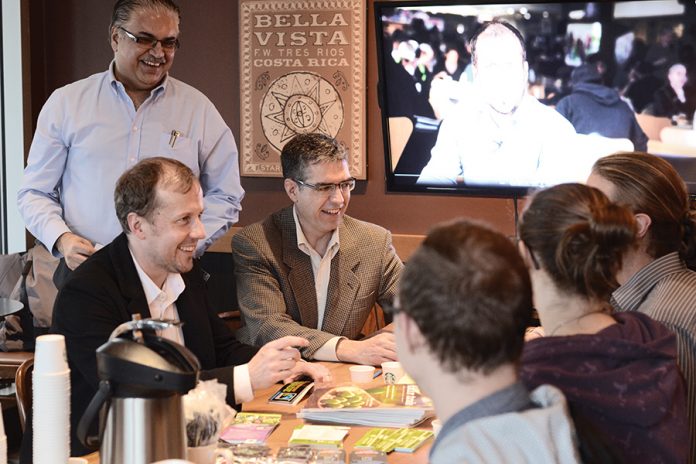
Just a few months after the opening of a predominantly fair trade Starbucks at SFU Burnaby, Sustainable SFU, Engineers Without Borders and Dining Services invited students to attend a Fair Trade learning day at Canada’s first of its kind location.

The event was held in the Starbucks itself last Tuesday, where students and Starbucks staff learned more about the fair trade initiative while enjoying complimentary refreshments. Guests also received dining services sporks and a gift certificate for a free fair trade coffee on location.

For executive director of the Canadian Fair Trade Network, Sean McHugh, the most important goal of the day was education and dialogue: “People kind of get lost in the complexity of it all, but at the end of the day it’s really about starting a conversation about where a product is coming from.”

McHugh was joined by Dan Traviss, manager of dining services at SFU, who organized the day with specific objectives in mind. He told The Peak, “We wanted to do two things: open it to the community but also have staff training for our dining services staff, teach them more about fair trade.”

The two fielded questions from dining services staff and Starbucks customers, most of which were about how to explain the idea of fair trade to customers and friends.

“Fair trade kind of exists as an idea, or a concept, something that someone generally likes to support but doesn’t necessarily have the opportunity to think about,” said McHugh. “This is great today to kind of discuss some of that. The history, where things are at in Canada, internationally, and just how important this Starbucks is in Canada.”

This Starbucks is the first in Canada to offer fair trade options, and it has already achieved success in that 80% of espresso beverage sales come from fair trade products. Although the myth exists that fair trade products might be more expensive than non-fair trade, there is no price differential at Starbucks.

Overall, Traviss and McHugh were pleased with the day. “It was fantastic. We did basically four rounds with the different staff from Starbucks, and [there was] a ton of interest,” McHugh said. “They were definitely more up to speed on stuff than I had anticipated, which was fantastic.”

“It’s a growing movement,” explained McHugh. “There’s interest from all the universities now that Starbucks has come to the table and is excited to be working with [SFU].”

Traviss echoed McHugh’s sentiments, concluding,“This is a pilot project. Our hope is that it does well here, which it really has so far, so it can roll out to other campuses.”

Transit referendum gains momentum

0

WEB-transit-Mark Burnham

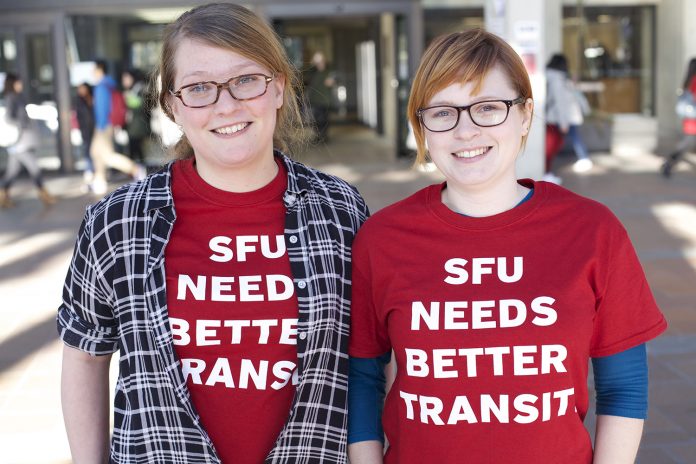
SFU students, along with the rest of Metro Vancouver, will be able to weigh in on improving transit in an upcoming November referendum. Although it is unclear exactly how the issue will be framed, the referendum will mean an opportunity to vote to put more provincial funding into TransLink.

The Simon Fraser Student Society (SFSS), the Graduate Student Society (GSS), and Sustainable SFU have collaborated to bring a transit advocacy campaign to the SFU community. The campaign aims to make students aware of the upcoming referendum and to encourage them to be informed voters.

The campaign emphasizes the potential this vote has to improve the transit situation between SFU’s different campuses. Chardaye Bueckert, SFSS external relations officer, told The Peak that in the undergraduate survey for the past 10 years, transit has consistently been in the top 10 list of how to improve the university experience.

“Everybody has transit horror stories,” Bueckert said.

Julia Lane, coordinating and external relations officer for the GSS, and Bueckert both commented on how happy they were with the progress of the campaign. Lane said that they have had a lot of people show interest and get involved.

The two organizations advocated awareness at Clubs Days earlier this month as well as in Convocation Mall last Wednesday. Students could sign up to receive information and enjoy a free cup of hot chocolate. Students who showed interest will receive information catered specifically to them based on certain factors, such as whether or not they were registered to vote and how much they already knew about the referendum. There is also a survey online where students can access similar information.


“Everybody has transit horror stories.” 

– Chardaye Bueckert, SFSS external relations officer


Bueckert mentioned how encouraging it was to see students she talked to “go from being frustrated when [asked] about their transit experience to feeling like they can actually do something to change it.” Lane stressed the importance of “opening people up to what could be.” She continued, “We get so stuck in what is, and we get so defeated by it.”

The organizations have been in discussion with TransLink and the provincial government. Bueckert explained that TransLink reported that they have “no funding to do any of the ideas and any of the initiatives that [were] brought to them.” According to her, this referendum is the only medium for increasing funding for transit.

The projects that these student organizations have presented include an increase in frequency for the 143 bus route to include weekend service, improvements to the 135 route, and the implementation of the Burnaby Mountain Gondola — affectionately referred to by SFU President Andrew Petter as “the skybus.” They would also like to see an extra stop added to the 135 route, as well as the implementation of a more efficient express bus between Burnaby campus and downtown.

A business case presented by TransLink and corporate management company Price Waterhouse Cooper predicted that transit demand in 2021 will be so high that it will necessitate a 145 bus leaving Production Way – University Station every 57 seconds. “We don’t have the facilities for that to occur,” said Bueckert.

If the “skybus” were implemented, replacing the 145 bus, there would be a gondola car leaving every two minutes; this trip would take approximately six minutes, a significant departure from the 10-15 minute travel time one can expect on the bus.

For Bueckert, this advocacy is a means to effect change as the considerable voting pool of students at SFU could have a real influence in this referendum. In a broader sense, she wants the campaign to “empower students to feel like they have the ability to actually improve things.”

Say “no” to coyote fur

0

WEB-coyote-Jess Findlay

“Authentic, iconic, Canadian” are words used by the Canadian brand Canada Goose, and words with which we love to identify. But would we continue to do so if they were stained by a connection to inhumane, unnecessary killing?

On the first Saturday of February, a group of animal activists from Ontario known as The Kitchener Ontario Animal Liberation Alliance (KOALA) held a protest outside of Channer’s Apparel store for men in Waterloo.

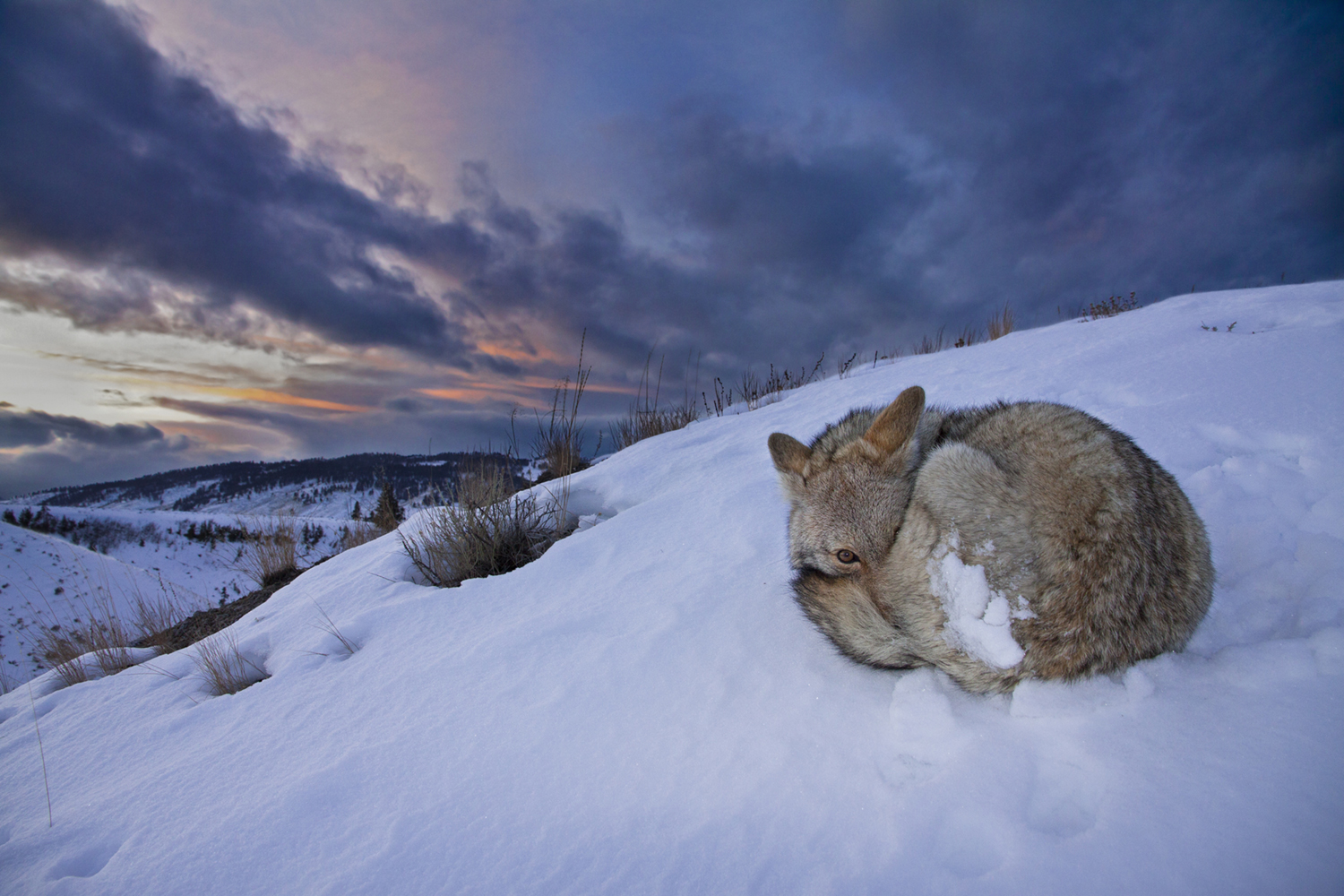
They were opposing the unnecessary use of coyote fur on the hoods of premium jackets made by the company Canada Goose, stating that the company uses inhumane practices to catch the coyotes with foot traps.

Malcolm Klimowicz, a member of KOALA told The Cord that once the coyote is trapped “they could be out there for weeks sometimes,” which means they either, “freeze or starve to death.” There is also a high risk of the injured animals chewing off their own legs to escape, he said, or being painfully “eaten by other animals.” Either way, death by trap probably results in a coyote’s suffering and torment.

Yet, this torture leaves many unfazed. An employee of Channer’s, Bill Townsend, ignorantly stated that the fur “is acquired in a humane fashion,” as it is done through a “managed process.” He continued, “This fur trade is providing jobs for people and it is creating commerce.”

As if we haven’t heard this argument before. A well thought-out and perfectly rational reason for murdering animals — the economy.

In this situation, though, the one to blame for such cruelty is not Townsend, his fellow employees, or the customers buying the fur. It is the president of Canada Goose, Dani Reiss. He is the person of power choosing to build a business that incorporates unnecessary death into its product.

I’m convinced that the company would still thrive without killing coyotes.

Nevertheless, Canada Goose does offer another reasonable explanation for the presence of the coyote fur: Reiss explains that the fur, “provides warmth around the face in a way that no synthetic fabric can.” Their website also states that coyote fur “doesn’t freeze, doesn’t hold moisture, retains heat and is biodegradable.”

All of these qualities are absolutely positive. However, there are alternatives that provide similar if not the exact same qualities such as cruelty-free versions of wool, for example. Even if other materials do not compare to real fur, there still needs to be an aspect of tolerance that we carry with us. Warmth or comfort doesn’t have to come at such a high price.

We need to ask ourselves whether these animals are being killed for survival or adornment. We no longer live in a world where high status is determined by whether our clothing was once able to walk.

As Klimowicz points out, “the majority of people who wear these things live in southern Ontario where it’s really not that cold.” Compare this to southern British Columbia, and wearing fur for warmth is simply ludicrous.

We as consumers can display our knowledge of the fur industry’s cruel origins and opt to buy non-fur coats in general, or at least Canada Goose jackets that do not use coyote fur. Better yet, we can invest in a good pair of long johns and a rain coat, clothes that actually suit our West Coast climate.

Satellite Signals

0

9679007919_d40bdc9ac1
Surrey

Surrey campus executive director Stephen Dooley blogged about his recent initiative, Dialogue with Dooley, which launched on Jan. 16. Each month, Dooley will reserve a table in the Mezzanine — “with coffee, tea and snacks” — to chat with students about their program, experiences, and educational and career goals. “I think we are off to a great start!” Dooley wrote. “I am really looking forward to the next Dialogue with Dooley. It is great connecting with students.”

Goldcorp

Last Tuesday, the first of four scheduled Coast Salish singing and drumming workshops was held at SFU Goldcorp Centre for the Arts. The workshop was lead by Russell Wallace, who is a board member for Warriors Against Violence Society as well as a composer, producer and traditional Lil’wat singer. The workshops will continue to be held once monthly and are free to the public.

Vancouver

Instead of seeing capitalism as a crisis to be resolved, John Holloway, professor of sociology, argued that “we should proclaim with pride that we are the force that is breaking through the old system to create a new world.” John Holloway, a professor from the Benemérita Universidad Autónoma de Puebla, Mexico, gave an experimental lecture at SFU Vancouver on Jan. 29 challenging the conception of capitalism as a system of domination that is failing or has failed.

Salt and Paper: eggs poached in white wine

0

Processed with VSCOcam with g3 preset

When I was a kid, I was allergic to eggs. Growing up, I never had scrambled eggs, toad in the hole, or eggs-over-easy — I was strictly a bowl of cereal kind of gal. Eventually, I grew up and grew out of the allergy, along with my allergy to grass-clippings. Now, I seem to be making up for the lack of eggs in my early life.

I love eggs. I have them, in one form or another, almost every morning when I have the time; breakfast has become one of my favourite meals of the day, especially when it comes to experimentation. Breakfast is important, as every mother and nutritionist will tell you, as it sets the tone for the rest of the day — why not set that tone in a decidedly delicious and adventurous way?

I also love wine, and life doesn’t get much better than combining two great loves. The sweet, sweet romance between wine and eggs may seem unexpected, but these two were meant for each other: the dry, refreshing acidity of the wine and the versatility of the egg marry beautifully, creating the best breakfast I’ve made yet.

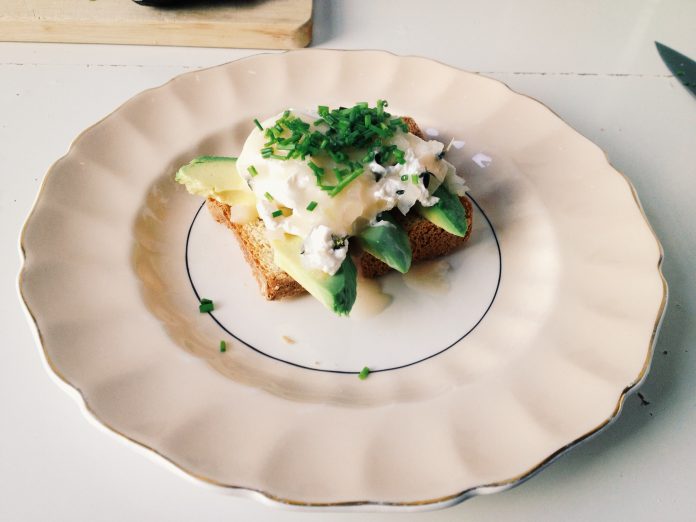
There’s something about this recipe that feels decidedly south of France. It’s simple yet incredibly flavourful, and it’s truly a sight to behold. I like mine on a bed of sliced avocado and toast, but it’s also good on a potato stew.

Processed with VSCOcam with f2 preset

• 1 cup dry white wine

• 1 cup water

• 2 shallots, minced

• A pinch of thyme

• 1/4 teaspoon sea salt

• 2-4 large eggs

• 1 tablespoon butter, room temperature

• 2 teaspoons flour

• to serve: toasted bread, avocado, chives

Processed with VSCOcam with f2 preset

In a medium skillet or pot, combine wine, water, shallots, thyme and salt. Bring to a boil and simmer for five minutes. Dial the heat down to medium and carefully crack in eggs. Depending on the size of your pot, it will likely be a shallow poach. Simmer for about five minutes, or until eggs are cooked to your preference. Remove eggs and place on a covered plate to keep warm. Cook the liquid in the pot down a bit more, until you have about half of what you started with.

While wine mixture is bubbling away, melt butter in a pan and stir in flour. Add the liquid to this pan and simmer on medium-low until it thickens up a bit. You can toast your bread and slice your avocado now, too. Gently place your egg on the toast and smashed avocado, then add as much of the white wine sauce as you’d like. Top with chives. Never look at eggs the same way again.

Processed with VSCOcam with f2 preset

Questionable Information: Superman

0

The popular film “Superman: The Movie” was based on a comic book of the same name.

A Particular Class of Women bares all

0

A Particular Class of Women Cast

It’s a play about strippers.

“If you don’t read the play and invest in it, you might think it is just trash up on stage,” actress Courtney Vye says. But, to the people at NeverYouMind Productions, their staging of A Particular Class of Women aims to be something much more substantive.

Their intention is to demystify the stripping industry, portraying the industry’s workers not as societal outliers nor abstract fantasies, but as actual human beings with ordinary human problems.

“It’s really a dramatic comedy, and a lot of fun, but you are going to see every face and every level about what working in this industry means. So you’re going to see the gritty parts, the awesome parts, the fantasy … you can’t separate them, they are all melded,” said actress Sarah Dawn Pledge.

The original production was a one-woman show written and performed by ex-stripper Janet Feindel. However, the version undertaken by the actresses of NeverYouMind has expanded, and now features a collection of eight separate monologues, each with its own mini-climax.

PinkChampagne

While “each monologue has its own [engaging] story, as a whole it connects,” said co-creator Lisa-Marie Marrelli. Through this, “[the show] becomes so full of these colourful characters that it’s popping at the seams — literally,” said director Flora Karas. This expansion allows the dramatists to explore the different corners of the stripping industry, showcasing a wide diversity of characters.

“I’m a 38-year-old ex-burlesque dancer who made the transition to nudity because she needed to, and I’m little rough around the edges, definitely one of the mother hens,” says Pledge about her character, Georgia Scott. “I’m an example of what age looks like in this business.“

Vye, on other hand, portrays something entirely different: “I’m Marky. She’s a dirty devil … she’s the newest to it, she’s 18, she took the job because it was no experience necessary.” Marky still sees stripping as a temporary stepping stone and “has her other goals and dreams,” according to Vye. “She’s not as jaded yet as the other girls, [but] she’ll get there.”

The performance contains some partial nudity and sensual dancing, a process that was new and daunting to many of the actresses involved. “I’m taking one piece of clothing off each week of rehearsals; it’s taking time,” laughs Vye.

However, the actresses fondly credit the environment of trust that prevails at their close-knit production company, giving special nods of respect to their entirely male backstage crew for acting in gentlemanly ways, making them feel safe even in the earliest rehearsals. “Thank god we have each other and can support each other,” reflects Karas.

Lil

A Particular Class of Women plays February 4–8 at the Firehall Arts Centre, February 18–23 at Presentation House, and March 6–8 at Inlet Theatre, all showtimes at 8 p.m. and with 2 p.m. Sunday matinees.

Update: A Particular Class of Women will be back from  Feb 18-23 @ Presentation House Theatre

Martial arts great for self-confidence of bully who now beats up nerds with blackbelts

0

SURREY — A local bully is crediting martial arts classes (taken by a bunch of dweebs at his school) as the source of a new found feeling of self-confidence.

Despite being experts in taekwondo, an activity they were told would improve their own self-confidence as well as self-defence skills, 14-year old Joey Castillo says that he can still easily beat-up any of his school’s dorks, but that now he feels better about it.

“I used to always be really down on myself even though I was the most feared kid in school,” Castillo said of his former struggles. “I thought, sure, I can beat all these weaklings but it’s not really making me happy.”

Castillo explained that the emptiness he felt from his bullying has nearly disappeared entirely since he became aware that these “weaklings” are actually highly trained and accomplished martial arts fighters.

“I don’t have to lie about who I’m beating up anymore and have never felt better,” Castillo said beaming in a way he never has before. “The same kids who I used to feel awful about stuffing in lockers because they were so helpless now make me feel like I’m really accomplishing something challenging.”

According to his parents, Castillo has never been more upbeat and full of life and they credit his entire transformation to martial arts classes.

“Now when he gets suspended, we know its not for preying on some defenseless kid,” Castillo’s father explained. “In fact he just got a three-day suspension for giving a wedgie to a 3rd-degree black-belt . . . we’ve never been so proud.”

While Castillo admits that, despite their training, none of his victims have ever actually fought back and that he’s pretty much just bullying in the same way he always has, he hasn’t let it stop his positive feeling towards himself.

“Just being able to say I beat up someone with a black belt puts a smile on my face,” Castillo concluded. “I feel like I could bully anyone now . . . well except for anyone who’s physically larger than me.”