Home Blog Page 1162

New chemotherapy iPad app allows cancer patients to spend their precious remaining days ignoring loved ones

2

CALIFORNIA — Apple introduced a new application for the iPad this weekend which they believe will help put an end to those struggling with near terminal diseases ever having to interact with their pesky well-wishing friends and family again.

According to Apple, their latest chemotherapy related app, iChemotherapy, not only reminds patients of important treatment dates and tracks blood cell counts, but it also takes up just enough of someone’s time to make human interaction completely unnecessary.

“It really is an amazing technological breakthrough,” explained radiation oncologist, Dr. Sanjay Atwal. “Ten years ago people said that finding a cure for cancer was impossible, and while that still might be true, now we have a cancer app for the iPad. I’m sure people didn’t see that coming either . . . I mean the iPad, isn’t it just like a big iPod?”

While most people agree that the new app, like anything Apple sells, is great and wonderful and totally different than anything that came before it, there are some family members of cancer patients who are less than pleased.

“Every time I go to the hospital to visit my mom, I feel like she isn’t actually listening to me,” complained one woman who is afraid her mother will pass away before they ever truly make a connection. “I’ll be pouring my heart out to her and she’ll just nod and say ‘uh-huh’ because she’s too preoccupied with her iPad.”

The woman says she has repeatedly tried to ask hospital staff to have the device removed but they have refused to interfere.

“She doesn’t even have the chemo app on that thing,” pointed out one nurse at the hospital, “it’s not the iPad’s fault she’s not talking to her daughter, it’s her daughter’s own fault: she’s the one who put her in a home and has been ignoring her for years. Suddenly now that her mom’s on her last legs she wants to connect with her . . . ain’t gonna happen, she’s still only on the second level of Angry Birds.”

Local man tattoos family crest on bicep as a tribute to being totally jacked

0

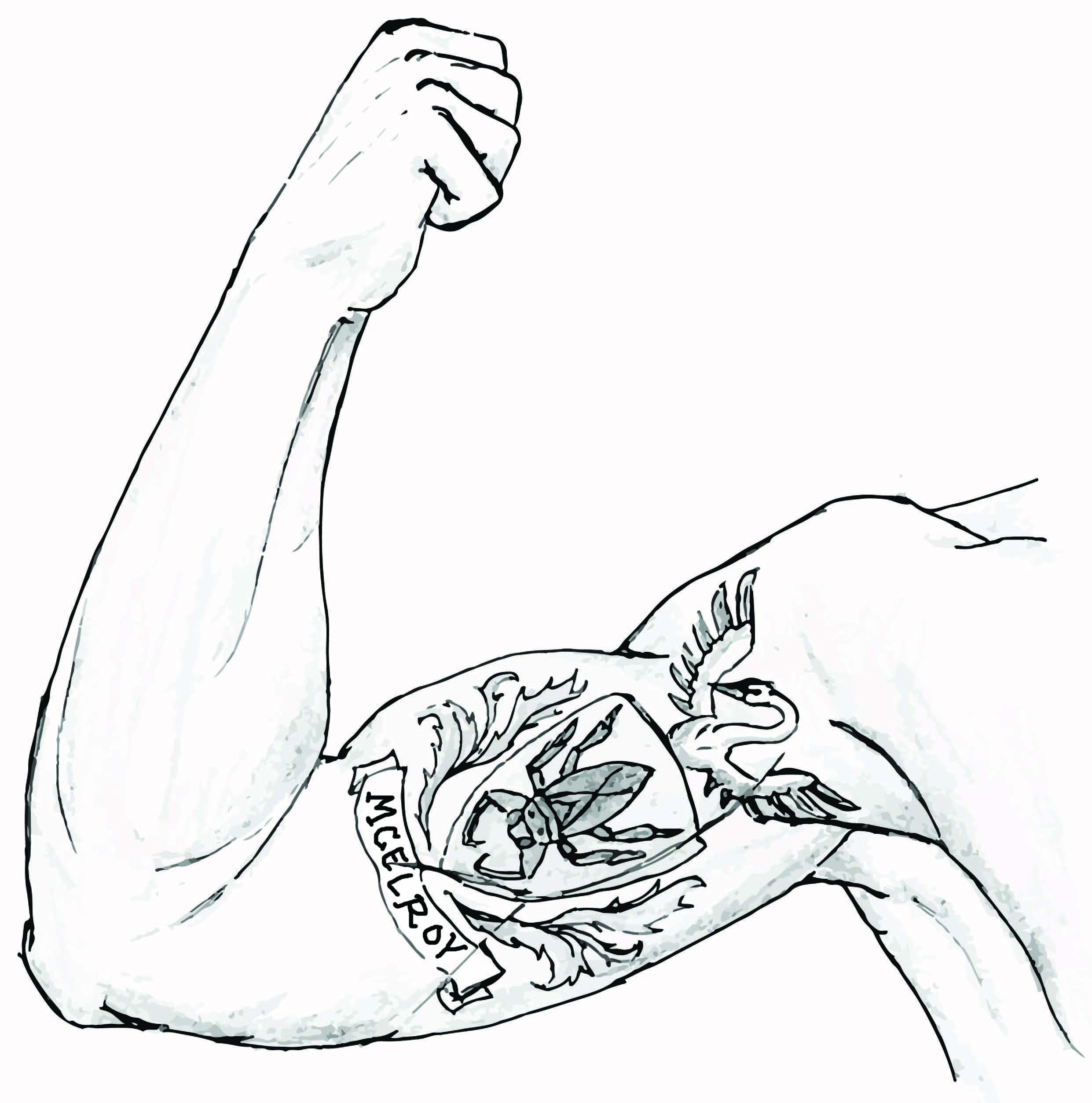
YOUR REGION — After careful thought and deliberation, a local man has decided to make a permanent mark in honour of his own ripped body by tattooing his family crest on his sweet, toned right bicep.

The tat belongs to Tom McElroy, a 22-year old worker at a nearby factory, who says that he got the tattoo only a week after the death of his grandfather, when he finally reached his target weight of 215 pounds. 

“It’s really something I’ve always wanted to do,” Tom explained, looking back (at himself in a full-length mirror). “There is nothing in this world that’s more important to me than my arms, and I’m extremely proud that I could find a symbol that showcases just how wide they are.”

Although Tom is sceptical about ever finding another tattoo design with as much significance as this one, he does have plans for a detailed portrait of the crucifixion of Christ on his chest, as a constant reminder of how he is able to make his pecs dance.  

Tippy Top Ten: Writer’s Block

0

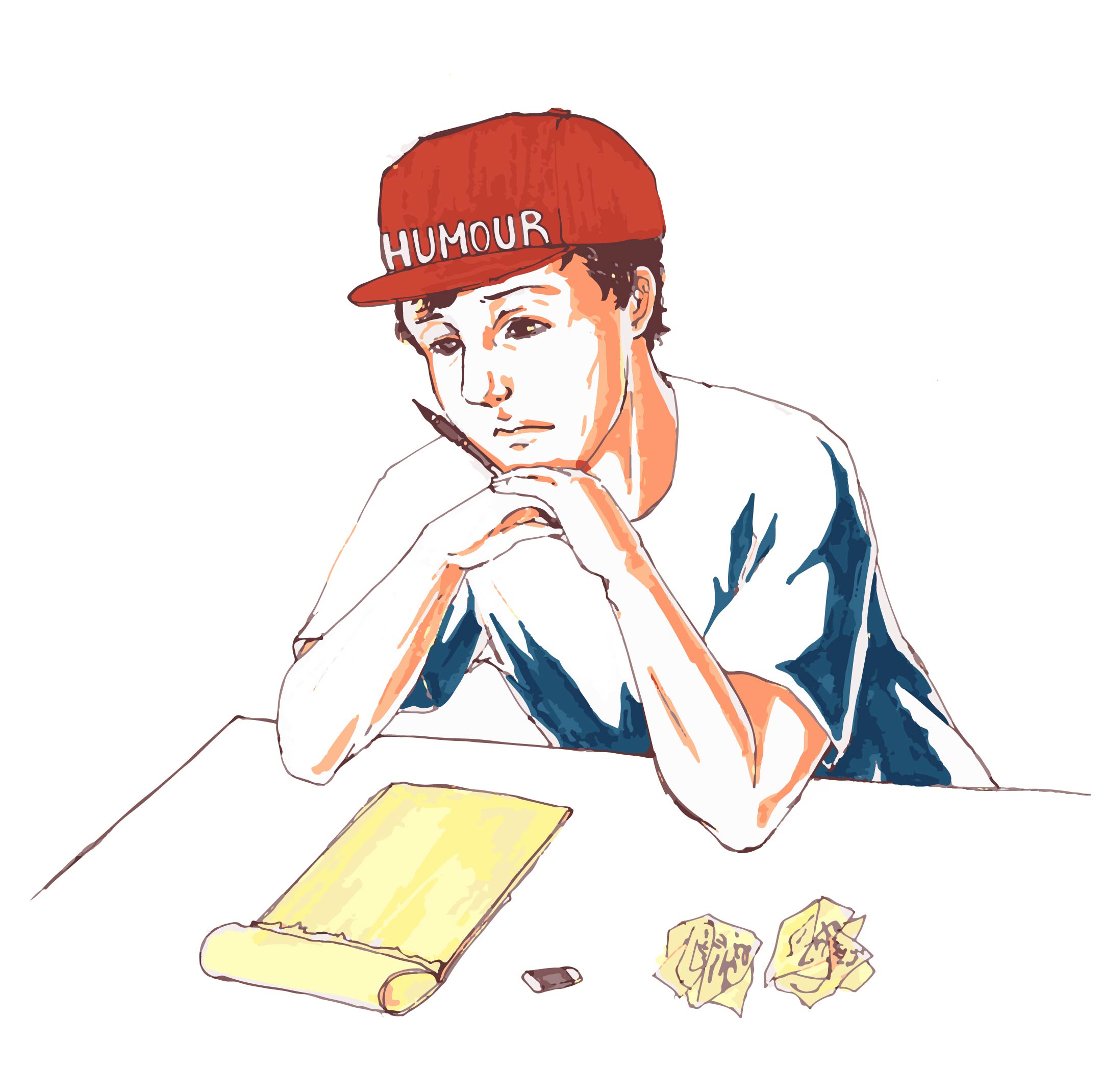
Here are the Tippy Top Ten Ways to Conquer Writer’s Block …


10. Ummm…

9. Uhhh…

8. Just, you know…

7. Check your e-mail?

6. Wait it out, you’ll think of something

5. Uhhh…

4. Just write, don’t meaning worry

3. Check your e-mail, there’s bound to be an inspiring groupon

2. Panic

1.

Satellite Signals

0


WEB-woodwardWoodward’s

On June 7, the first citizen festival called 100 in 1 Day was hosted at SFU Woodward’s. The event focused on raising awareness of social issues through acts of social change and was intended to motivate various leaders to re-evaluate old problems and issues. 

The event invited anyone interested to “come in with an idea or simply an open mind and a hunger for change. We’ll help you work that into an action plan and meet like minded people who might want to participate.”

surreySurrey

Last Friday, the fifth issue of the Lyre magazine — a literary publication produced by world literature students — was launched at the Central City pub. Lyre accepts submissions from undergraduate students around the world, including places as far as India, Mexico, and Australia. “Fever” was the theme of this year’s magazine. 

vancouverVancouver

Ian McCarthy, Kate Dilworth and Jan Simon of the Beedie School of Business hosted an event on entrepreneurial leadership and innovation called E-Merge! from June 9 to 12 at the Segal Graduate School. 

They hosted the day-long seminars to teach attendees from various organizations how to create value for people and communities, as well as how to start and launch new ventures to advance ideas for improving health and healthcare.

SFU student selected for Harvard summer internship

0

14104920429_1ec92ff0c2_z

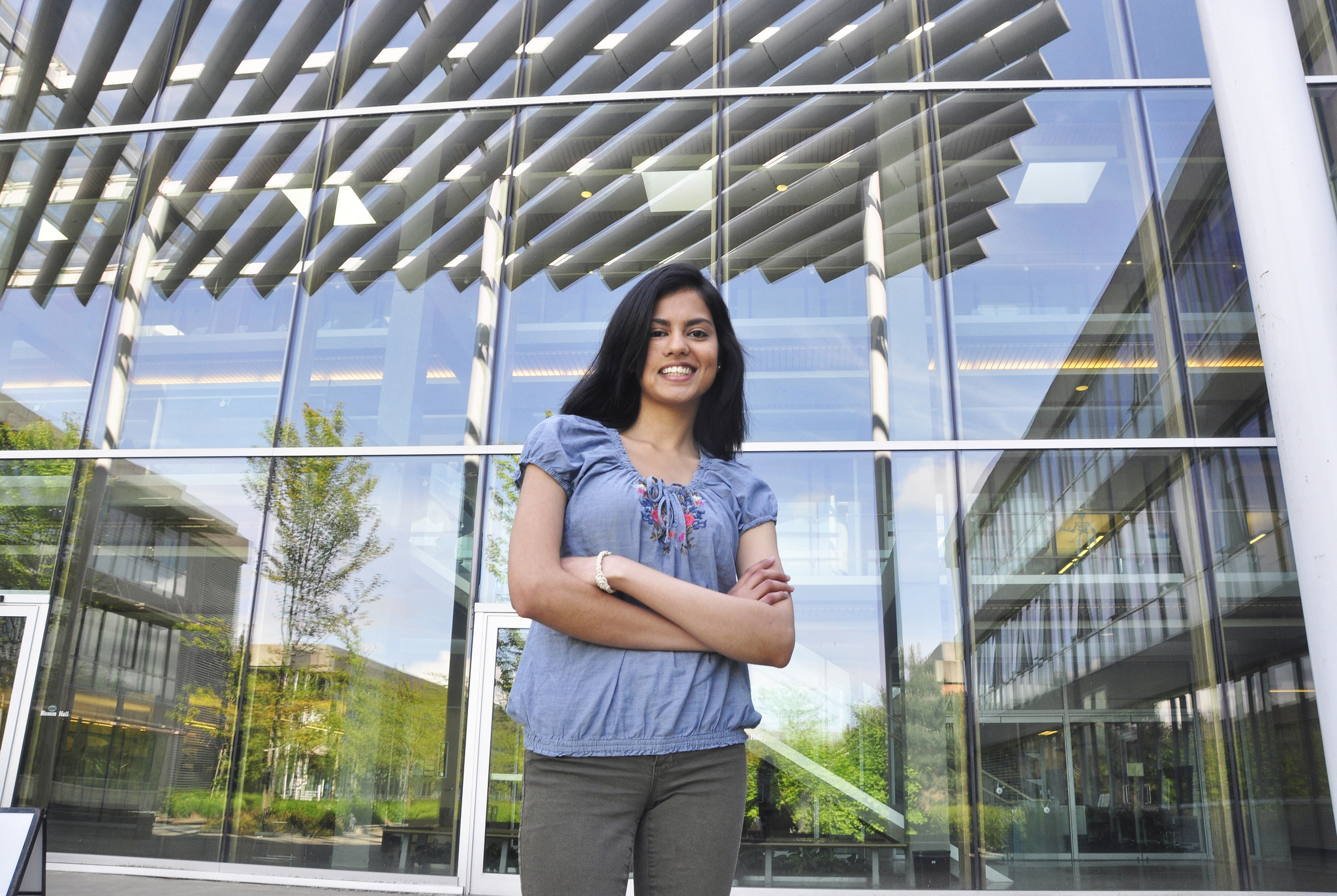
SFU undergraduate student in computing sciences and molecular biology and biochemisty, Jasleen Grewal, recently embarked for Boston; she was selected for a summer internship at Harvard University’s prestigious Stem Cell Institute.

Grewal edged out multiple other students from around the world who also applied for this position. Although the institute does not accept many international students — giving priority to American students — Grewal synched a spot.

In a phone interview with The Peak from her lab on Harvard’s campus, Grewal said, “I am soaking everything in, and it is quite an enriching experience to be working alongside such excellent peers.”

The position at Harvard will allow Grewal to pursue her core interest in stem cell research; this is an area of study with great promise as research has shown many potential uses for stem cells, including the generation of cells and tissues, and the treatment of heart and blood-based diseases, among others.

Grewal has research experience in the biological sciences, particularly concerning cancer growth, evolution, and cancer stem cells. According to Grewal, her lifelong passion for science began with her parents. She recounted, “My parents were teachers in mathematics and chemistry, and I think having a childhood where curiosity was constantly encouraged and satiated with mind-blowing explanations greatly contributed to my keen interest in science.”

She continued, “While in elementary school, I was learning about atoms and orbitals, and Fibonacci numbers and the golden ratio, while penning my pet dog’s biography, and it was just a really enriching atmosphere to grow up in. I am really grateful to my parents, and [. . .] high school biology teachers.”

Growing up in a curiosity-driven environment provided the bedrock for scientific inquiry that led Grewalto become involved in research work as a young scholar. “I was briefly involved in research work at the Genome Sciences Centre, Vancouver, on an ongoing project in collaboration with the Terry Fox Research Institute, on the Glioblastoma Multiforme, an acute form of brain cancer,” Grewal said.

When Grewal came across the internship program at Harvard’s Stem Cell institute, she recognized that their summer internship program fit well with her prior research experience and realm of interests.

She explained, “It was such a perfect program: 10 weeks of research under leaders in stem cell research, at Harvard, of all places — I figured I’ll give the application a shot, though it seemed like a long one at that time.”

Grewal’s internship will be spent working with Winston Hide’s lab at the biostatistics department of the Harvard School of Public Health. The work will involve practical elements, such as testing and creating a “cellular pathway printing tool that integrates genomic data to provide a quantifiable measure of gene expression” —  in other words, Grewal hopes to understand how interactions between cellular pathways influence different cell behavior in an organism.

Grewal gushed about the benefits of the program: “One [benefit] most definitely is the exposure to such diverse arenas of research, and to see how research occurs!  I hope to keep an open mind and learn everything I can about the avant-garde research being pursued here in Boston [. . .] and in general to get a firmer direction for my future career and to experiment with it a bit too.”

Board Shorts

0

stadium

Build SFU stadium investigation

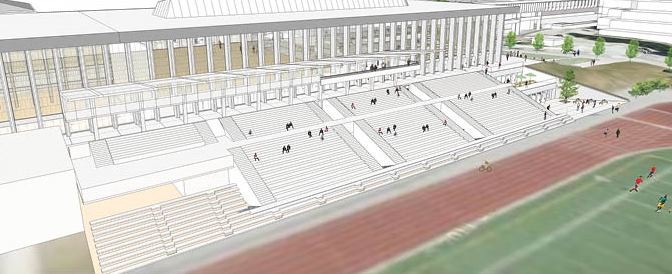
Board tasked at-large representative Jeremy Pearce to work with Build SFU general manager, Marc Fontaine, to begin discussions with Build SFU around the stadium project. Originally pitched as a project in conjunction with the Student Union Building (SUB), the stadium became a separate item when Build SFU decided not to build the SUB adjacent to Terry Fox Field.

“[The project] is happening quicker than originally expected, so [Fontaine] has asked me to join. I have a great deal of familiarity with stadiums,” explained Pearce.

Consultation and design work is set to take place in 2014 and 2015.

SFSS Consultation Project

The board voted to begin a large scale outreach project, tentatively named the “SFSS Consultation Project.” Discussed in detail at their retreat, the project will involve reaching out to the student body to provide more information about the SFSS as well as to elicit feedback. It is also one of the board’s main goals for the year.

No dollar figure was attached to the motion, but it did task VP external relations Darwin Binesh to create a proposal regarding possible options for consultation to be put forward to the board of directors.

Sale of the Maggie Benston Centre

VP finance Adam Potvin, VP university relations Moe Kopahi, and Fontaine were tasked by the board to negotiate with SFU for the surrender of the lease of SFSS MBC office space.

Board has been discussing selling the MBC in light of the construction of the SUB because the new building will have ample space for SFSS offices. Potvin plans to add some of the money raised from the sale—expected to total $3 million—to the SFSS operating budget and restricted surplus.

SFU photographer hosts wildlife workshop

0

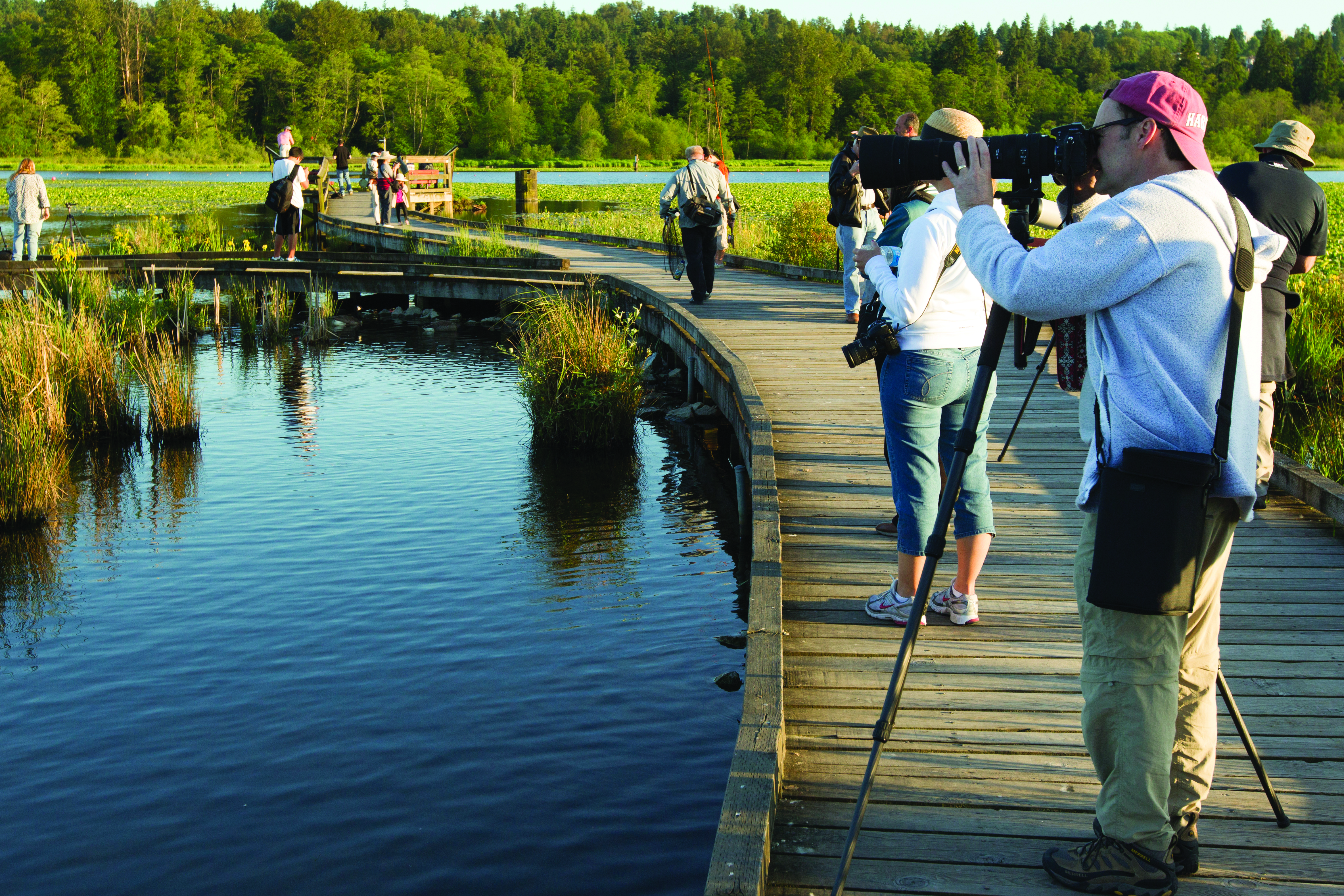
CMYK-ConnorStefanison_BbyLakeWorkshopRecent SFU graduate and international award-winning photographer, Connor Stefanison, gave a free workshop on wildlife photography as part of the City of Burnaby’s Environment Week earlier this month. 

The workshop was held on June 5 at the Piper Spit boardwalk at Burnaby Lake Regional Park, a location that the BBC wildlife photography award winner often visits for photo shoots. The workshop ran from 6:30 p.m. until around 10:00 p.m.

Stefanison told The Peak that the City of Burnaby contacted him and asked if he wanted to do a talk or presentation as part of the week’s activities. He opted for a workshop because he felt hands-on learning would be most valuable for aspiring wildlife photographers. 

Participants were asked to bring their own cameras, a long and short lens — if they had both — and were encouraged to also bring a flash, a tripod, bird seed, and weather-appropriate clothing. 

“A lot of people showed up,” Stefanison recalled. “Between 30 and 40, [. . .] which was more than ideal for one person [. . .] I was only expecting like 10 people.”

He also noted that the age group was mostly adults. “Well, I’m an adult,” he said, laughing. “But 40s, 50s, probably.”

Due to the large number of attendees, Stefanison had to change his original plans of a more hands-on tutorial; however, he felt he was still able to communicate the basic techniques of wildlife photography.

He began by introducing himself, and then explained to the group how to use specific settings on their cameras, how each setting affects an image, how to approach an image with natural and artificial lighting, and how to use wireless remote photography.

“Most of the people were beginners,” Stefanison said of the attendees. “[But] there were also intermediates, so everyone learned stuff.”

He also talked to the group about the various bird species in the park and the spots where they were active and could be found during different times of the year.

Stefanison was relieved by the positive feedback, telling The Peak: “Everyone seemed to like it, which was good, because I was worried with all the people that I would leave people out.”

However, he was encouraged by the attitudes of those in attendance, “Everyone was very enthusiastic about it, like everyone really wanted to learn. Everyone had a lot of good questions.”

Stefanison felt the event was an overall success, even though he personally was unable to take many photos.

“At the end we tried looking for an owl, but we didn’t get one,” Stefanison recalled. He admitted that during the entire evening, he only had time to take “five shots, just quick ones of people.”

The Concessions gets a Flying Start

0

Concessions139A7585e

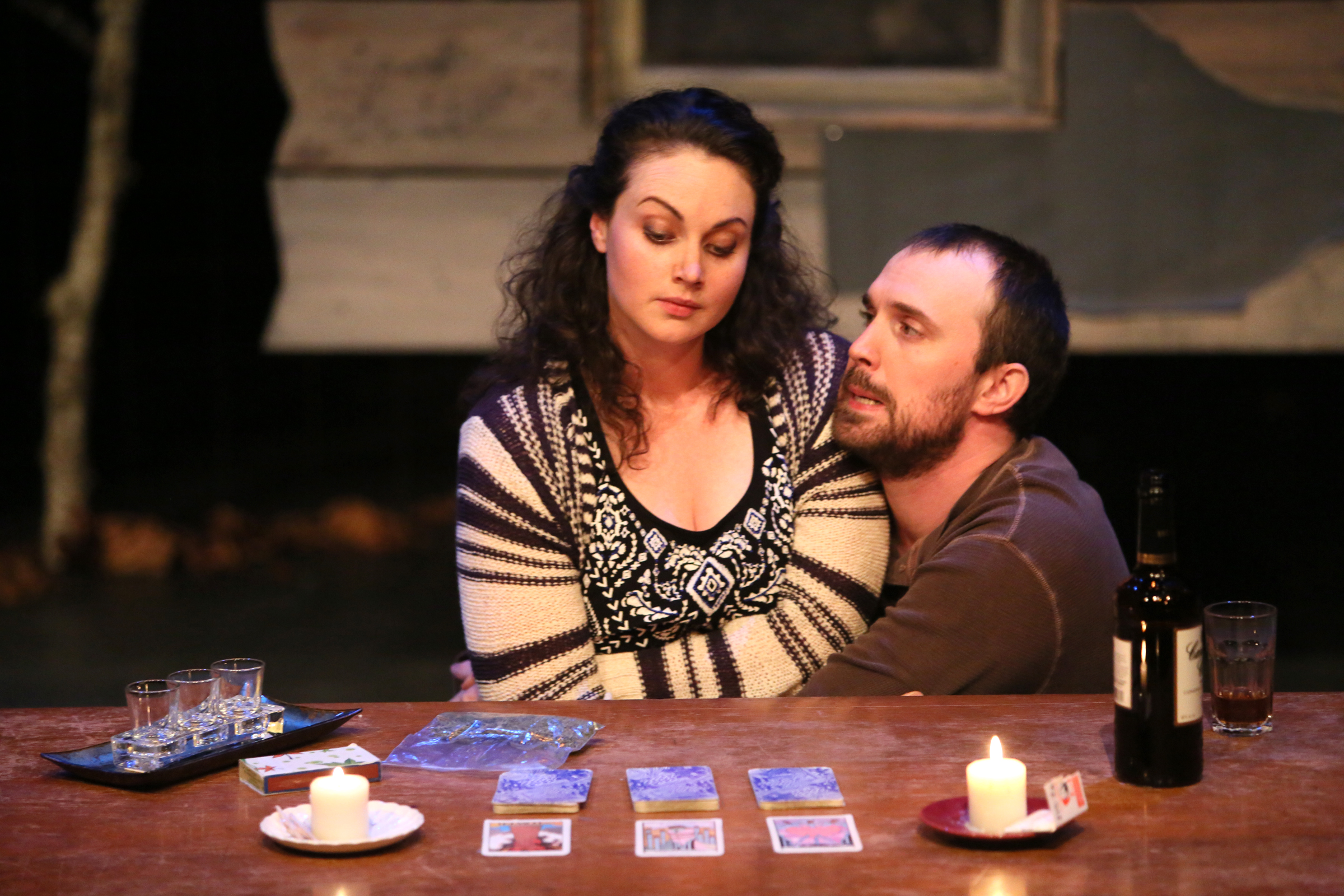
For 38 years, Touchstone Theatre has been quintessential in showcasing West Coast playwrights. Their Flying Start program has been giving voice to Canadians who have never been professionally produced since its launch in 2008. The program’s latest production is of Briana Brown’s The Concessions.

Brown’s play, a drama set in a small rural Canadian community, revolves around a precognitive woman named Fay (Emma Slipp) and the murder of someone close to her. This triggers her to question her abilities and consequently, the purpose of her life up until the tragic event. It’s a journey of exploring identity and relationships, as well as one’s duty not just to others, but to oneself.

Taking firmly established, rounded characters portrayed by talented cast members and weaving them into a plot involving tarot card readings and chasing lightning, the play uses supernatural elements to explore follies that result from unexplainable events amongst good people.

Slipp draws audiences in with nothing but tarot cards, two candles, and a bottle of alcohol as she begins her opening monologue seated at a table across from an “empty” seat on a dark stage. The foreboding demeanor with which Slipp opens the play is an intimidating presence as she flips through her tarot cards.

Once they start dropping one-liners, you can’t help but laugh, even though it is no laughing matter.

At the same time it is entertainingly intriguing, as she is able to get some laughs out of the audience. Her versatility is further displayed once she begins interacting with other characters who are actually visible to us.

Whether it is conflict with her husband John (Sebastien Kroon), or Sarah (Jillian Fargey), the town’s radio host, Slipp manages to hold her personas, while complimenting and even accentuating others’. Fargey’s character is a lovely addition to the story as you struggle with whether or not you should take her side. Despite this, she is able to provoke some laughter from the audience.

That’s what The Concessions does well. It puts you in a state of limbo before arriving at concrete impressions. A drama, it nonetheless leaves room for some on-point humour. The story revolves around a murder that has affected close relatives and friends of the victim, but once they start dropping one-liners, you can’t help but laugh, even though it is no laughing matter.

Some of this surprisingly comes from emotional turmoil in the victim’s mother, Julie (Marilyn Norry). Norry perfectly embodies the character of a mother unwilling to move on; the maternal presence on stage probably even outshines roles such as Slipp’s, and the comic relief adds another dynamic to the character. Whether intentional or not, the laughter is a good and surprising juxtaposition against the heavy drama, as it speaks to Brown’s ability to intertwine tones in her play writing.

The characters are well developed, their dialogue is strong, but The Concessions falls flat on the murder plot and resolution. It’s certainly a hook to get people interested in the story, but it eventually lands a bit stale.

It may seem a huge issue to call the plot out as unsatisfying, but when there are such strongly written characters backed with great talent, the need for an event as drastic as a murder isn’t necessary. It’s not an essential catalyst for what the characters experience and find out about themselves and each other.

With the creative liberty one could take with a character that can supposedly see the future, something like death isn’t a very unique problem for them to fail to foresee and prevent (it’s kind of a cliché, actually). Despite this, The Concessions is a wonderful production by the Flying Start program.

The Concessions runs until June 14 at The Firehall Arts Centre. For more information, visit firehallartscentre.ca.

The Concrete Acropolis

3

derp

“You know, Mr. Bennett, I want to have something really outstanding in the way of architecture, and I’d like to have a competition for the design of the university.”

Dr. Gordon Shrum, a 65-year old former physics professor and recently retired Dean of Graduate Studies at the University of British Columbia, was sitting down with W.A.C. Bennett, the then-premier of British Columbia, at the parliament buildings in the heart of Victoria. The year was 1962. Shrum had made the trip out to Vancouver Island to discuss his plans to build a new university — where he would serve as Chancellor — atop Burnaby Mountain. He had a team of staff, faculty, and financial backers at the ready. He had the support of the government, namely the board of education.

All he needed was an architect.

Shrum’s plan was to take submissions from up-and-coming architects across British Columbia and the rest of Canada. Along with a panel of judges, he would choose the five best designs — one winner and four runners-up. The university would be a combination of all five winning designs, and the number one choice would be allowed to supervise and guide the work of the other four. Bennett, as was his nature, took some convincing. “Fine,” he finally replied, “If it doesn’t cost anything, go ahead.”

SFU’s wide open spaces, bold use of concrete and glass, and interdisciplinary structure brought Erickson international acclaim.

The catch? Bennett asked that the university open in September 1965. Shrum had just over two years.

Meanwhile, across the Georgia Strait, a young professor and architect named Arthur Erickson and his business partner Geoffrey Massey had just opened their first firm together, Erickson/Massey Architects, in the heart of Vancouver. After designing several houses and garnering national attention, they prepared for their biggest project yet: an entry into a competition held by Dr. Shrum to design the recently announced Simon Fraser University.

Nearly 50 years later, Erickson’s architecture — Robson Square, the Law Courts, the Museum of Anthropology at UBC — is an enduring symbol of Vancouver. SFU remains a testament to both his innovative genius and the beginning of his rise to, and fall from, international acclaim. Though Erickson’s genius, extravagance, and immutable personality quickly became the stuff of legend, it was his boundary-pushing design of SFU that started it all.

The Architect

Erickson was born in 1924 in the burgeoning Shaughnessy neighbourhood of a then-young Vancouver. His parents were members of the first generation of Vancouverites — self-described pioneers whose interests lay in the promotion of art and culture in the community. With the support of both his mother and father, Erickson took an early interest in painting and illustration, eventually having his work featured at the Vancouver Art Gallery at the age of 14.

He served in World War II as a member of Canada’s Intelligence Corps, a position which sent him to India, Malaysia, and other areas in Southeast Asia. During his travels, he fell in love with Asian philosophy and art, a fascination which would go on to define much of his architecture.

Upon returning to Canada, he quickly developed a keen interest in architecture. According to a 2006 profile in Vancouver Magazine, “the story goes that Arthur Erickson’s love of architecture was born when he thumbed through a 1946 copy of Fortune and saw photos of Frank Lloyd Wright’s desert house.” Wright’s famous summer home, now the main campus of Frank Lloyd Wright School of Architecture, is not unlike many of Erickson’s buildings — its wide open spaces and right angles evoke the expanse of our own Academic Quadrangle.

Erickson enrolled in McGill’s architecture program, where he graduated in 1950 with honours. Considered a prodigy, he turned down a chance to work with Frank Lloyd Wright, his idol, in order to continue traveling. In the years following his schooling, he explored the Middle East and Europe, tracing the history of architecture from its beginnings in Mesopotamia to the lavish castles, aqueducts, and cathedrals of Italy, Spain and France. He returned in 1954 to teach architecture at the University of Oregon, and went on to earn a professorship at UBC at age of 33. During his tenure, he continued his travels sporadically, exploring numerous countries in Africa, South America, and Asia.

His fascination with international styles of art and architecture would inspire his own style, which was unlike anything that had come before, or since. By translating the organic design concepts of Asian architecture to the expansive green landscapes of British Columbia, Erickson would change Vancouver’s image forever.

After nearly a decade teaching in UBC’s architecture department, Erickson teamed up with his roommate Geoffrey Massey, a talented businessman and the nephew of Vincent Massey, former Governor General. Together, they formed Erickson/Massey Architects, a tiny firm based out of downtown Vancouver. Their first commission to garner national attention was the Graham House, a now-demolished residence on a rockbed in West Vancouver made entirely of wood and glass. Its open spaces, use of glass, and environmentally conscious design mirrors that of SFU — like our university, it simply became a part of the landscape.

Erickson and Massey were the perfect duo: the former had the creative genius and innovative spirit to design awe-inspiring structures, and the latter had the business sense and practicality to bring projects to fruition. “It was a wonderful working relationship,” says David Stouck, SFU professor emeritus and author of the award winning 2013 biography Arthur Erickson: An Architect’s Life. “They really impressed their clients, because all bases were covered.”

Massey’s insight would prove instrumental in Erickson’s winning design for SFU. According to Stouck, one of the judges is reported to have said the design “sits like a well-tailored cloak on the top of a mountain.”

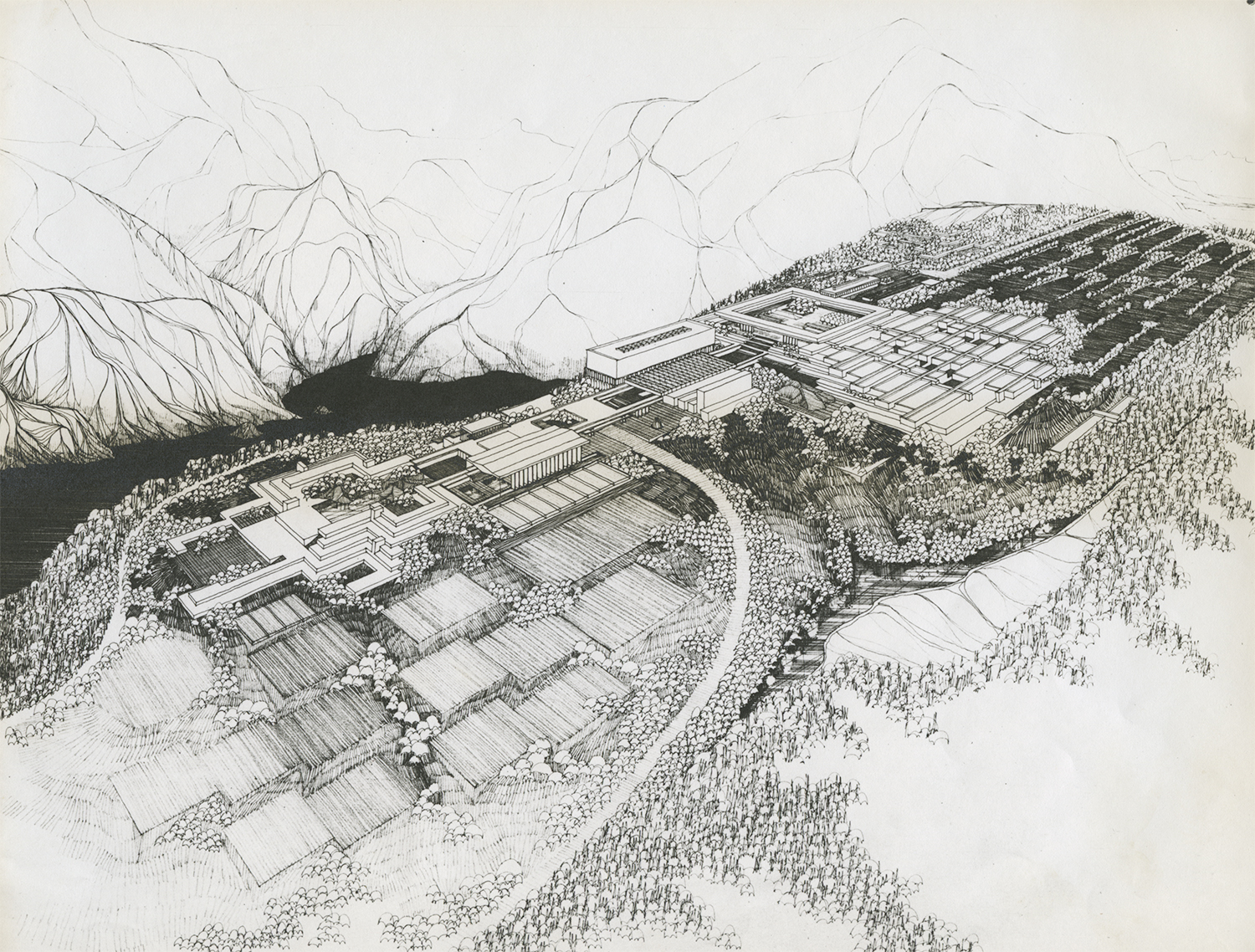
“What was unique about the design that he [Erickson] and Geoffrey Massey offered in the competition was that he didn’t create a bunch of high rises on top of a mountain,” Stouck says. “Instead, he saw the mountain as designing the shape of the campus.”

He mentions Erickson’s travels to Bali in Indonesia as a young man as a key influence: “What impressed him there was the way everything was conformed to the landscape itself. It was nature that determined the shape of things, not the human presence. So in his design for Simon Fraser, it’s terraced, just like the rice fields of Bali.” Erickson also looked to the Acropolis in Athens — an impressive structure, as much a part of the mountain as the grass below. Years later, Erickson would say that “the dialogue between building and setting is the essence of architecture.”

erickson

The Instant University

According to Shrum, Erickson and Massey’s design was chosen unanimously by the judges because it met all of his requirements. “I had always felt sorry for UBC students who had to walk from building to building in the rain,” he said; Erickson’s design allowed students to travel from any one building to another without exposure to the elements. Shrum also requested that there be ample space for parking, and that all the school’s large lecture theatres be together and not, as Shrum described it, “scattered all over the campus as they were at UBC.”

But Shrum’s final and most crucial stipulation — one that his advisors cautioned him would be too difficult for any applicant — was that “the university should appear in 1965 essentially as it would in 1995.” Shrum wanted a school which seemed complete on the day it opened, and could be expanded upon without fundamentally changing its appearance. In his 1986 autobiography, he deemed Erickson’s design, ultimately, a success: “Simon Fraser University looks almost the same now as it did the day we opened it, despite the great expansion that has taken place.”

As winner of Shrum’s design competition, Erickson and Massey were given two jobs: they were to implement their own design of Simon Fraser University, while also factoring in the design concepts of their four runners-up. Zoltan Kiss was put in charge of the Academic Quadrangle; Robert Harrison, the library; Rhone and Iredale, the science wing; Duncan McNab, the gym, pool, and theatre complex. Given first choice, Erickson and Massey chose Convocation Mall — in their minds, this would be the centre of the university, the meeting place for academic minds to exchange ideas and engage in discussion.

Years later, when the Mall became the centre of the radical political protests that came to define SFU’s first decade, Erickson came under fire for his design. Despite an unwillingness to publicly comment on the matter, by all accounts, he was pleased: this, of course, meant that his idea had worked.

“Erickson saw the mountain as designing the shape of the campus.” – David Stouck, author of Arthur Erickson: An Architect’s Life

As construction began in March 1964, a journalist for the national magazine Saturday Night dubbed the work in progress the “instant university.” The name stuck — during the gruelling construction phase, Erickson would joke that a project of its scale would usually require two years just to prepare the drawings, let alone the construction process.

Typical of their partnership, Erickson and Massey split the work to suit their talents. Stouck’s biography tells of one particular morning when Massey and Erickson learned that a shipment of concrete slabs had proved too thin to hold up the weight required of them, halting construction and pushing hard against their impending deadline. Massey spent the entire day telephoning suppliers and contractors, trying to fix the problem; meanwhile, Erickson spent the day researching to find the perfect species of reflecting koi fish for the Academic Quadrangle pond.

Despite minor setbacks, Erickson and Massey, along with their ragtag team of fellow architects, finished construction in time for the university to open in September of 1965, right on schedule.

Its first semester had over 2,500 students in attendance, and SFU’s groundbreaking design — its wide open spaces, bold use of concrete and glass, and interdisciplinary structure — brought Erickson international acclaim. He and Massey won multiple awards for their work, and in the years following, Erickson would go on to open offices in Montreal, Toronto, Los Angeles, Kuwait, and Saudi Arabia — at one point, running all five at the same time.

“From the outset, Simon Fraser — from an architectural point of view — was radical,” Stouck says. “In the old days, university campuses consisted of buildings that were separated from each other, and these separations represented a competitive spirit between departments. To put all these departments together and, in a sense, jumble them up to make sure that there was no sense of competition among the faculties was a completely new idea.”

Stouck also cites SFU’s interdisciplinary design as a reason for its political radicalism early on. “When you bring everybody together, they’re going to start talking to each other about their disciplines in relationship to each other. Pretty soon, you have an entirely new and different idea of how education can develop [. . .] and of course, it attracted radical students, it attracted radical faculty, and that became part of its reputation.”

SFU, known to many at the time as “the Berkeley of the North,” quickly gained notoriety as a school for outcasts, political dissidents, activists, and starving artists. Its unique design played a big role in enticing potential students. “SFU attracted students who were not inclined to follow a crowd,” writes Hugh Johnston, a professor emeritus at SFU, in his book Radical Campus. 

Though Erickson’s popularity would continue to grow after his work on the university, Shrum’s gradually sank — his old world approach to business and scholarship clashed with the radicalism of the SFU student body, and his chancellorship from 1963 to 1968 was an unpopular one.

Still, in his final years, Shrum remained proud of his accomplishment with Simon Fraser University. In his final years, he would remark, “I am certain that nobody, in any part of the world, ever built a university in two years and six months that accommodated 2,500 students at the opening.”

The Aftermath

Five years after the construction of Simon Fraser University was completed, Arthur Erickson received a letter from the Prime Minister’s office. A newly elected Pierre Trudeau was hosting an artists’ dinner: prominent creatives from across Canada were invited to share their views on Canadian nationalism and identity, as well as a Parliament cooked meal. Erickson, as it turns out, was the only architect to earn an invitation.

Erickson’s resulting friendship with Trudeau — which grew so close that the latter’s advisors, fearing rumours of homosexuality, urged him to marry immediately — proved the architect’s introduction to the world of fame and extravagance that came to dominate much of the rest of his life.

His parties at his Vancouver and Los Angeles homes became legend. His friendships with Prince Charles, Princess Diana, Katherine Hepburn and Shirley MacLaine catapulted him to celebrity status. Erickson’s homosexuality, an open secret among friends, would remain a source of tension in his professional career in the decades to come.

Although his status as one of Canada’s star architects continued to grow with projects such as UBC’s Museum of Anthropology, Robson Square, and the Canadian Embassy in Washington, DC, Erickson’s personal life was fraught with drama. His longtime life partner, Francisco Kripacz, a businessman and designer who helped decorate the interior of many Erickson projects, encouraged the couple’s increasingly decadent lifestyle, which kept them in near-constant financial strain.

“[Kripacz] was a very extravagant man,” says Stouck. “[Erickson] was under the spell of that man for years and years. The Arthur Erickson story is somewhat of a Greek tragedy, and this was his fatal flaw, in terms of his career as an architect; on the one hand, his instinct was to live very modestly, but he was surrounded by people, especially Francisco, who wanted everything to be as lavish and exciting as possible.”

Erickson’s tragedy reached its climax in 1992, when he was forced to declare bankruptcy in Vancouver’s Law Courts — the same ones he had designed only a decade before.

However, the final years of Erickson’s life saw his career and reputation restored. After more than a decade of separation from the architect, Kripacz died of respiratory failure. Erickson’s international offices had closed, leaving just his Vancouver office — the same place where he and Massey started it all. 

There is nothing more architecturally representative of Vancouver than Erickson’s green roofs, glass windows, and angular concrete.

Erickson’s split with Massey in the mid 1970s damaged both men professionally and personally, a blow from which, one might argue, the former never recovered. “Even though he tried to surround himself with other people working for him that could manage the business,” Stouck notes, “it was never the same.”

In 2006, just three years before his death on May 20, 2009, the Vancouver Art Gallery held a retrospective on Erickson’s life and work. Sketches of Simon Fraser University and paintings from Erickson’s childhood decorated the walls as the architect fielded questions from interviewers beneath the Robson Square dome he’d designed 20 years previous. The exhibit’s curator, architect Nicholas Olsberg, reflected on Erickson’s legacy: “I don’t think the world knows what he means, and I don’t think Vancouver knows.”

Erickson remains one of just two Canadian architects to win the American Institute of Architects Gold Medal, among countless other awards. According to friends, he was known to wear the medal proudly around his neck at parties and other social occasions.

Walking down the streets of Vancouver, it’s impossible to ignore Erickson’s impact on the city. Almost 50 years after his design of SFU brought him fame and fortune, there is nothing more architecturally representative of Vancouver than Erickson’s green roofs, glass windows, and angular concrete. His final work, Vancouver’s Trump Hotel — known to many as Vancouver’s Turn, a fitting double entendre — is set to be completed in 2016, almost a full decade after his passing.

Still, it’s hard not to think of Erickson’s life — part Greek tragedy, part rags-to-riches-to-rags parable, part epic journey — as being defined by the school he helped create. Atop Burnaby Mountain, in the midst of Erickson’s own concrete Acropolis, he lives on.

Erickson design images courtesy SFU Archives, Gordon Shrum fonds (F-32-1-0-0-6).

Zero Waste campaign relaunch tackles “separation anxiety”

2

CMYK-Recycling-Anderson Wang

Palms are sweaty, knees weak, arms are heavy — with all that recyclable waste you’re carrying.

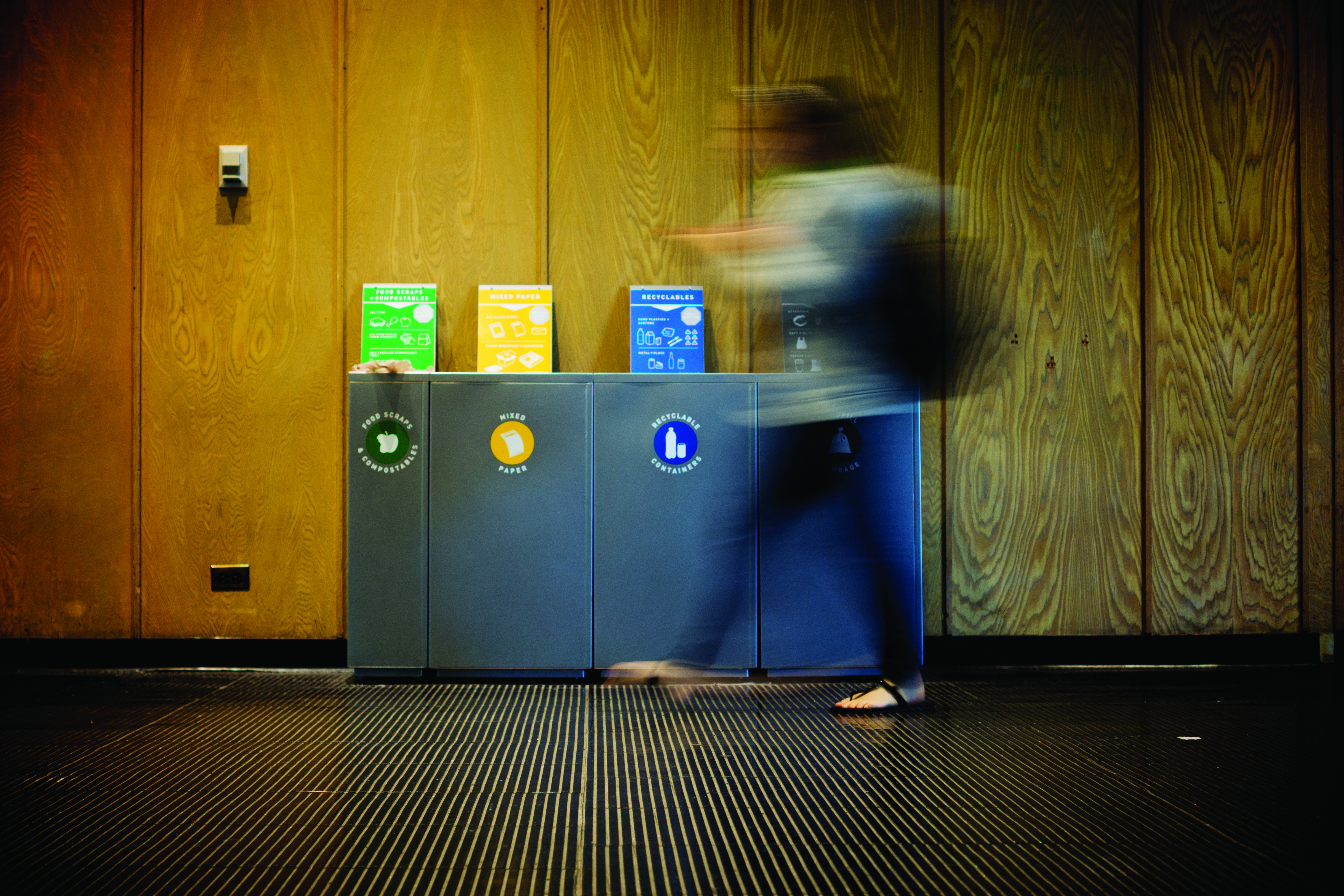
Don’t be afraid if you don’t know where to toss your mom’s spaghetti — a new campaign is hoping to help students get over the “separation anxiety” felt when having to decide how to separate their waste at SFU’s recently installed Zero Waste stations.

Originally launched in January, the Zero Waste Initiative aims to double the amount of waste SFU recycles or composts by 2015, while diverting 70 per cent of SFU’s waste from landfills.

“It’s one of the key goals of the Sustainability Strategic Plan for the university,” Rachel Telling, Zero Waste coordinator, told The Peak. “We’ve kind of taken the initiative to implement all of this stuff first, and we’re sharing it with other universities, so the idea is to become an industry leader in zero waste.”

On March 19, janitorial staff carried out a “waste audit,” collecting waste from the AQ 3000 level as well as Mackenzie Café. After sorting the waste into its four streams — paper, recyclables, compostable, and landfill — the team found that 47 per cent of materials were not being placed in the correct streams.

It seemed students and staff were mainly having difficulties disposing of coffee cups, compostable containers and food-soiled paper, and much of the contamination came from mixing up the paper and compostables streams. These findings spurred the team to relaunch their Zero Waste campaign, on a new theme of “separation anxiety.”

Telling explained, “We were noticing the same items in the same bins again and again and again. Coffee cups, for example. So we wanted to make it even easier for people.”

The relaunch will feature updated signs based on feedback from focus groups. “It was funny because some people said, ‘There’s too much information on the signs! Too cluttered!’ and then the same amount of people said, ‘There’s not enough information on the signs!’” exclaimed Telling. “We tried to find a middle ground that would please the majority of people.”

In addition to providing clearer instructions, the relaunch involves a Zero Waste selfie competition — or, “Zelfie” competition. For the remainder of the semester, students are invited to take a picture of themselves recycling correctly and send it to the Zero Waste campaign to be entered into a weekly competition for a $50 voucher to the on-campus vendor of their choice.

The team has also installed two stream bins — landfill and compost — in many of the washrooms on campus, hoping to divert a significant amount of paper towels to compost. With the help of Zero Waste educators, who will be available at stations on all three campuses for rest of the semester, the initiative hopes to transition to a greater focus on waste prevention in the fall.

With the relaunch in full swing, Telling hopes that students will take the time to consider what they are doing with their waste. “We see people sometimes just like, chucking things in them from afar,” said Telling; “Just take a second to read and make sure it goes in the right bin.”