Home Blog Page 1155

Students take Keys to the Streets

0

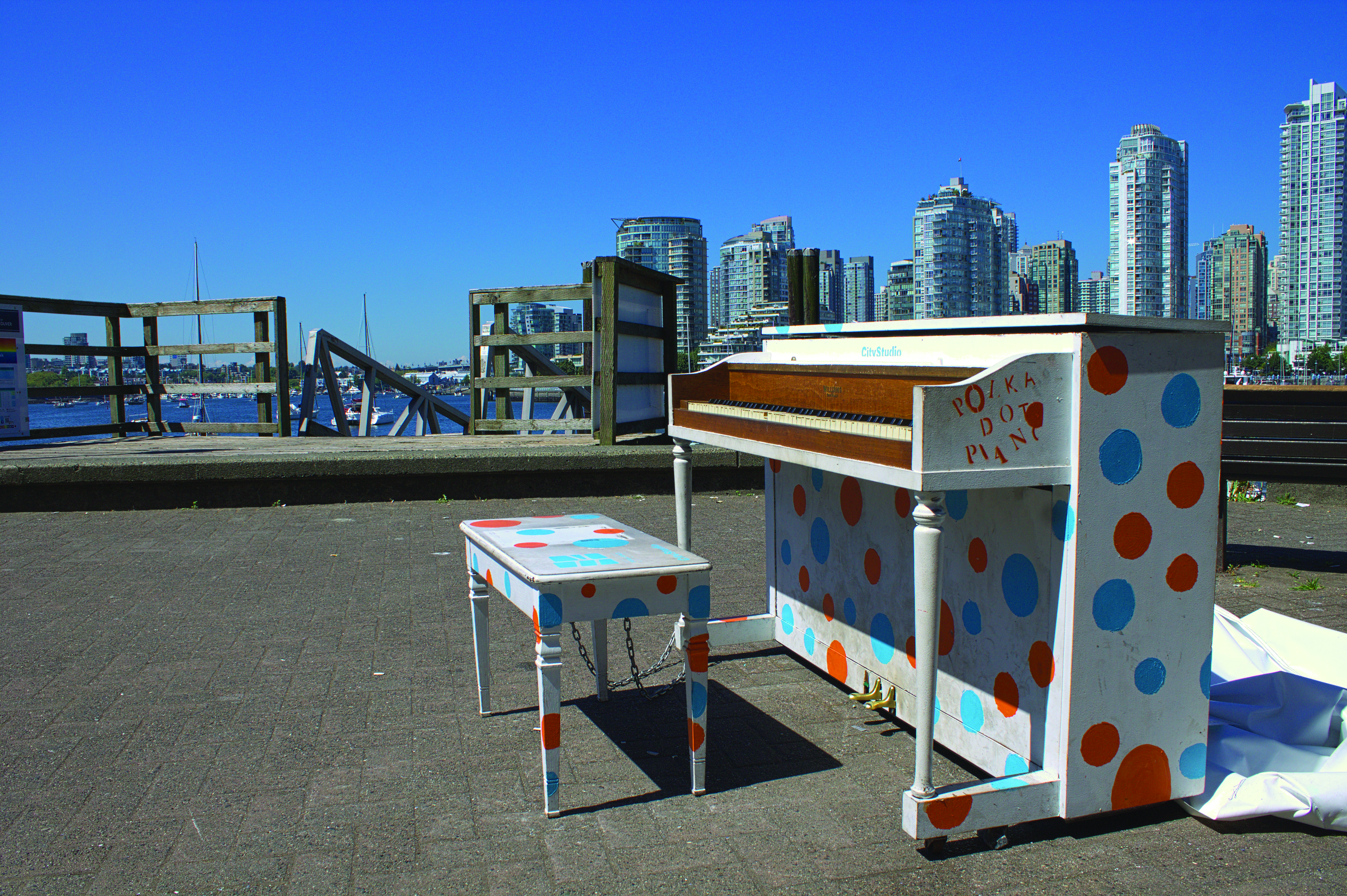
CMYK-Keys to the street-Kevin Krebs-FlickrOver the course of the next month, colourfully decorated pianos will appear across the city of Vancouver, to stay on the streets from July 1 until August 23.

Through collaboration with six post-secondary schools in the area and under the leadership of two SFU students, one current and one former, City Studio is beginning its second summer of the Keys to the Streets project.

Last year, Vancouverites were greeted by the sight of four pianos throughout the city, but this year, that number will grow to 10. Passers-by will be invited to sit down and play a tune, or simply to sit and listen to the music.

Originally inspired by the idea of a previous Semester in Dialogue SFU student, this summer’s project is being led by current SFU student Ebba Hassel and recent SFU alumna Jennifer Vallee, both of whom became involved after working with City Studio during their Semester in Dialogue at SFU.

City Studio is an “innovation hub” that unites city hall staff, community members, and university students to bring projects to life.

The goal of Keys to the Streets is to bring the community together through the art of music. Locations such as the Seawall, Robson Park, and seven others — to be revealed by the launch date of July 1 — will provide scenic spots to sit and play the pianos. Similar street musical art appearances have been implemented in cities such as Toronto, New York and Montreal.

Hassel and Vallee feel that connections are made with each stroke of the piano keys. “Even if someone just stops to listen to someone else, there’s a connection,” they stated. In the past, when one person started playing on the piano, others often joined in with their own musical instruments, creating a sort of impromptu street concert.

The pianos have been painted by local artists, and each individual piano will be looked after by a community steward, fostering further community involvement.

The culmination of this project has been a community effort in itself, brought to fruition through City Studio’s innovation and leadership, the city’s permission, and the support of local businesses. East Van Movers will help move the pianos to their destinations, Pacey’s Pianos will tune the instruments, and Delux Paint will provide the paint.

In a recent survey conducted by Vancouver Coastal Health (VCH), results showed that as many as one quarter of Metro Vancouverites could be experiencing social isolation. Organizers believe that, for this reason, the city can only benefit from such a project, the ultimate goal of which is the creation of a more social, vibrant, and colourfully connected community.

Album Review: Jon and Roy – By My Side

0

Jon and Roy


Like a cool sea breeze on a hot day, Victoria’s folk-rock duo Jon and Roy have a deeply calming effect. Their music is layered, pensive, and tranquil. This fifth album, By My Side, follows up their 2012 release, Let It Go, which earned them a Western Canadian Music Award for Best Roots Group Recording and featured the single, “Vibrant Scene.” 

The first single off By My Side, “Where’d My Light Go” is just as unassumingly catchy and has their trademark upbeat folk sound featuring a great harmonica solo. Themes of light and its various manifestations overtake the bulk of this record. 

The obvious one, “Where’d My Light Go” discusses light as perhaps a lost love, and “Moonrise” mentions the calming effect of the magic hour when everything looks golden. The moon also features in “Take Me By Surprise” as Jon sings “Out on a warm night, the moon is high / Out on a warm night and the moon is mine.” 

Light gives way to love on “Getting Warm” as Jon sings about lightning and a brightening road before filling his empty cup with a “loving wine.” The duo also loves to talk about love, and they do so with such beautiful simplicity. “Every Night” is a declaration of love that everyone can relate to about wanting someone’s love every night and lying next to them. 

The soothing guitar on this track gives it a lulling quality that will make you feel like lying down while Jon’s voice stretches around the higher notes of the line “Oh, I want your love.” 

On “Trouble in Mind” there is a much more melancholic tone with long drawn out notes and lyrics about not wanting to let someone down: “You can come to me / With your trouble in mind / And my darling I will be / There to hold you up fine.”

The seven songs on this album were written as the pair has always done — through jam sessions at Roy’s house. On this album, Jon also plays banjo and his new 1950s Gibson acoustic. Roy also experiments with new instruments using his custom Gretsch drum kit. With help from their friends, bassist Louis Sadava and supporting vocalist Carmanah’s Laura Mitic, the sound on this album feels wonderfully diverse.   

Feast your eyes at Dancing on the Edge

0

CMYK-Feast 4

SFU alumna Katie DeVries is thrilled about showing her work for the first time at contemporary dance festival Dancing on the Edge. “It’s a pretty big honour — I’m an emerging artist, so it’s a great privilege to be alongside these experienced artists.” DeVries is a big fan of another SFU alumna, Vanessa Goodman, who will perform her newest full length work, what belongs to you, at the festival. 

“I was finishing my [dance honours] degree,” said DeVries, “and I decided to do a directed study creating my own work and it became a show called The December Project. It draws from a lot of ideas and there’s no narrative, but it’s about torment and loss and the idea of being consumed throughout life. There’s also a through line of perseverance, and my son is in the piece so there’s subtle imagery of the passing on of life.”

This work has since evolved — the version to be presented is called Feast and will be performed in the courtyard of the Firehall Arts Centre. Performing outdoors is a new thing for this piece, explained DeVries. “It’s been challenging to adapt it to an outside setting.” In the theatre the lighting was very low to create an eerie and moody tone, but outdoors it’s hard to replicate that. “I’m excited by that challenge,” said Devries.

Dark lighting compliments the mood of Feast, which is almost like a haunted wedding, said DeVries. “There’s a table at the back covered in lettuce heads, and [the work] takes on a kind of haunted feel or a wedding gone wrong,” she laughed. 

Apart from her performance at Dancing on the Edge, DeVries is working on a new piece that will be performed on International Dance Day in April 2015. She is also working on a show with the working title Two Great Truths with Daisy Thompson who recently completed her MFA in dance at SFU. Their collaboration will also be performed on International Dance Day at the Scotiabank Dance Centre.

DeVries said that supporting festivals and events such as Dancing on the Edge is extremely important. “Contemporary dance is not always understandable, but I would encourage people to come and see what a wide range of choreography there is.” She also hopes that audiences will test themselves and expand their perspectives: “They might be pleasantly surprised.”

Not every piece is visually appealing, but DeVries explained that “even if you don’t find them beautiful, they are valuable.” In her piece, there is a moment when the dancers hiss at the lettuce heads and then smash them with their fists. At first glance that might look strange, but it adds to the show and you can even smell the lettuce, she explained, “it’s a very visceral experience.” 

DeVries enjoys experimenting with aspects that are new and different. “I played with smells —  perfumes and scentscapes instead of soundscapes,” she said describing one show where she released perfumes at certain points during the performance.

DeVries spoke fondly of her time spent at SFU’s School for Contemporary Arts. “It was absolutely what I needed both technically and for doing my own composition,” she said. “I came out of SFU with an idea of myself as an artist. It set me on the path to success.” While DeVries has recently graduated and feels like she’s still figuring out her artistic voice, and she also feels that SFU gave her the tools to succeed: “I’m emerging, but I’m on my way.” 

Feast will be performed on July 12 as part of Dancing on the Edge. For more information about the festival, visit dancingontheedge.org.

Dan Sawatzky brings his imagination to life

0

CMYK-Fraser Valley Pulse & Metro Vancouver Pulse-Flickr

The vibrant colors and interesting characters of cartoon life are usually reserved for the television screen. However, artist and Imagination Corporation owner Dan Sawatzky blurs the boundaries between animation and reality. Throughout the years, he has astonished both customers and critics with his amazing sculptures and paintings, creating everything from award-winning ice cream shop signs, to entire theme parks. Even his house is built in a comical fashion. 

His newest artistic endeavor is Cultus Lake Adventure Park. Described as a “whimsical and western,” it’s arguably one of the most heavily themed parks ever created. The Peak sat down with Sawatsky to discuss what it’s like to create a business and work daily designing worlds right out of Dr. Seuss books.

The Peak:When did you first begin to paint and sculpt? How did you discover your passion for this craft? 

Dan Sawatzky: I began drawing and painting at a young age and this ability showed up in my very first report cards when I was in school. While I have a talent inside me, I could name many I grew up with who were far better than I. I realized early [in life] that this was my passion, something I simply had to do. I started my own business painting seasonal window splashes at age 14. That was back in the late 60s. I made $600 after school in a few weeks that first Christmas season. I discovered I could make a living doing what I loved. I’ve never looked back and I am very fortunate to be able to follow my passion and do what I love every single day.

P:You have created many outstanding pieces of work, ranging from award-winning business signs to houses, and even theme parks. What is the project of which you are most proud?

Sawatzky: There have been countless projects through the years of every scale imaginable. Some went on over a period of years. Before moving to the Fraser Valley in 2000 I was very involved in the little town of Chemainus on Vancouver Island. I did many projects there as well as seven historical murals. My involvement there made it possible for me to paint more than 120 historical murals all over North America. 

Then I discovered the joy of designing and building theme parks. Our biggest project to date was the re-theming of Galaxyland in West Edmonton Mall. It took us more than five years. Giggle Ridge, which we owned for 12 years was a long held dream. Janis [Dan’s wife] and I, with a great team, built it in 2000. A couple of years later [in 2002] we drew the plans for the expansion of Giggle Ridge but we could not reach an equitable agreement for a lease on the needed land with the park board of the day so we put the dream away. 

When we sold Giggle Ridge to the Steunenburg family, ― owners of Cultus Lake Waterpark, ― we dusted off those old plans and showed them to the new owners. Now, two years later that dream is even bigger than we imagined.

P:You are currently working on the construction of Cultus Lake Adventure Park, the expansion of Giggle Ridge. What has taking on this project been like? Are there any challenges that you have faced? 

Sawatzky:  When we tackled the design and construction of Cultus Lake Adventure Park we started with the plans I had drawn over a decade ago. Chris Steunenburg wanted to maximize the potential of the relatively small footprint available and brought me a wish list of things they were considering. [. . .] 

We decided to theme one half of the project to the existing Giggle Ridge theme and the other half to a western theme. The challenge was to transition from one theme to the other. I believe it is done in a pretty slick fashion. In the process we also divided the rides and attractions for a younger crowd from the family rides that will appeal to older kids. We are very proud of this project and delighted to have this project so close to home!

P:Where will your next project be? Can you give us a sneak-peek?

Sawatzky: Our next project will take us all the way to Trinidad. It is a project very similar to [Cultus Lake Adventure Park]. Skallywag Bay Adventure Park will of course have a pirate theme. Attractions include adventure golf, a train, a kid’s play area, a climbing wall and rappelling rock of monstrous proportions, a ferris wheel and a wave swinger ride. All will carry a wonderful pirate theme, with a twist of course. We will build the components here in our studio over 48 weeks and then ship them down. 

P:What advice would you give to university students who would love to start their own business like yourself? 

Sawatzky: Follow your passion, not money. Learn your stuff, do your homework. Work hard. Become the best. Live the dream.

Cultus Lake Adventure Park opens June 28. To learn more about Dan Sawatzky’s work, visit his website imaginationcorporation.com.

Point/counterpoint: the Northern Gateway pipeline

1

Let’s build the pipeline.

Dustin Simmonds

As much as opponents do not want this pipeline built, the alternatives are potentially much more devastating. While I will be the first to admit that pipelines are not safe due to the potential for spills, they currently remain the safest way to transport a material that is only valuable because it is highly combustible. 

Some would argue that rail transport is better than pipelines. But to say so is to ignore the massive damage this method risks: just less than a year ago, a train derailed in the town of Lac-Mégantic, killing 47 people and levelling large portions of the town. If you go on Google Earth, you can still see the devastation. 

Furthermore, it is vastly more expensive, with the estimated cost of shipping oil sands to the American Gulf Coast — the route of another potential pipeline — close to five times the cost of moving it via the Northern Gateway.

It’s also worth mentioning that Northern Gateway has distinct advantages over southern routes, including the other most prominent proposed pipeline, the Keystone XL. Number one, it will be much easier to get the pipeline approved and built, as demonstrated by the lack of progress our government has had convincing the United States to press forward with Keystone. 

These resources do not do our country any good sitting in Alberta when they could be bringing in much needed revenue.

Moving forward with Northern Gateway instead of Keystone also means more jobs for Canadians, as the leaders of the project have already committed to providing over $3 million in funding for BC communities independent of Northern Gateway’s final approval, and estimate the pipeline will create over 3,000 construction jobs and 560 long-term jobs, which translates into $32 million per year flowing into local economies. 

Other suggested pipelines include the NDP’s proposed west-east pipeline, which they say will have the advantage of keeping the refining jobs in Canada. While I like the idea of refining Canadian oil in house and exporting the finished product, the truth of the matter is that Canadian refineries are currently not equipped to refine what is coming out of Alberta’s oil sands, and wouldn’t have the capacity to deal with this proposed pipeline even if they could do so.

I do not wish to belittle the fact that there are environmental hazards in moving forward with this project. But these resources do not do our country any good sitting in Alberta when they could be bringing in much needed revenue. It is estimated that this project will bring in an additional $300 billion in GDP over 30 years, which includes about $1 billion in tax revenue for British Columbia. 

We must not sacrifice the economic growth and the future of both our province and our country out of concern for a disaster.

Are you kidding? Let’s not.

Hannah Lingren

While the federal government may have offered its lukewarm blessing, the well-oiled publicity machine of Enbridge Inc. has failed to convince British Columbians that any economic benefits outweigh the costs and risks that the province must assume. As these become more apparent, it’s clear that this pipeline can’t be built.

As Enbridge attempts to jump through all the hoops laid out by BC and the Joint Review Panel, a number of dedicated people and organizations will be working to discredit this project. As it will likely be years before construction can even begin, there is plenty of time for the gaps, dishonesty, and dangers in the Northern Gateway plans to become obvious. They have already failed to obtain the cooperation of many Aboriginal groups, something integral to the success of the project.

The pipeline would definitely be a boost to the BC economy, but it is incredibly disproportionate to the money Alberta stands to make. In a report released by the Canadian Energy Research Institute, it is estimated that the pipeline will bring in $1 billion in tax revenue for British Columbia, but will also bring in $73 billion dollars in taxes for Alberta, and $4 billion for Ottawa. Another report predicts that BC will only receive $6.7 billion in government revenue, roughly eight per cent of the profit. This is a slap in the face to the province assuming all the environmental risk.

BC will have to worry not about having spills, but rather when they will occur and how bad they will be.

We cannot trust that Enbridge will adequately protect against the risk of an oil spill or leak, especially considering their track record of over 800 spills between 1999 and 2010. In fact, as they were preparing for public hearings in Alberta and BC in 2010, Enbridge was also dealing with 3.3 million litres of oil that spilled into the Kalamazoo River in Michigan. 

It seems that BC should worry not about having spills, but rather when they will occur and how bad they will be. A tanker spill in the Douglas Channel, infamous for its difficult navigation, seems inevitable. Such a spill could essentially negate all profits from the pipeline and cause irreparable damage to both local ecosystems and the industries and lifestyles that depend on them. Enbridge themselves seem aware of this: they edited out 1,000 square kilometres of islands from their route map in a televised ad. 

We have found ourselves wringing our hands over oil dependence while pouring all our resources and efforts into turning Canada into an oil exporting powerhouse. Allowing the completion of this project will cement Canada’s dependence on the oil sands, and perpetuate our status as an exporter of primary resources.

In the time we will have spent arguing over this project, the failure of which is inevitable, we could have focused on developing feasible energy alternatives.

Enbridge approval spurs opposition from BC residents

0

CMYK-Enbridge-April AlayonOn Tuesday June 17, the federal government approved Enbridge’s proposal for the Northern Gateway pipeline, subject to further talks with aboriginal communities and 209 conditions as recommended by the National Energy Board.

Despite Stephen Harper’s approval, both Tom Mulclair, leader of the NDP, and Justin Trudeau, leader of the federal Liberal Party, have said that they would reverse the approval if they were elected in the next election.

The pipeline still needs to be approved by the provincial government, but four of BC’s five conditions for heavy oil projects remain unsatisfied. According to BC environment minister Mary Polak, the federal decision does not affect the provincial government’s stance on the project. “Our position remains unchanged: It is no,” Polak said.

The pipeline has been met with much resistance, not only from environmentalists, but the majority of British Columbia’s residents. Several of British Columbia’s municipalities and First Nations groups have passed resolutions opposing the pipeline, as have both the provincial government and major NGO’s within the province.

Tom Gunton, director of the Resource and Environmental Planning program at SFU, has been examining the potential environmental risks of moving forward with the pipeline over the past few years. He told The Peak that this outcry is not surprising, considering that 65 per cent of BC residents disapprove of the pipeline, according to recent polls.

“The federal government called critics of the Northern Gateway Pipeline radicals supported by foreign interests, and of course 65 per cent of of British Columbians oppose the Northern Gateway Pipeline,” Gunton said. “You sort of can’t consider 65 per cent of British Columbians radicals. The British Columbia government opposes the Northern Gateway Pipeline, and it’s hard to define them as radicals!”

Although support and opposition to the pipeline is split more evenly across the country, Gunton explained, “It’s largely because of a lot of Canada won’t suffer the consequences and the bills associated with the Northern Gateway Pipeline.”

Opposition to the pipeline is largely due to the high risk of oil spills as well as the overwhelming cost of the project, according to the report. Communities in BC have hosted a number of petitions and protests since the pipeline was proposed and even more have emerged since its approval.

The announcement has also elicited reactions from the SFU community. The City of Vancouver and SFU’s Centre for Dialogue held an open discussion on June 24 so that people could exchange ideas and learn about the project.

On June 25, Jessie Russell, member relations officer on Sustainable SFU’s board of directors and secretary for SFU 350, approached Council, a monthly cross-campus dialogue composed of representatives from each department and SFSS constituency group, to recommend to the board of directors that they take an official position against both the Enbridge and Kinder Morgan proposed pipeline projects.

A group of academics, led by SFU ecologist Wendy Palen, has already taken a stand against the projects. On June 19, they wrote in the British journal Nature that Canada and the US should halt project approvals until oil sands developments are consistent with the government’s commitments to cut carbon pollution.

For Gunton, the reactions from the community are what he would have expected: “It’s one of the most significant projects ever proposed in British Columbia in terms of size and potential impact. Secondly, it’s going to result in major controversy in BC with court cases and protests.

“Consequently it’s going to have major repercussions, both provincial and national, and likely international issues,” he concluded.

Pepsi reveals secret formula of ice cubes

0

NEW YORK — The Pepsi Corporation held a much anticipated public event yesterday which they had billed online as “Pepsi Presents: A Secret Formula Revealing” to a record number of disappointed people.

The gathering, which was held at Pepsi’s international headquarters in New York, garnered over 10,000 curious visitors eager for a chance to see behind the magic of the sugary drink company.

“We really wanted to let our customers in on one of our biggest secrets,” announced Pepsi Co. Chairman and CEO, Indra Nooyi. “But everyone already knows how they can get the cool, refreshing taste of Pepsi — they just go to the store and buy one — so we decided to give them the opportunity to find out one of our most guarded secrets: how we make our ice cubes.”

After this point was made clear, most of the audience had already gone home, but for those who stayed they at least got a beginners science lesson.

“People always say to us, I love Pepsi and all its related products, but it never quite seems like it is in the commercial, what are those clear square shaped items in your glasses?” continued Nooyi over murmurs from a disgruntled crowd. “Those are called ice cubes and today, for the first time ever, I’m going to reveal their secret formula.”

The reveal was that these “ice cubes” were actually only made with one ingredient, water, or as Nooyi called it: Pepsi H2O.

Although anyone who had ever seen ice before was not shocked by the second step, there was an unexpected twist. To make Official Pepsi Ice Cubes, you need to freeze the water in an Official Pepsi Ice Cube tray. Luckily, they were being sold at the event for only $5.99.

Overall, Pepsi failed to impress the majority of their customers and only sold a handful of Ice Cube Trays but reports are that their rivals, the Coca-Cola Corporation, is still making plans to one up them.

According to our sources, Coke is holding their own event this week where they plan to not only reveal their own ice cube formula but also reveal the secret ingredient that makes Vanilla Coke different from regular Coke.

Moment of Zen

0

During the discussion on whether or not to appoint a board chairperson or to postpone the decision for another week, president Chardaye Bueckert passed the chairship to VP university relations Moe Kopahi in order to be able to discuss the proposed amendments herself.

Wary of the amount of time already spent discussing the motion, Kopahi said to the board members on the speakers list, “Please keep it short, 30 seconds maximum, or I will cut you.”

DNA in video games: no thanks!

0

The hoopla surrounding our lack of privacy in the digital age is about to reach an all-time high. While the Internet has increasingly provided authorities with ways to rob us of our privacy, mainly in the form of online spying, soon there may be a way to steal information on our genetic make-up.

An article from The Escapist by Josh Engen was recently brought to my attention, and to my shock and horror it states that DNA Diagnostic Center Inc. is engineering a new videogame experience — one that will allow us to essentially put ourselves into a videogame. The technology, titled “Helix Profile,” will use genetic testing to analyze the user’s DNA. “Once a genetic profile has been created,” the article reads, “the data could then be imported into a videogame.”

Sure, some people may find this rather exciting. In fact, just this afternoon a friend of mine immediately stated “wow, that’s actually pretty awesome,” upon hearing the news.

Submission of our DNA will allow people access to our physical, unadulterated selves.

“Awesome?” I replied. “Are you joking?” In a time when infringed privacy runs around us like angry chickens? Think of the ethical problems this could cause.

Privacy is a hot topic these days. After the NSA revelations were released, the stir that resulted sent shockwaves across the globe. It’s clear that our personal information is an easy swipe for almost any company on the net. It’s also clear that they provide an inviting entryway for authorities to walk in and steal our data from us without our knowledge.

The Internet is increasingly finding ways to take our personal information and use it to spy on and manipulate us. But this thievery has only been of our outward actions: text messages sent, pictures taken, personal information that has been created by moving fingers. While still a violation of our digital rights, this privacy breach is only of actions we have the power to manipulate.

DNA is something that we can’t manipulate. DNA is solid, concrete, a part of us. The Internet believes it can get to know us through what we do online, but these actions may or may not be who we actually are. Submission of our DNA will allow people access to our physical, unadulterated selves. It is the ultimate in privacy invasion.

I cringe to think of the unethical things that could occur should this information fall into corporate or even government hands. Words such as “fraud,” “identity theft,” and even “cloning” come to mind. If the wrong person had this information, they would have access to all of our medical records. Wrongful impersonation would reach a new high.

The sad thing is, no matter how unethical a technology may be, it will always be expanded upon and developed for use, even in private. And when the government is involved, the concepts of ethics and morals seem to go awry; they blur unapologetically with the the concept of power.

Sure, DNA Diagnostics Centre Inc. can claim that genetic testing is for entertainment purposes, but half of us know that it could, and probably will, be used elsewhere. Sadly, the other half will fall into the capitalist trap, responding to it with, “Whoa, this is really cool!”

Put simply, there are some technologies that should not be produced or further developed. Those who wish to explore this technology must stop and realize that our DNA belongs solely in a medical facility and not in the capitalist market. I, for one, will not allow my DNA to float about the web.

We got Desjardins!

0

After many weeks of speculation, Willie Desjardins has been hired as the Canucks’ new head coach; many had pegged him as the next coach after John Tortorella was fired in May.

For a brief time, it looked like the Pittsburgh Penguins had scooped him from right under us, with TSN analyst Darren Dreger reporting that he was going to sign in Pittsburgh, dashing many a Canucks fan’s hopes and dreams.

Aside from the quality coach, it’s nice to see the Canucks win one of these races for the best candidate or player again. For now, it looks like a huge victory for the Canucks and perhaps a loss for the Penguins, who, in the end, chose Mike Johnston, Vancouver’s plan B coach.

The 57-year old Desjardins is fresh off winning a Calder Cup with the Texas Stars, the Dallas Stars’ AHL affiliate. Prior to that, he ran the WHL Medicine Hat Tigers as both coach and GM with consistent success, including two WHL championships. It should also be noted that he drafted Canucks prospect Hunter Shinkaruk in the WHL.

With his strengths as a good communicator and successes in both the junior and minor leagues, Desjardins offers the Canucks a fresh start, and will help them usher in a youth movement.

Desjardins’ communication abilities may help players who suffered under the Tortorella regime.

Whether this year is actually a rebuild or not, they are likely to start introducing prospects such as Bo Horvat into the lineup, and increasing the roles of others such as Nicklas Jensen, especially with a possible Kesler deal. Not only will Desjardins benefit prospects who are looking to make the team, but also young players who are already on the roster such as Zack Kassian (assuming he will be re-signed as a restricted free agent).

His communication abilities may also help players who suffered under the Tortorella regime. Look at Alex Edler, for instance: as Torts admitted, the two were never on the same page. In addition, despite being a rookie head coach, Desjardins was an associate coach with Dallas from 2010-2012, ironically under current Canucks assistant Glen Gulutzan. 

Contrary to Torts, Desjardins is known for a more offensive game, which will be a nice contrast to last year. I also like the route of hiring a coach new to the NHL, as opposed to other coaching candidates, such as Dan Bylsma, who is fresh off of failure. The recent retreads have been pretty bad: look at Torts, and Randy Carlyle so far.

However, that’s not to say that experience is bad: experience is what it takes to make you better. Actually, that is one of the big question marks hovering over Desjardins’ head. Why, at 57, has he not coached an NHL team yet? He is pretty old for a first time coach.

And what if he is another Dallas Eakins? That’s not to say Eakins won’t turn things around in Edmonton, but so far he serves as a reminder that success in other leagues does not necessarily equal NHL success.

For now, though, it’s safe to say Desjardins is a much needed fresh face for this team.

(A)side Jab: Many analysts are shocked that Desjardins chose the Canucks over the Penguins, since they have two of the NHL’s biggest stars. However, despite their supposed superiority, they’ve won very little. Although this is easy to blame on the outgoing coach, it is possible that they just don’t have what it takes to win. Besides, where would you rather live, Vancouver or Pittsburgh?