Home Blog Page 1154

Believe in fairies with A Midsummer Night’s Dream

0

I’ve seen many productions of A Midsummer Night’s Dream over the years, but I have to say I laughed the most at this one. The Players, Puck, and even Helena were all just a bit more exaggerated in their humour, and it was refreshing. 

From the colourful circus-inspired fairy costumes to the umbrella motif used throughout the show, this was a unique staging that allowed for plenty of dreaming. The first thing the audience saw coming up over the stairs at the back of the open-ended tent were large black umbrellas as Theseus and Hippolyta discussed their daughter Hermia’s betrothal to Demetrius. 

The central conflict of the play comes from the fact that Hermia and Lysander are in love and she does not wish to marry the man her father approves of. Demitrius, while also in love with Hermia, has an admirer of his own: Helena begs for his love no matter how hard he tries to dissuade her. 

The four lovers all gave very strong performances, but Sereana Malani as Helena stood out with her perfectly sassy attitude. Naomi Wright’s Titania was an elegant performance that complemented Ian Butcher’s Oberon very well. Oberon’s scheming Puck played by Kyle Rideout was an audience favourite as he causes all the mischief and confusion between the lovers and even joins the audience, stealing some of their popcorn.

My favourite aspect of any production of Dream, and how I tend to rate its success, is The Players. This group of bumbling tradesmen, led by the well meaning Peter Quince (Bernard Cuffling) provided clever comedy as they rehearsed their play, Pyramus and Thisby. Bottom the Weaver (Scott Bellis) was perfect in his donkey mannerisms when transformed, and reminiscent of them when himself. As The Players performed for the duke at the end of the show, they topped off this production with non-stop laughter. 

Another unique element of this production is the use of pop music interludes. For example, when Puck puts his spell on the lovers, “I Put a Spell On You” blasts from the speakers as he busts a move. This kind of upbeat, tongue-in-cheek humour is what makes this Dream so much fun. 

A Midsummer Night’s Dream runs from June 11 to September 20 at Bard on the Beach’s BMO Mainstage in Vanier Park. For more information, visit bardonthebeach.org

Kick up your heels at Red Rock Diner

0

CMYK-Red_Rock_0158-s

One of the first DJs to play Elvis, Buddy Holly, and other rock n’ roll acts regularly in Canada, Red Robinson is a Vancouver radio star who was extremely popular with young people. He went on to have a very successful radio and TV career while authoring a couple of books along the way. I’m sure some people attending Red Rock Diner remember the days when Robinson dominated the airwaves, and this show is a nostalgic trip back to those days. It’s full of toe-tapping classic ’50s music, but it’s lacking a strong narrative. 

Act one is a collection of songs with interludes of Robinson’s DJ antics, and I found myself waiting for the show to give me some kind of plot. A few songs in, I realised that there wasn’t going to be much of a plot and accepted the fact that this show would be a series of loosely strung together songs set in a diner.  

This doesn’t mean the show wasn’t entertaining. I enjoyed the music and the infectious dancing of the extremely talented cast, and although I wasn’t around when these songs were being played on the radio, they still retain a certain charm. Songs such as “Rockin’ Robin” and “Jailhouse Rock” stuck with me for days afterwards, but I’m not sure that’s a good thing. 

Being set in Vancouver, there were plenty of stereotypical references to the city. Of course the weather report was all rain, the Canucks had just lost their latest game, and there were crowds of teenagers at English Bay. Robinson’s reaction to the price of houses in Kitsilano at $15,000 got a few laughs, and they even managed to fit in a dig at Whalley that fell quite flat. Other timely references include some advertisements of that era, such as 7-Up and Buick. 

The five-piece band really knows how to rock and gets to show their skills on tracks such as “Great Balls of Fire,” “Rock Around the Clock,” and “Good Golly Miss Molly.” The four main characters, if we want to call them that, are impressive with their smooth moves and stamina throughout the show, but some of the choreography felt a bit forced and not so rock n’ roll. 

The setting moves to King Edward High’s gymnasium for act two where Robinson hosts the school’s 1957 graduation night talent show. This section of the show was less entertaining, but still contained some crowd pleasers such as “Tutti Frutti” and “Stand By Me.”

With very little plot to work with, the show relies on audience participation for their series of songs with female names in the titles. As they began singing “Jenny, Jenny” they invited any Jennys to the stage. Same for “Diana,” “Oh, Donna,” and “Wake Up Little Susie.” Once all the audience members were on stage, they participated in a musical chairs competition, and while this was mildly entertaining, it detracted from the show and I would have preferred to see another song or two performed by the cast. 

Displayed on a screen above the stage as the audience enters the theatre is Edward Hopper’s Nighthawks. While it is a painting depicting a diner scene, I wasn’t sure how it fit with the themes of the show, and I think that it evokes many more deep emotions than Red Rock Diner

For an entertaining evening that will be pleasant for all ages, this show is a success, but as a piece of profound theatre, it has some work to do. 

Red Rock Diner runs from June 25 to August 2 at Arts Club Theatre’s Granville Island Stage. For more information, visit artsclub.com.

Former SFU resident blames decline in health on mould

3

WEB-Mould-Anderson Wang

A former SFU graduate student is still searching for answers after finding the presence of potentially toxic mould spores in his suite in Hamilton Hall in 2007.

George Kaufmann, who was recovering from lung cancer surgery when attending SFU, told The Peak that his health sharply declined over the course of his residency, during which he developed a “weeping body rash” and “difficulties in breathing,” according to a document he later filed under the Freedom of Information and Protection of Privacy Act in 2009. 

Kaufmann’s concern turned into alarm when he discovered a large colony of what he believed to be black mould behind his bed.

Administrative concerns at SFU regarding the deterioration of campus buildings and indoor air quality can be dated back to the late 1990s. Hamilton Hall, a student residential building constructed in 1992, was the subject of a series of building envelope assessments conducted by the environmental analysis group James Neill and Associates in 1998, 2003, and 2005. 

The reports recommended a review of maintenance records in addition to a list of remediative actions in 1998; the 2003 report recommended both temporary and full-scale repairs, with the latter estimated to cost up to $978,000.

The 2005 report observed that “with the exception of repairs conducted at the northwest corner [. . .] in 2003, it appears that minimal overall short term preventative maintenance was completed.” The report further explained that, “in some cases, the water penetration appears to have continued unabated to the point where advanced structural deterioration has occurred.” 

SFU continued renting rooms to students as late as 2007, prior to extensive building renovations that were conducted over a two year period. 

Kaufmann moved into suite 1013 in Hamilton Hall on May 8, 2007. The suite was designed for disabled persons, as Kaufmann was recovering from his surgery which had taken place in December of 2006 and was on a second round of chemotherapy. He was listed with the Centre for Students with Disabilities as an immunosensitive person, and claims that he was not informed of the building’s history prior to being assigned the room.

Kaufmann complained once via email about the quality of the carpets, but otherwise saw no cause for concern with the room. However, during his residence, he alleges that his health suffered. When he, along with the other tenants of the building, were relocated to Louis Riel House due to renovations taking place on Hamilton Hall, Kaufmann claims to have discovered the alleged black mould behind his bed

Upon further emailed complaints to Residence and Housing, Kaufmann was informed by Jan Flagel, a management representative of the Residence safety committee and SFU’s director of Residence and Housing, that the stain was “food-based,” despite the issuance of a report in September 2007 from Pacific Environmental Consulting that confirmed the presence of “significant fungal staining.” Flagel declined to comment for this article. 

The report stated that the spores were present in levels three times higher than outside air samples: approximately 57,000 spores per cubic metre inside versus approximately 17,100 per cubic metre outside. 

However, a second assessment of the room, which was conducted by Pacific Environmental Consulting after the room was left untouched for four days, found that fungal spore counts sharply declined for both indoor and outdoor numbers. The second evaluation found approximately 1,000 spores per cubic metre indoors and approximately 6,000 spores per cubic metre outdoors. 

Kaufmann speculated that every time he opened his drawers, displaced air beneath the bed caused the mould spores to become airborne, and when the room was left for four days, the spores may have settled.

In 2009, Kaufmann was relocated back to suite 1013. He complained about the mould colony under his bed to SFU Ombudsperson Jay Solomon, and Kaufmann claims that Solomon confirmed in an email that “the mould was tested and came back as ‘food-based’ and was not considered toxic or dangerous.”

The email in question continued, “Unless you have testing results that contradict the results of the tests done by SFU, comments by others are simply opinions not based on fact.” As of press time, attempts by The Peak to contact Solomon have been unsuccessful.

When recently asked by The Peak why SFU did not undertake a comprehensive safety assessment in response to the earlier reports, SFU chief safety officer Terry Waterhouse stated that mould spore counts were not the be-all-and-end-all of air quality assessment, stating that “observation by a knowledgeable assessor” is the most important quantifier. 

He explained, “The assessment [done] provided evidence of significant problems with [Hamilton Hall], which were responded to in a very comprehensive manner.”

The Great White Bore?

0

WEB-P.2 photo-Anderson Wang

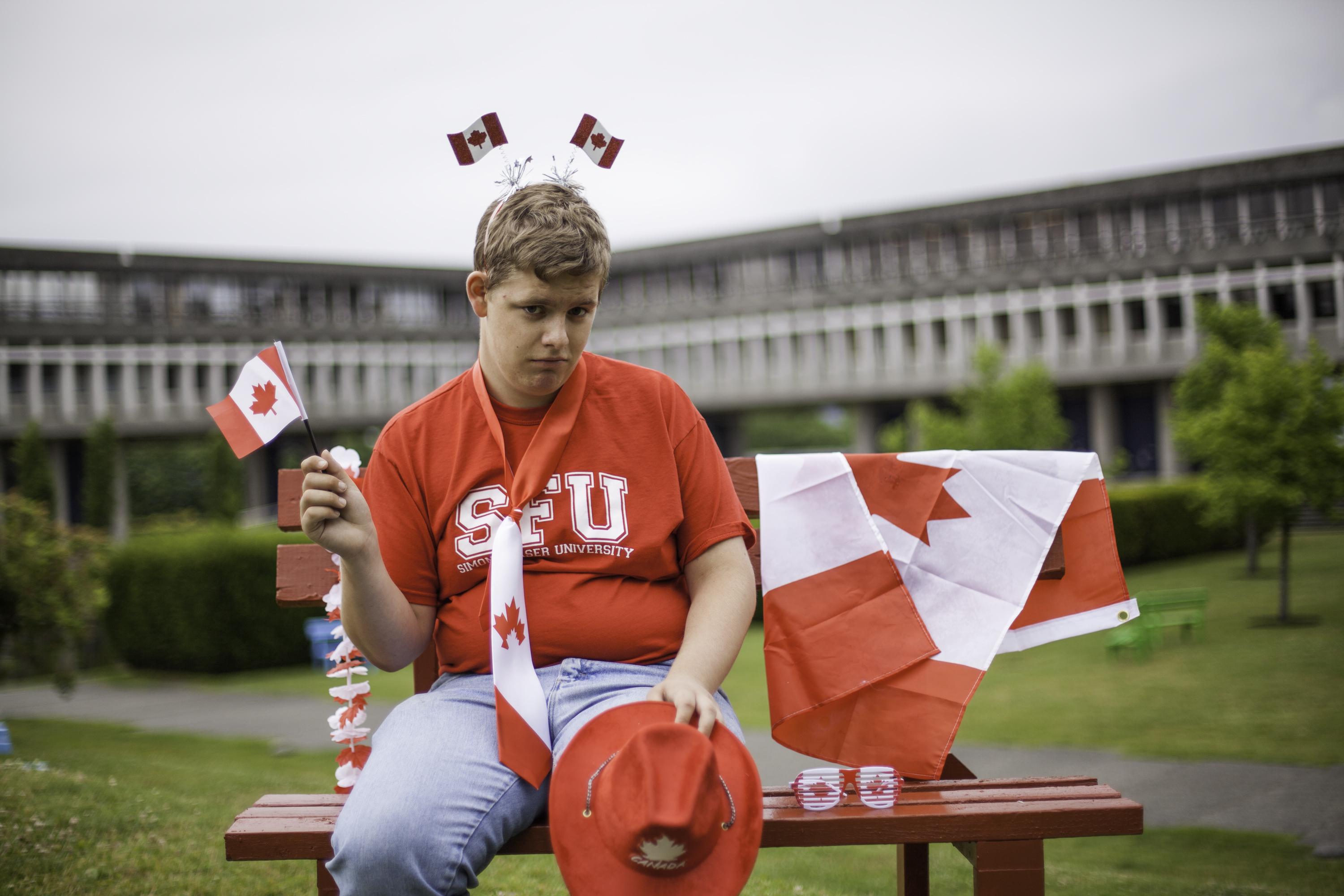
You’ve probably heard someone call Canada boring. You may have even been the one saying it. I know I used to when my childhood dreams all included moving down south to America, the land of opportunity — or so I thought.

As I’ve grown older, I’ve come to appreciate our country for what it is: beautiful, unique, and fascinating. What does interest me, though, is why so many people still think this way, the way I did so many years ago. What’s behind Canada’s boring reputation? What does it say about our culture, our nationhood, and, most importantly, about us?

If you can still remember your high school social studies classes, you probably recall the collective groan that came over the class whenever Canadian history came up. Studying Europe, you learn about the Roman Empire, the Black Plague, the Crusades; for our neighbour to the south, you’ve got the Civil War, huge battles in World War II, the Cuban Missile Crisis.

As soon as you get to Canada, though, discussing such topics as Confederation or how we got our constitution in 1982, the complaining starts. Compared to the rest of the world, Canadian history just doesn’t seem to cut it.

The same goes with politics — when the American elections come rolling by, you will surely hear more than a few passionate discussions about it here in the north (mostly demonizing the Republicans and showering love on Obama, since this is still Canada). However, during Canadian elections, it’s easy to forget they’re even happening. Barely anyone talks about them.

Probably our most common stereotype is that were nice, which isnt exactly the most exciting cultural trait in the book.

Aside from maybe a few anti-Harper jabs by fellow students, I remember being shocked at how little people seemed to care about the 2011 Canadian election, which had much more bearing on our nation than the Obama vs. Romney feud a year later. Over 40 per cent of eligible Canadian voters didn’t even bother to vote.

Not to mention that, as some people love to argue, Canada doesn’t really have much of a unified culture, or, at the most, a very boring one fuelled mostly by hockey and beer. Probably our most common stereotype is that we’re nice, which isn’t exactly the most exciting cultural trait in the book.

If you type “Canada most boring country” into Google, you will find some rather interesting results. These range from satire to serious criticism of not only Canadian culture and politics, but Canadians themselves. Sometimes, we’re even the ones calling ourselves boring. What gives? Is Canada really that uninteresting? And if so, can we do anything to spice up our national image?

Nicolas Kenny, a professor of Canadian and Quebecois history at SFU, doesn’t necessarily think that our country’s history is more boring than others’ — he simply thinks it’s not as well known. “I think a lot of people like to throw that word [boring] around because Canada’s a smaller country in terms of population, and it’s a country that has maybe a less well-known history.

“We don’t have those big kind of Hollywood moments [in our history],” he explains.

After all, when’s the last time you saw a war movie where Canadians were the heroes? Compared to Americans, our role in the World Wars and other global conflicts seems pretty drab and colourless. Of course, this might have to do with our reputation for peacekeeping and non-violence, one that stands in contrast to the comparatively bloody history of the US and others.

Fellow SFU history professor Allen Seager proposes an alternate theory as to our supposedly boring history: he thinks the way our history has been presented is to blame. “In my view, this idea of Canadian history being boring has been imposed by historians and popularisers of history, including a very influential group of people responsible for school curriculum.”

According to Seager, Canadian history is made to look boring “to develop this idea of Canada as a functioning federation of a peaceable kingdom,” and to make sure that “students will get no other message than the folks in charge of our country have always known how to make the system work.” In Seager’s view, our government and our history as a colonial subject cause our textbooks to ignore the radicals and game changers, favouring the more low key elements of our past.

“The boredom theme is, to me, disempowering,” Seager says. “It’s meant to impose on the students the idea that our elders long ago, like our elders today, have got their act together.” To Seager, this is a fantasy: no government is quite as stable as it seems on the outside.

We may be less aware of our nation’s more colourful historical moments, but that doesn’t mean they didn’t happen — a quick look through the biographies of figures such as Louis Riel and John A. MacDonald prove that our history might be more interesting, and scandalous, than we thought.

***

What is Canadian culture? Most would probably point to our cultural stereotypes: maple syrup, beavers, and lots of apologizing. However, there’s much more to our culture and nationality than what’s on the surface — and it goes far beyond sports and liquor.

Scores of great artists, comedians, actors, musicians, and other creatives have, at one time or another, called Canada home. Whether it be the music of Rush or The Guess Who, artists such as the Group of Seven and Emily Carr, filmmakers such as Atom Egoyan and David Cronenberg, or our amazing swath of comedians from Dan Akroyd to Jim Carrey, Canada has produced a lot of talent.

But, the key word here is produced. Jack Little, an SFU professor whose son is comedian Mark Little and whose daughter is an actress who studied in London, explains that Canada’s lack of cultural centres make it hard to make a living in the arts here.

“We don’t have cultural centres as exciting or as big as New York City, London or places like that,” he tells The Peak. “One of my two kids, he [Mark Little] has to go down to Los Angeles, he doesn’t make a living as a comedian in Canada. [. . .] They find a much broader venue for their kind of talents in a place like London or LA. In Vancouver, and the west coast in particular, it’s a struggle for people involved in the arts.”

Our sparse and relatively small population might be to blame for the lack of artistic opportunities in the Great White North — but that still doesn’t explain away the claim that we have no culture whatsoever. Among other complaints found on the web, two of the most common argue that there is no distinct Canadian cuisine, and no identifiable Canadian style.

Moreover, many complain that most of our pop culture is imported over the border, an argument that dates back to the creation of the CBC in 1936, established mainly to promote Canadian content in lieu of the American programs which, at the time, dominated the airwaves.

“I’m concerned about the degree to which we swallow American popular culture wholesale,” Little notes. “And even though my students are claiming a strong sense of Canadian identity, it’s very difficult for them to tell me how they are different from Americans.”

Little says the lack of an identifiable Canadian culture is the result of our values, which promote our nation as a cultural mosaic. “Canada is a country which doesn’t have a very strong cultural identity,” he says, “partly because we’re French and English, so we’re divided there. Partly because we’re a country of immigrants, and we’re promoting multiculturalism.”

Instead of a core national identity, then, Canadians would rather value a set of diverse cultures, making for a varied and interesting — but ultimately difficult to define — place to live.

***

When asked if there’s anything that separates us from other countries, Little says that “English Canadians define themselves as not Americans.” It turns out that for many, defining ourselves as the opposite of Americans is about as nationalistic as we get. After watching Olympic hockey matches between Canada and the US, it’s hard not to agree with this point.

Though our value of a complex cultural model is worthwhile, when it comes to a Canadian national identity, there’s certainly room for improvement. As Nicolas Kenny points out, both our history and politics are important factors in building a sense of national pride.

“I think it’s easy if you just dismiss [our history and politics] as being boring without taking the time to think about what’s going on, and why is it interesting,” Kenny explains. “I think it’s dangerous, because societies have a responsibility to understand where they came from, to know their past, to know their politics, to know what decisions are being made in their name, to know what impact they’re having on the world.

Wouldnt you rather have a boring and undramatic history than a violent and destructive one?

“If we just say ‘Oh, it’s just boring,’ we run the risk of letting other people decide for us. To remain engaged in the world we need to know what our world is about and what our country’s role in that is and remain critical of it.” For Kenny, part of nationality is the ability to know and take pride in one’s country — and to make sure we’re building a Canada we want to live in.

To Kenny, who’s studied Canadian history for decades, our story is far from boring. “We have a really interesting story of people trying to make this place home,” he explains: one filled with rebellion, bravery, intrigue, and drama. Still, he warns us to be careful what we wish for. “You’ve got to be careful not to say the opposite of boring is something positive,” he reminds.

Sure, Canadian history might not be the most interesting, but what’s the flip side? I would rather have boring and undramatic than violent and destructive, wouldn’t you?

When it comes to politics, Canadian government goings-on tend to elicit the same bored shrugs as any of our other cultural mainstays. Sure, occasionally you get a Jack Layton or a Pierre Trudeau. Most of the time, though, our leaders are much less charismatic than American presidents or British royalty. Regardless of your views on Stephen Harper’s politics, it’s hard to argue he’d be fun at a party.

Though our politics aren’t exactly action packed, we have a responsibility to pay attention to what’s going on in our country. We in Canada have the right to vote, something many people around the world would consider a luxury. Whether or not you’re interested in what’s going on in Ottawa, unless you’re paying attention and exercising your right to make your voice heard in an election, you have no right to complain.

Even my friends who have strong opinions on Canadian politics still seem to view them as a bore. Sure, we don’t focus as much on the private lives of our MPs here — you’d be hard pressed to find a news story on Harper’s favourite TV show or favourite restaurant, even though stories like this about President Obama seem to pop up every second week. Canadian politics are different in that we’re focused on just that: the politics.

There are certainly issues, but we have a rather stable political system, and I personally prefer a system that’s boring but efficient. It’s nice to know we’re voting people in on more than a rousing speech or a charismatic personality. Some may complain, but when it comes to picking between exciting disorder and bland order, I’ll go for the latter every time.

Plus, there are plenty of groups out there advocating for increased youth participation in  the Canadian democratic process. If you’re interested in looking at our political system in a fresh way, nonpartisan group Apathy is Boring is devoted to making our politics interesting for young voters in Canada. Their goal is to “build a sustainable dialogue between youth and elected officials” through social media campaigns and programs such as concerts, events, and democracy workshops. It’s nice to know that some still believe that our politics can be made interesting — even though it might be difficult.

It is hard to say whether something is boring, because meaning varies from person to person. One person’s paradise might make another man yawn. With that being said, those who think of Canada as boring could stand to learn a little more about it.

“I’m not really concerned with our image as Canadians,” Jack Little says. “You know — the image of being boring, or the fact that when you go to France or England, you never hear about Canada. I mean, usually you hear about places where there’s a lot of conflict.” Maybe a more low-key image isn’t so bad, after all.

Boring or not, Canada’s the best country in the world: it’s beautiful and full of life. I’m proud to be a citizen here, no matter what the rest of the world thinks.

So here’s to our nation’s 147th birthday: Happy Canada Day, everyone!

Research proposes strategies to save the sawfish

0
Image credit: Kenneth Uzodinma.

CMYK-sawfish-Kenneth Uzodinma

With new strategies inspired by collaboration with the world’s foremost sawfish experts, Nick Dulvy, a Canada Research chair at SFU, hopes to save this once-abundant breed of rays from extinction.

Sawfish are shark-like rays distinguished by a long snout called a rostrum filled with ‘teeth’ that resembles a saw. Although the ‘teeth’ on the snout are not, in fact, teeth, the sawfish uses them to stun its prey and ward off predators or divers.

However, the very weapon that helps the sawfish thrive is among the reasons they face possible extinction. The rostrum can get caught accidentally in fishing nets, and this often proves fatal for the sawfish.

Dulvy’s report, “Sawfish: A Global Strategy for Conservation,” states that sawfish “are entirely gone from 21 countries” and could be extinct in 42 out of their 92 “former range countries.” 

Habitat destruction and overfishing also threaten the species. “One path to extinction that is particularly prevalent in the ocean is that if you fish something hard enough, the population will decline, and if you do not manage that decline then it is inevitable that the decline will continue until the species [goes] extinct,” explained Dulvy.

Despite the alarming rate by which sawfish are disappearing, Dulvy, with the Shark Specialist Group (SSG) of the International Union for Conservation of Nature (IUCN), has come up with a strategy to reverse the decline in sawfish.

According to the official press release, the strategy calls for “national and regional actions to prohibit intentional killing of sawfish, minimize mortality of accidental catches, protect sawfish habitats, and ensure effective enforcement of such safeguards.” The report also outlines important areas for improvement, which include effective communications, capacity building, strategic research, responsible husbandry, and fundraising.

For Dulvy, implementing ways to protect sawfish and following through on those initiatives is crucial. “It’s one thing to have laws and legislation to do that but it’s another thing to act upon the laws and legislation,” Dulvy elaborated. “What we need to do is to ensure there are people who can do that. To some degree, you need the education and the awareness raising before policy makers even realize they have to produce laws.”

Effective training is yet another hurdle the industry needs to overcome. “At the moment there are very few people out there in the world who are actually capable of conserving sawfish, or any other marine fish for that matter,” said Dulvy.

Beyond the sawfish population, Dulvy argues that overfishing is harmful to fisheries themselves. He said, “We are overfishing the world’s oceans. That causes huge problems, not just for sawfishes and biodiversity, but overfishing the world’s oceans [means that oceans] don’t generate as much fish for food as they could be doing.”

Dulvy stated that the project’s goal is not only to conserve sawfish, but to help fisheries as well: “We’re not just in this game to save five wonderfully arcane species; we’re in this game to make the world’s fisheries more sustainable, more profitable and better able to support the food needs of coastal peoples.”

Coho cannibalize their cousins to prosper

0

cannibal salmon-Jerry Guo

Research out of SFU indicates that the coho salmon population may benefit from nutrients scavenged from the decaying bodies of their distant pink and chum cousins. 

Michelle Nelson, lead author of a recent report on the subject, explained, “This is the first study to look at the effects of spawning salmon on the population of another species of salmon.” She conducted the study for her PhD project along with her advisor, SFU professor of aquatic ecology and conservation, John Reynolds.

Nelson found a strong correlation between an abundance of baby coho salmon and high numbers of pink and chum salmon. In fact, “there were three times more baby coho salmon in streams with high numbers of pink and chum spawning salmon compared to those with none,” she said.

Nelson surveyed the coho salmon populations in over 20 streams in the Great Bear Rainforest. With the help of the Heiltsuk First Nations, Raincoast Conservation Society, and several members of the Reynolds research group, she did so by collecting data on the habitat characteristics of the streams and by counting the pink and chum salmon during spawning. 

With the data she collected, Nelson was able to create and test candidate models to determine the importance of pink and chum salmon in predicting juvenile coho salmon abundance.

These findings could indicate that juvenile coho are thriving by consuming eggs and tissues of the decaying adult pink and chum salmon. However, it was observed that there were similar benefits in populations of juvenile coho that were too young to have had contact with the other spawning species. 

The latter sort of benefit is considered to be indirect, and there are several different pathways by which nutrients travel that could explain the results. 

For example, the decaying bodies of the spawning salmon could provide the dissolved nutrients needed for the stream biofilm — the slimy algae found on solid underwater surfaces. The biofilm acts as a primary producer and is fed upon by aquatic invertebrates, who are subsequently fed upon by the juvenile coho.

Terrestrial invertebrates, such as flies, may also feed upon the carcasses of the pink and chum that decompose on the shore after being fed upon by wolves or bears. The larvae and/or adults could then provide a food source for the juvenile coho.

With further research, Nelson hopes to better understand these pathways and important “salmon-to-salmon interactions.” 

For researchers, this study reinforces the fact that diversity is key to maintaining healthy ecosystems. Nelson explained that the “circle of salmon” is just a small part of our delicate aquatic ecosystems, the complexity of which we are only beginning to understand.

Taking notes by hand is more effective than using a laptop

0

8576618657_8d635f43cb_o

My first ever lecture at Simon Fraser University was a learning experience in more ways than one. The prof, whose name I won’t reveal, began the class by sharing his golden rule, the number one pet peeve he would not tolerate. He told us to put our laptops away — there would be no typed notes in his class.

Having neglected to bring a pen and pad, thinking that most people would be taking notes with laptops anyway, I was surprised to find that most of my classmates had either anticipated this rule or simply preferred the pen-and-paper approach. Of the dozen or so students who were left unable to take notes on the lecture, about half scurried out of the room, surely rushing to buy a pad from the SFU Bookstore. Not knowing my way around campus, and too scared to stand up and walk out of my first lecture, I stayed in my seat. To this day, I’m missing the notes from this fateful day — I didn’t dare ask anyone to borrow theirs.

The second week, I arrived with a pen and three course notebook in hand, prepared to take my first handwritten notes since senior year of high school. No other prof had such a rule, so I’d gotten away with my laptop in my other lectures. Nervous and weak wristed, I waited, preparing to miss about half of what my prof said.

That lecture, I took some of the best notes I’d ever taken. By hand. Something was going on here.

Ask pretty much anyone who’s studied the difference between computerized note-taking and handwritten scribbling, and you’re likely to receive the same response: the pen is mightier than the laptop. A recent study conducted by Pam Mueller and David Oppenheimer of UCLA illustrates this seemingly paradoxical finding: of their test subjects, the group who took notes by hand retained about as much factual knowledge as those who used a laptop, but the former group performed significantly better when tested for comprehension than their computing comrades.

Research has consistently proven that, when it comes to lectures, you’re better off leaving your laptop at home.

The problem has to do with a laptop’s ability to take down notes more quickly than by writing them by hand — which makes them more likely to simply copy what a lecturer says verbatim. “The people who were taking notes on the laptops don’t have to be judicious in what they write down,” Mueller told The Atlantic

Those who used pens and paper, on the other hand, had to choose which notes they took carefully, which led them to more accurately keep track of the concepts behind the lecture rather than the exact words the professor said. “When tested on what they had heard, the students taking notes learned better,” the report stated. “They came away with a significantly better conceptual understanding and did no worse than the laptop users when it came to recalling facts.”

Mueller and Oppenheimer found that, even after warning laptop note takers to focus on the conceptual aspects of a lecture rather than just the words, their results barely changed. It turns out that, even if you tell a group what to do to take notes more effectively on a computer, few are actually likely to change their note taking style.

Apart from making conceptual understanding of lecture material more difficult, computers can also be a very distracting presence in a lecture hall. Research on undergraduate students shows that note takers have non-course-related content open on their laptops about 42 per cent of the time a number that seems confirmed by that kid at the front of lecture who’s always watching Youtube videos. As an added bonus, those who take notes on computers rate themselves as less satisfied with their academic experiences, and perform more poorly in classes.

This seems a little counterintuitive. Computers are supposed to increase our learning capacity, right? I can’t imagine having to write a 20 page final essay without the help of an online database. And it’s true that computers can be a huge help for your university degree. Still, research has consistently proven that, when it comes to lectures, you’re better off leaving your laptop at home. 

According to a similar study conducted by Virginia Berninger, the hand has “unique relationship with the brain when it comes to composing thoughts and ideas.” Suffice it to say, it’s a relationship that a computer just can’t compete with.

“I don’t anticipate that we’ll get a mass of people switching back to notebooks,” Mueller said of her findings. In fact, it seems like every semester, more students are showing up to class with Macbooks, signalling the gradual death of the standard handwritten note-taking system.

But Mueller and Oppenheimer aren’t Luddites. Though they caution against the distracting nature of the Internet, both seem to support the use of tablets, whose styluses allow for handwritten notes which can be subsequently saved onto a computer. This system, which Mueller calls “the best of both worlds,” might replace both pens and laptops in near the future.

For the time being, though, brush off your old coil bound notebook, pick up a box of pencils from the bookstore, and try taking notes for your next lecture by hand. You might be surprised by what you’ve been missing I sure was. 

Peace Labyrinth encourages spiritual exploration at SFU

0

CMYK-Peace Labyrinth Opening-Hamed Yaghoubi Shahir
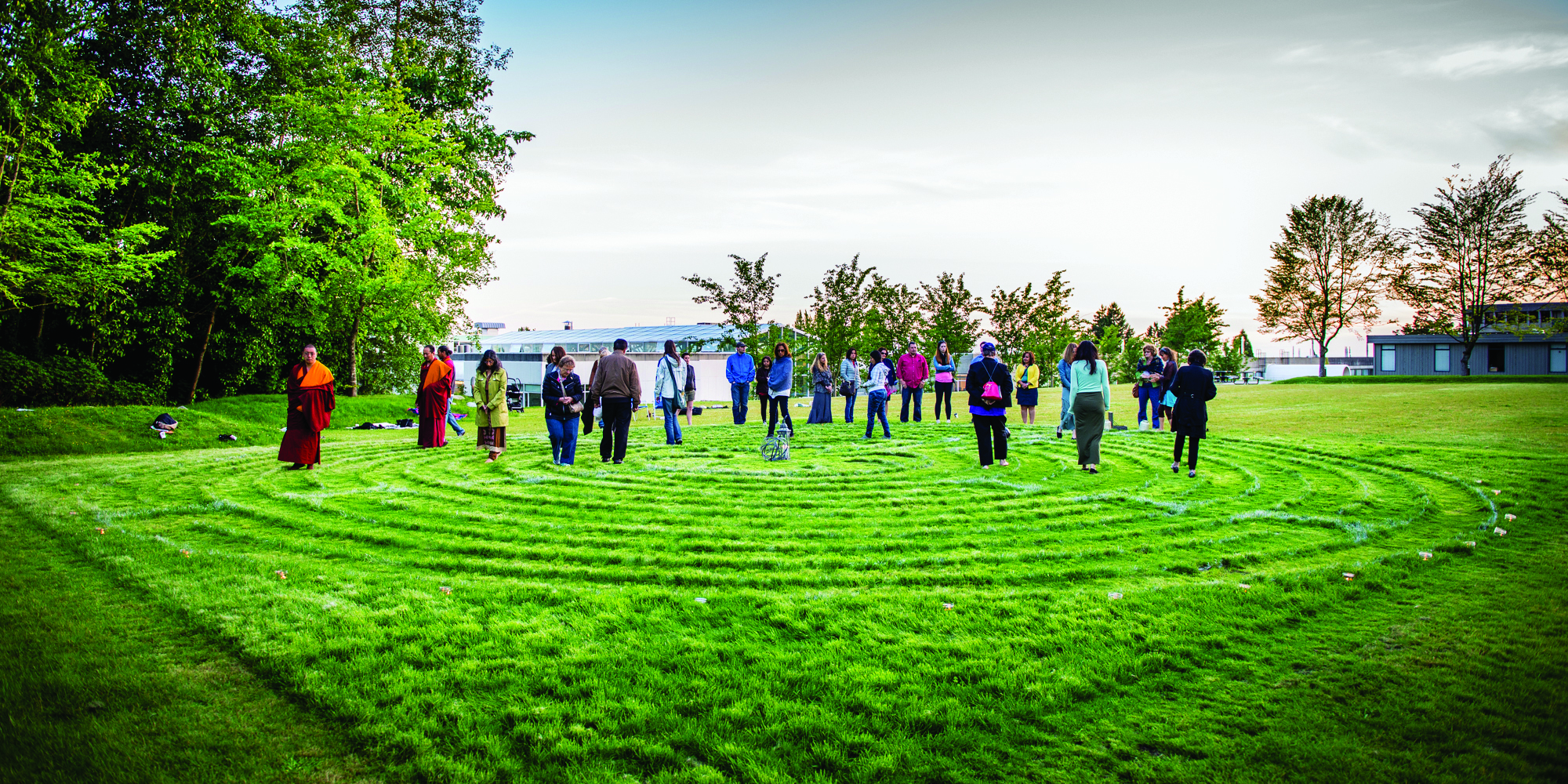
On the evening of the summer solstice this past Saturday, June 21, SFU’s Burnaby campus celebrated the opening of a new Peace Labyrinth with a free public ceremony that included activities such as spoken word performances, traditional words of wisdom, and a candle-lit walk through the labyrinth.

The labyrinth has been mown into the turf field adjacent to Strand Hall, located just beside Cornerstone. It is a single path walkway in a circular pattern that leads you to its centre and back. Traditionally, the walk can be either a solo journey, or a shared experience walking with friends.

Coordinator of the SFU Centre for the Comparative Study of Muslim Societies and Cultures (CCSMSC), Ellen Vaillancourt, lobbied for the idea of a highly accessible labyrinth on campus for the enjoyment of the entire SFU community. The project was approved Spring 2014, but last weekend her vision became reality.

The labyrinth is an ancient archetype that symbolizes the significance of journey and is sometimes used as a “method of discernment.” A person will enter the labyrinth with a question or a burden on their mind with the goal of finding resolution.

Vaillancourt was aided in her venture by The Labyrinth Society, an organization dedicated to the creation and maintenance of labyrinths globally, in order to provide people with the “opportunities to experience transformation” while walking through labyrinths.

“I believe we all have the opportunity to be transformed by journey and make a positive difference,” said Vaillancourt in a media release.

Celeste Snowber, an associate professor at SFU in the Faculty of Education explained that part of what makes walking a labyrinth unique and significant is the emphasis on process over product — it forces the walker to slow down.

“We’re living in this constant accelerated pace,” she continued. “It shifts your relationship to rhythm and time, and so you’re slowed down. Even that allows you to be present in a different way and we’re not often very present — we often live from our head, up.”

Snowber also spoke to the peace component of the Peace Labyrinth: “We talk about peace, but really, we don’t have that much within ourselves. The labyrinth can invite someone into a different relationship with themselves.”

The event concluded with a sun salutation at sundown, but the labyrinth remains mown into the lawn, providing what Snowber calls “an incredible tool.” Despite the simplicity of its make-up — patterns in the grass — she believes that “sometimes the simplest things are the most profound.”

The labyrinth is something that anyone can use. Snowber stressed that you don’t have to be of a certain belief to participate, and even intends on using it in her classes.

For Snowber, the labyrinth has a special significance for the SFU community: “I think it has an incredible connection to SFU. We talk a lot about engagement. And we see engagement as engaging in the world, but I think the first thing we need to do is engage with ourselves.”

Satellite Signals

0

vancouver
Vancouver

Two panelists from Kwantlen Polytechnic University and UBC discussed “waste to energy” as a possible option for managing solid waste and generating electricity in Metro Vancouver at Harbour Centre on Tuesday, June 24. Metro Vancouver’s waste to energy facility generates enough power for 15,000 households annually, but opponents cite issues of air pollution and a dependence on a constant waste stream, which is counter to the goals of zero waste policy.


surreySurrey

SFU President Andrew Petter invited 20 students, staff, and faculty out to the Surrey Campus last Friday for Breakfast with the President. These events offer attendees the opportunity to share perspectives about university issues over coffee and a muffin. At a previous event, Petter told The Peak that these events help him “stay as connected as [he] can to [our] community while being out there representing it.”

Waterfront Ballroom

SFU’s Beedie School of Business brought over 1,000 global thought leaders to Vancouver’s Waterfront Ballroom for the Academy of International Business’ Annual Meeting on Thursday, June 26. The public luncheon addressed “BC’s place in the global economy,” and this year’s recipient of the AIB Fellows’ International Executive of the Year Award, Dominic Barton, gave the keynote speech.


History’s Most Devastating Photo Bombings

0

Although the term “photo-bombing” may be relatively new, the concept of deliberately imposing oneself in a strangers photograph is a practice as old as time (well, time after the invention of the camera). While some may just look at it as silly, the effects of photo bombings can be incredibly harmful and occasionally even devastating. This list contains six of the most tragic photo bombing incidents ever recorded.

Crimea, Russia (1855)

Damage: 1 upset

PB1_edited-1

With the Crimean War raging (believe it or not Crimea was once a hotbed of controversy), pioneering British photographer, Robert Fenton was one of the first victims of a significant photobomb. Having invented the occupation of “war photographer,” Fenton covered the event by taking pictures of barren landscapes and immobile wagons. One of his wagon photos was ruined, though, by notorious prankster Marcus Sperling who managed to sneak on top of the wagon at some point during the eight hours it took to take a single photograph. Fenton was very upset when he got back to England and saw what happened, in fact he was pretty devastated by it.   

Paris, France (1898)

Damage: 10+ annoyed

PB2_edited-1

A lesser known but still egregious photobomb took place at a shoot for a collection of erotic pictures at an undisclosed location in the French capital at the end of the 19th century. Marcel Pitrie, a legendary erotica photographer had his shot and model all set up before it was suddenly ruined by a naked woman who out of nowhere splayed herself out on the bed. Pitrie was really annoyed by the whole event and it nearly ruined his collection of all shirtless bro pictures that he had been hired to produce. Several of the models and photography assistants were also vexed that they had to re-do the shoot and some described coming home later than usual that night as “devastating.” 

Hiroshima, Japan (1945) 

Damage: 2 peeved

PB3_edited-1

The Shizuka family was devastated by a photo-bombing which occurred during a day trip to Hiroshima in the summer of ‘45. Hayato and Manami Shizuka were at the end of their roll of film when they passed by the Hiroshima Prefectural Industrial Promotion Hall. The couple asked a local to photograph them in front of the building and, after snapping the photo, believed they had a perfect picture of just the two of them. The next day however, after developing their photos, they were extremely upset by the fact that a prankster sunbather had ruined their precious memory. August 5, 1945 would go down as the most devastating moment of their lives although they would feel some redemption during their visit to Nagasaki four days later when they nabbed a perfect picture of the exact moment they were hit by the atomic bomb.

Beijing, China (1989)

Damage: 1 irritated

PB4_edited-1

A young Chinese photographer just trying to make a difference during the ‘89 democracy movement was devastated when a photo-bomber ruined his picture. According to his story, Sun Jun was attempting to take a vivid and shocking photo of government tanks that would capture the struggle of his fellow students in their protests, but, unfortunately, a photo-bomber got in the way: another student, trying to earn his place in history ran out into the streets in front of the tanks to wreck his picture. Although Jun was happy that he managed to snap the photo before the photobomber dropped his pants and mooned the camera, the devastation of the incident caused him to throw out his camera and commit suicide knowing his photo would never achieve any recognition. 

Vancouver, Canada (1997)

Damage: 4 ticked right off

PB5_edited-1

The McNeil family were subjected to one of the most thoughtless and damaging photo-bombs in the fall of ‘97 at a family picnic at a local park. After a lovely afternoon of snacks, drinks and pleasant conversation, the day took a turn for the worst when their family portrait was infiltrated by a man that they didn’t even know. Due to the photo-bomb, the McNeils were unable to use the photo as the cover to their christmas card and had to go with a generic Santa Claus card instead. Upset by the family’s lack of personal touch, family friend Paul Stewart decided against sending a card of his own their way. According to all their mutual friends, Stewart’s card was pretty nice and thoughtful. The McNeil’s were devastated.    

Boston, USA (2013)

Damage: Dozens cheesed 

PB6_edited-1

Of course everyone knows that there was a real bombing on April 15 at the 2013 Boston Marathon but what is often forgotten is the heinous photo-bombing perpetrated moments before the tragedy. Brothers Dzokhar and Tamerlan Tsarnaev were responsible for a string of photo and even video bombs achieved by planting themselves in the background of a significant amount of security footage that was reviewed after the race. One of the photos they bombed was going to be a really nice one of the Stevenson family who were devastated that two strangers were in the background of an otherwise perfectly good photo. For their involvement in these photo-bombings the Tsarnaev brothers were the subject of a lengthy manhunt leading to an arrest and death. The brothers were later found to actually be the real bombers too, which Boston police have called a “fortunate coincidence.”