Home Blog Page 1123

SFU drives on its brand new roads

0
Life is a hiiiiiiighwaaaay
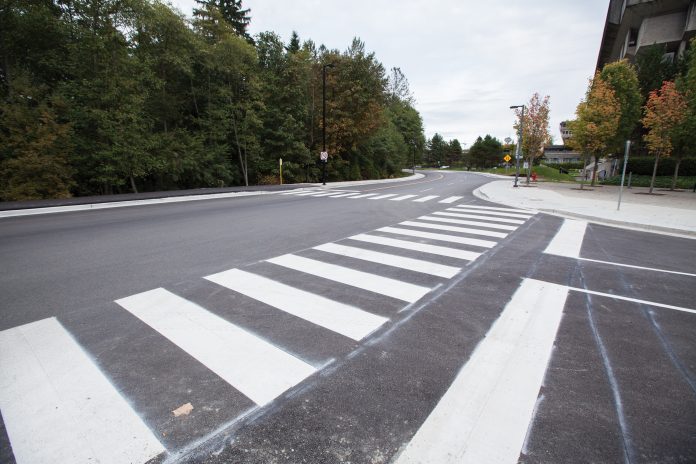
The roads were officially finished on October 1.

SFU Burnaby will now have full use of its new campus roads as construction comes to a close.

On Monday, October 6, transit routes will return to what they were last year, before the beginning of the roadway improvement project.

Parking Services director David Agosti said, “That will be a big change and I think a welcome change to students.”

This means that transit users will be able to exit the bus at the Transportation Centre first, before it heads to the bus loop. Buses will also leave the mountain via University Drive West, putting the residence bus stop back in circulation.

Parking Services told The Peak that there have been positive reactions to the road openings. “We’re not driving on the concrete roads of a year ago, but we’re also not driving on the unpaved gravel roads of two months ago,” said Agosti.

Though all the roadways are open and the multi-use pathway (MUP) along Gaglardi Way and University Drive West is in service, the eight month-long project is not quite complete as there is some landscaping yet to be done.

Agosti explained, “There may be some minor impediments, say if they’re putting in a tree beside the pathway or they’re putting in some shrubbery or what have you.”

He warned MUP users that workers are still in the process of fertilizing the gardens along the path. “It may be pungent for another week or two,” he said.

In regards to the West Mall parkade, SFU is considering an alteration to the original entrance and exit off of University Drive West. That section will be closed for potentially a week or two while Parking Services and Safety and Risk Services assess the area. People parking on the 8000 level of that parkade will still need to use the altered exit and entrance.

Agosti also encouraged drivers to try out new routes: “If you are [driving and] going to the west side of campus — to residence, childcare, recreation and athletics, West Mall Complex — it’s probably worth your while to try going up the new way now. See if that’s faster [or] more enjoyable.”


Homeless seniors rely most heavily on Victoria shelters

0
Seniors stayed at the shelters for an average length of six months per visit.

A recent study on patterns of homelessness in greater Victoria, led by SFU master’s student in public policy, Hannah Rabinovitch, reported that there are a disproportionate number of seniors utilizing emergency shelters as compared to all other demographics.

Rabinovitch, in partnership with the Centre for Addictions Research of BC (CARBC) at the University of Victoria, conducted a longitudinal study focused on patterns of emergency shelter use in greater Victoria.

Rabinovitch, who began collecting data for the study in April 2010 and ceased collection in May 2014, followed 4,332 individuals and examined approximately 46,000 shelter records.

“I was stunned by the amount of seniors [. . .] regularly seeking refuge.”

Over 85 per cent of shelter users accessed the shelters only once or twice. However, 13.6 per cent of users accessed the shelters as many as five times during the four-year period, with an average stay length of 30 days.

The remaining 1.5 per cent — mostly seniors — stayed four to five times over the four years for an average length of six months.

Despite the large sample of individuals followed, Rabinovitch conceded that the results were not fully representative of the population who use homeless shelters. “For example, it’s widely known in research that homeless women avoid emergency shelters for fear they’re unsafe and that their children will be apprehended, and because they lack women’s beds,” Rabinovitch said.

Rabinovitch, who has worked with five out of the seven emergency shelters in Victoria, is worried about the large number of seniors utilizing shelters. “I was stunned by the number of seniors with complex physical and mental health problems regularly seeking refuge in emergency shelters,” she said.

Rabinovitch also stated, “It really points to the fact that [. . .] there’s a housing gap and that they are finding serious challenges for homelessness.”

Seniors often experience more health problems than other segments of the population, and being homeless further contributes to these issues. “In general, older people experience more health challenges, and the longer people stay homeless, the worse their health outcomes get,” said Rabinovitch.

The homeless pattern reported in Victoria is similar to those in Ottawa, Toronto, and Guelph. The Greater Victoria Coalition to End Homelessness has partnered with the government, non-profit organizations, and local service providers to work towards eliminating the problem of homelessness in Victoria by 2018.

Bernie Pauly, Rabinovitch’s supervisor and a researcher for the University of Victoria’s Centre for Addictions Research, said that the team is investigating strategies that may contribute to finding a solution: “Those experiencing temporary homelessness would benefit from rapid re-housing, more emergency cash assistance and rental subsidies to prevent or quickly address homelessness.”

FIPA ratification is an insult to Canadian values

3

Despite widespread controversy, the Harper government ratified the Foreign Investment Promotion and Protection Agreement (FIPA) with China on September 12. The agreement took effect on October 1 and, from here on out, the welfare of Canadian citizens will be disregarded in favour of the prosperity of Chinese investors.

This is not to say that foreign investors do not already influence Canadian industries; Canada has a number of other FIPA agreements, but none are comparable to this lopsided, non-reciprocal agreement made with China. By signing this contract, the Harper government has devalued our country for short-sighted economic benefit. What’s worse is that these highly controversial decisions were made without public consent. 

The first problem with the agreement is that it locks Canada into a 31-year contact. Either party can withdraw only after the first 15 years, as long as one year’s notice is provided. However, any existing investments are preserved for another 15 years. Keep in mind that Canada’s participation in NAFTA can be terminated with six months notice.

Another horrific reality is that the contract’s parameters allow Chinese investors to challenge our provincial and municipal governments’ decisions. For example, if BC rejects or alters decisions regarding the Northern Gateway pipeline, and Chinese investors perceive these changes to have a negative impact on their investments, they could sue Canada.

Harper, the next time you completely screw us over, have the decency to send out a press release.

This means that Canada will have to choose between a hefty fine or the welfare of its citizens — a position the federal government has inflicted upon itself.

Canada has willingly given the reins to China in an exchange that is not mutual. Specifics of the agreement provide carve-outs, or exceptions, that each country has outlined to protect itself. Canadian carve-outs are specific and limited to existing entities, while China’s are extremely vague. This means that Chinese foreign investors could block Canadian influence more easily at even a municipal level, which makes the agreement exceptionally beneficial to China.

The situation becomes worse. Not only has the Harper government put foreign investors first by placing their needs above those of Canadian citizens, but the decision was made with very little debate. The treaty was quietly tabled by the House of Commons in October 2012, where it was signed by Stephen Harper without so much as a press release.

Unfortunately, the agreement was only subjected to a one-hour review before the trade committee. The opinions of Parliament were completely disregarded and the vote was contained within the Cabinet. Despite widespread opposition from the public, the NDP, the Greens, and even members of his own cabinet, the Harper government decided that nobody else’s opinion had any merit or value to the decision-making process.

We get it Stephen Harper — your horrible negotiation skills, along with your complete disregard for public opinion, clearly indicate how much you care about the citizens of your own country. Next time you completely screw us over, at least have the decency to send out a press release.

Obama’s plans to help moderate Syrian rebels aren’t feasible

0

According to legend, when asked to justify his tyranny over France, King Louis XV responded with the statement “Après moi, le deluge,” translated “After me, the flood.” While not particularly inspiring, statements such as this can nonetheless be seductive. Political revolutions are risky ventures with justifiable fears that the future may be worse than the status quo.

It was this line of rhetoric that President Bashir al-Assad used to dissuade the Syrian people from being swept up by the hope offered by the Arab Spring. And despite this rhetoric being cynical and self-centered, history has justified Assad. As bad as the Assad regime was for everyday Syrians, what has followed has been undeniably worse.

Since the onset of the conflict in 2011, the UN estimates over 191,000 Syrians have been killed and over three million have become refugees since the population was first caught in the crossfire between the regime and assorted rebel groups. With no faction able to gain a clear upper hand, Assad’s tyranny has devolved into a violent multipolar anarchy.

It is unquestionably a humanitarian disaster that deserves a response. Since the onset, many nations — Qatar, Turkey, Saudi Arabia, Russia, and Iran — have intervened, supporting one faction or another as they try to mold Syria’s political fate to their own interests. Until now the United States has done everything in its power to keep out of the conflict, as the nation is still war-wearied from long engagements in Iraq and Afghanistan.

The moderate Syrian rebels are not realistic contenders for power, but merely fuel anarchy.

Yet with the expansion of the particularly brutal jihadist faction of ISIS, America has finally decided it must do something. Thus Obama, with bipartisan congressional approval, recently agreed to supply modest amounts of arms and training to aid rebels deemed “moderate,” i.e. interested in constructing a liberal democratic state in Syria. This is a noble idea, but is it truly feasible?

The fact is, Syria’s moderate rebels are in no state to restore order or the rule of law to their country anytime in the foreseeable future. Divided and hopelessly outmatched by both the Assad regime and the more structurally organized jihadist rebels, the moderate Syrian rebels are not realistic contenders for power, but merely perpetuators of anarchy.

Perhaps if the West was willing to offer serious military commitment, including robust numbers of ground troops for occupation, they could manage to install the moderates into power. But no foreign public would tolerate their leaders embracing such a serious commitment. Instead, what Obama offers is a feel-good policy that gives the perception of doing something without paying the cost it would require.

Rather than trying to give the upper hand to one of the dominant factions in the civil war that could feasibly win, Obama shirks this hard choice and fuels the war’s continuance by supporting a faction with no chance of victory.

Ultimately, while liberty may be preferable to tyranny, tyranny is preferable to anarchy. And sadly, in present-day Syria, only tyrants remain powerful. Whatever Assad’s crimes, they pale in comparison to the brutality of ISIS, which has instituted policies of industrial sexual violence and the genocide of minorities.

If the world is truly serious about pushing back against ISIS, they must rally behind a feasible champion. Unfortunately Syria’s moderate rebels cannot supply this bulwark, but the Assad regime may. In a conflict with no good options, the West must support the lesser of two evils.

Researchers join Canadian team to study dementia

0

Three SFU researchers have joined a new Canadian initiative to address the problems posed to the individual and society by disorders such as dementia.

Over 340 experts in the field of neurodegenerative disease research across the country are involved in the effort coordinated by the Canadian Consortium on Neurodegeneration in Aging (CCNA), an organization dedicated to examining this growing issue.

“We need to look at the various ways of attacking [neurodegenerative diseases].”

With a rapidly aging population in the developed world, this initiative is one of many that are being created globally to combat the emergence of neurodegenerative diseases.

“It is a very large research network that has been set up by the Canadian Institutes of Health Research (CIHR) to look at the emerging problems around neurodegenerative diseases,” said Andrew Sixsmith, professor of gerontology at SFU and the director of the Gerontology Research Centre.

Sixsmith, along with SFU engineering science professor Mirza Faisal Beg and SFU biomedical physiology and kinesiology professor Charles Krieger, form one of the 20 multidisciplinary teams involved with the CCNA.

“My particular interest is with dementia. I think we all know that the Canadian population is aging, and the population worldwide is aging. Diseases and conditions like dementia are age related,” Sixsmith told The Peak. “There are an increasing number of people with neurodegenerative conditions. We need to look at the various ways of attacking it.”

When asked about his team’s particular focus, Sixsmith explained, “We are looking specifically at how we can use information technologies to help people with dementia live independently at home. One of the things that I’m particularly interested in is using readily available technology such as apps on smart phones to help people with very mild dementia live a bit more independently.”

On the question of SFU’s contribution to the overarching research, Joy Johnson, SFU’s VP research, was optimistic: “This consortium, which is being funded by the CIHR, is a large consortium that is crossing Canada and is really engaging top scientists in the field.

“The three researchers [from SFU] who are involved with this work are playing an important role in terms of advancing the science and our understanding of neurodegeneration in aging.

“Canada is a world leader in the field of neuroscience,” Johnson continued. “We partner on a number of international initiatives related to the neurosciences and this initiative really solidifies Canada’s strength in the field.

“I think it will really advance the field and keep Canada on top of what it really is — an international effort to understand issues like Alzheimer’s diseases and other neurodegenerative diseases.”

Sixsmith agreed with Johnson: “SFU has a major role in this particular area of research. Beyond the CCNA initiative, we recently submitted a large proposal for a network of sensors embedded in senior homes across Canada that would further support independent living.

“Helping support independence of all people is about letting them reach their aspirations, rather than just giving them basic services.”

Planning begins for proposed recreation facility

0

SFU’s board of governors has begun consultations with the City of Burnaby regarding the construction of a new recreational facility at SFU Burnaby.

At their meeting on Thursday, September 25, the board mentioned that Facilities Services is working with local contractors and construction managers to complete the development plan for projects that have come to be called the Link Building and the BC Chiropractic Association (BCCA) Facility.

“We would certainly make it clear that they are not part of SFU.”

The Link Building would be built in the athletics precinct, potentially linking the Lorne Davies Complex to the field, and would include a pool, a gym, and a racquetball court, among other services. As stated by the consultation flyers in February, it would aim to “revitalise recreation programming, improve women’s and men’s change rooms, house team locker rooms, and support space for field sports activities.”

The board of governors conducted consultations in February to discern whether the student body was in favour of the proposed recreational facility, which would be built by a private company in return for a 65-year lease of land adjacent to Discovery Park. The private company expressed a desire to use the land to build BC’s first school of chiropractic.

“[The consultations came back] mainly positive,” said SFU VP finance and administration, Pat Hibbitts. “Certainly there were concerns raised around what kind of association there would be with the chiropractic [school] and we would certainly make it clear that they are not part of SFU. They’re a tenant located in a building.”

The independent company was engaged because SFU does not have the capital required to construct a new recreation facility, nor is it able to borrow to fund this project because it is under a borrowing prohibition from the province. Therefore, SFU must investigate what Hibbitts referred to as “creative solutions.”

After the private company’s lease expires, the land would be returned to the university along with the chiropractic school building.

In relation to the amount of influence SFU will have over the construction of the private company’s building, Hibbitts explained, “We will have some say in terms of, we don’t want the ugliest building down there. We would want something that fits with us. Other than that, we wouldn’t have much say in it. We will set standards as to upkeep and all that. It reverts to us, so that’s the kind of thing you do in those [situations].”

The administration is currently working with Athletics and Recreation to determine the functions to be included in the Link Building. Once plans are finalized, they intend to re-enter discussion with the private company and engage in conversation with the City of Burnaby regarding zoning and development permits.

“If we can come to an arrangement that the proponent finds satisfactory — [if] what we have is acceptable to them, what they can build for the amount of money they’ve put aside — [then we will] carry on,” said Hibbitts.

Keep ads off NHL jerseys

0
Sponsorless jerseys are the last vestige of unspoiled team pride in today’s NHL.

In the fifth issue of The Peak, published on September 29, writer Nick Bondi argued that the NHL should sell ad space on their jerseys. His argument essentially boiled down to the fact that “it’s inevitable” (his words) and would “make a hell of a lot of money” (my words).

While I don’t necessarily disagree with either of these claims, I believe that desecrating sports’ most beautiful uniforms for the sake of corporate dollars would be an absolute travesty and isn’t something fans should just take lying down.

The NHL has already allowed advertisers into almost every facet of the game.Whether you’re at the arena or you stay home, you can’t escape an onslaught of promotions for McDonald’s, Budweiser, and other key components to a healthy lifestyle.

The jerseys, however, are still relatively untouched and pure, a remaining symbol of what sports were about before commercialization. Sure, they have the word “Reebok” stitched on the back but, other than that, a jersey still embodies a team and a city instead of any company.

If I wear a Canucks jersey, I’m only advertising for the Canucks and the city of Vancouver, something I can be proud of (most of the time). To me, that’s all a jersey should be communicating: the history and culture of the team, and the city in which they play.

As soon as you add corporate branding to the uniforms, it ceases to be that simple. There may be a similar storied rivalry between Pizza Hut and Domino’s as there is between the Montreal Canadiens and the Boston Bruins, but those fights should be held in different venues.

Unlike board ads or TV commercials, jerseys are for the fans to have and to hold. They’re the last vestige of unspoiled team pride and need to stay that way.

Authentic NHL jerseys already cost upwards of $300, and I don’t want to pay anything close to that to be a walking billboard for whichever company pays for the real estate on my favourite NHL team’s upper chest.

As Bondi states in his article, the main reason that the NHL is opposed to instituting ads right now is that they don’t want to be the first of the big four leagues to do it. This essentially means they’re going to wait until about five years after the NBA does it, seeing as that’s how long commissioner Adam Silver believes his league will hold out on them.

If the NHL wants to keep any integrity, though, they will do whatever they can to not follow in the footsteps of a league that actually refers to a last-second shot, on their official website, as a “Taco Bell buzzer-beater.”

I understand that professional sports are part of the entertainment business and that, above all else, the NHL exists to make money, but I hope they at least try to keep that aim subtle. Having ads right on players’ jerseys crosses a line — nothing would be sacred anymore and the league would lose all my respect.

It’s like product placement in movies. I don’t love when a character in a movie is clearly drinking a Pepsi, but I’ll sit through the movie, nonetheless. If they stick King Kong in a giant Pepsi sweater, though, I’m walking out.

I really hope the NHL can maintain some integrity, not ruin their jerseys, and keep that 6,000lb Pepsi-sweater-wearing monkey in it’s cage where it belongs.

SFU explores opportunity for satellite campus residences

0
The lot on which the proposed residences would be built is located near Victory Square.

The possibilities for life in residence at SFU are about to increase significantly. The university is currently considering a new residence building, valued between $15 million and $20 million, near its downtown campuses.

SFU has been in conversations with the City of Vancouver and a local developer in the hopes of extending the scope of its residences. If the project goes according to plan, the residences could be in place sometime in 2016 or 2017.

The project is geared towards SFU Vancouver graduate students.

The lot in question is adjacent to Victory Square at the the intersection of Cambie Street and Hastings Street. The plans for the Vancouver Student Residence project include 52 suites, 36 of which would be studios or single-bedroom apartments; the rest would be two-bedroom or even three-bedroom apartments.

The project is geared towards graduate students, particularly in the Segal Graduate School of Business, but the provided housing would be available to other students as well.

As of now, a construction agreement has been struck with the developer and a development permit application has been filed. Vancouver’s Urban Design Panel also reviewed the project and responded favourably to it.

The question of residence has been under discussion at SFU for a long time. VP finance Pat Hibbitts pointed to the limited residence capacity on Burnaby campus. Currently, SFU residence has room to accommodate 1,800 students.

“We’ve always talked about residence expansion, even up here [Burnaby] and at the other campuses — we don’t have a lot of residence capacity and should we be building more? [. . .] We’ve commissioned a person to do a study on if we should expand residences in all places, not just Surrey and Vancouver, Burnaby too,” explained Hibbits.

She spoke to the significance of the potential expansion. “We’ve traditionally been a commuter school. The majority of our students are from the tri-cities, Burnaby, and Surrey school boards. So it leads to a different pattern than what you see in other places.” she said.

She continued, “It could change the nature of the school a little bit if you have more people in residence.

“Can you build better student life if you have more kids in residence? That is the question.”

The university is waiting for its hired consultant to come out with recommendations as to the finer details of the Vancouver development as well as the residence potential on both other campuses.

Ultimately, SFU intends to provide student residences for all of its campuses, including Surrey, but three years of conversation with the City of Surrey have yet to yield any concrete plans.

“We do own lots in Surrey, we are trying to expand academically in Surrey, and residence is in our mind, but there’s nothing concrete there,” concluded Hibbits.

Starbucks to offer fair trade across Canada

1
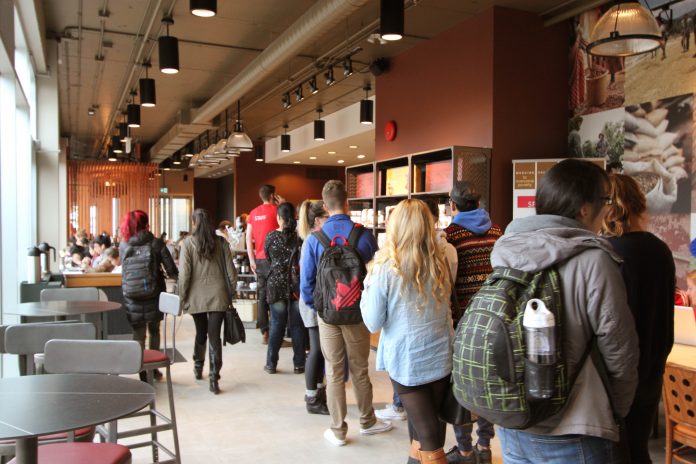
The first Canadian fair trade Starbucks opened last year at SFU Burnaby.

Starbucks’ initiative to serve ethically-sourced coffee has officially expanded. The company announced last Thursday that, beginning in spring 2015, Starbucks Canada will serve fair trade certified espresso at all Canadian university and college locations.

This decision coincides with the anniversary of the fair trade pilot program, which started here at the SFU Starbucks location one year ago.

The company also announced that it will open more locations on Canadian university and college campuses, and will also expand previously existing Starbucks. In the last two years, Starbucks Canada has increased its growth and presence on campuses by 50 per cent.

Starbucks says that it has become increasingly aware over the past few years of the need for ethically sourced coffee and has set a goal for all of its coffee to be certified through Coffee and Farmer Equity (CAFE) Practices. As of 2013, 95 per cent of Starbucks coffee was ethically sourced and had garnered the necessary verifications and certifications.

Rossann Williams, president of Starbucks Canada, said in Thursday’s press release, “We care about coffee farmers. We know many of these people personally and importantly, we know long term success is linked with theirs.”

She went on to say, “Ensuring that all Starbucks coffee is ethically sourced is a priority for us and we are proud to offer students a fair trade espresso.”

After being named “Best Campus of the Year” by Fairtrade Canada just last month, SFU’s leadership in utilizing ethically sourced coffee has led other universities and colleges to become active in serving fair trade coffee. Seven other campuses have joined SFU in a movement to make ethically sourced coffee a standard.

Roger Aube, director of Licensed Stores for Starbucks Canada, said in the same release, “We’re excited to build on the incredible success of the fair trade offering at our store at Simon Fraser University and take it country-wide.”

Mark McLaughlin, SFU director of ancillary services, stated, “We are extremely pleased by Starbucks’ announcement to offer fair trade certified espresso in its cafes on Canadian campuses. Students come to our institutions for an exceptional education, and more and more we find that they also come with hopes of changing the world for the better.”

Although Starbucks will offer fair trade certified espresso at all its locations at Canadian universities and colleges, the company will not offer fair trade certified espresso at off-campus locations, and does not have plans to start.

Fall: Expectations vs Reality

0

With Fall in full swing, it’s time to adjust your expectations.