Home Blog Page 1122

Meet the Clan: Ryan Stanford

0
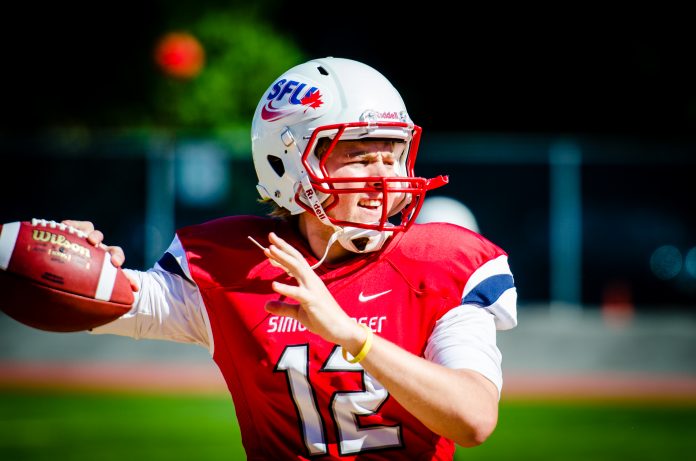
Ryan Stanford played for two different schools before coming to the Clan, but has found a home at SFU.

Screen Shot 2014-11-26 at 1.07.24 PMNow entering his second year with the Clan, Ryan Stanford has finally found a home.

A star quarterback on his high school team, the Horizon Huskies, Stanford initially chose to play for the North Dakota State Bison, an NCAA Division I FCS team. During his time there, the team won the first of its three national championships.

However, he was fourth on the quarterback depth chart, and did not see much playing time his freshman year; the team’s contender status made it unlikely that he would see any playing time in the near future.

So, in a bold move, he packed his bags and returned home where he played for Phoenix College, with the hope that another four-year football program would find him.

Luckily, the gamble paid off when then-SFU head coach Dave Johnson recruited him for the Clan’s 2013 season. And after a tough battle at training camp, he finally snagged his much coveted starting quarterback position.

He stresses, though, that his goals revolve around the team’s success, not individual glory: “I think, as a quarterback, the goal is always to put the team in the best possible chance to win. I’m not really concerned about personal statistics or anything like that. I want to be able to turn this program around, get some wins, some conference wins, and be competitive for years to come.

“Hopefully, [we can] change the culture of what people think about SFU football and take it to the next step,” he added.

Stanford hopes to help drive that culture shift within the team as well. “When I first got here [we had] this culture of accepting mediocrity and losing. We’re trying to change that. We want to be able to excel and succeed, be the best at what we do, so it starts one practice at a time. It’s not going to happen overnight, but I think we’re heading in the right direction.”

At the end of the day, what really matters is how the team plays on the field, and Stanford believes that this too is heading in the right direction towards contender status: “I think that the record doesn’t show it, but we’re really close and it’s frustrating and promising at the same time because we have the people to do it, but [we’re] just a little bit of confidence away from doing it.”

While the frustration of being close, but not putting up results can often lead to an even deeper hole, Stanford does his best to keep his head up. “It can [hurt],” he says. “I try not to show it. I think that each game we’ve gotten better at believing that we can achieve our goals, but it gets frustrating. It’s something that we have to overcome and will overcome.”

Despite going winless so far in their non-conference games, he still believes that the team can contend with anyone in the Great Northwest Athletic Conference (GNAC): “Going into every game, I felt we’ve been able to be in a position to win. Of course that’s probably biased from someone who’s on the team, but I don’t think we faced a team, and probably won’t, that is that much better than us.

“I think we’ve made mistakes and that’s what’s hurt us the most but [. . .] conference play starts this week, so all our goals that we set in the beginning of the year can still be accomplished,” said the 6’3 quarterback. “We haven’t given up on those goals yet, so we can still go out there, win the conference, and go from there.

“I do [believe winning the conference is possible]. If not this year, then this team will be a pivoting point for future teams and we’ll get it done sooner rather than later,” Stanford added.

At Swangard Stadium, home crowds provide the Clan with even more motivation to move in the right direction. But an away crowd motivates the QB as well.

“For me, I like playing away. I like being able to just go out there and disappoint those other [team’s fans]. I feed off both energies, positive and negative, and it motivates you to either quiet them down or make our own fans louder,” he concluded.Screen Shot 2014-11-26 at 1.08.54 PM

As conference games begin, Stanford will have to channel both the positive and negative energies, and the highs and lows, as he is expected to lead his team to success. He’s been preparing for a long time, and now it’s his time to shine.

Volleyball team lose back and forth affair

0
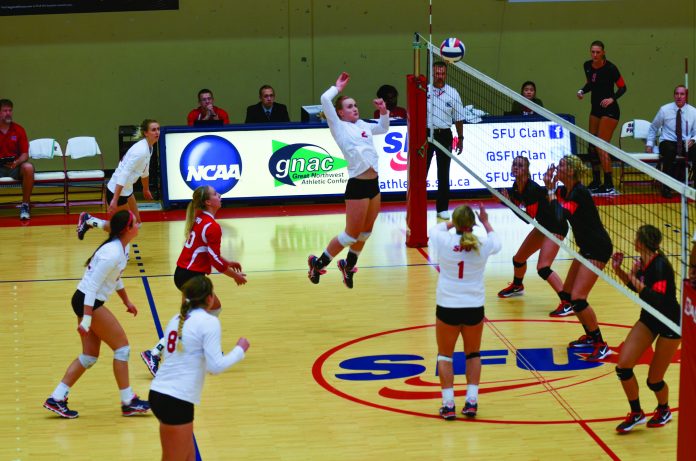
Clan fell just short after a hard fought fourth set.

The Clan went head-to-head with a giant and lost on Thursday night, as they fell in four sets to the Great Northwest Athletic Conference (GNAC) leader, the Northwest Nazarene Crusaders (NNU).

Despite strong performances at home by key players including Madeline Hait, Kelsey Robinson and Amanda Renkema, SFU was unable to contain the Crusaders, who continued their domination of the conference, pushing their winning streak to 12 games.

Down 24-21 at the end of a back-and-forth first set, SFU took a tactical timeout but unfortunately, not even the jazz band’s rendition of “Eye of the Tiger” could inspire them to claw their way back. NNU won the set after the next serve with a key block on a Clan attack by outside hitter Devon May.

SFU continued their strong play into the second set and managed to squeak out a 25-23 victory, finishing up with two straight kills from Kelsey Robinson.

“I think we showed a lot of composure at the beginning,” middle blocker Madeline Hait told The Peak. “It’s tough today because it’s a close game but I’m so proud of how my team played and everyone really came together.”

Hait, who was recently named the GNAC defensive player of the week, led the Clan offensively with 16 kills.

Unfortunately, the Clan could not maintain their solid play in the third set and decisively lost 25-13, notching only seven kills in the set. This killed the mood of a home crowd who had been treated to two sets of competitive volleyball, and a highly entertaining blindfolded volleyball contest during the intermission.

Screen Shot 2014-11-26 at 11.20.36 AMHowever, SFU returned to form, regaining the crowd’s support with a strong performance in the fourth set, featuring many rallies that could have gone to either side. In the end, though, they fell just short 25-21.

NNU’s Elayna Rice, who was named last week’s GNAC offensive player of the week, continued to shine by leading her team with 14 kills and, ultimately, got the best of the Clan.

“She was one of the key hitters and I definitely think that she’s a really good all-around player,” Hait said of Rice. “Something we can improve on is shutting down key hitters.”

The Clan will look to bounce back from this loss and already have their eyes set on Saturday’s tilt against Central Washington. Head coach Gina Schmidt likened the challenge to the one they just faced and said that she is “expecting another good game, just like this one.”

Clan seal first conference victory

0

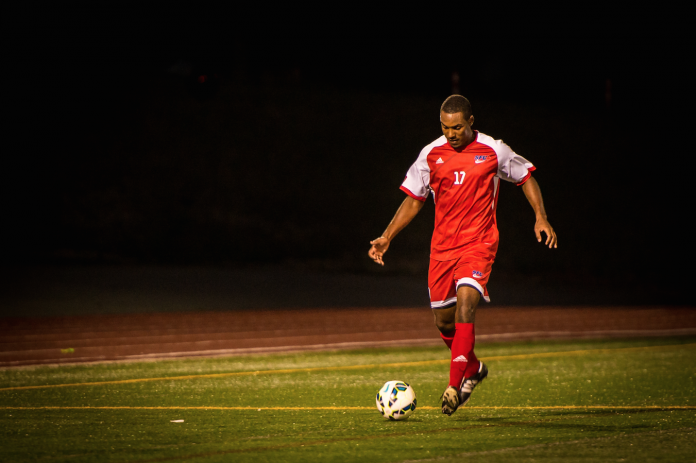
The SFU men’s soccer team got back to its winning ways on the road Thursday, with a decisive 4-0 result against the Saint Martin’s University Saints (SMU). With that, the Clan snapped a four match winless run and achieved their first victory in the Great Northwest Athletic Conference (GNAC).

It was a fantastic response to a frustrating setback last weekend against the Northwest Nazarene Crusaders, who handed the Clan their first loss at home this season with a goal in the dying minutes of overtime play.

SFU quickly shook off their disappointment and brought their A-game to Lacey, WA, much to the satisfaction of head coach Alan Koch.

“I’m very happy with how they played; they came here very prepared and put in a great performance,” Koch told The Peak.

“The guys have had a reality check the last few games and been humbled a bit, but today you could see the hunger in them and the willingness to play for each other,” he added.

Sticking with their trademark style of play this season, the Clan started the match guns a-blazing with three goals in the opening 20 minutes. Magnus Kristensen linked up with Ryan Dhillon in attack, who then provided the assist for Jovan Blagojevic’s go-ahead goal.

Screen Shot 2014-11-26 at 11.18.19 AMDhillon would contribute further, less than 10 minutes later, with his third goal of the season thanks to a pass from Nico Espinoza. Blagojevic found the back of the net just three minutes later, taking his tally to eight goals as top scorer in the GNAC.

Espinoza, who started for SFU for the first time, made his presence felt tremendously  by grabbing the Clan’s fourth goal of the match, as Blagojevic found him open to tap in the ball from the middle of the box.

“Nico’s first start was fantastic,” said Koch. “We expected a lot from him and he exceeded those expectations, he’s a great distributor of the ball and spread play throughout the entire pitch.”

Defensively, the Clan were also top notch, allowing just two shots on target in the match and achieving their first clean sheet of the season.

The men will have to turn this momentum into more wins, in order to make the post-season, in what is turning out to be a highly competitive season in the GNAC.

Clan split season openers

0

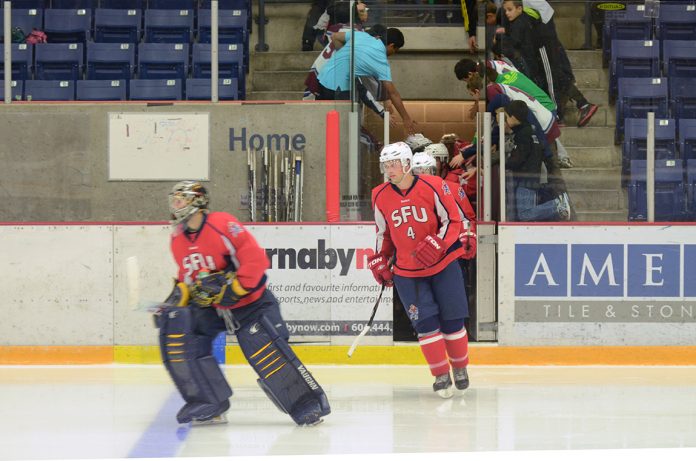
For the season opening series, the men’s hockey team hit the road, travelling to face the Eastern Washington University Eagles (EWU) in back to back games. The Clan were able to achieve a win on Friday night, but not on Saturday, losing out on a chance to shoot to the top of the league.

In Friday night’s game, the Clan got off to an early start, as Jesse Mysiorek and Jono Ceci made it 2-0 on a powerplay. However, the Eagles scored at the 7:07 mark of the first to cut the lead down to only one.

The second period was marked by a goal from Jesse Williamson, while the third period featured a goal from Nick Sandor, and a clean period of play with no penalties to either team. Jono Ceci was named the first star of the game, with a goal and two assists. The final score was 4-1 SFU.

Saturday night’s game was a different story entirely. This time, it was the Eastern Washington Eagles who got off to a quick 2-0 lead. The Clan managed to get to within one with a goal from Jared Eng, but the Eagles scored on a powerplay a few minutes later to restore the two goal lead.

Nick Sandor made it 3-2 in the second period, but due to a lack of Clan discipline, the Eagles were given a powerplay opportunity which they did not squander, bringing the score to 4-2.

The third period ended in a flurry of penalties. SFU’s Jesse Mysiorek and Tanner Hawes of Eastern Washington were both given 12 minutes in penalties: 10 minutes for game misconduct and two minutes for unsportsmanlike conduct. The Eagles added an empty net goal after the fact to make the final score 5-2 Eastern Washington.

Head Coach Mark Coletta, was pleased with how the team played over the weekend, however. “I thought we played really well,” he told The Peak in a phone interview. “We deserved to win both [games]. We just couldn’t score in the second game.”

Going forward, Coletta said, “We know we have a strong lineup. We can’t take games for granted like we did Saturday, we have to go into every game with the right mindset.”

The men’s hockey team will open at home on Friday, October 10 at Bill Copeland Sports Complex against Selkirk College.

Portrait of the Undergrad as a Young Man

10
Jacey smash!
"Frats are generally the go-to stereotype when we think of the college man; he goes on panty raids, engages in nasty hazing rituals, and drinks enough to tranquilize a horse."

Think of the average college man: what does he look like?

Is he the boozy, womanizing frat boy of films like Old School and Animal House? Is he the brazen college football star, whose ego is as artificially inflated as his GPA? Is he the nerdy shut-in, browsing 4chan and trolling feminist blogs instead of studying for his final exam? Or is he the snobby, pretentious Ivy League rich kid, silver spoon firmly implanted in his mouth?

If these seem like overgeneralizations and stereotypes, imagine how we feel. Young men in Canada and the United States, navigating the minefield between adolescence and adulthood, are in a steep and steady decline. Where their female counterparts are excelling in academics, starting clubs, and joining the workforce, men are getting lower grades, drinking more dangerously, and ignoring their studies.

They’re also reacting aggressively and often violently to the shifting demographics in colleges and universities across the continent. Business school students chant rape slogans at frosh events; sexual assaults are shared online and victims are blamed for attire and attitude; most recently, Carleton boys wearing “Fuck Safe Space” T-shirts have gained national attention and subsequent scorn.

There’s a strong link between participation in a fraternity and a decline in cognitive function and GPA.

Campaigns to quell the tide of sexual violence on campuses have begun shifting their focus towards men. Their argument is that, in a society that opposes rather than condones rape, we need to focus on the perpetrators, not just the victims.

These campaigns — as well as our cultural conversation around college men, and indeed all men — are on the right track. But they don’t go far enough. Telling men not to commit rape in college is a temporary bandage on a centuries-old wound that’s been festering since antiquity. Too many cultural critics have claimed that our sense of masculinity is in crisis, or that this is the end of men — and, in a way, it ought to be. But the problem here isn’t just men. It’s our cultural and social conception of what men should be.

Long before any boy in North America even thinks about applying to a post-secondary, he’s spent years of his life being told what to do and how to act by his parents, his peers, and countless authority figures.

He’s been called a pussy, a faggot, and a queer. He’s either been taunted in locker rooms and hallways, or done the taunting himself. He’s been threatened with social isolation and humiliation if he doesn’t live up to expectations of our society: namely, that he man up, not show any outward emotion, treat women as prizes to be won, show little interest in schoolwork, and express himself chiefly through violence and aggression.

As we age, the line we draw in the sand separating men from women becomes thicker and more pronounced. (As a result, those who don’t fit on either side of the binary tend to be unfairly cast out by our one-or-the-other society.) In that stressful and pivotal proving ground between boy and man is university: a series of culturally codified negotiations between scholastic achievement and party boy thrill-seeking.

This is a sales pitch. Our idea of college, borrowed from comedy flicks and breathless word-of-mouth, is culturally created, in part to woo young people into paying big money for an education they might not actually be interested in. We’ve created an image of college as one big four-year-long party, and this fantasy persists for many, despite the consequences.

We’ve created an image of college as one big four-year-long party, and this fantasy persists for many, despite the consequences.

It’s more complex than that: in college, we learn to negotiate social situations in a way we’ve never had to before, and issues such as consent and the politics of gender are introduced and explored, often for the first time. Our society does a woefully inadequate job of preparing men to deal with these issues in a respectful and tolerant way — boys are conditioned to react violently and carelessly to what they don’t understand, and what challenges their means of self-identification.

Masculinity is our societal default, our culture in neutral. We so rarely think of men as gendered the way we think of women, or those who exist outside the binary: so much of our society is built on our concept of masculinity, and the way it naturally intersects with values such as confidence, power, and accomplishment. It’s hard to think of a better way to describe the concept of man than as not woman, the same way women are defined as not men. Young boys are conditioned to be terrified of seeming girlish or feminine, and punished when they violate this social code: it threatens our sense of who we are.

But masculinity is a performance, like anything else. It’s made up of a complex language of codes and signifiers, all of which are taught to boys at an age too young to know any better. We don’t cry because men don’t cry. We drink because men drink. We are violent and aggressive and careless because that’s just the way boys are.

These are myths, plain and simple. There’s nothing intrinsic or natural about the way we think of manliness — it’s a performance that’s been carried on and on for centuries. The cast and the stage might be different, but the script has barely changed.

Untitled-1

Few contexts carry as many assumptions and challenges for our current definition of manhood as college. We think of it as the place where boys become men, as though it isn’t a process that spans one’s entire life. Countless friends and acquaintances, counting down the last days of high school, shared with me their lofty dreams for higher education: to go to parties, have sex, and generally raise hell.

Partly, this fantasy persists because college is historically a boys’ club. The first North American college to allow female students did so in 1833 — centuries after the first institutions opened their doors — and it took another hundred years or so until most colleges stopped categorizing women as ‘incidental students.’ Up to the 1970s, boys in Canadian colleges outnumbered women two to one.

Simon Fraser University, known for its political radicalism, introduced their first Women’s Studies course in 1971, but it took decades for other institutions to follow suit.

At the centre of the male university fantasy is the fraternity: historically all-white, all-male organizations which borrowed heavily from the guidelines of freemasonry and other secret societies. It’s impossible to tell the story of the university without telling the story of the fraternity — a quick look at the Fortune 500 or the list of big league politicians in the United States shows just how far the frat boy tag will take you.

Frats are generally the go-to stereotype when we think of the college man; he goes on panty raids, engages in nasty hazing rituals, and drinks enough to tranquilize a horse.

Sadly, there’s plenty of truth to the stereotype. The Atlantic reported earlier this year that over 60 people had died in the past decade as a result of fraternity-related pranks and activities. Many more have suffered serious injuries, engaged in or been victim to sexual assault or harassment, consumed dangerous amounts of alcohol or other stimulants, and ignored their studies.

The last issue is particularly prominent for first-years: multiple separate researchers have indicated a strong link between participation in a fraternity and a decline in both GPA and overall cognitive function.

Frank Harris of San Diego State University notes in an essay on college masculinities that membership in a fraternity is often seen as a measure of one’s popularity and dominance in the university setting — the only men more popular than frat boys are student athletes, whose statistical connections to physical assault mirror their fraternity brethren. Both subtypes tend to be associated with violence, power, and emotional immaturity — exactly the same archetypes boys are taught from childhood on.

The drinking doesn’t help, either. The world of alcohol has long been male-dominated: beer and spirit commercials uniformly target the frat boy and his grown-up counterpart, promising bikini-clad women and the excesses of unhampered virility. Every year, more than 1,800 college students die from alcohol-related accidents — most of those involved are men, who drink more than women on average. Students most at risk for drinking problems, according to recent research at the University of Washington, are “incoming freshmen, student athletes and those involved in the Greek system [fraternities].”

Where men who fit the narrow definition of manhood in college tend to be rewarded, those who don’t are often ostracized and humiliated. The pointed backlash against men who espouse feminist or egalitarian ideals betrays just how afraid men are of losing the power they’ve inherited. “Fuck Safe Space” T-shirts can be roughly translated as: I feel threatened.

The saddest part is that this reaction is hardly a surprise. These men have been told by authority figures their whole lives that masculinity is the ultimate ideal to live up to; that their dominance and influence in society is earned, rather than a product of historical power dynamic; that they should react to any challenge of that dominance with aggression and violence.

Yet we’re still shocked when men push back in violent and hateful ways against an increasingly tolerant and progressive society. We, all of us, are the ones who teach them to behave this way. It’s a poisonous and circuitous system, and one that’s best fixed by going straight to the source. To change men, we need to change our definition of what men can be; we need to throw out the rulebook and start fresh.

The truth is that universities, in the grand scheme of things, have only very recently become safe spaces for anyone who isn’t white, male, cisgender, heterosexual, and wealthy. And many would argue, convincingly, that they still aren’t truly safe spaces. The number of sexual assaults on campuses in North America is staggering: in Canada, roughly 29 per cent of female college students will experience some form of sexual assault while earning their degrees. These assaults are almost uniformly perpetrated by men.

And they’re getting worse: between 2001 and 2011, instances of sexual assault on American campuses shot up by 52 per cent.

The problem here isn’t just men. It’s our cultural and social conception of what men should be.

However, despite these challenges, women continue to excel in the university setting. Between 1971 and 2007, women went from making up 32 per cent to 59 per cent of college graduates in this country. Women in Canada are also much less likely to drop out of college or high school, and tend to be much more involved with extracurricular activities such as student government, clubs, or university media organizations.

Even sororities aren’t associated with the same low grades and violent statistics as their male counterparts — in fact, in second- and third-year students, sororities have been associated with positive trends in GPA and performance.

The increasing prominence of women on campus has inspired more institutions to adopt programs to benefit their needs: women’s centres have become commonplace, as well as LGBTQ organizations and expanded gender studies departments. The cultural conversation around campus sexual assault has been slow to build but steady, and an increasing outcry for better policies for victims has resulted in serious change at many institutions.

There’s no reason men can’t participate equally in this atmosphere of increased tolerance and understanding. Many do — our school is full of men who see themselves as allies, who support SFU as a positive learning space from those of all genders and backgrounds. Some of them are even involved in our fraternity or sports teams, changing the conversation from the inside out. Across the continent, others like them are working to make college campuses safer spaces for everyone.

But most importantly, we to change the way we treat men when they are young. We need to tell boys about consent, and teach them to think of women not as adversaries or sexual goals but as people, as equals, as collaborators. We need to promote respect and tolerance and emotional expression for everyone, and not make arbitrary distinctions based on a chromosome or a different set of genitals. We need to expose our ideas of masculinity for what they really are — a fiction.

In that fiction, there are ideas to reconcile. Strength and self-assurance and confidence are all virtues, and the leadership skills we teach boys have helped to make some of the most remarkable human beings who’ve ever lived.

But these traits needn’t be associated with any particular gender — or person, for that matter. Once we begin teaching boys that there are no limits to who they can be and what they can achieve, we’ll start to see the change our society sorely needs. To think men can’t change and evolve is shortsighted — we just need to give them the chance.

Want to change the world? Want to make better, more tolerant human beings? Start them young.

Survey tracks pass-ups at Burnaby campus

0
Transit on Burnaby campus has been a long-fought issue.

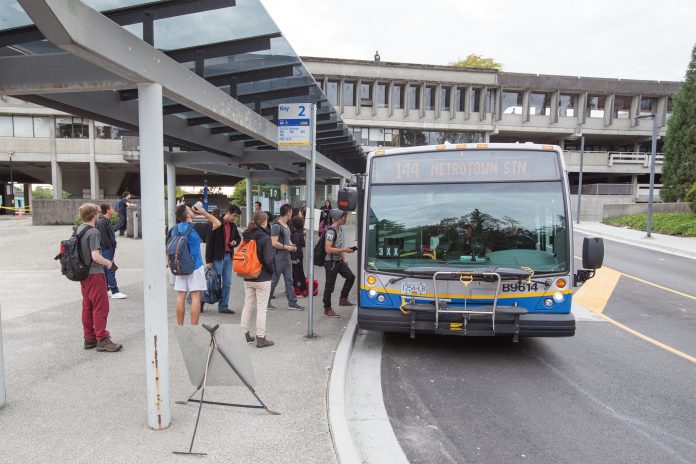
Next time the 145 passes you by, you can air your grievances online using the SFU Student Mobility Advisory Committee’s (SMAC) bus pass-up report form, meant to track transit troubles on the mountain.

SMAC, along with representatives from the SFSS, GSS, and SFU ancillary services, is asking students to contribute to the survey whenever they are passed by buses that are already at capacity — a frequent problem for students going to or departing from campus.

The groups plan to use this data to lobby Translink for improved bus service on Burnaby campus.

“There’s quite a level of frustration on campus about transit.”

“There’s quite a level of frustration on campus about transit, and so it’s really important that we capture this data, this information, so that when we meet with [Translink], we’re able to show what really is the situation,” explained Mark McLaughlin, director of SFU ancillary services. “The situation is really unacceptable, so we have been in touch with Translink to try to get them to remedy the situation.”

The problem of pass-ups is felt acutely at both the bus loop near Cornerstone and the Transportation Centre. McLaughlin explained, “There is a lot of congestion, a lot of overcrowding, and that results in pass-ups because the buses are full.”

The survey, which has been up since the end of September, asks for students’ emails, the bus stop at which they were passed, the number of the bus, and the time of day. “The information we’re gathering, it’s really coming in rather fast and furious,” McLaughlin commented.

The SFSS has a history of transit advocacy, so when McLaughlin approached the organization for support on the initiative, they quickly jumped on board. “Obviously there has been issues with [transit on campus],” Darwin Binesh, SFSS VP external said. “People sit at the last stop on the 143 and get passed seven or eight times before a bus actually brings them to school.”

He continued, “If we collect a lot of this data, if people fill out the form online, every time a bus passes them for whatever reason, we can keep track so that when we go to Translink and make arguments for better service, we have our own data to prove it.”

Cheryl Ziola, manager of media relations at Translink, told The Peak that they are well aware of the customer concerns about bus pass-ups at the SFU loop and have had transit supervisors and transit security on site to monitor the situation and ensure customer safety.

“We anticipate that congestion will ease next week when the detours around construction at the lower exchange are complete and all buses return to regular routes,” she explained. “Typically, September is one of our busiest months as students and teachers return to school. This peak ridership tends to level off as people adjust their schedules to non-peak class times or seek other alternative transport modes such as cycling or carpooling.”

For the fall, Translink has deployed all available buses to major student hubs as part of their service adjustments. These adjustments include weekday frequency increases to the 135 and 143 and a return to regular service hours for the 145.

The SMAC survey will continue to be offered online indefinitely, with SFU representatives approaching Translink once they have accumulated more data.

In the meantime, SFU will expand the space at the Cornerstone bus loop near the 145 stop in order to ease congestion and make transiting home more comfortable for students.

Forum fosters dialogue around “Education Behind Bars”

0
Because prison programs prioritize high school diplomas, inmates receive few options for post-secondary education.

While students often joke about SFU looking like a prison, many real inmates desire access to post-secondary education.

SFPIRG’s forum “Breaking the Cycle: Education Behind Bars” on October 1 sought to address this issue; students, teachers, and former inmates came together to engage in a dialogue about the lack of, and need for, educational resources within prisons.

“We really need to think seriously about the tools we give people in prison.”

According to SFU criminology professor Brenda Morrison, educational resources in prisons are seriously lacking. Correctional Services Canada (CSC) prioritizes high school diplomas, leaving inmates few options for post-secondary education.

Morrison stressed the positive impact that higher education could have on both inmates and society: “If we want people to be coming out of prison making good decisions [and] keeping themselves and others safe and productive, then we really need to think seriously about the tools that we give people in prison.”

Morrison credited university-based programs, rather than the CSC, with driving post-secondary education in prisons. One such program, Inside-Out, offers university-credit classes to groups of university students or ‘outsiders’ and incarcerated people or ‘insiders’ within prisons across Canada and the US.

Shoshana Pollack, Inside-Out coordinator and professor of social work at Wilfrid Laurier, was one of three speakers at the event.

Pollack described Inside-Out’s unique approach to education as offering multi-disciplinary classes that focus on the knowledge and experience that both groups of students — insiders and outsiders — as well as instructors bring to the table.

The event also featured Liz Fulton Lyne of the Greater Edmonton Library Association (GELA), and Kim Williams, career development coordinator in the criminology department at the University of the Fraser Valley.

Fulton Lyne highlighted GELA’s Prison Library and Reintegration Project, which includes book lending programs, book clubs, author visits, and a storybook reading program for incarcerated mothers.

Williams talked about the importance of fostering strong relationships between inmates and staff when working in prisons. Pollack agreed, saying, “Normally as a society [. . .] these two groups of people don’t often have the opportunity to talk with one another as equals, as peers, in a classroom.”

Pollack’s recent study of Inside-Out participants, however, suggests that reservations exist on both sides of the prison walls.

When it came to implementing education systems in prisons, Pollack found that insiders were typically afraid that they would be studied or scrutinized, and that outsiders would treat them as unintelligent or dangerous. Outsiders felt open to the experience but, Pollack said, many had assumptions about the degree of difference between themselves and inmates.

What these outsiders soon realised, Pollack explained, was that, “had it not been for a couple of factors in their lives, they themselves could quite easily end up within a prison or jail.”

Carla Stewart, the forum’s coordinator, said she hoped that the event’s participants left with a new awareness of the issues surrounding education behind bars.

Stewart stressed, “It’s important that the information gained goes beyond questions of ‘What can I do to help?’ or ‘What can I do with my criminology degree?’ and enters a deeper consider-ation of why prisons are such broken systems to begin with.”

Morrison concluded, “The only right that prisoners lose when they’re charged with a crime [. . .] is the right to freedom. All other rights remain in place.” As “Education Behind Bars” hoped to address, the right to an education is not a right that should be taken for granted.

The importance of following world news

1
World news stitches us together in a tapestry depicting not only struggle and turmoil, but happiness and prosperity.

As grotesque photographs of the devastating Ebola outbreak in Liberia filter through my newsfeed, I find it difficult to transcribe my reactions. My feelings are a sadness-stricken medley confused with a dash of relief and a hint of anxiety. Why do I feel these strange emotions toward something that is occurring thousands of kilometres away? And why am I further astonished to understand that many people don’t seem to care about these events?

A couple weeks back, I listened to a TA suggest to the class that foreign news coverage is pointless for Canadian news-watchers, and that headlines of significant relevance to readers are the only items that should concern them. After all, it doesn’t apply to me. I shouldn’t be interested in Hong Kong’s umbrella-battle for democratic liberties, when I’m safe at home with a smile on my face and a Charter of Rights and Freedoms to soothe me to sleep.

Growing up, the idea that I would someday be interested in global current events was unfathomable. My father’s six o’clock ‘click’ to Global News only supported the fact that Middle Eastern struggles or violent European protests bored the hell out of me. Thankfully, a solid education, curiosity, and a little procrastination now have me skimming sections of Al Jazeera and The Guardian, and realizing the true importance of reading up on world news.

Through global events, I understand we all fight for survival in a precarious world of uncertainty.

Foreign news gives me a sense of my place in the world as an individual, a citizen, and a human. Yes, it seems selfish and ironic to suggest that I read up on global events to understand myself a little more, but this is the fundamental reason that our access to world news exists. In learning of the ongoing battle against the Islamic State of Iraq and Syria, I begin to understand my own position as a citizen in my own country.

I am able to reflect on current situations surrounding me, and relate them to foreign situations. I analyze a snapshot of myself to discover my own fortunes or misfortunes, as compared with those of other individuals or states.

The Ebola outbreak saddens me because I envision myself in that Liberian world; I empathize with those coping with loss. Though, I’m relieved to not live in that position, but I’m also anxious that I could some day be struck with such a deadly virus. Through these emotions I come to comprehend that we are all people fighting for survival in a precarious world of uncertainty.

As Canadians, we relate with national events more directly, but global awareness is the gateway through which we come to see our broader situation. World news stitches us together in a tapestry depicting not only collective struggle and turmoil, but happiness and prosperity. This is something we can’t afford to bypass or ignore.

Pragmatically speaking, yes, Ukrainian civil unrest does not affect us Canadians directly, but it allows our nation to learn from others’ mistakes and to reflect these learned lessons back to the world as responsibly as we can. So think twice about your lack of interest in the world news section — through it you may find a sense of balance.

The Age of Anonymous

0
This Guy Fawkes mask makes me feel so unique!
Behind the veil of anonymity, Internet trolls encourage hate speech and bigotry.

The far reaching abilities of the internet have opened many doors for all of us, but they have also exposed us to a new racist, classist, homophobic, and (especially) misogynistic rhetoric that endangers the progressive ideals we’ve spent decades working towards.

Now, don’t get me wrong; I think the internet has been a great tool for spreading equality, and it has certainly been an excellent platform for women and other underrepresented groups around the world to make their voices heard. But increasingly, those who share their opinions and beliefs about injustice online are often met with a series of comments meant to shame them for speaking up.

Consider the efforts made by feminists to open discussion about gender equality. After Emma Watson’s stunning speech at the United Nations promoting the ongoing He for She campaign, she was immediately met with sexual threats and told by anonymous users that naked photos of her would soon hit the net. Despite the revelation that the supposed leak was a hoax, this is still an instance of misogynistic bullying, and a threat we should take seriously.

Watson is still being used as an object to make a point. Every day, women are being abused and harassed online — using Watson as a bargaining chip isn’t going to change that.

Just because these comments are made online doesn’t make them any less hateful or destructive.

We all live two lives: our physical one in the ‘real world,’ and our digital one online. Those with a prejudice against women or others tend to use the latter to express their hateful views. Operating from behind a veil of secrecy, people are allowed to openly propagate ideas which would be met with harsh criticism in the real world.

Social justice requires accountability, but the nature of the internet makes it difficult to know from where and from whom regressive comments are coming. Because of this, we tend to shift the blame for online attacks onto the victims, which is a serious step backwards.

The relationship between the web and society is not as simple as we like to think. The internet has become a sort of modern Wild West — lawless and often dangerous. From behind their screens, trolls attack others with vulgar comments and threats of assault.

But these attacks are only part of the problem. Perhaps an even bigger issue is how our society has normalized these attacks, often writing them off as minor annoyances or simply an unavoidable part of the web. As the real world continues to progress in favour of equality, the digital one is becoming exceedingly weighed down by the regressive forces of online harassment.

As Laurie Penny, British journalist and feminist, put it: “An opinion, it seems, is the short skirt of the internet. Having one and flaunting it is somehow asking an amorphous mass of almost-entirely male keyboard-bashers to tell you how they’d like to rape, kill and urinate on you.”

Society continues to put the blame the women who experience online invasions of their privacy, instead of focusing on the aggressors. After the recent nude photo leaks, many countered that, if a woman doesn’t want naked pictures of herself on the internet, she shouldn’t have taken any to begin with.

This is classic victim-blaming, plain and simple. It’s no mistake that the leaked photos were of some of the most powerful and prominent women in our society — this invasion of privacy was an attempt to reaffirm patriarchal ideas of gendered power dynamics.

The anonymity of the internet makes it hard to identify where threats are coming from, and because of this, we put responsibility on women to protect themselves. This often translates to dissuading women from participating in online discourse, rather than looking to change the problem.

Allowing anonymity on the internet, however, comes with plenty of potential benefits, and threats to remove anonymous outlets on the web have met with backlash. We know that being able to browse and post anonymously protects an individual’s right to privacy. In an effort to track the few who are responsible for hate speech, we would likely punish the large majority of web users who don’t engage in these sorts of exchanges.

Ultimately, we will change people’s attitudes about online threats and hate speech by recognizing and condemning them when they appear, anonymously or not. Instead of focusing on the victim, we need to call out these attackers and make sure they know that their comments are damaging and unacceptable.

Mob mentality and the feeling that anonymity allows one to get away with anything is what fuels many to keep posting offensive remarks — if we are watching and calling them out, they may think twice.

Blaming victims and dismissing hate speech as ‘trolling’ ignores the strides made by modern feminism, civil rights, gay rights, and other movements; and protects those who are making the internet a less safe place to be. We need to take these comments and threats seriously, just because they’re online doesn’t make them any less harmful or destructive.

I encourage all of you to think hard about the recent online shaming of women — if it had happened anywhere but on the web, would we be talking about it the same way? We need to focus on the real problem here; if we don’t, the internet will never become the safe and constructive environment that it’s meant to be.

Vancouver citizens must vote “yes” on transportation funding referendum

1

Within the next year, Metro Vancouver citizens will have the chance to vote on a new funding source to support the Mayors’ Council’s $7.5 billion vision for transportation in the region.  This plan includes upgrades to services and frequency of transit, an extension of the Millennium Line to Arbutus street, two light rail lines in Surrey, 11 new B-Lines, 2,700 km of bike-ways, and a replacement of the aging Pattullo bridge between Surrey and New Westminster.  A “no” vote on the referendum would be devastating for the region as a whole.

In order to build new transportation projects and improve the existing network, our governments and Translink need capital. Under current circumstances, there is just not enough money for new projects. With all other funding sources considered, the Mayors’ Council’s vision will require an additional $110 to $390 million per year.

It gets worse; according to Translink’s 2014 operating and capital budget report, this year Translink will not be able to expand bus, Seabus or West Coast Express services, nor move ahead on a number of pressing projects on the regional priority list due to limited revenue.

If we stick to the status quo, the situation will be dire. According to Vancouver’s Metro 2040 population projections, in the next 30 or so years, the population of Metro Vancouver is expected to rise by more than one million people. With current levels of transit service and funding, it would be impossible to move that many people and goods around the region. 

A “no” vote on the referendum would be devastating for the region as a whole.

Maybe you drive or don’t care about transit, so why should you have to pay for someone else’s transportation? The vision is not just about transit. Next time you’re stuck in traffic on Broadway or King George Boulevard, think about how much easier your commute would be if there were 10, 20 or even 50 per cent less traffic on the road.

When the Canada Line was built, many critics assumed that the ridership projections were false, and that the Canada Line would have no effect on congestion. The critics were proven wrong by the more than 120,000 people per day who use the Canada Line to get to work, school, and other activities. The Mayors’ Council’s vision estimates that drivers could save 20 to 30 minutes per day on some of the most congested corridors if the plan is implemented. A positive vote for new transportation funding means “yes” to less congestion.

The good news keeps on rolling. With the new transportation funding source, there would be major infrastructure projects and upgrades all over the Vancouver region. Those projects mean more jobs in engineering, construction, planning, manufacturing, energy, and all the secondary services that go along with those jobs.

As the dutiful citizens of Metro Vancouver, we have been given a great responsibility and opportunity to voice our opinions. Whether you are a student or professional, blue or white collar, millennial or senior citizen, transit-user or car driver, it doesn’t matter. If you live in Vancouver, this referendum affects you. Give your support to the new source of funding, and give support to less congestion, better transit, more jobs, and a prosperous region.