Home Blog Page 1110

Tim Hortons should be kept Canadian

0

I am in a flurry of motion. Tapping my feet, checking my watch every 0.62 seconds, I throw several anxious glances at the customs officer. Come on. I have a bus to catch at noon, and it’s already 11:40 a.m. Ten agonizing minutes later, I’m through the gates and rushing through the arrivals hall to the bus terminal. That’s when I see it.

Inside SPAR, an Irish convenience store, is a Tim Hortons coffee machine and doughnut rack.

For a split second, I smile, immediately thinking of Canada. But then that second’s gone, replaced by ‘Oprah say what?’ thoughts as I wander into the store. If I were more daft, I’d probably prod the machine. As it is, I’m gobsmacked. A Tim Hortons in Ireland of all places? It doesn’t make sense. The machine with the bold brand name on it flutters its eyelashes innocuously at me.

I didn’t have time to buy any of the Timbits on sale, or issue a firestorm questionnaire at the salesclerk, but as I sat on the bus, watching Irish cityscape and countryside slide by, I mused rather sadly, “I thought Tim Hortons was supposed to be Canadian.”

Is it so bad to want a company to just be national or even local? Why do so many companies have to become global? With so many businesses hungry for expansion, one of the ways to stand out is to stay true to your roots and cater to a smaller, more specific audience.

There was once a time when Americans had to make the trip up over the border to enjoy Timbits.

There’s still a strong appreciation for local and national brands like that family-run fish-and-chips store. With smaller establishments, your experience is  much more intimate; you might be friends with the owner or know the history of the place right from its very beginning.

Likewise, there’s something  special about seeing a Tim Hortons branch and feeling that familiar bloom of Canadian pride — after all, it was founded by a very famous Canadian hockey player.

It’s definitely not McDonalds, which you can find in even the most remote places of the world. I don’t know about you, but I go into Tim Hortons feeling more chipper than when I go to McDonalds, possibly because I subconsciously associate it with Canada more than McDonalds, but possibly also because I love their white hot chocolate so goddamned much!

Currently, Tim Hortons is a larger food service operator in Canada than McDonalds, bringing in more than one-fifth of the nation-wide fast food revenue — which is quite an achievement! There was once a time when Americans had to make the trip over the border to enjoy some Timbits; now, there are around 800 branches in the States.

With Tim Hortons’ recent sell-out to the American owned Burger King, the current plan to set up more branches elsewhere in the world and become a global superstar could eventually bury its Canadian roots. Fellow customers will nod automatically and indulgently at the reminiscent old geezer insisting that Tim Hortons used to be solely Canadian.

Tim Hortons is often seen as a symbol of Canadian identity, much like the maple leaf or hockey. The company has woven itself into the Canadian fabric, and I would hate to see it become a stitch on other countries’ quilts.

Please, don’t let Tim Hortons become the next Dunkin’ Donuts. Call me selfish, but Tim Hortons shouldn’t be shared with the world. If the world wants it, they can come to Canada, and find us Canadians already at the counter.

Fear of a yellow planet

0
No TV and no beer make Homer something something.
Twenty five years later, The Simpsons is still the best — and funniest — TV show of all time.

Back in those halcyon days when I had home-recorded VHS tapes and late-night cartoon marathons in lieu of summer jobs and print deadlines, my sister and I would exhaust each and every Simpsons videotape we owned, to the point where we could no longer attribute the loud wheezing of our long-abused VHS player to poor craftsmanship. Of course, my father, our Homer, who habitually joined us in our nonstop binge-watches, had no one to blame but himself.

We knew each joke by heart, every episode by its opening couch gag, and each film reference by instinct — even if we hadn’t yet seen the films they were referencing. Many young people of our age (millennials, as we’ve been unwillingly labelled) likely have similar stories of lazy Sunday pajama-clad Simpsons sprees.

Despite occasional maternal hand-wringing and the often over-our-heads political barbs, The Simpsons were my teacher, my mother, my secret lover. They taught me more about the nuances of family, culture, and society than public schooling or an emaciated prepubescent social life ever could.

Straight out of the gate, The Simpsons established an immutable presence in the pop culture of the era.

Twenty years and a dizzying dip in quality later, it’s become increasingly hard to think of a time when The Simpsons legitimately held claim to the title of the greatest TV show of all time. But those of us who grew up with Homer, Marge, Lisa, Bart, and Maggie remember how the show once blended self-aware humour, biting social commentary, and unashamed slapstick to make for one of the most well-realized explorations of the human condition this side of Tolstoy’s War and Peace.

Occasionally, shades of the old Simpsons — the family my generation and my parents’ fell head over heels for — will shine through, but by and large, their glory days are far behind them. Thankfully, the show’s 25th anniversary this December inspired FXX to air the entire series in a blissful two-week marathon, introducing a new generation and reintroducing an older one to the glory days of primetime TV’s greatest achievement.

In honour of the show we grew up with, The Peak is taking a look back at the show’s beginnings, as well as its lingering effects on the language, TV, and culture of the present day.

***

Imagine a time when there was no Breaking Bad, no Sopranos, no Orange is the New Black — where the best you could expect on the tube was the sort of wholesome, saccharine sitcoms we now know only as the subject of merciless satire for better shows: The Cosby Show, Full House, Growing Pains, and so on. Sure, there was a hint of subversiveness in shows like Cheers and Roseanne, but the sort of challenging, intellectual fare we’re accustomed to now would have been unheard of in the pre-Simpsons era of TV.

Enter Matthew Groening (it’s pronounced Gray-ning): a bearded comic book nerd and cartoonist at the Los Angeles Reader, an alternative rag for which he also delivered papers and answered phones. Groening’s strip, Life in Hell, featured anthropomorphic bunnies and explored themes of religion, philosophy, culture, and language. Though unmistakably neither yellow nor human, Groening’s rabbits were Simpsonian both in vibe and aim; a tongue-in-cheek send-up of everything from love and sex to death and morality.

Among the many fans of the strip was James L. Brooks, a Hollywood bigwig and famed writer on The Mary Tyler Moore Show, one of the gems of TV’s first Golden Age. After winning multiple Oscars for writing and directing the maudlin 1983 hit Terms of Endearment, Brooks found his way back to television with The Tracey Ullman Show, a fledgling primetime sketch comedy program hosted by a British comic relatively unknown in Canada or the States. Among the show’s variety of segments were elaborate musical numbers choreographed by a then-unknown Paula Abdul; sketches tailored to show off Ullman’s talent for vocal mimicry; and, of course, the occasional animated short.

The story has since become apocryphal. Groening, encouraged to pitch Brooks his Life in Hell characters as an animated segment for the Ullman show, was hesitant to hand over the rights to Fox. “I was made aware that I might lose ownership of whatever I pitched [to the network],” Groening told The Hollywood Reporter. “Instead of pitching Life in Hell, I drew new characters on the spot. I’d had them in mind for a while but had never drawn them.”

In Brooks’ waiting room, minutes before the pitch, he scribbled down his new idea for a series of shorts: a family of five, named after his own family — except, of course, for Bart, a stand-in for Matt.

Premiering on April 19, 1987, The Simpsons shorts quickly became the breakout hit of the show; their popularity inspired Fox to feature the clips alongside trailers before movies. “I went to a theater, and the moment The Simpsons came up on the screen, the audience burst into applause,” said Groening. “That was the first major indication of, ‘Whoa, we have something here.’”

***

The popularity of the shorts led Fox to consider the possibility of a full-length show; it would become the first animated sitcom since The Flintstones, more than three decades earlier. According to Brooks, animator David Silverman — who’d go on to be one of the show’s biggest creative influences — cornered him drunk at a party, begging him to give the Simpsons their own slot.

Luckily, the network was hungry for a hit, as shows like Ullman were suffering from low ratings despite critical acclaim. With Brooks’ backing, the show was picked up for a 13-episode debut season, with Groening, Brooks, and Brooks’ longtime collaborator Sam Simon as executive producers.

On December 17, 1989 (just under 25 years ago today), The Simpsons debuted on primetime with an episode-length Christmas special, “Simpsons Roasting on an Open Fire.” Sporting subversive, anti-authoritarian humour, casually crude animation, and brief hints of the sort of introspective genius that would become commonplace in the series’ own Golden Age, The Simpsons proper became an immediate and all-consuming hit.

Though The Simpsons’ first two seasons were immensely popular, controversy and strife festered behind the scenes. Animation flubs were common in the show’s early days, and commentators were quick to criticize the show’s supposedly amoral messages.

Sam Simon, who was responsible for much of the show’s early success — assembling its impressive team of nerdy, Harvard-educated writers; editing and re-editing and then re-editing scripts; encouraging voice talent to record their lines together in one room rather than separately — suffered strained relations with creator Groening. Simon resented receiving less credit than the show’s official creator, whereas Groening was critical of Simon’s creative fingerprint on the series.

Simon left during the show’s fourth year, though he retained a producing credit and received royalties for the series long after his departure. The Simpsons would switch showrunners every two seasons during its best seasons — generally agreed as occurring between 1991 and 1997  — and these would become the seasons that established it as the unique, genre-bending masterpiece it’s now considered to be.

***

Straight out of the gate, The Simpsons established an immutable presence in the pop culture of the era. The early seasons cast Bart Simpson, the flippant daredevil of the family, as the show’s protagonist, much to the ire of conservative critics and families fearing their children might ape his penchant for bad behaviour. Tongue-in-cheek catchphrases such as “Don’t have a cow, man” and “Eat my shorts!” only heightened the cultural tensions spurred by Bart’s devil-may-care attitude.

The cultural outcry against Bart’s antics went hand in hand with an influx of Bart-themed merchandise — hats and shirts which eventually moved to the black market as more and more teachers began to ban the spiky-haired troublemaker’s image in their classrooms. At the peak of Bartmania, Michael Jackson even offered to write a novelty song in honour of the character. “Do the Bartman” would go on to top the UK charts, though it was never officially released overseas.

As the show gained more popularity and both its animation and writing improved, Groening, Brooks, and Simon passed the baton to Al Jean and Mike Reiss, who served as showrunners during the show’s third and fourth seasons. These are generally agreed to be the first seasons in the show’s Golden Age — writers like John Swartzwelder, David M. Stern, and a young Conan O’Brien worked with Reiss and Jean to create some of the show’s most legendary episodes, such as “Kamp Krusty,” “Homer at the Bat,” and “Marge vs. the Monorail,” respectively.

The next seasons polished the show’s mix of subversive humour, broad comedic situations, and emotional gravitas. The show won multiple Emmys and critical acclaim across the board, becoming so famous as to warrant a public denunciation from then-president George H. W. Bush. In 1999, Time magazine rated the show as the best in television history, and even saved a space for Bart among its 100 most influential people — despite the show’s spotlight long ago having transferred to Homer, the series’ bumbling but well-meaning patriarch.

For Simpsons fans such as myself, these years exist encased in a sort of pop cultural amber. They’re untouchable. They didn’t just change the face of TV for good; they also changed us, and (mostly) for the better.

***

The influence of The Simpsons on today’s television landscape is hard to miss — Family Guy,South Park, Beavis and Butt-Head, Bob’s Burgers, King of the Hill, Futurama, and countless others have taken proverbial pages from the book of Simpson, to varying degrees of success. The calculated blow dealt to TV by that yellow fivesome meant an influx of shows which aimed similarly to challenge the status quo: The Office, Malcolm in the Middle, Married… with Children, and even The Daily Show followed in the footsteps of that Springfieldian family, and shades of its meta humour can be seen even in more recent fare like Community, Archer, and Rick and Morty.

But The Simpsons also introduced viewers both young and old to a radical, counter-cultural way of thinking, diametrically opposed to the milquetoast nuclear family values of The Cosby Show and Full House. Bart’s opposition to authority and gleeful taste for mayhem made him the poster-child for the MTV generation; Lisa’s uncommon intelligence and subsequent disillusionment with institutions betrayed the show’s own distrust of the powers that be; Marge’s gracefulness under the pressures of domesticity made her the unlikeliest of feminist heroines.

The show satirized the pillars of North American society religion, media, politics, sex, race, class with both wit and warmth.

For his part, Homer, the show’s breakout protagonist, was an all-out deconstruction of the classic family man of sitcoms past — simultaneously a source of humour and tenderness, bigotry and warmth, idiocy and insight. Though each member of the Simpson family has since been simplified and sterilized to the point of unrecognizability, there was a time when each stood as a sign both of the strength of the series and of the changing tides of 20th century society.

The show satirized the pillars of North American society — religion, media, politics, sex, race, class — with both wit and warmth. Episodes explored the characters’ faith and moral beliefs, as well as their prejudices and preconceptions, in a way that was both informative and insightful. The Simpsons’ creative use of language also had a lasting effect; phrases like “d’oh,” “yoink,” and “meh” have been popularized by the show, and quotes from its best episodes have found their way into the everyday slang of superfans and casual viewers alike.

Of course, the show’s best feature may well be its most obvious — it’s really, really fucking funny. In its heyday, The Simpsons combined self-referentiality, political satire, wordplay, slapstick physical gags, rapid-fire witticisms, celebrity impressions (sometimes done by the celebrities themselves), and off-the-wall absurdity, all making it the funniest show ever to air on primetime television. To watch these episodes now, many of the references seem dated or passé, but the show itself is still as laugh-out-loud hilarious as ever.

So — what happened?

***

The jury’s out on when The Simpsons officially ‘jumped the shark.’ Some cite the season 12 episode “Homer vs. Dignity,” in which Homer is implicitly raped by a panda at the Springfield zoo, as the series’ nadir; others mention the season nine bomb “The Principal and the Pauper,” where supporting character Principal Skinner is revealed to be an impostor, abandoning much of the series’ canon up to that point; and many diehards will go as far back as season eight — usually cited as part of the series’ Golden Age — and cite “Homer’s Enemy,” in which Homer indirectly causes the death of a rival at work then loudly snores through the funeral.

Each of these episodes shows a disregard for the emotional core of the series and a general lack of consistent characterization — whichever you may choose as the official point of no return, things were never the same for The Simpsons after about season eight or nine (depending, of course, on who you ask). Money disputes among cast and crew obfuscated the show’s creative integrity; constant changes in showrunners and writers resulted in a serious lack of consistency; and, frankly, they may have just run out of ideas after over 500 episodes and almost 25 years on the air. I know I would.

Just five years ago, The Simpsons beat out the legendary Western drama Gunsmoke as the longest-running scripted primetime TV series of all time; it also holds the title of longest-running animated series and longest-running sitcom. Its cast of recurring characters numbers in the hundreds, and its recycled plot points surely run a similar tally. If nothing else, FXX’s Simpsons marathon gives viewers ample opportunity to watch the steady decline of the series in real time — the jokes sag along with the verisimilitude and consistency of the characterization, and the cries of helpless fans echo soundlessly into the void.

But hey, maybe I’m being a little dramatic. If nothing else, a 25th anniversary celebration is a great chance to introduce the new generation to the show which ingrained the same sardonic indifference that launched a thousand anti-millennial op-eds. Once upon a time, The Simpsons was among the most ground-breaking, envelope-pushing cultural creations of all time, and its scope and breadth of vision remains impressive despite its inevitable decay.

So if you take one thing away from this piece, it’s this: watch the damn show. I’d be willing to go toe to toe with anyone who’d argue that South Park, Family Guy, or even Seinfeld can stand up to The Simpsons at the zenith of its creative quality. In the same way the show still links my sister and I, it links a generation of like-minded viewers together, yearning for donuts and slouching towards Sunday afternoon TV binges in a manner distinctly yellow in tone.


Kinder Morgan expansion: a plea for personal action

0

Simon Fraser University is a progressive academic think-tank of 30,000 students and 6,500 faculty and staff, with a handful of critical departments who pride themselves on breeding socially responsible citizens.

   However, SFU seems to be allowing Kinder Morgan to expand its pipeline infrastructure through Burnaby Mountain, SFU’s home. Please take a minute to understand the grim irony in this situation.

From my experience at SFU, many students, faculty and university representatives are opposed to any kind of pipeline expansion. So, now that there is a pipeline of crude black gold — the currency of corporate rule — soon to be built right under our feet, we should do something about it.

Many of us will do what we have been taught: try to understand why this is happening by raising critical questions about all stakeholders involved. Why does a corporation have power over the municipal governmental body and the university? If Derek Corrigan, Burnaby’s mayor, really does not support the pipeline expansion, it’s odd that he’s simply supervising the Kinder Morgan worksite and only intervening if bylaws are broken.

Where are the municipal outreaches and community initiatives to work together to stop the pipeline expansion? Where is the response from SFU’s political and legislative bodies? Why are local media outlets reporting the story as a clash between the municipality and Kinder Morgan, when the approval of the pipeline expansion  already sounds the municipality’s downfall?

But before we propose questions that shift responsibility into the hands of others, perhaps those of us who do not support the pipeline expansion should look into the level of personal responsibility we have invested in the cause.

As SFU students who don’t want to see an oil pipeline [on campus], we are powerful stakeholders.

It’s important to understand that natural resource commodification, corporate takeover, and government legislation at all levels have resulted in blunders in the past.

If we do not want to see a pipeline built under our feet on Burnaby Mountain, we need to recognize the conditions that have manifested around us over time. We must take some level of responsibility to push the transition to our future into conditions that are more equitable than the ones we live in today.

Every day at SFU, I see a large populace of students who have no sense of certainty behind their values and self-proclaimed moral codes, but I also see a portion of individuals who are grounded in their beliefs and passionate about a cause.

So where is this passion on a pragmatic level? If you take a strong oppositional stance on the pipeline expansion, maybe you should also take a few minutes to reflect on how much responsibility you’ve taken to change the conditions, and how you can take leadership to create positive change.

As students of SFU who do not want to see an oil pipeline go through the land upon which our education is built, we are powerful stakeholders. As students of the university, we have access to a wide range of resources and networks, an open space for collaboration, and a large portion of forward-thinking individuals who already stand against the project. Whatever cause you believe in that has led you to oppose this pipeline expansion, it connects you with a range of other individuals whose passions have led them to take the same stance.

Yes, Kinder Morgan is looking to build a pipeline through Burnaby Mountain: what are you going to do about it?

Why I’m siding with BC teachers

0
More like Crusty Clark, amirite?
Don't blame BC's teachers for the elongated strike — blame Christy Clark's liberals.

On June 5, 2001, when I was just seven years old, Christy Clark began her reign as BC’s Education Minister. The BC Liberals, a party Clark now leads, ran on a platform entitled “A New Era for British Columbia” which promised to “create a public education system that’s the envy of the world.”

Since that day, Clark’s policies have certainly marked a new era for British Columbia — one with a deeply broken and battered public education system.

On my last day of the first grade, the collective agreement between the British Columbia Teachers’ Federation (BCTF) and the BC Government expired. In her campaign, Clark had vowed to increase parental involvement in the public education system, restore education as an essential service, and ensure that school would remain in session for students in the event of a strike. These promises manifested themselves in several legislative actions, most notably through Bill 27 and 28, which both passed on January 27, 2002.

These bills imposed the teachers’ contract, and effectively stripped the BCTF of the right to collective bargaining, including their ability to negotiate class size, composition, and other working and learning conditions for teachers and students alike. The BCTF reported that this cut roughly $275 million in education funding, leaving our teachers with some of the lowest salaries in Canada.

Christy Clark’s policies have marked a new era for British Columbia — one with a deeply broken and battered public education system.

The salary increases that were established in the teachers’ contract were delegated to the school districts across the province, leading to incredible deficits in my school district during my time in grades three and four. To top it all off, Bill 19 was passed in 2005, which extended the imposed contract of Bill 28 into 2006. As a result of this unreasonable neglect, the BCTF went on strike in October 2005.

In 2005, I moved to another school district in BC, and there I had my first experience with a teacher who was willing to donate hundreds of hours of volunteer work to provide me and my peers with a quality education. She held book clubs, taught us to sing French music, and even took us all on a weekend camping trip to Cultus Lake where we carved soapstone and found salamanders.

This teacher, who took extra time to listen to me, who sparked my love of literature and outdoor education, was one of thousands of BC teachers who went on illegal strike in protest of their treatment by the Liberal government for over two weeks. At the end of this strike in 2006, a five-year tentative agreement was signed by both teachers and the government which included a signing bonus and wage increase for educators.

The years between 2006 and 2011 were big for me. I was in a pubescent hot mess of pimples and crushes, sneaking out of my parents’ houses and getting into trouble. Eventually, I moved away to finish my public education career in the same sleepy small town I started it in. There, I met teachers who, again, donated hundreds — maybe thousands — of volunteer hours towards extra-curricular music, theatre, and film programs that have since served as the foundation of my passion for filmmaking and community service.

Meanwhile, on April 13, 2011, the BC Supreme Court ruled that Bills 27 and 28, enacted by the BC government in 2002, were “unconstitutional and invalid.” As a result, the government was given 12 months to remedy its illegalities and return the language about class size and composition to the contract.

The next year, my final one in the public education system, my teachers went on a three-day strike to protest the lack of action by Christy Clark’s government in addressing the illegality of Bills 27 and 28. Bill 22 was then legislated to bring teachers back to school after spring break. As the Liberals still had not struck a collective agreement with teachers and their illegal actions had not been addressed, the BCTF took the BC government back to the Supreme Court.

My graduating year, 2012, was a success largely due to the immense support of my teachers. Despite my disappointment in losing extra-curricular privileges such as in-school film festivals, extra rehearsals, and after school support, I left the public education system with immense gratitude for many teachers who mentored me far beyond the curriculum.

That same year I began my career at SFU, and began working for an organization in East Vancouver that serves some of the city’s most vulnerable inner-city children. In 2013, around the time I started working with this organization, a report was published stating that BC has the highest rate of child poverty in all of Canada: 19 per cent of children in our province live in poverty, compared to the 13 per cent national average.

We must consider that many children who miss school due to strikes may not even be having their most basic needs met. BC public schools provide meal programs, education, and support to children who otherwise may not receive these essential services due to financial barriers. These barriers simply will not be broken down by the $40-a-day offered by the BC government for every day on strike after September 2, 2014. In order to serve BC’s most vulnerable youth, the government needs to find a way to deal with the teachers effectively and fairly.

Almost 12 years to the day of the enactment of Bills 27 and 28, the BC government was ordered to pay the BCTF $2 million in damages for its ongoing neglect to address the language of class size and composition. On August 30, 2014, Christy Clark ended her recent silence on the matter with a series of tweets, the first of which read, “We remain committed to negotiating a fair deal with the BCTF, but it has to be affordable for taxpayers.”

Allowing BC’s students to have access to necessary support in a safe environment does need to be affordable for British Columbians, but Clark and the Liberal government have neglected the concerns of our teachers far past the point of no return. Court battles, media campaigns, and $40-a-day band-aids are just some ways Clark and her government evade the BCTF’s concerns, and these ploys are costing taxpayers and children alike.

Christy Clark, I was in the BC public school system with you for over a decade. Now, as a taxpayer and citizen fighting for the basic human rights of children in this province, I urge you and your government to give the BCTF a fair deal.

Satellite Signals

0

Woodward’s

SFU Woodward’s played host to CreativeMornings Vancouver last Friday, September 5. The event featured Andrea Chlebak, Senior Digital Intermediate (DI) Colourist and Director of Creative Services at Central. In her capacity as a colourist she has worked on popular Hollywood films such as Elysium. The morning’s talk was accompanied by free breakfast.

Surrey

The SFU Software Systems and the Mechatronics Systems Engineering Student Societies held a joint frosh event for incoming students from Wednesday, September 3 to Saturday, September 6. The students partook in a range of activities, from circuit building exercises to a “Midnight Madness” all-night event at Burnaby campus, with the week culminating in a final barbeque in English Bay.

Harbour Centre

SFU’s City Conversations presented “The Arbutus Corridor: A Way Forward?” last Thursday, September 4.

The focus was on the conflict between Canadian Pacific Rail and the City of Vancouver over the sale of the Arbutus Corridor. The session began with a survey of the issue by an advisory panel of neighbourhood representatives and was then opened up to the room for discussion.

Kinder Morgan surveys Burnaby Mountain as potential pipeline site

0
The proposed route runs 1,150 kilometres from the Alberta oil sands to the Westridge Marine Terminal in Burnaby.

Canada’s National Energy Board recently issued a review granting permission to Kinder Morgan to study the possibility of running a pipeline under Burnaby Mountain to the Burrard Inlet. The energy company wants to do so as part of a plan to increase capacity of their existing pipeline.

SFU’s John Clague and Doug Stead, professors of earth sciences, are working with Kinder Morgan to enact the study, though many SFU alumni have spoken out against the project.

Mike Soron, executive director of Sustainable SFU, says that his group is currently reminding students that these pipeline plans, “threaten both the health and safety of our student members and communities worldwide that are vulnerable to climate change.”

Sustainable SFU is “encouraged by the actions of campus climate leaders like Dr. Lynne Quarmby,” said Soron. Quarmby, chair of molecular biology and biochemistry at SFU, along with a small group called ForestEthics, launched a constitutional challenge against the National Energy Board in May. They objected to the decision, claiming that the review obstructs public participation and silences public concerns.

In late June, SFU ecologist Wendy Palen led a demonstration with other academics calling for a moratorium on oil sands and pipeline projects until such developments are consistent with the government’s commitments to carbon pollution reduction.

Palen was also a cosigner of an article recently published in Nature magazine that cited what the authors interpreted as flaws of how decisions regarding oil sands are made. The study argues that debate regarding individual projects only considers short-term costs and local benefits without accounting for long-term consequences extending to multiple or worldwide projects.

“If Canada and the United States continue to move forward with rapid development of these reserves,” Palen is quoted as saying, “both countries send a signal to other nations that they should disregard the looming climate crisis in favour of developing the most carbon-intensive fuels in the world.”

Clague stands by his decision to research the topic. While sympathetic towards concerns about the project, he is confident that such a pipeline route “is less expensive than [one] near the surface through Burnaby neighbourhoods,” and eliminates the disruption of those neighbourhoods.

Clague also responded to Sustainable SFU’s claim that the pipeline poses a threat, saying that he believes, if properly constructed, it “would pose no risk either to people or the environment.” He pointed to the hydrocarbon pipeline that “has operated beneath Burnaby without leaks,” and the “light oil products [which] have been shipped from the Chevron Refinery in Burnaby through Burrard Inlet, English Bay, and the Strait of Georgia,” all without incident for 60 years.

He argues that the ‘real issue’ is not the safety of the pipeline, saying, “Opponents of the Trans Mountain pipeline project should worry less about pipeline safety and more about our government’s energy export policies.” He continued, arguing that individuals would be better off changing “their focus and pressure our federal government to provide leadership in reducing Canadians’ rampant consumerism, while changing our economy to one based more on renewables.”

Despite Clague’s assurance that the pipeline would be beneficial to the community, local resistance persists. Sustainable SFU, according to Soron, promises “a number of community events already planned” concerning the issue, and regular encouragement for student involvement. One goal of the group, says Soron, is “seeing SFU divest its endowment from pipeline companies like Kinder Morgan and [. . .] fossil fuel companies.”

New course opens entrepreneurial avenues

0
SFU professor Sarah Lubik will teach BUS 238 for the first time this fall.

A new course offered this fall by two SFU professors will open entrepreneurial avenues to undergraduate students in all faculties.

The 200-level introductory course, BUS 238: Introduction to Entrepreneurship and Innovation, emphasizes cooperative, team-based approaches to entrepreneurship and innovation. Available to any student who has 12 or more credits, the course will make upper-division business classes accessible.

Taught by Sarah Lubik, lecturer in the Technology Entrepreneurship@SFU program, and Andrew Gemino, professor of management information systems, BUS 238 demonstrates that you don’t have to take courses in business fundamentals — such as finance or accounting — to learn about entrepreneurship at SFU.

For the duration of the course, Lubik and Gemino intend to bring in multiple guest speakers from differing disciplines to discuss team-based approaches. As of yet, the guest speakers have not been confirmed.

Lubik told The Peak, “The course looks at empowering students in understanding themselves as entrepreneurs and innovators. It looks at studying problems, going deep into problems.”

According to Lubik, this type of course instruction will allow all students to develop basic, core skills necessary for any innovator or entrepreneur. “This course is important because entrepreneurship and innovation skills are important no matter what faculty you are in, no matter what you think your future is,” Lubik said.

She added that the course will help students develop “the ability to come up with an idea that actually meets needs [as well as] the ability to execute on an idea and to iterate, and to pivot.”

In addition to these benefits, Lubik said the course is important for the university and its students because it brings together all of the different faculties involved in entrepreneurship and innovation. “It is open to everybody, regardless of faculty,” she said.

According to Lubik, one of the most important skill sets in entrepreneurship and innovation relates to the ability of people to work in a team and cooperate to succeed at an entrepreneurial goal.

“The reason I keep saying ‘team’,” she told the Georgia Strait, “is because traditionally, business schools have tried to teach entrepreneurship to business students, not realizing that as soon as you get out into the real world, you’re going to be working with people who don’t speak that language — who are completely different from you.”

Lubik emphasized the importance of involving students who have the ability to work across disciplines because of the challenges — such as communicating in different languages — that are encountered in different fields.

In such situations, it becomes important to find a common language or conversational style which allows everyone involved to bridge disciplinary jargon. 

She concluded, “No matter what your discipline or interests are, entrepreneurship and innovation skills will give you greater flexibility, more value for many potential employers and the security of knowing you have the ability to create and seize your own opportunities.”

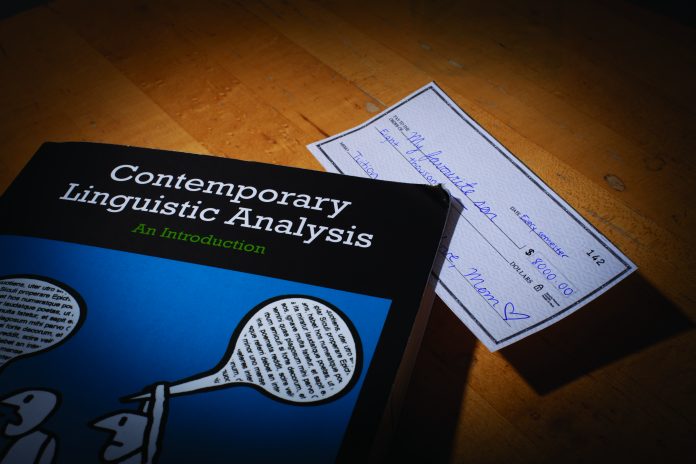
BMO finds half of Canadian parents pay children’s tuition

0
BMO found 10 per cent of parents thought they’d be footing the whole bill.

A recent Bank of Montreal (BMO) study claims that almost half of Canadian parents expect to pay for all or most of their children’s post-secondary education.

The survey included 1,000 parents from coast to coast, who were questioned regarding the cost of tuition, books, living cost, and school supplies. However, associate VP of students, Tim Rahilly, suggested that SFU may not follow mainstream trends.

“I think SFU is perhaps a little different than some other schools insofar as the use of the student loan system. I think we have more part-time students proportionally than some other schools,” said Rahilly.

He explained, “I think our student demographic is slightly different because we draw from the nation of people who are relatively close by, along with people who are either first generation or new Canadians and so they tend to be a little bit more financially conservative. They don’t necessarily like to have a lot of debt, if I can stereotype slightly.”

Rahilly also served on the board for the Canadian University Survey Consortium (CUSC), which surveyed second and third year students this past year regarding the way students across Canada pay for their schooling. According to the survey, 71 per cent of middle years students at SFU rely on their family, spouse or parents for financing.

The CUSC study notes that although 73 per cent of students across Canada under 20 are relying on family for financial support, only 30 per cent of students 30 or older rely on their families the same way.

Rahilly speculated that this difference may stem from parents’ desire to continue providing for their kids. “[Parents] seem quite comfortable having those students live at home,” he explained. “I think that has two elements to it. One means that it saves the students the cost of renting or other housing costs, and secondly, I think it means that that particular family wants to stay involved and give support to that student.”

Despite the high number of students who are financially supported by their parents, the CUSC also revealed that 46 per cent of students at SFU work off campus, five per cent work on campus and two per cent work both on and off campus. The study also notes that there are varying degrees of how students say work affects their schoolwork.

“You have some students that reported negative impact to their work, but I think there’s some other work that shows that students who work, be it on campus or off campus, if they’re working a moderate amount then that is actually beneficial to them,” Rahilly commented.

No matter how SFU students pay for their schooling, Rahilly encourages working while attending university: “It gives them good skills, it keeps them involved, it means that they’re earning some money, and that is generally a positive thing.”

Let me be blunt

0

When it comes to the benefits of being direct, let me be blunt. I believe that when it comes to relationships — be they work related or personal — it pays to tell it to someone straight instead of beating around the bush. When you’re routinely honest with someone, your word becomes more reliable; you can be approached without fears of being duplicitous.

Nevertheless, there is a stigma associated with being direct that has caused me to more carefully pursue a balance between being blunt and remaining quiet.

The words associated with being assertive are overwhelmingly negative. Sure, one can be described as honest or direct, but they can also be called arrogant, overconfident, and insistent. When describing women in particular, these descriptions can often take the form of bossy or bitchy.

In personal life, navigating the fine line between being assertive and being an asshole comes with its fair share of challenges. I was always very careful about what I said when I was younger, which most likely resulted in me giving an insincere or evasive impression. As such, I’ve attempted to break those internal walls down during my time at university; in the process, I’ve often overstepped my boundaries, speaking brusquely in situations that may have required more subtlety.

It’s about navigating the fine line between being assertive and being an asshole.

Nevertheless, putting those blunt feelings out there can also lead to refreshment and growth as a person. When I bottle up my direct and honest opinions, I often find my emotions build to a point where conversing productively is difficult. Instead of resolving an issue at its inception by discussing the problem, choosing to remain silent can lead to confusion and feelings of betrayal. The other person may then ask whether this is the way you’ve been feeling all along.

There are certain situations when speaking directly can be a strong asset. At The Peak, for example, we constantly make stylistic decisions that require us to separate personal feelings from the decision-making process. I often become very invested in my own work, which causes me to want to sympathize or console someone when I have to critique their content in turn. However, I’ve found that this can quickly lead to more emotions becoming embroiled in a process that is purely professional, resulting in hurt feelings.

By speaking to the point without commiserating, a decision is seen as a calculated determination based on the merits of the work, rather than a judgment on someone’s skills or intellect. In the future, this allows people to trust that your decisions are based on merit rather than petty emotional responses.

As with all things, it’s important to realize that being direct may not be appropriate in all circumstances. Sometimes we don’t need to hear a blunt assessment of the situation, but rather need a person who will just sit and listen.

Social interactions aren’t black and white — as much as I’d like them to be — and being direct isn’t a panacea for traversing conversations. Nevertheless, being honest in a constructive manner, rather than speaking rudely as the stereotype might suggest, may be a good path to take when navigating the shades of grey in between.

Translink announces bus driver barrier pilot project

0
As of July 31, there had been a total of 65 reported assaults on bus drivers in 2014.

Translink has announced that it will implement a pilot project to install bus driver barriers on a number of Coast Mountain buses to protect its employees from violent assaults by unruly passengers.

The move follows Translink’s “Don’t Touch The Operator” campaign, which was launched in March to combat the increasing number of assaults on bus drivers. As of July 31, the number of assaults on operators in 2014 totalled 65.

In a news release on August 29 regarding the Pilot Barrier Program, transit police stated, “Bus operators should not have to go to their workplace every shift with the fear of being verbally or physically assaulted.”

In March, three young women allegedly attacked a bus driver, grabbing her by the hair and punching her. One month later, a woman leapt out of her wheelchair and punched a bus driver in the head while attempting to bite him. Similar attacks range from death threats to physical abuse to spitting on the drivers.

Following these incidents, Coast Mountain Bus Company, Translink’s largest operating company and the contract operator for bus transit services in Metro Vancouver, decided to consider installing plexiglass barriers in accordance with drivers’ wishes. However, Ruth Armstrong, a representative of the Metro Vancouver Transit Operators union, Unifor 111, responded that drivers would not be in favour of the barriers if they were mandatory.

Armstrong told the Vancouver Sun last March that some drivers expressed feelings of claustrophobia behind the shields, while others felt they were unnecessary. “Though, if I was doing a late night shift through the downtown core, then I might want a shield. And I should have that option,” she said.

A late-night driver himself, Derek Metz operates the number 19 bus through downtown into Stanley Park. As someone who has encountered assault, Metz told the Vancouver Sun that he wouldn’t mind if barriers were mandatory, because he feels they are essential to maintaining drivers’ safety.

“You never know what you are going to get with these people. The potential for them to do something harmful is very real,” he said.

Gordon Price, director of SFU’s City Program, echoed Armstrong’s concerns, but added that a balance needs to be pursued in order to preserve the “emotional capital” that comes with greeting your bus driver or acknowledging your fellow passengers.

“A lot of [drivers] really value the interaction they have with the public,” he said. “From a social trust point of view, there’s a price to pay here that shouldn’t be discounted. This ability to have interaction, just a friendly smile or a hello, even a name, that really counts.”

He also said that design elements such as height, transparency, and whether or not the barriers can be removed easily all need to be considered when implementing the pilot program.

Nevertheless, Price feels that these initiatives mark steps in the right direction. “The protection of the driver clearly has to be a high priority for Translink,” he said. “[However], I think it has to go in conjunction with other things, and that is effective use of the transit police, cameras where appropriate, things like that. I don’t think there’s a single solution to this.”

In the long term, Price advocates for preserving the human interaction on transit. “Being able to say thank you to the bus driver or again acknowledge them with just a word or two, that I think is necessary for the kind of society where trust is something that gives it strength,” said Price. “And if a barrier makes it seem inappropriate or not possible, then there is a real loss there.”